This study examines how green transformational leadership and green motivation improve organizational environmental performance and investigates the mediating effect of eco-friendly behavior. While the relationship between green practices and employee engagement in ecological protection has been studied, further research is needed, particularly in the coal mining sector, whose operations significantly contribute to emissions and climate change. Addressing this gap aligns with SDG 13 (Climate Action) and SDG 12 (Responsible Consumption and Production).
Data were collected from 124 respondents who hold different managerial positions at coal mining companies in Indonesia through a cross-sectional survey. The partial least squares method using Smart PLS was applied to analyze the data.
Findings show that eco-friendly behavior, green transformational leadership and green motivation positively affect environmental performance. Additionally, green motivation shapes employees’ eco-friendly behavior, contributing to improved organizational performance.
These results offer valuable insights for stakeholders to encourage and motivate employees to proactively protect the environment, enhancing environmental performance.
This study contributes to the literature about environmental issues where superior environmental performance not only enhances an organization’s competitiveness but also aligns with broader sustainability goals. By minimizing negative environmental impacts such as carbon emissions and resource depletion, companies play a crucial role in mitigating climate change and fostering long-term ecological balance. This contribution underscores the importance of integrating sustainable practices within organizational strategies to support global sustainability efforts.
1. Introduction
The consequences of economic development, including climate change, deforestation, biodiversity loss and water resource depletion, continue to exacerbate pollution and environmental challenges, undermining efforts toward sustainable practices (Abdul Rahman and Mansor, 2023; Sarkodie et al., 2020). These issues are particularly pressing in the context of the United Nations Sustainable Development Goals (SDGs), specifically SDG 13 on Climate Action and SDG 12 on Responsible Consumption and Production, which aim to mitigate environmental damage and promote sustainable resource use. The Intergovernmental Panel on Climate Change (IPCC) (2023) highlights that over a century of fossil fuel combustion, paired with unequal and unsustainable energy and land use, has led to global warming of 1.1 C above pre-industrial levels, placing ecosystems and livelihoods at risk. In this context, Indonesia’s performance on the Environmental Performance Index (EPI) developed by Yale University and the University of Columbia is concerning, ranking it 164 out of 180 countries with a score of 28.20 out of 100. This underlines the urgent need for environmentally-friendly practices, especially in sectors such as coal mining, to align with global climate goals and national commitments to the SDGs.
The increasing pressure on environmental issues from shareholders, government regulators, consumers, employees and society has motivated companies to pay more attention to environmental performance (Bendig et al., 2023; George et al., 2021; Indriastuti and Chariri, 2021). Corporate environmental strategies, such as eco-friendly human resource management together with government enforcement of environmental policies, which are reflected in environmental behaviors, have a significant impact on the environmental performance of companies (Zhang et al., 2023; He et al., 2021; Jia and Chen, 2019). One of the government’s efforts in supervising and protecting the environment is through the Corporate Environmental Performance Rating Program known as PROPER (Fahmawati and Purnaweni, 2018). Based on the official website of the Ministry of Environment and Forestry, information about company performance is communicated using color codes to facilitate public understanding: Gold, Green, Blue, Red and Black.
Although the relationship between environmental performance and eco-friendly human resource management practices has been studied across various industries, the impact of green management activities on employee engagement in ecological protection still requires thorough investigation (Pham, 2020). Previous studies have extensively explored the role of green management in improving environmental performance (Yusoff et al., 2020), but research on green motivation in employees when enhancing organizational environmental performance remains underexplored (Junsheng et al., 2020). This gap calls for deeper examination of the role of employee green motivation in environmental performance.
Although employee participation is crucial for organizational environmental protection, research on employees' eco-friendly behavior is still limited (Omarova and Jo, 2022) as researchers have primarily focused on environmental strategies at the organizational level. Based on this, it is important to investigate the mediating role of employees' eco-friendly behavior in enhancing environmental performance. Existing research indicates that green transformational leadership and green human resource practices are vital in promoting employees' eco-friendly behavior, which ultimately improves environmental performance and sustainability (Chen and Wu, 2022). Although several studies have explored environmental performance in manufacturing (Singh et al., 2020; Yang et al., 2020) and service sectors (Riva et al., 2021; Sobaih et al., 2022; Yusoff et al., 2020), there is limited research in the extractive industries, particularly coal mining, which has a significantly larger environmental footprint. This gap is particularly relevant, given that the operational activities of the coal mining sector significantly contribute to carbon emissions and climate change. However, no previous studies have empirically analyzed the role of transformational leadership in improving the environmental performance of coal mining companies in Indonesia.
This study also contributes to the literature on social identity theory by examining how variables such as green transformational leadership, green motivation and eco-friendly behavior improve environmental performance in coal mining. By applying social identity theory (Tajfel and Turner, 2004), organizations can promote pro-environmental behavior among employees who are already motivated to act green and who are guided by sustainability-focused leadership. This approach enables coal mining companies to achieve optimal environmental performance.
In this context, the study seeks to address the following research questions:
How does green transformational leadership affect the environmental performance of coal mining companies?
What is the impact of green motivation on the environmental performance of coal mining companies?
What is the mediating effect of employees' green behavior on the relationship between green transformational leadership, green motivation and environmental performance of coal mining companies?
This study holds significant implications for coal mining companies striving to improve their environmental performance and organizational sustainability. By encouraging green behavior through environmentally-conscious leadership, organizations can cultivate a culture in which employees naturally align their actions with sustainable practices. Leaders play a critical role in shaping this behavior, as their commitment to environmental responsibility directly influences employees' commitment to sustainability. When employees are motivated to adopt environmentally-friendly practices, organizations not only strengthen their environmental initiatives but also gain a competitive advantage. Thus, embedding environmentally-friendly behavior in the corporate culture is crucial to achieve long-term sustainability goals. Furthermore, this study provides valuable insights for employees, executives and managers to integrate environmental sustainability into the coal mining industry and strengthens the sector’s commitment to a greener future.
This article is structured into five main sections: Section 1 provides the background, identifies research gaps, highlights the study’s contributions and outlines its objectives; Section 2 explores the theoretical framework and hypothesis development; Section 3 presents the adopted research methodology; Section 4 details the findings based on PLS analysis and discusses the research outcomes; and, finally, Section 5 offers an in-depth interpretation of the study, discussing its theoretical and practical implications while also presenting the conclusion, research limitations and directions for future studies.
2. Literature review and hypotheses development
2.1 Underpinning theory
This study investigates the role of green transformational leadership, employee green motivation, employee eco-friendly behavior and environmental performance in the coal mining sector within the Indonesian context, a developing country. The study employs Social Identity Theory (SIT) as a theoretical lens to explore these relationships. SIT provides a comprehensive framework for understanding the dynamic interaction between organizations and their employees. According to Tajfel and Turner (2004), this theory posits that organizations can instill socially-esteemed traits in their employees, both internally and externally, fostering a sense of pride and strengthening their identification with the organization.
Furthermore, this study argues that a number of social factors may impact how a person forms their social identity, leading to behavioral acts including eco-friendly behavior motivated by their compliance and beliefs to act in accordance with them. Employees with a strong social identity connected to their organization tend to take the initiative in environmental sustainability efforts, which ultimately leads to better overall organizational performance. When employees recognize that their company has the same goal of promoting environmentally-friendly behavior, they feel motivated to engage in certain actions or behaviors that can, in turn, significantly improve the company’s environmental performance (Sampene et al., 2023). This alignment between corporate values and employee initiatives fosters a culture of sustainability and drives collective progress towards environmental goals.
2.2 Green transformational leadership
Green transformational leadership is a dynamic leadership approach that embeds environmental sustainability into an organization’s core values and operational practices, inspiring a culture of eco-consciousness and sustainable innovation. Based on a study by Wang et al. (2018), much empirical research has demonstrated that transformational leadership plays a pivotal role in shaping and influencing employee behavior, driving engagement and fostering positive outcomes. Transformational leaders possess the ability to articulate an inspiring vision that motivates their followers to proactively achieve personal and organizational goals. By fostering an environment that encourages creativity, these leaders act as catalysts for innovation, driving the generation and implementation of novel ideas within their organizations (Chen et al., 2014). Their leadership behaviors serve as “creativity-enhancing forces,” crucial for cultivating a culture of innovation. Specifically, green transformational leadership is characterized by leaders who inspire and empower their followers to exceed expectations in achieving environmental objectives and advancing sustainability goals (Chen and Chang, 2013).
Green transformation leadership impacts many aspects within an organization. A study conducted by Zhang et al. (2020) on China’s steel enterprises demonstrated that green transformational leadership significantly influences green creativity among employees. The findings reveal that green transformation leadership not only has a direct positive impact on employees' green creativity but also exerts an indirect effect through enhanced engagement in the creative process. Building on previous findings, a study by Ozgul (2022) found that green transformational leadership in SMEs significantly boosts green absorptive capacity that denotes the ability to integrate and apply green knowledge for sustainable innovation (Qu et al., 2022). Additionally, this leadership style positively impacts both internal and external environmental orientation, guiding businesses towards more sustainable practices and strategies. These insights emphasize the pivotal role of green transformational leadership in driving eco-friendly innovation and aligning organizational practices with sustainability goals. Some studies, however, suggest that green transformational leadership does not always directly lead to eco-friendly behavior, particularly when intrinsic motivation is low (Sobaih et al., 2022; Febrian and Solihin, 2024).
Green transformational leadership significantly contributes to improving environmental performance by motivating members to adopt new perspectives and support the development of innovative ideas, as well as influence employees through their actions, with such leaders serving as role models (Riva et al., 2021; Sun et al., 2022). This is supported by previous research that found leaders can motivate employees by providing a clear vision, aspirations, inspiration and enthusiasm for their followers and these atrributes can create sustainability (Perez et al., 2023; Begum et al., 2022). The goal is to enhance individual or organizational management through leadership behavior and human resource management practices, which positively impact the organization’s environmental performance (Tang et al., 2017).
2.3 Green motivation
Green motivation plays a crucial role in fostering eco-friendly behavior among employees and enhancing overall organizational environmental performance. It serves as a driving force that encourages individuals to actively participate in sustainable practices, aligning personal values with organizational goals. Based on a study by May Zhara Averina et al. (2023), green motivation is crucial for effective green environmental performance as without motivated employees green initiatives cannot be successfully implemented (Mittal and Dhar, 2016). Employees' green motivation drives them to adopt, sustain and excel in eco-friendly practices, promoting outstanding green capabilities and fostering a protective attitude towards the environment (Suwondo and Sutanto, 2015). This motivation not only encourages but also rewards and maintains green behavior, as it aims for optimal results and a sustainable work culture.
As global sustainability challenges intensify, it becomes essential to adopt a leadership style that transcends personal interests and distributes leadership opportunities across the organization (Çop et al., 2021). Green motivation encompasses both intrinsic and extrinsic factors that encourage employees to behave in an environmentally-friendly way. Intrinsic motivation stems from internal rewards while, on the other hand, extrinsic motivation is influenced by external incentives, including monetary or non-monetary benefits such as recognition and awards. By fostering both forms of motivation, organizations can create a culture of sustainability and inspire their employees to actively engage in environmentally-friendly practises and contribute to wider environmental goals.
According to the research conducted by Febrian and Solihin (2024) in Indonesia, indicators of green motivation in Micro, Small and Medium-sized Enterprises (MSMEs) highlight their commitment to sustainable practices. Among the indicators of green motivation in MSMEs include the adoption of renewable energy, energy and water efficiency, and effective waste management systems. These practices reflect their commitment to sustainable and environmentally responsible operations. Empirical evidence regarding the importance of green motivation is mentioned in a study by Waqas et al. (2021) that stated that green motivation significantly improves employee green behavior. By fostering a work environment that prioritizes green motivation through regular feedback and performance-based rewards, organizations can enhance employees' commitment, skills and sense of responsibility toward environmental management (Jackson et al., 2011).
2.4 Eco-friendly employee behavior
Eco-friendly behavior refers to the intentional actions and practices of employees aimed at positively impacting the environment. These behaviors are designed to minimize the adverse effects of human activities on the ecosystem, thereby contributing to environmental sustainability (Ribeiro et al., 2022). By engaging in eco-friendly practices, employees help drive positive environmental changes and support the organization’s commitment to sustainable development (Juárez-Nájera et al., 2010; Wegge et al., 2006). These intentional efforts are crucial for reducing the ecological footprint and fostering a culture of environmental responsibility within the workplace.
Promoting eco-friendly behaviors beyond the workplace is crucial for enhancing environmental and sustainability awareness among corporations, governments, regulators, community groups, customers and other key stakeholders (Usman et al., 2023). This holistic approach not only benefits the environment but also strengthens the collective effort towards achieving long-term ecological and economic sustainability goals that can lead to greater environmental consciousness and more impactful actions across various sectors.
2.5 Environmental performance
A company’s environmental performance serves as a critical measure of its commitment to sustainability and ecological responsibility (Dzikriansyah et al., 2023) and reflects efforts to safeguard and enhance the natural environment, as highlighted by Rakhmawati et al. (2019). The dimensions of environmental performance identified by Darwish et al. (2021) and Vanalle et al. (2017) include reducing the use of hazardous or toxic materials and minimizing the occurrence of environmental accidents. Furthermore, these dimensions encompass lowering air emissions, managing solid and liquid waste more effectively, conserving energy and limiting the consumption of hazardous substances. These practices collectively demonstrate an organization’s dedication to environmental stewardship.
A study by Waqas et al. (2021) suggested that adopting eco-friendly policies and encouraging employees to support green products can enhance an industry’s environmental performance. By fostering a culture of sustainability, organizations not only reduce their ecological footprint but also inspire employees to actively contribute to environmentally-responsible practices, driving long-term positive impact. Environmental performance also can be affected by organizational identification, a form of social identification where individuals feel emotionally connected to their workplace (Ribeiro et al., 2022) and this connection fosters responsible employee behaviors aligned with the organization’s environmental goals in promoting sustainability.
2.6 Hypothesis development
2.6.1 Green transformational leadership and eco-friendly behavior
Green Transformational Leadership is a leadership approach that emphasizes inspiring and motivating employees to engage in environmentally-friendly practices. This leadership style integrates environmental management with human resource management, making it a critical component in fostering a culture of sustainability within organizations (Sobaih et al., 2022). If employees perceive that their managers are demonstrating environmentally-conscious transformational leadership behaviors, they are more likely to adopt eco-friendly practices themselves (Chen and Wu, 2022). According to Perez et al. (2023), leaders who embody green transformational leadership inspire their teams to adopt behaviors that support environmental sustainability, cultivating a culture of pro-environmental behavior throughout the organization. As leaders act as role models and mentors for their followers, transformational leaders have the opportunity to influence the environmental behavior of their subordinates by exemplifying environmentally-friendly practices (Ahmed et al., 2021).
Furthermore, the environmental impact of leadership is characterized by superiors who act as role models in ensuring environmental sustainability, which in turn promotes environmentally-conscious motivation and behavior among their subordinates (Hameed et al., 2020). This reinforces the role of green transformational leadership as an effective tool for embedding sustainability principles in corporate culture and practices. In addition, the environmental impact of leadership is reflected in the qualities of line managers who act as role models in ensuring environmental sustainability and these supervisors inspire and encourage environmentally-conscious motivations and environmentally-friendly behaviors in their subordinates (Khan et al., 2022). A study by Sobaih et al. (2022) confirmed the direct influence of green transformational leadership on pro-environmental behaviors, both in task-related and pro-environmental activities. This highlights how effective leadership can inspire employees to actively engage in sustainable practices. Based on the above discussion, the following hypothesis was formulated for this study:
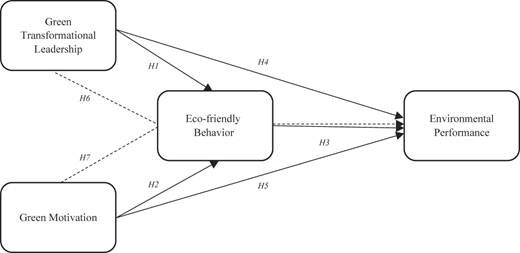
Green transformational leadership positively influences eco-friendly behavior.
2.6.2 Green motivation and eco-friendly behavior
Green motivation refers to the drive that encourages employees to engage in environmentally-friendly behaviors (Anwar et al., 2020). When organizations implement practices to enhance green motivation it significantly increases employees' willingness to participate in environmental initiatives and green motivation also involves employees' concern for the environment, perceived organizational support and their commitment to sustainable environmental initiatives (Junsheng et al., 2020). Liaquat et al. (2024) stated that green motivation plays a crucial role in promoting eco-friendly behaviors among employees, highlighting the need for organizations to implement effective reward systems to boost eco-friendly behaviors and improve environmental performance.
Research by Anwar et al. (2020) shows that employees are more likely to take environmental initiatives when they are offered rewards for their efforts. This indicates that recognition and encouragement play a significant role in motivating employees to adopt eco-friendly behaviors. A study by Junsheng et al. (2020) found that motivated employees are more likely to engage in environmentally-friendly practices, contributing to overall eco-friendly behavior; in addition when employees' environmental values align with the organization’s goals, they are more motivated to engage in pro-environmental behaviors (Hu et al., 2022). This alignment enhances employees' commitment to green initiatives in the workplace. Therefore, based on the above discussion, the following hypothesis was formulated for this study:
Green motivation positively influences eco-friendly behavior.
2.6.3 Eco-friendly behavior and environmental performance
The coal mining industry is a significant contributor to environmental degradation, making it essential for organizations in this sector to prioritize sustainable practices (Zhou et al., 2024). One approach to enhancing environmental performance is the implementation of eco-friendly human resource management practices, which can influence employee behavior and commitment to environmental preservation (Anwar et al., 2020) such as eco-friendly behavior, a key strategy that organizations can consider for achieving environmental performance and promoting environmental sustainability (Elshaer et al., 2021). Effective green strategies can improve eco-friendly attitudes and behaviors, thereby enhancing a company’s environmental performance (Pham et al., 2019) as active employee participation in eco-friendly behavior not only addresses environmental issues but also contributes to the overall performance of the organization (Nisar et al., 2021).
Nisar et al. (2021) asserted that employees' pro-environmental behavior plays a crucial role in advancing environmental performance. However, research by Liaquat et al. (2024) indicates that task green behavior impacts environmental performance, but voluntary green behavior does not. This research gap will be further explored by integrating green transformational leadership and employee green motivation to foster environmental performance, with eco-friendly employee behavior acting as a critical mediator. This approach contributes to the broader sustainability agenda by emphasizing leadership and motivation as drivers of sustainable practices.
Research by Kim et al. (2019) showed that employees' eco-friendly behavior impacts and improves environmental performance. This is supported by Pham et al. (2019), who stated that increased eco-friendly behavior can lead to a better environment as well as Anwar et al. (2020), who found that there is a significant influence of eco-friendly behavior on environmental performance. These findings collectively suggest that when employees actively participate in pro-environmental behaviors, the overall environmental performance of an organization improves. Therefore, the following hypothesis is proposed:
Eco-friendly behavior positively influences environmental performance.
2.6.4 Green transformational leadership and environmental performance
Leadership is considered one of the most crucial factors directing organizational performance through the establishment of a clear vision for both short-term and long-term commercial operations (Singh et al., 2020). The intellectually-inspired aspects of transformational leadership have a significant impact on both employee effectiveness and overall company performance (Kazmi et al., 2021). The role of leadership in motivating, inspiring and encouraging employees can efficiently enhance company outcomes and productivity (Sun et al., 2022). Cheema et al. (2020) mentioned that green transformational leadership plays a vital role in helping companies realize their ecological vision and strategy, ultimately leading to environmentally-friendly corporate performance. This is primarily because they provide clear vision and direction for sustainability efforts within the organization (Perez et al., 2023).
Research by Perez et al. (2023) showed that green transformational leadership is significantly related to environmental performance. Green transformational leaders must focus on compelling and motivating personnel to understand an organization’s environmentally sustainable goals by providing clear objectives, inspiration, vision and enthusiasm to subordinates while meeting employee needs to achieve environmental performance. Furthermore, a study by Çop et al. (2021) highlighted that ecological transformational leaders significantly influence the environmental performance of organizations in various ways. Other research also underscored that green transformational leadership leads to the achievement of environmental goals (Begum et al., 2021). Therefore, the following hypothesis is proposed:
Green transformational leadership positively influences environmental performance.
2.6.5 Green motivation and environmental performance
Companies are increasingly recognizing the importance of environmental sustainability and are implementing strategies to enhance their environmental performance. This shift in focus is largely influenced by the growing awareness of environmental challenges, which has driven businesses to cultivate green behavior among employees as a fundamental element of corporate sustainability efforts (Bashirun et al., 2022). Previous research has highlighted the critical role of green motivation in the workplace, which can subsequently improve the overall environmental performance of organizations (Abdul Rahman and Mansor, 2023; Bashirun et al., 2022; Blazejewski et al., 2020; Gu and Liu, 2022). Employee motivation is also crucial for employers to ensure they have positive and engaged employees in the workplace (Yafi et al., 2021), both intrinsic and extrinsic. Intrinsic motivation occurs when employees are driven to adopt green behaviors for their own happiness and satisfaction, while extrinsic motivation happens when employees are motivated to act in order to receive rewards from the organization (Zaki and Norazman, 2019). When employees are effectively motivated—whether intrinsically or extrinsically—they are more likely to achieve enhanced green environmental performance, contributing significantly to the organization’s sustainability goals (Yafi et al., 2021).
Previous studies indicate that intrinsic and extrinsic factors motivating employees to engage in eco-friendly actions, referred to as green motivation, can significantly impact eco-friendly behavior in the workplace (Bashirun et al., 2022; Blazejewski et al., 2020). Eco-friendly behaviors such as recycling, energy conservation and participation in environmental initiatives are crucial for the successful implementation of an organization’s environmental strategies (Abdul Rahman and Mansor, 2023; Gu and Liu, 2022). Furthermore, when employees feel empowered and possess a strong sense of environmental identity, they are more likely to take initiatives beyond their assigned roles, fostering a culture of sustainability that can lead to enhanced environmental performance for the organization as a whole (Blazejewski et al., 2020). Organizations that implement effective eco-friendly human resource management practices not only motivate employees but also create an environment that encourages pro-environmental behavior, ultimately aligning individual actions with corporate sustainability goals and further driving improvements in environmental performance within the organization. Based on the above discussion, the following hypothesis is formulated for this study:
Green motivation positively influences environmental performance.
2.6.6 The mediating role of eco-friendly behavior on green transformational leadership and environmental performance
Green transformational leadership is crucial for promoting a sustainability culture within organizations (Kim et al., 2019). This leadership style inspires and motivates employees to align with the organization’s environmental goals, and Singh et al. (2020) stated that this approach encourages employees to believe in the leader’s vision, which has a positive impact on innovation and organizational performance. Transformational leaders are committed to changing employee and organizational behaviors, including the adoption of effective environmental management practices (Peng et al., 2021). Eco-friendly behavior includes all positive workplace practises that benefit the environment, such as energy and water conservation (Sobaih et al., 2022). Organizations can achieve better environmental outcomes by promoting leadership that emphasizes sustainability and environmental responsibility (Sanusi et al., 2023).
A study conducted in the Saudi Arabian food industry shows that green transformational leadership influences employees' eco-friendly behavior, which in turn affects the overall environmental performance of the organization (Sobaih et al., 2022). According to Sanusi et al. (2023), when leaders adopt green transformational practices they encourage their employees to act in an environmentally-friendly manner and thus improve environmental performance. Peng et al. (2021) also found that green transformational leadership encourages pro-environmental behavior and improves environmental performance. Perez et al. (2023)’s results suggested that the direct effect of green transformational leadership on environmental performance is significant, and when employees' pro-environmental behavior is included in the analysis, the relationship becomes even stronger. Therefore, we hypothesize that:
Eco-friendly behavior mediates the relationship between green transformational leadership and environmental performance.
2.6.7 The mediating role of eco-friendly behavior on green motivation and environmental performance
Employees' eco-friendly behavior is significantly influenced by their green motivation. When employees are motivated, they are more likely to engage in eco-friendly actions (Hu et al., 2022). This motivation acts as a driving force, encouraging employees to adopt behaviors that positively contribute to environmental performance. A study by Liaquat et al. (2024) identified that task-related eco-friendly behavior serves as a mediator between motivation and environmental performance. This indicated that when employees are motivated, they tend to exhibit eco-friendly behaviors, which in turn enhance environmental performance. Therefore, we propose the following hypothesis:
Eco-friendly behavior mediates the relationship between green motivation and environmental performance.
Figure 1 below presents an overview of all the hypotheses developed and illustrates the conceptual relationships of variables in this study.
3. Methodology
This study uses a descriptive research design with a quantitative survey approach. The population comprises employees from coal mining companies located in East Kalimantan. The companies selected for sampling hold mining business licenses under PKP2B (Coal Mining Concession Work Agreement) and IUPK (Special Mining Business License) granted as an extension after the completion of PKP2B. Additionally, these companies received a performance rating for environmental management from the Ministry of Environment and Forestry of the Republic of Indonesia in 2023, with at least a Blue rating. Based on these criteria, there are 15 companies that meet the requirements to be included as the workplaces of managers sampled in this study, as listed in Table 1.
Data collection was carried out over three months (June–August 2024) using a cross-sectional approach. The questionnaire form outlined the research objectives and assured participants of the following: (1) confidentiality of responses; (2) data usage solely for academic research purposes; and (3) voluntary participation for research ethics. Before data collection began, permission was obtained through official letters to the companies for conducting the survey. The sample selection for the mining sector considered the following criteria: (1) inclusion of several companies from various cities in East Kalimantan to enhance population diversity and generalizability; and (2) selection of managerial-level employees based on their significant contributions to strategic planning for environmental protection, ensuring their ability to understand and respond to the questionnaire effectively. Furthermore, the analytical unit in the current study is positioned at the organizational level, thus requiring that the respondent hold a managerial position. Only those in managerial capacities are adequately prepared to convey their strategic vision and environmental orientation, as well as to effectively inspire their team members to participate in sustainable practices (Singh et al., 2020). The researcher adopted a convenient sampling approach, distributing 200 questionnaires and receiving 130 responses. Removing incomplete questionnaires resulted in a response rate of 62 per cent, with 124 respondents from coal mining companies in seven cities: Samarinda, Kutai Kartanegara, Kutai Timur, Kutai Barat, Bontang, Paser and Berau.
The research questionnaire was adapted from previous studies, and respondents were asked to provide their responses on a five-point Likert scale ranging from 1 (strongly disagree) to 5 (strongly agree). The measurement of environmental performance included six items adopted from Kim et al. (2019), the measurement of green transformational leadership included six items adopted from Chen et al. (2014), the measurement of green motivation included five items adopted from Junsheng et al. (2020) and the measurement of eco-friendly behavior included seven items adopted from He et al. (2021).
4. Results and discussion
4.1 Demographic profile of respondents
The survey respondents hold different managerial positions from the frontline to the top levels of leadership. Demographic analysis of respondent profiles showed that 83.06per cent were male and 16.94per cent were female. The majority of respondents were aged 20–30 years (54.03per cent), 31–40 years (31.45per cent), 41–50 years (11.29per cent) and above 50 years (3.23per cent). Regarding work tenure, 58per cent had worked for 1–5 years, 31per cent for 5–10 years, 10per cent for 10–20 years and 3.23per cent had worked for more than 20 years. The mining locations where the respondents worked were Kutai Kartanegara (47.58per cent), Samarinda (20.16per cent), East Kutai (11.29per cent), West Kutai (4.03per cent), Bontang (6.45per cent), Paser (4.84per cent) and Berau (5.65per cent).
4.2 Data analysis result
4.2.1 Descriptive statistics
A total of 124 individuals participated in the study. Table 2 displays the results of the descriptive statistical calculations performed on the replies of the respondents. These calculations include the mean, the standard deviation, skewness and kurtosis for the five Likert-scale questionnaires used in this study. The survey data revealed that the constructs’ mean values vary from 4.419 to 3.621. In addition, the values of the standard deviation are within the range of 0.649 to 0.432. It was found that the range of values for skewness coefficient was less than 3, and the coefficient values for the kurtosis were similarly less than 10 (Sampene et al., 2023). These statistics demonstrate that the research data fulfills the usual distribution criteria for data analysis.
4.2.2 Measurement model
The analysis model used in this study is Partial Least Square (PLS) analysis, utilizing the SmartPLS program. The stages in the PLS analysis include testing the outer model (measurement model) and testing the inner model (structural model). In the outer model testing stage, validity and reliability tests are conducted on all indicators within the model. In the inner model testing stage, hypothesis testing is carried out based on significant values and path coefficients. To determine the validity and reliability of the measured variables, we evaluated the items separately through convergent validity, discriminant validity and reliability tables. All items on the variables have factor loadings between 0.673 and 0.884, which are greater than the recommended value of 0.60, and AVE values greater than 0.50, indicating that all constructs have achieved validity and are understandable to respondents (see Table 3).
It is impossible to completely rule out the possibility that common method bias (CMB) could influence the analysis of the research findings. When evaluating the research data using PLS, the CMB test should next be examined to look for multicollinearity problems (Kwasi et al., 2024). Podsakoff et al. (2003) suggested that when a single latent parameter explains less than half of the variance inflation factor (VIF), the concept is free of CMB problems. Furthermore, as shown in Table 3, the statistical coefficient of VIF for each parameter was below 5.0, the cutoff point recommended by previous research (Hair et al., 2019). The findings show that all of the construct’s parameters are appropriate for this study and that there are no collinearity problems with the study’s variables. It also indicates that multicollinearity is not a major concern, reducing the likelihood of endogeneity issues in the model. In this case, the independent variables are not excessively correlated with each other, meaning that the estimations of path coefficients in the model are likely to be unbiased and reliable.
Discriminant validity was conducted to test whether each indicator has higher cross-loading for the latent variables being measured compared to indicators on other latent variables. The Cronbach’s alpha and composite reliability values for each variable have values above 0.70, as presented in Table 3, thus indicating that all items in this study are reliable. As seen in Table 4, the results of the discriminant validity test are good, and all items used are valid. As shown in Table 5, all Heterotrait-Monotrait Ratio (HTMT) values are below the threshold of 0.90. This indicates that the measurement model demonstrates an adequate level of discriminant validity, ensuring that the constructs in the model are sufficiently distinct from one another. Consequently, the reliability of the model for further analysis is well-supported.
4.2.3 Structural model
The coefficient of determination is a measure of the predictive accuracy of the model, indicating the amount of variance in the dependent variable explained by all the independent variables related to it (Junsheng et al., 2020). An R-square value of 0.44 shows that 44 per cent of the total variation in environmental performance can be explained by green transformational leadership, green motivation and eco-friendly behavior. Furthermore, the R-square value for the eco-friendly behavior variable of 0.39 indicates that 39 per cent is influenced by green transformational leadership and green motivation. In addition, to define the importance of f2 values must satisfy three basic criteria: between 0.02 and 0.15 as small effect size, in the range of 0.15–0.35 as medium effect size and if the f2 value bigger than 0.35 as a large effect size (Yafi et al., 2021). All relationships among latent variables exhibit a small effect on their respective endogenous variables. The f2 value of 0.052 for the path from eco-friendly behavior to environmental performance indicates that eco-friendly behavior contributes marginally to explaining the variance in environmental performance. Similarly, the path from green motivation to environmental performance yield an f2 value of 0.067, which also reflects a moderate effect in enhancing environmental performance. The relationship from green motivation to green behavior shows a slightly higher f2 value of 0.122. However, it still falls within the category of a small effect size. Furthermore, the effects of green transformational leadership on environmental performance and eco-friendly behavior recorded at 0.029 and 0.034 suggest that these predictors make a minimal contribution to explaining variation in the associated dependent variables.
In addition to the coefficient of determination, the structural model assessment was conducted for this study to estimate the hypotheses after determining the validity and reliability of the measurement model. It is assumed that the relationship between variables is positive and significant if the t-value is above 1.96 and the p-value is below 0.05. The direct effect test shows in Table 6 that H1 is rejected, meaning that green transformational leadership does not have a positive and significant effect on employees' eco-friendly behavior. Next, the analysis results in Table 6 confirmed that H2 is accepted, which means that green motivation has a positive and significant effect on eco-friendly behavior. The table also shows that H3, H4 and H5 are accepted, meaning that eco-friendly behavior, green transformational leadership and green motivation have a positive and significant impact on environmental performance.
The indirect effect test was conducted to assess the hypotheses related to mediation in this study. The hypothesis results in Table 7 show that VAF values were 19 per cent for relationship Green Transformational Leadership → Eco-Friendly Behavior → Environmental Performance and 25 per cent for Green Motivation → Eco-Friendly Behavior → Environmental Performance. Since VAF values of H6 was smaller than 20 per cent, findings indicate that eco-friendly behavior does not mediate the effect of green transformational leadership on environmental performance. However, since VAF value of H7 was greater than 20 per cent, eco-friendly behavior positively and significantly plays intermediate roles in transmitting the effect of green motivation on environmental performance. Thus, H6 is rejected and H7 is accepted.
4.3 Discussion of research results
This study examined and analyzed the role of green transformational leadership and green motivation on environmental performance with the mediation of eco-friendly behavior and supports previous research stating that green motivation influences employees' eco-friendly behavior (Junsheng et al., 2020; Hu et al., 2022). The findings also contribute to and support previous literature, where eco-friendly behavior has a direct impact on environmental performance (Khan et al., 2024; Sobaih et al., 2022). Green transformational leadership has a direct effect on environmental performance, supporting previous research that mentions it plays an important role in helping companies realize their ecological vision and strategy, ultimately leading to improved environmental performance (Perez et al., 2023; Sun et al., 2022). The findings also support earlier studies stating that green motivation directly influences environmental performance within an organization (Bashirun et al., 2022; Blazejewski et al., 2020). Furthermore, the results of this study support the hypothesis that eco-friendly behavior mediates the effect of green motivation on environmental performance (Liaquat et al., 2024) which indicates that eco-friendly behavior contributes to strengthening the role of employees' green motivation, which ultimately can enhance environmental performance.
Insignificant findings were also observed in the hypothesis related to green transformational leadership and employees' eco-friendly behavior. Additionally, eco-friendly behavior does not mediate the relationship between green transformational leadership and environmental performance. This contradicts previous research, which stated that green transformational leadership significantly influences eco-friendly behavior (Sobaih et al., 2022) and the mediating effect of eco-friendly behavior between green transformational leadership and environmental performance (Sobaih et al., 2022; Perez et al., 2023).
These findings indicate that although environmentally-oriented leadership has the potential to promote environmentally-friendly behavior among employees, its effect is not strong enough to be considered significant in this study. Leadership can influence employee behavior when adopting environmentally-friendly practices, but it cannot be fully controlled (Omarova and Jo, 2022). Employees, as individuals, have their own values, attitudes and principles that cannot be fully influenced by others, even by leaders with green transformational leadership. Employees who hold stronger environmental values are more likely to voluntarily engage in eco-friendly actions as they align with their personal desires (Graves and Sarkis, 2018). These environmental values may stem from good habits cultivated in their home environment from an early age (Herdiansyah et al., 2021). Therefore, hiring employees who are environmentally-conscious can be beneficial for achieving the organization’s environmental goals.
Factors beyond green transformational leadership, such as implementing a comprehensive eco-friendly human resource management strategy and aligning environmental values, may play a more significant role in influencing employees' pro-environmental attitudes, motivation and behavior in the workplace (Chen and Wu, 2022; Wang et al., 2018). The presence of other more dominant factors can influence employees' pro-environmental behaviors, as other studies suggest that pro-environmental human resource management practices, such as empowerment and eco-friendly training, depend on corporate leadership. In addition, the interplay of values between managers and employees is crucial for promoting pro-environmental behavior (Ashraf et al., 2024).
The research findings indicate that eco-friendly behavior does not mediate the relationship between green transformational leadership and environmental performance. This suggests that the relationship between green transformational leadership and environmental performance is not dependent on the presence of pro-environmental behavior as a mediator. Eco-friendly transformational leaders can directly influence environmental performance without relying on changes in individual behavior. Eco-friendly behavior is characterized as behavior that is responsible toward the environment or pro-environmental actions that reflect environmental sustainability values, including reducing resource waste and recycling resources (He et al., 2021). Green transformational leadership does not have a significant influence on employees' behavior because employees engage in eco-friendly actions due to internal factors, such as the willingness or desire to participate in environmental activities (Nisar et al., 2021). This also explains why employees' eco-friendly behavior does not contribute to or strengthen the relationship between green transformational leadership and environmental performance.
5. Implications and conclusions
5.1 Theoretical implications
This study contributes significantly to the theoretical understanding of sustainability practices within organizational contexts, particularly in high-impact industries such as coal mining. It adds to the growing body of literature by identifying potential contextual and cultural factors that may moderate the effectiveness of green transformational leadership on eco-friendly behavior and environmental performance. Additionally, the findings call for further refinement of leadership theories in the sustainability domain, particularly by exploring alternative mediators including green knowledge and environmental values, which could deepen the understanding of how leadership influences environmental outcomes.
This study strengthens theoretical insights into the critical role that employees play in the successful implementation of a company’s environmental plans (Kwasi et al., 2024) and provides valuable guidance for future research and practices aimed at improving environmental performance within the coal mining sector. Furthermore, the findings contribute to the application of social identity theory by providing a contextual understanding of eco-friendly behavior among employees in Indonesian coal mining companies and highlighting the importance of aligning organizational goals with employee actions to effectively achieve sustainability goals.
5.2 Practical implications
From a practical perspective, this study provides actionable insights for organizations aiming to improve their environmental performance. To enhance their environmental performance, companies in the coal mining sector can implement several actionable strategies. By fostering green transformational leadership, they can train leaders to inspire and influence employees towards achieving environmental goals, effectively addressing cultural and value-based barriers. Additionally, enhancing green motivation through targeted initiatives, such as reward systems and awareness programs, can align employees' intrinsic and extrinsic motivations with the organization’s environmental objectives. Promoting eco-friendly behavior by embedding sustainability into daily operations encourages employees to consistently adopt green practices. These combined efforts create a cohesive approach to improving environmental performance and ensuring long-term sustainability.
Furthermore, this study emphasizes the broader impact of organizational efforts to contribute to the United NationsSDGs, particularly SDG 13 (Climate Action) and SDG 12 (Responsible Consumption and Production). To achieve these goals, organizations can adopt practical measures such as introducing energy-efficient technologies, reducing carbon emissions through cleaner production methods and optimizing resource usage to minimize waste. Partnerships with environmental organizations and stakeholders can also increase their impact on climate protection. By integrating these practices into their operations, organizations not only strengthen their competitiveness, but also position themselves as responsible industry leaders that actively contribute to mitigating global climate change and promote a long-term ecological balance.
5.3 Conclusion, limitations and future research
This study investigated the role of green transformational leadership and green motivation in fostering eco-friendly behavior based on social identity theory and its subsequent impact on environmental performance within companies in East Kalimantan’s coal mining sector. The findings affirmed the positive relationships between green transformational leadership, green motivation and eco-friendly behavior on environmental performance, supporting prior research on the pivotal role of these variables in organizational sustainability. However, the study reveals an insignificant direct relationship between green transformational leadership and employees’ eco-friendly behavior, alongside the absence of eco-friendly behavior as a mediator between green transformational leadership and environmental performance. These results underscore the nuanced and context-dependent nature of these relationships, potentially influenced by factors such as organizational culture and employees' environmental values.
This research has significant limitations, including a very small sample size, which may affect the generalizability of the results. The data were obtained cross-sectionally and confined to managerial-level personnel in the coal mining industry of East Kalimantan, and future research should extend the geographic scope and should expand the sample to include non-managerial employees from multiple coal mining companies across different regions, ensuring broader generalizability of findings. Future research should also explore longitudinal designs to capture the long-term impact of green transformational leadership and motivation on environmental performance. Additionally, investigating cross-industry comparisons could provide deeper insights into how green leadership functions in different high-emission sectors. Furthermore, since the mediating role of eco-friendly behavior between green transformational leadership and environmental performance was not significant, future research should examine alternative mediators, such as environmental awareness, green innovation or corporate environmental policies.
The authors would like to express their sincere gratitude to the Ministry of Research, Technology and Higher Education of the Republic of Indonesia (Kemenetrian Riset Teknologi dan Pendidikan Tinggi Republik Indonesia) for their generous financial support through a research grant of IDR 25 million. This funding has been instrumental in facilitating this study, from data collection to analysis, and has greatly contributed to the successful completion of this research. We also extend our appreciation to all individuals and institutions who supported and collaborated in this work.