

It may seem obvious but the best thing about the new Manual for Streets is on the first page, which says, ‘MfS supersedes Design Bulletin 32’ (DB32). While most people know what ‘new’ housing estates are like, few knew about DB32 or the impact of its guidance.
Studying urban design as a mature student 25 years ago and designing a new housing area, it was suggested that I look at DB32. I was appalled to see that it described everything that I felt to be awful about new housing. It was also a revelation because slowly it dawned on me that ‘this was it’. Here was the conceptual basis for British urban layout; in practice there was no alternative. I slowly grasped that there was also no ‘urban’ in any guidance and no ‘High Street’ worth the name in any new development. The only thing I took from the first DB32 was the practicability of narrow roads. The authors were striving for good living environments (which meant, as it had for the designers of Radburn nearly 50 years earlier, avoiding the invasive effects of the car); or were they?
By the late 1920s cars could travel quickly but were heavy and their brakes were poor. A road layout which avoids meeting pedestrians removes a great inconvenience for the driver: having to slow down. This is what Radburn delivered; it had a grade-separation for the pedestrian route (in a housing estate) and no footpath around much of its perimeter. One could infer that walking, for the purpose of making a journey, was made obsolete by the ‘segregation’ concept. Radburn is ‘sold’ on its living quality, its calmness and behind the houses a great space for recreation. In 1963, 35 years later, Buchanan's report popularised the concept. In 1977, 49 years later, segregation became official guidance in DB32. Car braking by then had caught up with performance, arguably making segregation of modes unnecessary. However, the segregation was good for driving and the ends of the culs-de-sac were calm enough places. The result for British housing, and perhaps British society too, is increasing social segregation, introspection, and congestion on the faceless distributor roads; convenience for car journeys and the inconvenience of walking, cycling or public transport; the destruction of the high street, the growth of the supermarket and certainly greater obesity could all be added as related outcomes.
Can the new guidance mend all these ills? At the very least it removes a big part of the problem. The opening paragraph continues ‘MfS comprises technical guidance and does not set out new policy …’ The Minister's foreword explains that ‘streets (are) the arteries of our communities’ and also describes connectedness as a good, and ‘streets having many other functions’. Others have claimed that MfS is only for the ‘lightly-trafficked residential streets’ while glossing over the end of that same sentence: ‘… many of its key principles may be applicable to other types of street, for example high streets and lightly trafficked lanes in rural areas'. The ground is now set to realign layout guidance fundamentally. The authors were interested in making this into a document for ‘all streets’ beyond the trunk network; this is the case in numerous parts of the manual, but a ‘full’ ‘manual for all streets’ is awaited. Hopefully such a document will arrive soon. In Germany a combined document was published in 2006. RASt 06: Richtlinien für die Anlage von Stadtstraßen (The New Directives for Urban Streets) representing the state of the art concerning the design of streets inside built-up areas. They are not only based on the former Recommendations for Residential Streets (EAE 85/95) and Main Streets (EAHV 93), they also integrate the new knowledge and recommendations concerning pedestrian traffic, cycling, public transport and so on. High Street design guidance has been in use since 1993 (EAHV 1993: Empfehlungen für die Anlage von Hauptverkehrsstraßen). The Dutch ASVV (aanbevelingen voor verkeersvoorzieningen binnen de bebouwde kom: the first edition appeared in 1984 as Recommendations for Urban Traffic Signing, the current edition is the fifth in a row and replaces the 1996 edition) combined guidance has been in print since 1984.
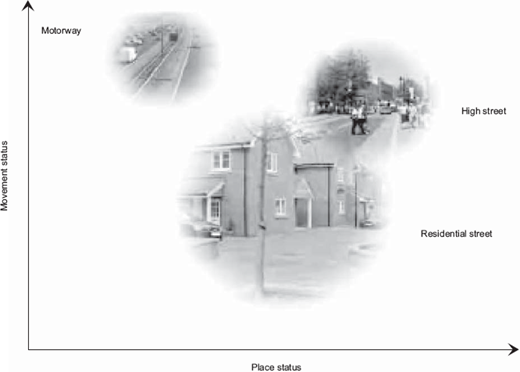
The first big change in the manual is the serious establishment of a movement hierarchy based on walking, cycling and public transport. The second is a two-dimensional matrix which plots ‘movement’ against ‘place’, locating the motorway, high street and residential street (see Fig. 1). This allows designers a more subtle response rather than responding mainly to traffic considerations. The third is a stunning set of reassessments of unproven shibboleths such as ‘stopping sight distances’ and limitations for direct frontage access on to roads up to around 10 000 vehicles/day or more. This latter quasi-rule has probably created more damage to urban life than any other. Fourth is the unpicking of claimed ‘safety’ by research, which establishes that speeds rise as roads become wider and forward visibility is increased. Fifth is that connectedness and permeability do not lead to greater levels of accident and may therefore be used to improve accessibility by walking and cycling. Finally, there is the idea that the street can be a place, used in a range of ways, for play or even for parking.
This is simply the best UK urban design manual of the 21st century.

