

Promenade of Light, Tonkin Liu's £1 million competition-winning scheme for the refurbishment of the pedestrianised zone west of Old Street London, is a superb example of innovative and effective regeneration of the urban public realm. It has completely transformed a neglected 3500 m2 city at the gateway of London's financial district, making it safer, fully accessible, better looking and easier to maintain.
1. ASPIRATIONS FOR THE SITE
The site was identified in the EC1 Public Space Strategy as being of key importance to the locality and in need of refurbishment, and broadly perceived as being run down, unattractive and unsafe at night. An initial consultation ‘Any Old Street’ organised by EC1 New Deals for Communities (NDC) sought comments, perceptions and attitudes towards the locality from local residents and businesses and helped to establish a brief for a high-profile architecture competition organised by the Architecture Foundation launched in May 2004. The competition invited strategic proposals for the redevelopment of the grassed area and pathway west of the roundabout, in front of a parade of shops, as well as a wider strategy for the surrounding area.
From the outset of the competition EC1 NDC set up a steering group of EC1 and London Borough of Islington (LBI) officers and residents and appointed three local representatives to play a very active role in the redevelopment, as well as act as spokespeople for the local community. These three representatives sat on the jury of the design competition and met regularly with the council and design team.
The principal aims of the project were threefold: to regenerate an area of central London prone to a high volume of pedestrian traffic, making it more accessible; to convert an underused green space into a high-quality public space with ample seating opportunities; and to improve lighting and accessibility, making the site a safer, more pleasant environment.
2. THE DESIGN SCHEME FOR PROMENADE OF LIGHT
The site as found was characterised by an under-used grassed area, which orientated pedestrians along the busy road or on a narrow area of paving in front of the parade of shops. Winners of the design competition, Tonkin Liu, observed that the site was characterised by a range of user groups — commuters, shoppers, couriers, school children, the elderly, office workers, families — and that these user groups inhabit the space in different ways, at different hours of the day and, most importantly, at different paces. The intention was to create a more inviting public space, which would appeal to all users, invite occupation in the day and provide a safe and pleasurable route in the evening.
Tonkin Liu's scheme has altered the pace of the existing streetscape with the introduction of a traditional tree-lined promenade, an arrangement that invites dwelling and celebrates the experience of walking and interaction, allowing ideas to unfold and relationships to grow.
The 21 mature plane trees were the best aspect of the existing site and provided a basis for the new scheme, ensuring minimal disruption to the existing planting (see Fig. 1). The existing trees were supplemented with an additional 18 trees to delineate two distinct rows. The central grassed area and boundary low wall have been removed and replaced with a central stone promenade, which is fully accessible to all, including the elderly and mobility impaired. Measuring 2015 m2, the promenade increases the hard landscaping on the site, accommodating a greater flow of pedestrians during rush hour.
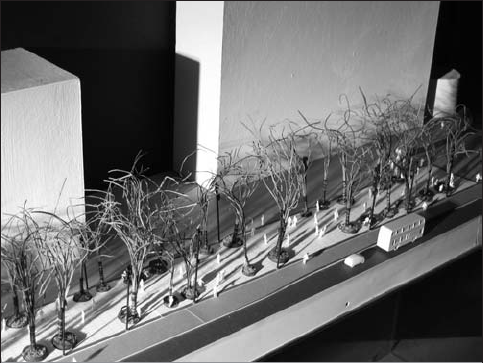
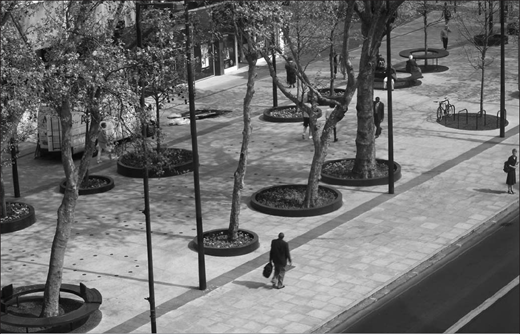
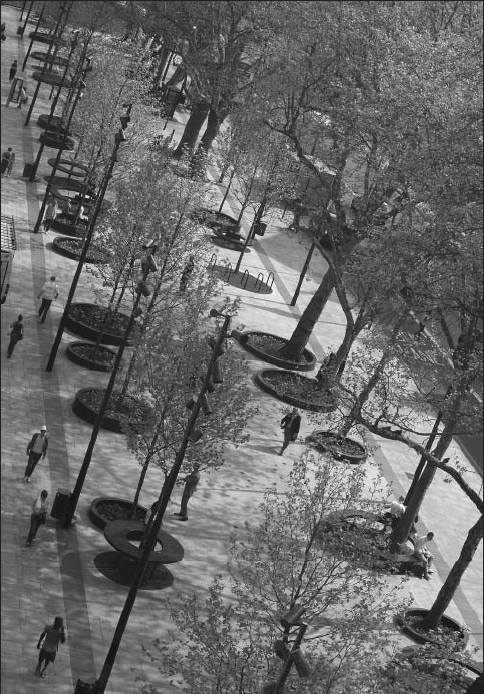
Every tree in the scheme has been framed by a ring, which takes the form of a bench, a table, a planter or cycle facilities. The ring motif is repeated in the paving and creates an arrangement of clusters of rings to bring people together and create urban rooms under the shelter of the trees and clearings to accommodate the varying rhythms and paces of the broad demographic of users.
For the promenade a light stone was specified to maximise the dappling effect of sunlight and shadows through the canopy of trees during the day (see Fig. 4) and to provide a canvas for more dramatic light projections at night. The promenade is subject to a high volume of traffic, so it was important that hard-wearing stone was used. Stone panels, pre-cut to the radii for the benches and the cut-outs in the paving, arrived on site and slotted together like jigsaw puzzles. This system ensures that any component can be repaired and replaced easily. Hard-wearing timber benches were specified to withstand regular cleaning, shot-blasted and stained to minimise potential vandalism.
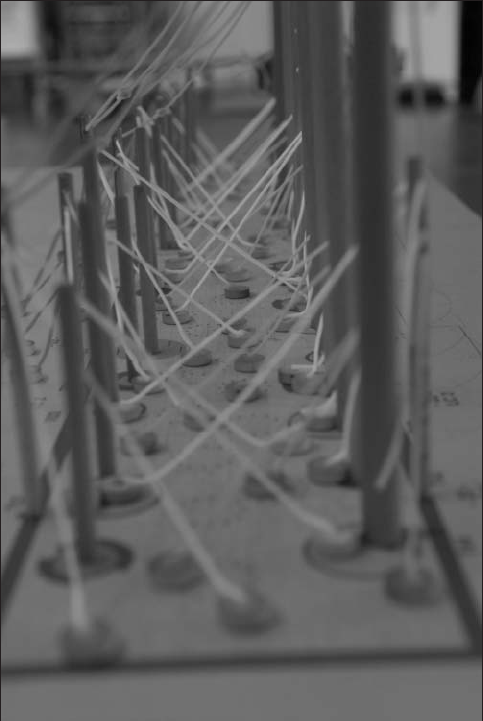
Illumination of the promenade has been a principal consideration in making the space safer and more attractive at night. The scheme makes a feature of the lighting, introducing 23 lamp columns, each fitted with 6–8 multi-directional spotlights. From 5-degree to 100-degree beam angles, and from yellow safety light to bright white light, each lamp was individually positioned, to illuminate the foliage and tree canopy or cast shadows of people and trees (See Fig. 2). In order to maximise energy efficiency and to reflect the different seasons, a sun-tracking timed switch has been integrated and programmed to vary the configuration between weekends and weekdays, summer and winter. This arrangement ensures that basic footway illumination is provided, making the route safer at night while also inviting occupation through the changing projected patterns of light and shadows.
3. PROJECT SUCCESSES
The new promenade has created a more open, usable space, which is made safer through better illumination and clearer sight lines. Commuters, shoppers, couriers, school children, the elderly, office workers, families, each emerge at different hours of the day, to inhabit different sections of the promenade. Their paces range from the very fast to motionless, from rushing to waiting. Shifting the circles of movement around the trees, the promenade encourages these different rhythms, creating clusters and clearings, where smaller communities of activities would take place. A gentle camber was created towards the centre of the promenade, creating a sense of play while remaining 100% accessible to all.
Pre- and post-implementation on-street attitudinal surveys by the council indicate that users feel safer on the promenade. Monitoring data show that the elderly, females and children spend more time in the space. When asked if users enjoyed being in the space, 80% of interviewees strongly agreed in comparison with 59% prior to the implementation of the new promenade. The improved streetscape has also improved access to the shops, thereby benefiting local businesses.
In summary, the Promenade of Light is a socially and economically sustainable regeneration scheme. The area has been transformed into a vibrant public space where people can sit, linger, eat, talk, play and meet in a relaxed way. Existing shopkeepers have noticed an increase in custom and new businesses have been attracted to the parade, which has benefited the streetscape and the local economy. The Scheme won a RIBA award in 2007. It was a finalist in the European Prize for Urban Public Space 2008 and The Prime Minister's Better Public Building Award 2007. It was also shortlisted for the Lighting Design Awards 2008 and the Regeneration Awards in 2007.
ACKNOWLEDGEMENTS
The authors would like to acknowledge the client, London Borough of Islington, EC1 NDC and TFL (Transport for London), as well as the key client contact Anthony Bailey, Senior Transport Planner (Public Realm), London Borough of Islington. Community consultation was conducted by Liz Kessler, EC1 NDC and the architects were Tonkin Liu, with design team made up of Mike Tonkin, Anna Liu and Robert Urbanek-Zeller.

