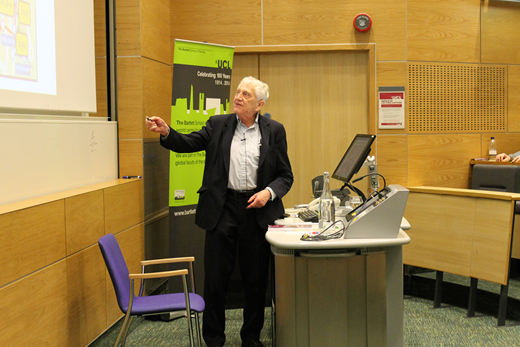
Many accounts of Peter's life have been written since his death in late July, some celebrating the extraordinary breadth and impact of his work across urban planning and associated fields, and others noting his many accolades that are testament to the esteem in which he and his work were held. To friends, colleagues and students he will be remembered for his irrepressible energy and warmth – a humble, kind and understated man who we assumed would or could never stop; a man who worked a punishing routine until the end – emailing late into the night or on a Boxing Day afternoon. He also gave his time generously to those who sought it.
An egalitarian sense of duty drew him to the Fabian Society in his early years as a student at St Catharine's College, Cambridge, and in turn attracted him to Ebenezer Howard's earlier communitarian garden city ideas to be delivered through a benign governance structure. This belief in the potential for planning to create positive, nourishing environments in which society could flourish infused much of his subsequent work, even if the means and the tools for delivery had to change with the times, or the particular government of the day. Peter put pragmatism over dogma, dealing with the different pieces that counted towards the broader pursuit of creating ‘good cities, better lives’ as and when the opportunity allowed. His academic work often went backwards in time – capturing the essence of the human social condition and the intricacies of societal development in the urban setting (Hall, 1998), or exposing the historic impact of planning on communities and livelihoods (Hall, 1988) – work that formed a solid grounding for projecting his own proposals forward, sometimes in visionary form (Hall, 1963), but more usually in practical schemes to address specific issues. In an early attempt to kick-start Britain's depressed, post-industrial inner cities he developed the enterprise zone concept to bring Kowloon-style dynamism to the Thames and the Mersey. Two decades later he would be brought in to advise another Conservative government on the development of the Thames Gateway region through a proposed high-speed rail link to the Channel Tunnel. These are just two examples of public service recognised in a knighthood received in 1998.
His academic career had similar twists. He was appointed Professor of Geography at the University of Reading in 1968 aged just 37, following earlier lectureships at Birkbeck and the LSE. There followed a period in California with his wife Magda, for a chair at Berkeley between 1980 and 1992 before returning to Britain to take up his last appointment as Bartlett Professor of Planning and Urban Regeneration at UCL. He contributed high-quality journalism on a weekly basis and was always concerned to communicate planning matters to practitioners and to the wider public, but he was also a scholar of immense academic distinction, as was recognised in 2005 by the award of the Balzan Prize for his contribution to urban history. His return to Europe opened the way for two further projects. POLYNET (2004–2006) exposed for the first time the connectedness of lives and livelihoods between cities in northern Europe, while SINTROPHER (2009–2015) implemented investments to improve connections between core cities and their economic peripheries. This last project provided a return to Peter's roots, metaphorically by deploying planning as a means of improving the lives of the everyman and, literally, by returning to Blackpool – the city of his childhood and a key project partner.