

Overview of Urban Design and Planning: current trends and progress
Reflecting on recent developments within Urban Design and Planning, we are proud of the journal’s latest achievements. The new Scimago rankings highlight our research’s growing influence and scholarly contributions, reinforcing our commitment to advancing interdisciplinary discourse in urban design, planning, and architecture.
Urban Design and Planning’s CiteScore increased to 3 in 2023, up from 1.9 in 2022—an impressive leap highlighting the journal’s global reach and academic impact. This achievement is a testament to the hard work of our authors, reviewers, and editorial team, and we extend our heartfelt congratulations to everyone involved.
We are also proud to announce that the journal is now ranked in the first quartile (Q1) in Architecture, in the 32nd rank among 189 journals indexed in Architecture. We also received the second quartile (Q2) in urban studies (85th rank out of 279 journals) and Q2 in Geography, Planning, and Development (#303 out of 821 journals). These rankings position us among the leading urban design, planning, and architecture journals, affirming our commitment to advancing interdisciplinary research that addresses cities’ critical challenges today.
This editorial acknowledges our editor-in-chief’s unwavering leadership and vision and sincerely appreciates the editorial board and reviewers for their dedication and hard work. Their invaluable contributions in meticulously reviewing each content published in Urban Design and Planning have been instrumental in the journal’s continued success and growth. One such challenge is ensuring that researchers fully consider the diverse factors shaping urban environments over time.
During the past few years, we have noticed a point in various manuscripts published in urban studies related to the literature review sections in scientific manuscripts. As cities evolve, they are influenced by a complex interplay of historical and societal factors—socio-cultural, socio-spatial, spatial-temporal, economic, environmental, technological, and political. However, academic research—particularly by early-career researchers in urban planning and design—often overlooks the critical role of context, which is mentioned in the works of their scientific manuscripts, which sometimes end far away from what is meant by the authors of the cited manuscripts. By understanding ideas’ historical evolution and relevance to contemporary issues, researchers can develop a deeper and more comprehensive analysis of the built environment and contribute to more impactful research.
In this context, incorporating a phrase from a manuscript into the literature review without adequately considering the temporal, spatial, and authorship context is analogous to citing idiomatic expressions without understanding their cultural meaning. For example, the British expression ‘break a leg’ used to wish performers good luck to actors and musicians may convey an entirely different meaning if translated literally. This challenge is further compounded for early-career researchers and non-native speakers when composing literature reviews in languages other than their own.
Early-career researchers and writing literature review section
We focussed this editorial on early-career researchers (Bazeley, 2003; Frandsen and Nicolaisen, 2024) rather than novice researchers (Jatin et al., 2009; Kalman, 2019). While these terms are often used interchangeably, they represent distinct stages in academic development. Early-career researchers have completed formal training, such as a master’s or PhD, and are actively engaged in research activities (Sendur et al., 2021). They possess a solid grasp of research methodology and typically have practical experience in publishing, presenting, or collaborating on research projects. In contrast, novice researchers, often students working on their first projects, are at the very start of their research journey. They may lack experience and are still learning foundational skills in research methodology, data analysis, and academic writing.
Topics in urban planning and design constantly evolve with new developments and changes. For early-career researchers, keeping up with these changes while producing meaningful research can be particularly challenging, especially when writing the literature review section of their peer-reviewed academic papers. This editorial argues that incorporating historical and societal authentic context is essential for producing literature reviews that are not only comprehensive but also impactful in the broader field of urban studies.
Research consistently shows that early-career researchers struggle with a range of issues in writing literature reviews (Chen et al., 2015; Jatin et al., 2009). Common challenges include addressing broader issues, overlapping unrelated ideas, lacking conceptual clarity, failing to understand or apply theoretical frameworks appropriately, and struggling to strike the right balance between breadth and depth in their coverage of the literature (Ameen et al., 2018; Daldrup-Link, 2018; Presnell, 2007). Early-career urban planning and design researchers often need help to connect contemporary design challenges to historical precedents, leading to less impactful and nuanced research.
While numerous studies have addressed the evaluation of literature reviews or provided cognitive approaches for newcomers in various disciplines such as research design (Hart, 2018), humanities (Templier and Paré, 2015), philosophy (Mikkonen, 2009), education (Ching, 2019), management, business, accounting, and decision making (Jiang, 2019; Snyder, 2023) and engineering and informatics (Reda et al., 2023), a dedicated framework for evaluating literature reviews in the built environment fields—encompassing urban planning and design—remains largely unexplored. While some researchers have explored the role of historical context within built environment disciplines (Luce et al., 2023; Sotoudeh and Abdullah, 2013), an approach for evaluating the quality and strengthening of writing literature review section in these disciplines remains largely unexplored. This editorial responds to this gap by exploring the need for a guide to help early-career researchers navigate the evolution of ideas and better connect historical developments to contemporary urban planning and design challenges. By considering the discursive context of their research, these researchers can create more nuanced and impactful literature reviews, thusly contributing to a deeper understanding of urban studies’ complex and dynamic field.
The power of authentic context in academic urban planning and design research
This editorial explores the vital role of “authentic context” in shaping insightful and influential literature review sections in built environment fields such as urban planning and design. Despite a comprehensive search of major academic databases, such as Scopus and Web of Science, we identified no development of a dedicated framework designed explicitly to incorporate context into the literature review process within urban planning and design. This absence highlights the need for a dedicated approach to incorporating context in urban planning and design research. Considering the authentic context ensures that literature reviews provide a more complete and nuanced understanding of the field’s evolution and challenges.
Drawing from the literature by Wan (2009), Flowerdew (2017) and Burke (2022), we define ‘authentic context’ as the framework that includes the complete conditions in which discourse is produced, circulated, and interpreted. The authentic context surrounding and influencing every aspect of knowledge production and understanding consists of a wide range of factors, such as historical and societal factors—social, cultural, political, economic, legal, technological, and environmental. Neglecting context can detract from the quality of academic discourse, which focuses on understanding the meaning and significance of texts and ideas, within which the text is positioned to provide a deeper and more comprehensive understanding.
Research conducted by early career researchers should discuss events within the collaborative planning process. In this regard, events can be understood in their historical context (AlWaer and Cooper, 2020). Additionally, everything we encounter should be seen in its context for understanding. Thusly, authentic context is the envelope surrounding every thesis intended for knowledge, and its absence or neglect can detract from the quality of academic discourse.
Several precedents highlighted the importance of understanding authentic context based on the concept of historical context or historical contextualisation in social sciences, including the psychology of education (Huijgen et al., 2017), comparative political studies (Mahoney et al., 2009; AlWaer et al., 2023) and learning sciences (Sendur et al., 2021). While definitions have often focussed on the “context” in general, defining its relationship to the immediate surroundings or social environment, they have not fully captured the dynamic and complex interaction of historical forces that shape the built environment. This lack highlights the need for a specific definition of a dedicated framework that addresses the unique characteristics of the authentic context within the built environment.
Therefore, this editorial defines ‘authentic context’ as the essential framework encompassing the events, societal repercussions, power dynamics, ideologies, biases, and hidden forces surrounding a specific topic within the built environment. This framework, encompassing the ‘why’ behind these elements, collectively informs the topic’s evolution and relevance within the built environment and underscores the transformative power of understanding the historical context. When evaluating literature reviews, understanding this context helps researchers illuminate the evolution of ideas, theories, and practices within their specific time and place, enhancing the depth and relevance of their analysis.
Authentic context, often overlooked, plays a pivotal role in shaping urban environments. In urban planning and design fields, understanding historical text and context enriches analysis, informs critique, and fosters innovative design solutions (Bod, 2022; Camic, 2016; Burke, 2022; Mahoney et al., 2009). This idea leads to more rigorous research and ensures its relevance to real-world challenges. Tracing their historical origins and evolution provides a deeper understanding of contemporary urban issues (Elshater et al., 2022; Flowerdew, 2017; Power and Berga, 2019). Previous studies emphasise integrating cultural and socio-economic factors in analysing urban planning trends (Abusaada et al., 2023; Abusaada and Elshater, 2022, 2024). These studies highlight the importance of a contextual approach for successfully implementing smart city initiatives, demonstrating how technological advancements, governmental policies, and socio-economic conditions shape urban planning outcomes.
By integrating authentic context into urban planning and design academic research, practitioners and researchers can gain a more nuanced understanding of the forces that shape cities and contribute to more effective writing of a literature review section and impactful design solutions (Huijgen et al., 2017). Incorporating authentic context into research offers several practical implications. It helps identify hidden biases by uncovering underlying assumptions that may have influenced previous studies, allowing for a more comprehensive analysis. This approach challenges established perspectives by considering alternative interpretations and questioning dominant paradigms. It also deepens the understanding of the subject matter by tracing the evolution of ideas, identifying patterns and recurring themes, and highlighting areas for future research. Ultimately, this leads to the development more innovative design solutions that are better tailored to the specific needs and challenges of contemporary urban environments.
Five procedures for the “authentic context” concept
Understanding the context in a literature review section helps illuminate the evolution of ideas, theories, and practices within their specific historical and societal context. This editorial advocates for a deeper examination of the “authentic context” concept and its critical role in creating an impactful literature review section. It suggests a guide to help early-career researchers integrate this crucial discursive context into their reviews. This approach goes beyond summarising previous research by encouraging researchers to (Figure 1):
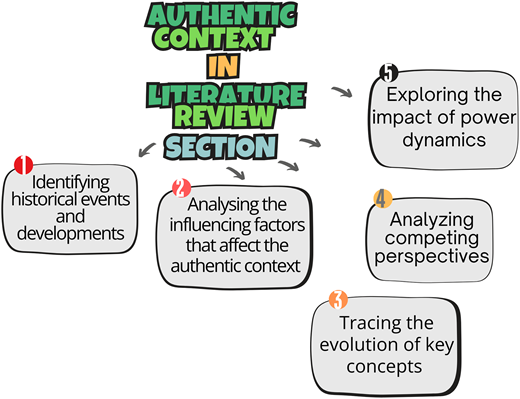
Five procedures for utilising the “authentic context” through writing a literature review section in scientific research
Five procedures for utilising the “authentic context” through writing a literature review section in scientific research
Identifying historical events and developments is crucial for understanding the evolution of urban planning and design. Early career researchers can assess how these events contribute to the current understanding of urban design by pinpointing key moments that have shaped the field. This identification of historical events involves examining who was involved, to whom these developments were directed, and where these events took place, providing a comprehensive view of the field’s growth and influence over time.
Analysing the influencing factors that affect the authentic context is essential for understanding how various factors, such as social movements, political ideologies, and economic shifts, have shaped the production and interpretation of knowledge about cities. This examination reveals the underlying forces that have influenced urban planning and design, offering insights into how these external factors have impacted the development of cities and the field’s ongoing discourse.
Tracing the evolution of key concepts in urban planning and design involves investigating how dominant ideas, such as “sustainability,” “universal design,” “Sin City,” and the architecture of “Duck versus Decorated Sheds” have transformed over time. By exploring the shifts in these concepts, we can better understand how changing priorities, technological advancements, and societal needs have influenced their development and application in contemporary urban design.
Analyzing competing perspectives involves exploring how key urban planning and design ideas have been debated and interpreted. This includes identifying conflicting schools of thought and understanding how tensions between these perspectives contribute to the evolving discourse. By examining these debates, we gain insight into the dynamic nature of the field and how differing viewpoints drive progress and innovation.
Exploring the impact of power dynamics involves investigating how social, political, and economic forces have shaped the dominant discourse on urban issues. This exploration includes examining how the roles of entities such as the state or private developers have influenced urban design practices. Understanding these power dynamics reveals how various interests and influences have guided the development of urban environments and the priorities in urban planning.
In this issue
Kicking off our exploration, the first manuscript by Plaves et al. (2024) ventures into the groundbreaking realm of regenerative design. This paper redefines traditional sustainability by advocating for a holistic systems approach to revitalising urban environments. With practical insights from Australia, the authors offer a compelling vision for enhancing societal well-being and environmental health, providing early career researchers with valuable guidance on implementing regenerative design principles across diverse urban landscapes.
Shifting gears, the second manuscript, authored by Mahmoud (2024), navigates the intricate world of nature-based solutions (NBS) in urban planning. Focussing on cities like Nice, Utrecht, and Milan, this comprehensive review delves into the multifaceted role of NBS in fostering urban sustainability. The paper illuminates the advantages and challenges of NBS, highlighting the crucial role of citizen engagement and a holistic approach. It also addresses the application of NBS across different spatial scales and the importance of evidence-based standards and collaborative stakeholder efforts.
Next, the third manuscript by Al-Khazaleh et al. (2024) uncovers the nuances of child safety in gated versus conventional neighbourhoods. This study delves into how social and environmental factors shape parents’ perceptions, examining concepts like ‘defensible space’ and ‘crime prevention through environmental design.’ By analysing the impact of neighbourhood features on safety perceptions, the paper advocates for further research into social cohesion and the development of child-friendly urban spaces.
Finally, the fourth manuscript, authored by Shahabi Shahmiri et al. (2024), tackles the pressing issue of obesity due to the built environment in Tehran that hinders physical activities. The authors investigate factors such as population density, access to public transportation, and green space availability. Their literature review sheds light on how these elements contribute to obesity and chronic diseases, drawing comparisons with environments in China, the USA, and England. The study emphasizes the role of urban design, walkability, and transportation accessibility in promoting physical activity and healthier lifestyles.
Looking Ahead
This editorial emphasizes the urgent need for a new approach to empower early-career researchers in urban planning and design to explore the complexities of existing literature more deeply. By embracing an authentic context, researchers can transcend superficial readings and better understand the historical and societal influences, evolving ideas, and diverse perspectives that shape our field. This approach encourages researchers to challenge existing assumptions, uncover the driving forces behind key concepts, trace their evolution, and identify patterns and divergences across different perspectives.
Such a guide would enable researchers to leverage historical and societal insights to inform their current work, leading to more comprehensive, profound, and impactful scholarship. We urge early-career researchers to engage with this challenge and explore ways to translate these concepts into practical frameworks or approaches, drawing upon areas such as historical and societal perspective, context, and critical discourse analysis. By empowering researchers to engage with authentic contexts, we can foster a more nuanced and impactful body of scholarship, ultimately contributing to better urban planning and design practices.

