Papers published in Water Management are eligible for awards from the Institution of Civil Engineers. Papers from any of the ICE journals can be nominated for several awards. In addition, each journal has awards dedicated to their specific subject area.
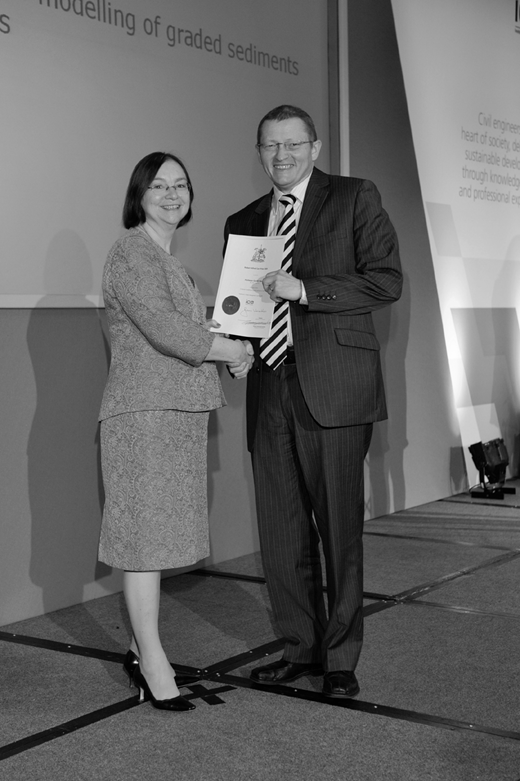
On Friday 23 October 2009, ICE president Jean Venables presented an award to the following paper published in Water Management in 2008. The editorial panel nominated their best papers and an awards committee chaired by Adrian Long allocated the award.
The R A Carr Prize was awarded to: Shvidchenko AB and Pender G (2008) Computer modelling of graded sediments in rivers. Proceedings of the Institution of Civil Engineers, Water Management, 161(5): 289–297.
ABSTRACT
This paper reports on current engineering capability to simulate the behaviour of graded sediments in rivers using one-dimensional computer models. Emphasis is placed on non-equilibrium conditions when the bedload transport rate, bed elevation and composition of the bed material are changing with time. The model used is typical of those available to practicing engineers. A general description is given and comparisons are made of the model's ability to reproduce available laboratory and field data. The performance of four sediment transport equations (Ackers and White, Meyer-Peter and Muller, White and Day, Parker) in predicting graded sediment movement is assessed by comparison with the measured data. Of these equations, the first two were originally developed for application to uniform sediment and do not account for size fraction interaction, while the other two take account of sediment grading. The test simulations demonstrate that the use of the Parker equation provides the best overall agreement with the measured data, while the use of the other equations provides inadequate prediction in the case of graded sediments. It is concluded that an adequate computer simulation of long-term trends in the behaviour of graded sediments is only possible if size fraction interaction in the sediment mixtures is accounted for in the sediment transport equation used. Fig. 1.