

Contribution by Alireza Vatankhah, Assistant Professor, University of Tehran
The author has determined the vertical distance between the centroid of the flow area and the water surface, by equating the two areas above and below the horizontal centroid line. This derivation is not generally true. It is correct only if the horizontal centroid line coincides with the horizontal symmetric axis of the section. The author also derived Equations 4a and 4b with respect to his definition incorrectly.
The centroid position could be determined by taking moments about the invert axis of the section as follows
Rearranging Equation 16 yields
Equation 17 can be simplified as
Centroid position for a trapezoidal section
Centroid position for a trapezoidal section can be determined as follows
By differentiation of the left-hand side of Equation 19 with respect to y, the following is obtained
Equation 20 can be used for the Newton–Raphson method.
Centroid position for a circular section
Centroid position for a circular section can be determined as follows
in which
where θ is the water surface angle in radians according to Figure 3, and η = y/D and y denotes the depth of the water in the pipe.
Substituting Equation 22 into Equation 21 and integrating yields
By differentiating the left-hand side of Equation 23 with respect to y, the following is obtained
In general using Equation 18 it is proved that
Equation 25 can be used for the Newton–Raphson method; however, this method is not the most efficient for calculating conjugate depths. The fixed-point method could also be used to provide solutions, without long computations and also which converge faster towards the solution. Distinguishing pre-jump and post-jump depths using this method is also possible.
Using the fixed-point method for a trapezoidal section
The dimensionless specific force equation for a trapezoidal cross-section takes the form (Vatankhah and Kouchakzadeh, 2008)
In which, y* = sy/B, F* = sF/B3, Q* = Q2s3/(2gB5) and F is the specific force as follows
The sequent depths are obtained by solving Equation 26 for a given dimensionless specific force and discharge. Different iterative arrangements of Equation 26 in the form of y*(n + 1) = f(y*(n)), n = 0, 1, 2, 3,… might be considered for determination of conjugate depths; however, the most suitable form that converges to the desired root by using the fixed-point iteration technique should be sought. Two arrangements of Equation 26, in the forms of Equations 28 and 29, are proposed herein for calculating the dimensionless conjugate depths y*2 = sy2/B and y*1 = sy1/B, respectively.
The subscripts 1 and 2 refer to the pre-jump and post-jump depths, respectively. The general forms of h2(y*) and h1(y*) are drawn in Figure 9. The slopes of h1(y*) and h2(y*) functions near the root govern their behaviour. That is, starting the computation from points having a slope close to zero tends to increase the convergence rate, whereas using any point with a slope greater than + 1 would either diverge the iteration process or produce another root.
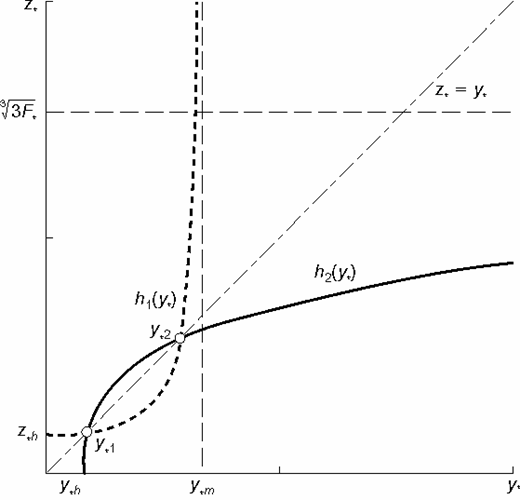
The function h2(y*) has two asymptotes (i.e. z* = (3F*)1/3 and y* = 0) and intersects the abscissa at y*h = −0·5 + (0·25 + 2Q*/F*)0·5. Likewise, h1(y*) intersects the ordinate at z*h = −0·5 + (0·25 + 2Q*/F*)0·5 and has two asymptotes (i.e. z* = 0 and y*m) given by one of the roots of the following equation
As the root must be real and positive, it could be determined by the following relationship
Now h1 and h2 functions could be used for calculating y*1 and y*2 provided that an appropriate initial guess is considered. In this case values of and is an approximation of y*m) could be used to determine y*1 and y*2, respectively.
Fixed-point method for author's example
For this example Q* = 0·0205 and F* = 0·501 thus using Equation 29 the following can be obtained
This result is significantly different from that obtained by the author, which was y1 = 0·236 m.
Author's reply
The author agrees that the accurate calculation for the centroid of a trapezoid cross-section is given by Equation 16 and the equations that follow it. For a circular section running part full an accurate calculation is given by Equation 21. Although the formula for the centroids of trapezoidal and part-circular shapes initially provided by the author was in error, the author believes that it remains a reasonable approximation in most cases, particularly where the sides of the channel are steep. The comparison of the results with experimental data originally shown by the author also demonstrates that this original method provides a reasonable first step for the design of trapezoid and circular channels using hydraulic jumps. Nevertheless, the author accepts that the discusser proposes a worthwhile refinement to the technique.
The author agrees that the fixed-point method is a useful alternative to the Newton–Raphson method for determining the mathematical solution for depths upstream and downstream of the hydraulic jump.
The discusser has also raised an important point which the author feels was not made clear in the original paper. The trapezoidal sections (Figures 4 and 6) suggest that the relationship for the depth ratio y2/y1 against F1 is the same irrespective of the downstream depth y2. This is not the case, as higher flow rates in the same cross-section will alter the nature of this relationship. The use of the dimensionless parameters F* and Q* helps to bring this out, although it should be emphasised that the main aim of the original paper was to demonstrate a method for using a simple spreadsheet tool in a design office, applicable by engineers and mathematical modellers working on hydraulic design problems.

