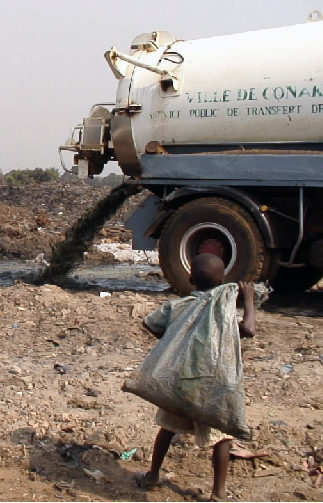
Waste management in developing countries started to be modernised at the end of 1960s. However, the transfer of technology-centred ‘hardware’ from industrialised countries to low-income countries turned out to be non-viable in the long run as in many cases the corresponding ‘software’ – such as users and their capacities and skills, socio-cultural embedment, financial viability and policy frameworks – were simply neglected.
Other ideas subsequently emerged, focusing on people-centred and demand-oriented approaches. These tried more to understand the diverse contextual frameworks in which waste management solutions are placed. However, a closer look at low-income countries reveals that waste is still a problem despite overall performance improvements evident in the last decade.
Changes in waste management are based on innovations and changing mindsets, but this requires a rethinking of processes – not only from waste management users and service providers in low-income countries but also from donors, politicians, research and the global waste management industry. Certainly there is huge market potential in developing and transition countries.
This themed issue of Waste and Resource Management entitled Sustainable waste management in developing countries brings together both research and practical experience of the technological and non-technological aspects of sustainable waste management planning, monitoring and implementation in developing countries.
The briefing article by Linzner and Ali (2013) puts forward the diversity of potential drivers to improve solid waste management systems in low-income countries and how past approaches tried to counter increasing waste generation in the developing world. The authors raise the question whether modernisation of waste management has to deal with inclusive approaches based on existing knowledge and practice or to focus on development of parallel and sophisticated waste management systems.
In the first paper Wilson et al. (2013) elaborate on the concept of integrated sustainable waste management, examining how cities in developing countries have been tackling their solid waste problems. The authors report on how far developing countries have progressed with modernising their waste management systems based on benchmark indicators derived from the authors’ recent work and experience. In addition they draw conclusions on what makes a solid waste system sustainable and how developments in low-income countries can be linked to past experience in the developed world.
The second paper by Linzner and Lange (2013) examines the role and size of the ‘informal sector’ in waste management in low-income countries. On the one hand, an army of informal workers provides waste-related services and, on the other hand, this is highly relevant from an income generation point of view. Informal activities are often perceived as inefficient and ‘dirty’ and therefore are considered as being the opposite of what good waste management practices have to represent. The authors have gathered a large amount of research in this area and provide key parameters for waste management planning and monitoring.
The third paper also deals with informal recycling systems but focuses on the development of a social assessment methodology. Aparcana et al. (2013) present three Peruvian case studies where an assessment based on the social life-cycle assessment concept was conducted. The authors provide a methodology, impact categories and indicators that might be useful in social assessments of formal and informal recycling systems in the global south.
Paper number four by Zurbrügg and Rothenberger (2013) discusses community-led waste management initiatives as a coping strategy to overcome the lack of public services. The authors identified and analysed driving forces, factors of sustainability, as well as internal and external factors that influence failure or success of community-based schemes in India using the protection motivation theory, the resilience concept and the sustainable livelihood approach. An important key message is that the assessment of strengths and weaknesses in solid waste projects often focus only on a physical, technical and financial description but leaves out the human factor. The analysis shows that human and social assets are the key to success of all community initiatives.
I hope you find these papers interesting and motivating thus generating new insights for both practitioners and research working in the low-income country context. I would be pleased to receive comments on this issue or proposals for future themed issues.