Over the past decade, research into chemical recycling (CR) of plastic waste has gained significant traction. Simultaneously, life cycle assessment (LCA) has become an increasingly crucial tool for evaluating the environmental impacts of materials, products, and processes. This review provides a critical overview of the current research landscape. It highlights the ambiguity surrounding nomenclature, where ‘chemical recycling’ and ‘feedstock recycling’ are often used interchangeably to encompass the several waste plastic conversion processes. This can lead to unclear comparisons between CR and mechanical recycling (MR) processes. This critical analysis of major technical papers on CR revealed the common pitfalls of CR LCAs. Direct comparisons between CR and MR and between chemical processes and conventional incineration are now considered obsolete, given the variety of chemical processes and feedstocks available. CR complements MR by recovering plastic waste that is not amenable to MR, hence the need to specify the wider context. To establish a fairer and more comprehensive assessment of CR methods, and support its policy integration, further research on processing of plastic waste is imperative. This paper provides recommendations on how to expand the data pool and improve the assessment of the real environmental benefits of CR.
1. Introduction
Plastic is widely used in modern society due to its low cost and excellent material properties such as low weight, flexibility, and high durability, making it ideal for numerous applications. Plastic waste generation is growing at an alarming rate and has become a major environmental issue. According to the Organization for Economic Cooperation and Development (OECD, 2023), an estimated 50% (w/w) of worldwide plastic waste (around 175 million tonnes in 2022 alone) enters landfill each year, 35% (w/w) of plastic waste is either incinerated or enters the environment, and less than 15% is effectively recycled (OECD, 2023).
To counteract this, several countries have introduced plastic recycling targets and policy drivers such as the EU Plastics Strategy (EC, 2018). However, there are several hurdles that must be overcome before these objectives can be met. One challenge is that many plastic products contain chemicals and dyes in their final composition, which inhibit their recyclability.
Chemical recycling (CR) is an emerging technology that breaks down plastic waste into its chemical building blocks, which can then be used to make new plastic products or other useful materials. By recycling plastic waste into new materials, CR could reduce the demand for virgin plastic and divert plastic waste from landfills and incinerators. Over the past decade, research into CR of waste plastics has gained significant traction. CR is the broad term used to describe a range of emerging technologies in the waste management industry which allow plastics to be recycled, that are difficult or uneconomic to recycle mechanically. [It] describes any technology that utilises processes or chemical agents that directly affect the chemistry of the polymers (BPF, 2024). The technologies used in CR of plastic include pyrolysis, gasification, depolymerisation, and dissolution (Broeren et al., 2019). This paper focuses on gasification and pyrolysis processes due to the current high market interest in these technologies (The Consumer Goods Forum, 2022).
Mechanical recycling (MR) is the ‘traditional’ method of recycling plastics (Plastics Europe, 2024 ; Ragaert et al., 2017) that involves physically breaking down plastics into flakes or pellets so that they can be re-melted into new shapes for new applications. MR does not alter the chemical structure of the plastics.
CR has several advantages over ‘traditional’ MR methods. MR can only process certain types of plastic and the quality of the recycled plastic is often lower than the quality of virgin materials. CR, on the other hand, can process a wider range of plastic waste, and the resulting recycled materials can be of higher quality. Therefore, CR can be regarded as a complementary solution to MR, in increasing the overall circularity of polymers. CR is still in its early stages of development and presents several challenges such as high capital cost and unclear environmental impact but has the potential to play a significant role in reducing plastic pollution.
Life cycle assessments (LCAs) are an internationally recognised and accepted method for quantifying the potential environmental impacts of a product such as recycled plastics. LCAs represents a key tool to assess and evaluate the real impact on the environment of novel technologies to boost the circularity of essential materials, such as waste plastics. LCAs consider not only the direct impacts and emissions of the manufacturing process itself, but also those associated with all stages of the life cycle, including raw material extraction, transportation, pre-treatment, use, and end-of-life treatment. There are widely accepted procedures for carrying out an LCA as governed by ISO 14040:2006 (ISO, 2006a), which provides the principles and framework of LCAs, and ISO 14044:2006 (ISO, 2006b), which outlines the guidelines and requirements for those performing an LCA.
Despite these common procedures, there is still a vast amount of variation in LCA methodologies, particularly with regard to evaluating, at least in part, the impact associated with CR processes. The purpose of this paper is to critically review published LCAs of CR solutions for the treatment of plastic waste, to determine the trends, pitfalls, and data gaps some of these studies present. CR is also often presented as an alternative to MR. In this paper, we review existing LCAs of CR as well as comparisons to MR to determine whether there is sufficient good quality information available to accurately compare the two methods and, furthermore, whether it is even useful to pit CR and MR against each other.
These conclusions, trends, and pitfalls are then used to provide recommendations regarding how future LCA studies might be designed to avoid some of these pitfalls or fill the current gaps in data.
2. Literature review methodology
The first step of this literature review was to collect published papers that review LCA studies that focus on CR. Where possible, this search was focused on only papers concerned with either gasification or pyrolysis. However, many papers were based on broader definitions of CR that encompass a range of processes or technologies and these were included in the literature review where they met the relevant criteria set out below. Reference lists of identified papers were also reviewed to ensure a thorough literature search was carried out.
From the literature search, 28 published papers and reports that compare the environmental impacts of CR and MR, including those that review LCA studies, were identified and reviewed against the following criteria:
quality of data presented/reviewed in paper
inclusion of pyrolysis or gasification (or a range of technologies/processes including at least one of these)
inclusion of mixed plastic waste or single stream plastic waste.
Of the 28 reviewed papers, 16 met the above criteria and were selected for further analysis to determine the trends, common pitfalls, and data gaps in LCAs of CR of waste plastics. Table 1 provides information on the title and reference of the chosen 16 papers.
3. Analysis of trends, pitfalls, and gaps identified
3.1 Unclear definition of chemical recycling
CR is a broad term covering a range of technologies such as gasification, pyrolysis, dissolution, and depolymerisation, otherwise known as chemolysis, hydrolysis, or solvolysis, that can convert plastic waste into useful raw materials by changing its chemical structure. A common pitfall some reviewed studies fall into is using the term CR as if it refers to a specific process that can be directly compared with other treatment options or using the term interchangeably with pyrolysis. For example, while Badische Anilin- und Sodafabrik (BASF) acknowledges the existence of other CR technologies in its overview of LCAs (BASF, 2020), its review is limited to pyrolysis only and makes broad statements comparing CR’s carbon footprint to other treatment options. Certain reviews of LCA methodologies limit CR to only pyrolysis or hydrolysis with no mention of other technologies (Alhazmi et al., 2021). On the other hand, Rickert et al. (2020) and Koffler et al. (2021) do not specify exactly which technologies are covered under the term ‘chemical recycling’ in their case study overviews of LCAs. The issue with this unclear definition is an LCA performed on a pyrolysis plant would yield different results to one performed for a gasification or solvolysis process.
Another common example of the unclear definition of CR causing uncertainty is whether solvent purification falls under the umbrella of CR technologies. Some reviews of LCA studies categorise it as a CR technology that should be considered (Hann and Connock, 2020), whereas others (Rizos et al., 2023) specifically exclude solvent purification from CR as it does not change its chemical composition.
3.2 No legal definition of chemical recycling
Within the EU, the legal classification of CR technologies remains ambiguous due to the current definition of recycling in Directive 2008/98/EC (EC, 2008). This directive establishes a waste hierarchy, prioritising waste management strategies with prevention and reuse at the top, followed by recycling, other recovery (including energy recovery), and finally disposal. The directive defines recycling as the reprocessing of waste materials into new products or materials, excluding energy recovery. However, CR technologies often convert part of the processed waste into fuels, creating uncertainty regarding their categorisation within the hierarchy. The directive classifies processes such as gasification and pyrolysis for chemical production as ‘recovery’ operations, distinct from recycling. This ambiguity surrounding CR’s placement within the waste hierarchy has significant ramifications. It hinders a clear understanding of the technology’s environmental benefits and discourages potential investors due to the lack of a definitive legal status.
3.3 Difference in scope and system boundaries
To effectively compare two technologies, LCA studies should be based on clear scope, objectives of the study, system boundaries, reliable data assumptions, and similar basis. MR and CR are very different technologies, and most importantly, they are designed to cooperate and complement each other in the waste plastic value chain. The studies reviewed present several instances of unsymmetrical comparison. For example, given that the intended applications of CR technology are to treat hard-to-(mechanically)-recycle mixed and contaminated plastics, while MR is focused mostly on high-density polyethylene and polyethylene terephthalate recycling, the comparison is in fact ineffective.
Another example of asymmetrical comparison is the assumption that CR outputs contain high levels of contamination, which would make the product unsuitable for the desired application (Tabrizi et al., 2020), without equally considering the quality of certain materials recycled by way of MR.
In addition, there is a lack of correlation between the feedstock quality and the potential value recovered and reinjected into the plastic-to-plastic (P2P) loop (Tabrizi et al., 2020). Similar to any other chemical process, the quality or yield of production is affected by the feedstock quality.
Another example of unsymmetrical comparison is the benchmarking exercise comparing CR technologies with one of the two actual disposal routes for hard-to-recycle materials: incineration and landfilling (Jeswani et al., 2021; Rizos et al., 2023). Although the reasoning behind this comparison might be relevant, the two processes should be carefully compared, given the different feedstock materials they adopt, the average process capacity, their relative technology maturity level, and, ultimately, their different products. Incineration is often not classified as ‘recycling’, given that the feedstock material is usually downgraded (downcycling). Although CR technologies are unable to recover the entire value from the feedstock adopted, given their average efficiency, at least a part is recycled back into the materials value chain.
In addition, given the absence of publicly available information on the technology performance at industrial level, several studies reviewed adopt laboratory results or abstract modelling to compare CR against MR (Rollinson and Oladejo, 2020; Schwarz et al., 2021). This may lead once again to an unsymmetrical comparison and provide insufficient information regarding the true environmental impact of the systems.
Overall, the differences in scope, feedstock, and application make these comparisons potentially misleading without a clear definition of the system boundaries and scope of the study.
3.4 Carbon tunnel vision
LCA studies allow for the assessment of the potential impact of a product or service on different dimensions, such as environmental and social impacts. Each of these dimensions presents numerous metrics, also known as impact categories, to obtain a picture of the estimated environmental impact of the product under scrutiny (Tabrizi et al., 2020).
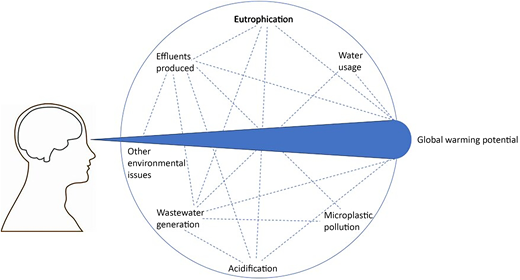
The literature review has shown that the comparison between CR and other options is mostly focused on its global warming potential (GWP), largely ignoring other effects and impact categories (Davidson et al., 2021), as shown by Figure 1. Despite GWP having a remarkable relevance, given its capacity to measure the carbon emission associated with the product, it is not the only suitable metric to assess the environmental impact. For example, while comparing CR to incineration, it has been proven that incineration performs better in other environmental impact categories such as acidification, photochemical ozone formation, and eutrophication (Tabrizi et al., 2020). In addition, as water use is very high at some plants for washing and cooling processes, wastewater volumes can be significant. Microplastic pollution from wastewater has been identified as a potential problem for both MR and CR processes (Bell, 2023) but is rarely reported. Additional consideration of by-products and effluents is often omitted for both technologies (Rollinson and Oladejo, 2020), which would limit the effectiveness of the studies that analyse these technologies.
3.5 Carbon allocation
There are several factors that often differ between LCA studies that influence the overall carbon allocation reported, especially in multifunctional systems. One major difference in the way carbon is allocated is whether an LCA is performed from a waste perspective (i.e., the carbon footprint to treat a waste functional unit) or a product perspective (i.e., the carbon footprint to produce a specific product functional unit). More specifically, LCA models can adopt the following allocation methods.
Substitution: In LCA, substitution involves considering the environmental benefits of a product by subtracting the environmental impacts avoided by using that product as a substitute for another product.
System expansion: System expansion broadens the system boundaries of the LCA study to include the additional function provided by the co-product.
Allocation at the point of substitution: This method considers the environmental impacts of both the main product and the co-product based on their potential substitutes.
Cut-off allocation: This is a simpler method where the environmental impacts of the production process are solely allocated to the main product, and the co-product is essentially ‘cut off’ from the system.
Studies performed from the waste perspective, such as the BASF LCA study (BASF, 2020) and Jeswani et al. (2021), factor in the carbon footprint of the following processes:
fossil-based naphtha production substituted by way of using pyrolysis oil.
thermal energy substituted by way of using energy from waste (EfW).
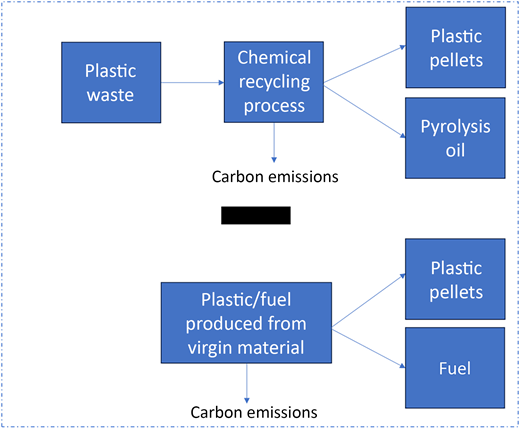
Both carbon footprints are allocated as credits or negative emissions for each process, essentially applying the substitution allocation method. Factoring in the substituted emissions of virgin plastic production is common practice across CR LCAs (see Figure 2). Koffler et al. (2021) noted a drawback of this method and stated that it can lead to overall net ‘negative’ emissions figures, which are not necessarily appropriate for waste treatment processes since the absolute carbon dioxide emissions attributed to the CR process must be acknowledged. Koffler et al.’s conclusions align with the principles suggested by the European Commission where substitution should only be performed if there is clear empirical evidence of ‘direct substitution’ (Nessi et al., 2021).
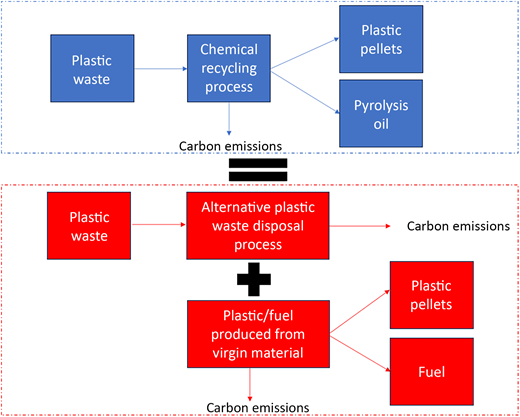
Another way LCAs have been performed from a waste perspective is ‘system expansion by addition’, which is typically used to compare CR to a different treatment option. In this case, the carbon dioxide emissions of traditional plastic production are added to the carbon dioxide emissions of the process being compared to CR rather than subtracted from the overall emissions or discounted as shown by Figure 3. Rickert et al. (2020) and Koffler et al. (2021) provide a more detailed summary of this LCA methodology. This method can allow for a more realistic comparison between treatment options, and it is approved under the ISO 14044:2006 (ISO, 2006b). A drawback is that more factors need to be considered in the study, making it more complex and potentially reliant on assumptions.
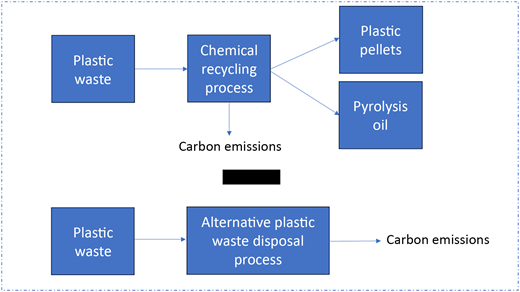
Studies performed from a product perspective (BASF, 2020; Plastic Energy, 2020) subtract the calculated avoided emissions that CR prevents from plastic going to incineration from the carbon footprint of CR, as displayed in Figure 4. This may lead to an overly positive carbon footprint for CR. For instance, the BASF study determined pyrolysis had higher process emissions than virgin low-density polyethylene production but claimed it had lower overall carbon dioxide emissions due to the avoided emissions from incineration (BASF, 2020). As pyrolysis is not necessarily a direct substitution for incineration, this might provide an inaccurate picture. In addition, several studies present uncertainties when substituting the carbon footprint of incineration regarding whether this refers to pure incineration, refuse-derived fuel combustion, or a mixture of both. For instance, BASF (2020) and Jeswani et al. (2021) provide this breakdown, whereas the Plastic Energy study does not (Plastic Energy, 2020). Plastic Energy (2020) also concluded that CR has higher avoided emissions substituted from incineration than MR due to its lower efficiency, leading to more plastic being processed per tonne of product. Using lower process efficiency as a point in the favour of CR when analysing its carbon footprint does not acknowledge the by-products resulting from this lower efficiency, such as char, or part of the feedstock, which is discarded during its pre-treatment. Jeswani et al. (2021) also subtracted the avoided carbon dioxide emissions of substituting incineration when performing the LCA from a product perspective but removed the carbon footprint EfW avoids compared with traditional energy production from the total subtracted. This is a somewhat more realistic approach of acknowledging the carbon footprint by a product perspective. The lack of clarity associated with this approach does not reflect common practice and the mandatory requirements associated with the Circular Footprint Formula, as defined by the EU Joint Research Center (Nessi et al., 2021).
3.6 Supply chain and system boundaries
Another source of confusion is the exact system boundaries and how much of the process supply chain is covered by the LCA, which often differs between studies. As previously mentioned, system boundaries definition is critical for LCA and especially comparative studies. As example, BASF (2020) considered the carbon footprint associated with plastic collection, transportation, sorting, pre-treatment, and purification of pyrolysis oil in addition to the pyrolysis process itself, whereas the carbon footprint of baling prior to transportation is not considered. Other studies (Schwarz et al., 2021) have not considered the full system and have excluded pre-treatment from the LCA model or only considered plastic recycling up to monomer production and do not account for the carbon footprint of re-polymerisation or purification of pyrolysis oil.
Estimating the carbon footprint of transportation also brings in additional challenges such as having to assume distances from waste collection to sorting and from sorting to the treatment facility as well as the type of vehicle used and fuel efficiency. These factors can be very dependent on the geography of the study. For instance, the average transportation distances and fuel efficiency of a waste collection vehicle in the UK may differ from one in China. Both BASF (2020) and Jeswani et al. (2021) assumed transport distances of 50 and 80 km from waste collection point to sorting and from sorting to the CR facility, respectively; however, Jeswani et al. (2021) also considered the carbon footprint of transporting pyrolysis oil to downstream processes, whereas BASF did not.
A final difference in the way carbon footprint is accounted for is the majority of LCA studies on CR are performed cradle to gate; however, it is noted some have been performed cradle to grave (Jiang et al., 2022). Considering the emissions of the product in use, particularly if looking at the waste-to-fuels application of CR, the latter stage of the product life has a non-negligible effect on the carbon allocation of the process.
3.7 Contextual ambiguity
The literature review identified a general ambiguity in the context provided in some of the papers, which might have had an impact on the data presented or conclusions drawn. These areas of ambiguity include some specific details of the processes and underlying process or technology preferences.
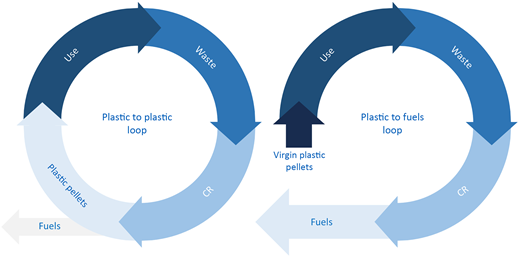
For example, CR will not solely be used for the P2P loop, but also, or at least in part, for plastic-to-fuel. The route taken can have an impact on the process’s environmental impact. For pyrolysis in particular, pyrolysis oil produced will be used in part to produce new monomers, as a substitute for the fossil naphtha used in steam crackers. Steam crackers generate different products simultaneously, including monomers, which brings the pyrolysis oil back into the plastic loop, but also in part into the fuel sector. If pyrolysis oil will be adopted in these units as feedstock, only part of it will be reinjected back into the P2P loop rather than all of it, as seen in Figure 5. However, the LCA studies reviewed do not fully specify, nor acknowledge, the effective conversion rate for the P2P loop (Tabrizi et al., 2020). This lack of transparency might be due to several elements, including:
absence of sufficient information on long-run production at industrial scale.
intellectual property–related reasons.
unclear allocation methods.
However, this still constitutes an additional ambiguity in measuring its real effectiveness as recycling technology.
Another area that lacks transparency in some of the reviewed papers concerns the presentation of information that supports an apparent preference for CR over MR, or for one technology type over others, without providing necessary context or alternative approaches.
For example, some of the literature reviewed states that CR technologies have been operated for over 40 years (Bell, 2023), suggesting that this makes them well established for recycling waste plastics. While it is correct that both pyrolysis and gasification technologies have been developed in the last century, they have mostly been adopted for feedstock other than plastic, such as wood and coal (Bell, 2023). The use of these technologies for waste is a novel approach, which presents additional challenges that have not been represented in the reviewed literature. These technologies are now considered to present more advantageous investments due to the introduction of a more favourable policy framework aimed at supporting the circular economy. Therefore, when applied to the waste management industry, CR technologies should be considered novel and in a development phase.
It is also noted that the reviewed papers tended to present data or arguments stating a particularly high performance for these technologies when it was considered that they could have a potential commercial interest in these technologies (Rollinson and Oladejo, 2020), despite only a few technology suppliers having successfully developed such a facility at commercial scale (Bell, 2023).
Another area where further details of the context would have been practical in some of the reviewed papers is that, when compared to MR technologies, CR technologies require a higher energy consumption (Rizos et al., 2023). However, not all processes are equal in this respect. For example, pyrolysis is an endothermic reaction, which requires an external source to provide the necessary reaction energy, while a gasification reaction might be self-sustained. In the literature reviewed, little information is provided on the energy consumption of these technologies, and this is one of the main points of criticism against CR (Tabrizi et al., 2020). To compare the energy requirements more fairly, a further distinction between ‘reaction’ and ‘process’ is needed. While pyrolysis reactions are energy intensive, most of the heat required is often produced internally by the process itself, combusting part of the reaction by-products (i.e., syngas) to generate energy for the process, after the initial start-up. This energy requirement is also usually considered in the greenhouse gas calculations for the process, as the fuel combusted to generate this energy will produce additional emissions. However, in some cases it is also stated that the process will require additional energy, which could result in double counting the impacts of its energy requirements.
3.8 Procedural risks
The combination of lack of transparency and data gaps observed within the chosen literature leads to the development of ambiguities in several of the studies reviewed. The International Organization for Standardization (ISO) has published standards—ISO 14040:2006 (ISO, 2006a) and ISO 14044:2006 (ISO, 2006b)—that provide guidelines on the approach and the methodologies that should be used to conduct LCA studies and life cycle inventory studies.
ISO standards state that the scope of an LCA should include an inventory analysis and data quality requirements, which address multiple factors including geographical and time-related coverage, as well as data precision, completeness, consistency, reproducibility, and any uncertainty related to the information used for the assessment (ISO, 2006b). In the literature reviewed, some of the LCAs lacked data quality requirements. For example, a review of four of the most cited CR LCAs found that none of the studies fully disclosed the data used for the assessments (Tabrizi et al., 2020). In one of the LCA studies conducted by BASF, the reviewers did not have access to original data and thus were not able to assess data quality (BASF, 2020). In addition, another LCA study used data obtained from confidential sources (Broeren and Bergsma, 2020).
When LCA results are used to support comparative assertions, the ISO standards state that a critical review is needed to corroborate the results and ensure that the LCA has met the requirements and guidelines as per the international standards (ISO, 2006a). As this paper focuses on the environmental impacts of CR by comparing multiple LCA reviews, all the LCAs discussed should, ideally, have undergone a critical review. However, this is not the case for all the LCAs analysed in the literature reviewed in this paper. For example, from a total of nine papers that were reviewed by Davidson et al. (2021), an assessment of five LCAs that focus on mixed plastic waste recycling found that only one paper explicitly states the LCA was peer reviewed and provides detailed information on the peer reviewers and the feedback they provided (Shonfield, 2008). This adds on to the risks and challenges of accurately determining the environmental impacts of CR using existing LCAs.
4. Conclusions and recommendations
The papers chosen for this literature review either discussed and/or reviewed the environmental impacts of recycling waste plastics by way of CR with the use of LCAs. Based on the literature reviewed, pyrolysis is the most discussed, recommended, and implemented CR technology (Davidson et al., 2021; Maisels et al., 2022,; Rizos et al., 2023). However, in several instances, the reviewed papers do not specify which technologies are considered in the study. To avoid any possible confusion, LCA studies must specifically mention which CR technologies are covered and should avoid making conclusions about CR as a whole if only a single CR technology has been considered in the study. The environmental impacts of other CR technologies apart from pyrolysis should also be studied to conclusively determine the impact of the whole technology portfolio (Jeswani et al., 2021).
From the literature review, it is clear that the focus of most of the studies is on the GWP associated with the CR technologies discussed. However, the adoption of additional impact categories, such as acidification, eutrophication, and photochemical ozone formation, is relevant in order to fully evaluate the potential environmental impact and to be able to successfully compare this technology with current practice and waste disposal routes.
Generally, the severity of the environmental impacts of CR is dependent on a variety of factors such as geographical location, source of the energy used for the recycling process, the quality and composition of the plastic waste being recycled, and the quality of the final products (Jeswani et al., 2021; Schwarz et al., 2021). In particular, the real efficiency of processes and the expected product and feedstock quality requirements are often not discussed with sufficient level of detail and more clarity should be provided.
The literature review has also shown a high level of inconsistencies regarding system boundaries, assumptions, allocation methods, and data adopted to conduct LCAs. These variations make it challenging to objectively compare the outputs of different LCA studies or understand the effectiveness of the comparison made. Secondly, there is a lack of transparency on the details of the assumptions and data used to conduct LCAs and it was determined that the published reports only provided summaries of relevant assumptions and data (Hann and Connock, 2020). The results of the study have been summarised into a procedural checklist (Table 2), listing key actions needed to avoid the most common pitfalls identified.
4.1 Practical relevance and lessons learned
Overall, the literature review presents numerous gaps and inconsistencies in evaluating the real impact of CR technologies and comparing it to existing waste plastic treatment technologies. Despite these technologies still being considered novel, the majority of the gaps are often due to limited disclosure of the information, unclear definition of the system under scrutiny, and diversified allocation methods adopted. It is therefore recommended that future studies include all possible details of the parameters involved, including the technology type(s), data sources, definitions, and assumptions made, in order to allow decision makers and policy makers to be aware of the current limitations that LCA studies on CR present and to evaluate the benefits and risks of each individual technology accordingly. Despite the risks highlighted in performing comparative LCAs on CR technologies, this analysis still remains essentials in establishing their impact on the environment and unlock their potential to strengthen the circularity of waste plastic materials.
Acknowledgements
The authors would like to acknowledge Ricardo PLC, which funded this project.