

Papers published in Waste and Resource Management are eligible for awards from the Institution of Civil Engineers. Papers from any of the ICE journals can be nominated for several awards. In addition, each journal has awards dedicated to their specific subject area.
On Friday 17 October 2014, ICE president Geoff French presented awards to the following papers published in Waste and Resource Management in 2013. The editorial panel nominated their best papers and an awards committee chaired by Quentin Leiper allocated the awards.
Telford Premium Prize
The Telford Premium Prize, presented for the best paper published in Waste and Resource Management, was awarded to Roll and Streisselberger (2013).
Abstract
European waste markets all fall under the joint regulatory framework determined by European Union (EU) legislation. Despite this, there are still strong structural differences among the EU-27 countries, such as differences in national quotas for recycling, landfilling and energy from waste (EfW). In particular, in the most mature markets, it is clear that EfW contributes significantly to sustainable waste management – not opposing, but complementing, recycling. Comparing the German EfW market, as a mature market, and the UK market, which can be regarded as a growth market in EfW, several differences are obvious. These include waste arisings, national legislation, planning frameworks, support instruments, number and size of market participants and the existing EfW plant structure and technology. MVV Umwelt, with an incineration capacity of 1ṡ4 Mt/year (non-recyclable waste and biomass), is one of the market leaders in Germany, and it has also been active in the UK market since September 2008. In March 2011, it signed a project agreement with the South West Devon Waste Partnership for the design, finance, construction and 25 year operation of an EfW combined heat and power (CHP) plant in Plymouth. Planning permission for the project was granted in February 2012. The main focus of the company's operations, not only in Germany but also in UK projects, lies in energy efficiency as well as CHP energy generation.
Telford Premium Prize
The Telford Premium Prize, presented for the fourth best paper overall, was awarded to Wilson et al. (2013).
Abstract
This paper uses the lens of ‘integrated sustainable waste management’ to examine how cities in developing countries have been tackling their solid waste problems. The history of related concepts and terms is reviewed, and ISWM is clearly differentiated from integrated waste management, used mostly in the context of technological integration in developed countries. Instead, integrated sustainable waste management examines both the physical components (collection, disposal and recycling) and the governance aspects (inclusivity of users and service providers; financial sustainability; coherent, sound institutions underpinned by proactive policies). The data show that performance has improved significantly over the last 10 years. Levels of collection coverage and controlled disposal of 95% in middle-income and 50% in low-income cities are already commonplace. Recycling rates of 20–30% are achieved by the informal sector in many lower income countries, at no direct cost to the city – presenting a major opportunity for all key stakeholders if the persistent challenges can be resolved. The evidence suggests that efficient, effective and affordable systems are tailored to local needs and conditions, developed with direct involvement of service beneficiaries. Despite the remaining challenges, evidence of recent improvements suggests that sustainable solid waste and resources management is feasible for developing countries.
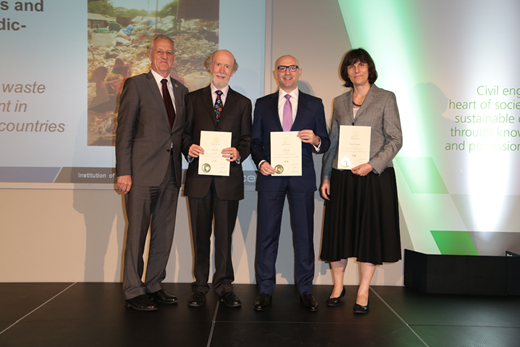
ICE President Geoff French with David Wilson, Costas Velis and Ljiljana Rodic-Wiersma, winners of the Telford Premium Prize
ICE President Geoff French with David Wilson, Costas Velis and Ljiljana Rodic-Wiersma, winners of the Telford Premium Prize

