

As the engineer responsible for the conceptual design of the overall surface water drainage system of what is now the Queensway Meadows Estate in Newport, the contributor is pleased to see that many of the fundamental design issues identified at the time are corroborated in this paper. In particular, the authors' conclusion (paragraph 48) that traditional design assumptions regarding the coincidence of peaks are overly conservative was identified at an early stage in the design studies. An original approach was developed to determine the return period for given water levels, based on the combined probability of rainfall events and tidal influence.
The original analysis in 1980 was subject to a number of constraints, including
the very tight programme for submission of the planning application for the development, which was seen as crucial in the provision of alternative employment opportunities required as a result of major job losses expected in the nearby Llanwern steelworks
the non-availability at the time of suitable computer hardware and software which limited the analysis to manual methods (the paper indicates the step change in computing power now achievable for such analyses with a normal PC)
the need to maintain reasonably conservative assumptions in what was regarded as an innovative design approach by the local drainage authority, and which resulted in an off-site sewer of much lower discharge capacity than the traditional design criteria.
Figure 7 shows the storage/discharge relationship that was developed for the site covering a wide range of possible combinations, including the effect of doubling the area served at a later stage without constructing a further outfall sewer. The design approach was developed by considering all the factors identified in Table 1 of the paper, but simplified from a preliminary assessment of prevailing site conditions. Firstly, as the authors note in paragraph 44, the tide amplitude is much less critical than the tide lag. This is partly a result of a physical constraint which resulted in the offsite sewer outfall being located at mean sea level. In the original analysis, discharge under partial tide-lock conditions was ignored. It was accepted that this would lead to a conservative design, but not excessively so with the extreme tidal range at this site, particularly for the 100 year return period condition for the full area of development when the critical rainfall durations is of the order of 24 hours. Secondly, storm profiles were ignored in the original analysis as the critical characteristic for detention ponds is the total volume rather than peak inflow, and uniform rainfall was assumed over the storm duration. These simplifying assumptions were required to facilitate manual calculation, although it was recognised that subsequent refinements in analysis, particularly taking account of discharge under partial tide-lock conditions, could result in a reduction in the storage volume requirement for later stages of the development.
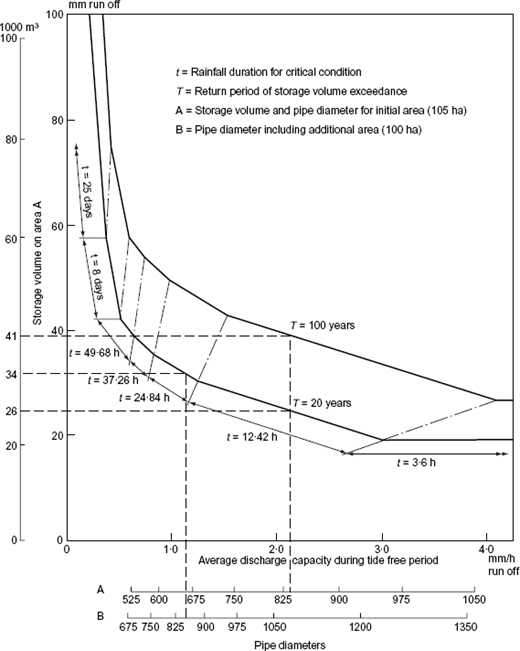
Surface water drainage storage discharge relationship
Surface water drainage storage discharge relationship
The design water levels identified in 1980 were 5·5 m AOD for 20 and 100 year return periods respectively. These may be compared with a return period for a level of 5·5 m AOD of about 120 years identified by the authors in Fig. 6 for what appear to be the same site conditions. In terms of water level, Fig. 6 gives a level of 5·1 m AOD for a return period of 20 years, i.e. some 400 mm lower that the design conditions for the original analysis, which as intended is conservative but not excessively so.
It should be noted that a large number of analyses similar to Fig. 6 would need to be undertaken to derive the full storage/ discharge relationship corresponding to Fig. 7. This relationship would be required for a similar undeveloped site in order to select the appropriate combination of on-site storage capacity and off-site sewer capacity.
Apart from the fundamental storage/discharge/return period relationship discussed above, the surface water drainage system of the site has a number of other innovative features which could readily be applied elsewhere. The storage volume is provided by a series of meandering linear depressions connected by culverts, which eventually will total some 3 km in length. These depressions not only serve as a very low hydraulic gradient conveyance, but are designed as the major landscape feature of the site, utilising many areas that could not easily be developed due to constraints of existing services such as overhead power lines and of irregular boundaries. The depressions have relatively flat side slopes (generally about 1 in 3·5) to facilitate gang mowing around substantial areas of both retained vegetation and new planting. A large capacity under-drainage system in installed so that for most of the year the depressions remain dry and, once full, will empty within a reasonable time-scale of about two days.
The success of the overall concept of creating a surface water drainage system for the site, as a landscape facility, can be seen in Fig. 4, where the park-like appearance of the channel upstream of the outfall structure is in marked contrast to an adjacent older industrial site where the ‘wet’ storage channel, largely hidden at the back of buildings, is little more than a wide rubbish-filled ditch.
Authors' reply
The authors are grateful for the contribution of Mr Widgery to the discussion. We were, when writing the paper, aware of the basis on which the Newport system was designed and are very supportive of the overall concept. Indeed the use of the linear pond both as the method of transfer of the water and as storage works very well on this site. The size of the outfall drain is indeed well below that which would have been necessary if the more normal conservative design assumptions had been made.
The paper was an attempt to extend the general statistical approach previously used in the Flood Studies Report9 to the problem of the analysis of these storm water detention ponds. To develop a general approach assumptions that may be suitable in particular cases were specifically not made so as to retain the complete flexibility of the method. This general approach does therefore require additional effort but this can be reduced if valid site based assumptions are made. The particular system at Newport does allow certain assumptions to be made, for example the tide locked period is constant because the outfall is at mean sea level. Other assumptions particularly those associated with no outflow when the water is above the outfall level are conservative even for this system. The difference in design levels between the original design, as quoted by Mr Widgery, and those contained in the paper appear small but are not. The correct way of comparing these is not the top water design level but the return period protection offered. A 400 mm increase in depth not only requires considerable additional storage in a triangular shaped ditch but also allows additional outflow capacity. The 5·5 m AOD level has a return period design of 150 years according to the paper as compared to the original estimate of 20 years. This is a significant difference but may not all be associated with differences in the two methods used.
The authors' have developed a design approach based on a limited number of events and this will be the subject of a subsequent paper. This design approach is based on consideration of the relative frequencies of the actual events that make up the design levels. As an example of this Fig. 8 shows the relative frequencies of the storm profile events that make up the contributions to levels in the range 5.00−5.25 m AOD for the Newport system. Included in the figure are the relative frequencies, taken from Table 1, with profile event 1 being the 10% Summer profile and profile event number 6 being the 10% Winter profile. It is clear from the graph that events that make up a level of about 5 m AOD are generally taken from storm profiles that are larger than the average although only marginally so. It is therefore reasonable to consider that in a design approach it might be sensible to adopt a 50% Summer profile as a suitable representative design event. In general terms return periods of the order of 20 years are not composed solely of a series of extremely unlikely events but must include significant contributions for average events.
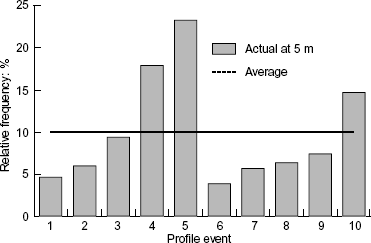
Relative frequency of actual storm profile events that contribute to levels in the range 5−5·25 m compared to the average relative frequency
Relative frequency of actual storm profile events that contribute to levels in the range 5−5·25 m compared to the average relative frequency
It is anticipated that the design procedure will provide answers similar to those produced for the full simulation and at a cost significantly less than the analysis on which the original design was undertaken. Any rational based design method must however retain consideration of the various lags between tidal and runoff peaks at its heart.

