This paper aims to introduce a semi-structured interaction observation methodology to highlight how structures, roles, constraints and feedback loops shape the publishing process, examining in detail a single instance. It focuses on academic publishing as a systemic interaction between the author and the editor. The study invites researchers to observe their research-related interactions and, by sharing structured results, support the development of a case-based body of knowledge. Results can be comparable by applying large language models, which opens new perspectives in recording research observations.
The paper applies a newly developed CyberSystemic interaction observation methodology with an observation framework grounded in systems thinking and second-order cybernetics. It introduces subjective, structured and relational observation in research reporting. The method combines subjective insight with structural rigour and is designed for LLM-based examination. In the method application, it maps five phases of the publishing process, from framing the manuscript to its long-term impact.
Interactions of publishing a paper are often structurally asymmetric, recursive, cognitively demanding and affected by existing structures and emerging related interactions, many of which may not substantially contribute to advancing the body of knowledge. According to the reflexive author's observations, many of the identified pathologies result from the closed academic and publishing ecosystems. Additionally, the paper highlights the methodological potential of interaction observations for making visible the often-opaque structures of any observed interaction.
The work is based on a single reflexive case. While rich in insight, it reflects the dual role of the author as both observer and method designer. To generate a requisite holistic perspective, the method should be applied by multiple observers of the interaction and combined with other examination tools.
The paper offers researchers a new tool for observing systemic dynamics in academic work. It supports critical self-reflection and opens possibilities for aligning publishing processes with societal relevance, institutional learning and AI-supported analysis. With its ontologies, it can provide an input for developing artificial intelligence-supported mind models of systemic reasoning.
The paper introduces a novel, structured methodology for observing complex interactions from within systems by proposing a rich ontology-based approach, reaching beyond the limitations of strictly quantitative modelling. It contributes to CyberSystemics and scholarly communication by framing publishing as a dynamic, reflexive process embedded in institutional environments.
1. Introduction
Academic publishing is one of the most structured and consequential systems in scholarly life, shaping not only what is communicated but also how knowledge is framed, validated, and made visible (Hamilton et al., 2020). Yet while extensive critique exists regarding metrics, access, peer review, and commercial publishing models, very little attention is paid to how publishing is experienced from within. It should be considered not just as a sequence of procedural steps, but as a system of interactions that shapes the epistemic and emotional rhythms of academic work (Bourdieu, 1988; Hyland, 2004).
Many publishing studies and science policy research rely on secondary analysis of artefacts: citation networks, impact metrics, peer review systems, or bibliometric trends (Bourdieu, 1988). While valuable for macro-level insights, such approaches often miss the lived, situated, and relational dimensions of scholarly activity. They rarely capture how participants experience publishing processes, how decisions are negotiated, or how internal and external structures interact in the course of producing a single scholarly work. As a result, they fall short of providing the requisite variety needed to observe and understand the complex, often recursive feedback loops between authors, editors, institutions, and publishing systems (Woods et al., 2023).
In many cases, the term holistic (Beer, 1988; Caputo, 2021) is used, and in many cases overemphasised, because it is nearly impossible to explore the observed object fully holistically. Usually, the required level of holism is dependent on the purpose and the circumstances of the observation. To acknowledge this, the term requisite holism was coined by Mulej (Mulej and Kajzer, 1998), where limitations on the holism level are defined and considered in the observation process.
This paper addresses that gap by adopting a first-person observational stance grounded in systemic thinking, enabling a different class of insights that emerge from within, rather than above, the interaction. It provides an example that publishing can be observed as a structurally mediated interaction, which involves formal infrastructures, implicit norms, and personal reflexivity. To do so, it introduces a semi-structured methodology for interaction observation grounded in systems thinking (Reyes and Perko, 2024; von Bertalanffy, 1950), second-order cybernetics (von Foerster, 2003), and interaction observations (Pask and de Zeeuw, 1992). The proposed methodology does not seek to abstract or model general patterns. Instead, it focuses on a detailed, situated observation of a single interaction. In this particular observation, the preparation, submission, and reception of a conceptual paper in a systems-oriented journal are examined.
By offering a structured observation of this scholarly interaction, the paper demonstrates how even a single case, when carefully examined, can reveal recurrent system tensions, role asymmetries, supportive and constraining patterns, and the invisible scaffolding that supports intellectual production. The methodology frames interactions along normalised dimensions of zoom running from 0 to 1 and time, running from −1 to 1. The method provides a frame, which assists the observer in reporting on the structures and interactions, which are related to the observed interaction.
While influenced by CyberSystemic concepts and methodologies, the interaction observation approach is intended as a methodological contribution in its own right. It invites scholars to examine the systems they operate in, not from the outside, but through their lived participation within them. The aim is to open a space for structured subjectivity, grounded reflection, and, resultantly generating the data support for conducting rich comparative insight.
The paper begins by situating the work within relevant theoretical and systemic backgrounds, particularly the traditions of systems thinking, second-order cybernetics, and publishing critique. The following section introduces the interaction observation methodology, including its structural elements, coordinate system, and typology of interactions. This is followed by a sequence of structured observations across five key phases of the publishing interaction, each analysed through the proposed lens. The final sections synthesise the findings, reflect on methodological contributions and limitations, and propose dilemmas for future application and development of the approach.
2. Background
2.1 Perspectives on publishing a paper
Traditional literature analysis methodologies have extensively addressed how knowledge is reviewed, synthesised, and communicated through publishing. Systematic literature reviews, as proposed by Tranfield et al. (2003), aim to improve rigour and transparency in evidence synthesis, particularly within the social sciences. Complementary approaches, such as scoping reviews (Arksey and O’Malley, 2005) and integrative reviews (Torraco, 2005), emphasise mapping broad conceptual fields and generating novel theoretical insights. Meanwhile, bibliometric methods (Zupic and Čater, 2015) introduce objectivity into literature analysis by uncovering structural patterns of scholarly communication. Although second-level research is important for organising the body of knowledge, it indirectly draws the focus from basic research.
Additionally, while these approaches clarify the content of academic knowledge, they often overlook the lived, structural, and interactional processes of producing and publishing that knowledge. Authors such as Hyland (2004) and Bourdieu (1988) point out that academic publishing is not merely a technical process, but is embedded within disciplinary discourse and shaped by power dynamics. This is further supported by empirical studies on peer review (Hamilton et al., 2020; Woods et al., 2023), which expose inconsistencies, opacity, and evolving editorial norms across disciplines.
The present work builds on these foundations by shifting focus from analysing the outputs of scholarly communication to observing the interaction of publishing itself Bourdieu (1988). By introducing a CyberSystemic interaction observation methodology, it provides a reflexive perspective on how structures and interactions co-shape the experience of academic publishing.
2.2 Interactions modelling and observing
To fully understand any interaction, a requisitely holistic overview should be modelled. Modelling should combine systems thinking generated upon the General Systems concept (von Bertalanffy, 1950), with the Cybernetics (Wiener, 1948) concepts. This requires joining perspectives that each structure can and should be identifiable as a system with its parts, existing in an environment with all sub and super elements defined as systems with a view on the flow of communication, information and control, feedback and self-reflection learning mechanisms (Umpleby, 2016). Further on, second-order cybernetics, as developed by von Foerster (2003), extends traditional systems theory by including the observer within the system being observed. This approach challenges the notion of objectivity and emphasises that all observations are made from a particular standpoint. It introduces recursive understanding and ethical responsibility into systemic inquiry, offering a philosophical foundation for observing and modelling interactions not from a distance, but from within. The unified concepts are referred to as CyberSystemics (Reyes and Perko, 2024).
There were several attempts to address interactions as a general concept (Pask and de Zeeuw, 1992) or in different domains of knowledge involving statistics, physics, biochemistry, sociology, to name a few (Afik et al., 2022; Auda et al., 2023; Battiston et al., 2021; Becker, 1974; Braibant et al., 2011; Knapp and Wuttke, 2006; Lloret-Climent, 2003; Nel et al., 2009; Wang et al., 2017; Xu et al., 2024). The moment of interaction is significantly expressed and elaborated in the theatre. Thus, theatre interaction-related research (Scholte, 2018) serves as an inspiration for this work.
Only recently, a universal model of interactions, combined with the observation protocol, was proposed (Perko, 2025), generating an option to collect interaction observation data in a standardised ontological form (Espejo and Lepskiy, 2021), which allows comparing related interactions and, more importantly, interactions from different environments. Standardised collecting of observation data, general ontological structuring of various interactions could act as an enabler for interdisciplinary communication, AI-based reasoning and, consequently, transdisciplinary knowledge development.
The proposed interaction observation methodology liberates the collecting data methodology from being only a preparation for the data analysis to a stand-alone methodology on its own. It is intended not to reduce the observation to the measuring elements, but to deliver the content as observed by the observer in a self-defined structure. The results can be examined by reading directly or analysed and compared using Large Language Models (LLMs) methodologies.
2.2.1 Structures–interactive VSM
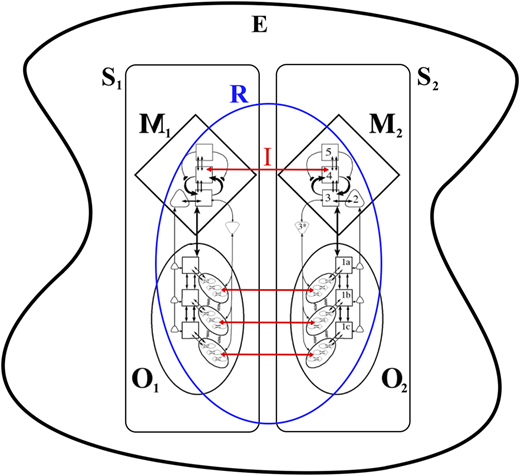
To illustrate structures examined in an interaction, a modified Visible System Model (VSM) (Beer, 1984; Espejo, 2020; Espinosa, 2015) is utilised. The original recursive standardised system structure is retained. Still, in order to focus on a single interaction, the generalised communication of the system with the environment is replaced with direct interaction I between System 1 and System 2 in a common environment. The new focus is depicted in Figure 1.
As shown in Figure 1, interactions are conducted between two systems, based on the VSM structure, in an environment that takes part in a series of interactions. These systems have the capacity and desire to receive, interpret, and send information, energy or matter. The structures consist of:
Environment (E) is a place where general structures for enabling interactions reside. These include structures for executing specific interactions, as well as structures for the existence of systems S1 and S2.
When observed closely, S2 and S2 encompass several subsystems, most generally Management (M) and Operational (O) subsystems. Adapted from (Beer, 1984).
Management subsystems (M1, M2) are structures for guiding the mechanisms required to conduct the interaction.
Operational subsystems (O1, O2) are structures for executing the mechanisms required to conduct the interaction.
Relations between systems 1 and 2 (R1,2) are the structures developed for conducting interaction between System 1 and System 2.
In the first part of the proposed model, all structures, potentially involved in an interaction (I), are accounted for as elaborated in (1) and (2).
In (1), the interaction is dependent on the structures in place to support it; these structures can reside in any of the parts and are designed to support or prohibit emerging interactions.
In (2), the function of the interaction (I) affects (generates changes) of the structures listed above. The quality of understanding the interaction is related to understanding the complexity of functions f1 and , which, of course, are interrelated. Structures affect the execution of the interaction, while interactions affect in redesigning of structures. Since this cycle is repetitively executed through time, a cyclical relation between structures and interactions can be observed, explained and thus governed.
2.2.2 Network of interactions
Interactions do not depend only on existing structures and frameworks. They relate to a whole network of interactions. Observing related interactions is particularly useful if we cannot clearly understand the structures or, more importantly, if we would like to redesign the processes involved in generating high-level results. At the same time, observing, remembering and understanding interactions is much harder than simply analysing their results (structures).
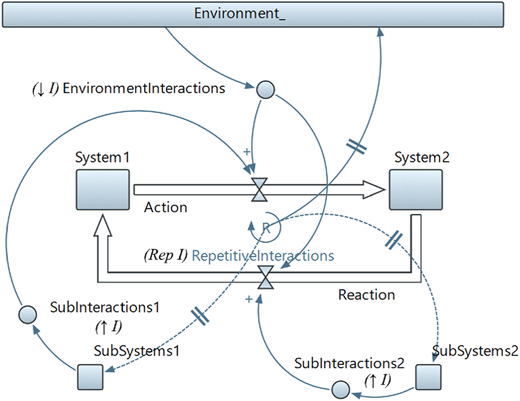
In Figure 2, the cyclical and recursive network of interactions, based on systems dynamics concepts, is elaborated. In the inner cycle, the observed interaction consists of a two-step repeating cycle of action and reaction; in the longer run, the observed interaction is merely an instance in a series of repeating interactions of the same kind. The observed interaction is affected by the results of previous interactions, while its results influence future interactions. Similar to the model of the structures, some interactions are recursive, meaning that the environment interactions of the currently observed interaction can be observed on a lower recursion level. In comparison, sub-interactions are observable in detail on a higher recursion level.
In (3) and (4), we can identify multiple interactions which are related to the observed interaction:
Repetitive interactions (Rep I) of the same kind are executed in cycles, where the outcomes of previous interactions affect the execution of the follow-up interactions.
Sub-Interactions (↑ I) are executed as a part of the observed interaction.
Environment interactions (↓ I) are executed beyond the level of the observed interaction.
Loosely related interactions (? I) do not have a hierarchical/recursive relation with the observed interaction but may directly or indirectly affect its execution.
Each of these interaction types can be.
Supportive (→ I) or Constraining (← I) of the observed interaction.
By joining the structures and interactions, we can design a set of perspectives in which the observed instance can be examined well enough to form a sharable representation in its environment.
Before continuing, another complication is required for the interactions to be observable, understandable, predictable, and transcribable. We need to define the observation point(s). Since interactions are time-restricted and develop over time, it may not be enough to record the interaction-related environment at a single point in time; it is appropriate to define multiple observation points relating to the interaction properties.
2.2.3 Observations protocol
Before starting the observation, we define multiple observation points relative to the interaction. We claim that a single observation point is not requisite to understand an interaction; therefore, multiple observation points should be defined, depending on the purpose of the observation.
To define observation points, we can form an interaction-related two-dimensional space with the normalised dimensions of Zoom and Time.
Zoom (Z) level reflects the granularity of focus. It ranges from 0 to 1 (0 means seeing the interaction from far away, providing a broad picture of its environment, while 1 examines the inner interaction details).
Z = 0: Abstract/systemic
Z = 0.5: Meso/system-relational
Z = 1: Detailed/operational
Time (T) reflects the time-state of the observation. It flows from −1 to 1. Where −1 is the time of first planning the interaction, 0 is the time of the interaction execution, and 1 is the long-term interaction effects. Time flows linearly, but the observed time segment is dependent on the interaction speed.
T = −1: Preparatory (before the action)
T = 0: Executory (during the action)
T = +1: Reflective (after the action)
Since observing the whole interaction plane clearly surpasses our observation and reasoning capacity. We propose a simplification: instead of observing all properties of all structures and related interactions throughout the observation plane, let the observer define a limited number of observation points in the observation plane.
For each of the observation points, the observers should agree upon which interaction properties can and should be observed and collected.
Agreeing on the interaction observation points is crucial for the development of observation data semi-structured ontologies, ready for reasoning and sharing.
Defining multiple observation points properties should, therefore, be part of a particular observation protocol; it may depend on the observer's goal and capacity to observe, the interaction, the interaction itself, and the capacity to share and reason upon the observation data.
Typically, the observation point should elaborate on the following attributes:
Observation Title:
Coordinates: Z = ___, T = ___
Structures Involved:
Interaction Types:
Narrative Description:
Observer Reflection:
Observed Effects (on system or self):
Potential for Structural Change
To summarise, the observation protocol should consist of the following steps:
First, identify interaction points.
For each interaction point:
Assign Z and T coordinates.
Map the involved structures.
Classify interaction types.
Write a narrative and a reflection.
3. Methodology – the observation points definition
Let us try to design a framework for observing a selected interaction. We start by identifying the observed interaction parameters, in this case, publishing an academic paper, specifically the paper “of publishing a paper “Hybrid reality development-can social responsibility (SR) concepts provide guidance?” (Perko, 2021).
The interaction observation starts with a two-step definition process.
Selecting the observation points observation points (defining coordinates, normalised time and zoom detail)
For each observation point selecting which structures and which related interaction will be observed in this particular observation point.
By defining the observation points (remember the authors decide how many are being defined), a structure of the observation report is selected.
Determining the interaction and the observation points beforehand will help us develop the content of a semi-structured ontology. As additional interaction cases are observed and reported (by other observers), the observation reports can be compared, either on the interaction topic or on the parts of the ontology, significantly increasing the interaction report value added.
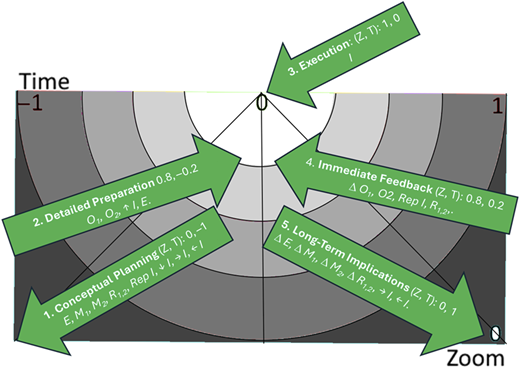
In this particular observation, five observation points are defined, each of which focuses on a point in time and the detail level important for the observer, as elaborate in Figure 3.
Conceptual Planning. Observation point coordinates (Z, T): 0, −1, which means total zoom out, when the idea of the interaction emerged. Designing the conceptual framework of the planned interaction, focusing on the long-term implications and status of the external systems, focusing on the environment €, System 1 and 2 management systems (M1, M)2, (Relations between System 1 and 2) R1,2, series of previous repetitive interactions (Rep I), Super interactions (↓ I), Supportive and Constraining interactions (→ I, ← I), and providing some information on un Loosely related interactions (? I)
Detailed Preparation. Observation point coordinates (Z, T): 0.8, −0.2, which means observing the interaction from close by, almost immediately before it was executed. Developing the executive detailed plan of interaction, including a whole subset of sub-interactions. Preparing internal capacity to interact and pre-preparing relationships with external systems, which includes building their capacities to interact, focusing on System 1 and 2 operational systems (O1, O2), sub-interactions (↑ I), and examining the properties of the local environment (E).
Execution. Observation point coordinates (Z, T): 1, 0, which examines the details of the interaction at the time of execution. Executing the planned sub-interactions according to the plans, adapting to the execution situation, and focusing on the performance of our activities, focusing on the actual interaction (I).
Immediate Feedback and Follow-Up. Observation point coordinates (Z, T): 0.8, 0.2. Immediately after the execution, we observe from close up how the environment reacts to the interaction. After the interaction is completed, the immediate feedback from internal sub-systems and external systems is examined. Opening the space for after-event interactions, focusing on Changes in System 1 and 2 operational systems (Δ O1, O2), the impact on the prepetition interactions (Δ Rep I) and on the relations between the systems (Δ, R1,2).
Long-Term Implications. Observation point coordinates: (Z, T): 0, 1, display a picture of the effect of the interaction on the environment from far away, long after the interaction was executed. Have we met the initial objectives? How have the external systems changed? How to prepare for the next interactions, focusing on changing the environment (Δ E), changes in the System 1 and 2 management systems (Δ M1, Δ M2), long-term changes in the relations (Δ R1,2,) and implications on related interactions (supporting and constraining) (→ I, ← I).
The question posts: When does the interaction start? When does it end? Are the preparation and implication phases part of the interaction, or should they be separated? In the line of the functional understanding of an interaction, the observation scope can vary throughout the observation. Therefore, fixing a single observation point risks oversimplifying the process. Observing multiple interactions at different time points and zoom levels helps us understand the interaction and its place in the environment much better.
In line with second-order cybernetics, the methodology employed in this paper recognises the observer as an integral part of the interaction. The observer is related to the observed phenomena, sometimes even actively participating in that process. This necessitates a reflexive stance throughout the observation. This can be achieved by acknowledging subjectivity, documenting interpretive choices, and understanding that observation reports generated are co-constructed with the system being observed. Observation points are thus selected not only for their analytical relevance but also in reflection of the author's role, decisions, and limitations within the interaction.
4. Results
Let's first define the observed interaction parameters.
Interaction name: publishing a paper “Hybrid reality development-can SR concepts provide guidance?” (Perko, 2021) in a scientific journal.
Interaction definition: A complex interaction between an academic author and an academic editor in a scientific journal.
Participants: Author and Editor in the publishing environment of a scientific journal.
The observer role: active participant–author.
Timeframe: From the decision to write a paper to the post-submission implications.
Type of interaction: Complex, partially formalised, feedback-driven.
Observation points: In the line of paper publishing, we decided to focus on five observation points, each of which focuses on different structures and related interactions.
In the follow-up, we will examine the selected structures and relations from multiple observation points provided in Table 1, generating a semi structured set of observations.
4.1 Conceptual Planning, observation point 1 (Z: 0, T: −1)
In this observation point, we are observing E, M1, M2, R1,2, Rep I, ↓ I on a general level.
4.1.1 E the environment
A series of environmental structures shaped the author's decision to begin writing the observed paper. Rather than describing these systems comprehensively, this observation focuses on how they shaped the author's thinking, framing, and sense of opportunity.
The following systems are referenced not as static entities, but as dynamic forces experienced through their effects:
Academic Publishing Systems – Institutions and processes that manage the dissemination, validation, and archiving of scholarly knowledge, including journals, editorial offices, and digital publishing platforms. These are often driven by Commercial Publishing Logics, Market-driven dynamics that shape publication access, cost, and visibility, often operating through for-profit publishers and commercial metrics of success.
Institutional Research Systems – Universities, research institutes, and funding agencies that provide frameworks, expectations, and resources for academic work, often influenced by performance indicators and strategic priorities.
Knowledge Validation and Recognition Systems – Structures that assess, certify, and reward research quality and credibility, including peer review, citation metrics, referencing standards, journal impact systems and habilitation processes.
Societal, Regulatory and Professional Systems – Broader societal forces (legal, ethical, political, applied research related) that influence research relevance and acceptability, including intellectual property laws, public funding mandates, applied research, and evolving ethical norms.
Technological and AI-Driven Structures – Digital systems, particularly those involving AI, that influence how knowledge is produced, filtered, accessed, and evaluated, including tools for writing, reviewing, publishing and summarising research.
4.1.1.1 Observed Effects on framing and intention
At the beginning of the process, the author's thinking was shaped by the presence of these structures, not as abstract systems, but as patterns of interaction, incentive, and perceived limitation. Performance metrics within institutional contexts, past research and publication experiences, and shifting norms around publishing novelty influenced early framing decisions.
Conceptual innovation had to be framed within accepted academic categories. In this case, we are building on Systems Thinking and Cybernetics, yet attempting to step beyond the state of the art. The introduction of AI, both as a tool and a potential disruption, added further perspective: publishing now meant not just contributing to knowledge, but anticipating shifts in how knowledge would be created, analysed, validated and shared.
The author felt tensions in the environment: the institutional quantitative focus in assessing authors' performance, the publisher's profit focus, and the decoupling of academic publishing from social and organisational systems, displaying the fact that academic and publishing are closed systems.
4.1.2 M1 The academic writers' management subsystems
The writer's goal set was diverse and partly in tension. On one hand, it included institutional performance metrics: the need to publish, to be cited, and to meet expectations of academic productivity. On the other hand, there was a personal drive to explore an underdefined but socially relevant concept: Hybrid Reality (HyR), and to articulate its connection to systems thinking and SR. The topic at the time was not identified as mainstream relevant, thereby not well aligned with the institutional metrics. These goals were not imposed directly, but internalised over time, shaping the author's sense of what kind of research would be considered valid, valuable, or publishable.
Tacit knowledge played a key role. The author brought prior experience with interdisciplinary publishing, familiarity with systemic methodologies, and a growing sensitivity to how framing decisions affect peer review outcomes. Past publications and rejections informed what could be assumed, what needed explanation, and how much deviation from standard methodological paths would be tolerated. This unspoken experiential knowledge acted as a filter, shaping not just what was written, but what was imagined as possible.
The capacity to invoke external knowledge was exercised both conceptually and socially. The author integrated the Viable System Model and evolutionary systems theory with normative frames like SR, which required reinterpretation across disciplinary boundaries. Additionally, concepts were tested in conferences and academic settings, where feedback and peer reactions helped shape the eventual manuscript. These exchanges served not only to refine the content but to reduce epistemic isolation and ensure that the eventual submission would resonate within scholarly discourse, and, hopefully go beyond academic world.
4.1.3 M2 academic editors management subsystems
The editor, as observed from the author's side of the process, operates within a constrained and often opaque set of structural expectations. While their formal role involves evaluating manuscripts, coordinating peer review, and ensuring the journal's standards, their goal set is shaped by a blend of editorial responsibility and publisher-driven performance indicators. These include maintaining or enhancing journal visibility, meeting publication timelines, and contributing to metrics such as citation impact and indexing coverage. These goals are not always visible to the author, but they utilise influence through editorial tone, review expectations, and selection behaviour.
Tacit knowledge plays a key role in editorial functioning. Editors develop an internalised sense of what counts as publishable, including disciplinary fit, methodological familiarity, and rhetorical style. This tacit filter can disadvantage submissions that challenge established categories, especially when they come from outside dominant institutions or disciplines. The observed tendency toward conservatism is not always explicit. Still, it emerges through patterns: extended review cycles, vague feedback, or desk rejections that reflect not low quality, but low familiarity or perceived risk.
The editor's capacity to invoke external knowledge lies primarily in reviewer selection, alignment with the journal's thematic direction, and the ability to shape a submission's trajectory through feedback and framing. In ideal cases, this role becomes constructive: editors help authors raise the quality of a submission, guiding it toward alignment with the journal's standards without suppressing its originality. This developmental function, though often under-recognised, plays a critical role in enabling novel or interdisciplinary work to enter established academic discourse.
However, this capacity is exercised unevenly. In contexts of high submission volume or misaligned incentives, editors may lean towards superficial filtering or even to subjective favourism. The author perceives the editorial decision space as partly opaque: even when rationales are explained, the effects on the submitted paper are not predictable in advance. The combination of extensive editorial discretion and the lack of involvement from non-academic environments reinforces systemic closure. Editors and authors alike may ignore perspectives or impacts outside their primary goal sets, further narrowing the relevance and accessibility of academic publishing to broader audiences.
4.1.4 Rep I, repetitive interactions and R1,2, relationship between the author and the editor
Repetitive interactions between authors and editors are mutually influential, and they form relational structures over time.
Multiple of the author's previous publications were focused on themes like systems thinking, responsible innovation, data sharing frameworks, and hybrid socio-technical systems. The act of publishing across such domains involved learning how to align novel concepts with disciplinary expectations, often requiring compromises in framing or emphasis to meet editorial and reviewer standards.
From the author's perspective, the relationship with editors formed over time, not only through direct feedback but also through accumulated interactions across submissions, shared discourse, and previous experiences with the same journal. In this case, the journal Kybernetes was not unfamiliar: the author had previously published work within its pages and contributed as both a reviewer and guest editor. This familiarity shaped the way the editorial relationship was approached, not as a neutral or anonymous exchange, but as an ongoing engagement within a shared conceptual space.
The particular editor selected for this submission had a known background in systems thinking and second-order cybernetics, with publications and editorial roles aligning closely with the themes explored in the manuscript. This prior knowledge made the submission both easier and more difficult. Easier, in the sense that the editor would likely be able to recognise the relevance and framing without excessive justification. More difficult, because it also raised the stakes: submitting a reflexive, experimental piece to someone with overlapping expertise introduced a deeper kind of exposure is a concern not just about acceptability, but about resonance.
Over time, the author had come to recognise that editors do more than make decisions; they shape the developmental trajectory of a submission. In some cases, editors had offered transformative feedback, improving clarity, sharpening focus, and challenging assumptions. In others, the interaction was reduced to binary outcomes: accept or reject, often with little insight into how or why decisions were made. This variability contributed to a sense of asymmetry: while the author reveals thinking, methodology, and intention, the editor's selection process often remains unseen.
Learning from interactions was not abstract. Both critical (negative) and encouraging (positive) feedback, whether provided valuable feedforward support for the next interaction. Editors often acted as gatekeepers but also as developmental partners. Reviewers, though anonymous, became part of a tacit dialogue across submissions, and their recurring critiques helped surface blind spots, sharpen conceptual clarity, and occasionally redirect methodological framing.
Co-authorship usually adds another layer: it provides a space for dialogue, debate, and joint sense-making, especially valuable when navigating interdisciplinary boundaries. Yet even in solo-authored pieces, including this one, the echoes of past interactions informed the author's anticipations. It helps align the paper with the expectations of what might be questioned, what would require justification, and what might be dismissed as “too unfamiliar.”
Despite ongoing structural pressures: performance metrics, journal selectivity, and the commercialisation of academic publishing, the individual interactions with editors and reviewers generally reflected sincere commitment to quality and fairness on both sides. Negative feedback was often specific and aimed at improvement. With each review round, the author gained not just insight into the publishing system but a clearer sense of their position within it.
These repetitive publishing interactions have created a kind of publishing reflex: a way of thinking, structuring, and even self-filtering that reflects prior experience. In this paper, that reflex was both a resource and a constraint, offering navigation skills but also requiring conscious effort to resist auto-conforming to past patterns.
In each paper, published before, and in each editorial task, the observer learned a bit on the contents of the research field and the publishing process, on the publication process and formed relations with the publishers. In this case, each publication tried to explore a different perspective of the research field and sometimes exited the original research field, reporting on new research results, forming new methodological paths, trying to build and share a diverse understanding of the topic observed.
The interactions can follow a converging path, leading to in-depth discoveries in your field of research. Still, in this particular case, the author tested the boundaries of the system, using experience not just to navigate, but to better understand and expand the structural and relational limits of scholarly publishing.
In this submission, the trust dynamic was especially present. The paper aimed to explore HyR and SR using CyberSystemic methodology within a reflexive format that risked being seen as unconventional. Trusting the editor to recognise and engage with this framing was central to the decision to submit.
The relationship with the editor, in this case, was not simply procedural. It reflected ongoing professional entanglement within a shared epistemic system. It highlighted both the potential for meaningful engagement and the risks that come with structural asymmetry.
4.1.5 ↓ I top-down / environmental interactions
In the observed case, institutional expectations were experienced not as explicit demands, but as a diffused, ever-present background force. These expectations took shape through a range of interactions: workshops, mentoring sessions, peer discussions, and academic conferences, where research ideas were developed, tested, and informally validated (→ I). Periodic evaluation processes, such as habilitations, reinforced the sense of a long-term trajectory and a need to demonstrate continuous contribution and academic productivity (→← I).
During the preparation phase, several unsolicited invitations from publishers were received, often requesting payment for Article Processing Charges. These were quickly identified as predatory (← I) and dismissed, but they served as reminders of the blurred line between legitimate and exploitative publication opportunities in today's publishing landscape.
Interactions with actors outside the academic domain were limited. Aside from occasional engagement with societies promoting SR and systems thinking, there was little contact with business communities, regulators, or public institutions (← I). While this may partly reflect the theoretical nature of the research focus, particularly in systems thinking and cybernetics, similar patterns were noted even when the author published on more applied topics, such as business intelligence.
We assess that this dissonance emerged as a recurring sense of disconnection between academic publishing and external societal systems. While institutions and journals advocate engagement with real-world challenges, the structural support for such interactions remains underdeveloped. In this observation, the top-down forces were present, but diffuse, shaping the framing of the work more through ambient norms than through direct influence.
This reinforces earlier reflections on the structural closure of academic publishing: while internally dynamic, the system remains poorly coupled with its wider environment. That said, this observation remains situated, and further comparative cases would be needed to understand how pervasive this pattern really is.
We can assess that the preparation time, from the idea concept until active writing, took at least 180 days.
4.2 Detailed preparation, observation point 2 (Z 0.8, T −0.2)
In the detailed preparation phase, most of the effort was concentrated within the author's operational Structures (O1), with some assumptions made about the expectations of the publisher's operational Structures (O2). The main goal was to prepare the manuscript and submission materials in line with both internal quality standards and the anticipated norms of the receiving journal.
4.2.1 O1 – operational structures of the author system
The author system entered the preparation phase with several pre-existing operational structures that enabled engagement with the observed interaction. Among these were:
A conceptual foundation for HyR, which had already been formulated, discussed, and presented at academic events. This included verbal articulation, framing for interdisciplinary discourse, and partial testing through informal peer feedback.
Familiarity with systemic methodologies, including the Viable System Model (VSM), second-order cybernetics, and frameworks for SR. These were known concepts with prior application in both research and publication contexts.
Procedural and experiential knowledge of academic publishing, particularly in interdisciplinary domains. This included manuscript structuring, anticipation of editorial and peer review expectations, and alignment with submission protocols.
These pre-existing structures constituted the baseline operational capacity of the author system. However, during the preparation of this particular paper, new operational structures emerged in response to the specific demands of the interaction:
The HyR concept required formal stabilisation for publication. This included a precise definition, boundary-setting, and integration into a scholarly narrative coherent enough for peer evaluation.
Methodological synthesis was not merely applied but actively developed. The author reinterpreted VSM and SR frameworks within the HyR context, creating novel theoretical linkages that were not previously routinised.
Operating as a solo author under interdisciplinary and methodological pressure required internal mechanisms for self-critique, iteration, and motivational stability.
4.2.2 O2 – operational structures of the editorial system (as perceived from O1)
From the author's perspective, the editorial structures (O2) presented themselves primarily through structured signals and inferred capacities. While not directly observable, its operational structures were partially accessible through the journal's history, thematic focus, and the published call for submissions.
Journal's historical association with cybernetics and its documented engagement with second-order methodologies contributed to the perceived compatibility. Prior publications, including some by the author, reinforced the sense that this was a space where methodological innovation would be understood and evaluated on its terms.
The author inferred several operational structures from this setup:
A peer review infrastructure consistent with established academic standards, but flexible enough to accommodate interdisciplinary or reflexive work.
Editorial competence in systemic and cybernetic theory, based on the special issue framing and editorial board composition.
A logic of selection favouring thematic relevance, structural clarity, and methodological coherence, not necessarily constrained by narrow disciplinary norms.
In sum, O2 was experienced not as a monolithic system, but as a structured set of expectations, some explicit, some inferred, that shaped the author's strategic decisions during preparation. The interaction was not direct, but the operational structure was real and substantial.
4.2.3 ↑ I sub-interactions in the preparation process
While the primary focus of this observation is on the systemic interaction between the author and the editorial structure, the preparation phase itself is embedded in a dense network of supporting sub-interactions. These interactions, though often below the threshold of formal recognition, play a critical role in shaping the quality, rhythm, and viability of the work, and can be identified as supportive (→ I), constraining (← I), or internally recursive (→← I).
At the centre were the direct, structurally essential sub-interactions:
Underlying research processes: Prior fieldwork, literature analysis, and conceptual design provided the raw material from which the paper emerged. These interactions did not occur during the paper's preparation, but their products shaped every sentence (→ I).
Writing and rewriting cycles: Composing, editing, and restructuring the manuscript involved iterative internal feedback loops. These loops included surface-level revisions and deep model refinements (→← I).
Self-interactions in conceptual modelling: The paper's methodological framing, particularly the integration of HyR with VSM and SR, emerged through recursive internal dialogue. Visual sketches, informal notetaking, and self-mind modelling acted as interactional spaces where the author refined the model by observing its framing process (→← I).
Peer communication prior to submission: Conversations at conferences, informal reviews from trusted colleagues, and feedback loops with co-thinkers supported clarification and positioning, even if they did not result in formal co-authorship (→ I).
Beyond these, there existed a wider layer of indirect but influential interactions:
Parallel professional responsibilities, such as teaching, project management, and administrative work. These can compete for cognitive and emotional bandwidth, fragmenting focus and pacing (← I).
Technological infrastructures of referencing software, document formatting systems, and writing platforms, which subtly shaped workflow and output. Interruptions caused by software updates or compatibility issues created minor friction that affected flow (→ I).
At the periphery were background systemic interactions that sustained the viability of the author system:
Basic physiological cycles: sleep, nutrition, movement, which determine energy, clarity, and resilience (→← I).
Interaction in the environment: workspace quality, noise levels, and seasonal rhythms had marginal but compounding effects on concentration and endurance (→← I).
Interactions affecting emotional and social state: encouragement, isolation, or stress from unrelated life contexts shaped motivation and tolerance for uncertainty (← I).
Though these interactions vary in proximity to the observed publishing interaction, they collectively constitute the framework of the writing process.
The data Writing process started in 2019 and lasted until the submission in January 2020, it took about 90 days.
4.3 The submission, observation point 3 (Z = 1, T = 0)
The interaction observation. The submission initiated a structured interaction within the editorial system (O2) in which the manuscript was processed, evaluated, and eventually accepted through a system of rule-based interactions and feedback loops.
The manuscript was submitted through the journal's digital platform, accompanied by the required metadata, declarations, and an optional cover letter. The authors perceived the process as neutral, since they were already familiarised with the procedure.
Two rounds of review followed. Each round produced formal feedback focused largely on aligning the paper's structure, tone, and framing with the journal's norms and audience expectations. These interactions functioned primarily as constraining (← I) forces: they shaped the paper's language, reduced conceptual ambiguity, and reinforced alignment with disciplinary conventions. However, they were not experienced as negative. On the contrary, the author found them constructive and clarifying, offering an opportunity to revisit and refine the original framing (→ I).
Although all participants: the author, the reviewers, and the editor shared an academic background, their interaction was mediated and shaped by the publisher platform. This is an interesting phenomenon: even though the editorial process is not part of the publishing process and the actors are not publishers, the publishers design the framework and the procedural rules of the editorial process.
After the editorial process was concluded, the publisher took over and technically published the paper, leaving the authors to share the publication news.
The time frame of the reviewing process enabled enough time for reflection, but from the operational perspective, the two reviewing cycles took 227 days, which is not optimal.
4.4 Immediate feedback and follow-up, observation point 4 (Z = 0,8, T = 0.2)
Δ O1, Changes in the system 1 operational subsystem. Immediately after the paper was accepted, the author expected some level of feedback or engagement — a sign that the work had entered the discourse space. However, very little interaction occurred. One key reason was the delay imposed by the publishing process structure: the paper's formal publication occurred in March 2021, 183 days after acceptance, and nearly two years after the original idea linking SR with HyR was first developed.
For a conceptual paper, this delay was tolerable. But in the case of applied research, such a lag would likely render the findings obsolete or irrelevant. This highlights a systemic misalignment between the timing of knowledge creation and its formal release, which is a recurring structural tension in academic publishing (← I).
To mitigate this delay, several alternative dissemination pathways were explored (→ I). The publisher made the paper available in a pre-publication form, nevertheless, without full citation metadata (volume and issue). In parallel, the author shared the ideas through academic workshops, informal discussions, and via platforms like ResearchGate, depending on licensing permissions. While these channels helped bridge the timing gap, they remained structurally peripheral, lacking the recognition and permanence of formal publication.
ΔO2 Changes in the system 2 operational subsystem. Since publishing a paper is part of the process, publishing this particular paper, the authors are not aware of changes in the editorial process. The feedback survey was sent to the authors, but it did not really affect the existing operational structures.
ΔRep I The effect on future interactions. Since no major incident occurred, the relations between the editor and the authors slightly improved, thereby the preparedness for future publications is present. The operational performance, the conceptual alignment and the economic structure of publishing proved to be of most importance. In many journals, access to published work is limited by institutional licences or APCs, often paid by authors or their institutions. In the observed case, the institutional contract permitted open access publication without APCs, which improved accessibility. However, such financial structures still introduce systemic inequalities in visibility and reach, particularly for scholars without such support (← I).
Δ E Direct environment impact feedback on the published work from the community remained limited. A few colleagues who had been personally involved during the paper's development responded positively (→ I), but broader engagement, through citations, discussions, or invitations, was notably absent. This absence may be attributed to the invisibility gap introduced by the delayed publication, the slow resonance of conceptual work, or, more fundamentally, to the disconnect between academic publishing and external societal systems.
4.5 Long-term implications observation point 5 (Z: 0, T 0.8)
Δ E: Long-term environment implications. In the period between 2021 and 2025, the observed paper was read over 150 times and cited over 30 times, which, according to the published paper statistics, is not bad. Still, the author's perspective is that it did not provide a groundbreaking shift in CyberSystemics or other research domains. It inspired a few article authors related to artificial intelligence ethics, corporate SR, blockchain applications, and mixed reality systems. Nevertheless, we have no evidence that it pierced outside the academic environment and affected research and development in information technology or society.
Δ M1: Changes in the system 1 management subsystem. For the observed paper author, the paper provided a shift in understanding how AI and people could assimilate and help him prepare the conceptual foundations for the interaction observation methodology used in this paper. Thereby, M1 is significant.
Δ M2: Changes in the system 2 management subsystem. From the author's perspective, for the editor, the paper was simply another paper in the list of editorial tasks and did not modify its structure.
R1,2: Changes in the relation between systems 1 and 2. Subjectively observing, the relations to the specific editor rose in quality, but the relation to the publishing environment as such deteriorated. Re-examining the process using the interaction observation methodology exposed the author to pathogen-structured behavioural patterns, which made him understand that there are several layers of complexity in the author–editor interplay that should be considered.
5. Summary and discussion
This paper uses a new interaction observation methodology to examine the complexity of a single scholarly interaction: publishing an academic paper.
At the core of the paper is the position that every single case of interaction, when observed, can reveal systemically relevant patterns and should therefore be examined closely. Since close observation brings in subjective perspectives, these should not be excluded but acknowledged and addressed.
Addressing subjective reporting involves combining multiple comparable perspectives, which is hard because observations usually differ substantially, preventing a rigid comparison. To standardise observations, which makes them more comparable, several second-order cybernetics concepts are involved. First is naming the observation object: the interaction. This is selected because interactions are time-limited events between at least two systems; thus, they are observable and important. The second is that the structure of an observation should resemble the structure of the observed object.
When observed closer, interactions are related to complex structures and other interactions within their limited time span. So, observing an interaction should examine related structures and related interactions at different points in time and at different granularities of detail. To generate a complex observation scheme, an ontology of interaction observation is tested for the first time in this paper. It comprises several (five) defined observation points, in which several structural elements and a network of interactions are observed. Not isolated from its environment, but integrated. Not condensed by a limited mathematical formulation but explained in natural language.
This observation methodology does not propose the formal analysis reduction part, since it is intended to participate in enriching the reasoning background of LLMs, capable of reasoning from natural language content. Its ontological structure, on the other hand, enables comparison of different observations on interactions. Both of this means that, when multiple observations are available, a holistic perspective on an interaction can be generated. Still, quite as important, observation points between different interactions can be compared and reasoned upon. The results can be examined by reading directly or, better, analysed and compared using LLMS.
In this particular case, an interaction observation report of publishing a paper is provided. It tells the story of the asymmetry between author and editor, reports on the systemic opacity of publishing infrastructure, reports on the importance of sub-interactions, and offers a way to understand publishing as an evolving ecosystem of structurally conditioned relationships. One of the most important observations is the realisation of how many structures are designed and developed to support and guide the publishing process and how many barriers are placed in the publishing and academic systems, gradually isolating them from the environment.
Importantly, this paper provides no claim to objectivity or general scope. It is situated, subjective, and methodologically bounded. The values of the observation lie in clarification and insight, not in representativeness. Still, by articulating the experience in a formally structured way, the work opens space for comparing different perspectives, especially if more researchers undertake similar observations across different domains or roles (e.g. editors, reviewers, institutional gatekeepers).
The most obvious limitation is that only one author's perspective was examined, and that perspective was highly embedded, as both author and method designer. The editorial system (O2) remained partially opaque, with inferences made based on procedural responses, rather than direct access to decision-making processes or reviewer perspectives. To remove this autopoietic risk, a cross-pollination through multiperspectivity should be invoked, provided by other related agents: editors, publishers, readers and reviewers.
The methodology itself, while novel, is still under development. The assignment of interaction coordinates and the classification of interaction types require subjective judgement and may evolve with further application. Certain categories (e.g. supportive vs. constraining interactions) may benefit from greater differentiation or automation where patterns become clearer.
During the preparation of the paper, several dilemmas emerged, which we were not in a position to fully resolve:
How can this interaction observation methodology be extended to multi-actor observations? Would involving editors, co-authors, or reviewers break the reflexive consistency or enhance systemic depth?
What does it mean to compare two publishing interactions using this model? Can a future corpus of such observations provide not just interpretive insight, but a basis for system redesign?
Should only interactions within a certain domain be compared, or can we reveal similar patterns in interactions across the research body of knowledge?
Where is the boundary between constructive standardisation and systemic constraint? When does supportive feedback become suppressive? When does formality prevent knowledge augmentation?
Can this approach reconnect academic publishing with its broader societal context, or will it simply reveal the structural closures already in place?
These dilemmas remain open. However, surfacing and situating them within lived publishing interactions may offer one of the few ways to move from critique to redesign. At the very least, the interaction observation methodology makes visible the experience of navigating academic publishing, not as an abstract process, but as a system of structurally mediated, personally consequential interactions.
The interaction observed elaborates an instance of publishing a paper by one author. We argue that the same method could be applied and any given interaction, from subatomic particles, through chemical and biological interactions, social, economic or political interactions, to better understand the fabric of the universe and metaphysical phenomena. The semi-structured approach with multiple observation points provides a challenge for the observer to examine a single interaction in its environment more holistically and opens new understanding for the observer.
More importantly, the structured multi-observation point structure enables comparison between different perspectives on the same interaction. These comparisons between similar interactions or even mechanisms affect unrelated interactions 8os as we thought). As more researchers adopt and adapt this methodology, a new reflexive map of the academic system may begin to emerge, one that not only describes, but evolves, the very structures it observes.
This paper was developed through a collaborative process involving the author and an AI assistant (ChatGPT GPT-4.5), used to support reflection, clarity and structural organisation and language proofing. The conceptual content, observations, and interpretations remain the sole responsibility of the author. The collaboration reflects the paper's focus on systemic interactions and second-order observation, while also experimenting with emerging forms of human–machine co-development.