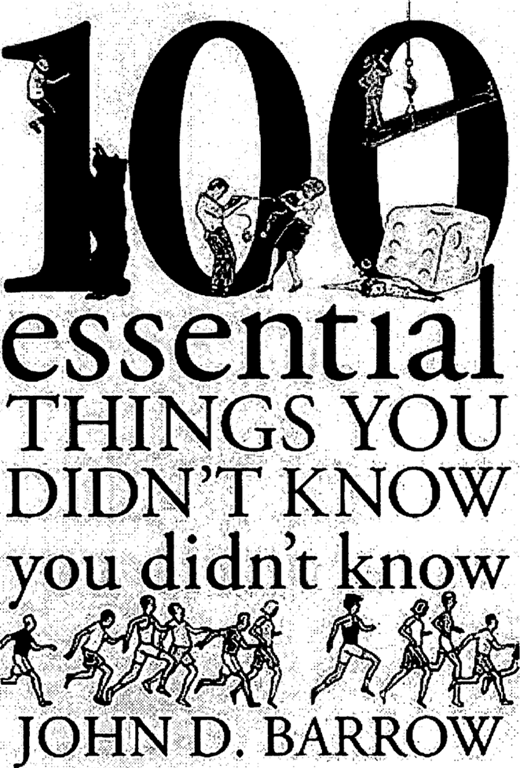
Fixed graphic 1This is a book that aims to provide and amaze the reader with fascinating facts, anecdotes and also paradoxes. Each entry is interesting in itself particularly to those cyberneticians and systemists who use mathematics and indeed to management scientists who are becoming more aware of the importance of the subject. The examples given are as diverse as the current range of puzzles and mathematical conundrums now so commonly occurring in the media, specifically in television and our major newspapers. Indeed, the popular mathematician Professor Marcus de Savouy could well have been involved in the selection of examples given, these included common misunderstandings in statistics, which would do credit to the Royal Statistical Society's well‐known column “Forsooth!” which appears in its publication RSS News on a regular basis.
Counter‐intuitive result's in mathematics are provided. All are selected from everyday life and include applications involving products and also decision making, and from nature itself. Those from the sporting world will prove particularly popular with readers.
Looking at sport, first “arithmetic means” receives attention and examples from cricket given which can be summed up as illustrating the common flaws found when player's averages are calculated.
Most practising mathematicians will know that when such results are published they should be treated with great caution.
It is not surprising that in considering collective decisions an example is given that involves politics and elections. For this example of collective decision making a version of Arrow's paradox is given under the title “How to rig an election.”
The book would not be complete without reference to essential things you did not know about the natural world. The author considers “How the leopard got its spots.” This example is treated in a more scientific way and the way in which the animal's skin pigment is produced and the chemical actions involved. We are informed that the leopards spots and stripes on its body are created in this manner.
With the Olympics soon to be with the world's readers of this text there must be a great deal we do not know about the way in which atheletes perform. How high, for example, can a high‐jumper jump? He believes the laws of physics will help us work out the limits that can be achieved. Although some professional athletics coaches believe these laws can be defied!
The section on simulation makes good reading.
This is a book worth having and the author believes in giving us access directly to the 100 essential things he promises in his title. There is no attempt to bring any order into the presentation and no attempt to connect the different examples in any way.
In many ways, mathematicians and those who use mathematics will already know many of these “essential things” the author has included. It is unlikely that we will be aware of them all and the title chosen does provide us with a challenge so that we can assess “How many essential things do we know?”
A book with the title 100 Essential Things You Should Know might well sell more copies. That apart the book does provide a stimulus to the mind and because it is not over mathematical with the minimum of mathematical symbolic of formulated notations it can reach a wide range of readers from the expert to the merely interested who may not possess the ability to understand the complexities of the subject. It should be noted that for the latter set of potential readers the author has provided background explanations of some of the mathematics that you require to appreciate the 100 Essential Things.