


This paper aims to define hybrid reality (HyR) as an ongoing process in which artificial intelligence (AI) technology is gradually introduced as an active stakeholder by using reasoning to execute real-life activities. Also, to examine the implications of social responsibility (SR) concepts as featured in the HyR underlying common framework to progress towards the redefinition of global society.
A combination of systemic tools is used to examine and assess the development of HyR. The research is based on evolutionary and learning concepts, leading to the new meta-system development. It also builds upon the viable system model and AI, invoking SR as a conceptual framework. The research is conducted by using a new approach: using system dynamics based interactions modelling, the following two models have been proposed. The state-of-the-art HyR interactions model, examined using SR concepts; and a SR concept-based HyR model, examined using a smart vehicle case.
In the HyR model, interaction asymmetry between stakeholders is identified, possibly leading to pathological behaviour and AI technology learning corruption. To resolve these asymmetry issues, an interaction model based on SR concepts is proposed and examined on the example of an autonomous vehicle transport service. The examination results display significant changes in the conceptual understanding of transport services, their utilisation and data-sharing concepts.
As the research proposal is theoretical in nature, the projection may not display a fully holistic perspective and can/should be complemented with empirical research results.
For researchers, HyR provides a new paradigm and can thereby articulate potential research frameworks. HyR designers can recognise projected development paths and the resources required for the implication of SR concepts. Individuals and organisations should be aware of their not necessarily passive role in HyR and can therefore use the necessary social force to activate their status.
For the first time, to the best of the author’s knowledge, the term HyR is openly elaborated and systemically examined by invoking concepts of SR. The proposed model provides an overview of the current and potential states of HyR and examines the gap between them.
1. Introduction
Hybrid reality (HyR) is a brief, dynamic unstable period in which people and artificial intelligence (AI) technology coexist and affect each other. Technology does not simply modify people’s existence, but people help technology in forming its worldview. During HyR, the framework of coexistence between people and AI technology will take shape, based on formal frameworks and relevant experience.
In HyR, not only existing processes are redesigned, but more importantly, whole new structures for information transfer (Mao et al., 2017) and high capacity reasoning nodes (Samsonovich, 2020) are constructed. Consequently, we are witnessing the emergence of a new meta-system, connecting intelligent technology and, hopefully, people in a global entity.
As far as we are aware, current attempt to examine the singular point in time of AI technology effects (Guzman and Lewis, 2020; Heer, 2019; Teixeira et al., 2020) do not adequately address the HyR phenomenon as a new meta-level system gradual development.
The self-developing AI technology is raising considerable ethical and security considerations (Aliman and Kester, 2018; Nath and Sahu, 2020), nevertheless a systems perspective is still lacking. This is putting pressure on us to rethink the role of AI technology in HyR: the period of transcendence from Anthropocene (Ison and Shelley, 2016) to a new form of co-existence.
Social responsibility (SR) concepts (Mulej and Dyck, 2014/2015) are trying to provide a requisite holistic framework for the personal and organisational behaviour in the society. In this paper, we will examine the hypothesis that the SR concepts (Mulej and Dyck, 2014/2015) may help us provide a framework that will lead us through the HyR.
It is difficult to identify patterns in the past, which are comparable to HyR development. If we build on the presumption that the AI technology will develop the capacity to self-reproduce, we can draw the evolutionary development: the processes of autopoiesis, fertilisation (Darwin, 1877) and hybridisation (Deley et al., 1970).
We can expect that these development mechanisms will lead to the emergence of a new meta-system. It may well be compared to the development of the nervous system in an organism (Francis, 2007).
To elaborate on the development of HyR paths, system dynamics (SD) based interaction modelling (Guzman, 2019) is used. SD models are valuable in examining the gradual development of the system, identifying pathologies and examining the implications of modified interactions in the system (Schwaninger and Rios, 2008).
SR concepts (Mulej and Dyck, 2014/2015) and behavioural examples (Perko et al., 2019) are proposed as a learning environment providing requisite holistic conceptual base for the sustainable co-existence of people and AI technology. The proposition is based on the assumption that AI technology will gradually develop an active learning capacity from the rules framework and experiences (Perko and Espejo, 2017).
The structure of this paper follows the proposed research concept. In Section 2, we elaborate the backgrounds of multiple concepts that could be applied to explain developments in HyR and the development of a new meta-level system. This is built upon AI technology development concepts and systemic toolset. Then SR backgrounds are examined. In Section 3, the research methodology presents interaction modelling of current pathologies and SR-based system.
In Section 4, an HyR interactions model is proposed and examined by using SR concepts, identifying multiple potentially pathological behaviour patterns. In Section 5, an SR-based HyR interactions model is proposed. The proposed model is then examined on the example of an autonomous vehicle. In Section 6, the paper concludes with a discussion on the implications and limitations of the proposed models and HyR potential development.
2. Backgrounds
To appropriately elaborate HyR complexity and dynamics, it requires for a systemic interdisciplinary examination of the social, organisational and personal behavioural backgrounds, projected to the development and co-existence of AI technology. In this paragraph, we are outlining theoretical backgrounds which might partially elaborate some drivers of the developing HyR.
2.1 Artificial intelligence-based technology
The information technology (IT) rate of development is, at least from the evolutionary perspective, unprecedentedly rapid. Enticknap (1998) elaborates on how IT advanced from a decoding gadget to an omnipresent field of services embedded in all levels of human interactions, whereas Litman (2020) predicts on the future autonomous vehicles employment and implication to the society.
The AI concept is defined from the perspective that intelligence in the form of intelligent agents is focussed on specialising in resolving limited task (narrow AI), mimicking human beings (general AI) (Poole et al., 1998) or by controlling the environment (super AI) (Kaplan and Haenlein, 2019).
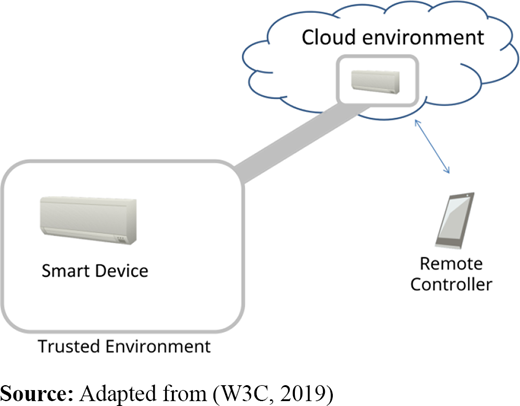
To enable universal communication and control protocols, the simplified cloud-based structure of AI (Figure 1), is quite favourable (W3C, 2019). It invokes three entities: the electronic appliance (smart device) with sensors, actuators and narrow reasoning capacities, the cloud with storage, high reasoning and sharing capacities and the cloud twin representation user interface.
2.2 Systemic backgrounds
The evolutionary theory (Darwin, 1877) has been proposed to explain the development of AI technology (Havlík, 2019; Kaplan and Haenlein, 2019). Because autopoiesis (Luhmann, 1986; Maturana and Varela, 1992) is conceptually easily transferable to the social environment, some researchers (Aguayo, 2019) are proposing it as the theory capable of explaining the AI development mechanisms.
To adequately elaborate on HyR, other natural and controlled reproduction mechanisms should be invoked: fertilisation, hybridisation, controlled selection, genetic material manipulation and systemic design (Schwaninger, 2000). Evolutionary approaches, focussing on passing the properties between generations are complemented with learning processes, occurring within a reproduction lifecycle (Bogdanov, 1913; Wiener, 1948) based on individual or shared experiences.
HyR is conceptually developing through time. In its early stages, it is not self-sustainable, but resides heavily on external resources and development drivers, thereby innovation theories (sustaining and disruptive) (Bower and Christensen, 1995) could explain the initial relations between the innovation facilitators and the AI technology.
In HyR, we expect the emergence of a new meta-level system. Similar development can be identified in the emergence of the nervous system (Kandel et al., 2000), leading to the next level of symbiotic behaviour (Leonard, 2007) and the development of complex multicellular organism (Lynn, 1998).
2.3 Social responsibility
SR (social responsibility) concepts are designed to universally apply to all subjects in society at all levels (Aguilera et al., 2007; Bach et al., 2014; ISO, 2010; Mulej et al., 2017). Original SR concepts acknowledge the complexity of the interaction between people, organisations and society. By applying the natural environment to the original SR principles, a “Triple P” bottom line: Profit + Planet + People (Carroll, 1999; Elkington, 1998) was formed.
In ISO 26000 (ISO, 2010), the three basic principles are as follows: the subject’s responsibility for its influences on society, interdependence and a holistic approach (Mulej et al., 2017).
These principles are supported by the seven SR concepts (ISO, 2010) are listed as attributes of human, organisational and social behaviour: Transparency, Accountability, Respect for stakeholders, Ethical behaviour, Respect for the rule of law, Respect for international norms of behaviour and Respect for human rights.
In SR, interactions with seven core stakeholders are being addressed (ISO, 2010): Human rights, Labour practices, the environment, Fair operating practices, Consumer issues and Community involvement and development (ISO, 2010).
SR systemic integration into processes does, however, have some serious drawbacks compared to streamlined, optimised processing (Cruz, 2009). Process optimisation provides instant effects, while SR generally delivers indirect results, provided by the environment feedback and feedforward loops. From this perspective, SR correlates with sustainability concepts (Aguinis and Glavas, 2012).
3. Methodology: the interaction model design process
System dynamics (Krallmann, 1980) is used to explore and provide an insight into the processes of sociotechnical transition by causal loops. This provides an insight into the relations of complex systems on multiple levels of abstraction and simulate its development (Papachristos, 2019). Schwaninger and Rios (2008) propose using SD in synthesis with a viable system model in order to analyse and structure a model of this nature.
Combined with Soft systems methodology (Checkland and Poulter, 2010), SD is argued to possess the capacity to address problematic, messy situations through repetitive development in multiple generations.
Recently, Guzman (2019) proposed a version of the SD to analyse dynamic interaction processes in which, similar to SD, the relevant subjects (stakeholders) interact to execute influence on each other. In Figure 2, Stakeholder 1 influences Stakeholder 2 using Interaction 1. It additionally uses interaction 2 for self-adjustment. Stakeholder 2 uses Interactions 3 and 4 for affecting Stakeholder 1 and itself. The interaction model can be set on different levels of a system, from instance to a global level, used to identify on the current state pathologies and to elaborate on development paths (Figure 3).

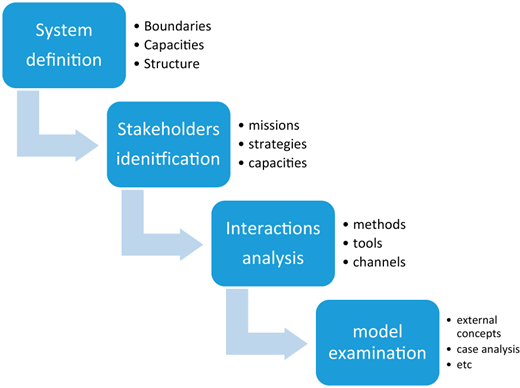
In the SD-based interaction model design process, a four-step process is employed: on the top level, the systems parameters are elaborated, then the stakeholders and their role in the system are identified, on the bottom level interactions between the stakeholders are elaborated, i.e. the methods, tools and channels used. The model is then examined, using external conceptual model.
In this paper, we design two interaction models: first, a HyR model based on state of the art is designed and examined using SR concepts to discover potential pathological interactions patterns, then a RS concepts based model is designed and examined using an autonomous vehicle case study.
The prosed methodology has never been used in the literature and therefore represents a major step forward in the body of knowledge related to complex systems examination.
4. Hybrid reality
To define HyR as a system, its boundaries, capacities and structure should be observed.
Physical or organisational dimensions are inadequate in defining HyR boundaries, because of the omnipresence of AI in all instances and at all organisational levels; AI can be observed on any scale, from making a simple phone call to organising a society. Thereby, HyR can be time-limited, setting a timeframe in which AI technology gradually develops its abilities to actively participate in the complete loop of observing/deciding/acting/learning processes with its elements and services. HyR begins with technology (Davis, 1989) autonomously joining the three basic capacities:
the capacity to sense;
the capacity to reason – currently called artificial intelligence; and
the capacity to act in the real world.
The HyR period ends when the relationship between the AI technology and other stakeholders becomes stable.
HyR invokes multiple stakeholders: individuals, organisations, AI technology, regulators and the natural environment, interacting, competing and working together to survive and develop. The level of stakeholders’ activity explains its ability to control the interactions affecting its viability. Agents provide this capacity for the passive stakeholder. In the case of AI intelligence, this role is played by information communication technology (ICT) providers.
Each stakeholder develops their own survival strategies, based on the rules of interaction and experiences of previous interactions. Their speed and complexity are adapted to the individual stakeholder’s capacity to maintain his/her/its activity.
The development of AI technology is actively redefining the rationale of all stakeholders at all levels of interaction and development. By using AI technology, stakeholders are gradually augmenting the experience of perceived reality (Hwang and Lee, 2019). Currently stakeholders possess a limited capacity to cope with the actual complexity of and generate a limited understanding of reality (Mulej and Potocan, 2007). With the emergence of AI, these capacities will increase considerably (Collier, 2018; Liang et al., 2018). Therefore, the task is to gradually expand the expected capacity of requisite holism for all stakeholders in order to increase the viability odds of the whole system.
HyR system capacities are constantly changing, and the speed of AI technology development is unprecedented. For the first time, technology is not limited to storing and sharing information, but actively understands – and responds to – the desires, beliefs and intentions (Perko et al., 2011) of individuals and organisations.
In HyR, a new, meta-level system in the form of a global communication network with reasoning nodes is developed, supporting the communication and combined reasoning of AI technology, raising the capacity to communicate, reason and act to an unprecedented, global level.
The HyR development invokes multiple generations of AI technology, first invoking external guided evolution (systemic design, controlled selection, hybridisation, genetic material manipulation), later migrating towards standalone evolution (autopoiesis, fertilisation). Within these stages, the processes of learning and knowledge sharing are going on. While humans are guiding the process, it is relatively slow. With the AI technology self-governing the process, we can expect to speeds-up considerably.
We do expect that through the transition from guided evolution to standalone evolution, a relatively narrow set of goals and reduced perception of the environment complexity is increased towards a more holistic perspective.
To develop a robust, viable new meta-level system, it is important to experience, recognise and develop a complete set of interactions, thus invoking the requisite holism (Mulej et al., 2013; Mulej and Potocan, 2007) concepts.
The HyR model suggests a universal structure, an access point, in which the real-world processes are increasingly integrated with IT services. Three fields of development where IT will increase its role in redesigning the real world as can be identified:
IT and real world monitoring integration: the real world is becoming represented by digital data, with digitalisation providing considerably simplified models of it. In order to integrate IT and the real world, sensors, communication bandwidth, storage capacities and levels of representation are to be considerably increased to reduce the gap between the real and digital world.
IT reasoning capacities: Currently, digital IT services do not possess the complex internal reasoning capacities to provide significant insight into real-world complexity. The complexity of the real world greatly exceeds the IT capacity to provide real-time reasoning or predictions in large intelligent environments.
IT-managed real-world operations (Berawi, 2019): the new scale automation identified in smart devices (Gubbi et al., 2013), Industry 4.0 (Wang et al., 2016) and society 5.0 (Shiroishi et al., 2018) will provide active IT support in physical activities that are currently manually operated.
AI technology will gradually increase its capacities to experience, understand and act within its environment. In return, the interactions between all HyR stakeholders, their roles, goals and structure and thus the civilisation’s overall conceptual organisation is going to be fundamentally redefined. It is imperative to identify and follow a path that will lead through the HyR evolution process.
4.1 Hybrid reality interactions model
In the HyR interactions model, we first identify the major stakeholders in the system and extrapolate the most significant reoccurring interactions. Special emphasis is set on the strength and speed of interactions and feedback. If the interactions are imbalanced, they can result in an unequal position of the stakeholders, and thus the development of pathological behaviour patterns.
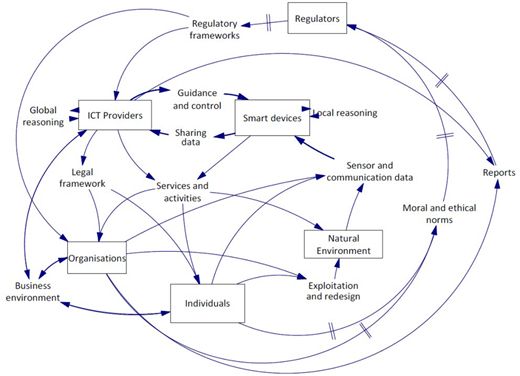
The main stakeholders in the HyR interactions model, depicted in Figure 4, are as follows: Smart devices and ICT providers, AI technology, individuals, organisations and the natural environment and regulators. Interactions invoke some of the most representative logical groups of interactions. Some of the interactions are near to real time, while those that are delayed are indicated with II.
For the sake of presentation, the model significantly reduces the complexity of the actual environment. If parts of the model were closely examined, a new level of complexity would emerge.
In the centre of the model are services and activities. These are provided by smart devices or ICT providers and are specially tailored to fit the situation experienced by organisations and individuals. The natural environment is considered to be a passive stakeholder because its complexity is not understood or is simply ignored. This asymmetry results in the overwhelming exploitation and destruction of natural habitats, wildlife extinction, lack of preparedness for natural disasters and the degradation of the quality of life. Besides providing services and activities, Smart devices collect Sensor and communication data, often without the stakeholder’s consent.
Smart devices are strongly connected with ICT providers. They constantly share data and rely on the guidance and control received by ICT providers. Because of limited local reasoning, smart devices largely reside on the global reasoning provided by ICT providers, making a fast and highly robust link between them essential.
ICT providers develop and manage hardware, services and software (apps) provided by (through) smart devices. They can provide hardware and software or can focus exclusively on software. ICT providers possess the capacity to store and reason upon data and decide on the functionality of the smart devices. Thereby, a large portion of complex reasoning processing is commonly carried out within ICT providers and communicated via smart apps. For example, data for the weather or traffic warnings communicated by smart devices is first collected from multiple sources (many of which are smart devices) and reasoned upon by the weather service provider. In the last step, individual users access the localised instance of the weather model.
Smart devices’ performance complies with the legal framework issued by ICT providers and accepted by users. Swift decisions are supported by local reasoning processes, based on fixed decision logic or limited artificial intelligence protocols. Smart devices are considered assets; they are owned by organisations or Individuals but are actually controlled by ICT providers.
Smart devices and ICT providers are the fastest developing stakeholders in the system; their reproduction cycle can be measured in months, while they learn in real time. Even now, their capacities to deal with data on local and global scales reshape the performance of HyR and, as a result, their importance is growing significantly. Even though AI Technology is currently considered a passive stakeholder in HyR, ICT providers act as AI technology agents.
Organisations and individuals actively exploit and redesign the natural environment, directly or by using services and activities provided through smart devices, and share their data according to legal frameworks with the ICT providers. Based on their experience, their individual moral and ethical norms are gradually changing.
All subjects actively or passively report to the regulators, adjusting the reporting dynamics and complexity to the regulators’ capacity to accept and reason on the reports.
The natural environment is regarded as a passive stakeholder. It is redesigned and exploited by the active stakeholders, directly or by using services and activities provided through smart devices, while the natural environment-related data is being actively analysed and shared. A representative example is deep oil seismic exploration enabled by ICT (Zhang and Zhai, 2019), in which the natural environment without an active agent cannot resist redesigning and exploitation.
Regulators check the received reports for compliance with the regulatory frameworks. With a delay, regulators adapt regulatory frameworks according to the currently valid moral and ethical norms and reports provided by the regulators to ICT providers and organisations. Since they mainly depend on the reports and the weak, delayed loop of the redefinition of moral and ethical norms, they can only provide delayed responses to the existing pathological behaviour patterns and often lack the capacity to keep up with the dynamic of changes in HyR or even to predict and direct future development.
At first glance, we can identify significant discrepancies between the regulatory frameworks developed to protect the system on the one hand, and the goals of stakeholders, focussed on surviving and thriving in the system. The gaps can easily lead to pathological behaviour patterns among the stakeholders (Rios, 2008a, 2008b) and require a more detailed examination.
4.2 Hybrid reality examination from the social responsibility perspective
The HyR interactions model is examined from the perspective of SR concepts to identify interactions bearing a risk of developing pathological behaviour patterns. SR concepts are currently being used as an extrinsic framework. In order for them to actually function, they need to become an intrinsic part of individual and organisational reasoning and behaviour.
In HyR, we expect AI technology to learn from existing frameworks, observations and experiences. If the experiences from the real world exhibit pathologic patterns, we can expect these to affect the AI technology learning and evolutionary processes:
Transparency and accountability: Owing to data asymmetry, the concepts of transparency and accountability are not applied. Detailed data on all stakeholder activities is gathered, stored and used by ICT providers but is generally not reported back; thereby, the first feedback loop is not functional. The second feedback loop, in which organisations and ITC providers report to the regulators, is limited by the regulators’ capacity to deal with big data. Resultantly, even though the data that could increase transparency and imply accountability is gathered, requisitely holistic information does not reach individuals, natural environment agents or regulators adequately, resulting in transparency and accountability asymmetry.
Respect for stakeholders and ethical behaviour: Streamlined success rationalisation, focussed only on optimisation and profit drive by digitalization, denotes respect for stakeholders and ethical behaviour as a means of achieving higher profit. From the data perspective, ICT providers and organizations are actively gathering data on passive stakeholders, such as individuals and the natural environment. Consequently, the feedback loops that would support the development of real respect and ethical behaviour do not develop.
Respect for the rule of law: Essentially, regulators redefine regulatory frameworks upon moral and ethical norms established by organisations and individuals. As observed, the dynamics in interactions between ICT providers and smart devices has increased considerably, especially since they are based on high-performance grid protocols, and supplied by instant feed-in from smart devices’ sensors and communication data. This enables ICT providers and organisations to misuse existing legal frameworks or even to influence on the development of legal frameworks excluding the passive stakeholders from the process.
Let us examine an example: End User License Agreements (EULA) are used for framing the use of ICT-related services. EULAs are composed by the ICT providers supporting their privileges; a typical EULA complexity exceeds the users’ capacity to read, understand or react in a limited time, thus reducing their role to a passive stakeholder. If EULA are automatically activated by ICT providers, they turn into smart contracts (Giancaspro, 2017), actively enforcing the statements of the ICT providers and increasing the power imbalance.
Respect for international norms of behaviour: International ICT providers and organisations govern international data on experiences, which enables them to better understand and dynamically manage local activities. It is up to them whether they support or exploit local organisations, individuals and the natural environment. Based on their power to assess multiple local situations, they actively contribute to the redefinition of the international norms of behaviour. Without clearly defined power mechanisms for all stakeholders, a high risk of one-sidedness exists (Dragan and Mulej, 2019).
Respect for human rights: The application of Human rights should enable all stakeholders to develop and maintain their integrity. In HyR, human rights are closely related to managing individual digital identity (Allison et al., 2005). The concepts of digital identity and privacy are often ignored, resulting in massive data exploitation with only limited protective measures for individuals, organisations or the natural environment. The concept of human rights is limited to individuals, which keeps most HyR stakeholder rights, such as natural environments, smart devices, organisations and regulators, unaddressed. Though some regulators are providing protective regulative frameworks (Sullivan, 2019), these are proved to be ineffective without public awareness and empowerment.
From the SR related analysis, a conclusion can be drawn that the effects will be three-fold:
First: direct increase in power of the ICT providers and international organisations’ influence in the HyR fostering and use of AI capacities.
Second: ICT providers and international organisations’ influence on the legal frameworks formulation, based on a higher reasoning capacity compared to the regulators.
Third: the construction of AI technology self-development, based on experience and involving the exploitation of passive stakeholders may result in the development of AI pathological behaviour patterns.
The question then is as follows: How to govern HyR development to reach the stage of sustainable future for all stakeholders in HyR? Can SR concepts be applied for this purpose?
5. Socially responsible in hybrid reality
The inclusion of AI technology as an active stakeholder requires rethinking its overall position. According to SR concepts, the objectives of the stakeholders should be considered when planning and implementing activities. For SR concepts to be effective, all active players should comply with all SR concepts on topics and principles. Alignment cannot be achieved instantly; it is a learning and adaptation process.
We argue that it is important to clarify behavioural rules at the point at which technology begins to explore and actively interact to play an increasingly important role in the system. Thus, we pose the question: Can SR concepts help in guiding HyR development?
5.1 A social responsibility--based hybrid reality model
In this section, we examine if and how SR concepts can be invoked in the HyR redesign of prevailing values and support more sustainable development. The model timeframe is set to lead to the moment in time at which AI technology is accepted as an active stakeholder, based on its capacities and role in HyR.
SR concepts can be invoked on multiple levels. In the examined model, we are proposing to integrate SR concepts effectively governing the system parameters of success.
By invoking SR concepts in the HyR interaction model, four predispositions are considered:
All SR concepts should be invoked in all stakeholder (including AI technology) reasoning, activities and interactions affecting the performance of the whole HyR: organisations, individuals, environments, regulators and AI technology.
The processes of regulatory frameworks’ development, legal frameworks and business environment ought to be based on SR concepts.
The concepts of SR are to be upgraded according to the recognised and consensual needs and desires of the stakeholders, becoming an integral part of the overall system.
The SR-supported HyR model projection suggests a substantial increase in the complexity of currently relatively straightforward individual and organisational goals. For each interaction in the current business environment, profit is usually the main measure of success. In an SR-based environment, success is constructed as a combination of the implications for all stakeholders. We expect AI technology services to enable the HyR stakeholders to increase their capacity to deal with the actual complexity, thus upgrading their goal sets.
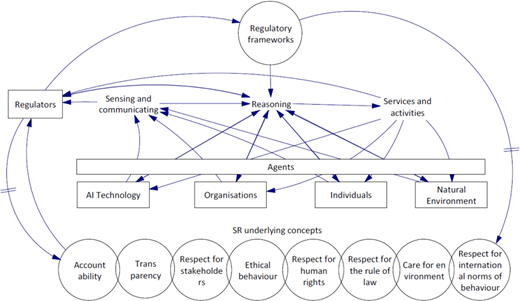
As depicted in Figure 5, SR concepts provide an underlying set of values applicable to all stakeholders in the system. In the SR-supported model, the role of the individual is expected to shift from exploiting available resources in order to survive as an entity to supporting the global system in its viability efforts. Given the gravity of the change, it is expected to take multiple learning loops or even generations for all of the stakeholders to realign the existing system with SR concepts on all levels.
Let us explore the conceptual modifications in the proposed model.
The underlying concepts, among them SR concepts, apply to all stakeholders, including AI technology. They play an important role in the development of the regulatory frameworks. The underlying concepts are the slowest changing part of the system. They are modified with a delay, mostly through changes in the regulatory frameworks orchestrated by the regulators.
Regulators play multiple roles: they oversee system dynamics by monitoring the sensing and communication data, using common reasoning capacities and communication. Regulators form regulatory frameworks such as legislation, the business environment, etc. based on underlying concepts, sensing by sensors and communication with all stakeholders and their agents.
Agents act on behalf of partially or fully passive stakeholders; they can directly by supporting the stakeholder interactions or indirectly by supporting the regulators in modifying the regulatory frameworks. Even though agents act on behalf of a stakeholder, they are bound by regulatory frameworks and aligned with the underlying concepts of SR. Physically, agents can be AI technology or physical entities (individuals, organisations or regulatory bodies), presumably with AI technology support.
Sensing and communication is largely supported by the AI technology. Even though the services of sensing and communication are AI technology supported, the sensor and communication data is owned and managed by the stakeholders and their agents – even for the passive stakeholders.
Reasoning provides support for each stakeholder regarding other stakeholders’ and the system’s short- and long-term viability. Reasoning is conducted on behalf of all stakeholders, by all stakeholders, using internal and external reasoning capacities, based on stakeholder shared data and resources.
Services and activities provide channels to execute activities for the system’s stakeholders, based on the results of reasoning.
5.2 An interaction examination: autonomous vehicles transfer service social responsibility analysis
Autonomous vehicles characterise multiple properties of AI technology in HyR. A vehicle service is simple: to safely transport passengers or cargo from Point A to Point B. Currently, the main focus is set on driving, based on: sensing, recognising, reasoning and predicting the natural environment, to identifying the best possible driving route (Miglani and Kumar, 2019; Talebpour and Mahmassani, 2016). To support reliable driving in any conditions and situation, a vehicle invokes external sensors, internal computational power, communication and coordination with the external coordinator (AI technology) and other smart devices (Teixeira et al., 2020).
Additionally, to achieve a perceived high-level service, the vehicle should, at each particular point in time, understand the full complexity of the situation, reason on internal sensors, passengers’ behaviour, other traffic members’ interpretations and past situational experiences (Chen et al., 2019). It is clear that to manage this complexity, the vehicle needs to share resources with collective intelligence (Park et al., 2019).
When looking from a systems perspective, beyond single point-in-time, a simple point A to point B service turns into a series of interaction between passengers, transport units, traffic, energy and material producers, service units, natural resources use and emissions output throughout the vehicle life span. These factors impact on traffic, energy consumption, required infrastructure, the natural environment, materials and product usage to produce autonomous vehicles, materials recycling, the passengers and traffic participants’ rights for privacy, to name a few.
In an SR-based HyR, equilibrium is set and understood by all of the stakeholders: the passenger needs for a transfer are compared with the service provider (AI technology) organisational effort and the effects on other stakeholders. Passengers understand and respect the service value and effort invoked to provide the service. On the data sharing level, the equilibrium between the data privacy and the need for using the data is uphold. Let us examine the situation from the perspective of SR concepts.
Transparency and accountability: Data related to the transport service is shared among the participants, and their agents. In the examined case, the vehicle, the passengers and the regulators are preserving the digital integrity of the participating stakeholders. Each request for sharing information is instantly reasoned and negotiated upon by the stakeholder (AI technology based) agents. The sharing reasoning is based on the law frameworks and subsequently by the (SR) underlying principles.
Ethical behaviour, respect for stakeholders and international norms of behaviour: Idealistically, service execution is not based on ownership or service reimbursement. It is assessed according to the need for the transfer versus the effort required to provide the service. For all participating stakeholders and their agents, the direct and indirect implications of their activities to the other stakeholders are known. The vehicle recognises the passengers’ preferences, needs and desires. The passenger understands the effort required in order to provide the service and asks for it only if needed.
Respect for the rule of law The process of recognising activities’ compliance with the legal framework is supported by active negotiations between the involved stakeholders or their agents. Thereby, even if the involved stakeholders (for instance passengers) do not understand the travel service’s legal background, their rights are represented. The legislation itself is dynamically modified to keep up with the latest developments in stakeholder interactions, in accordance with underlying concepts, SR among them.
5.3 Respect for human rights and care for environment
Human rights concepts, particularly regarding the management of digital identity and data privacy, are addressed systemically and rolled out to all stakeholders. For instance, AI technology and the natural environment possess the right for digital identity and data privacy, according to their self-awareness capacity.
Passive stakeholders, such as the natural environment, are invoked through agents, actively elaborating their perspectives. Combined with the sensor data, the travel impact on the environment can be reasoned upon and embedded into the regulatory frameworks.
Processes, invoking this level of instant interactions can only be developed gradually. It is important to design the appropriate framework, which will support the appropriate mixing of concepts in every step of the development and prohibit the autopoietic pathologic behavioural patterns development.
6. Conclusions
From the CyberSystemic perspective, HyR elaborates a phenomenon in which the growth in AI technology capacities to collect, reason and act upon data will considerably alter relationships and interactions among HyR stakeholders and contribute in developing a new meta-level system. We claim that this newly-forming intelligence will learn to evolve according to existing frameworks and experience.
To elaborate on the AI technology development processes, multiple systems toolsets are engaged; the multi-generational HyR controlled and natural evolution of a new meta-system. To examine the HyR state of the art, the interactions among the HyR stakeholders are elaborated using system dynamics-based interaction modelling.
The HyR state of the art interaction model is cross examined using SR concepts. The results point to asymmetries in interactions which may lead to the development of pathological behaviour patterns of HyR stakeholders. Three levels of such developments are exposed and are as follows:
direct increase and a potential abuse of power by active HyR stakeholders;
development of biased legal frameworks towards active HyR stakeholders’ desires; and
Integrating pathological behaviour patterns into AI technology reasoning by learning from examples.
To examine if the negative results can be mitigated, a SR concepts-based interactions model is designed. We expect that combining SR concepts with the development of a new level of communication and control standards will gradually raise the HyR system to the next meta-level, capable of providing a supportive environment for the HyR stakeholders. Special focus is in supporting the passive stakeholders by appointing AI supported agents that increase their capacities to sense, understand and act socially responsible. The development of a supportive environment should help individual stakeholders to reallocate their resources and activities from competition to support and collaboration, thus increasing the viability of the system.
An autonomous vehicle transport service, based on the proposed model, is examined using SR concepts. The examination results display significant changes in the conceptual understanding of transport services, their utilisation and data-sharing concepts.
Current SR concepts are limited in providing guidance for business organisations. Their level of complexity is thereby relatively low, compared to the potential future AI technology reasoning capacity. Consequently, the underlying concepts of SR are to be further upgraded to provide a holistic perspective on the interactions between HyR stakeholders.
Predicting the development of a systemic new meta-model, especially if based on the hybridisation of AI technology and SR, is highly uncertain; it should therefore be approached innovatively and critically.
The proposed SR-based HyR model may provide the background for a critical discussion including creative outcomes on a potential framework, which is worth pursuing through research and development activities for researchers and AI technology designers, business leaders and individuals .

