


This remastered analysis focuses on the impact of entrepreneurial interventions in higher education institutions (HEI), particularly in social entrepreneurship. The study evaluated the effectiveness of such interventions through a pre-and post-test approach, examining various skill sets in students. The primary goal was to analyze the influence of entrepreneurial training programs on students' competencies in social entrepreneurship by analyzing changes in personal behavior, leadership, innovation, social value and management skills before and after the educational interventions.
The study employed a quasi-experimental design, analyzing pre-and post-test results in three distinct social entrepreneurship training experiences. The sample consisted of 304 participants, providing a comprehensive view of the impact of these interventions.
The main findings were: (1) Educational interventions in social entrepreneurship must emphasize strategies for self-awareness, emotional intelligence and personal development improvement. The analysis revealed significant improvements in these areas, indicating that targeted strategies in these domains are essential for enhancing the effectiveness of social entrepreneurship education. (2) The impact of educational interventions on these capabilities can be effectively evaluated using machine learning methods such as ordinary least squares (OLS) regression. This approach allows for the inclusion of variables such as gender, age or location, providing a comprehensive assessment of the interventions' impact. (3) The interventions were particularly effective in improving students' innovation and leadership competencies. The analysis demonstrated substantial enhancements in these areas, underscoring the success of the interventions in developing these critical skills. (4) The study highlighted the need for a more focused approach in future interventions, emphasizing the importance of management, social value and personal skills. Additionally, it pointed out the necessity of developing and utilizing appropriate tools to create and evaluate these interventions effectively.
The study provides insights into improving educational interventions in social entrepreneurship to better develop essential skills in students.
This research introduces a significant approach to educational interventions for educational communities and decision-makers by demonstrating the effectiveness of entrepreneurial training for competencies in innovation and leadership, which are crucial for societal and economic development.
1. Introduction
The approaches of academic institutions to enhance entrepreneurial culture and its goals to identify abilities and predict the prospects of the economy are still challenging. Research on social entrepreneurship capabilities has shown that self-efficacy, social support, and educational support are associated with higher probabilities for future social entrepreneurship (Akhter et al., 2020). Current systematic reviews suggest that the prediction equation should introduce cognitive factors and combined factors such as environment, perceptions (of the economy, market, and opportunities), and previous experiences (Maheshwari et al., 2022). Some studies have indicated that future entrepreneurial intentions are influenced by multiple personal traits such as the need for achievement, locus of control, and self-confidence (Vodă and Florea, 2019). The approaches are multiple, but a systematic and multidisciplinary intervention would be the best method to understand causes and stimuli.
Social entrepreneurship has become a significant topic in recent years due to its role in addressing social and environmental issues and contributing to community development. Various authors, including Méndez-Picazo et al. (2021), Bansal et al. (2019), and Littlewood and Holt (2018), have investigated the factors influencing social entrepreneurship as a driver of sustainable development. Other researchers, such as Cardella et al. (2020), Bastida et al. (2020), and Argyrou et al. (2018), have explored the gender perspective within social entrepreneurship to identify research areas where this field has gained attention and relevance, particularly in educational and sociocultural contexts. Despite these advances, the field still requires further expansion. Agrawal and Hockerts (2019) and Gali et al. (2020) note that while the field is progressing towards rigorous scientific research, much of the existing scholarship remains exploratory. In various contexts, the subjects of study will be specific, but social entrepreneurship as a field continues to pose several unanswered questions that require further research.
In the capitalist context, the question always arises if entrepreneurs are born or made; it is a multidimensional question in which the answer sometimes lies in the environment and exposition. Experiential social entrepreneurship education (such as bootcamps, courses, and summer camps) can increase students' propensity to enter the world of enterprise by stimulating their engagement; however, sometimes moral empathy or obligation for entrepreneurial ventures are elements that should be assessed and stimulated (Hockerts, 2018). Personality traits such as openness, extraversion, and conscientiousness are essential for innate skills in entrepreneurship (López-Núñez et al., 2020). Psychological traits also mediate entrepreneurial education and goals (e.g. the need for achievement is one of the most potent variables affecting entrepreneurial intentions) (Ndofirepi, 2020). Most research results highlight personal traits, the cultivated interest of entrepreneurs in their success, and the HEIs' entrepreneurial activities; however, management, ethics, and holistic extracurricular approaches also play a role in deciphering the triggering factors.
The incognita about the impact of entrepreneurial and management interventions during higher education or vocational education lead to holistic and systematic initiatives. The recommendations for future research in metanalysis include representative sampling of participants, samples from vocational schools, collecting detailed information about interventions, implementing reliable tests, and applying interventions of control groups in pre and post-test phases to have better insight into the effects on entrepreneurial intentions (Martínez-Gregorio et al., 2021). Human capital interventions such as business training, formal education, and entrepreneurial education have correlated with higher entrepreneurial performance, at least in industrialized countries (Hogendoorn et al., 2019). The evidence of interventions is unclear yet, and the literature tells us integrative approaches are indispensable to measure genuine impact. For this reason, we innovated interventions by analyzing the impact of entrepreneurship courses, management, and social ethics on students' perceptions of family expectations about entrepreneurship, measuring their perceptions regarding social value, using creative thinking to develop innovative solutions to social problems, and identifying their understanding and commitment to create social impact.
This study is the first of its kind, with the original goal to analyze the influence of entrepreneurial training programs on perceived personal traits, leadership, innovation, social value, and management skills before and after extracurricular entrepreneurial experiences. This article presents a brief literature review of social entrepreneurship education and its impact on innovation and the co-creation of ecosystems by Industry and HEIs. The pre-and post-test results are presented originally through data visualization and logistic regression techniques; finally, the results are reported with a discussion and conclusions about the impact and importance of the entrepreneurial approaches.
1.1 Social entrepreneurship in higher education
Higher education has incorporated new competencies vital to address the world’s needs, such as social entrepreneurship. Social entrepreneurship is a type of entrepreneurship whose primary purpose is to generate social value while not neglecting the creation of economic value (García-González and Ramírez- Montoya, 2021; Saebi et al., 2019; Gupta et al., 2020; Watson et al., 2023). The fact that it generates social value is crucial in a context where innovation is necessary to address societal needs.
Considering the characteristics of social entrepreneurship requires the social entrepreneur to develop competencies to identify and address a social issue(s) through a business proposal (Vázquez-Parra et al., 2020; Portuguez Castro et al., 2018). In this sense, García et al. (2020) proposed that the competency of social entrepreneurship has four components: social change, social innovation, social/environmental value, and the management of social change. These characteristics enable the social entrepreneur to generate innovative proposals that, through proper implementation, produce social and environmental value.
The integration of social entrepreneurship education in higher education requires a comprehensive approach that transcends traditional academic instruction. Rojas et al. (2024) demonstrated that, despite educational initiatives aimed at fostering social entrepreneurship, the development of these competencies remains a challenge in practice. Their study in Colombia revealed no significant differences in competence acquisition between early and advanced stages of academic programs, suggesting that traditional instruction may not be sufficient to nurture these skills. Wang (2024) further emphasized the importance of a multidimensional approach, advocating for the integration of social entrepreneurship education (SIE) across disciplines, beyond just business schools. This perspective aligns with Sharifi’s (2024) findings, which highlight the critical role of sociocultural competencies in preparing future leaders to navigate global challenges. Consequently, it is evident that higher education institutions must focus not only on technical and entrepreneurial skills but also on sociocultural and interdisciplinary competencies to enable students to develop innovative, socially impactful, and sustainable solutions in their careers.
The development of these significant competencies must be a part of educational programs in higher education. Although predominantly implemented in business education, social entrepreneurship competency must be interdisciplinary in higher education (Vásquez-Parra et al., 2020; García-González et al., 2020; Gupta et al., 2020). Developing these competencies in higher education is crucial because it gives graduates the knowledge and skills to propose ethical and sustainable solutions to various problems they will confront in their professional and personal endeavors.
1.2 Co-creation with learners and stakeholders
In the realm of social entrepreneurship, the social entrepreneur must collaborate with other actors to satisfy the requirements of the activity. Thus, co-creation is the process where social entrepreneurs cooperate with other actors to create value for their users or clients (Pokojski, 2020; Milici et al., 2023; Portuguez-Castro, 2023). Co-creation enables the creation of networks that facilitate the development of social enterprises and the generation of value.
In the context of social entrepreneurship education, co-creation among learners, educators, and stakeholders is a crucial strategy for developing real-world skills and building entrepreneurial ecosystems. Okuogume and Toledano (2024) demonstrated the effectiveness of co-creation in sustainable entrepreneurship education at Lapland UAS, where students, faculty, and local businesses collaboratively engage in addressing real-world problems. This approach equips students with the competencies needed to identify and evaluate sustainable business opportunities while simultaneously fostering innovation within local enterprises. Similarly, Chui et al. (2023) illustrated how co-creation in social entrepreneurship education at the University of Hong Kong enhances students' empathy, multidisciplinary knowledge, and practical skills through experiential learning and social enterprise projects. Furthermore, Puerta-Sierra and Puente-Díaz (2023) highlighted the positive impact of involving students in course design, showing that increased participation in the co-creation of curricula boosts students' sense of autonomy, motivation, and entrepreneurial intent. Collectively, these studies underscore the critical role of co-creation in fostering collaboration between learners and stakeholders, positioning universities as key contributors to entrepreneurial ecosystems by supporting social enterprises and driving sustainable change in their communities.
The collaboration among actors creates communities with common interests who want to generate value. Thus, forming entrepreneurial ecosystems allows collaboration among entrepreneurs and other actors to provide value with a strengthened ability to achieve common objectives (Ortiz-Ledesma, 2022; Pokojski, 2020; Znagui and Rahmouni, 2019). Academia is one of these network actors; it plays a significant role in achieving the goals of the ecosystems.
Universities and higher education institutions can be strategic actors in these ecosystems. They can educate and train in the competencies necessary for social entrepreneurs, establish business incubators, science parks, and programs aimed to provide or fund the necessary seed capital to implement a business project (García-González and Ramirez-Montoya, 2021; Wagner et al., 2021; Cruz-Sandoval et al., 2022). These characteristics make universities significant in developing social enterprises, positively impacting their localities.
1.3 Future of education: educational opportunities
The future of education requires developing competencies that align with the needs of the present world. These changes involve leveraging new technologies in learning design strategies incorporating new competencies (García-González and Ramirez-Montoya, 2021; Akimov et al., 2023; Pinto-Santos et al., 2022). Integrating new competencies is essential, particularly in developing transversal competencies across different professional training areas.
One of these competencies to integrate into education is social entrepreneurship. This competency is not exclusive to business training areas but is beneficial for anyone needing a tool to create social or environmental value (Gupta et al., 2020; Vásquez-Parra et al., 2020). Moreover, research has shown it helpful in developing other competencies, such as complex thinking and its sub-competencies (systemic thinking, critical thinking, scientific thinking, innovative thinking) (Vazquez-Parra, 2023). In this sense, the competency of social entrepreneurship stands out not only for its ability to cultivate social entrepreneurs but also for developing other competencies crucial for today’s society.
The role of technology in educational innovation is crucial for the future of education. It provides opportunities for personalized and adaptive learning, access to resources and information, global connectivity, and collaboration among students and educators (Zhang et al., 2022). For social entrepreneurship education, technology can offer various advantages, such as access to online platforms and resources for learning, virtual mentoring, networking opportunities, and the ability to create and implement innovative projects using digital tools (Horiashchenko, 2022). Additionally, integrating digital technologies in social entrepreneurship education allows the cultivation of skills essential in the modern world.
Social entrepreneurship is a competency of significant value in education. Hussein-Elhakim et al. (2024) emphasize the importance of incorporating practical experiences and interdisciplinary collaboration into social entrepreneurship education (SEE), noting that these elements are crucial for developing competencies that drive social and environmental impact. Similarly, Liang and Shurui Bai (2024) highlight how generative AI tools, such as ChatGPT, can enhance learning in SEE by facilitating collaborative learning, connecting knowledge, and integrating theory with practice. These technologies enable immersive learning experiences and virtual mentorship, fostering the development of essential skills for social entrepreneurship. Furthermore, Karatas-Ozkan et al. (2023) propose that social entrepreneurship education should also focus on helping students develop and mobilize various forms of capital—cultural, social, economic, and symbolic. This approach, grounded in Bourdieu’s theory, enriches students' reflexivity and equips them with the tools to navigate the complex ecosystems of social entrepreneurship. Collectively, these studies suggest that future educational opportunities in SEE will increasingly rely on the integration of technology, practical learning, and a comprehensive understanding of social capital to cultivate a new generation of social entrepreneurs capable of creating sustainable value.
2. Methods
The research involved a quasi-experimental study that implemented pre- and post-training interventions: nine extracurricular experiences in social entrepreneurship divided into three major categories: a) Social Impact, b) Entrepreneurship and Innovation, and c) Ethics and Society.
These nine extracurricular experiences were integrated into various courses to enhance students' mastery of social entrepreneurship competencies, ultimately aiming to produce changemakers capable of addressing social and environmental challenges through innovative and ethical solutions. The experiences were categorized as follows:
Social Impact Courses:
Development of social impact companies: This course trains students to become social entrepreneurs by developing companies with significant social impact.
Service learning: This course combines service-learning methodologies with social entrepreneurship, enabling students to work on real-world projects that contribute directly to social welfare.
Collaboratory of social entrepreneurship: This experience adopts a multidisciplinary approach, where students from various fields collaborate to solve social problems through entrepreneurial initiatives.
Entrepreneurship and innovation:
Entrepreneurship and innovation Course (Master’s Level): This virtual course for master’s students focuses on social impact within the broader context of entrepreneurial projects, emphasizing ideation, prototyping, and the creation of socially impactful ventures.
Ideation and prototyping workshop: As part of the entrepreneurship and innovation course, this workshop specifically targets the development and prototyping of innovative ideas to address social challenges.
Technology-Driven social entrepreneurship course: This course helps students develop innovative solutions to social problems, focusing on the role of technology in driving entrepreneurial initiatives.
Ethics and Society:
Ethics, the individual, and society course: This course integrates ethical considerations into social entrepreneurship, guiding students in developing projects aligned with social justice and ethical business practices.
Ethics, profession, and citizenship course: This course explores how professional ethics and citizenship responsibilities can be intertwined with social entrepreneurship to foster positive societal change.
Didactics of Early Childhood education: This course incorporates social entrepreneurship principles into early childhood education, preparing educators to cultivate social consciousness and entrepreneurial thinking from a young age.
2.1 Participants
The study analyzed students' perceived levels of social entrepreneurship competencies (SEC) (304 students from different universities) in the pre and post-intervention stages. The perceived level of SEC was recorded using the instrument developed and validated by García-González et al. (2020). It assessed five social entrepreneurial competencies: (1) personal (items 1–6); (2) leadership (items 7–10); (3) social innovation (items 11–18); (4) social value (items 19–23), and (5) entrepreneurial management (items 24–28) on a five-point Likert scale, where 1 represented “Totally disagree” and 5 indicated “Totally agree.” The instrument was previously demonstrated to have good internal consistency with an overall Cronbach’s alpha of 0.891 (García-González and Ramírez-Montoya, 2021). Subcompetency-specific alphas ranged from 0.534 to 0.797 which make it optimal to comprehensively assess and analyze students' competencies in social entrepreneurship, useful for both research and educational curriculum enhancement.
2.2 Data collection
The data collection involved a comprehensive questionnaire administered to 304 students participating in nine distinct extracurricular experiences in social entrepreneurship. These experiences were categorized into three major themes: Social Impact, Entrepreneurship and Innovation, and Ethics and Society.
Participants came from diverse academic backgrounds, including Architecture, Business, Health Sciences, Social Sciences, Engineering, and Humanities.
The questionnaire gathered demographic information such as age, gender, and country, as well as detailed items related to prior experience in social entrepreneurship, family background in entrepreneurship, and personal and professional aspirations. This rigorous data collection methodology provided a holistic view of participants' initial competencies and their development through the intervention.
To ensure data reliability, we employed validated instruments to measure the impact of educational interventions. Competencies were assessed using a five-point Likert scale, which facilitated detailed statistical analysis. ANOVA tests were conducted to compare pre- and post-intervention results, verifying that observed changes were statistically significant. This was complemented by Ordinary Least Squares regression, as explained in the subsequent data analysis section. Additionally, rigorous data handling procedures were implemented to maintain dataset integrity, ensuring that all data points were consistently measured and accurately recorded.
2.3 Data analysis
The study compared pre and post-intervention variables to find correlations through heatmaps (pre and post-intervention). The Python module matplotlib.pyplot was used for visualization, and Ordinary Least Squares regression (OLS) estimated the relationship between interval/ratio variables in pre and post-interventions (Table 1 shows the description of variables).
Pre and post-intervention variables analyzed
| Variable | Description |
|---|---|
| Gender, age, country, discipline | Sociodemographics |
| Experience in social entrepreneurship activities | Previous experiences |
| Family experience with entrepreneurship | Previous experiences |
| Family expectations regarding entrepreneurship | Existence or not of expectations |
| Personal skills | Improvement in self-awareness, emotional intelligence, and personal development |
| Innovation skills | Growth in creative thinking and the ability to develop innovative solutions to social problems |
| Social value | Increased understanding and commitment to creating social impact |
| Management skills | Development in organizational and strategic planning abilities |
Source(s): Authors’ own work
3. Results
Understanding the distinction between pre-test and post-test skills in all five categories is crucial for assessing the effectiveness of the intervention. Figure 1 presents a box and whisker plot depicting skills at the pre-test and post-test levels. Describing how the designed questionnaire evaluates each skill is essential. Personal skills were scored through averaging the responses to specific questions. Individuals were queried about their passion and determination to achieve goals, ability to identify strengths and weaknesses in colleagues, persistence in completing work despite challenges, proficiency in communicating ideas to groups, perception of how others received ideas, and persuasiveness in convincing others of ideas and actions.
 The two box plots are presented in side-by-side panels. The left panel is titled “Pre-test Skills”, and the right panel is titled “Post-test Skills”. Each panel displays six horizontal box plots corresponding to six measured skill categories. The horizontal axis in both panels ranges from 2 to 5 in increments of 1 unit. The vertical axis in the left panel lists the following categories from top to bottom: “Pre-test: total”, “Pre-test: management skills”, “Pre-test: social value”, “Pre-test: innovation skills”, “Pre-test: leadership skills”, and “Pre-test: Personal skills”. The vertical axis in the right panel lists the following categories from top to bottom: “Post-test: total”, “Post-test: management skills”, “Post-test: social value”, “Post-test: innovation skills”, “Post-test: leadership skills”, and “Post-test: Personal skills”. The details for the box-plot values in the Pre-test Skills panel are as follows: Pre-test: total Minimum: 2.71. Lower Quartile: 3.49. Median: 3.81. Upper Quartile: 4.09. Maximum: 4.86. Outliers are present at 2.46 and 2.5. Pre-test: management skills Minimum: 1.22. Lower Quartile: 2.61. Median: 3.2. Upper Quartile: 3.8. Maximum: 5. Pre-test: social value Minimum: 2.2. Lower Quartile: 3.6. Median: 4.02. Upper Quartile: 4.62. Maximum: 5. Outliers present at 1.6. Pre-test: innovation skills Minimum: 2.12. Lower Quartile: 3.15. Median: 3.64. Upper Quartile: 4. Maximum: 5. Pre-test: leadership skills Minimum: 2.75. Lower Quartile: 3.76. Median: 4.02. Upper Quartile: 4.51. Maximum: 5. Outliers present at 2.5. Pre-test: Personal skills Minimum: 2.86. Lower Quartile: 3.84. Median: 4.17. Upper Quartile: 4.5. Maximum: 5. Two Outliers at 2.5 and 2.7. The details for the box-plot values in the Post-test Skills panel are as follows: Post-test: total Minimum: 2.98. Lower Quartile: 3.76. Median: 4. Upper Quartile: 4.33. Maximum: 5.0. Outliers are present at 2.59 and from 2.78 to 2.91. Post-test: management skills Minimum: 1.59. Lower Quartile: 2.98. Median: 3.6. Upper Quartile: 4. Maximum: 5. Outliers are present at 1.2 and 1.39. Post-test: social value Minimum: 2.61. Lower Quartile: 3.8. Median: 4.18. Upper Quartile: 4.59. Maximum: 5. Outliers present at 2.38. Post-test: innovation skills Minimum: 2.6. Lower Quartile: 3.6. Median: 4. Upper Quartile: 4.37. Maximum: 5. Outliers present at 2.37. Post-test: leadership skills Minimum: 2.25. Lower Quartile: 3.76. Median: 4.25. Upper Quartile: 4.75. Maximum: 5.0. Post-test: Personal skills Minimum: 3.35. Lower Quartile: 4. Median: 4.35. Upper Quartile: 4.51. Maximum: 5. Outliers are present at 2.67, 3, and 3.2. Note: All numerical data values are approximated.
Pre-test vs post-test comparison of entrepreneurial interventions
The two box plots are presented in side-by-side panels. The left panel is titled “Pre-test Skills”, and the right panel is titled “Post-test Skills”. Each panel displays six horizontal box plots corresponding to six measured skill categories. The horizontal axis in both panels ranges from 2 to 5 in increments of 1 unit. The vertical axis in the left panel lists the following categories from top to bottom: “Pre-test: total”, “Pre-test: management skills”, “Pre-test: social value”, “Pre-test: innovation skills”, “Pre-test: leadership skills”, and “Pre-test: Personal skills”. The vertical axis in the right panel lists the following categories from top to bottom: “Post-test: total”, “Post-test: management skills”, “Post-test: social value”, “Post-test: innovation skills”, “Post-test: leadership skills”, and “Post-test: Personal skills”. The details for the box-plot values in the Pre-test Skills panel are as follows: Pre-test: total Minimum: 2.71. Lower Quartile: 3.49. Median: 3.81. Upper Quartile: 4.09. Maximum: 4.86. Outliers are present at 2.46 and 2.5. Pre-test: management skills Minimum: 1.22. Lower Quartile: 2.61. Median: 3.2. Upper Quartile: 3.8. Maximum: 5. Pre-test: social value Minimum: 2.2. Lower Quartile: 3.6. Median: 4.02. Upper Quartile: 4.62. Maximum: 5. Outliers present at 1.6. Pre-test: innovation skills Minimum: 2.12. Lower Quartile: 3.15. Median: 3.64. Upper Quartile: 4. Maximum: 5. Pre-test: leadership skills Minimum: 2.75. Lower Quartile: 3.76. Median: 4.02. Upper Quartile: 4.51. Maximum: 5. Outliers present at 2.5. Pre-test: Personal skills Minimum: 2.86. Lower Quartile: 3.84. Median: 4.17. Upper Quartile: 4.5. Maximum: 5. Two Outliers at 2.5 and 2.7. The details for the box-plot values in the Post-test Skills panel are as follows: Post-test: total Minimum: 2.98. Lower Quartile: 3.76. Median: 4. Upper Quartile: 4.33. Maximum: 5.0. Outliers are present at 2.59 and from 2.78 to 2.91. Post-test: management skills Minimum: 1.59. Lower Quartile: 2.98. Median: 3.6. Upper Quartile: 4. Maximum: 5. Outliers are present at 1.2 and 1.39. Post-test: social value Minimum: 2.61. Lower Quartile: 3.8. Median: 4.18. Upper Quartile: 4.59. Maximum: 5. Outliers present at 2.38. Post-test: innovation skills Minimum: 2.6. Lower Quartile: 3.6. Median: 4. Upper Quartile: 4.37. Maximum: 5. Outliers present at 2.37. Post-test: leadership skills Minimum: 2.25. Lower Quartile: 3.76. Median: 4.25. Upper Quartile: 4.75. Maximum: 5.0. Post-test: Personal skills Minimum: 3.35. Lower Quartile: 4. Median: 4.35. Upper Quartile: 4.51. Maximum: 5. Outliers are present at 2.67, 3, and 3.2. Note: All numerical data values are approximated.Pre-test vs post-test comparison of entrepreneurial interventions
Leadership competency was evaluated by averaging responses to questions addressing delegation skills, proficiency in scheduling activities for optimal results, active team collaboration to achieve common objectives, and belief in the valuable contributions of all team members. Innovation competencies were measured by averaging responses to questions related to problem identification in social or environmental contexts, enjoyment in seeking information on unfamiliar topics, belief in learning opportunities from mistakes, knowledge of strategies for generating new ideas or projects, tolerance of ambiguous situations, commitment to participating in social aspects, ability to establish assessment criteria for social impact, and familiarity with strategies for project development in resource-scarce conditions.
Social value competencies were scored by averaging responses to questions expressing interest in leading initiatives that would have favorable societal and environmental results, adherence to moral norms based on respect and caring for people and nature, awareness of the impact of personal actions on society, consistent demonstration of ecological consciousness, and passion for working towards social causes. Management competencies were assessed by averaging responses to questions about accounting and financial knowledge for entrepreneurial development, familiarity with marketing strategies, understanding of organizational management logistics, knowledge of managing an organization, and the ability to set clear goals and steps for achievement.
To determine the total value of social entrepreneurship competencies, we calculated an average across personal skills, leadership, innovation, social value, and management competencies. This comprehensive assessment provided a nuanced understanding of the interventions' impact across various skill categories, aiding in identifying strengths and areas for improvement.
The detailed evaluation of each competency provided valuable insights into the interpretation of Figure 1, particularly the comparison between pre-test and post-test skills. While the overall box-and-whisker plot for total averages may suggest no discernible difference, a closer examination of individual competencies contributing to social entrepreneurship reveals more nuanced findings. Upon analyzing the box and whisker plots for management, social, and personal competencies, there appears to be little disparity between the pre-test and post-test results. This observation might lead one to conclude that the intervention did not yield significant benefits, as the statistical distribution remains consistent. However, a more insightful revelation emerges when examining the box-and-whisker plots for innovation and leadership skills. Notably, the post-test results for these competencies are on the higher end of the Likert Scale, indicating a positive shift. It suggests that the intervention process was particularly effective in improving innovation and leadership skills.
In conclusion, while there may be limited apparent changes in the management, social value, and personal skills, the notable differences in innovation and leadership skills highlight the potential impact of the intervention. It prompts consideration that future iterations of the intervention should focus on management, social value, and personal skills. Addressing these specific areas can elevate the overall differences between pre-test and post-test results, leading to a more comprehensive and impactful intervention. This insight can guide future interventions strategically targeting areas requiring additional attention and improvement.
The box-and-whisker plot effectively elucidated the differences in fitness functions, encompassing total and individual competency levels. However, this study’s additional dimension of interest is correlating the sample profile variables with the fitness functions. This profile encompasses factors such as gender, age, country, discipline, experience in social entrepreneurship activities, family experience with entrepreneurship, and family expectations regarding entrepreneurship skills. The interconnection between the sample profile and fitness functions was examined using the Pearson Correlation coefficient. Figure 2 presents the heat maps to visualize the results.
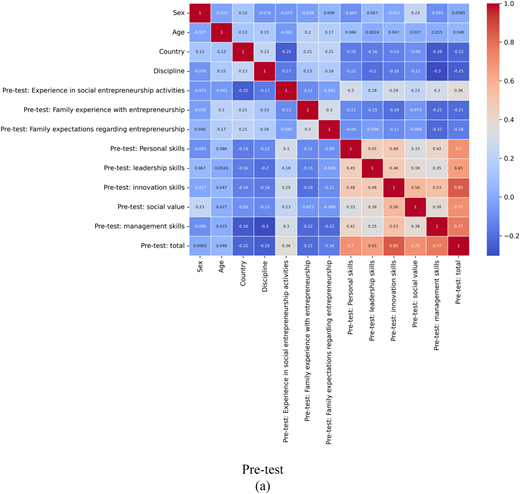
 The first heatmap is labeled “(a) Pre-test”. The heatmap has a horizontal axis labeled from left to right as “Sex”, “Age”, “Country”, “Discipline”, “Pre-test: Experience in social entrepreneurship activities”, “Pre-test: Family experience with entrepreneurship”, “Pre-test: Family expectations regarding entrepreneurship”, “Pre-test: Personal skills”, “Pre-test: Leadership skills”, “Pre-test: Innovation skills”, “Pre-test: Social value”, “Pre-test: Management skills”, and “Pre-test: Total”. The vertical axis is labeled from top to bottom using the same sequence of variables. A colour scale is displayed on the right side of the heatmap, ranging from negative 0.2 in dark blue at the bottom to 1.00 in dark red at the top, with lighter shades of blue and red indicating weaker correlations. The entries in the matrix are as follows. Sex: Sex: 1, Age: negative 0.027, Country: 0.12, Discipline: negative 0.078, Pre-test: Experience in social entrepreneurship activities: negative 0.073, Pre-test: Family experience with entrepreneurship: negative 0.039, Pre-test: Family expectations regarding entrepreneurship: 0.046, Pre-test: Personal skills: negative 0.093, Pre-test: Leadership skills: 0.067, Pre-test: Innovation skills: negative 0.017, Pre-test: Social value: 0.23, Pre-test: Management skills: negative 0.095, and Pre-test: Total: negative 0.0065. Age: Sex: negative 0.027, Age: 1, Country: 0.12, Discipline: 0.15, Pre-test: Experience in social entrepreneurship activities: negative 0.061, Pre-test: Family experience with entrepreneurship: 0.2, Pre-test: Family expectations regarding entrepreneurship: 0.17, Pre-test: Personal skills: 0.086, Pre-test: Leadership skills: 0.0024, Pre-test: Innovation skills: 0.047, Pre-test: Social value: 0.027, Pre-test: Management skills: 0.015, and Pre-test: Total: 0.048. Country: Sex: 0.12, Age: 0.12, Country: 1, Discipline: 0.23, Pre-test: Experience in social entrepreneurship activities: negative 0.25, Pre-test: Family experience with entrepreneurship: negative 0.21, Pre-test: Family expectations regarding entrepreneurship: 0.21, Pre-test: Personal skills: negative 0.16, Pre-test: Leadership skills: negative 0.16, Pre-test: Innovation skills: negative 0.14, Pre-test: Social value: negative 0.09, Pre-test: Management skills: negative 0.26, and Pre-test: Total: negative 0.22. Discipline: Sex: negative 0.078, Age: 0.15, Country: 0.23, Discipline: 1, Pre-test: Experience in social entrepreneurship activities: negative 0.17, Pre-test: Family experience with entrepreneurship: 0.13, Pre-test: Family expectations regarding entrepreneurship: 0.16, Pre-test: Personal skills: negative 0.12, Pre-test: Leadership skills: negative 0.2, Pre-test: Innovation skills: negative 0.16, Pre-test: Social value: negative 0.11, Pre-test: Management skills: negative 0.3, and Pre-test: Total: negative 0.25. Pre-test: Experience in social entrepreneurship activities: Sex: negative 0.073, Age: negative 0.061, Country: negative 0.25, Discipline: negative 0.17, Pre-test: Experience in social entrepreneurship activities: 1, Pre-test: Family experience with entrepreneurship: negative 0.11, Pre-test: Family expectations regarding entrepreneurship: negative 0.041, Pre-test: Personal skills: 0.3, Pre-test: Leadership skills: 0.18, Pre-test: Innovation skills: 0.29, Pre-test: Social value: negative 0.23, Pre-test: Management skills: negative 0.3, and Pre-test: Total: 0.36. Pre-test: Family experience with entrepreneurship: Sex: negative 0.039, Age: 0.2, Country: 0.21, Discipline: 0.13, Pre-test: Experience in social entrepreneurship activities: negative 0.11, Pre-test: Family experience with entrepreneurship: 1, Pre-test: Family expectations regarding entrepreneurship: 0.3, Pre-test: Personal skills: negative 0.11, Pre-test: Leadership skills: negative 0.15, Pre-test: Innovation skills: negative 0.19, Pre-test: Social value: negative 0.073, Pre-test: Management skills: negative 0.22, and Pre-test: Total: negative 0.21. Pre-test: Family expectations regarding entrepreneurship: Sex: 0.046, Age: 0.17, Country: 0.21, Discipline: 0.16, Pre-test: Experience in social entrepreneurship activities: negative 0.041, Pre-test: Family experience with entrepreneurship: 0.3, Pre-test: Family expectations regarding entrepreneurship: 1, Pre-test: Personal skills: negative 0.09, Pre-test: Leadership skills: negative 0.046, Pre-test: Innovation skills: negative 0.11, Pre-test: Social value: negative 0.068, Pre-test: Management skills: negative 0.22, and Pre-test: Total: negative 0.16. Pre-test: Personal skills: Sex: negative 0.093, Age: 0.086, Country: negative 0.16, Discipline: negative 0.12, Pre-test: Experience in social entrepreneurship activities: 0.3, Pre-test: Family experience with entrepreneurship: negative 0.11, Pre-test: Family expectations regarding entrepreneurship: negative 0.09, Pre-test: Personal skills: 1, Pre-test: Leadership skills: 0.45, Pre-test: Innovation skills: 0.48, Pre-test: Social value: 0.33, Pre-test: Management skills: 0.42, and Pre-test: Total: 0.7. Pre-test: Leadership skills: Sex: 0.067, Age: 0.0024, Country: negative 0.16, Discipline: negative 0.2, Pre-test: Experience in social entrepreneurship activities: 0.18, Pre-test: Family experience with entrepreneurship: negative 0.15, Pre-test: Family expectations regarding entrepreneurship: negative 0.046, Pre-test: Personal skills: 0.45, Pre-test: Leadership skills: 1, Pre-test: Innovation skills: 0.48, Pre-test: Social value: 0.38, Pre-test: Management skills: 0.35, and Pre-test: Total: 0.65. Pre-test: Innovation skills: Sex: negative 0.017, Age: 0.047, Country: negative 0.14, Discipline: negative 0.16, Pre-test: Experience in social entrepreneurship activities: 0.29, Pre-test: Family experience with entrepreneurship: negative 0.19, Pre-test: Family expectations regarding entrepreneurship: negative 0.11, Pre-test: Personal skills: 0.48, Pre-test: Leadership skills: 0.48, Pre-test: Innovation skills: 1, Pre-test: Social value: 0.56, Pre-test: Management skills: 0.53, and Pre-test: Total: 0.85. Pre-test: Social value: Sex: 0.23, Age: 0.027, Country: negative 0.09, Discipline: negative 0.11, Pre-test: Experience in social entrepreneurship activities: 0.23, Pre-test: Family experience with entrepreneurship: negative 0.068, Pre-test: Family expectations regarding entrepreneurship: 0.33, Pre-test: Personal skills: 0.38, Pre-test: Leadership skills: 0.38, Pre-test: Innovation skills: 0.56, Pre-test: Social value: 1, Pre-test: Management skills: 0.38, and Pre-test: Total: 0.71. Pre-test: Management skills: Sex: negative 0.095, Age: 0.015, Country: negative 0.26, Discipline: negative 0.3, Pre-test: Experience in social entrepreneurship activities: negative 0.3, Pre-test: Family experience with entrepreneurship: negative 0.22, Pre-test: Family expectations regarding entrepreneurship: negative 0.22, Pre-test: Personal skills: 0.42, Pre-test: Leadership skills: 0.35, Pre-test: Innovation skills: 0.53, Pre-test: Social value: 0.38, Pre-test: Management skills: 1, and Pre-test: Total: 0.77. Pre-test: Total: Sex: negative 0.0065, Age: 0.048, Country: negative 0.22, Discipline: negative 0.25, Pre-test: Experience in social entrepreneurship activities: 0.36, Pre-test: Family experience with entrepreneurship: negative 0.21, Pre-test: Family expectations regarding entrepreneurship: negative 0.16, Pre-test: Personal skills: 0.7, Pre-test: Leadership skills: 0.65, Pre-test: Innovation skills: 0.85, Pre-test: Social value: 0.71, Pre-test: Management skills: 0.77, and Pre-test: Total: 1. The second heatmap is labeled “(b) Post-test”. The horizontal and vertical axes use the corresponding post-test variables. A colour scale on the right ranges from negative 0.2 in dark blue to 1.00 in dark red. The matrix entries are as follows. Sex: Sex: 1, Age: negative 0.027, Country: 0.12, Discipline: negative 0.078, Post-test: Experience in social entrepreneurship activities: 0.013, Post-test: Family experience with entrepreneurship: 0.015, Post-test: Family expectations regarding entrepreneurship: 0.1, Post-test: Personal skills: negative 0.1, Post-test: Leadership skills: 0.056, Post-test: Innovation skills: negative 0.065, Post-test: Social value: 0.12, Post-test: Management skills: negative 0.061, and Post-test: Total: negative 0.03. Age: Sex: negative 0.027, Age: 1, Country: 0.12, Discipline: 0.15, Post-test: Experience in social entrepreneurship activities: negative 0.053, Post-test: Family experience with entrepreneurship: 0.26, Post-test: Family expectations regarding entrepreneurship: 0.16, Post-test: Personal skills: 0.12, Post-test: Leadership skills: 0.075, Post-test: Innovation skills: 0.039, Post-test: Social value: 0.048, Post-test: Management skills: negative 0.011, and Post-test: Total: 0.059. Country: Sex: 0.12, Age: 0.12, Country: 1, Discipline: 0.23, Post-test: Experience in social entrepreneurship activities: negative 0.18, Post-test: Family experience with entrepreneurship: 0.25, Post-test: Family expectations regarding entrepreneurship: 0.22, Post-test: Personal skills: negative 0.18, Post-test: Leadership skills: negative 0.17, Post-test: Innovation skills: negative 0.24, Post-test: Social value: negative 0.078, Post-test: Management skills: negative 0.24, and Post-test: Total: negative 0.25. Discipline: Sex: negative 0.078, Age: 0.15, Country: 0.23, Discipline: 1, Post-test: Experience in social entrepreneurship activities: negative 0.083, Post-test: Family experience with entrepreneurship: 0.17, Post-test: Family expectations regarding entrepreneurship: 0.16, Post-test: Personal skills: negative 0.13, Post-test: Leadership skills: negative 0.16, Post-test: Innovation skills: negative 0.11, Post-test: Social value: negative 0.098, Post-test: Management skills: negative 0.28, and Post-test: Total: negative 0.21. Post-test: Experience in social entrepreneurship activities: Sex: 0.013, Age: negative 0.053, Country: negative 0.18, Discipline: negative 0.083, Post-test: Experience in social entrepreneurship activities: 1, Post-test: Family experience with entrepreneurship: negative 0.091, Post-test: Family expectations regarding entrepreneurship: negative 0.07, Post-test: Personal skills: 0.32, Post-test: Leadership skills: 0.2, Post-test: Innovation skills: 0.32, Post-test: Social value: 0.3, Post-test: Management skills: 0.21, and Post-test: Total: 0.35. Post-test: Family experience with entrepreneurship: Sex: 0.015, Age: 0.26, Country: 0.25, Discipline: 0.17, Post-test: Experience in social entrepreneurship activities: negative 0.091, Post-test: Family experience with entrepreneurship: 1, Post-test: Family expectations regarding entrepreneurship: 0.4, Post-test: Personal skills: negative 0.11, Post-test: Leadership skills: negative 0.12, Post-test: Innovation skills: negative 0.14, Post-test: Social value: negative 0.14, Post-test: Management skills: negative 0.2, and Post-test: Total: negative 0.19. Post-test: Family expectations regarding entrepreneurship: Sex: 0.1, Age: 0.16, Country: 0.22, Discipline: 0.16, Post-test: Experience in social entrepreneurship activities: negative 0.07, Post-test: Family experience with entrepreneurship: 0.4, Post-test: Family expectations regarding entrepreneurship: 1, Post-test: Personal skills: negative 0.11, Post-test: Leadership skills: negative 0.12, Post-test: Innovation skills: negative 0.15, Post-test: Social value: negative 0.11, Post-test: Management skills: negative 0.27, and Post-test: Total: negative 0.21. Post-test: Personal skills: Sex: negative 0.1, Age: 0.12, Country: negative 0.18, Discipline: negative 0.13, Post-test: Experience in social entrepreneurship activities: 0.32, Post-test: Family experience with entrepreneurship: negative 0.11, Post-test: Family expectations regarding entrepreneurship: negative 0.11, Post-test: Personal skills: 1, Post-test: Leadership skills: 0.5, Post-test: Innovation skills: 0.49, Post-test: Social value: 0.48, Post-test: Management skills: 0.4, and Post-test: Total: 0.72. Post-test: Leadership skills: Sex: 0.056, Age: 0.075, Country: negative 0.17, Discipline: negative 0.16, Post-test: Experience in social entrepreneurship activities: 0.2, Post-test: Family experience with entrepreneurship: negative 0.12, Post-test: Family expectations regarding entrepreneurship: negative 0.12, Post-test: Personal skills: 0.5, Post-test: Leadership skills: 1, Post-test: Innovation skills: 0.51, Post-test: Social value: 0.49, Post-test: Management skills: 0.36, and Post-test: Total: 0.69. Post-test: Innovation skills: Sex: negative 0.065, Age: 0.039, Country: negative 0.24, Discipline: negative 0.11, Post-test: Experience in social entrepreneurship activities: 0.32, Post-test: Family experience with entrepreneurship: negative 0.14, Post-test: Family expectations regarding entrepreneurship: negative 0.15, Post-test: Personal skills: 0.49, Post-test: Leadership skills: 0.51, Post-test: Innovation skills: 1, Post-test: Social value: 0.61, Post-test: Management skills: 0.57, and Post-test: Total: 0.86. Post-test: Social value: Sex: 0.12, Age: 0.048, Country: negative 0.078, Discipline: negative 0.098, Post-test: Experience in social entrepreneurship activities: 0.3, Post-test: Family experience with entrepreneurship: negative 0.14, Post-test: Family expectations regarding entrepreneurship: negative 0.11, Post-test: Personal skills: 0.48, Post-test: Leadership skills: 0.49, Post-test: Innovation skills: 0.61, Post-test: Social value: 1, Post-test: Management skills: 0.41, and Post-test: Total: 0.76. Post-test: Management skills: Sex: negative 0.061, Age: negative 0.011, Country: negative 0.24, Discipline: negative 0.28, Post-test: Experience in social entrepreneurship activities: 0.21, Post-test: Family experience with entrepreneurship: negative 0.2, Post-test: Family expectations regarding entrepreneurship: negative 0.27, Post-test: Personal skills: 0.4, Post-test: Leadership skills: 0.36, Post-test: Innovation skills: 0.57, Post-test: Social value: 0.41, Post-test: Management skills: 1, and Post-test: Total: 0.77. Post-test: Total: Sex: negative 0.03, Age: 0.059, Country: negative 0.25, Discipline: negative 0.21, Post-test: Experience in social entrepreneurship activities: 0.35, Post-test: Family experience with entrepreneurship: negative 0.19, Post-test: Family expectations regarding entrepreneurship: negative 0.21, Post-test: Personal skills: 0.72, Post-test: Leadership skills: 0.69, Post-test: Innovation skills: 0.86, Post-test: Social value: 0.76, Post-test: Management skills: 0.77, and Post-test: Total: 1.
Heatmaps (a) pre and (b) post entrepreneurial interventions
The first heatmap is labeled “(a) Pre-test”. The heatmap has a horizontal axis labeled from left to right as “Sex”, “Age”, “Country”, “Discipline”, “Pre-test: Experience in social entrepreneurship activities”, “Pre-test: Family experience with entrepreneurship”, “Pre-test: Family expectations regarding entrepreneurship”, “Pre-test: Personal skills”, “Pre-test: Leadership skills”, “Pre-test: Innovation skills”, “Pre-test: Social value”, “Pre-test: Management skills”, and “Pre-test: Total”. The vertical axis is labeled from top to bottom using the same sequence of variables. A colour scale is displayed on the right side of the heatmap, ranging from negative 0.2 in dark blue at the bottom to 1.00 in dark red at the top, with lighter shades of blue and red indicating weaker correlations. The entries in the matrix are as follows. Sex: Sex: 1, Age: negative 0.027, Country: 0.12, Discipline: negative 0.078, Pre-test: Experience in social entrepreneurship activities: negative 0.073, Pre-test: Family experience with entrepreneurship: negative 0.039, Pre-test: Family expectations regarding entrepreneurship: 0.046, Pre-test: Personal skills: negative 0.093, Pre-test: Leadership skills: 0.067, Pre-test: Innovation skills: negative 0.017, Pre-test: Social value: 0.23, Pre-test: Management skills: negative 0.095, and Pre-test: Total: negative 0.0065. Age: Sex: negative 0.027, Age: 1, Country: 0.12, Discipline: 0.15, Pre-test: Experience in social entrepreneurship activities: negative 0.061, Pre-test: Family experience with entrepreneurship: 0.2, Pre-test: Family expectations regarding entrepreneurship: 0.17, Pre-test: Personal skills: 0.086, Pre-test: Leadership skills: 0.0024, Pre-test: Innovation skills: 0.047, Pre-test: Social value: 0.027, Pre-test: Management skills: 0.015, and Pre-test: Total: 0.048. Country: Sex: 0.12, Age: 0.12, Country: 1, Discipline: 0.23, Pre-test: Experience in social entrepreneurship activities: negative 0.25, Pre-test: Family experience with entrepreneurship: negative 0.21, Pre-test: Family expectations regarding entrepreneurship: 0.21, Pre-test: Personal skills: negative 0.16, Pre-test: Leadership skills: negative 0.16, Pre-test: Innovation skills: negative 0.14, Pre-test: Social value: negative 0.09, Pre-test: Management skills: negative 0.26, and Pre-test: Total: negative 0.22. Discipline: Sex: negative 0.078, Age: 0.15, Country: 0.23, Discipline: 1, Pre-test: Experience in social entrepreneurship activities: negative 0.17, Pre-test: Family experience with entrepreneurship: 0.13, Pre-test: Family expectations regarding entrepreneurship: 0.16, Pre-test: Personal skills: negative 0.12, Pre-test: Leadership skills: negative 0.2, Pre-test: Innovation skills: negative 0.16, Pre-test: Social value: negative 0.11, Pre-test: Management skills: negative 0.3, and Pre-test: Total: negative 0.25. Pre-test: Experience in social entrepreneurship activities: Sex: negative 0.073, Age: negative 0.061, Country: negative 0.25, Discipline: negative 0.17, Pre-test: Experience in social entrepreneurship activities: 1, Pre-test: Family experience with entrepreneurship: negative 0.11, Pre-test: Family expectations regarding entrepreneurship: negative 0.041, Pre-test: Personal skills: 0.3, Pre-test: Leadership skills: 0.18, Pre-test: Innovation skills: 0.29, Pre-test: Social value: negative 0.23, Pre-test: Management skills: negative 0.3, and Pre-test: Total: 0.36. Pre-test: Family experience with entrepreneurship: Sex: negative 0.039, Age: 0.2, Country: 0.21, Discipline: 0.13, Pre-test: Experience in social entrepreneurship activities: negative 0.11, Pre-test: Family experience with entrepreneurship: 1, Pre-test: Family expectations regarding entrepreneurship: 0.3, Pre-test: Personal skills: negative 0.11, Pre-test: Leadership skills: negative 0.15, Pre-test: Innovation skills: negative 0.19, Pre-test: Social value: negative 0.073, Pre-test: Management skills: negative 0.22, and Pre-test: Total: negative 0.21. Pre-test: Family expectations regarding entrepreneurship: Sex: 0.046, Age: 0.17, Country: 0.21, Discipline: 0.16, Pre-test: Experience in social entrepreneurship activities: negative 0.041, Pre-test: Family experience with entrepreneurship: 0.3, Pre-test: Family expectations regarding entrepreneurship: 1, Pre-test: Personal skills: negative 0.09, Pre-test: Leadership skills: negative 0.046, Pre-test: Innovation skills: negative 0.11, Pre-test: Social value: negative 0.068, Pre-test: Management skills: negative 0.22, and Pre-test: Total: negative 0.16. Pre-test: Personal skills: Sex: negative 0.093, Age: 0.086, Country: negative 0.16, Discipline: negative 0.12, Pre-test: Experience in social entrepreneurship activities: 0.3, Pre-test: Family experience with entrepreneurship: negative 0.11, Pre-test: Family expectations regarding entrepreneurship: negative 0.09, Pre-test: Personal skills: 1, Pre-test: Leadership skills: 0.45, Pre-test: Innovation skills: 0.48, Pre-test: Social value: 0.33, Pre-test: Management skills: 0.42, and Pre-test: Total: 0.7. Pre-test: Leadership skills: Sex: 0.067, Age: 0.0024, Country: negative 0.16, Discipline: negative 0.2, Pre-test: Experience in social entrepreneurship activities: 0.18, Pre-test: Family experience with entrepreneurship: negative 0.15, Pre-test: Family expectations regarding entrepreneurship: negative 0.046, Pre-test: Personal skills: 0.45, Pre-test: Leadership skills: 1, Pre-test: Innovation skills: 0.48, Pre-test: Social value: 0.38, Pre-test: Management skills: 0.35, and Pre-test: Total: 0.65. Pre-test: Innovation skills: Sex: negative 0.017, Age: 0.047, Country: negative 0.14, Discipline: negative 0.16, Pre-test: Experience in social entrepreneurship activities: 0.29, Pre-test: Family experience with entrepreneurship: negative 0.19, Pre-test: Family expectations regarding entrepreneurship: negative 0.11, Pre-test: Personal skills: 0.48, Pre-test: Leadership skills: 0.48, Pre-test: Innovation skills: 1, Pre-test: Social value: 0.56, Pre-test: Management skills: 0.53, and Pre-test: Total: 0.85. Pre-test: Social value: Sex: 0.23, Age: 0.027, Country: negative 0.09, Discipline: negative 0.11, Pre-test: Experience in social entrepreneurship activities: 0.23, Pre-test: Family experience with entrepreneurship: negative 0.068, Pre-test: Family expectations regarding entrepreneurship: 0.33, Pre-test: Personal skills: 0.38, Pre-test: Leadership skills: 0.38, Pre-test: Innovation skills: 0.56, Pre-test: Social value: 1, Pre-test: Management skills: 0.38, and Pre-test: Total: 0.71. Pre-test: Management skills: Sex: negative 0.095, Age: 0.015, Country: negative 0.26, Discipline: negative 0.3, Pre-test: Experience in social entrepreneurship activities: negative 0.3, Pre-test: Family experience with entrepreneurship: negative 0.22, Pre-test: Family expectations regarding entrepreneurship: negative 0.22, Pre-test: Personal skills: 0.42, Pre-test: Leadership skills: 0.35, Pre-test: Innovation skills: 0.53, Pre-test: Social value: 0.38, Pre-test: Management skills: 1, and Pre-test: Total: 0.77. Pre-test: Total: Sex: negative 0.0065, Age: 0.048, Country: negative 0.22, Discipline: negative 0.25, Pre-test: Experience in social entrepreneurship activities: 0.36, Pre-test: Family experience with entrepreneurship: negative 0.21, Pre-test: Family expectations regarding entrepreneurship: negative 0.16, Pre-test: Personal skills: 0.7, Pre-test: Leadership skills: 0.65, Pre-test: Innovation skills: 0.85, Pre-test: Social value: 0.71, Pre-test: Management skills: 0.77, and Pre-test: Total: 1. The second heatmap is labeled “(b) Post-test”. The horizontal and vertical axes use the corresponding post-test variables. A colour scale on the right ranges from negative 0.2 in dark blue to 1.00 in dark red. The matrix entries are as follows. Sex: Sex: 1, Age: negative 0.027, Country: 0.12, Discipline: negative 0.078, Post-test: Experience in social entrepreneurship activities: 0.013, Post-test: Family experience with entrepreneurship: 0.015, Post-test: Family expectations regarding entrepreneurship: 0.1, Post-test: Personal skills: negative 0.1, Post-test: Leadership skills: 0.056, Post-test: Innovation skills: negative 0.065, Post-test: Social value: 0.12, Post-test: Management skills: negative 0.061, and Post-test: Total: negative 0.03. Age: Sex: negative 0.027, Age: 1, Country: 0.12, Discipline: 0.15, Post-test: Experience in social entrepreneurship activities: negative 0.053, Post-test: Family experience with entrepreneurship: 0.26, Post-test: Family expectations regarding entrepreneurship: 0.16, Post-test: Personal skills: 0.12, Post-test: Leadership skills: 0.075, Post-test: Innovation skills: 0.039, Post-test: Social value: 0.048, Post-test: Management skills: negative 0.011, and Post-test: Total: 0.059. Country: Sex: 0.12, Age: 0.12, Country: 1, Discipline: 0.23, Post-test: Experience in social entrepreneurship activities: negative 0.18, Post-test: Family experience with entrepreneurship: 0.25, Post-test: Family expectations regarding entrepreneurship: 0.22, Post-test: Personal skills: negative 0.18, Post-test: Leadership skills: negative 0.17, Post-test: Innovation skills: negative 0.24, Post-test: Social value: negative 0.078, Post-test: Management skills: negative 0.24, and Post-test: Total: negative 0.25. Discipline: Sex: negative 0.078, Age: 0.15, Country: 0.23, Discipline: 1, Post-test: Experience in social entrepreneurship activities: negative 0.083, Post-test: Family experience with entrepreneurship: 0.17, Post-test: Family expectations regarding entrepreneurship: 0.16, Post-test: Personal skills: negative 0.13, Post-test: Leadership skills: negative 0.16, Post-test: Innovation skills: negative 0.11, Post-test: Social value: negative 0.098, Post-test: Management skills: negative 0.28, and Post-test: Total: negative 0.21. Post-test: Experience in social entrepreneurship activities: Sex: 0.013, Age: negative 0.053, Country: negative 0.18, Discipline: negative 0.083, Post-test: Experience in social entrepreneurship activities: 1, Post-test: Family experience with entrepreneurship: negative 0.091, Post-test: Family expectations regarding entrepreneurship: negative 0.07, Post-test: Personal skills: 0.32, Post-test: Leadership skills: 0.2, Post-test: Innovation skills: 0.32, Post-test: Social value: 0.3, Post-test: Management skills: 0.21, and Post-test: Total: 0.35. Post-test: Family experience with entrepreneurship: Sex: 0.015, Age: 0.26, Country: 0.25, Discipline: 0.17, Post-test: Experience in social entrepreneurship activities: negative 0.091, Post-test: Family experience with entrepreneurship: 1, Post-test: Family expectations regarding entrepreneurship: 0.4, Post-test: Personal skills: negative 0.11, Post-test: Leadership skills: negative 0.12, Post-test: Innovation skills: negative 0.14, Post-test: Social value: negative 0.14, Post-test: Management skills: negative 0.2, and Post-test: Total: negative 0.19. Post-test: Family expectations regarding entrepreneurship: Sex: 0.1, Age: 0.16, Country: 0.22, Discipline: 0.16, Post-test: Experience in social entrepreneurship activities: negative 0.07, Post-test: Family experience with entrepreneurship: 0.4, Post-test: Family expectations regarding entrepreneurship: 1, Post-test: Personal skills: negative 0.11, Post-test: Leadership skills: negative 0.12, Post-test: Innovation skills: negative 0.15, Post-test: Social value: negative 0.11, Post-test: Management skills: negative 0.27, and Post-test: Total: negative 0.21. Post-test: Personal skills: Sex: negative 0.1, Age: 0.12, Country: negative 0.18, Discipline: negative 0.13, Post-test: Experience in social entrepreneurship activities: 0.32, Post-test: Family experience with entrepreneurship: negative 0.11, Post-test: Family expectations regarding entrepreneurship: negative 0.11, Post-test: Personal skills: 1, Post-test: Leadership skills: 0.5, Post-test: Innovation skills: 0.49, Post-test: Social value: 0.48, Post-test: Management skills: 0.4, and Post-test: Total: 0.72. Post-test: Leadership skills: Sex: 0.056, Age: 0.075, Country: negative 0.17, Discipline: negative 0.16, Post-test: Experience in social entrepreneurship activities: 0.2, Post-test: Family experience with entrepreneurship: negative 0.12, Post-test: Family expectations regarding entrepreneurship: negative 0.12, Post-test: Personal skills: 0.5, Post-test: Leadership skills: 1, Post-test: Innovation skills: 0.51, Post-test: Social value: 0.49, Post-test: Management skills: 0.36, and Post-test: Total: 0.69. Post-test: Innovation skills: Sex: negative 0.065, Age: 0.039, Country: negative 0.24, Discipline: negative 0.11, Post-test: Experience in social entrepreneurship activities: 0.32, Post-test: Family experience with entrepreneurship: negative 0.14, Post-test: Family expectations regarding entrepreneurship: negative 0.15, Post-test: Personal skills: 0.49, Post-test: Leadership skills: 0.51, Post-test: Innovation skills: 1, Post-test: Social value: 0.61, Post-test: Management skills: 0.57, and Post-test: Total: 0.86. Post-test: Social value: Sex: 0.12, Age: 0.048, Country: negative 0.078, Discipline: negative 0.098, Post-test: Experience in social entrepreneurship activities: 0.3, Post-test: Family experience with entrepreneurship: negative 0.14, Post-test: Family expectations regarding entrepreneurship: negative 0.11, Post-test: Personal skills: 0.48, Post-test: Leadership skills: 0.49, Post-test: Innovation skills: 0.61, Post-test: Social value: 1, Post-test: Management skills: 0.41, and Post-test: Total: 0.76. Post-test: Management skills: Sex: negative 0.061, Age: negative 0.011, Country: negative 0.24, Discipline: negative 0.28, Post-test: Experience in social entrepreneurship activities: 0.21, Post-test: Family experience with entrepreneurship: negative 0.2, Post-test: Family expectations regarding entrepreneurship: negative 0.27, Post-test: Personal skills: 0.4, Post-test: Leadership skills: 0.36, Post-test: Innovation skills: 0.57, Post-test: Social value: 0.41, Post-test: Management skills: 1, and Post-test: Total: 0.77. Post-test: Total: Sex: negative 0.03, Age: 0.059, Country: negative 0.25, Discipline: negative 0.21, Post-test: Experience in social entrepreneurship activities: 0.35, Post-test: Family experience with entrepreneurship: negative 0.19, Post-test: Family expectations regarding entrepreneurship: negative 0.21, Post-test: Personal skills: 0.72, Post-test: Leadership skills: 0.69, Post-test: Innovation skills: 0.86, Post-test: Social value: 0.76, Post-test: Management skills: 0.77, and Post-test: Total: 1.Heatmaps (a) pre and (b) post entrepreneurial interventions
Noteworthy in Figure 2 is that the correlation between gender and the total measure of social entrepreneurship is minimal, with coefficients of −0.0065 and −0.03 for pre-test and post-test, respectively. It suggests an initial hypothesis that there may be no substantial correlation between gender and the abilities associated with social entrepreneurship. Similarly, a modest correlation existed between age and the total mean of social entrepreneurship. However, the negative correlation (between −0.22 and −0.25) between the country variable and the total social entrepreneurship mean is intriguing. It implies that Mexico, Austria, and Colombia exhibited a higher tendency toward social entrepreneurship than countries in the lower group, such as Guatemala, Peru, and Argentina. However, the original data reveals that over 95% of the data originated from Mexico as the source country. Consequently, we must conclude that the current dataset lacks sufficient diversity to substantiate this evidence. In other words, it is reasonable to assert that the correlation between the country variable and social entrepreneurship should be disregarded due to the skewed data distribution originating predominantly from Mexico. This observation underscores the importance of considering sample representativeness when interpreting correlation results.
The limitations of using a heatmap based on the Pearson coefficient of correlation are evident, as it can only offer information regarding the degree of correlation among various sets or groups of variables. Thus, it fails to allow a precise understanding of the significance of a particular profile concerning social entrepreneurial abilities. To address this issue, we present an analysis of variance results for both the pre-test and post-test phases, employing the ordinary least squares (OLS) method. Table 2 details the outcomes in two sections. Section (a) of the table illustrates the pre-test results, while section (b) outlines the findings from the post-test. This comprehensive approach allows for a more nuanced examination of the social entrepreneurial abilities associated with specific profiles.
OLS Regression by least squares in (a) pre-test and (b) post-test data
| Statistical measure | Value | Standard error | t-statistic | p-value | 95% confidence interval |
|---|---|---|---|---|---|
| (a) | |||||
| Constant (Intercept) | 3.4887 | 0.160 | 21.793 | 0.000 | [3.174, 3.804] |
| Pretest: gender | 0.0258 | 0.047 | 0.543 | 0.588 | [−0.068, 0.119] |
| Pre-test: age | 0.0121 | 0.004 | 2.720 | 0.007 | [0.003, 0.021] |
| Pre-test: country | −0.0163 | 0.011 | −1.529 | 0.127 | [−0.037, 0.005] |
| Pretest: discipline | −0.0418 | 0.014 | −3.091 | 0.002 | [−0.068, −0.015] |
| Pre-test: experience in social entrepreneurship activities | 0.1775 | 0.031 | 5.706 | 0.000 | [0.116, 0.239] |
| Pre-test: family experience with entrepreneurship | −0.0554 | 0.022 | −2.546 | 0.011 | [−0.098, −0.013] |
| Pre-test: family expectations regarding entrepreneurship | −0.0646 | 0.043 | −1.494 | 0.136 | [−0.150, 0.020] |
| Note(s): Prob (F-statistic): 1.86e−13 | |||||
| (b) | |||||
| Constant (Intercept) | 3.6668 | 0.160 | 22.856 | 0.000 | [3.351, 3.983] |
| Post-test: gender | −0.0105 | 0.048 | −0.218 | 0.828 | [−0.105, 0.084] |
| Post-test: age | 0.0134 | 0.005 | 2.938 | 0.004 | [0.004, 0.022] |
| Post-test: country | −0.0244 | 0.011 | −2.275 | 0.024 | [−0.046, −0.003] |
| Post-test: discipline | −0.0358 | 0.014 | −2.624 | 0.009 | [−0.063, −0.009] |
| Post-test: experience in social entrepreneurship activities | 0.1882 | 0.032 | 5.943 | 0.000 | [0.126, 0.250] |
| Post-test: family experience with entrepreneurship | −0.0375 | 0.022 | −1.703 | 0.090 | [−0.081, 0.006] |
| Post-test: family expectations regarding entrepreneurship | −0.0949 | 0.044 | −2.151 | 0.032 | [−0.182, −0.008] |
Note(s): Prob (F-statistic): 9.28e−14
Source(s): Authors’ own work
In the ANOVA tables for the pre-test and post-test conditions, the p-value of the F-statistics is a critical indicator. This value informs the hypothesis testing, wherein the null hypothesis posits that the regression model is invalid, while the alternative hypothesis suggests the validity of the regression model. The rejection of the null hypothesis is contingent upon the p-value of the F-statistics being less than the predetermined significance level. For both cases, it is noteworthy that the p-values are considerably lower than the significance level, specifically 1.86e-13 for the pre-test and 9.28e-14 for the post-test. This compellingly indicates the validity of the regression model, thereby permitting the use of ANOVA for further interpretations. Certain variables exhibited significance in both instances, as their p-values fell below the significance level. These variables include the intercept, age, discipline, and experience in social entrepreneurship activities.
This observation aligns with the intuitive understanding that factors such as age, discipline, and experience in social entrepreneurship activities play pivotal roles in developing social entrepreneurship competencies. Conversely, the gender variable was found to be insignificant in explaining the variability in the model for both pre-test and post-test conditions, suggesting no discernible gender-related significance in developing social entrepreneurship skills. The pre-test scenario further identified that the “country” variable lacks statistical significance, which is attributable to the limited sampling in other countries. Moreover, family expectations regarding entrepreneurship were found to be non-contributory to this competency in the pre-test, indicating that its development is not contingent upon familial pressure. In conclusion, these findings underscore that the focus for developing new intervention policies should center on age, discipline, experience in social entrepreneurship activities, and family experience with entrepreneurship. These variables emerged as crucial determinants in shaping effective strategies for fostering social entrepreneurship competencies.
After constructing an ANOVA model, which provides insights into the significance of variables in both the pre-test and post-test fitness functions, there is often a desire to represent the distribution of the regression fit visually. Figure 3 presents this graphical representation with part (a) illustrating the pre-test distribution and part (b) the post-test. In Figure 3a, the graph showcases the distribution of the regression fit for the pre-test, offering a visual understanding of how well the model aligns with the observed data. Meanwhile, in Figure 3b, the graphical representation shifts its focus to the post-test, providing a comparable visualization of its regression fit.
 The first graph is labeled “(a)” and the title at the top of the graph reads “Actual versus Predicted Pre-test: total”. The horizontal axis is labeled “Actual Pre-test: total” and ranges from 2.5 to 4.5 in increments of 0.5 units. The vertical axis is labeled “Predicted Pre-test: total” and ranges from 2.5 to 4.5 in increments of 0.5 units. A legend in the upper left corner shows a dashed line labeled “Perfect Fit”. The dashed line begins at the (2.47, 2.46) and slopes upward and ending at the point (4.86, 4.86). Clusters of circular markers scatter around the perfect fit line, showing how closely the model’s predicted Pre-test totals align with the actual Pre-test totals. Most points lie between the Actual values of 3.3 and 4.4 and the predicted values of 3.3 and 4.1. Some data points are as follows (3.36, 4.18) (3.58, 3.96) (3.97, 4.00) (4.03, 3.93) (4.22, 4.10) (3.89, 3.38). The second graph is labeled “(b)” and the title at the top of the graph reads “Actual versus Predicted Post-test: total”. The horizontal axis is labeled “Actual Post-test: total” and ranges from 2.5 to 5.0 in increments of 0.5 units. The vertical axis is labeled “Predicted Post-test: total” and ranges from 2.5 to 5.0 in increments of 0.5 units. A legend in the upper left corner shows a dashed line labeled “Perfect Fit”. The dashed line begins at the (2.56, 2.56) and slopes upward and ending at the point (5.00, 5.00). The circular markers are scattered throughout the plot, showing how closely the predicted Post-test totals match the actual Post-test totals. Most points lie near Actual values between 3.6 and 4.3 and Predicted values between 3.6 and 4.3. Some coordinates of the plotted points include (3.68, 4.47) (3.78, 4.08) (3.96, 3.75) (4.21, 3.80) (3.50, 3.46) (4.47, 3.79) (4.71, 3.99). Note: All numerical data values are approximated.
Representations of regression fit for (a) pre-test and (b) post-test conditions
The first graph is labeled “(a)” and the title at the top of the graph reads “Actual versus Predicted Pre-test: total”. The horizontal axis is labeled “Actual Pre-test: total” and ranges from 2.5 to 4.5 in increments of 0.5 units. The vertical axis is labeled “Predicted Pre-test: total” and ranges from 2.5 to 4.5 in increments of 0.5 units. A legend in the upper left corner shows a dashed line labeled “Perfect Fit”. The dashed line begins at the (2.47, 2.46) and slopes upward and ending at the point (4.86, 4.86). Clusters of circular markers scatter around the perfect fit line, showing how closely the model’s predicted Pre-test totals align with the actual Pre-test totals. Most points lie between the Actual values of 3.3 and 4.4 and the predicted values of 3.3 and 4.1. Some data points are as follows (3.36, 4.18) (3.58, 3.96) (3.97, 4.00) (4.03, 3.93) (4.22, 4.10) (3.89, 3.38). The second graph is labeled “(b)” and the title at the top of the graph reads “Actual versus Predicted Post-test: total”. The horizontal axis is labeled “Actual Post-test: total” and ranges from 2.5 to 5.0 in increments of 0.5 units. The vertical axis is labeled “Predicted Post-test: total” and ranges from 2.5 to 5.0 in increments of 0.5 units. A legend in the upper left corner shows a dashed line labeled “Perfect Fit”. The dashed line begins at the (2.56, 2.56) and slopes upward and ending at the point (5.00, 5.00). The circular markers are scattered throughout the plot, showing how closely the predicted Post-test totals match the actual Post-test totals. Most points lie near Actual values between 3.6 and 4.3 and Predicted values between 3.6 and 4.3. Some coordinates of the plotted points include (3.68, 4.47) (3.78, 4.08) (3.96, 3.75) (4.21, 3.80) (3.50, 3.46) (4.47, 3.79) (4.71, 3.99). Note: All numerical data values are approximated.Representations of regression fit for (a) pre-test and (b) post-test conditions
Regression fitting for a dataset with a social analysis presents notable challenges, primarily due to the uncontrollable nature of the variables involved; they can only be measured, not controlled. Moreover, the outcomes, i.e. entrepreneurial competencies, do not indicate a straightforward one-to-one relationship with the profile. The same profile can manifest diverse entrepreneurial competencies. This complexity is evident in both graphs, highlighting a considerable degree of multicollinearity. In simpler terms, the graphs show no unique correlation between input profiles and entrepreneurial competencies; instead, multiple potential outcomes exist for the same input profile.
Consequently, the coefficient of determination for both graphs hovers around 0.20. Achieving a high fit of regression would necessitate more advanced machine learning methods. However, it is essential to note that the level of significance revealed by the analysis of variance provides valuable information for improving intervention methods. Despite the inherent complexity and variability in the relationship between input profiles and entrepreneurial competencies, the significance levels extracted from the analysis of variance offer actionable insights. While achieving a precise regression fit may be challenging, the identified significant variables can guide the development of more effective intervention strategies, leveraging the insights gleaned from the existing analysis.
4. Discussion
The current challenges of complex reality demand effective strategies for competency development in students, aligned with their social values and the maturation of personal skills. As seen in Figure 1, the intervention process proved to be an effective strategy to promote innovation and leadership skills while confirming that the intervention did not significantly affect management, social value, and personal skills. In this sense, we evaluated skills and disposition for entrepreneurial intentions (Hockerts, 2018) to find the proper path for their stimulation and evolution. The follow-up of this study should emphasize strategies for self-awareness, emotional intelligence, and personal development to increase students' understanding and commitment to positive social impact from their organizational and strategic planning abilities.
A relevant consideration for social entrepreneurship educational content is addressing diversity in every aspect of the educational experience. As shown in the pre and post-heatmaps of Figure 2, there is a modest or no correlation between gender and the total social entrepreneurship indicator, which suggests that the intervention had no specific impact on these variables. Diverse entrepreneurial ecosystems foster horizontal collaboration among entrepreneurs and stakeholders, nurturing the conditions to create value and strengthen workgroups in achieving common objectives (Znagui and Rahmouni, 2019). From that observation, we can confirm that the intervention was applied in equal conditions for gender and that ecosystems promoting social entrepreneurship can sustain straightforward machine learning methods for evaluating this variable.
To develop inclusive and effective strategies regarding entrepreneurship, higher education institutions (HEIs) seek to identify abilities, profiles, and personality traits to anticipate the higher probabilities for students' future social entrepreneurial paths. Table 1 shows that the focal points for developing future intervention policies should include age, discipline, experience in social entrepreneurship activities, and family experience with entrepreneurship. The literature findings suggest that cognitive factors such as environment, perceptions, and previous experiences should be integrated (Maheshwari et al., 2022). Therefore, the key variables of interventional designs must include diversity in the abovementioned variables, such as a sample that included HEI students from public, private, and marginal contexts.
Complex thinking, a meta competency to develop in HEI students, involves understanding and envisioning relations and interconnections of topics, data, and agencies. From the study (see Figure 3), we learned that there are multiple potential outcomes for the same input profile; therefore, a more advanced machine-learning method would support improving intervention strategies. As social entrepreneurship is a competency required for every discipline and learners need a tool to generate social and environmental value (Gupta et al., 2020; Vásquez et al., 2020), developing complex thinking can be a helpful educational strategy for future educational environments.
5. Conclusion
We presented an evaluation of the impact of an educational intervention on social entrepreneurship in HEIs through a multivariate prediction model. The findings showed that it is necessary to emphasize strategies to improve self-awareness, emotional intelligence, and personal development in educational interventions. We also confirmed that the interventions could be evaluated by simple machine learning methods, examining variables such as gender, age, or location, although there must be a further revision of machine learning methods to search for practical tools to create and evaluate social entrepreneurship interventions for HEI students in diverse contexts.
This research contributes to social entrepreneurship education by providing empirical evidence of the effectiveness of entrepreneurial interventions in HEIs. It underscores the importance of integrating social entrepreneurship education across various disciplines beyond traditional business school curricula.
Skills Development: The positive changes in the pre-and post-test scores indicate that entrepreneurial interventions effectively enhanced key competencies in social entrepreneurship.
Background factors: Variables like discipline, experience in social entrepreneurship activities, and family experience with entrepreneurship showed significant changes post-intervention, highlighting the importance of considering students' backgrounds in designing and tailoring entrepreneurial programs.
Gender and age factors: While the study showed minor changes based on gender, age appeared to be a more influential factor, suggesting that entrepreneurial tendencies might develop or change with age.
Cultural and environmental factors: The study highlighted the influence of cultural and environmental factors on the development of entrepreneurial skills, as indicated by the variable changes related to the country of origin.
The study’s findings have significant implications for entrepreneurial interventions in higher education institutions (HEIs). The observed improvements suggest that such courses effectively equip students with the necessary skills to become successful social entrepreneurs, addressing the growing need for innovative solutions to social and environmental challenges.
This research addresses several gaps identified in the literature on social entrepreneurship education, providing both empirical contributions and recommendations for future research and practical applications. Firstly, the study responds to the scarcity of research evaluating the long-term impact of educational interventions in social entrepreneurship, a gap noted by Hussein et al. (2024). Through pre- and post-intervention analysis, this study offers a rigorous assessment of competencies such as leadership and innovation—areas previously underexplored using robust methods and multivariate analysis. Additionally, the study highlights the importance of integrating technological tools into social entrepreneurship education and proposes implementing experiential and collaborative learning approaches through real-world projects.
From a practical perspective, the research has significant implications for educational program designers. It demonstrates that theoretical teaching alone is insufficient for developing competencies in social entrepreneurship. Instead, it suggests that educational interventions should include practical experiences, co-creation with external stakeholders, and the use of technology to enhance learning outcomes. These findings provide a framework for higher education institutions to adjust their programs and pedagogical approaches to better foster critical skills in students, including the ability to identify and capitalize on opportunities for social and environmental value creation.
Regarding societal implications, the study reinforces the importance of social entrepreneurship as a crucial tool for addressing social and environmental challenges. By evidencing the positive impact of educational interventions on leadership and innovation competencies, the study suggests that greater integration of social entrepreneurship into education can empower future professionals to become change agents in their communities. It also underscores the need to strengthen partnerships between universities, businesses, and local communities to ensure that learning aligns with real-world challenges and generates tangible social impact.
Moreover, this research addresses a gap in the rigorous measurement of educational interventions' success, as noted by Karatas-Ozkan et al. (2023), by employing solid statistical methods such as Ordinary Least Squares regression and analysis of variance (ANOVA) to assess intervention impacts. This approach offers a replicable model useful for future studies evaluating competency development in different cultural and educational contexts.
However, the intervention had some limitations, including sample diversity, primarily due to the overrepresentation of participants from Mexico, which may affect the generalizability of the findings. Additionally, the reliance on self-reported data and the specific nature of participants' extracurricular experiences may limit the extrapolation of these findings.
Our intervention had some limitations in its sample diversity, primarily due to the overrepresentation of participants from Mexico, which may affect the generalization of the findings. Additionally, the reliance on self-reporting and the specific nature of the student’s extracurricular experiences, backgrounds, and other experiences during interventions may limit the extrapolation of these findings.
For future research, the authors recommend refining machine learning methods, exploring longitudinal studies to assess the long-term impact of entrepreneurial interventions, diversifying the participant sample to enhance the generalizability of findings, adopting holistic educational approaches that transcend traditional disciplines, validating measures through complementary objective methods, and personalizing interventions by considering individual participant factors. These recommendations aim to enrich the understanding and applicability of the results, contributing to the ongoing development of social entrepreneurship education in HEIs.
Research funding: The authors would like to thank Tecnológico de Monterrey for the financial support provided through the 'Challenge-Based Research Funding Program 2023', Project ID #IJXT070-23EG99001, entitled 'Complex Thinking Education for All (CTE4A): A Digital Hub and School for Lifelong Learners.' The authors also acknowledge the technical support of the Writing Lab, Institute for the Future of Education, Tecnologico de Monterrey, Mexico, in the production of this work.
Author contributions: All authors contributed to the study conception and design. Material preparation, data collection and analysis were performed by R-M, M.S., T. R., and C.M., F. The first draft of the manuscript was written by P.-C., M., and A-I, I and all authors commented on previous versions of the manuscript. All authors read and approved the final manuscript.
Availability of data and materials: The datasets used and/or analyzed during the current study are available from the corresponding author on reasonable request.
Competing interests: The authors declare no competing interests.

