


Sociocybernetics
Sociocybernetics
1. Sustainable cities
City in the next millennium. When the programme manager with overall responsibility for the European Foundation for the Improvement of Living and Working Conditions, addressed the European Parliament in Brussels recently, many members were surprised at its content. Voula Mega, who has overall responsibility for the European Foundation's research on urban environments, outlined the challenges facing the future of European cities. Mega was attempting to stimulate dialogue and consultation on the theme "towards an urban agenda", which is a communication distributed by the European Commission.
Mega said that:
Europe is first and foremost urban. As we move towards the 21st century cities seem certain to be the main centres of economic activity, innovation and culture. They all want to win the battle of sustainable development and to become more attractive to people and capital. Change is inevitable. The challenge is how best to manage change in order to achieve the best European future. The Foundation's research suggests that cities are the political institutions that are most able to create new democratic spaces, between the world economic macro-regulations and the micro-regulations of the local communities. The Foundation's project on urban innovations linked up with all European and international efforts to produce best practices and paradigms to inspire and motivate cities.
The search for a sustainable city has been the theme of a major research project carried out by the Foundation since 1993. Called The Overview of Urban Innovations in the European Union, it included the identification and description of 110 creative projects to simulate urban sustainability.
Mega also said that:
The project synthesises information on existing and planned policies as well as actions and research on innovative approaches. It highlights the different approaches where innovative policies have achieved gains towards the sustainable city. The value of this work is that while each city is unique models are universal and important shortcuts can be made by imitation. The city must be socially, economically and environmentally sustainable. A sustainable city cannot be conceived without environmental awareness, social integration, a sustained economy and citizen participation, together in harmonious coevolution.
It was also pointed out that cities need sustainable regions and have enormous potential in promoting sustainable territorial patterns, thus acting as accelerators of balanced regional development.
The project objectives are:
To highlight innovative visions, practices and actions towards the improvement in the quality of the urban environment.
To pull together information on exemplary approaches with innovative policy elements.
To identify ways in which urban innovation can serve sustainability.
To identify concrete interests of the employers and trade union associations on innovations needed for the achievement of the intelligent and sustainable city of the twenty-first century.
Social justice in the city. Even in the most prosperous European cities, we are told, there are "urban islands" where environmental degradation and social exclusion go hand in hand. The spirals of unemployment and exclusion constitute the most severe problems for cities that do not wish to become "dual cities". An estimated 52million people live below the poverty line, with 18 million unemployed and threemillion homeless, according to the research.
Measuring the progress is an important cybernetical principle for any research and this need has been recognised. A methodological framework for success and failure to be evaluated has now been put in place.
Mega also said that the level of awareness varies greatly from city to city. Research has shown that established administrative and financial structures can inhibit the potential of innovative policies. Redressing this problem represents a vast field of innovation and change. Overall, it is believed, top-down models which seek to impose innovation have failed.
The research, it is reported,concluded that cities cannot progress without innovation. Innovation, we are told, will not happen without human creativity and it has to be accepted that success is never certain. Each successful innovation is probably the result of various trials. We are told quite firmly that traditional cost-benefit analysis does not apply in matters of urban sustainability.
The future of cities and the implications to those who inhabit them must become one of the most important studies into the millenium. The search for urban sustainability continues. The cities of the future, we are told, must be socially, economically and environmentally sustainable, cybernetics must surely have a contribution to make to this desirable end.
2. Quantifying risk in society
Sociocyberneticians are now presented with a method of quantifying risk. The recent issue of the Royal Statistical Society News, Vol. 26 No. 2, 1998 (October), looks at the fascinating subject of risk as applied to humans. A note in the issue (pp.10-12)has the objective of attempting to quantify risk. The note is by Frank Duckworth and it follows an editorial in the issue which has the title "A lifetime of risk". What makes this study so interesting is its attempt to set out a structure for defining the various aspects of the "risk" topic and to propose asetof precise mathematical definitions. This, the writer says, is to enableinformation to be provided directly relevant to the decision problemsfaced bythe parties involved. What is of importance is the suggestionthat a"risknumber" may be calculated, which can be displayed on a simple one-dimensional scale that will allow valid comparisions to be made between different types of risks to which the individual may be exposed.
The note defines and discusses the terms to be used, for example:
Definitions: "risk" has itself to be defined, it is a qualitative term which, it is suggested, could be defined as "the potential for exposure to uncertain events, the occurrence of which would have undesirable consequences". This is not in itself a measurable quantity and, we are told, it should not be used synonymously with probability. To "take a risk is to allow or cause exposure to the danger". What is needed, the note says, is a quantity that combines the probability of the undesirable event with the magnitude of the consequence. Hence follows the concept of a "risk magnitude".
Types of risk: types of risk are classified and include such types as: natural; social or industrial; necessities of everyday life; voluntary activities; hostilities (from an organised power); malicious and criminal acts;domestic mishaps; miscellaneous.
Consequences: two types are considered loss of quality of life, and loss of property, i.e. bodily or financial risk.
Imposed and exposed risk: decision processes. The writer believes we should consider two sides to risk. The source, which generates it, and the subject, who is put at risk. Thus, he says, the source imposes a risk on thesubject and the subject is exposed to the risk by the source.
Measurement of risk: risk needs to be measured for both imposed risk and exposed risk. A suitable measure of the risk is the expected loss of taking it, while loss of life (quality of life) requiries more detailed consideration. The writer indicates that if the consequences are financial, then the loss is simply the expectation of monetary loss, dependent only on the degree of exposure of the property at risk. The author devises a loss function for a more quantitive assessment.
He also considers the deferred consequences of risks, the problems of acute, chronic or habitual risk exposure. The measurement of imposed risk is also discussed. His structure of risk is classified into four subdivisions:
imposed or exposed risk;
financial or bodily risk;
immediate or deferred consequence; and
acute, chronic or habitual exposure.
Each of the 24 combinations of these seems to indicate that one might need a separate measure, but the writer does not believe this is so. He says that we only require a single definition of risk magnitude, expressed as either monetary loss; or the number of equivalent instant deaths (imposed) or equivalent probabilty of instant death (exposed). Risk magnitude is then defined and a riskometer introduced, and a risk number(R) is defined.
Based on this thesis, examples of some of the calculated values of the risk number are given in Table I (all figures refer to the UK, with smoking data from British Medical Journal,Vol. 309 No. 6959, 1994, and are lifetime exposures except where a specific exposure is given).
The author of this note, Frank Duckworth, is at pains to point out that his note is an attempt to set out a structure for defining the "risk" topicand the full details are obtainable from the reference given.
In discussing "a lifetime of risk"the editor of the Royal Statistical News says that:
Taking risks is a straightforward example of decision making under uncertainty. In deciding willingly to expose ourselves to danger we are striking a balance between the benefits derived and the possibility of danger becoming a reality with its known consequences. The process is a subjective one and involves our evaluation of the benefits and our perceptions of the risks.
Sociocybernetics involves a study of people in society and also an examination of people's real decisions. Often,we are told, these can be "totally irrational". This is particularly true, it would seem, when they often refuse to take part in activities which have known,but quite negligible, risks yet "fearlessly participate" in those whose dangers are orders of magnitude greater.
We are grateful to the Royal Society of Statistics for putting the matter in perspective and also for illustrating how a mathematical approach to the subject provides a structure for enlightened discussion.
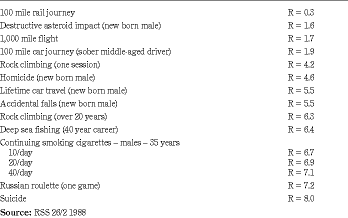
Table I.Examples of risk number

