


Pat Wall
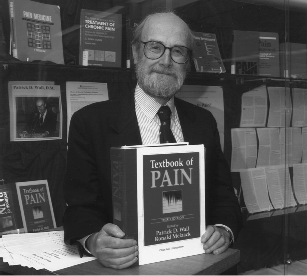
Professor Patrick David Wall FRS died on 8th August 2001, aged 76. Prostate cancer had been recognised for some years, but until very shortly before his death it did not deter him from continuing his research and other activities. He was a pioneer in the scientific study of the nature of pain and in the devising of means of relieving it. With Ronald Melzack he originated the revolutionary"gate control" theory of pain. He was founder and editor of the journal Painand besides developing technical means of dealing with pain he supported initiatives like the setting up of pain clinics and of hospices for terminally-ill patients.
Obituary notices have appeared in Nature (September 27), The Times(August 15), The Guardian (August 16), New York Times (August 21), Irish Times (August 18) and other leading papers. These emphasise his independence of thought and his support for liberal causes the terms "anarchic"and "iconoclastic" appear. The major breakthrough represented by the "gate control" theory showed independence in the scientific context since it was contrary to previously–accepted views. Liberal causes that he supported included opposition to apartheid and to the use of rubber bullets in Northern Ireland.
The notices rightly stress the clinical and humanitarian value of his work,which also sheds much light on the basic working of the nervous system. Investigations contributing to the main theme produced the first demonstration of neural plasticity in adult mammals, as well as suggesting a role for the fine C fibres that are plentiful in the nervous system but for which no function had previously been suggested. Pat Wall was instrumental in setting up the Brain Research Association, later renamed British Neuroscience Association, as the primary British forum for discussion in the field.
Part of the research career was in USA, first in Yale and later in Manteno State Hospital, near Chicago, and then in the Massachusetts Institute of Technology. At Manteno and MIT he was one of a group around Warren McCulloch and including Walter Pitts and Jerry Lettvin. A study was made of transmission in the cat spinal cord using techniques that are described in a paper by Pitts(1953). The insights from this work paved the way for the "gate control" theory,though various other considerations played a part, including observations on the phantom limb pains of amputees. It is, however, interesting and gratifying to note the link between this achievement and the beginnings of Cybernetics. (I was fortunate enough to be invited to join the group in MIT for a time during 1954–55.)
At the same time as this work was in progress in the Research Laboratory of Electronics of MIT, Pat Wall also taught in Harvard Medical School and later ran a separate research group in the Biology Department of MIT. His return to Britain was prompted by his outrage when he was questioned, presumably by the CIA, about political attitudes of research students he had supervised. His refusal to comply produced a warning that this could prejudice the funding of his group's research from government funds.
Fortunately a congenial position was available as head of a Cerebral Function Research Unit in University College, London, and the flow of research findings continued from there, with later changes of location to St. Thomas's Hospital Medical School and then Guy's Hospital. The passing of retirement age made little difference except that freedom from certain administrative chores left more time for research, in which Pat always did practical experimentation himself, and sometimes on himself.
He is survived by his third wife Mary, who kindly supplied the photograph and copies of obituaries. Pat's death is a great loss to her, and to science, and to the world.
Alex M. Andrew
ReferencePitts, Walter (1953), Investigations on synaptic transmissiono, in: von Foerster, Heinz (ed), Cybernetics: Circular Causal and Feedback Mechanisms in Biological and Social Systems (Transactions of the Ninth Conference), Josiah Macy, Jr. Foundation, New York, pp. 159–66.Note:Comprehensive tributes to Pat Wall, with personal reminescences and informed commentaries on his work, appear in the British Neuroscience Association Newsletter, number 40, Autumn/Winter 2001. Authors include Stephen B. McMahon of King's College, London, Maria Fitzgerald of University College,London and Steven Rose of the Open University.

