


Internal control systems are critical to an organization's efficiency and promotes the adherence to norms and rules. The purpose of this study is to evaluate the impact of internal control systems on banking industry effectiveness.
Data were collected from 15 commercial and 20 rural banks. The hypothesized relationships were supported by the data. A structural equation modeling was applied in testing the conceptual model and hypothesis. Confirmatory factor analysis was conducted to establish validity and reliability of the dimensions.
The results show that organizational effectiveness was significantly impacted by three dimensions of internal control systems: control activities, control environments and risk assessment. However, the impact of monitoring of control on organizational effectiveness was not significant. The results also show a nonsignificant impact of information and communication on organizational effectiveness.
Since the current study concentrated on the banking sector with its distinct characteristics, the generalizability of the conclusions may be limited.
The study's findings may aid decision-makers and stakeholders in the adoption, designing and implementation of proactive internal control system to enhance operational efficiency, effectiveness and competitive advantage.
The study advances the literature by empirically evidencing that internal control systems impact organizational effectiveness.
Introduction
The demand for stronger shareholder returns and increase in global market volatility as occasioned the development of internal control mechanisms to boost a company's competitive edge (Bhaskar, Schroeder, & Shepardson, 2019; Rittenberg & Schwieger, 2005; Su, Baird, & Schoch, 2015). As a result of business risk, business transaction complexities, growing use of information technology and globalization, internal controls are becoming increasingly crucial as a component of corporate governance (Alfartoosi & Jusoh, 2021; Le et al., 2020; Odek & Okoth, 2019). An efficient internal control system aids organizations in realizing its goal of providing trustworthy financial information as well as protecting its assets and other significant resources (Francis & Imiete, 2018; Hermanson, Smith, & Stephens, 2012; Hoai, Hung, & Nguyen, 2022).
The efficacy and quality of the internal control system implemented by organization's management are key factors in an entity's ability to survive (Chalmers, Hay, & Khlif, 2019; Lawson, Muriel, & Sanders, 2017; Musah, Padi, Okyere, Adenutsi, & Ayariga, 2022). The degree to which internal controls are appropriately implemented to ensure continuous growth in returns is obvious as a result of the changing competitive environment (Nanzala & Ingabo, 2021; Ndungu, 2014; Omar & Yussuf, 2021). Internal controls are a system of rules and processes that help a company comply with regulations and laws, improve operational efficiency and effectiveness and achieve financial reporting dependability (Cameron, 1978; Hazzaa, Abdullah, & Dhahebi, 2022; Johnston & Zhang, 2018).
A variety of perspectives have been used to investigate internal control systems effectiveness. The agency and contingency theories are espoused as perspectives theoretically in internal control systems (Arnold & De Lange, 2004; Donaldson et al., 2006; Jensen & Meckling, 1976; Schoonhoven, 1981). The agency theory covers the optimal approach to arrange interactions in which the job is defined by the principal or shareholder and the agent or manger sees to its performance (Connelly, Hoskisson, Tihanyi, & Certo, 2010; Koch, Ostner, Peisker, & Schülke, 2009). The agency theory is premised on mental processes and human preferences (El-Mahdy & Park, 2013; Sarens & Abdolmohammadi, 2011). Chang, Chen, Cheng, and Chi (2019) postulate that internal control systems help to maximize shareholder wealth by reducing agency cost.
The contingency theory emphasizes that the ideal approach to organize a business is determined by the sort of environment in which it works (Chenhall, 2003; Jokipii, 2009). The contingency theory assumes a no unanimously superior strategy (Richard, 2003; Bergeron, Raymond, & Rivard, 2001). Weak internal controls accounts for most business failures (Oladimeji, 2016; Otoo, 2019a, b). Poor and inefficient internal control mechanisms result in theft, loss of income and fraud conspiracy (Hoai et al., 2022; Muhunyo & Jagongo, 2018; Zhou, Chen, & Cheng, 2016). Internal control is important for all organizations, but it is especially crucial for the banking industry whose industry environment is prone to risks that must be mitigated for efficiency and profitability (Hayali, Dinç, Sarıl, Dizman, & Gündoğdu, 2011; Gao & Zhang, 2019; Vulley, 2022).
Banks are effective partners for economic development (Ewa & Udoayang, 2012; Haq, Faff, Seth, & Mohanty, 2014). A nation's financial system depends heavily on the banking industry (Olatunji, 2009; Saha & Arifuzzaman, 2011). Majority of studies on internal control systems in the banking industry focus on developed economies such as the United States of America (USA) (Ellul & Yerramilli, 2013), United Kingdom (UK) (Eling & Marek, 2014), Germany (Goncharov & Jochen Werner, 2006), Italy (Palfi & Muresan, 2009), Australia (Goodwin-Stewart & Kent, 2006), Spain (Akwaa-Sekyi & Moreno Gené, 2016) and New Zealand (Haq & Heaney, 2012). However, with some exceptions (Ali, 2013; Asiligwa, 2017; Vulley, 2022), scant research study exists on internal control system in the West Africa banking industry.
Hayali, Sarili, and Dinc (2012) posited that effective internal control systems have a significant impact on the banking industry's stability. Given the vital role that the banking industry plays in socioeconomic development, it is crucial to investigate the factors influencing internal control systems on banking operations. Consequently, the purpose of this study was to evaluate the impact of internal control systems on banking industry effectiveness. The theoretical underpinning of internal control systems and organizational effectiveness are described to set the groundwork for the study. The hypotheses are then framed within the conceptual framework that connects internal control systems to organizational effectiveness.
Using structural equation modeling, the efficacy of the proposed conceptual model and hypotheses are evaluated and the results are then compared to findings from past studies that have produced conclusions along similar lines. The study's implications, limitation and directions for further research are presented.
Literature review and hypothesis development
Internal control system
Internal control systems have evolved as a unique area of research and study drawing on theories from a variety of disciplines (Otoo, 2019a, b; Vu & Nga, 2022). Internal controls are measures established for the attainment of organizational objectives (Odunko, 2022). Udu (2013) categorized internal control system as a detective, preventative, directive, corrective or compensatory controls. These functions are aimed to decrease substantial errors, omissions, wastes, purposeful acts and frauds which impacts negatively on a company's performance (Quasim, 2021; Singleton & Singleton, 2010). Vulley (2022) postulates that internal control systems are essential for an efficient and effective monitoring and evaluation of business performance.
COSO (2013) accentuate that internal control systems must be incorporated into an organization's operation in order to detect, avoid and offer reasonable assurance of meeting performance targets and correct material misstatement.
Organizational effectiveness
The core of organizational theories is the idea of organizational effectiveness (Chelladurai, 1987). Despite its importance, the construct has yet to be defined clearly. Instead, it has become one of management's most convoluted, complex and contentious concerns, as well as one of the most difficult to conceptualize (Yuchtman & Seashore, 1967). Different models and their associated criteria reflect various schools of thoughts and preferences in terms of effectiveness (Goodman & Pinning’s, 1980). The competing value approach, strategic constituency approach, system resource approach and gaol attainment approach are four techniques to evaluate organizational effectiveness proposed by theorists (Price, 1968; Keeley, 1978).
The most influential multidimensional technique for creating the organizational effectiveness framework is the competing value model (Quinn & Rohrbaugh, 1983). The system constituency model accentuates that organizational effectiveness is attained, when a company identifies and satisfies the needs of its key groupings (Cameron, 1978). The system resource model asserts than an organization is effective if it can use its surroundings in order to acquire scarce and valuable resources in absolute or relative terms (Connolly, Conlon, & Deutsch, 1980). A company's ability to achieve its goals is emphasized as effectiveness by the goal attainment model (Chelladurai, 1987).
Based on the literature, the competing value model, system constituency model, system resource model and goal attainment model were examined as organizational effectiveness measures.
Internal control systems and organizational effectiveness
Internal controls are a system of rules and processes that help a company comply with regulations and laws, improve operational efficiency and effectiveness and achieve financial reporting dependability (Alfartoosi & Jusoh, 2021; Cameron, 1978; Bett & Memba, 2017) Internal control mechanisms improve financial reporting systems, operational effectiveness and efficiency and adherence to established norms and rules (Mary, Albert, & Byaruhanga, 2014; Nanzala & Ingabo, 2021; Francis & Imiete, 2018). Internal control mechanisms safeguard firm’s assets, improve financial and operational performance and assure policy compliance (Hoai et al., 2022; Johnston & Zhang, 2018; Omar & Yussuf, 2021).
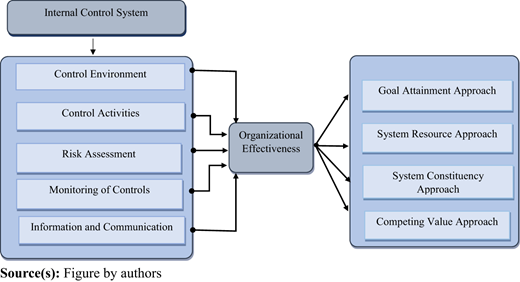
Several authors contend that internal control mechanisms enhance organizational effectiveness through control environment, control activities, risk assessment, monitoring of controls and information and communication (Asiligwa, 2017; Chen, Yang, Zhang, & Zhou, 2020; Guo & Eschenbrenner, 2018). The control environment offers order and structure for the internal control framework's goals to be met (Al-Zwyalif, 2015). Control activities guarantees management controls and directions on financial reporting (Chang et al., 2019). Risk assessment detects and analyzes operational risks in a timely manner (Taiwo et al., 2016). Monitoring of controls assure efficacy and efficiency in system design and operation (Masa’deh, Al-Dmour, & Obeidat, 2015).
Information and communication promote the various segments of internal control so that they can work properly (Martin, Sanders, & Scalan, 2014). The researchers focus on internal control dimensions of control environment, risk assessment, control activities, information and communication and monitoring of controls as antecedents to organizational effectiveness in this study.
Control environment and organizational effectiveness
Control environment is the supporting attitude, style and philosophy of those connected with the organization as well as their competency, morale, integrity and ethical values (Kaplan, 2013; Chen et al., 2020; Gao & Zhang, 2019). Several authors concord with the above view, when they assert that the control environment consists of structures, methods and measures that serve as a foundation for evaluating the internal control framework (Chalmers et al., 2019; Kinyua, Gakure, Gekara, & Orwa, 2015; Vu & Nga, 2022). Control environment provides discipline and structure for attaining internal control system goals and improving system quality (Chiu & Wang, 2019; Ngudu, 2014; Peterson, 2018).
Similarly, several authors contend that control environment demonstrates management dedication to ethical business practices which enhance employee behavior and organizational performance (Gal & Akisik, 2020; Hermanson et al., 2012; Su et al., 2015). The study proposes the following hypothesis.
Control environment has a significant impact on organizational effectiveness.
Control activities and organizational effectiveness
Control activities are systems, procedures and policies that ensure the implementation of directives on financial reporting as well as management controls (Adegboyegun, Ben-Caleb, Ademola, Oladutire, & Sodeinde, 2020; Ali, 2013; Le et al., 2020). GamageLow and Keving (2018) postulates that control activities ensure that all required steps are taken to lower risk and help organizations accomplish its objective. Several authors argue that the control activities permeate all organizational levels to make sure that all activities and procedures are recorded (Arham, 2014; Chalmers et al., 2019; COSO, 2013). D'Aquila (2013) stressed that when selecting and establishing control activities, management should consider operations, particular characteristics of the organization and the control environment.
In a similar vein, Chang et al. (2019) emphasize that management should periodically examine control activities to see if they are still relevant and make any required changes. Fourie and Ackermann (2013) argued that documentation of the planning and implementation of control activities is necessary for accurate monitoring. The study proposes the following hypothesis.
Control activities has a significant impact on organizational effectiveness.
Risk assessment and organizational effectiveness
Risk assessment is the process of identifying and evaluating threats to an organization's goals (Asiligwa, 2017; Chen et al., 2020; Theofanis, Drogalas, & Giovanis, 2011). Chen et al. (2020) argue that risk assessment facilitates the identification of relevant risks that could affect the achievement of management objectives. Several authors contend that risk attitude and management are essential for organizational effectiveness (Chiu & Wang, 2019; Musah et al., 2022; Ngari, 2017). Similarly, several authors postulate that risk assessment help prioritize specific objectives that have a substantial impact on organizations control systems (Schroy, 2010; Hamdan, 2019; Taiwo et al., 2016).
De Simone, Ege, and Stomberg (2015) posited that risk assessment is critical in lowering and eliminating the cost of risk while also adding to society's well-being. The study proposes the following hypothesis.
Risk assessment has a significant impact on organizational effectiveness.
Monitoring of controls and organizational effectiveness
Monitoring entails evaluating the quality of the control systems' functioning (Oyoo, 2014; Siayor, 2010; Wali & Masmoudi, 2020). Monitoring of controls ensure effectiveness and efficiency in system operation and design (Masa’deh et al., 2015; Muraleetharan, 2013). Several authors postulate that evaluating a system's effectiveness and efficiency on a frequent basis is an essential component of any comprehensive internal control system (Crosman, 2018; Feng, Li, McVay, & Skaife, 2015; Zhou et al., 2016). In the same vein, several authors assert that monitoring assesses the quality of the controls and their effectiveness in managing identified risks (Dowdell, Klamm, & Andersen, 2020; Jacob & Philip, 2016; Obeidat et al., 2016). The study proposes the following hypothesis.
Monitoring of controls has a significant impact on organizational effectiveness.
Information and communication and organizational effectiveness
Information and communication are processes used in the location, collection and properly disseminating essential information within the confines set by management to fulfill the organization's financial reporting purpose (Frazer, 2020; Taiwo et al., 2016; Vu & Nga, 2022). Hamdan (2019) contend that effective communication is predicated on disseminating pertinent information with every significant organizational division. Several authors assert that the effectiveness of information and communication in an organization reflects the organization's control environment (Bhardwaj, 2014; Bruwer, Coetzee, & Meiring, 2018; Carrington, 2014).
Similarly, several authors argue that an effective information and communication system promptly provide accurate and pertinent information to the various stakeholders (El-Mahdy & Park, 2014; Peterson, 2018; Badara & Saidin, 2013). Martin et al. (2014) underlined the necessity of information and communication in supporting the various segments of internal control to function efficiently. The study proposes the following hypothesis.
Information and communication has a significant impact on organizational effectiveness.
Methods
Research setting and data structure
Banks are effective partners for economic development (Ewa & Udoayang, 2012; Haq et al., 2014). An effective internal control system has a significant impact on banking operations making it unique in examining banking industry effectiveness related issues (Hayali et al., 2011; Otoo, 2019a, b; Vulley, 2022). The survey included 35 banks, of which 15 were commercial banks and 20 rural banks. The study sample was 985 respondents. Due to the dearth of studies in the banking literature, employees (both senior and junior staff) were selected as crucial informants for the study (Eling & Marek, 2014; Otoo, 2020). The Bank of Ghana (2022) Directory was sourced in obtaining information about the banks. A structured questionnaire and a cross-sectional study design were used (Creswell & Creswell, 2018; Jensen & Laurie, 2016).
Banks were chosen using stratified sampling technique (Ross, 2017; Singleton & Straits, 2018). 780 comprehensive responses were received (a 79.2% response rate) were deemed appropriate. Inference from Table 1, men made up 60.9 % (majority respondents). 31.0% of respondents were between the ages of 36 and 45. 57.1% of the banks were rural banks, while 42.9% were commercial banks. 47.1% (majority respondents) were in the operations department.
Profile of respondents
| Variables | Frequency (s) | Percentage of totals (%) | Variables | Frequency (s) | Percentage of totals (%) |
|---|---|---|---|---|---|
| Gender | Age | ||||
| Male | 475 | 60.9 | 18-25 | 102 | 13.1 |
| Female | 305 | 39.1 | 26-35 | 209 | 26.8 |
| 36-45 | 242 | 31.0 | |||
| Education | 46-55 | 100 | 12.8 | ||
| Senior High | 118 | 15.1 | 56-65 | 127 | 16.3 |
| Diploma | 172 | 22.1 | |||
| HND | 199 | 25.5 | Department | ||
| Bachelor’s degree | 241 | 30.9 | Operations | 325 | 41.7 |
| Master’s degree | 50 | 6.4 | Credit | 135 | 17.3 |
| Risk & compliance | 60 | 7.7 | |||
| Banks | Marketing | 85 | 10.9 | ||
| Commercial banks | 15 | 42.9 | Human resource | 105 | 13.4 |
| Rural banks | 20 | 57.1 | Audit | 70 | 9.0 |
Source(s): Table by Authors
Measures
A Likert scale, which ranges from 1 (“strongly disagree”) to 5 (“strongly agree”) was used to score the measures. The suggested criterion for construct standards estimations by Hair, Wolfinbarger, and Money (2015) was used. Statement of a construct that did not meet the ideal standard of 0.60 or higher was deleted.
Internal control systems scale
Control environment (Hermanson et al., 2012) control activities (D'Aquila, 2013), risk assessment (Theofanis et al., 2011), monitoring of controls (Siayor, 2010) and information and communication (Martin et al., 2014) were employed in measuring internal control systems. Sample items include ‘‘communication and reinforcement of standards of conduct”, “the bank's organizational structure is suitable for its size and complexity”, “control activities are examined at several levels of the bank”, “policies and procedures are reviewed on a regular basis”, and “the bank assesses its exposure to fraudulent conduct and how it might affect operations on a regular basis.”
“Management ensures that risk identification takes into account both internal and external elements, as well as their impact on achieving goals”, “monitoring aids in determining the bank's overall performance quality over time”, “internal reviews of the implementation of internal controls in all units are conducted by the bank on a regular basis”, “the bank has procedures in place to ensure that relevant and timely information is communicated to external parties” and “each transaction is identified separately in the bank's accounting system”. The reliability for each of the five dimensions of internal control system was 0.89, 0.84, 0.81, 0.79 and 0.75 respectively. The overall reliability of the 19 items was 0.86. The interdimensional correlations which ranged between 0.56 and 0.76 were high.
Organizational effectiveness scale
Goal attainment approach (Etzioni, 1960), system resource approach (Cunningham, 1977), system constituency approach (Keeley, 1978) and competing value approach (Price, 1968) were employed in measuring organizational effectiveness. Sample items include ‘‘anticipate surprises and crises”, “identify new business opportunities”, “quickly adapt to unanticipated developments”, “ensure that the development of company initiatives does not overlap”, “anticipate prospective new product/service market opportunities” and “adapt goals and objectives quickly to changes in the industry or market”. The reliability for each of the four dimensions of organizational effectiveness was 0.83, 0.78, 0.86 and 0.74 respectively. The overall reliability of the 9 items was 0.82. The interdimensional correlations which ranged between 0.59 and 0.77 were high.
Analytic approach
A confirmatory factor analysis (CFA) was applied to examine whether the indicators adequately represented their postulated constructs (Sellbom & Tellegen, 2019). A two-level hierarchical linear model was developed. Utilizing the statistical package for social science (SPSS) 21.0 and the analysis of moment structure (AMOS) 26.0, the proposed conceptual model and hypotheses were tested (Yuan & Chan, 2016). The link between observable indicators and their latent construct as well as the relationships between subdimensions were examined (Williams & O’Boyle, 2015). Convergent validity, construct validity and construct reliability criteria were examined (Hair et al., 2015). The conceptual model is depicted in Figure 1.
Common method bias
A number of a-priori measures were implemented in addressing the issues of common method bias (Fuller, Simmering, Atinc, Atinc, & Babin, 2016; Simmering, Fuller, Richardson, Ocal, & Atinc, 2015). During the pretest study, ambiguous questions were clarified and mid-point scales for each survey item were provided (Antonakis, 2017; Podsakoff, MacKenzie, & Podsakoff, 2012). Confidentiality and anonymity and were guaranteed to lessen social desirability bias (Williams & McGonagle, 2016; Spector, Rosen, & Richardson, 2019). Harman's one-factor test was used as a posthoc analysis (Jakobsen & Jensen, 2015; Chiew, Mathies, & Patterson, 2019). The results demonstrate the suitability of the established benchmarks (Podsakoff et al., 2012; Carpenter et al., 2014). Consequences of common technique bias remained negligible as these strategies called for.
Results
Internal control systems and organizational effectiveness were represented by a two-factor CFA model that had good model fit (2/df = 2.59, root mean square of approximation (RMSEA) = 0.052, standardized root mean residual (SRMR) = 0.041, Tucker-Lewis index (TLI) = 0.982, comparative fit index (CFI) = 0.984) (Hair, Hult, Ringle, & Sarstedt, 2022; McNeish and Hancock, 2018). Estimates for the coefficient ranged from 0.74 to 0.89. (Stanley & Edwards, 2016; Trizano-Hermosilla & Alvarado, 2016). The range of standard estimations was 0.70 to 0.89 (Dijkstra & Henseler, 2015; Kuppelwieser, Putinas, & Bastounis, 2019). While estimate for composite reliability (CR) ranged from 0.73 to 0.90, average variance extracted (AVE) estimates ranged from 0.52 to 0.64 (Aguirre-Urreta, Ro¨nkko¨, & McIntosh, 2019; Sarstedt, Hair, & Ringle, 2021). Discriminant validity was established (Henseler, Ringle, & Sarstedt, 2015; Radomir & Moisescu, 2019).
Correlation analysis and descriptive statistics reported in Table 2 while model test results in Table 3. CFA results in Table 4. Table 5 for discriminant validity test. Results for the hypothesis test are shown in Table 6. Control environment had a significant impact on organizational effectiveness (0.704, p < 0.05) thereby supporting Hypothesis 1. Similar to Hypothesis 1, Hypothesis 2 reports of a significant impact of control activities on organizational effectiveness (0.569, p < 0.05) thereby supporting Hypothesis 2. In a similar vein, a significant impact of risk assessment on organizational effectiveness was noted (0.569, p < 0.05), hence, supporting Hypothesis 3.
Descriptive statistics, correlations and scale reliabilities
| Items | Mean | Sd | 1 | 2 | 3 | 4 | 5 | 6 | 7 | 8 | 9 | 6 |
|---|---|---|---|---|---|---|---|---|---|---|---|---|
| 1. Control Environment | 18.08 | 7.24 | 1 | |||||||||
| 2. Control Activities | 13.51 | 5.45 | 0.243** | 1 | ||||||||
| 3. Risk Assessment | 12.42 | 5.18 | 0.277** | 0.655** | 1 | |||||||
| 4. Monitoring of Controls | 8.63 | 4.26 | 0.558** | 0.341** | 0.569** | 1 | ||||||
| 5. Information and Communication | 8.76 | 4.15 | 0.560** | 0.426** | 0.433** | 0.723** | 1 | |||||
| 6. Goal Attainment Approach | 4.08 | 1.25 | 0.460** | 0.544** | 0.453* | 0.623** | 0.618** | 1 | 1 | |||
| 7. System Resource Approach | 3.76 | 1.03 | 0.552* | 0.626** | 0.564** | 0.617** | 0.603** | 0.454** | 1 | |||
| 8. Strategic Constituency Approach | 4.14 | 1.12 | 0.555** | 0.453** | 0.466** | 0.628** | 0.455* | 0.512** | 0.592** | 1 | ||
| 9. Competing Value Approach | 4.26 | 1.37 | 0.455** | 0.559** | 0.488** | 0.618** | 0.672** | 0.755** | 0.539** | 0.588** | 1 |
Note(s): **Correlation is significant at the 0.01 level (2-tailed); *Correlation is significant at the 0.05 level (2-tailed)
Source(s): Table by Authors
Results of the measurement and structural model test
| Model | x2 | Df | x2/df | P | RMSEA | SRMR | TLI | CFI |
|---|---|---|---|---|---|---|---|---|
| First order CFA | ||||||||
| Internal Control Systems | 219.627 | 67 | 3.28 | 0.000 | 0.054 | 0.051 | 0.941 | 0.937 |
| Organizational Effectiveness | 228.816 | 69 | 3.32 | 0.000 | 0.056 | 0.053 | 0.932 | 0.921 |
| Second order CFA | ||||||||
| Internal Control Systems | 218.528 | 67 | 3.26 | 0.000 | 0.055 | 0.054 | 0.927 | 0.943 |
| Organizational Effectiveness | 223.694 | 69 | 3.24 | 0.000 | 0.057 | 0.056 | 0.934 | 0.951 |
| Measurement model-Overall model | 219.705 | 65 | 3.38 | 0.000 | 0.058 | 0.058 | 0.956 | 0.963 |
| Structural model -Overall model | 101.245 | 39 | 2.59 | 0.000 | 0.052 | 0.041 | 0.982 | 0.984 |
Note(s): RMSEA = Root mean square of approximation; SRMR=Standardized Root Mean Residual; TLI = Tucker-lewis index; CFI=Comparative fit index; *p < 0.05
Source(s): Table by Authors
Confirmatory factor analysis
| Factor names, factor loadings and Cronbach’s alpha | ||||
|---|---|---|---|---|
| Factor | Items | (λ) | AVE | CR |
| Control Environment (α = 0.89) | Communication and reinforcement of standards of conduct at several levels of the bank | 0.746 | ||
| The bank's organizational structure is suitable for its size and complexity | 0.771 | |||
| Procedures in place to assess employee performance against expected norms of conduct | 0.756 | 0.55 | 0.82 | |
| Employee assessments are documented and presented on a regular basis | 0.669 | |||
| Control Activities (α = 0.84) | Control activities are examined at several levels of the bank | 0.725 | ||
| Relevant business processes requiring control activities are determined | 0.717 | |||
| Policies and procedures are reviewed on a regular basis to ensure its relevance | 0.697 | 0.52 | 0.81 | |
| Policies and procedures are in place for easier recording and accounting for transaction in accordance with rules | 0.736 | |||
| Risk Assessment (α = 0.81) | The bank assesses its exposure to fraudulent conduct and how it might affect operations on a regular basis | 0.746 | ||
| The bank establishes objectives in a way that allows for the detection and assessment of risks that could jeopardize the attainment of those goals | 0.733 | |||
| Management ensures that risk identification takes into account both internal and external elements, as well as their impact on achieving goals | 0.723 | 0.53 | 0.82 | |
| The bank manages risks to the organization efficiently and has implemented internal controls to mitigate the identified hazards | 0.701 | |||
| Monitoring of Controls (α = 0.79) | Monitoring aids in determining the bank's overall performance quality over time | 0.798 | ||
| On a continuous basis, the bank has an independent methodology, checks and evaluations of control activities | 0.815 | |||
| Internal reviews of the implementation of internal controls in all units are conducted by the bank on a regular basis | 0.873 | 0.52 | 0.87 | |
| Information and Communication (α = 0.75) | The bank has procedures in place to ensure that relevant and timely information is communicated to external parties | 0.764 | ||
| Each transaction is identified separately in the bank's accounting system | 0.704 | |||
| The code of conduct, or other policies, expressly prohibit override of internal controls by management | 0.736 | 0.55 | 0.83 | |
| Rules or regulations are reviewed with one or more of the following: governing board, audit, finance or another committee | 0.756 | |||
| Goal Attainment Approach (α = 0.83) | Decrease market response times | 0.859 | ||
| Anticipate surprises and crises | 0.885 | 0.56 | 0.90 | |
| Identify new business opportunities | 0.856 | |||
| System Resource Approach (α = 0.78) | Quickly adapt to unanticipated developments | 0.755 | ||
| Organize and coordinate the development efforts of various units | 0.772 | 0.58 | 0.73 | |
| System Constituency Approach (α = 0.86) | Ensure that the development of company initiatives does not overlap | 0.808 | ||
| Anticipate prospective new product/service market opportunities | 0.789 | 0.64 | 0.78 | |
| Competing Value Approach (α = 0.74) | Adapt goals and objectives quickly to changes in the industry or market. | 0.796 | ||
| Rapidly commercialize new innovations | 0.735 | 0.59 | 0.74 | |
Note(s): AVE represents average variance extracted; CR represents composite reliability. All Factor loadings are significant at *p < 0.05
Source(s): Table by Authors
Discriminant validity
| 1 | 2 | 3 | 4 | 5 | 6 | 7 | 8 | 9 | |
|---|---|---|---|---|---|---|---|---|---|
| 1. Control Environment | (0.761) | ||||||||
| 2. Control Activities | 0.081 | (0.781) | |||||||
| 3. Risk Assessment | 0.126 | 0.494 | (0.699) | ||||||
| 4. Monitoring of Controls | 0.557 | 0.240 | 0.359 | (0.733) | |||||
| 5. Information and Communication | 0.165 | 0.394 | 0.607 | 0.037 | (0.772) | ||||
| 6. Goal Attainment Approach | 0.206 | 0.292 | 0.463 | 0.345 | 0.398 | (0.746) | |||
| 7. System Resource Approach | 0.024 | 0.374 | 0.257 | 0.150 | 0.261 | 0.395 | (0.815) | ||
| 8. System Constituency approach | 0.149 | 0.526 | 0.311 | 0.206 | 0.261 | 0.542 | 0.429 | (0.726) | |
| 9. Competing Value Approach | 0.004 | 0.512 | 0.350 | 0.201 | 0.157 | 0.468 | 0.682 | 0.752 | (0.728) |
Note(s): Values in diagonal represent the squared root estimate of average variance extracted (AVE)
Source(s): Table by Authors
Inferences drawn on hypotheses
| Hypothesis | Beta coefficient | p value | Result |
|---|---|---|---|
| H1: Control environment has a significant impact on organizational effectiveness | 0.704 | 0.004 | Accepted |
| H2: Control activities has a significant impact on organizational effectiveness | 0.569 | 0.011 | Accepted |
| H3: Risk assessment has a significant impact on organizational effectiveness | 0.636 | 0.021 | Accepted |
| H4: Monitoring of controls has a significant impact on organizational effectiveness | 0.481 | 0.143 | Rejected |
| H5: Information and communication has a significant impact on organizational effectiveness | −0.429 | 0.167 | Rejected |
Source(s): Table by Authors
A noninsignificant impact of monitoring of control on organizational effectiveness was observed (−0.067, p > 0.05). Hypothesis 4 is unsupported. Similarly, the impact of information and communication on organizational effectiveness was not significant. Consequently, Hypothesis 5 was not supported.
Discussion
This study offers important empirical insights in comprehending the impact of internal control systems on organizational effectiveness. The results show a significant impact of control environment on organizational effectiveness. Control activities had a significant impact on organizational effectiveness. The results also indicate a significant impact of risk assessment on organizational effectiveness. Monitoring of controls had a nonsignificant impact on organizational effectiveness. The results further reveal a nonsignificant impact of information and communication on organizational effectiveness. Internal control mechanisms improve financial reporting systems, operational effectiveness and efficiency and adherence to established norms and rules (Mary et al., 2014; Nanzala & Ingabo, 2021; Francis & Imiete, 2018).
Several authors argue that internal control systems ensure the effective and efficient use of both current and noncurrent assets, acting as the lifeblood of organizations (Asiligwa, 2017; Crosman, 2018; Vulley, 2022). Taiwo (2016) and Nyakundi (2014) posited that internal control systems improve organizational performance by reducing fraud, mistakes and minimizing wastage.
Theoretical implication
The contention for the enhancement of internal control systems and a further investigation into the nexus between internal control systems and organizational effectiveness is supported by the study (Hermanson et al., 2012; Hoai et al., 2022; Quinn & Rohrbaugh, 1983). The study's findings clarify the uncertainty in the literature on internal control systems and organizational effectiveness (Cameron, 1980; Gal & Akisik, 2020; Johnston & Zhang, 2018). A significant impact of control environment on organizational effectiveness was observed. The results support earlier studies which contend that control environment provides discipline and structure for attaining internal control system goals and improving system quality (Chiu & Wang, 2019; Ngudu, 2014; Peterson, 2018).
They also concur with earlier research which argued that control environment consists of structures, methods and measures that serve as a foundation for evaluating the internal control framework (Chalmers et al., 2019; Kinyua et al., 2015; Vu & Nga, 2022). The findings support the postulation of researchers (Al-Zwyalif, 2015; Gao & Zhang, 2019). The results also indicate that control activities had a significant impact on organizational effectiveness. The results support earlier studies which contend that control activities help in managing business risk while also considering the operational environment (COSO, 2013).
They also align with previous research which showed that control activities ensure that all required steps are taken to lower risk and help organizations accomplish its objective. (GamageLow & Keving, 2018). The findings support the assumption of researchers (Adegboyegun et al., 2020; Chalmers et al., 2019). Furthermore, the results show that the risk assessment had a significant impact on organizational effectiveness. The results are consistent with earlier studies which indicated that risk assessment facilitates the identification of relevant risks that could affect the achievement of management objectives (Chen et al., 2020).
They also parallel previous research which contends that risk assessment help to prioritize specific objectives that have a substantial impact on organizations control systems (Schroy, 2010; Hamdan, 2019; Taiwo et al., 2016). The findings support the postulation of researchers (Chiu & Wang, 2019; Ngari, 2017).
Practical implications
Internal control mechanisms promote operational efficiency, effectiveness and competitive advantage (Otoo, 2019a, b). The results show a significant impact of control environment on organizational effectiveness. Organizational competencies, morale, integrity and ethical values are associated with organization's style, supporting attitude and philosophy (Chen et al., 2020). Therefore, one of the most pressing concerns for the banks is to (re)consider a control environment where standards of conduct are reinforced and communicated as well as the suitability of the bank’s organizational structure (Gao & Zhang, 2019; Kinyua et al., 2015). Vu and Nga (2022) posited that organizational members' control consciousness as well as the tone of the organization are influenced by the control environment.
Banks would have to (re)consider a control environment where employee performance are assessed against expected norms of conduct and where the assessments are conducted on regular basis and documented (Gal & Akisik, 2020; Peterson, 2018). The results also show that control activities had a significant impact on organizational effectiveness. Control activities permeate all organizational levels to make sure that all activities and procedures are recorded (Arham, 2014). Banks would have to (re)consider relevant business processes requiring control activities as well as the revision of policies and procedures on a regular basis to ensure its relevance (D'Aquila, 2013; Fourie & Ackermann, 2013).
Control activities guarantee management controls and directions on financial reporting (Chalmers et al., 2019). Banks would have to (re)consider relevant control activities where policies and procedures are in place for easier recording and accounting for transaction in accordance with rules (Chang et al., 2019; Musah et al., 2022). The results further shows that risk assessment had a significant impact on organizational effectiveness. Risk assessment should be integrated into an entity's operations and activities (Kaplan, 2013). Banks would have to (re)consider its exposure to fraudulent conduct and how it might affect operations on a regular basis as well the establishment of objectives that allows for the detection and assessment of risks that could jeopardize its operations (Schroy, 2010; Taiwo et al., 2016).
Risk assessment identifies and analyzes threats to an organization's goals (Theofanis et al., 2011). Banks would have to (re)consider its risk assessment strategies where risk identification takes into account both internal and external elements, as well as their impact on achieving goals (De Simone et al., 2015; Hamdan, 2019). Internal control mechanisms safeguard firm’s assets, improve financial and operational performance and assure policy compliance (Hoai et al., 2022; Johnston & Zhang, 2018; Omar & Yussuf, 2021). Consequently, the banking industry should promote the enhancement of internal control systems since the efficacy and quality of the internal control system are key factors in an entity's ability to survive (Chalmers et al., 2019; Lawson et al., 2017; Musah et al., 2022). The banking industry would have to adopt, design and implement proactive internal control systems to enhance operational efficiency, effectiveness and competitive advantage.
Limitations and future study
Despite the possibility that this study could significantly advance theory and practice, the results should be evaluated in light of their limitations. First, because the study was cross-sectional, it is impossible to rule out the possibility of inferring a causal association or reverse causality from the findings (Malhotra, Nunan, & Birks, 2017). Longitudinal studies will be required in the future for these goals (Churchill & Iacobucci, 2018). Employees' subjective opinions were also considered in this investigation. Nonetheless, in future studies, it is advised that objective measures be used (Spector et al., 2019). Furthermore, when objective measures are utilized, common method bias is less likely (Williams & McGonagle, 2016).
Similarly, the current study used different internal control dimensions to explore the effects of internal control systems on organizational effectiveness. However, to provide a comprehensive and clear analysis of the nexus between internal control systems and organizational effectiveness, further empirical and theoretical research is needed. Since the current study concentrated on the banking sector with its distinct characteristics, the generalizability of the conclusions may be limited. It would be worthwhile to apply the model to other areas or industries.

