Research on library smart reading promotion lacks the interpretation of the connotation and expression of readers’ willingness to participate deeply as well as in-depth research on the influencing factors of readers’ willingness to participate deeply. In this paper, we study the influence mechanism of multiple external factors on readers’ willingness to deeply participate in library smart reading promotion from the perspectives of technology, organization and environment, based on the TAM, SIPS model and TOE framework.
First, based on the review of relevant literature, this paper seeks the theoretical basis of the research with the guidance of the technology acceptance model, TOE framework and SIPS model. Then the grounded theory is used to dig out the five main categories of technical factors, environmental factors, organizational factors, readers’ perception and willingness to participate deeply, explore the constituent factors of the main categories and the mechanism of action between them, and we construct a model of factors affecting the readers’ willingness to participate deeply in the promotion of smart reading in libraries. In the quantitative research part, 466 valid questionnaires were collected and the structural equation model is used to verify the relationship between variables.
The study finds that: (1) in the process of readers’ deep participation in library smart reading promotion, technological factors (personalization, interactivity and integration), organizational factors (information quality and service quality) and environmental factors (interactive atmosphere) positively affect readers’ perceptions of smart reading promotion, with interactivity and interactive atmosphere having a more significant effect; (2) the degree of confirmation of expectations has a significant positive effect on readers’ perceived usefulness (3) Readers’ willingness to participate in depth includes three aspects: willingness to read, willingness to interact and willingness to share and readers’ perceived usefulness and perceived ease of use can significantly affect willingness to participate in depth.
(1) In terms of research methodology, the questionnaire was distributed in a rather basic form, and there are limitations in the screening of the survey sample and the breadth of sample coverage. In order to understand the relationship between variables more comprehensively, future research could consider using longitudinal data and conducting longer-term observation and research on the same group of subjects to further validate the conclusions of this paper. (2) In terms of the survey subjects, this paper was selected as a group of library readers who have carried out smart reading promotion. Meanwhile, most of the respondents are young readers with higher education, and the sample range is limited.
This paper explores the various factors that affect users’ deep participation in smart reading promotion and provides theoretical and practical guidance for the library’s smart reading promotion work. Its research results help libraries improve the effectiveness of smart reading promotion activities from multiple aspects, such as technology, organization and environment, so as to create a better reading environment for all users.
This paper’s discussion on readers’ willingness to participate deeply has great theoretical significance and practical value, which will help improve the overall quality of the nation, enhance the level of smart library services and promote the development of national reading.
This paper divides readers’ willingness to participate deeply in reading promotion into three variables: willingness to read, willingness to interact and willingness to share, expanding the connotation and extension of readers’ willingness to participate deeply in reading promotion. Secondly, based on the SIPS model and TOE framework, a model of influencing factors of readers’ willingness to participate deeply in library smart reading promotion is proposed, and the structural equation model method is used to test the hypothesis, verifying the feasibility of the model.
1. Introduction
Libraries, as an important part of the strategy of national reading, undertake the core task of leveraging library resources and promoting reading popularization and play an irreplaceable role in the promotion of smart reading. At present, library smart reading promotion presents new features: First, the focus has shifted gradually from books to readers; second, the forms of interaction have diversified, transforming library smart reading promotion from flat to three-dimensional and immersive; and third, the empowerment of technology has been significantly enhanced. Although smart reading promotion has become a key project in the construction of smart libraries, it is still deficient in relevant technology, reader reading depth, library services and reading popularization. From relevant studies, the current research on reader participation in smart reading promotion is still insufficient, and the influencing factors of readers' deep participation in smart reading promotion need to be further explored. Therefore, based on the theoretical research of scholars, this paper focuses on the influence mechanism and boundary conditions of external factors on readers' willingness to participate deeply from the perspectives of technology, organization and environment, and is based on the TAM (Technology Acceptance Model) model, SIPS (Sympathize, Identify, Participate, Share and Spread) model and TAM (Technology Acceptance Model) model. (Share and Spread) model, SIPS (Sympathize, Identify, Participate, Share and Spread) model and TOE (Technology-Organization-Environment) framework to explore readers' willingness to participate deeply in smart reading promotion.
2. Literature review
2.1 Related concepts
Smart reading is the use of intelligent technology to provide intelligent services for readers, emphasizing autonomous, precise and adaptive reading (Nie, 2021). Smart reading service represent a mode of knowledge acquisition that provides users with personalized content services. Smart reading promotion is a library resource dissemination and promotion activity aiming at promoting smart reading and facilitating dissemination through interactive sharing (Mao et al., 2020).
Customer engagement refers to the behavior of customers' intellectual, physical, energetic, and emotional inputs and expenditures during the production or delivery of products or services. The currently recognized dimensions for measuring customer engagement were proposed by Ennew and Binks (1999). They divided customer engagement into three dimensions: information sharing, cooperative behavior, and interpersonal interaction. In this paper, Readers' willingness to participate deeply in smart reading promotion is conceptualized as involving two aspects: reading and promotion. Readers' participation in reading promotion is further divided into three dimensions: willingness to read, willingness to interact, and willingness to share.
2.2 Review of relevant studies
2.2.1 State of the art in smart reading research
The current theme on smart reading focuses on the following three aspects. (1) Smart reading technology. Wu (2021) pointed out that leveraging relevant technologies can assist users in smart reading management, assessment, and content customization for smart reading. (2) Smart reading platform. Tang and Peng (2020) constructed a full-process reading cloud platform containing four subsystems: user management, resource management, smart reading and reading evaluation. (3) Smart reading services. Tang and Liu (2021) proposed to build a new ecology of library smart reading service, including reading space services, ubiquitous reading services, and smart reading recommendation services. Foreign research focuses on the following two aspects of technology. (1) Smart reading technology applications. Park et al. (2017) applied text-to-speech software to assisted reading for high school students, which improved students' reading vocabulary and reading comprehension ability. (2) Smart reading services. Barzillai et al. (2018) argued that improving the quality of three aspects of smart reading hypertext navigation; information source integration and information assessment can significantly improve readers' reading ability in a smart reading environment.
2.2.2 Current status of research on smart reading promotion
The themes on smart reading promotion can be divided into three categories: (1) Theoretical research based on the application of intelligent technology. Xie et al. (2022) argued that 5G technology enhances knowledge accessibility, scalability, and the explanatory nature of reading marketing and promotion, thereby improving users' reading interest. (2) Theoretical research based on the concept of optimized service. Sun et al. (2021) constructed a smart reading promotion service model centered on core promotion elements such as the subject, object and content in reading promotion. (3) Practical research on smart reading promotion. The forms of library smart reading promotion include the following three categories: (1) Online reading promotion activities. WeChat public account of Guangzhou Municipal Library integrates various online service functions, including Guangtu Live, 3D interactive knowledge modeling, and Bookchild Yuan Universe Library. (2) Offline reading promotion activities, with the help of VR and IoT technologies, the Wuhou District Library in Chengdu has designed interactive exhibition areas around different themes to create a “Science Fiction World Reading and Creation Center”. (3) The combination of online and offline, the Ningbo Library’s “Tianyi Book Tour” series combines online lending with the unique attractions of tourist cities to promote readers' willingness to read.
2.2.3 State of research on readers' willingness to participate deeply in smart reading promotion
Research on readers' willingness to participate in reading promotion can be broadly categorized into two directions: (1) Studying the influencing factors affecting readers' participation in activities. Liu and Zhang (2021) found that improving the vividness, interactivity, and professionalism of digital reading promotion live events can improve the effectiveness of reading promotion. (2) Studying the channels of readers' participation in library reading promotion. Zhu and Ke (2023) summarized the implementation path of cultivating readers from casual leisure readers to deep leisure readers in reading promotion through research. However, the above studies focus on the field of digital reading promotion. There is a notable difference in the service level between smart reading promotion and digital reading promotion (Mao et al., 2020).
There is a lack of reader engagement studies conducted in the context of smart reading promotion. Dong and Zhang (2023) pointed out that the application of the community cooperation model can promote diversified participation in reading promotion, and proposed an optimization strategy for promoting reading for minors through community cooperation. Wang and Li (2022) proposed that reading promotion should realize the human-computer cooperative promotion mode as soon as possible and reconstruct the new environment of smart reading, thereby creating a standardized, professional and ecological atmosphere of national reading.
2.2.4 Review of research
Through analyzing the relevant literature on the promotion of smart reading, the following shortcomings of the existing research have been found: (1) More case studies, less integrated research. The research focuses on a certain field or link in the promotion of smart reading, lacking a dynamic management perspective, and failing to establish a reasonable and effective system to solve the existing problems of smart reading promotion. (2) Lack of a model of factors influencing readers' willingness to participate deeply in the promotion of smart reading in libraries. Most of the existing research on the promotion of smart reading focuses on the potential and path of technology application, neglecting the exploration of the factors influencing the readers' willingness to participate. (3) Lack of quantitative analysis of readers' willingness to participate in the promotion of smart reading. Most literature relies on theoretical exploration without comprehensive quantitative research on readers' willingness to participate throughout the entire process.
3. Presentation of the model
Based on TAM, SIPS model, and TOE framework, this study focuses on the influence mechanisms and boundary conditions of external factors on readers' willingness to participate deeply from the perspectives of technology, organization, and environment, and constructs a theoretical model of the influencing factors of readers' willingness to participate deeply in the promotion of smart reading in libraries, as shown in Figure 1. Among them, technical factors include integration, personalization, and interactivity; organizational factors include information quality and service quality; and environmental factors include interactive atmosphere. External influencing factors affect readers' willingness to participate deeply through user-perceived factors.
3.1 Variable definition
The definitions of the variables involved in this study are shown in Table 1.
3.2 Research hypotheses
3.2.1 External influences and reader perceptions
- (1)
Identification of technology-based factors
Libraries use intelligent technology to analyze users' reading characteristics and feedback on user needs so that the promotion aligns with the personalized needs of different readers. The personalization of learning platform content can positively affect readers' perceived ease of use (Sun, 2021). Moreover, this personalization can also enhance readers' perceived ease of use. Through the introduction of virtual reality, augmented reality, and other technologies, libraries can also enable readers to immerse themselves in the virtual reading experience (Chen et al., 2016), increasing their engagement and enjoyment of reading. Stronger resource integration results in richer content within information resources, making it more convenient to query multiple sources of information. At the same time, the integration of reading promotion services enhances effectiveness and reduces reading costs. Based on this, the following hypotheses are proposed:
Personalization of smart reading promotion positively affects readers' perceived usefulness.
Personalization of smart reading promotion positively affects readers' perceived ease of use.
Interactivity in smart reading promotion positively affects readers' perceived usefulness.
Interactivity in smart reading promotion positively influences readers' perceived ease of use.
Integration of smart reading promotion positively affects readers' perceived usefulness.
Integration of smart reading promotion positively affects readers' perceived ease of use.
- (2)
Identification of organizational factors
As the main service provider of smart reading promotion, the quality of resources and services provided by libraries is an important factor in determining whether smart reading promotion services can be carried out effectively (Hendijani Fard and Marvi, 2020). They examined the effect of viral marketing on the purchase intention of mobile application users, and found that the quality of information positively affects the perceived usefulness and perceived ease of use of the application. Based on this, the following hypotheses are proposed:
Information quality positively influences patrons' perceived usefulness of library smart reading promotion.
Information quality positively influences patrons' perceived ease of use of library smart reading promotion.
Service quality positively influences patrons' perceived usefulness of library smart reading promotion.
Service quality positively influences patrons' perceived ease of use of library smart reading promotion.
- (3)
Environmental factors
Environmental factors also play an important part in influencing the acceptance of smart reading promotion by the reader community. Kusumasondjaja (2017) states that interactions among members of e-commerce communities can facilitate the dissemination of information to fulfill consumers' needs for shopping information. Based on this, the following hypothesis is proposed:
Interactive atmosphere positively influences patrons' perceived usefulness of smart reading promotion in libraries.
Interactive atmosphere positively influences patrons' perceived ease of use of smart reading promotion in libraries.
3.2.2 Reader perception factors and willingness to participate deeply
In the promotion of smart reading in libraries, readers make value choices and value confirmations by comparing the expectations and performance of participation. If the quality of information and services provided by the library exceeds users' psychological expectations, users' expectations are confirmed to a higher degree, which in turn increases users' perceived usefulness (Guo and Ming, 2020). Meanwhile, if readers perceive that the resources for reading promotion are easily accessible, they will pay more attention to the reading resources and perceive the usefulness of reading promotion. Zhang et al. (2023) argues that perceived ease of use can significantly affect perceived usefulness in digital reading promotion contexts. Based on this, the hypothesis is proposed:
Expectation confirmation positively influences patrons' perceived usefulness of library smart reading promotion.
Readers' perceived ease of use of smart reading promotion positively influences perceived usefulness of smart reading promotion.
In library smart reading promotion, whether libraries provide smooth interaction channels and whether patrons perceive that engaging in interactions can facilitate libraries in providing valuable promotion will affect users' judgment of interaction behavior. Based on this, the following hypotheses are proposed:
Perceived usefulness positively influences readers' willingness to read to promote reading.
Perceived ease of use positively influences readers' willingness to read to promote reading.
Perceived usefulness positively influences readers' willingness to interact with reading promotion.
Perceived ease of use positively influences readers' willingness to read and promote interactions.
Perceived usefulness positively influences readers' willingness to share reading promotions.
Perceived ease of use positively influences readers' willingness to share reading promotions.
4. Empirical research design
4.1 Scale design
4.1.1 Measurement of technical factors
The technological factors in this study include the variables of personalization, interactivity, and integration. This paper draws on Pearson et al. (2012), Fan (2017), and Smith et al. (2005) to derive the measurement scale of related technology factors, as shown in Table 2.
4.1.2 Measurement of organizational factors
Organizational factors are measured from two aspects: library information quality and service quality. This paper draws on the relevant scales of DeLone and McLean (2003) and Cao et al. (2013) to obtain the measurement scale of relevant organizational factors, as shown in Table 3.
4.1.3 Measurement of environmental factors
Environmental factors mainly refer to the interactive atmosphere of library smart reading promotion. The interactive atmosphere emphasizes the social environment at the site of the library promotion activity or the online platform. The details are shown in Table 4.
4.1.4 Measurement of reader perception
Reader perceptions are assessed through three dimensions: perceived usefulness, perceived ease of use, and expected degree of confirmation. This paper draws on the work of Guan (2020), Liu and Zhang (2021), and Bhattacherjee’s (2001) related scale to derive the measurement scale of reader perception. The details are shown in Table 5.
4.1.5 Measurement of willingness to participate deeply
Willingness to participate deeply includes three elements: willingness to interact, willingness to read, and willingness to share. This paper draws on the work of Hu (2022), Wang (2020) and Shi and Yu (2021) to develop the measurement scale of deep participation willingness. The details are shown in Table 6.
4.2 Questionnaire design
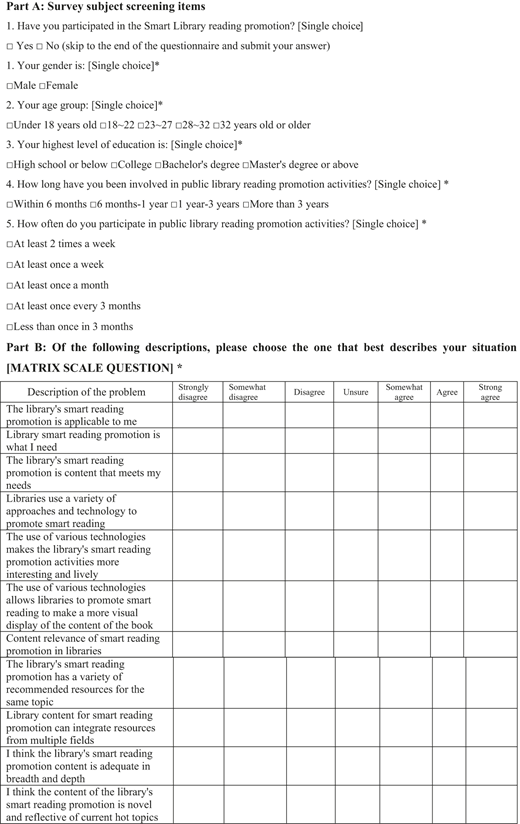
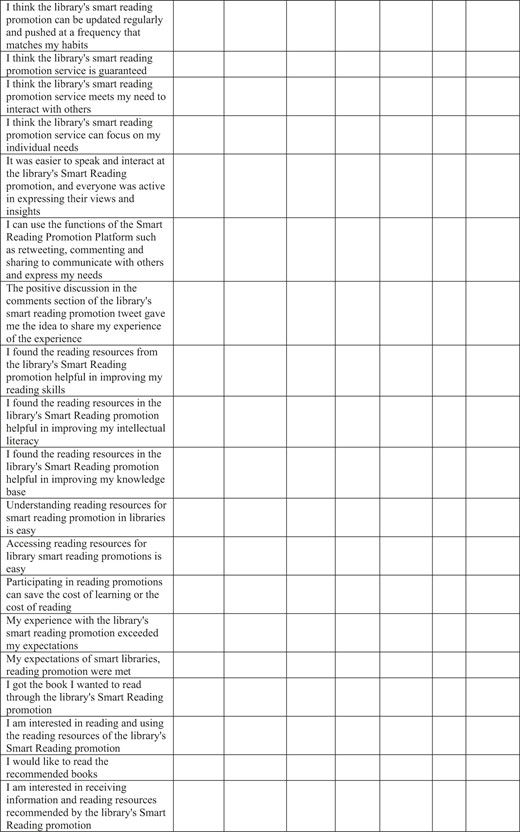
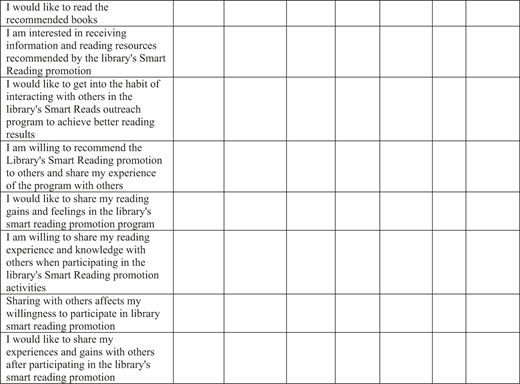
This paper focuses on the main factors affecting readers' deep participation in the promotion of smart reading in libraries, so readers who have had experience in the promotion of smart reading in libraries were selected for the questionnaire research. The questionnaire for the study mainly consists of the following two parts:
The first part is the research subject screening and demographic information. In the screening of research subjects, if the respondents had not participated in the promotion of smart reading in libraries, the answers were terminated and treated as invalid responses. The demographic information section consisted of three questions on gender, age group, and education, which were used to characterize the demographics of the respondents (Yu et al., 2022).
The second part is the main body of the questionnaire, which consists of 36 items to measure 12 variables. The scale design refers to the questionnaire design of related studies and has been modified and expanded. Considering the correctness of the scale and the usability of the collected data, the number of measurement variables was controlled as much as possible, and three measurement variables were placed in all potential variables.
4.3 Questionnaire distribution and collection
4.3.1 Pre-questionnaire
In order to ensure the rationality and scientificity of the questionnaire, we conducted a small-scale questionnaire pre-test. The pre-test phase was conducted by distributing the questionnaires and interviewing the respondents through online questionnaires. A total of 53 responses (20 male and 33 female) were collected in the pre-test stage, and the age distribution was concentrated in the range of 23–27 years old. The reliability and validity of the variable question items were tested by SPSS 23 and were confirmed to be suitable for the formal survey.
4.3.2 Formal investigations
The survey respondents of this paper are readers who have experience in participating in the promotion of smart reading in libraries. In terms of sampling method, non-probability sampling was conducted by combining snowball sampling and judgment sampling; in terms of obtaining the answer sheets, the combination of sending questionnaires online and collecting paper questionnaires offline was used. The questionnaire distribution methods include: (1) sending online questionnaires to close friends who have experience in participating in smart reading promotion in libraries, and inviting them to send questionnaires to other groups of readers who have relevant experiences; (2) Collecting paper questionnaires from participating readers at the sites of smart reading promotion activities in libraries such as Nansha District Library in Guangzhou, Guangzhou Library, Zhongshan Library in Guangdong Province, and Ningbo Library.
The official questionnaires were distributed between August 6, 2023, and December 8, 2023, and the questionnaires were distributed to the participants. A total of 494 questionnaires were collected, and 466 valid questionnaires were obtained after excluding invalid questionnaires that took less than 240 s to answer, those who answered all the options by choosing the same item and those who did not have the experience of participation. Thus, the sample size met the standard.
5. Empirical analysis
SPSS 23.0 and SmartPLS 3.0 were used to empirically test the previously constructed model of influencing factors on readers' willingness to deeply participate in library smart reading promotion.
5.1 Descriptive statistical analysis
5.1.1 Demographic characteristics of the sample
Descriptive statistics of the samples were analyzed using SPSS 23.0, and the results are shown in Table 7.
5.1.2 Descriptive statistics of variables
The results of the descriptive statistical analysis of the questionnaire are demonstrated in Table 8. The mean and standard deviation were calculated using SPSS 23.0 to further analyze the response characteristics and distribution of the study participants.
5.2 Reliability test
Model validity and accuracy of parameter estimation were measured using SmartPLS 3.0, the workhorse of all PLS-SEM analyses, which is based on the principle of partial least squares for statistical analysis.
5.2.1 Credibility analysis
The metrics used in this paper to assess internal consistency reliability are Cronbach’s alpha coefficient and rho_A. Both values are usually required to be no less than 0.7 (Dijkstra and Henseler, 2015). The Cronbach’s alpha coefficient and rho_A values were calculated using SmartPLS 3.0 for the 12 variables involved, and the results of the reliability analysis are shown in Table 9.
5.2.2 Validity analysis
SmartPLS 3.0 software was used to measure model validity and accuracy of parameter estimation. The KMO and Bartlett’s Sphericity test are required for all measurement topics before conducting factor analysis. KMO and Bartlett’s test of sphericity were performed in this paper using SPSS 23 software (Table 10). The overall KMO value of the variable measurement scale in this paper is 0.942, and the p-value of Bartlett’s sphericity test is less than 0.001, so it meets the requirements.
In testing the structural validity of the questionnaire, this paper examines it through Composite Reliability (CR) and Average Variance Extracted (AVE). It is determined by the criterion that when CR > 0.7 and AVE > 0.5, it indicates high convergent validity (Dijkstra and Henseler, 2015). The results of the validity analysis of the sample data are shown in Table 11.
As can be seen in Table 10, the AVE values corresponding to the 12 variables are greater than 0.821, and the CR values are higher than 0.932. Thus, the data of this analysis have good convergent validity.
5.3 Structural modeling analysis
Before the structural modeling analysis, the fitness test of the model was conducted. Dijkstra and Henseler (2015) concluded that the fitness of PLS-SEM can be tested with standardized root mean square residual (SRMR) and NFI values, and that the model has a good fit when the SRMR value is less than 0.08 and the NFI value is close to one. The model in this study had an SRMR of 0.027 and an NFI value of 0.890 (Table 12), indicating that the model passed the fitness test.
To test the hypothesized results of the structural model, the model was fitted and analyzed on SmartPLS 3.0 software using Bootstrapping algorithm with a set number of iterations of 5,000 to check the statistical significance of the path coefficients between the variables. The results of the analysis are shown in Figure 2, including the path coefficients between the variables, p-values and explained variance (R2). It is generally accepted that an R2 greater than 0.25 is an acceptable fit (Hulland, 1999). The results of structural modeling analysis are shown in Figure 2.
The external influences on smart reading promotion explained 62.8% (R2 = 0.628) of perceived usefulness and 54.9% (R2 = 0.549) of perceived ease of use. The two variables at the reader perception level together explained 55.6% (R2 = 0.556) of the variance in readers' willingness to read, 48.5% (R2 = 0.485) in readers' willingness to interact, and 47.3% (R2 = 0.473) in readers' willingness to share. The model of this paper has a good predictive effect. The data show that the external influencing factors of smart reading promotion play an important role in the reader perception factors, and the user perception factors are the important influencing factors of the readers' willingness to participate in-depth. The results of the model hypothesis testing are shown in Table 13, including the hypothesized standardized path coefficients and T-values.
5.4 Analysis of results
5.4.1 External influences and reader perception factors
From the above test results, it can be seen that technical factors, organizational factors, and environmental factors can significantly affect the readers' perception of library smart reading promotion. Among them, the path coefficient of environmental factors is the largest, i.e. the interactive atmosphere profoundly affects readers' perceived usefulness (β = 0.173, t = 3.284) and perceived ease of use (β = 0.230, t = 4.471). On the one hand, the application of technology makes the originally bitter and difficult-to-understand contents of the book become visual and easy to understand through interaction; on the other hand, the perfect interaction mechanism opens up the channels of demand feedback, making the contents of smart reading promotion more satisfying to the demand. Meanwhile, the positive communication can deepen the readers' understanding of the contents, and enhance the readers' perception of usefulness of smart reading promotion.
Technological factors also play a key role in readers' perceptions, with the interactivity of smart reading promotion technology having the greatest impact on users' perceived usefulness (β = 0.208, t = 4.237) and perceived ease of use (β = 0.186, t = 3.946). The integration of smart reading promotion technology significantly affects readers' perceived ease of use (β = 0.117, t = 2.509) and perceived usefulness (β = 0.098, t = 2.429). Personalization of smart reading promotion significantly affects readers' perceived ease of use (β = 0.115, t = 2.683) but has no significant effect on perceived usefulness (β = 0.064, t = 1.693). The higher degree of personalization made possible by the technology implies that the reading promotion satisfies the personalized needs of readers with different reading abilities to a higher degree. Personalization did not significantly affect perceived usefulness. This may be due to the fact that personalization techniques are generally less effective when readers have a clear retrieval goal, and readers have a weaker perception of task benefits, which in turn affects perceived usefulness.
Organizational factors encapsulate the information quality and service quality of smart reading promotion in libraries. Both information quality and service quality of smart reading promotion can significantly influence readers' perceived usefulness and perceived ease of use. Among the organizational factors, information quality is the main influencing factor with the greatest effect on perceived usefulness (β = 0.106, t = 2.855) and perceived ease of use (β = 0.170, t = 3.620). Information quality, as a core element in measuring the quality of reading promotion, can significantly enhance readers' judgment of the value of reading promotion. Service quality can also positively affect readers' perceived usefulness (β = 0.105, t = 2.348) and perceived ease of use (β = 0.100, t = 2.362), and personalized recommendation services and professional explanations by promoters can help readers understand the difficult points and improve their perceptions.
5.4.2 Reader perception factors and willingness to participate deeply
The degree of expectation confirmation is the extent to which readers experience better than previously expected when participating in smart reading promotion. According to the results of the empirical study, the degree of expectation confirmation significantly affects perceived usefulness (β = 0.117, T = 2.788). This is because readers with a high degree of expectation confirmation pay more attention to the content and effects of reading promotion and are more likely to perceive the usefulness of smart reading promotion. The empirical findings also point out that readers' perceived ease of use significantly affects perceived usefulness, and both perceived usefulness and perceived ease of use can significantly affect users' willingness to read, willingness to interact, and willingness to share, with perceived usefulness has a greater effect on readers' willingness to participate in-depth than perceived usefulness. Library smart reading promotion emphasizes more on reader-centeredness, and readers' judgment on whether smart reading promotion is useful or not is more concerned with personal benefits and functional needs, while perceived ease of use is mainly concerned with convenience and intuitiveness, so the impact of perceived usefulness is more direct and important in this context.
Perceived usefulness (β = 0.467, T = 10.512) and perceived ease of use (β = 0.355, T = 7.848) both have a significant effect on the willingness to read. Perceived usefulness is the main basis for readers to judge whether the content of smart reading promotion can provide useful information and knowledge. The higher the readers' perceived ease of use of reading promotion the more friendly the reading experience and access to resources of smart promotion content are, enhancing the willingness to read in-depth.
Both perceived usefulness (β = 0.443, T = 9.851) and perceived ease of use (β = 0.324, T = 7.322) significantly affect readers' willingness to interact. If smart reading promotion is perceived as useful and easy to use by readers, it means that readers can easily access the resources, which enhances satisfaction and pleasure and stimulates interaction willingness.
Perceived usefulness (β = 0.464, T = 9.869) and perceived ease of use (β = 0.291, T = 5.843) both significantly affect readers' willingness to share. If readers find reading promotional content useful and easy to understand, they are more likely to develop a stronger sense of identification and find it worth sharing with others.
6. Conclusions and future work
6.1 Conclusions
Based on the TAM, SIPS model, and TOE framework, we construct a theoretical model of the influencing factors of readers' willingness to participate in-depth in library smart reading promotion, and analyze the influence of technological, organizational, and environmental factors on readers' perceptions and willingness to participate in-depth using empirical research to answer the core research question of “the connotation and role of the influencing factors of readers' willingness to participate in-depth in library smart reading promotion”. This paper answers the core research question of “the connotation and role of factors influencing readers' willingness to participate deeply in library smart reading promotion”. At the same time, this paper explores the mechanism and factors that constitute readers' willingness to participate in-depth. It is found that: (1) in the process of readers' deep participation in the promotion of smart reading in libraries, technological factors (personalization, interactivity and integration), organizational factors (information quality and service quality) and environmental factors (interactive atmosphere) positively affect readers' perceptions of the promotion of smart reading, with interactivity and interactive atmosphere having a more significant effect; (2) the degree of confirmation of expectations has a significant positive effect on readers' perceived usefulness; (3) readers' willingness to participate deeply in the promotion of smart reading has a significant positive effect on readers' perceptions of usefulness; (4) Readers' willingness to participate in-depth includes three aspects: willingness to read, willingness to interact and willingness to share, and readers' perceived usefulness and perceived ease of use can significantly affect willingness to participate in-depth. This suggests that the construction of library smart reading promotion requires the joint participation of readers, libraries and the community.
6.2 Limitations and future work
The research limitations of this paper are: (1) In terms of research methodology, the questionnaire was distributed in a rather basic form, and there are limitations in the screening of the survey sample and the breadth of sample coverage. In order to understand the relationship between variables more comprehensively, future research could consider using longitudinal data and conducting longer-term observation and research on the same group of subjects to further validate the conclusions of this paper. (2) In terms of the survey subjects, this paper was selected as a group of library readers who have carried out smart reading promotion. Meanwhile most of the respondents are young readers with higher education, and the sample range is limited.
Future research can consider collecting more practical cases of smart reading promotion, incorporating different types of groups as research samples, and conducting cross-group comparisons to increase the applicability of the research results.
This research is supported by Guangdong Planning Office of Philosophy and Social Science Grant GD23XTS09 awarded to Zhiyi Li.
This paper would like to thank all the authors cited in the reference for their contributions to this field.
The research contained in our paper involves human or animal participants. It has passed the ethical review of the Scientific Research Ethics Committee.
References
Further reading
Appendix 1 A Outline of interviews on readers' willingness to participate deeply in smart libraries
- 1.
**Background information**
- 1.1
Please describe your age and education.
- 1.2
Have you participated in the Smart Library Reading Promotion?
- 1.3
How often do you participate in reading promotions? About how long does it take each time?
- 1.1
- 2.
**Experience of activities**
- 2.1
What types of reading promotions do you regularly participate in?
- 2.2
Please describe the reading promotion that impressed you?
- 2.3
Please recall what you accomplished during these reading promotion activities?
- 2.1
- 3.
**Influencing factors**
- 3.1
What appeals to you most about these reading promotions?
- 3.2
Are there specific types of promotions that would better capture your interest?
- 3.3
What are the reasons that constrain (may constrain) your regular participation in reading promotion activities?
- 3.1
- 4.
**Effectiveness of outreach activities**
- 4.1
With regard to the library reading promotions in which you have participated, how effective do you think they have been in increasing interest in reading and improving personal skills?
- 4.2
What did you get out of participating in the reading promotion? (How did participation in the reading promotion differ from what you expected?)
- 4.1
- 5.
**Recommendations and expectations**
- 5.1
What suggestions do you have for libraries to promote reading?
- 5.2
In the future, in what ways do you expect the library to participate more readers in reading promotion?
- 5.1
Appendix 2 Questionnaire on readers’ willingness to deeply participate in library smart reading promotion