This paper aims to provide a reflection on innovating and repurposing collection development and marketing strategy, particularly for eBooks in libraries.
This paper provides a general review where previous research papers on the phenomenon of the study have been consulted.
The findings indicate that there is a lack of awareness of eBooks and marketing, and virtual bookshelves in the form of LibGuide gallery boxes are identified as a solution in promoting these resources.
This is a valuable contribution that sheds insight on the usage of LibGuide gallery boxes as virtual bookshelves in marketing library resources, particularly eBooks.
Library collection marketing
Library marketing aims to identify the client base and determine and fill its needs, wants and demands by designing and delivering appropriate products and services (Madhusudhan, 2008). Collection marketing and visibility are critical in libraries because they increase awareness and usage, boosting return on investment. This is supported by Musoke and Mwesigwa (2017), asserting that books that are not used are not good for the collection, no matter their quality. Traditional and online methods of collection marketing are available, and librarians must use as many of them as possible.
Virtual bookshelves in libraries
Libraries have reinvented ways of marketing and raising the visibility of their collections through the application of information and communication technologies. Virtual shelves are an online replacement for physical bookcases that libraries use to categorise and display their catalogues so that patrons can explore and find the books they want to read online. These virtual bookshelves play a vital role in making users aware of new books, special collection materials, under-circulated items and, in particular, objects that are critical for reading and learning but frequently go unnoticed (Lussier, 2020). Interestingly, virtual bookshelves have also gained popularity among book publishers, vendors and eBook aggregators in marketing their collections. As libraries enhance their eBook acquisition endeavours, virtual bookshelves are used to raise visibility and widely market these collections. They raise the visibility and awareness of both print and electronic books. This improves the information and services distributed by the library to the users. There are many ways that libraries have reacted to this “digital transition”.
LibGuide gallery boxes as virtual bookshelves
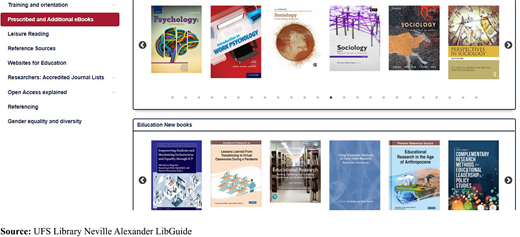
A LibGuide is a product of SpringShare that allows librarians to organise and present information to users in a customisable fashion using Web 2.0 applications. Over 5,000 institutions globally use LibGuides to share information with their users (SpringShare, 2022). Boxes are the basic content containers for LibGuides. A page can have multiple boxes, and boxes can contain multiple blocks of content. Dobbs and Sittler (2016) state that LibGuides started in 2006 and have since grown into a suite of products called LibApps that now encompass a variety of services and functions. Gallery boxes allow authors to create a simple slideshow for galleries of images, book covers, databases, guides, and LibCal events, and creators can mix and match any of the abovementioned content pieces and have complete control over features like slide transition, speed, the number of slides that can appear at once, navigation dots, captions, and more. Various authors state that LibGuides can be used as library benchmarking tools for enhancing collection development endeavours (Metcalf, 2013; Bangani and Tshetsha, 2018). Based on this, LibGuide gallery boxes can be used as virtual bookshelves, where book covers can be used, and links to eBooks can be embedded. This also has the additional benefit of enhanced LibGuide usage, as other pages can be browsed and accessed with ease. Figure 1 is a snippet of gallery boxes used as virtual bookshelves to raise awareness of prescribed and newly acquired eBooks for the field of education.
Library eBooks marketing and visibility
To align with the changes in their environments, libraries have enhanced the acquisition of eBooks in support of digital transformation. The rise and embracement of eBooks were also motivated by the Covid-19 pandemic, which forced libraries to shut their doors and limit access to print collections to mitigate the spread of the virus. Some academic libraries went to the extent of additional sourcing funding and liaised with publishers in providing access to eBooks to support teaching and learning. Covid-19 reinvented the collection development practices of libraries and also presented opportunities for marketing and raising awareness of these collections. Most eBook collections are hidden behind library databases, and there is a dire need to promote these, mainly prescribed eBooks, for easy access and enhanced usage. Various authors support this, as they concur that there is a lack of awareness and visibility of eBooks, leading to minimal usage (Tingle and Teeter, 2018; Dawkins and Gavigan, 2019; Casselden and Pears, 2020). Displays are often erected for print books; however, little is done for electronic books. Therefore, virtual bookshelves can be a solution in marketing ebooks that are trending, newly acquired, prescribed for teaching and learning, and those that focus on research methodology to appeal to a wide range of users and their needs. As LibGuide gallery boxes can be designed for this purpose, they are also versatile as they can be embedded in various platforms such as social media, learning management software, library websites and display screens in library entrances for promoting eBooks.
Concluding remarks
Collection marketing and visibility are essential in ensuring enhanced usage. As libraries continuously add more items to their collections, they also need to ensure that the users are well aware of the resources available to them to support their needs. Librarians should be strategic in developing mechanisms to promote their collections, particularly those available in electronic format, and also provide training in using them effectively. Not only are libraries using virtual bookshelves, but publishers, vendors and aggregators have grasped these with both hands to improve their sales. LibGuide gallery boxes can be used as bookshelves; this also ensures that libraries with SpringShare products can innovate tools they currently have instead of investing in additional infrastructures to develop virtual bookshelves.
Dina Mokgadi Mashiyane (mashiyanedm@ufs.ac.za) is based at Library and Information Services, University of the Free State – South Campus, Bloemfontein, South Africa
Tebogo Agnes Makhurupetsi (MakhurupetsiTA@ufs.ac.za) is based at Library and Information Services, University of the Free State – South Campus, Bloemfontein, South Africa