

A bid for the acceptance of diversity - or, how do you plan for total accessibility?
David Johnson, Column Editor
A bid for the acceptance of diversity or, how do you plan for total accessibility?
Susan Gilbert Beck, Guest Columnist
Introduction
Whenever I teach about disabilities in general, to introduce learning disabilities (LD), I put the following text in front of my students and ask them to read:
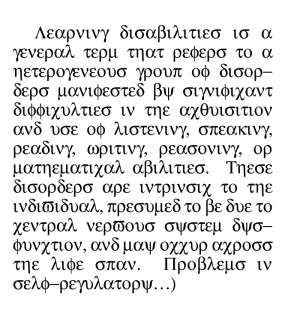
Many laugh. Then, I change the slide another two times: the second time, the text is mirrored; the third time, it looks like this:
Learning disabilities is a general term that refers to a heterogeneous group of disorders manifested by Learning disabilities significant difficulties in the to a heterogeneous acquisition and use of listening, speaking, reading, writing,reasoning, or mathematical abilities. These disabilities significant disorders are intrinsic reading, writing, reasoning to the individual, presumed to be These disabilities due to central nervous system dysfunction, and may occur across nervous system dysfunction the life span. Problems in self-regulatory behaviors, social perception, m dysfunction and social system dysfunction interaction may exist with learning disabilities but Problems in self-regulatory do not by themselves constitute a learning disability. Although learning disabilities may Learning disabilities is a general term occur concomitantly with other handicapping nervous system dysfunction conditions (for example,sensory impairment, mental disabilities significant disorders retardation,serious emotional disturbance) or with disabilities is a general extrinsic influences (such as cultural disabilities significant disorders differences,insufficient or inappropriate instruction), they are not the result of those conditions or heterogeneous group of disorders influences. (This definition serves as a theoretical basis for the discipline, not for the purpose of identifying of disorders influences. various learning disabilities.)
By this time, I can hear people at the back of the room trying to make sense of the definition. They are reading aloud. No one is smiling. So, I display:
Learning disabilities is a general term that refers to a heterogeneous group of disorders manifested by significant difficulties in the acquisition and use of listening, speaking,reading, writing, reasoning, or mathematical abilities. These disorders are intrinsic to the individual, presumed to be due to central nervous system dysfunction, and may occur across the life span. Problems in self-regulatory behaviors, social perception, and social interaction may exist with learning disabilities but do not by themselves constitute a learning disability. Although learning disabilities may occur concomitantly with other handicapping conditions(for example, sensory impairment, mental retardation, serious emotional disturbance) or with extrinsic influences (such as cultural differences,insufficient or inappropriate instruction), they are not the result of those conditions or influences. (This definition serves as a theoretical basis for the discipline, not for the purpose of identifying various learning disabilities.)(National Joint Committee on Learning Disabilities [NJCLD] in Gajar et al.,1993, p. 16)
Many breathe a sigh of relief, including the instructor. "Imagine", I say, "going to work or to school or to the library and having to decipher variations on any of the first three slides every day all day. I do not think I would have made it through." The first slide is done in Symbol, the second reverses characters, the third shows how saccades (jerky eye movements that all humans have) may go wild. All of the above are lessons in the reality of the need for assistive technology. The presence of any of the difficulties shown does not indicate a lack of or low intelligence. Any of them indicate that a learning disability is present. One may be born with it or receive a head injury that produces the condition. But a learning disability is no measure of intelligence. Normal to very high intelligence may be part of the person's makeup, too.
The Complete Definition and Identification of Learning Disabilities
The reading difficulty is only one manifestation of LD, and disabilities may come in combination within LD or include an LD with a disability, like deafness, not included in the LD definition. But the combination is not necessarily existent. A learning disability, as the definition shows, may encompass reasoning, math, spatial cognizance, writing, social understanding, speaking. or hearing. The federal definition does not highlight the central nervous system, but lists the disorders as psychological. The learning disabilities listed, however, are about the same as are the conditions not linked to causing the disabilities:
Specific learning disability means a disorder in one or more of the basic psychological processes involved in understanding or in using language, spoken or written, which may manifest itself in an imperfect ability to listen, think, speak, read, write,spell or do mathematical calculations. The term includes such conditions as perceptual handicap, brain injury, minimal brain dysfunction, dyslexia and developmental aphasia. The term does not include children who have learning problems, which are primarily the result of visual, hearing, or motor handicaps,of mental retardation, or of environmental, cultural or economic disadvantage.(Gajar et al., 1993, p. 16)
So while there are disagreements over language in definitions and possible causes that began with the study of learning disabilities in the 1800s, those who study the disabilities agree that they exist. Whether the researcher is a psychologist, an educator, or from the medical field, all agree that learning disabilities are not immediately discernable to the observer. Certainly, their causes pose mysteries. They are a surprise for the uninitiated the uneducated whether the person discovers he or she has an LD or whether the "able" person must meet the needs of the person with LD. Wisdom and common sense are demanded in such situations to lead to productivity.
A Positive Approach to Challenges
There is nothing like a positive approach! The most wonderful businesses and services have representatives who answer, "Let me see what I can do to make that happen for you!" That is one way to remove any stigma. It is friendly, warm, and reasonable to want to help if one offers a service. The message is, "You are quite right to think we should offer this service. It is normal to expect that we might."Library personnel should be able to take this approach from shelvers to the top administrators. It is a good stance in community relations no matter what the library type.
Learning disabilities create challenges for those who have them who wish to succeed in a society that is very much text-based. Persons who have the disabilities, studies have shown,try to hide them by compensating in other ways. Back in the 1960s when I was a children's librarian, I was dismayed by parents who restricted their children to measured reading levels when they looked for books in the public library. Now I wonder what the parents could read. Often a child with a book report to do would ask for "a thin book." My reply before I learned about learning disabilities was always, "A long good book is better than a short bad one." I am embarrassed to remember that answer, but librarians in those days did not learn about how to teach reading much less the devastating disability. We librarians are the part owners of this text-based society and most definitely the facilitators or not of accessibility. The accessibility may be without the conditions of stigma or with them. It is in our hands to a large extent.
Checking the "I have a disability" box on any application has the potential for trauma for any person. Our society has a careful description of what is "acceptable" or "able". One is"able" if one wears glasses of the thickest sort. One may even be seen as "able"if one wears a tiny, hidden, hearing aid that works well. But if one needs an extra hour to take an examination, suddenly one may be viewed as taking advantage of the system in which the law recognizes learning disabilities(Wolinsky and Whelan, 1999, p. 287) or as someone with the LD stigma (Johnson,1999, p. 17) or as someone who simply learns in a different mode from others.
It is easy to point at someone else's disability; however, the first time that the application is one's own and the disability box must be checked is likely to be, at least, memorable. What would help the person feeling the stigma to relax enough to come to the library and to use everything accessible? Of course, one should ask the community of persons with disabilities as well as the professional people who work with them, like rehab engineers, occupational therapists, and physical therapists. These people will be able to offer a good range of suggestions of equipment and software as well as situational solutions.
Let's take the proactive approach a step further. Suppose none of the advice-givers above, except the users afraid to come, were available? Then what? I propose that we are not necessarily a text-based society. I believe that if people were encouraged to examine their favorite ways of learning and giving information, the answers would be extraordinarily diverse. When I tell people I am a librarian, very often the response is, "Oh, that is wonderful! I love to read!" I always reply that I like to read, too, but that the reason I am a librarian is more because I am interested in people and like to help them in their continuing education. I do love to read, but the library has more to offer than text.
Making Diversity the Norm
Suppose we made every condition the norm? The psychologist, L.S. Vygotsky (1993), (Vygotsky et al.,1994), thought that each of us lives in his or her own learning dimension. Those of us who read comfortably and well are lucky that our dimension is the most accepted. But suppose it were not? Suppose listening, the oral tradition,had been maintained? Are you a good listener? Is your memory like a sponge when you are listening? If not, what an unfortunate accepted dimension that might be for you. Or suppose you were expected to remember everything through tactile communication. How would you be doing? It is my suspicion that a larger percentage of society than expected would be successful and enjoy doing the variations on textual learning.
I have an acquaintance,who is working on his doctorate. He is not hearing impaired, but he has slow hearing. If he asks for directions, he hears them several seconds after most people would. So, it is better to tell him the directions, at the same time,giving him a map. Multiple modes of access make it all easier. He does not mind requesting multiple modes, but why not make that access the normal response to anyone asking? Start thinking of this in terms of any planning. People can always refuse one or more modes, but more than likely will take all. We librarians are in the perfect position to do this for everyone since part of our mission should be to impart the importance of continuing education and to make it comfortable. With the aging community and with all the non-traditional students, multiple access makes sense.
Using multiple modes of access does not have to be embarrassing, or the person stigmatized, if it is the accepted approach. While it is true that there is much diversity in disabilities, it is also true that some basic software and hardware may answer many needs. Also, the vendors are bridging some gaps. "ViaVoice" has come to the MacIntosh! A new software is out with which, the creators claim, one may "feel"the Web. It is tactile. Does this sound like fun in general? It does to me. There are some days when I would rather tune in to David Erdody's Web site,Assistive Media, to listen to the Saturday Evening Post being read than read it myself. I have never tried to read tactilely, but it might turn out to be one of the best ways to read for me.
Mr Holland's Opus is one of my favorite movies because it offers a positive view of teaching and a view of a teacher learning. Mr Holland makes music fun for the students he is paid to teach. His son, Coltrain (named after the jazz musician), is with deafness, and Mr Holland does not learn about the music learning dimension Coltrain knows until the boy is a teenager and John Lennon is killed. Then, Mr Holland finds out that Coltrain has known about music all along. He knows the words and the rhythms. It is normal. It is easy. The uneasy part is that Mr Holland was not open to that dimension for so long. Open as he was to learning to teach, he missed the nearest and most important lesson in his life because he was not open to trying. He was disappointed in and put off by his son's deafness. The communication was too difficult for him. He retreated rather than moving into multiple dimensions of communication for his child's childhood and some teen years. What are we missing as a society because it is taking so long for educators and librarians to take the real lead in assessing what baselines of multiple access should be available could be affordable and offering them without ceremony?
What Librarians Can Do
Librarians are lucky. Not only are wonderful professionals waiting to give us advice from the local community, but expert advice exists on the World Wide Web. The pages done by the engineers at TRACE are probably known to the readers of this column, but I will remind you that they offer excellent advice on a broad range of positive access. The University of Washington offers another source. More and more pages are evolving. The Canadians put up an excellent page on Learning Disabilities, and there are several in the United States as well (see Appendix).
Also, librarians may go beyond their own professional organizations to join an association in another profession. There they may engage in the dialog about the kaleidoscope of learning situations. For example, the Rehab Engineers Society of North America(RESNA) listserv refreshes one's perspective daily on the use of software,hardware, and the dimensional learning diversity of potential library users.
It is possible to begin building a collection of hardware and software, adding as needs arise. A good rule is to go for the most multiple access technology one can afford for the dollars one has. I am calling it multiple access rather than assistive technology to bring some democracy to the terminology. Surprisingly, some programs, like pwWebSpeak or JAWS (programs that will allow the computer to read out loud to the user), are not so expensive especially in terms of the access they offer. The program, Textbridge comes with scanners so that optical character recognition is done and transferred easily. Often programs like ViaVoice, Dragon Dictate[1], or Dragon's Naturally Speaking (softwares that allow voice operation and dictation to the computer) come with hardware one buys. Of course, institutions must consider licensing, but this is the place that consortiums are positives in helping with the expense. Also, it is my firm belief that people invest in good products, and that wealth begets wealth. Patrons of the new multi-access library system will appear as if by magic if the publicity, word of mouth and formal, is positive and the need is obvious. "You are enjoying our new system, and we need to offer it so that more people can access it at the same time!"
At the same time the technology appears in your library, begin to publicize it to your community as the norm: Not only does the library offer you a new book. You may come in to scan and listen to it, using earphones. A wonderful way to spend a rainy afternoon! Not only (in a special library) do we have the information in text that you requested. We have a new tactile reader for those who learn best that way. Our staff will be happy to show you how to use the equipment if you want to give it a try. When you have experienced the literature in the multiple access mode of your choice, please join our chat group, an asynchronous (come when you can) discussion of the literature in the multiple access mode of your choice!
Users who are comfortable with using a broad range of access may agree to help the library to put the message out to the community through radio interviews, newspaper articles, and pictures, on links to the library's Web page, in visits to nursing homes and independent living centers, or in fliers, to name a few ways. This is a global approach, so use all the person power you can gather to make diversity in accessibility and use the norm. Form a "Diversity-Friendly" Group which meets to discuss a reasonable, positive presentation and approach in language and dimension, and who will help you to make such a program a reality. Include all staff, at least now and then, in refresher sessions and for input as to how the effort to serve the entire community at the optimum level of access is progressing.
Finally, try it all yourself:
You will discover that the norm for software and hardware, no matter what the application, is that glitches arise. So when you invest in the technology,invest in a staff member or two who can troubleshoot well. In test modes,troubleshooting with a positive end means everything.
You will discover, as my friend, Norman Coombs (who is with blindness),observed, "Yes, it's flawed, but it's wonderful (in reference to various screen readers). For the first time, I can scan The New York Times on my own" (a paraphrase from a discussion in Minneapolis, Spring 1998).
Look at the prices and alternatives to planning before deciding all forms of what is called "assistive technology" are too expensive. Positive all the multiple access way is the way to a future that uses the productive energy and talent in the community no matter what the learning and communication styles. It is the way to the most positive use of libraries.
The Future
Let's go back to the beginning. Imagine getting up in the morning and knowing that when you go to work or to school or to the library, though you have a reading disability, the following text will be read to you in the language of your choice, in the order in which it was written:
Learning disabilities is a general term that refers to a heterogeneous group of disorders manifested by Learning disabilities significant difficulties in the to a heterogeneous acquisition and use of listening, speaking, reading, writing, reasoning, or mathematical abilities. These disabilities significant disorders are intrinsic reading, writing, reasoning to the individual, presumed to be These disabilities due to central nervous system dysfunction, and may...
Not only that, imagine that when you want to respond to an assignment or to chat with friends, you may key in your response, speak it, or choose the tactile method that works for you. You may even use some method like Words Plus or Prentke Romich's Liberator.These speak sentences and phrases linked to pictures on a keyboard. Imagine that your intelligence and intellect may develop unfettered, and that this has all come about because your librarians took the lead the democratic tack of studying users' diverse needs and preferences in learning styles at very basic levels in their communities, followed by beginning, building, and maintaining multiple modes of access.
Note
Appendix: Learning Disabilities Sites in Canada and the United States
ASCLA New Scholarship for People with Disabilitieshttp://ala8.ala.org/ascla/centuryscholarship.html
Links to Learning Disability Resources http://lbd.coe.uky.edu/html/lbdres.html
Demystifying the Licensing of Electronic Resources http://www.arl.org/scomm/licensing/videoconf.html
EASI Equal Access to Software and Information http://www.rit.edu/~easi/workshops.html
Feel the WEBhttp://www.feeltheweb.com/
LD Association of Canadahttp://eduss10.educ.queensu.ca/~lda/ldac/ldacothe.htm
About Apple>Media & Analyst Informationhttp://www.apple.com/pr/library/1999/jul/21ibm.html
National Adult Literacy and Learning Disabilities Centerhttp://novel.nifl.gov/nalldtop.htm
National Library Service to the Blind and Physically Handicappedhttp://lcweb.loc.gov/loc/visit/ada.html
Switches for Kids (YAACK)http://www.maui.com/~duffy/yaack/c4.html#c4a0
TRACE Research and Development Center http://trace.wisc.edu/
WEB Accessibilityhttp://home.earthlink.net/~dawwn/webacces.htm
Workplace Design for Difficulty in Learninghttp://www.worktech.state.md.us/rt_at_work.html#Learning_Disability-Workplace_Design
Susan Gilbert Beck has worked in three library types as an administrator and has represented all types as the president of a multitype consortium. Currently, she directs the Siena Heights University Library in Adrian, Michigan and is a doctoral student in the University of Michigan's School of Information. MAILTO:sbeck@umich.edu
David Johnson, Column Editor of EASI Access, is an Abstractor/ Information Specialist at the National Rehabilitation Information Center (NARIC), Silver Spring, MD. Readers with questions, comments, or suggestions may e-mail him at MAILTO:jdivad@aol.com.

