


This study aims to conceptualize the application and management of research data in academic libraries through institutional repositories. The objectives of the study are to determine the role of academic libraries in managing research data, to explore the ethical issues related to research data management (RDM) services and to determine stakeholders involved in the success of RDM.
The study employs a qualitative research design within the interpretive paradigm, using content analysis to explore RDM in academic libraries and institutional repositories. The research aims to determine the role of academic libraries in managing research data, explore ethical issues related to RDM services and identify key stakeholders. Literature was sourced from databases like Emerald Insight, Scopus and Google Scholar, focusing on publications from 2020 to 2024. Case studies from institutions such as the University of Pretoria and Stellenbosch University illustrated practical RDM implementations. Ethical considerations were strictly adhered to, ensuring proper citation and adherence to RDM guidelines.
The reviewed literature established the significance of managing research data through institutional repositories while highlighting the research data lifecycle, stakeholders involved in the success of RDM and ethical issues related to RDM services. RDM involves stakeholders such as institutional researchers, government and funding agencies, university leadership and research support units.
This study demonstrated the importance of effective RDM practices in enhancing transparency, reproducibility and efficiency in academic research. Institutional repositories play a crucial role in preserving and making research data accessible, thereby promoting interdisciplinary collaboration and increasing citation rates.
The study provided actionable recommendations for academic libraries to support researchers in complying with RDM policies through training, clear guidelines and user-friendly repository interfaces. These strategies enhance the effectiveness of RDM practices and ensure regulatory compliance.
The study underscores the need for regulatory frameworks that promote open science and data sharing while ensuring ethical guidelines for data privacy and informed consent. It also highlights well-managed research data’s economic and commercial benefits, such as facilitating industry–-academia collaboration.
This study is significant as it contributed to the body of knowledge and theoretically motivated how institutional repositories can be of value in reserving research data by highlighting the benefits and significance of sharing research data. A proper RDM increases the opportunities for funders, institutions, publishers and libraries to redesign policies that govern research data sharing.
1. Introduction
Research data management (RDM) in academic libraries is driven by the increasing need to manage, use, and share research data effectively. The use and sharing of research data ease the burden on researchers as they collect multifaceted datasets that they cannot manage independently and are not visible for other researchers to use (Xu, 2022). Institutional repositories serve as a vital reservoir of research data, providing a centralized and secure platform for storing, preserving and disseminating datasets generated by academic institutions. These repositories play a crucial role in ensuring the long-term accessibility and usability of research data, which is essential for advancing scientific knowledge and fostering collaboration among researchers. By fostering structured metadata, controlled access and compliance with standards such as FAIR (Findable, Accessible, Interoperable and Reusable) principles, institutional repositories enhance researchers' discoverability and reuse of research data for new research projects that can yield new research findings. They support the entire research data life cycle, from data management planning and collection to analysis, documentation, preservation and sharing. This comprehensive approach facilitates effective data management and promotes transparency, reproducibility and innovation in research. Institutional repositories thus serve as a cornerstone of modern research data management practices, enabling academic libraries to fulfil their mission of supporting research and scholarship.
The RDM involves active engagement and sustenance of the research data life cycle. This life cycle includes several critical stages: data management planning, research data collection, data analysis, documentation and metadata, data preservation and archive, sharing data and reusing data. Each stage is essential for ensuring that research data is managed effectively. The evolving need to manage research data motivated academic libraries to prioritize and consider how to manage the research data life cycle in support of researchers (Sheikh et al., 2023). Additionally, the requirement for a data management plan (DMP) and the sharing of research data from the government and funding agencies have obligated academic libraries to use institutional repositories as a hub for datasets that researchers can reuse for new research projects that can yield new research findings.
2. Literature review
RDM is gaining momentum in academic libraries. To understand RDM, describing what research data is pivotal. Research data is gathered, observed, and produced to substantiate research findings (Bangani and Moyo, 2019). Data is a research product comprising statistics and facts gathered during the scientific research process for analysis and reference. In library and information science, data is gathered for analysis, aiming to produce new findings. Research data can be in the form of spreadsheets, documents, field notes, diaries, transcripts, questionnaires, codebooks, videotapes, audiotapes, films, photographs, test responses, slides, specimens, artefacts, samples, data files, collection of digital outputs, database contents, algorithms, scripts, models, methodologies, content of an application, workflows, sketches and standard operating procedure and protocols that researchers can use to reproduce scientific findings. Also, research data can be quantitative or qualitative and incorporates data gathered through interviews, observation, experiments, surveys and testing hypotheses.
RDM is defined as a process that includes gathering, analyzing, preserving and using data with the purpose of decision-making, drawing conclusions, creating new knowledge and adjusting or adding to the existing knowledge, thus obtaining new findings for reuse (Sheikh et al., 2023). Andrikopoulou et al. (2022) also defined RDM as the management of data from creation following all the processes of the research cycle, including the dissemination and archival of research results. RDM services assist researchers in managing the complex description of data planning, organization, storing and sharing of research data by enabling the preservation and reuse of research data.
RDM is a comprehensive and systematic approach to handling data throughout the lifecycle of a research project and encompasses a series of practices and processes (Sheikh et al., 2023). Firstly, data is systematically arranged and categorized to facilitate easy access, analysis and interpretation. This involves creating transparent, consistent file naming conventions, using standardized formats and maintaining detailed documentation. Secondly, data are securely stored in a manner that protects it from loss, corruption or unauthorized access. This includes using reliable storage solutions such as cloud services, institutional repositories or dedicated servers and implementing regular backup procedures. Thirdly, data is preserved over the long term to ensure its continued accessibility and usability. Preservation involves using stable file formats, adhering to best practices for data archiving and ensuring that data remain readable and interpretable in the future. Fourthly, as appropriate, data are made available to other researchers, stakeholders and the public. Sharing data enhances transparency, reproducibility and collaboration and can be achieved through data repositories, publications or direct sharing with collaborators.
Briney et al. (2023) indicated that effective RDM is crucial for maintaining research integrity, reliability and impact. It ensures that it is accurate, complete and secure and can easily be accessed and reused by others. By adhering to the best practices in RDM, researchers can comply with funder and institutional requirements, enhance their results' reproducibility and contribute valuable resources to the broader scientific community.
Tenopir et al. (2020) alluded to the fact that data sharing is a pillar of open science that makes scientific research data accessible to all researchers. It also included campaigning methods for open access to research data, publishing open scientific research and making it easier to access, use and communicate scientific knowledge. For RDM to be effective, proper and manageable, data management requires that researchers share data by uploading datasets to the institutional repositories and preparing and providing metadata to make the data easy to access.
Researchers in institutions of higher learning are producing a vast amount of research data motivated by advanced information technologies (Sheikh et al., 2023). As a result, academic libraries considered implementing RDM as one of the services researchers are expected to facilitate sharing of research data through the institutional repositories.
Managing and storing research data depends on researchers sharing their academic knowledge for reuse by other researchers. Academic libraries’ responsibility is to curate, preserve, store and reuse research data that are produced by the university community (Andrikopoulou et al., 2022). The sharing of scholarly knowledge depends on innovative networks and methods of scholarly communication platforms. Curating, preserving, storing and reusing research data produced by university researchers and academics are fundamental for the management of continuous scientific research. The administration of research data throughout the research lifecycle is referred to as RDM.
Academic libraries presently use various means to manage research data, such as launching research data repositories where academics and researchers upload their research data to determine storing, preserving and sharing with other researchers (Buhomoli and Muneja, 2021). Even though some academic libraries do not have research data repositories, they depend on policies and guidelines which command how and where the researchers can store research data for a specific period in cloud storage. However, cloud storage can pose challenges regarding access and sharing research for reuse by other researchers.
Research data is a powerful tool that can significantly enhance the impact of research output and increase the number of citations (Gomes et al., 2020). For researchers, this translates into a tangible benefit, the recognition and acknowledgment of their work by their peers. After all, which researcher would not want their publications to be recognized or cited by other scholars? This is the potential that open data holds, and it is a benefit that is within reach.
Furthermore, the usage of research data assists in improving research integrity, reuse and innovation by ensuring that ethical issues are adhered to. As a result, academic libraries developed policies on RDM to ensure that research data is stored, preserved, retained and made accessible for use and reuse by researchers (Mwinami et al., 2024). The policy guides the researchers in uploading data to comply with the ethical issues of providing personal information and anonymity. This policy is accessible through the Intranet under library policies.
Recent studies have further emphasized the evolving role of academic libraries in RDM. Xu (2022) highlights the increasing demand for RDM training across various disciplines, noting that while Science, Technology, Engineering and Mathematics (STEM) fields have seen significant RDM training initiatives, non-STEM fields such as the social sciences still lack comprehensive RDM training programs. Additionally, Andrikopoulou et al. (2022) discuss how involvement in RDM practices is reshaping the identity and roles of academic libraries, emphasizing the need for librarians to develop new skills and competencies to manage research data effectively. These developments underscore the critical role of academic libraries in supporting the research community through effective RDM practices.
Azeroual (2024) explored the integration of AI into RDM, highlighting its potential to enhance the analysis and presentation of research activities and results. The study emphasizes the need for a holistic approach that successfully considers the technical and social aspects of integrating AI into existing university infrastructures. This integration can significantly improve the efficiency and effectiveness of RDM practices.
The challenges of managing the escalating volume, heterogeneity and multi-source nature of research data within institutional repositories have been addressed (He et al., 2024). They proposed a data lakehouse architecture as a scalable solution to enhance data management capabilities and services provided by institutional repositories. This architecture aims to modernize the role of institutional repositories in the research ecosystem, offering practical benefits and improved researcher experiences.
Recently, the Association of College and Research Libraries (ACRL) published “Data Culture in Academic Libraries: A Practical Guide to Building Communities, partnerships, and Collaborations,” edited by Isuster and Rod (2024). This volume emphasized the importance of fostering a data culture within academic institutions, which includes the norms, values, skills and behaviors that inform how data is produced, shared and used. The book provides case studies and strategies for building data communities and partnerships, highlighting the role of academic libraries in promoting data literacy and supporting diverse data needs.
Bouchrika (2024) discussed the evolving landscape of RDM, emphasizing the need for effective DMP to ensure the accuracy and accessibility of research data. The article outlines the benefits of RDM, including improved data sharing, compliance with funder requirements and enhanced research impact. It also addresses common pitfalls in RDM and offers practical advice for developing robust DMP.
McMaster University’s RDM Institutional Strategy underscores the importance of good management and stewardship of research data, which supports research excellence by improving efficiency and integrity, enabling new types of exploration and supporting research transparency and reproducibility. The strategy highlights the shared responsibilities of researchers, institutions, governments and funding agencies in developing, learning and implementing good RDM practices (McMaster University, 2023).
3. Aim and objectives
This study aims to conceptualize the application and management of research data in academic libraries through institutional repositories. The objectives of the study are to the following:
- (1)
Determine stakeholders involved in the success of research data management
- (2)
Determine the role of academic libraries in managing research data.
- (3)
Explore the ethical issues related to research data management services.
4. Method
The study employed a qualitative research design anchored by the interpretive paradigm, as it relies extensively on the practicalities of content analysis, where concepts are deliberated to convey a comprehensive understanding of the phenomena being investigated to create new knowledge. Therefore, content analysis is used as a means of data collection whereby existing journal articles and websites about the RDM in academic libraries and how research data are preserved in institutional repositories are analyzed. The researcher conducted this study to determine the role of academic libraries in managing research data, to explore ethical issues related to RDM services and to determine stakeholders involved in the success of RDM.
The search for relevant literature was done using phrases based on the objectives of this study. The phrases are as follows:
- (1)
Research data management in academic libraries.
- (2)
Academic libraries and research data management.
- (3)
Institutional repositories for managing research data.
- (4)
Managing research data through institutional repositories.
- (5)
Research ethics guidelines for research data management.
Online databases such as Emerald Insight, Scopus and Google Scholar were comprehensively searched using the above-mentioned search phrases to identify the broad range of potential sources. This step aimed to capture a comprehensive list of articles and websites related to the study’s objectives. To manage the large volume of retrieved articles, filters were applied to narrow down the results. The filters focused on publication dates (2020–2024) and language (English) to ensure the relevance and currency of the selected literature. Any publications before 2020 were discarded as they were not suitable for addressing the objectives of this study, and journal articles written in languages other than English were disregarded.
The filtered articles were then screened for relevancy. This involved reviewing the abstracts and, where necessary, the full texts to determine their suitability for addressing the study’s objectives. Articles that did not align with the research focus were excluded. The final selection of the articles was based on their methodological quality and relevance to the study. Peer-reviewed journal articles that met the inclusion criteria were used for the literature review. This selection process ensured the literature review was based on high-quality and relevant sources. Therefore, by adhering to this systematic approach, the study ensured that the literature review was comprehensive, relevant and up-to-date, providing a solid foundation for the research findings.
Case studies of RDM implementations in various academic institutions were incorporated to illustrate the theoretical discussion. For example, the University of Pretoria and Stellenbosch University have developed institutional repositories that serve as platforms for research data preservation and sharing. These repositories provide structured metadata, controlled access and compliance with FAIR guiding principles. Another example is the University of South Africa (UNISA) Research Data Repository, which offers a structured framework for storing and managing research data while ensuring ethical compliance and demonstrating how academic libraries address common challenges such as data curation, security and accessibility.
Ethical considerations were adhered to as the researcher ensured that all sources of information used were cited to avoid plagiarism and respected the intellectual property rights of the authors. In addition, the study adhered to ethical guidelines for RDM by ensuring that the information used was obtained ethically.
5. Originality and significance of the study
The paper extensively reviews RDM within academic libraries, focusing on institutional repositories as crucial tools for storing, archiving and sharing research data. While the study offers a valuable synthesis of existing knowledge on RDM on RDM, it does not introduce substantially new empirical findings or innovative frameworks. To enhance originality, the paper could incorporate primary research through case studies, interviews or surveys with the stakeholders, such as librarians, researchers and data managers, to offer practical insights into real-world RDM implementation. This approach would strengthen the paper’s contribution by bridging the gap between theory and practice. Additionally, proposing a novel framework for institutional repositories or suggesting improvements to current RDM policies would further justify publication in a journal like Library Management.
This study is theoretically motivated and adds value to the body of knowledge regarding RDM in academic libraries and how institutional repositories can be of value in reserving research data by highlighting the benefits and significance of sharing research data. The sharing of research data positively assists institutional researchers, government and funding agencies, university leadership and research support units in accessing data for reuse to publish new ideas. At the same time, they develop creativity, problem-solving skills and intellectual independence. Most research institutions and funders require that researchers develop a DMP. Eventually, this study will raise awareness among researchers and Library and Information Services (LIS) professionals regarding the significance of managing research data. A knowledgeable researcher about the RDM would increase the opportunities for funders, institutions, publishers and libraries to redesign policies that govern research data sharing. Furthermore, this study is significant as it thoroughly analyses the concept of RDM and its lifecycle and further addresses ethical concerns concerning sharing research data.
6. Research data management stakeholders
The success of RDM in academic libraries depends on the collective, coordinated and managed efforts of various partners and stakeholders. Effective RDM practices require these stakeholders’ active engagement and collaboration to ensure that research data is managed, preserved and shared in a manner that maximizes its value and utility. The stakeholders involved in RDM are categorized into four primary units: institutional researchers, government and funding agencies, university leadership and research support units.
- (1)
Institutional researchers are at the forefront of generating and utilizing research data. Their active participation in RDM ensures that data is collected, documented and stored according to best practices. Researchers are responsible for creating DMPs that outline how data will be handled throughout the research lifecycle. By adhering to these plans, researchers can ensure that their data are accurate, complete and accessible for future use. Additionally, researchers play a key role in promoting data sharing and reuse, enhancing research findings’ transparency and reproducibility (Sheikh et al., 2023).
- (2)
Government and funding agencies provide the financial resources necessary for conducting research and often set the standards and requirements for RDM. These agencies mandate the creation of DMPs and require researchers to deposit their data in institutional repositories. By establishing clear guidelines and policies, funding agencies ensure that research data is managed in compliance with ethical and legal standards. Furthermore, these agencies support the development of infrastructure and tools necessary for effective RDM, thereby facilitating the long-term preservation and accessibility of research data (Bryant, 2023).
- (3)
University leadership, including administrators and policymakers, plays a pivotal role in fostering a culture of effective RDM within academic institutions. They are responsible for developing and implementing institutional policies that support RDM practices. This includes providing the necessary resources, such as funding, training and infrastructure, to support researchers in managing their data. University leadership also maintains institutional repositories and data management practices that align with the institution’s strategic goals and objectives (Andrikopoulou et al., 2022).
- (4)
Research support units, such as libraries, information technology (IT) departments and data management offices, provide the technical and administrative support needed for effective RDM. These units offer training and guidance to researchers on best practices for data management, including data curation, metadata creation and data preservation. They also manage institutional repositories, ensuring data is stored securely and accessible over the long term. By providing these essential services, research support units enable researchers to focus on their core research activities while ensuring that their data is managed effectively (Kanza and Knight, 2022).
The collective efforts of institutional researchers, government and funding agencies, university leadership and research support units are essential for the success of RDM in academic libraries.
7. Research data management life cycle
The RDM lifecycle designates the way data is created through the final stage of how data can be reused. Data management starts with the DMP, research data collection, data analysis, documentation and metadata, data preservation and archive, sharing data and reusing data. The RDM lifecycle is shown in Figure 1 below.
Step 1: Data management planning
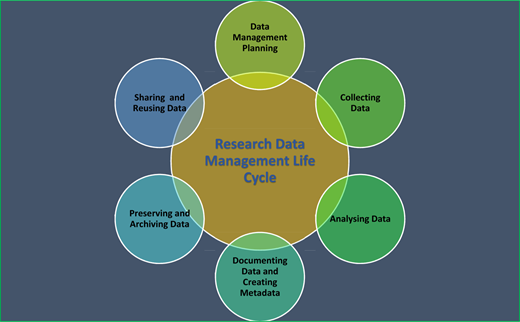
Research data management lifecycle (Source: Singh, 2020)
Research data management lifecycle (Source: Singh, 2020)
A DMP is a written document outlining data the researcher intends to gather during the research project (Bryant, 2023). Most research funding agencies need a DMP as part of the application process. DMP can also be drafted even if the researcher is not in need of funding, but it can be helpful in documenting a research plan. The researcher must also indicate the type of data to be gathered, how it will be managed, described, analyzed and stored and what procedure to be used to ensure that the datasets are accessible, shared and preserved for future reuse. The purpose of drafting the DMP is to formalize the process, identify gaps and provide a record of what is intended to be done. The DMP should include elements such as data description, access and sharing, metadata, intellectual property rights, ethics and privacy, structure/layout, archiving and preservation and storage and backup. Most research funders require a DMP to form part of the research application.
Step 2: Collecting data
The researcher should indicate how data will be collected by describing the data collection tools, methods and processes. Data collection can be done through observation or interviews where data can be recorded manually or using audio-visual devices, experiments and electronic means of email to send a questionnaire. There are various ways to collect research data, such as collecting new data, transforming legacy data and sharing and buying data.
Step 3: Analyzing data
Data analysis is a stage where raw data is interrogated to determine data that can be used to constitute the research findings, which will be published as research output. The analysis of research data can be done manually using tally sheets and online using online survey tools, such as Statistical Package for the Social Sciences (SPSS), SurveySparrow, SurveyMonkey, SurveyLegend, Zoho Survey, SoGoSurvey, Qualtrics and QuestionPro.
Step 4: Documenting data and creating metadata
Documenting research data and creating metadata is the core of effective data management, which ensures that the documented data will be findable/discoverable and usable in the future. Librarians describe, classify, explain or organize metadata to make it possible to be located so that it must be easy to access when searched on the institutional repositories. Metadata assists researchers in understanding the data and assists other researchers in finding, reusing and citing research data.
All items, collections and projects in the institutional repositories are searched using simple search or advanced search in a search field. Searchable attributes are as follows:
- (1)
Title, author, description, subject, category, funders and language
- (2)
Tag: The keyword used to describe an item
- (3)
Item type: To determine whether it is an article, project, collection, dataset, figure, poster, media, presentation, paper, file set, thesis and code
- (4)
Search term: To search in all fields and match phrase
- (5)
Orcid: To retrieve the exact match
- (6)
Extension: To retrieve the exact match for the file extensions
- (7)
References: To retrieve the exact match
- (8)
Doi: To retrieve the exact match
- (9)
Institution: This is only for institutions that have institutional repositories. Researchers would use the string ID from the URL
- (10)
Project: To retrieve the exact match
- (11)
Date of publication: To retrieve the exact match
- (12)
Rights: To retrieve the exact match, enter any known intellectual property rights held to access data
- (13)
Resource_doi: To retrieve the exact match
- (14)
Resource_link: To retrieve the exact match
Step 5: Preserving and archiving data
Research data must be preserved and archived in an accessible format in the institutional repositories for future use and easy retrieval. The preservation and archiving of research data might involve quality assurance of data, converting file format, creating metadata records by assigning digital object identifiers (DOIs) to datasets, licencing data for reuse and putting in place any other required measures. Confidential and non-digital data must be kept in a safe place, and access should be controlled locally by the librarian working with RDM.
Step 6: Sharing and reusing data
Sharing and reusing research data can make researchers' work more transparent, reproducible, reusable and impactful. This is the aspect that researchers should know the significance of sharing data.
The following are the benefits of sharing research data:
- (1)
It increases citations and recognition when another researcher uses data.
- (2)
Sharing research data can assist in meeting funder requirements and complying with the funder’s and publishers’ policies for data management and sharing and journal policies for data availability.
- (3)
It enables researchers’ growth and reproductivity in research output.
- (4)
Researchers can collaborate with other national and international researchers within the discipline with the same research interest.
- (5)
RDM is a good practice as it adheres to ethical issues to ensure research integrity.
- (6)
Simplify the sharing and reuse of research data by other researchers with the same research interest, thus producing new research findings.
- (7)
The risk of data loss is minimized by keeping the research data secure and safe for a more extended period.
- (8)
Research integrity in terms of adhering to ethical clearance is guaranteed.
- (9)
They depend on RDM as a platform to showcase research data outputs to an international audience.
- (10)
Researchers can attract new collaborators and research partners for future research projects.
When considering sharing research data, researchers must consider the following:
- (1)
To consider ethical issues such as consenting to share human subject data and personally identifiable information (PII). Only fully de-identified data without PII should be shared by uploading datasets to the institutional repository.
- (2)
To consider copyright issues such as having the right to share research data/being the custodian of the research data.
- (3)
To make research data FAIR.
- (4)
To include descriptive metadata to enhance the discoverability of the work and provide context to the research study.
- (5)
To link research data with related publications that were previously uploaded to the institutional repository.
- (6)
Selecting an appropriate license for reuse, paying particular attention to which licenses are best suited to different output types such as data, code or written text.
8. Ethical considerations for research data sharing
RDM and research ethics are applied across all stages of the RDM lifecycle, from the need to plan to start the research project, the storage of data for access by other researchers, securing transfer of data, managing access to research data for research projects, retaining research data and archiving research data by anonymizing research data before sharing or applying data management and access control responsibilities (Kanza and Knight, 2022). To ensure that the institution, through the academic libraries responsible for RDM, complies with the ethical considerations, it is important to apply institutional ethical guidelines and the national and international codes of conduct. Institutional researchers and stakeholders should consider whether ethical issues are adhered to in terms of how data was gathered, stored, transferred/used, who is eligible to use research data and how long data should be preserved in the institutional repositories (Mahomed et al., 2022).
Suppose the research study is conducted involving human participants and/or wishes to make research data available after the completion of the study. In that case, informed consent must be provided, permitting the future use of research data and data sharing for reuse. The informed consent process includes describing the research project to the potential participants. Informed consent is “a process by which an individual voluntarily expresses his or her willingness to participate in a particular trial after being informed of all aspects of the study that are relevant to the decision to participate” (Kaye, 2020). It is the responsibility of the researcher to explain to potential participants the level of confidentiality of the research data, the measures to be taken to maintain confidentiality, and the consequences of bringing about ethical issues related to confidentiality. In a nutshell, the researcher should draft and provide descriptions of measures to be taken to protect the participants’ privacy, then indicate the conditions under which records of data will be made available to other researchers for future use and sharing.
Anonymization permits data to be shared for use while maintaining privacy. The process of anonymizing data compels identifiers to be amended in such a way as to being eradicated, replaced, altered, generalized or combined.
Personal data cannot be shared with a third party unless explicit consent is secured (Adams et al., 2021). Even if data can be de-identified before sharing with the third party, the applicable consent of the person to whom the data pertains should be covered. Failure to address issues of consent, the use of such data, the publishing of research findings and the sharing of research data might be restricted.
Researchers should ensure that the participants are fully informed about the nature of the research, how their data will be used, and the measures to protect their privacy. Consent forms should clearly outline the scope of data sharing and any potential risks involved (Big Data and Privacy Concerns in Research, 2024). To protect participants’ identities, the researcher must implement robust anonymization techniques such as data masking, pseudonymization and aggregation. These techniques should be applied consistently across all datasets to maintain privacy (Ethical Issues in Big Data Research, 2024).
Strict access controls must be established to limit who can view or use the data. This includes implementing role-based access controls and ensuring that only authorized personnel access sensitive information (Ethical Considerations in International Research Collaborations, 2024). Engagement with institutional ethics review boards or ethics committees to review and approve DMPs. These boards can provide valuable oversight and ensure that ethical standards are upheld throughout the research process (Ethical Considerations in International Research, 2024).
Maintaining transparency and accountability in RDM practices by documenting all steps taken to protect participants’ privacy and secure informed consent is crucial. This documentation should be made available to stakeholders and participants upon request. Researchers should comply with relevant legal and ethical standards, such as the General Data Protection Regulation (GDPR) and other applicable data protection laws. Researchers must remain informed about the changes in regulations and adapt their practices accordingly (Big Data and Privacy Concerns in Research, 2024).
Researchers must be trained in ethical data management practices. These trainings should include data anonymization, informed consent and the ethical implications of data sharing. Understanding the ethical implications of data sharing is vital, as it involves balancing the benefits of open science with the need to protect individual privacy and comply with legal and regulatory requirements (Ethical Issues in Big Data Research, 2024).
9. Implications of the study
The implication of this study highlights the significant impact of effective RDM practices. The following are the implications for research, practice and public policy, underscoring the broader benefits of well-managed research data.
- (1)
Implications for research: A well-managed RDM system promotes transparency, reproducibility and efficiency in academic research. Researchers benefit from institutional repositories, as these platforms ensure the long-term preservation and accessibility of datasets. Additionally, data sharing encourages interdisciplinary collaboration and enhances citation rates, contributing to the overall visibility of research output. Therefore, emphasizing how RDM practices contribute to new knowledge creation and interdisciplinary collaboration would make the study more impactful.
- (2)
Implications for practice: Academic libraries must adopt proactive strategies to support researchers in complying with RDM policies. This includes providing training on data curation, implementing repository guidelines and establishing data stewardship roles. Institutions should also develop user-friendly repository interfaces that streamline dataset submission and retrieval processes. Discussing how academic libraries can actively support researchers in RDM through training tools and policies would provide actionable recommendations that enhance the effectiveness of RDM practices and ensure compliance with institutional and regulatory requirements.
- (3)
Implication for public policy: The study underscores the need for regulatory frameworks that encourage open science and data sharing. Government agencies and funding bodies should establish mandates that require publicly funded research to be deposited in institutional repositories. Policies should also ensure that ethical guidelines for data privacy and informed consent are adhered to, safeguarding the rights of research participants. Exploring how RDM can influence public policy by promoting open science and ensuring research integrity would broaden the study’s relevance. Additionally, discussing the potential economic and commercial benefits of well-managed research data, such as facilitating industry–academia collaborations, would enhance the paper’s real-world applicability.
10. Conclusion
This study highlighted the concepts of RDM, RDM stakeholders, the RDM lifecycle and ethical considerations for research data. The significance of sharing research data demonstrates the pivotal role of RDM in the research process. Data sharing and management are fundamental aspects that facilitate ongoing research projects, thus saving time and resources that would otherwise be spent gathering new data. While some researchers are willing to share data for reuse by other researchers, there is notable resistance among others due to concerns over data misuse, intellectual property and the potential for misinterpretation.
Despite the availability of resources and tools within academic libraries to manage research data, there are obstacles that researchers face in accommodating the role of librarians. Librarians must approach researchers with an understanding of the research language and the value researchers place on their data. Effective communication and collaboration between librarians and researchers are essential for successful RDM implementation. Librarians need to interview researchers to elicit their beliefs and determine their attitudes regarding data sharing. This personalized approach can help address concerns, build trust and promote a culture of data sharing.
Furthermore, the study underscores the importance of ethical considerations in RDM, ensuring data-sharing practices comply with legal and ethical standards. By adhering to ethical guidelines, academic libraries can support researchers in managing their data responsibly, thereby enhancing the integrity and impact of research. The study emphasizes that RDM is not just a technical necessity but a collaborative and ethical endeavor that requires the active participation of all stakeholders. Academic libraries can play a crucial role in advancing research and contributing to the broader scientific community by fostering a supportive environment for data management and sharing.

