


Based on the job demand and resource (JD–R) model, this study identifies the factors influencing fatigue among seafarers in Malaysia.
A total of 250 responses were gathered via an online survey applying a purposive sampling method. The derived data were analysed using partial least squares-structural equation modelling (PLS-SEM) via SmartPLS 4.
Job demand positively influences sleep problems and occupational stress, while job resources positively impact job autonomy. The research analysis also confirms the positive effect of sleep problems and occupational stress on fatigue. Furthermore, the study reveals the negative effect of job autonomy on fatigue. In-depth analysis confirms the mediation and sequential mediation effects as the determinants of fatigue among seafarers in Malaysia.
Besides enriching the literature on fatigue, the findings provide practical insights to maritime agencies to develop an effective policy to reduce fatigue among seafarers.
The study develops a new model for seafarers’ fatigue via the JD–R model by introducing work pressure, sleep problems, occupational stress and autonomy as sequential mediators.
1. Introduction
Seafarers are exposed to fatigue, which adversely affects occupational safety. The International Maritime Organisation (IMO, 2019) defines fatigue as a decline in mental or psychological capacity due to health issues. This detrimental effect lowers an individual’s ability to perform physical tasks involving decision-making, stamina, speed and reaction time. Fatigue presents seafarers with numerous challenges (Lin and Sarza, 2024). In particular, the lack of focus caused by workplace exhaustion can instigate fatigue-related incidents (Monteiro et al., 2020). Fatigue can substantially damage seafarers’ health in the long term and lower their concentration and assessment, which instigates maritime accidents (Zhao et al., 2023). As reported between 2014 and 2020, 60.6% of marine accidents were caused by human errors. Meanwhile, 67.1% of the factors contributing to maritime casualties resulted from human behaviour, such as fatigue (Fan and Yang, 2024).
Despite working in a well-paying profession, seafarers are exposed to injuries or hazardous work conditions (Zhang et al., 2020). Undeniably, fatigue due to long working hours is a key issue in various industries, including maritime transportation. The high psychological and physical demands required for daily sailing trips induce fatigue, which is common in seafaring.
Despite efforts to mitigate seafarers’ fatigue via new technology, precautionary laws and training and development (Rajapakse and Emad, 2023), the number of fatigue-induced maritime accidents continues to increase (Yang et al., 2023). This scenario implies the need for improved maritime safety and in-depth research, which can better characterise seafarers’ fatigue and offer workable solutions (Rajapakse and Emad, 2023). In Malaysia, working conditions are a key factor influencing seafarers’ fatigue. Dohrmann et al. (2019) claim that 12–38% of onshore personnel experienced exhaustion, while 38–76% of their offshore counterparts reported fatigue.
Up to 33% of crew members reported fatigue-induced accidents or mishaps, 23% of them fell asleep at work more than once a month, and up to 89% reported being too tired to concentrate at work. In line with Liu et al. (2020), fatigue can cause property and environmental damage and even the death of seafarers. The National Transportation Safety Board identified human weariness as a key catalyst for accidents (Marcus and Rosekind, 2017). Following Sharma et al. (2016), weariness contributed to 33–16% of human injuries and vessel casualties, respectively. Moreover, seafarers with no rest hours experience weariness, which accounts for 75–95% of the marine accidents caused by human errors (Bielić et al., 2017). As reported by the Marine Accident Investigation Branch, the crew of a Dutch ship collided with another vessel due to exhaustion. The crew members, who had not slept since 07:00 the night before the crash, were unaware of the approaching ship.
The issues underlying seafarers’ fatigue affect their work productivity (Jepsen et al., 2015). Workload, stress and insecure jobs are the work structure roles that are impacting a sailor’s job state. Based on Baumler et al. (2021), combining these variables directly or indirectly influences the sailors. Despite being the most visible members of this sector, seafarers are highly vulnerable to different mental health concerns, such as anxiety and depression.
Despite numerous studies on individuals and work factors, these empirical works are confined to the aviation, chemical, oil and gas and nuclear sectors. Research on the maritime industry, which is deemed a high-risk industry, remains lacking (Rajapakse and Emad, 2023). Past works on seafarers’ fatigue primarily involved vacation schedules (An et al., 2020), job demand and resources (Andrei et al., 2020), long working hours, long service on board, poor work settings and sleep (Zhao et al., 2023) and shorter departure intervals (Yang et al., 2023). In addition, most of the studies were performed pre- and mid-Covid-19 (Zhao et al., 2023).
Seafarers commonly experience high work pressure, which is often associated with occupational stress due to long working hours and challenging working conditions. Despite the significance of self-efficacy in a seafarer’s job autonomy, studies that collectively investigate these variables (as an extension of the JD–R theory) remain lacking. Only a few scholars, such as Andrei et al. (2020), utilised this theory. Nevertheless, sleep problems, occupational stress and job autonomy have not been tested with the JD–R model. This study uses the JD–R theory and incorporates occupational stress, job autonomy and sleep problems into the JD–R model to bridge the existing gap and determine the factors influencing fatigue among Malaysian seafarers post-pandemic.
Essentially, this quantitative work examines the causes of fatigue among mariners via the JD–R model to expand the current body of literature. First, the current work is conducted among Malaysian seafarers post-pandemic. Second, this research extends the JD–R model by including occupational stress, sleep problems and job autonomy. Lastly, the study presented job autonomy as a mediator for the relationship between (1) self-efficacy and fatigue, (2) work pressure and occupational stress and (3) work pressure and sleep problems among Malaysian seafarers. These variables sequentially mediate the workload–fatigue relationship. The elicited outcomes can facilitate maritime agencies and seafarers to align their working procedures with certain work resources and demands and reduce seafarers’ fatigue. Marine management and policy must gain a sound understanding of the significance of fatigue in shipping accidents.
2. Literature review
2.1 Job demand–resource (JD–R) model
First introduced to examine burnout factors, Demerouti et al.’s (2001) JD–R model has become a popular framework for exploring the interplay between job characteristics and employee well-being. This model proposes job demand and resources as the two key job characteristics underpinning all occupations. Job demand encompasses the physical, psychological, social or organisational aspects that require sustained effort, thus resulting in psychological or physiological costs. Conversely, job resources alleviate these demands to accomplish work objectives and foster personal growth and development (Demerouti et al., 2001). Recent maritime research employing the JD–R model highlights its potential usefulness in understanding well-being and safety outcomes in the industry.
2.2 Workload and work pressure
Despite variances in its interpretation, the term “workload” underscores mental effort as a key factor. Gore et al. (2018) define workload as a concept entailing the physical and mental efforts associated with task initiation and completion. Poor equipment design or complex environmental conditions can affect workload. In addition to physical requirements in specific occupational groups, mental demands are a key component of workload (Bakhshi et al., 2019).
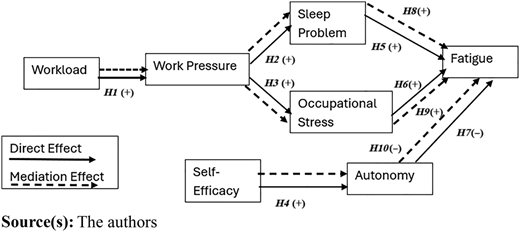
The paucity of crew numbers to manage ships has increased seafarers’ workload (Rajapakse and Emad, 2023). Despite the initial improvement in productivity, service efficiency decreased with an increase in workload intensity, which exceeded a critical limit. Jensen and Oldenburg (2021) and Choi et al. (2019) revealed the positive influence of seafarers’ workload on work pressure. Based on these arguments, the first hypothesis was developed:
Workload is positively related to work pressure among seafarers.
2.3 Work pressure and sleep problems
Work pressure is a subjective feeling of stress connected to task completion within specific timeframes. It is also an emotional condition of stress that relates to key job demands (hierarchical level, work and rest schedules), which are associated with strain (Andrei et al., 2020). Generally, work pressure increases with various work demand patterns. Zhang et al. (2019) denote the diverse sources of work pressure in work environments, which inevitably induce stress. Shifts in work schedules and operational hours potentially impact the likelihood of experiencing work pressure. For example, working at the expense of an individual’s biological sleep cycle can disrupt their circadian rhythm and cause sleep disruptions. Prolonged working hours and overtime adversely impact sleep quality (John et al., 2022). Furthermore, Triyanti et al. (2020) highlight the positive impact of work pressure on sleep problems. Past works by Jonglertmontree et al. (2022) reveal a positive work pressure–sleep problem relationship among seafarers. Based on these discussions, the second hypothesis was developed:
Work pressure is positively related to sleep problems among seafarers.
2.4 Work pressure and occupational stress
Political, cultural, social and economic factors influence workplace stress management strategies and how individuals perceive and respond to stressors (Nuamah and Mehta, 2020). With regard to healthcare workers, occupational stress stems from conflicts between job demands and an individual’s control over meeting them (Nuamah and Mehta, 2020). Workplace stress is categorised into physiological, psychological and behavioural effects that impact one’s physical health, mental well-being and behavioural patterns (Rezaei et al., 2020).
Seafarers in the maritime industry frequently work for extended periods in confined environments and face pressure and stressors. Such conditions affect their physical and mental health (Oldenburg and Jensen, 2019). Key differences are also indicated between offshore (at sea) and onshore (in port) work times (Baumler et al., 2021). Although maritimers work an average of 8–11 h a day at sea, their working hours often exceed 12 h per day. Evidently, high work pressure obviously increases occupational stress (Baumler et al., 2021). In particular, workers with different roles onboard (deck ratings) and engine room officers experience stressors influenced by work pressure and responsibility levels (Oldenburg and Jensen, 2019). Andrei et al. (2020) highlight that work pressure is positively related to stress. As employees with increased work pressure experience high levels of work stress (Thanem and Elraz, 2022), the third hypothesis was developed:
Work pressure is positively related to occupational stress among seafarers.
2.5 Self-efficacy and autonomy
Defined as an individual’s belief in his capability to effectively perform tasks, self-efficacy plays a pivotal role in behavioural change and goal achievement (Bandura, 1994). This concept influences individual actions to solve problems, achieve their objectives and foster optimism and confidence. Meanwhile, autonomy denotes an individual’s ability to make independent decisions and foster positive interactions between workers and their organisations.
High self-efficacy increases one’s confidence in independently managing tasks. This confidence influences the level of effort exerted to achieve optimal outcomes. A positive relationship is identified between employees’ self-efficacy and autonomy, with self-efficacy positively linking to job autonomy and various aspects of employee mental health (Komnik, 2023). Relevant research (Benneker et al., 2023) also confirms the positive impact of self-efficacy on autonomy. Based on these findings, the fourth hypothesis was developed:
Self-efficacy is positively related to autonomy among seafarers.
2.6 Sleep problems and fatigue
The sleep problems–fatigue relationship has been extensively examined in various domains. Concerning rheumatic diseases, sleeplessness (often attributed to pain) contributes to high fatigue levels (Castelli et al., 2022). As one of the key psychological issues in the maritime industry, fatigue is associated with poor health, well-being and safety outcomes (Andrei et al., 2020). Sleep issues in the maritime sector, including disrupted sleep patterns owing to irregular work hours and night shifts, are prevalent among nautical officers (Pauksztat, 2017). Engine noise and ship motion contribute to crew members’ sleepiness while affecting their ability to function optimally. Relevant research demonstrates a strong positive relationship between fatigue and sleep problems among seafarers (Sabaner et al., 2022). For example, Barak et al. (2020) revealed a positive association between sleep problems and fatigue. Based on these arguments, the fifth hypothesis was developed:
Sleep problems are positively related to fatigue among seafarers.
2.7 Occupational stress and fatigue
Occupational stress may threaten one’s quality of life, including psychological and physical health (Cho et al., 2008). A worker’s response to physical and mental pressures in their environment, also known as occupational stress, is classified into (1) the stress arising from personal characteristics and (2) the stress caused by negative work environment elements (Nuamah and Mehta, 2020; Sliškovíc and Penezíc, 2017). The mismatch between job demands and an employee’s control over meeting the demands induces workplace stress and undermines their physical and emotional well-being. This concept entails physiological, psychological and behavioural effects, including compromised immunity, mental health issues and behavioural changes (low job attachment or emotional withdrawal) (Rezaei et al., 2020).
In maritime contexts, seafarers often work seven days a week for months on end. Such prolonged hours lead to stressors that impact their physical and mental health (McVeigh et al., 2021). Specific roles involving deck ratings or technical officers in the engine room experience distinct stressors, such as high physical exertion or responsibility during emergencies. Past works revealed a positive relationship between workplace stress and fatigue, which associates employees’ stress levels with anxiety, depression and fatigue (Tong et al., 2022). Onboard conditions, including environmental factors of ship movement or climate change, may heighten seafarers’ stress levels. In line with relevant maritime works, occupational stress positively influences fatigue (Andrei et al., 2020). Aslan et al. (2022) highlight a positive relationship between stress and fatigue. These discussions led to the development of the sixth hypothesis:
Occupational stress is positively related to fatigue among seafarers.
2.8 Autonomy and fatigue
Autonomy allows employees to exert control over task organisation and execution, which proves beneficial in various work scenarios (Collie, 2023). In essence, autonomy is a behaviour supported by coworkers, with the management providing encouragement, feedback, gratitude and awards (Andrei et al., 2020). Employees with increased autonomy experience high levels of motivation and enriching work experiences, which allows them to use their skills for task performance. From a scholarly perspective, job autonomy is linked to seafarers’ improved well-being and reduced fatigue (Granziera et al., 2021). Cham et al. (2021) claim that job autonomy can reduce seafarers’ fatigue. Allowing seafarers to independently use their skills lessens fatigue while enhancing productivity, which renders their tasks less challenging. Based on these arguments, the seventh hypothesis was developed:
Autonomy negatively influences fatigue factors among seafarers.
2.9 Work pressure and sleep problems as sequential mediators
Simple or sequential mediation is a key contribution to social science studies (Ngah et al., 2023). Seafarers’ additional working hours increase their workload, work pressure and fatigue (Andrei et al., 2020). Following Rajapakse and Emad (2023), port management innovation results in shorter vessel turnaround and increased fatigue for maritime workers. Seafarers with a high workload experience an increase in work pressure, sleep issues and fatigue. As such, work pressure and sleep problems potentially mediate the workload–fatigue relationship among seafarers. The eighth hypothesis was developed as follows:
Work pressure and sleep problems positively and sequentially mediate the relationship between workload and fatigue.
2.10 Work pressure and occupational stress as sequential mediators
Inadequate tools and technology increase work pressure (Manroop and Petrovski, 2023). A high workload contributes to work pressure, which results in occupational stress (Prasetyaningtyas et al., 2022). Seafarers who work long hours and perform various tasks experience an increase in work pressure, stress and fatigue (Baumler et al., 2021; Andrei et al., 2020). Workload directly relates to fatigue (Zhang et al., 2019), with high workload increasing work pressure, occupational stress and fatigue. High work pressure leads to an increase in seafarers’ workload, occupational stress and fatigue. As such, work pressure and occupational stress might influence fatigue and mediate the relationship between workload and fatigue. The ninth hypothesis was developed as follows:
Work pressure and occupational stress positively and sequentially mediate the relationship between workload and fatigue.
2.11 Autonomy as mediator
Employees’ self-efficacy increases when linked to autonomy, which fosters a sense of value and commitment to their organisational tasks (Komnik, 2023). Relevant studies denote a positive relationship between self-efficacy and autonomy, with autonomy effectively reducing seafarers’ fatigue (Andrei et al., 2020). Associated with low fatigue levels, autonomy enhances productivity by allowing the use of skills and knowledge (Cham et al., 2021). Following past research, a negative relationship was identified between seafarers’ autonomy and fatigue (Cham et al., 2021). Self-efficacy potentially increases job autonomy while reducing fatigue. Thus, autonomy may negatively mediate the relationship between self-efficacy and fatigue. The tenth hypothesis was developed as follows:
Autonomy negatively mediates the relationship between self-efficacy and fatigue.
Figure 1 illustrates the current research framework.
3. Methodology
The present study adopted a quantitative approach by collecting the data via an online questionnaire. Specifically, five items measuring workload were derived from Smith and Smith (2017), three items examined work pressure and autonomy, respectively, and four items measuring sleep problems and fatigue were extracted from Andrei et al. (2020). Self-efficacy was measured with four items adopted from Yuen et al. (2020). Four items measuring occupational stress were modified from Cho et al. (2008). All the selected measurement items demonstrate satisfactory reliability and validity. The study items are attached as Appendix 1. In addition, two academicians and two industry experts from the field of study were selected to establish the questionnaire’s content validity. The questionnaire items’ structure, logic and wording were then reviewed to improve presentation and readability. A pre-test with cognitive interviews was conducted with two sailors, a machinist, a chef, an engineer and a captain to confirm the measurement items’ suitability. All the respondents were men between 20 and 39 years old with approximately 10 years of seafaring experience.
Purposive sampling was employed due to the unavailability of a sampling frame for seafarers in Malaysia (Rashid et al., 2022). As the targeted respondents were difficult to reach, the questionnaire link was shared in Facebook groups related to seafarers, such as the Malaysian Seafarers Community and personnel connection groups (including WhatsApp). Human resource managers in shipping companies were contacted to share the link with seafarers and increase the number of respondents. A total of 270 responses were received within four months (May to August 2022). Only 250 responses were considered valid post-data cleaning. About 20 incomplete and suspicious responses were removed. The G-power software, based on the model’s complexity, served to determine the study’s minimum sample size (Ngah et al., 2021a, b). With 80% power and three predictors at medium effect size (Halimi et al., 2022), the minimum sample size to test the research model was 77. Therefore, a sample size of 250 respondents proved adequate for testing the research model. The majority of respondents (95.6) in this study were men, with 39.8% of them between 30 and 39 years old. Approximately 37.5% of the individuals attended junior college (minimum qualification). In terms of work experience, 26.3% had six to 10 years of experience as a seafarer. Regarding monthly income, 35.1% of the respondents earned between RM3,001 and RM5,000. Moreover, 27.1% of them worked as sailors. Table 1 presents the respondents’ profiles.
4. Data analysis
4.1 Common method bias
As the current data were gathered from a single source Rahi et al. (2022) state that common method bias must be addressed to ensure that the derived outcomes are free from bias (Ngah et al., 2022a, b). A statistical method was applied following Kock (2015) and Tuan Mansor et al.’s (2022) full collinearity tests. A variance inflation factor (VIF) value exceeding or equal to 3.3 indicates common method bias. The research results revealed VIF values under 3.3, which suggests no single-bias issues. Table 2 depicts the VIF values for full collinearity outcomes.
Convergent validity and full collinearity testing
| Construct | Item | Loading | CR | AVE | VIF |
|---|---|---|---|---|---|
| Autonomy | A1 | 0.889 | 0.901 | 0.753 | 1.29 |
| A2 | 0.898 | ||||
| A3 | 0.814 | ||||
| Fatigue | F1 | 0.762 | 0.891 | 0.673 | 1.793 |
| F2 | 0.826 | ||||
| F3 | 0.875 | ||||
| F4 | 0.814 | ||||
| Occupational stress | O1 | 0.761 | 0.810 | 0.523 | 1.874 |
| O2 | 0.513 | ||||
| O3 | 0.725 | ||||
| O4 | 0.849 | ||||
| Self-efficacy | SE1 | 0.889 | 0.942 | 0.801 | 1.547 |
| SE2 | 0.876 | ||||
| SE3 | 0.921 | ||||
| SE4 | 0.894 | ||||
| Sleep problems | SP1 | 0.829 | 0.894 | 0.68 | 1.990 |
| SP2 | 0.890 | ||||
| SP3 | 0.722 | ||||
| SP4 | 0.849 | ||||
| Workload | WL1 | 0.749 | 0.854 | 0.539 | 3.027 |
| WL2 | 0.716 | ||||
| WL3 | 0.731 | ||||
| WL4 | 0.694 | ||||
| WL5 | 0.779 | ||||
| Work pressure | WP1 | 0.880 | 0.925 | 0.805 | 2.029 |
| WP2 | 0.910 | ||||
| WP3 | 0.902 |
Source(s): The authors
4.2 Measurement model
This study employed a two-step approach following Ngah et al. (2022a, b) to confirm the measurement and structural models. A measurement model can be established via convergent validity and discriminant validity (Ngah et al., 2022a, b). Notably, convergent validity is established if the loading is ≥ 0.5, the average variance extracted (AVE) is ≥ 0.5 and the composite reliability (CR) is ≥ 0.7 (Hair et al., 2019). All the item loadings exceed 0.5 (see Table 2). Both the AVE and CR values exceed 0.5 and 0.7, respectively. Overall, all the items’ convergent validity is established (Hair et al., 2019). Discriminant validity is established when all the heterotrait-monotrait (HTMT) values are under 0.85 (Franke and Sarstedt, 2019). Based on Table 3, all the values are below 0.85 and indicate discriminant validity.
Discriminant validity (HTMT)
| Construct | Autonomy | Fatigue | Occupational stress (OS) | Self-efficacy (SE) | Sleep problems (SP) | Workload (WL) | Work pressure (WP) |
|---|---|---|---|---|---|---|---|
| Autonomy | 0.124 | ||||||
| Fatigue | |||||||
| Occupational stress (OS) | 0.255 | 0.485 | |||||
| Self-efficacy (SE) | 0.477 | 0.190 | 0.239 | ||||
| Sleep problems (SP) | 0.091 | 0.678 | 0.448 | 0.231 | |||
| Workload (WL) | 0.150 | 0.711 | 0.734 | 0.272 | 0.782 | ||
| Work pressure (WP) | 0.066 | 0.611 | 0.635 | 0.064 | 0.619 | 0.760 |
Source(s): The authors
4.3 Structural model
It is crucial to ensure that the study’s multicollinearity does not affect the findings pre-hypothesis testing. Based on the analysis, all the VIFs are under 5 (Hair et al., 2017). The level of collinearity was not severe in this study. Figure 2 illustrates the structural model. A bootstrapping technique was applied with a 5,000-resampling procedure for hypothesis testing. The hypotheses are supported with a beta value that parallels the hypothesis direction of (t-value ≥1.645, p-value ≤0.05), with no zero in between the confidence interval (Ngah et al., 2021b).
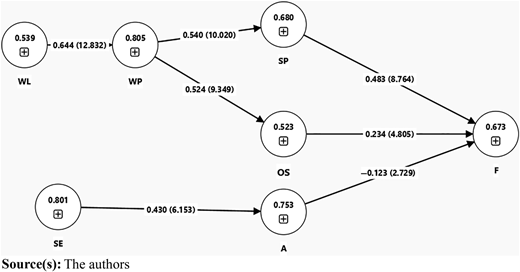
Table 4 presents the hypotheses testing outcomes for the study’s direct and indirect effects. Resultantly, the relationships between workload → work pressure (β = 0.644, p = 0.001), work pressure → sleep problems (β = 0.540, p = 0.001), work pressure → occupational stress (β = 0.540, p = 0.001), sleep problems → fatigue (β = 0.483, p = 0.001), occupational stress→ fatigue (β = 0.234, p = 0.001), self-efficacy → autonomy (β = 0.430, p = 0.001) and autonomy → fatigue (β = −0.123, p = 0.003) suggest that all the direct hypotheses (H1–H7) are supported.
Hypothesis testing for direct and indirect effects
| H’thesis | Relationship | Beta | SE | T-value | P-values | LL | UL | VIF | F2 |
|---|---|---|---|---|---|---|---|---|---|
| H1 | WL → WP | 0.644 | 0.050 | 12.832 | 0.001 | 0.524 | 0.708 | 1.000 | 0.708 |
| H2 | WP → SP | 0.540 | 0.054 | 10.020 | 0.001 | 0.440 | 0.628 | 1.000 | 0.411 |
| H3 | WP → OS | 0.524 | 0.056 | 9.349 | 0.001 | 0.410 | 0.601 | 1.000 | 0.378 |
| H4 | SE → A | 0.430 | 0.070 | 6.153 | 0.001 | 0.299 | 0.529 | 1.000 | 0.227 |
| H5 | SP → F | 0.483 | 0.055 | 8.764 | 0.001 | 0.383 | 0.566 | 1.189 | 0.320 |
| H6 | OS → F | 0.234 | 0.049 | 4.805 | 0.001 | 0.149 | 0.308 | 1.199 | 0.074 |
| H7 | A → F | −0.123 | 0.045 | 2.729 | 0.003 | −0.193 | −0.050 | 1.011 | 0.024 |
| H8 | WL→WP→ SP → F | 0.168 | 0.036 | 4.625 | 0.001 | 0.109 | 0.235 | ||
| H9 | WL →WP → OS → F | 0.079 | 0.023 | 3.494 | 0.001 | 0.042 | 0.114 | ||
| H10 | SE → A → F | −0.053 | 0.022 | 2.394 | 0.009 | −0.092 | −0.021 |
Source(s): The authors
Regarding the indirect effect results, only two out of the three hypotheses (H8, H9 and H10) are supported. Both work pressure and sleep problems sequentially mediate the relationship between workload and fatigue, thus supporting H8 (β = 0.168, p = 0.001). Furthermore, work pressure and occupational stress sequentially mediate the relationship between workload and fatigue, which supports H9 (β = 0.079, p = 0.001). Regarding H10, job autonomy negatively mediates the relationship between self-efficacy and fatigue (β = −0.053, p = 0.009). Cohen’s (2013) guidelines serve to determine the effect size (f2). The f2 values of 0.02, 015 and 0.35 are considered small, medium and large, respectively. Relationships between workload → work pressure, work pressure → sleep problems, work pressure → occupational stress and self-efficacy → autonomy reveal a large f2, sleep problems → fatigue denote a medium f2 and occupational stress → fatigue and autonomy → fatigue imply a small f2.
The predictive model was applied via partial least square (PLS) to predict relevance. Relevant works (Shmueli et al., 2019) have highlighted a strong predictive power when all PLS-root mean squared error (RMSE) values at the item level are lower than that of the linear model-root mean squared error (LM-RMSE) value. In Table 5, the predictive relevance (Q2) for the fatigue construct is ≥ 0. All the items measuring fatigue indicate PLS-RMSE to be lower than LM-RMSE, which proves a strong predictive power (Shmueli et al., 2019; Rashid et al., 2022).
5. Discussion
This study examines the factors influencing fatigue among Malaysian seafarers. Specifically, workload and work pressure (job demand) and self-efficacy (job resource) were used in the JD–R model, which is extended with occupational stress, job autonomy and sleep problems (mediators) to enrich the existing body of knowledge.
Based on this study and past empirical outcomes, workload is positively related to work pressure (Jensen and Oldenburg, 2021). Even with the adoption and advancement of new technologies, which reduce the number of ship crew members, the workload increases two-fold for seafarers (Rajapakse and Emad, 2023). Their workload and work pressure remain high given the dynamic and intricate work environment. It is essential to implement supportive strategies that align the actual workload with the number of ship crew members to mitigate the workload effects on work pressure. Fruitful discussions with the crew responsible for certain sections (new technology) also ensure that adopting new technology does not increase seafarers’ workload. As such, this strategy effectively identifies crew members’ workloads, specifically before sailing on a new route, to ensure that each member absorbs the assigned workload during the journey.
Work pressure positively affects sleep problems, which indicates its negative influence in disrupting seafarers’ sleep cycles. This outcome corroborates past scholars (Jonglertmontree et al., 2022). Long working hours and irregular work schedules prove to instigate sleep problems among seafarers. Poor sleep quality can affect their performance. Consequently, providing seafarers with adequate rest periods and breaks between work periods ensures sufficient rest and potentially reduces work pressure. The individuals can be encouraged to work collaboratively, practise good communication and receive support from the ship management.
Work pressure positively affects occupational stress among seafarers (Andrei et al., 2020b). Given their demanding and isolated profession in the maritime industry, seafarers frequently experience high work-related stress following heavy workloads, long working hours and the unpredictability of their working environment. Ship authorities or employers should collaborate with seafarers to overcome such occupational stress. For example, seafarers could be properly trained and briefed to manage possible challenges during their voyage. As each voyage involves a different route, duration and hurdles, seafarers who are briefed on potential sailing challenges and relevant techniques to address them can be more mentally prepared. Being part of a good team and having good social and family support to endure longer ship sails could also reduce seafarers’ stress.
Furthermore, self-efficacy positively influences seafarers’ autonomy. Seafarers with high self-efficacy experience high quality of life and low fatigue. This outcome parallels past works (Komnik, 2023; Lange and Kayser, 2022). In this vein, employers can foster a culture of self-efficacy by providing seafarers with opportunities for professional and skills development, extensive training and working in a conducive environment. Organisations that prioritise self-efficacy and autonomy can facilitate seafarers to better regulate their work, increase job satisfaction, reduce stress and improve mental health.
Sleep problems and occupational stress are positively linked to seafarers’ fatigue (Andrei et al., 2020; Sabaner et al., 2022). Poor sleep quality, disrupted sleep patterns and long working hours contribute to fatigue. As work pressure was found to positively affect sleep problems and occupational stress, reduced work pressure could resolve both issues. Baygi et al. (2022) highlight the need for conducive cabin conditions that enable seafarers to sleep well. However, the lack of crew members for loading and discharging forces them to stay awake for two to three consecutive days, which disrupts their sleep cycle. Adequate cabin facilities and manpower would alleviate seafarers’ sleep issues, improve their sleep quality and reduce fatigue. Employers can reduce such fatigue by providing their subordinates with appropriate resources, increasing the awareness of fatigue-related risks at work and ensuring a healthy shipboard environment.
Autonomy negatively influences seafarers’ fatigue (Andrei et al., 2020; Cham et al., 2021). Therefore, seafarers must wisely organise their workload and time pressure via efficient resource allocation, realistic scheduling and workload management strategies to avoid extreme stress and fatigue. Meanwhile, organisations can create an environment that supports the seafarers to perform their obligations without being overwhelmed and control their work schedules and tasks in high-pressure situations.
The research results denote a sequential mediation effect of work pressure and sleep problems on the workload–fatigue relationship. Based on the third hypothesis, work pressure and sleep problems positively impact seafarers’ fatigue. Furthermore, work pressure and occupational stress positively and sequentially mediate the workload–fatigue relationship. Seafarers’ work pressure, sleep problems and occupational stress are key factors positively mediating the workload–fatigue relationship. These individuals become fatigued when experiencing high work pressure, sleep problems and occupational stress during sea voyages.
Lastly, this study evidences the role of autonomy as a mediator in the relationship between self-efficacy and fatigue. Autonomy negatively mediates the aforementioned relationship. An independent seafarer with high self-efficacy would experience less fatigue, even during a rough sea voyage. Overall, the ship management must promote more job autonomy among crew members with high self-efficacy to ensure optimal task performance.
5.1 Theoretical contributions
Based on the survey of Malaysian seafarers, this study expands the current body of literature on seafarers’ fatigue. First, a new model on seafarers’ fatigue is developed based on the JD–R model. Workload and work pressure imply job demand, while self-efficacy denotes job resource. Despite the existing knowledge gap on fatigue, few studies have used the JD–R model to explore the factors influencing fatigue post-pandemic, specifically in Southeast Asia. The current work underscores the significance of occupational stress, sleep problems and job autonomy in predicting seafarers’ fatigue.
The JD–R model’s capability in predicting seafarers’ fatigue is also confirmed in this study. By extending the model with occupational stress, sleep problems and job autonomy as the mediator and sequential mediators, the current work escalates the model’s predictive power to predict seafarers’ fatigue. Future scholars can examine work pressure and occupational stress, with sleep problems as a sequential mediator for seafarers’ fatigue under the JD–R model.
5.2 Practical implications
This study serves as a guideline for maritime industry authorities and agencies to improve current policies and practices, seafarers’ well-being and their intention to remain in the industry. Failure to make necessary improvements and reduce fatigue would result in a talent gap, as the younger generation would hesitate to join the workforce. In addition to tarnishing the industrial image and deterring potential candidates from considering seafaring as a career, seafarers’ fatigue could lead to serious damage to goods and even threaten the lives of crew members onboard. Relevant authorities in the maritime industry can reduce seafarers’ fatigue and create a better professional image by addressing the issues of workload, work pressure, self-efficacy, occupational stress, sleep problems and job autonomy. Proper investigation and simulation should be run on new vessels equipped with advanced technology to ensure shipowners’ and seafarers’ well-being.
5.3 Conclusion, limitations and recommendations for future research
Based on this study, workload, work pressure, sleep problems, occupational stress, self-efficacy and job autonomy significantly influence seafarers’ fatigue. Each of the parties involved (maritime authorities and stakeholders) must undertake key measures to remedy seafarers’ fatigue. However, the lack of effort by seafarers themselves would perpetuate the issue. Relevant parties should collectively develop a new policy that benefits government agencies, the maritime industry and seafarers.
Despite expanding the current body of literature (for direct and indirect effects), this study is confined to workload, work pressure, self-efficacy, occupational stress, sleep problems, job autonomy under the JD–R theory and seafarers from Malaysia. Given the use of non-probability sampling, the current findings could not be generalised to seafarers in other settings. Future works could replicate this model to validate these findings in other contexts or use other counterparts, such as the stimulus-organism-response model or the ability-motivation-opportunity model. Additionally, work engagement or supportive family could be employed as mediators or moderators to analyse seafarers’ fatigue.
Disclosure statement: No potential conflict of interest was reported by the author(s).
References
Appendix
Profile of respondents
| Item | Frequency | Percent (%) |
|---|---|---|
| Gender | ||
| Male | 240 | 96 |
| Female | 10 | 4 |
| Age | ||
| Less than 29 | 94 | 37.6 |
| 30–39 | 100 | 40 |
| 40–49 | 34 | 13.6 |
| 50–60 | 22 | 8.8 |
| Education | ||
| Junior middle school and below | ||
| Secondary technical school/Senior high school | 86 | 34.4 |
| Junior college | 94 | 37.6 |
| Bachelor’s degree | 52 | 20.8 |
| Master’s degree or above | 18 | 7.2 |
| Working experience as seafarer | ||
| 1–5 years | 84 | 33.6 |
| 6–10 years | 66 | 26.4 |
| 11–15 years | 36 | 14.4 |
| Above 15 years | 64 | 25.6 |
| Income | ||
| Less than RM3,000 | 70 | 28 |
| RM3,001–RM5,000 | 26 | 10.4 |
| RM5,001–RM15,000 | 88 | 35.2 |
| RM15,001 and above | 66 | 26.4 |
| Position | ||
| Captain | 36 | 14.4 |
| Chief engineer | 20 | 8 |
| Chief officer | 12 | 4.8 |
| Second officer | 22 | 8.8 |
| Third officer | 8 | 3.2 |
| Other engineer | 54 | 21.6 |
| Boatswain | 8 | 3.2 |
| Sailor | 68 | 27.2 |
| Others | 22 | 8.8 |
| Total | 250 | 100 |
Source(s): The authors
Variables and items
| Variable | Indicator | Item |
|---|---|---|
| Workload | WL1 | I have to work constantly; I cannot take breaks beyond strict regulations |
| WL2 | I often work with annoying interruptions | |
| WL3 | I have trouble forgetting the problems of my job | |
| WL4 | My work affects my personal relationships | |
| WL5 | My job has a big impact on my emotions | |
| Work pressure | WP1 | I have to work very fast |
| WP2 | I have too much work to do | |
| WP3 | I have to hurry to get things done | |
| Autonomy | A1 | Able to use personal initiative or judgement in carrying out your work? |
| A2 | Able to make a lot of decisions on your own in your work? | |
| A3 | Given the authority to make your own decisions? | |
| Self-efficacy | SE1 | I am confident that I can handle any safety issues |
| SE2 | I can always solve safety issues if I try hard enough | |
| SE3 | Due to my training, I know how to handle safety issues | |
| SE4 | When I am confronted with a safety issue, I can usually find several ways to handle the issue | |
| Occupational stress | O1 | I am asked to do another work before finishing the work I am doing |
| O2 | I feel myself responsible for co-workers | |
| O3 | My work requires a long-lasting concentration | |
| O4 | I have to do various jobs simultaneously | |
| Sleep problem | SP1 | I have difficulty falling asleep |
| SP2 | I have difficulty in staying asleep | |
| SP3 | I have difficulty staying awake (during work) | |
| SP4 | I have restless or disturbed sleep | |
| Fatigue | F1 | I often fear waking up to another day onboard |
| F2 | I often wonder how long I can keep working at sea | |
| F3 | I feel I do not get to do anything else in my life besides work | |
| F4 | My job at sea takes all of my energy from me |
Source(s): The authors

