


A significant body of literature suggests that shipping companies operate in an extremely volatile and risky environment, relying on the effective use of information to remain competitive. However, decision-making in this market is demanding because of the high uncertainty, market competition and significant capital investments. Moreover, the rapid spread of COVID-19 renders information uncertainty a daunting challenge for companies engaged in global trade. Hence, this study aims to explore the information behavior of managers in a time of crisis seems compelling.
This study provides novel insights into the information behavior of senior managers by adopting a qualitative approach. Forty-nine semi-structured face-to-face interviews with individuals from Hellenic shipping companies were conducted. Moreover, this study explores the extant theory qualitatively, using the grounded theory methodology and shows that an unprecedented event (pandemic crisis) can redefine the information behavior of managers.
This study highlights the importance of information in decision-making. Moreover, the results show that, during a pandemic, managers resort to alternative information sources, adopt collaborative information behaviors and take advantage of digital technology.
There is limited research in exploring the information behavior of managers in times of pandemics. This research underscores the fact that during a crisis, managers seek information from digital information resources and decision-making assumes a more decentralized form. This study concludes with a discussion of the theoretical and practical implications of these findings.
1. Introduction
The shipping industry can be highly volatile and risky (Kavussanos and Visvikis, 2006), and most activities are performed under conditions of great uncertainty and stress (Visvikis, 2002). Visvikis (2002) argues that information can assist challenging decision-making by reducing uncertainty. Further, shipping managers should adopt a certain comportment when decision-making is aimed at profit maximization in a competitive (Choi et al., 2020) and volatile environment (Yin et al., 2019). However, decisions related to risks in the market, the operation of vessels and other technical areas may have a harmful impact on shipping companies (Yin et al., 2019). These perceived risks affect and shape the information behavior and the performance of shipping managers (Yin et al., 2019).
Furthermore, an event such as the COVID-19 pandemic has the capacity to alter macroeconomic variables, shock market participants and augment uncertainty (Michail and Melas, 2020). A phenomenon of this type, which affects geopolitical factors, may noticeably influence global trade and shape decision-making in shipping companies (Kotcharin and Maneenop, 2020). More accurately, information chaos created amid the new pandemic has contributed to an increase in market uncertainty and price volatility (Haroon and Rizvi, 2020). It should be emphasized that, since the financial crisis of 2008, effective information management practices, such as knowledge management procedures, can enhance decision-making and have become a necessity for shipping firms. Given these factors, this research appeals to companies that operate in competitive environments in a crisis.
The very essence of this research lies in the way managers inform their decisions. Cartenì et al. (2020) underline the importance of knowledge and information resources for effective decision-making. They argue that managerial decisions should be adequately informed of the context and the process of decision-making itself. Moreover, the literature suggests that managers make decisions under conditions of uncertainty and high risk (Da Silva and Roglio, 2015).
Only a few studies focus on the shipping industry during extraordinary events (Michail and Melas, 2020). Therefore, it would be interesting to explore the information behavior of managers when making decisions during a pandemic crisis. This study discusses the way managers of Hellenic shipping companies actively use knowledge and information resources to make informed decisions and focuses on the change in information behavior of managers after the advent of the recent pandemic.
These findings contribute to managerial decision-making through the adoption of more effective procedures for managing information by exposing information behavior of managers in a crisis.
2. Theoretical background
2.1 Managerial decision-making traits
Huang et al. (2015) clarified that the presence of risk and uncertainty often demands complicated decision-making scenario analysis. Decision-making typically involves the study of industry fundamentals, long-term objectives and test cases regarding the theories of market patterns (Hilton, 2001). Julmi (2019) implies that decision-making should be a rational mechanism because rationality can cope with uncertainty. The literature reveals two modes of decision-making:
the rational mode, based on logical thinking and analysis; and
the intuitive or irrational mode, based on affection or emotion (Huang et al., 2015).
Existing literature reveals that the industry influences the type of decision-making adopted by managers. Abubakar et al. (2019) suggest that competitive industries tend to trigger rational decisions. Nevertheless, rationality in making decisions often presents some drawbacks. In this respect, the literature argues that rational decision-making depends on speed, capacity and technology and limits the information that can be processed (Abubakar et al., 2019). In the same context, Hilton (2001) supports the view that advances in technology have resulted in information overload for decision-makers, creating more constraints for rational decision-making. It is plausible that managers have little guidance on how to cope with the volume of available information using their limited information-processing capabilities (Winkler et al., 2015).
Abubakar et al. (2019) also suggest that managerial decisions often have no feedback about the outcome of either the chosen or rejected decision. Similarly, Hilton (2001) adds that because managers are accountable for their decisions, they often adopt fewer rational decisions and choose decisions that can easily be explained. Literature suggests that intuition is a managerial skill used when making important decisions because it can deal with volatility and uncertainty, whereas logic and rationality do not (Constantiou, 2019). Further, managers frequently base their strategic decisions on intuition to cope with uncertain, risky, volatile environments and time constraints (Dane and Pratt, 2007).
The literature reveals that although intuitive decision-making is often regarded as inferior to rational decision-making, intuition involves the use of instinctive cognitive systems, which are capable of handling demanding cases (Dane and Pratt, 2007). Further, Dane and Pratt (2007) explained that the accuracy of decision-making is not equally related to the speed of decision-making, as quick decisions might also be successful. Dane and Pratt (2007) admit that many accurate decisions have been based on intuition and not on time-consuming rational thinking.
In the past, research connected decision-making to the cognitive approach, but it has been recently related to emotions as well (Li et al., 2014). Li et al. (2014) argue that, although emotions may constitute distractive elements in decision-making, they are essential and can be indispensable elements of a rational decision-making process. Moreover, uncertainty is a factor that triggers the use of emotion in decision-making (Li et al., 2014). Keller and Sadler‐Smith (2019) suggest that effective managers are capable of combining and synthesizing processes that are controlled by the right hemisphere (judgment) with those controlled by the left hemisphere (analysis and logic).
In fact, managers need to be able to critically analyze problems and at the same time, rapidly respond using intuition in a demanding environment (Simon, 2020). Keller and Sadler‐Smith (2019) are convinced of the fact that planning and analysis systems do not facilitate decision-making on their own. This study examines whether senior managers of Hellenic shipping companies adopt different information behaviors that are, leaning more toward rational analysis or relying on feelings and intuition when making strategic decisions.
Wilson (1997) indicates that information behavior is initiated when an individual needs information. Information-seeking behavior is categorized into passive and active information-seeking (Wilson, 2000). Several intervening factors such as personal, social and environmental variables influence the information-seeking behavior of individuals (Wilson, 1997). Moreover, a major factor affecting information-seeking behavior is the characteristics of the information source itself (Wilson, 1997).
2.2 Effect of the pandemic on managerial decision-making
The current pandemic has resulted in the implementation of social distancing measures worldwide, including working from home; it has also affected the information behavior of individuals (El Junusi, 2020). Moreover, the lockdown disrupted supply chains and a deadlock in the shipping industry. Overall, it can be implied that this pandemic and measures related to it have affected the global economy in a detrimental way (Vidya and Prabheesh, 2020).
The study of information behavior during a pandemic crisis is relatively unknown (Pan et al., 2020). An inevitable consequence of this pandemic is an unusual pattern of information-seeking behavior, as people are confronted with a need for information (Bento et al., 2020a, 2020b). Unavoidably, all information about this crisis, including measures taken, has impacted the market expectations in a negative way, by increasing levels of uncertainty in the shipping industry (Nikolopoulos et al., 2020). This incremental amount of uncertainty has complicated the process of decision-making.
As a result, decisions are often made under time constraints and high uncertainty owing to the lack of credibility of information resources (Rosella et al., 2013). However, there is still a need to make informed decisions under such conditions (Lipsitch et al., 2011) because firms should pursue critical and quick decision-making for survival (Cesari and Proietti, 2020). In these circumstances, managers are faced with the challenge of collecting relevant information. These challenges in managerial decision-making can be remedied by adopting suitable and effective decision-making policies. Predictive tools can also be adopted to assist in effective managerial decision-making during pandemic crises.
Decision-making can be enhanced by using simulation tools that replicate the circumstances of a similar event (Araz et al., 2013). Doing so will minimize uncertainty during a real event because individuals will be more prepared. Furthermore, uncertainty during pandemics could be reduced by using contingency/emergency plans (Rosella et al., 2013), thus facilitating decision-making.
Managers should not underestimate the role of collaboration in decision-making during a pandemic crisis. Communication between decision-makers and data collectors should be supported to strengthen information channels (Lipsitch et al., 2011). In fact, individuals tend to use informal channels as information resources during pandemic crises (Lipsitch et al., 2011). This type of collaboration often results in quick and innovative analyses of data that support effective decision-making under these circumstances (Lipsitch et al., 2011). Essentially, information dissemination, collaboration and building of strategic alliances could contribute to more effective decision-making during pandemic crises (Crick and Crick, 2020). More specifically, coopetition (which refers to competitive firms collaborating) could help companies withstand the economic effects of the COVID-19 pandemic (Crick and Crick, 2020). Overall, decision-making during pandemic crises should be based on credibility, transparency and explicitness (Rosella et al., 2013).
3. Methods
3.1 Research methodology
This study adopts a qualitative approach, using the grounded theory methodology to analyze the extant literature on the information behavior of managers after the advent of the COVID-19 pandemic (El Junusi, 2020). In the first stage, this research analyzed 31 academic papers from recent literature, which combines the fields of information behavior and decision-making during pandemic crises. Parallelly, it used a multi-case study approach as the research method; we analyzed responses to four questions, which were part of a semi-structured, individual, face-to-face interview protocol comprising 16 questions, to qualitatively explore the decision-making-related responses of 49 managers of Hellenic shipping companies. The responses to the remaining 12 questions were not analyzed, as they were irrelevant to this study.
Referring to the semi-structured interviews, the researcher acted in an honest manner in regard to the validity and proper reference of resources. Moreover, the researcher ensured all participant organizations and professionals that the anonymity of the data would be maintained. The researcher also assured all participants that no criticism was to be exercised in the data that they provided. The scope of the proposed study was only to examine knowledge and information use by managers of Hellenic shipping companies in financial decision-making as well as the intervening variables affecting that use. To mitigate any concerns that the participating managers may have had in relation to possible leakage of personal and commercially sensitive data, the researcher stated clearly to all participants that all data would be used exclusively for the scope of this research and would be kept private and confidential.
Confidentiality and anonymity were secured throughout the entire research process. More specifically, all interview records were identified through a reference code, which was locked with a password in a computer file. Moreover, a numbering system was adopted to include all managers who were invited to participate in the face-to-face interviews. All companies were identified by a number (in the form of Company 1, 2 … etc.), and all managers by a letter (in the form of Participant A, B … etc.). The data would be retained for a period of up to one year following completion of the study. Before the beginning of each interview, the manager was reminded that the interview would be recorded. To alleviate any concerns that might affect participants’ behavior regarding the recording of the interview, it was clearly stated that all data was private and confidential. Regarding the managers’ concern of feeling personal deficiency in relation to their answers, all participants were reassured that no type of judgment whatsoever would be exercised regarding the data collected.
3.2 Grounded theory: extant literature analysis
This study adopted a constructivist grounded theory methodology with a view to explaining a managerial phenomenon subjectively (Miller et al., 2019). Grounded theory involves both qualitative and quantitative methods and aims to create theory based on data (Chun Tie et al., 2019). Given the fact that this study explores a managerial phenomenon, the theoretical framework was better developed using data instead of testing existing theories (Miller et al., 2019). In this context, grounded theory is a part of the qualitative methodology used to analyze data derived from semi-structured interviews and identify patterns through induction (Winkel et al., 2019). Data analysis was performed through the initial and focused coding (Elliott et al., 2020).
Grounded theory starts with the initial identification of concepts and connections between some of these concepts through deduction and involves coding the interview text in thematic categories to create a new theory out of existing data (Snodgrass et al., 2020). Subsequently, memo notes were created in this study to advance the theory creation and an initial open coding was conducted, referring to the identification of the categories in the data using keywords (Snodgrass et al., 2020). Initial coding of data enabled comparisons to identify the differences and similarities in the data (Chun Tie et al., 2019). Following the analysis and codification of the first two interviews, memo notes were created, which led to a better understanding of data and the formation of themes and the identification of potential causal relationship between categories (Snodgrass et al., 2020).
Initial content-driven codes led to constant comparisons of data collected and to the identification of more specific codes (Winkel et al., 2019). More specifically, constant comparative analysis contributes to the codification and the development of the categories, creating theories through inductive processes (Chun Tie et al., 2019). Axial coding was then used and involved the connection of categories to their subcategories (Snodgrass et al., 2020). Selective coding further defragmented the data and generated theoretical propositions associated with the identified categories (Snodgrass et al., 2020). In effect, intermediate coding translates preliminary data information into abstract theories (Chun Tie et al., 2019). Additionally, constant comparison was used to create codes and form categories, which would subsequently lead to the formation of a theory (Miller et al., 2019). Data saturation was attained when no further connection among categories could be identified (Snodgrass et al., 2020).
3.3 Grounded theory: semi-structured interviews analysis
Individual interviews constitute a research method associated with the grounded theory methodology (Elliott et al., 2020). In this research, 49 managers’ responses to four questions, which were part of a semi-structured individual face-to-face interview protocol comprising 16 questions, were analyzed. The answers to the remaining 12 questions were not analyzed, as they were not within the scope of this study. The four questions in the interviews were related to the information behavior of managers when making decisions and focused on identifying factors that stimulated the use of knowledge and information in decision-making. Hence, the questionnaire included questions related to what triggers the need for knowledge and information and whether managers use knowledge and information resources instead of relying on their experience or intuition. The scope of this study was limited to examining the information behavior of managers during decision-making in times of crises.
Specifically, the interview questions were categorized and organized in a thematic way to anticipate particular codes and categories (Hoddy, 2019). The codes were related to themes and concepts, leading to the formation of theories (Winkel et al., 2019). Participants were chosen through purposive sampling, which refers to choosing participants based on their ability to answer the research question, followed by a parallel generation and analysis of data (Chun Tie et al., 2019). The semi-structured face-to-face interviews were audiotaped and subsequently transcribed and coded using the MAXQDA software (version 2020) for qualitative analysis (Snodgrass et al., 2020). The interviews generated many distinctive themes.
3.4 ANOVA analysis of semi-structured interviews
Furthermore, this research adopts the ANOVA (i.e. Analysis of Variance) analysis to explore the results of semi-structured face-to-face interviews with a limited sample size quantitatively. More specifically, individual answers from the 49 interviewed participants to four questions, which were part of the semi-structured face-to-face interviews comprising 16 questions, were examined by industry sector (Bulkers, Tankers, etc.) to identify potential differences. Thus, triangulation was used, which enabled a better interpretation of the research results.
In this research, one-way ANOVA analysis was used with a view to examine response differences among the three shipping sectors (Bulkers, Tankers and Containers/Ropax) as it relates to the information behavior of managers in decision-making (Gupta, 2020). Bartlett’s test was used to verify the assumption that the variance is equal among the groups.
3.5 Data collection
The research subjects were 49 Hellenic shipping managers from small-sized companies (10–25 employees) in Piraeus, Greece. Most of the companies were family-owned. The average fleet size of the sample companies was between 5 and 30 vessels. The average turnover of the companies fluctuated between US$7m and US$50m and their asset value varied between US$50m and US$800m.
The sample companies were initially contacted through telephone; the scope of the research was explained to the managers and they were asked if they wished to support the study. Initial contact with the concerned managers in each firm was informal. A manager was selected after the initial contact confirmed the organization’s commitment to the study and the researcher ensured access to and commitment of time by the participants. The researcher endeavored to build confidence and trust with the staff of the shipping companies. All the participants were sent a letter preceding the interview stating that the participation was voluntary, explaining how the data was supposed to be used, and reassuring anonymity and confidentiality.
The participating companies were involved in the dry bulk, wet bulk, containers and ferry sectors of the shipping industry. The research did not examine the managerial population of all shipping companies; 40 shipping companies were selected (out of about 450 shipping companies) from which 49 managers were interviewed. The individual managers represented the unit of analysis. This study adopted a phenomenological paradigm, based on a qualitative method. As such, the objective was to acquire deep knowledge of a small sample regarding the use of knowledge and information resources in decision-making. Additionally, the sample was statistically examined to identify any significant differences among the various shipping sectors. The same interview structure was used across all companies and decision-making areas to enable cross checking of results and achieve a deeper understanding of the research issues. More specifically, data was collected and recorded at three levels. First, an individual transcript was prepared for each participant. Second, details from each individual were compiled into an individual record. Third, the aforementioned data was further aggregated across all companies to enable the analysis of the results. The participants’ comments regarding a particular theme constituted a critical element of the research results. Analysis of the research data was supported by tape recording (Mays and Pope, 1995) because audiotapes allowed for ease of reference to data and details on the responses of participants, thus minimizing bias (Barriball and While, 1994).
The data collected from the semi-structured interviews was subsequently analyzed using content analysis in the context that the research was based on a qualitative approach. Namely, this study aimed to try enabling understanding at a deeper level of the use of information resources by managers of Hellenic shipping companies when making financial decisions. At the data analysis level, the researcher first made notes of her first impressions and thoughts and coded labels representing key themes revealed through them. These codes were then categorized according to their linkage and relation. The research aimed to identify and quantify the level of occurrence of the themes using a key-word approach and listing, counting and categorizing themes from the individual records.
This study adopted clear data collection and analysis methods to strengthen not only research validity but also the reliability of results along with the ethical guidelines for research. Additionally, the research results were reported in a detailed and integrated manner to mitigate bias effects.
4. Results
4.1 Semi-structured interviews: ANOVA analysis
The ANOVA results for the 49 managers’ answers to the four questions on decision-making, which were part of the semi-structured face-to-face interviews comprising 16 questions, indicated that significant differences existed among the groups; therefore, Scheffe’s test was used as an ad hoc analysis to identify which specific groups differed. A significance level of 5% was chosen to determine statistical significance for all hypothesis testing (Alagarsamy and Ravichandran, 2020). The statistical analysis showed that overall, the managerial information behavior when making decisions is similar among the three shipping sectors. The only exception refers to the question regarding whether decision-making is based more on intuition or rational thinking (Table 3). There was evidence that managerial behavior differs among the sectors.
Responses to interview question of whether decision-making is based on intuition or rational thinking
| Shipping sector | Intuition | Rational thinking | Both | Total |
|---|---|---|---|---|
| Bulkers | 3(13.04%) | 10(43.48%) | 10(43.48%) | 23(100.00%) |
| Tankers | 3(18.75%) | 6(37.50%) | 7(43.75%) | 16(100.00%) |
| Containers/Ropax | 0(0.00%) | 0(0.00%) | 10(100.00%) | 10(100.00%) |
| Total | 6(12.25%) | 16(32.65%) | 27(55.10%) | 49(100.00%) |
| ANOVA | |||||
| Source | SS | df | MS | F | Prob > F |
| Between groups | 4.13 | 2 | 2.065 | 4.78 | 0.013 |
| Within groups | 19.87 | 46 | 0.432 | – | – |
| Total | 24.00 | 48 | 0.500 | – | – |
Notes:
Bartlett’s test for equal variances: chi-square(2) = 0.1654 Prob > chi-square = 0.684
4.2 Semi-structured interviews: grounded theory analysis
More specifically, the qualitative analysis of the 49 responses to the four questions on decision-making revealed that all participants (100%) replied positively to the question of whether managers actively seek knowledge and information to make informed decisions. Moreover, the managers supported the opinion that shipping is an industry that required quick and up-to-date information. They argued that information was vital for taking better decisions and minimizing risks. Accordingly, we consider some representative answers:
Participant 03-A: “Shipping always needs information.”
Participant 06-A: “The industry is dynamic; so information needs to be up-to-date.”
Participant 04-A: “To make educated decisions.”
Participant 05-A: “To reduce the number of unknowns.”
Participant 30-A: “To undertake calculated risks every time.”
They also indicated that being aware of competitors’ moves as well as the market levels was necessary; hence, the need for information. In this respect, the following are some illustrative answers:
Participant 09-A: “The observation of the market is the best information method.”
Participant 11-A: “To know the competition and the market levels.”
Participant 38-A: “… need direct intelligence on the industry.”
It can, therefore, be implied that making informed decisions is important for managers who increase their firm’s competitiveness, even with the effects of the COVID-19 pandemic on global trade (Figure 1).
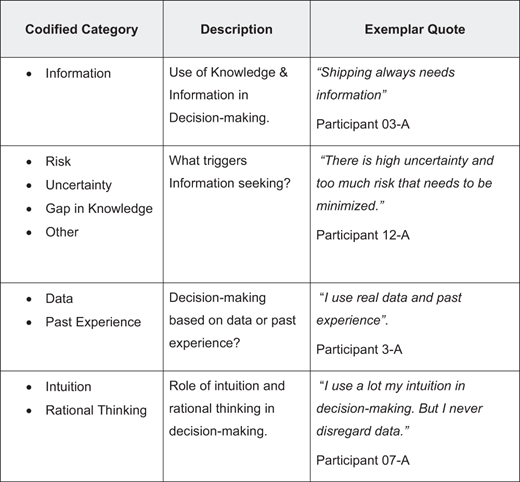
Theoretical framework of the factors affecting managerial information behavior and decision-making
Theoretical framework of the factors affecting managerial information behavior and decision-making
Most managers indicated that high uncertainty (28.57%) and high risk (24.49%) triggered the search for information (Table 1). Thus, we can quote some characteristic answers:
Responses to interview question regarding the factors that stimulate information-seeking
| Shipping sector | Gap in knowledge | Risk | Uncertainty | Other | All of three | Total |
|---|---|---|---|---|---|---|
| Bulkers | 1(4.35%) | 7(30.43%) | 8(34.78%) | 1(4.35%) | 6(26.09%) | 23(100.00%) |
| Tankers | 1(6.25%) | 2(12.50%) | 4(25.00%) | 1(6.25%) | 8(50.00%) | 16(100.00%) |
| Containers/Ropax | 0(0.00%) | 3(30.00%) | 2(20.00%) | 1(10.00%) | 4(40.00%) | 10(100.00%) |
| Total | 2(4.08%) | 12(24.49%) | 14(28.57%) | 3(6.12%) | 18(36.73%) | 49(100.00%) |
| ANOVA | |||||
| Source | SS | df | MS | F | Prob > F |
| Between groups | 4.062 | 2 | 2.031 | 1.17 | 0.3207 |
| Within groups | 80.142 | 46 | 1.742 | – | – |
| Total | 84.204 | 48 | 1.754 | – | – |
Notes:
Bartlett’s test for equal variances: chi-square(2) = 0.1322 Prob > chi-square = 0.936
Participant 4-A: “Both of these stimulate info seeking.”
Participant 12-A: “There is high uncertainty and too much risk that needs to be minimized.”
Participant 27-A: “Mostly the high risk stimulates me. Also, the high uncertainty stimulates ‘cause you can make predictions easily.”
Participant 36-A: “The risk is high in our business; we need to minimize it. There is a lot of uncertainty.”
However, several participants supported the view that lack of knowledge played no significant role in seeking information (Figure 1). In this respect, the following are some representative answers:
Participant 1-A: “There is no lack of knowledge.”
Participant 8-A: “There is no lack of knowledge; procedures are specific in this market.”
Moreover, Table 1 shows that there is no evidence that the responses for factors that stimulate information-seeking differ significantly among the sectors (p = 0.3207).
The study explored the reliance of managers on either real time data (up-to-date) or experience (the use of knowledge from similar, past cases) to inform decisions. Most managers (59.18%) confirmed using both data and experience when making decisions (Table 2). More specifically, the following are some indicative answers:
Responses to interview question of whether decision-making is based on real evidence or past experience
| Shipping sector | Data | Past experience | Both | Total |
|---|---|---|---|---|
| Bulkers | 6(26.09%) | 2(8.70%) | 15(65.22%) | 23(100.00%) |
| Tankers | 6(37.50%) | 3(18.75%) | 7(43.75%) | 16(100.00%) |
| Containers/Ropax | 1(10.00%) | 2(20.00%) | 7(70.00%) | 10(100.00%) |
| Total | 13(26.53%) | 7(14.29%) | 29(59.18%) | 49(100.00%) |
| ANOVA | |||||
| Source | SS | df | MS | F | Prob > F |
| Between groups | 1.96 | 2 | 0.98 | 1.29 | 0.2838 |
| Within groups | 34.816 | 46 | 0.757 | ||
| Total | 36.776 | 48 | 0.766 | ||
Notes:
Bartlett’s test for equal variances: chi-square(2) = 0.8775 Prob > chi-square = 0.645
Participant 3-A: “I use real data and past experience.”
Participant 9-A: “I use past experience in combination with data analysis.”
Participant 14-A: “I use a combination of experiences and data.”
Nevertheless, a few of the participants (26.53%) supported the view that experience played no role in making decisions. We give some examples of the participants’ answers:
Participant 12-A: “My decisions are of course based on data.”
Participant 18-A: “My decisions are based on logical thinking.”
Participant 19-A: “I always make a logical analysis.”
An even smaller proportion of the participants (14.29%) argued that experience was far more important than data as far as decision-making was concerned (Figure 1). Accordingly, the following are some characteristic answers:
Participant 16-A: “I decide only based on my gut feeling.”
Participant 17-A: “I use mostly my experiences in decision-making.”
Participant 20-A: “Most times there is no evidence, only some indications.”
Similarly, Table 2 shows that the question of whether decision-making is based on real evidence or past experience, revealed that there is no evidence that the responses differ significantly among the sectors (p = 0.645).
Table 3 shows the results for the role of intuition (decisions based on gut feeling) and rational thinking (decisions based on logical analysis) in managers’ decision-making. Most participants (55.10%) indicated that decisions were based on both intuition and logic. Some exemplary answers verify this statement:
Participant 07-A: “I use a lot of my intuition in decision-making. But I never disregard data.”
Participant 21-A: “It is a combination of intuition and data.”
A small proportion of managers (32.65%) opined that decision-making should always be the product of logical analysis. The following are a few answers suggesting this opinion:
Participant 02-A: “I always decide based on analytical thinking. Intuition doesn’t represent me.”
Participant 04-A: “My decision-making is always analytical and never emotional.”
Even fewer managers (12.25%) had confidence that data had no significance in decision-making and intuition played the leading role (Figure 1). The following are some indicative answers:
Participant 01-A: “I base my financial decisions on my intuition.”
Participant 12-A: “I basically decide based only on my intuition. It’s actually gambling for me.”
Participant 15-A: “In shipping, no matter what data you have available, the decision is always an assumption. I work with my intuition.”
Referring to Table 3 and whether decision-making is based on intuition or rational thinking, the results demonstrate that there is some evidence that the responses differ among the shipping sectors (p = 0.013), which is statistically significant at the 5% significance level. In effect, multi-comparison tests (Scheffe) suggest that responses of the participants of the Containers/Ropax sector differ from those of the Tankers (p = 0.025) and Bulkers (p = 0.027) sectors. In particular, all participants from the Containers/Ropax sector believe that decision-making is a combination of intuition and logical analysis.
This study explored whether successful decisions are related to information and knowledge.
Although a substantial proportion of the participants (40.82%) was skeptical, even more (51.02%) had a positive view (Table 4). The following are some indicative answers:
Responses to interview question of whether successful decision-making is linked to knowledge and information
| Shipping sector | Negative | Skeptical | Positive | Total | |
|---|---|---|---|---|---|
| ANOVA | |||||
| Bulkers | 1(4.35%) | 9(39.13%) | 13(56.52%) | 23(100.00%) | |
| Tankers | 3(18.75%) | 5(31.25%) | 8(50.00%) | 16(100.00%) | |
| Containers/Ropax | 0(0.00%) | 6(60.00%) | 4(40.00%) | 10(100.00%) | |
| Total | 4(8.16%) | 20(40.82%) | 25(51.02%) | 49(100.00%) | |
| Source | SS | df | MS | F | Prob > F |
| Between groups | 1.408 | 2 | 0.704 | 1.86 | 0.1665 |
| Within groups | 17.367 | 46 | 0.378 | – | – |
| Total | 18.775 | 48 | 0.391 | – | – |
Notes:
Bartlett’s test for equal variances: chi-square(2) = 1.4658 Prob > chi-square = 0.481
Participant 2-A: “Absolutely! Information is the most important thing.”
Participant 5-A: “Yes, otherwise it is a casino. Sustained success needs knowledge!”
In effect, managers, while recognizing the contribution of knowledge and information for effective decision-making, were nevertheless convinced that analysis of data cannot guarantee successful decisions. According to these managers, there are many unpredictable factors in the shipping industry that may negatively affect a decision. Several other managers thought that knowledge and information should be present in decision-making, but it did not guarantee successful decisions. In this respect, the following are some illustrative answers:
Participant 18-A: “Information is necessary, but information and data don't always show the right decision.”
Participant 28-A: “Yes there is certainly a link but there are many parameters that are unknown and influence the market. So, intuition remains important.”
Participant 23-A: “Yes there is a link. Information is always necessary, although the decision might not always be successful. What is important is how you interpret the information.”
Again, when uncertainty increases, the effective use of available information is of paramount importance (Figure 1). Finally, Table 4 shows the results of the question whether successful decision-making is based on knowledge and information. The findings revealed that there is no evidence that the responses differ significantly among the sectors (p = 0.481).
4.3 Extant literature: grounded theory analysis
Referring to the analysis of the extant literature, the research results (Figures 2 and 3), referring to the effect of COVID-19 on managers’ information behavior, revealed that pandemics affect how individuals seek and use information. In particular, Figure 2, which presents the way in which the codes are related, depicts how often the specific codes identified in this research have occurred in the document segments (i.e. large squares represent large occurrences of the research codes). The research findings suggest that the COVID-19 pandemic created the need for decision-makers to make informed decisions in urgent conditions using available information. However, the research results showed that decision-makers adopted irrational information behaviors and often made decisions without information, or with some form of bias.
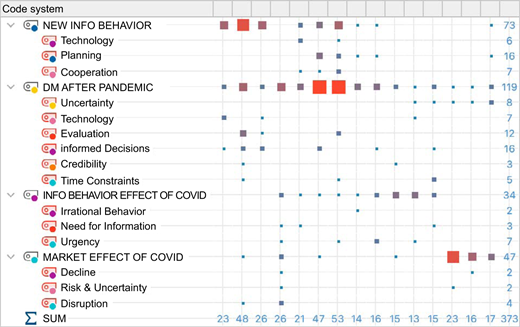
Codification map of the factors affecting information behavior and decision-making following a pandemic
Codification map of the factors affecting information behavior and decision-making following a pandemic
Further, the research findings (Figures 2 and 3) confirmed that pandemic influences not only the society but also the markets, affecting global trade and especially the shipping industry. In particular, the research results showed that future pandemics might cause great disruptions in international trade and supply chains. In addition, market risk and uncertainty increase because of a pandemic. This increase is followed by a decline in revenues and a rise in costs, which further hinders effective decision-making.
Concerning the effect of COVID-19 on decision-making, the literature suggests that decision-makers are obliged to make decisions often without information and under time constraints (Rosella et al., 2013). The research findings (Figures 2 and 3) confirmed the suggestion of Lipsitch et al. (2009) that conditions of great uncertainty and stress render decision-making challenging. Concerning the characteristics of decision-making following a pandemic, the research results showed that the aggressiveness of COVID-19 combined with government policies to contain the spread resulted in an increased need for information and increased uncertainty. In addition, decision-makers needed to make quick decisions under time constraints. However, the results revealed that managers were confronted with credibility concerns in times of crises as it related to the available information, a factor that influences decision-making in a negative way. On that basis, the research findings showed that managers ought to better evaluate not only information resources but also their decisions, taking advantage of the available technology to make better informed decisions. In effect, managers must reevaluate their decision models by assessing the amount of time spent on prioritizing existing and new/alternative variables that affect any decision (Crick and Crick, 2020; Lipsitch et al., 2011). The results also highlighted the importance of using preparedness and predictive plans to better cope with the effects of such a crisis (Lipsitch et al., 2011; Araz et al., 2013).
The last major category identified by the qualitative analysis of the research data refers to the new mode of information behavior adopted by individual managers following a pandemic crisis (Figures 2 and 3). The research results revealed that decision-making ought to be supported by effective planning as a characteristic of such a new mode of information behavior during a pandemic. The use of predictive tools that can simulate the circumstances of a crisis would also be useful for decision-makers. Moreover, the research findings underscored the importance of collaboration among competing companies during crises. In particular, the research results suggest that effective communication, the usage of personal channels of information and the establishment of a “coopetition” among competing companies, for sharing and using credible data, could enhance decision-making during a pandemic crisis. Finally, the research results emphasized the important role that technology can play in supporting more effective information dissemination and sharing of data, to make more informed decisions in times of crises.
5. Discussion
This study revealed several findings regarding the use of information for decision-making by senior managers of Hellenic shipping firms and the impact of the pandemic crisis on managerial decision-making. Collecting all relevant information before each decision is not an easy task for managers; experience is of little use as this pandemic is unique. The establishment of a new reality concerning information is imperative to overcome this crisis. Specifically, managers are confronted with a need to use added information sources (El Junusi, 2020). Following the outbreak of the pandemic and the measures imposed, most companies adopted the use of digital technology media such as online videoconferencing software (El Junusi, 2020).
Overall, this study contributes to the body of knowledge by decreasing the scarcity of research studies that focus on managerial phenomena in the shipping sector (Wu et al., 2018). More specifically, this research combines the literature of various fields (that is, information behavior, shipping and managerial decision-making), advancing the field of scholarly research in managerial decision-making. This study demonstrates the key role played by information in successful decision-making. It provides fruitful suggestions, both to managers and to decision-makers, for enhancing business practices during and following a pandemic, through the support of effective information behavior. Managers have the opportunity to evaluate and harness the positive effects of information on decision-making under uncertainty.
The managerial implications derived from this study are primarily related to the change and improvement of management procedures during a crisis. It suggests that management practices could be supplemented with knowledge management procedures to increase the effective usage of knowledge and information in decision-making (Atapattu and Jayakody, 2014; Fahey and Prusak, 1998).
Additionally, management could change organizational culture and direct it toward knowledge sharing. Companies could adopt policies that support decision-making and enable them to survive the crisis. Managers would be able to deal with the decision-making challenges of a pandemic by considering the significant factors that affect decision-making during crises, namely, improving the overall communication and dissemination of knowledge, using alternative sources of information, exploiting digital information technology, carefully planning decisions and strengthening the explicitness of knowledge.
6. Conclusion
In conclusion, by using a qualitative approach and adopting the grounded theory methodology, this study offers a phenomenological exploration of senior managers’ information behavior when informing decisions in times of crises. Specifically, by extending the existing theories, this study illustrates effective types of information behavior for managers during crises, to improve decision-making. The results depict the significance of information for decision-making, especially in an era characterized by a unique pandemic such as the COVID-19 pandemic. The results highlight the significance of using alternative information resources, investing in collaboration and explicitness of information, taking advantage of the new digital technology to assess decision-making plans and collect relevant information, to cope with novel and challenging market situations. Finally, as with all research methods and methodologies, this study has inherent limitations. More specifically, this research adopted an exploratory approach using the grounded theory methodology. Perhaps a positivist address of the research question using quantitative methods would have strengthened the research findings and added to the generalizability of the results. The usage analysis of a suitable number of questionnaires could enhance the reliability of the results that emerged from the semi-structured interviews and data mining.
Referring to future research, examining a larger number of participants could offer an opportunity to conduct a larger-scale study using quantitative methods. Statistical techniques could be adopted in a quantitative research project with a larger sample size, which would test levels of significance that cannot be examined by a small, in-depth study.
We hope that more studies will be conducted in the future to strengthen the findings of this research and identify increasingly significant results concerning the information behavior of individuals in the shipping industry during and following a pandemic crisis. More specifically, future studies could focus on the exploration of predictive plans for market crises to help managers when necessary. In addition, future research could investigate the development of contingency plans with a view to assist in effective decision-making during a pandemic.
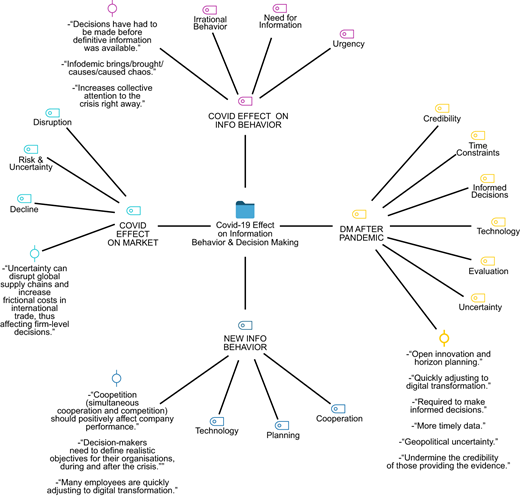
Conceptual framework of how a pandemic can influence information behavior and decision-making
Conceptual framework of how a pandemic can influence information behavior and decision-making
The author would like to thank the Editor, as well as the two anonymous reviewers for their constructive comments, which helped him improve the manuscript. Moreover, author would like to acknowledge and thank Mr Aristeidis Triantafyllides, BSc, MSc, MBA, for his assistance with the statistical analysis in this manuscript. His work is very much appreciated, and his knowledge and experience were a tremendous help.
Funding: This research did not receive any specific grant from funding agencies in the public, commercial, or not-for-profit sectors.

