In a work environment marked by unprecedented complexity, volatility and ambiguity, managers must accomplish their objectives while navigating many challenges. This paper aims to investigate potential interrelations among environmental transformations, cognitive biases and strategic decisions. In particular, the purpose of the study is to crystallize the state of art on the impact of cognitive biases on strategic decisions, in the context of environmental transformations.
The authors have conducted a systematic literature review to identify existing relevant work on this topic and to detect potential avenues for future research.
The findings highlight how decision-making is influenced and enabled by internal (e.g. perception) and external factors (e.g. digitalization). Specifically, the strategic role of cognitive biases appears to be crucial when investigating the related impact on strategic decisions in times of environmental transformation.
Implications are drawn for scholars and practitioners interested in evaluating the role of specific decision-making determinants for the formation and implementation of strategic decisions. In this sense, we stress that decision-makers need to manage their cognitive biases and select the right information out of a wide data set in order to adapt to environmental transformations.
By systematizing the literature review, potential interrelations among environmental transformations, cognitive biases and strategic decisions are identified. Furthermore, the primary phases that drive the decision-making process are proposed (analysis, decision, onboarding and control).
Introduction
Demographic change, aging populations, urbanization, climate change, the growth of the middle class, globalization, the evolution of the workforce and digitalization are the main demographic and socioeconomic drivers of transformation. These megatrends that characterize the 21st century have had profound implications for business models, processes and organizational structures; furthermore, they call into question current paradigms, threatening to transform the world over the next few years. The transformation enacted by these trends requires managers to effectively implement new strategies; faced with transformations, complexities and uncertainties, leaders should be ready to pursue opportunities (Sorrell et al., 2010). Operating as transformative leaders (Caldwell et al., 2012), new managers should develop and exploit specific qualities in order to be effective on both micro and macro levels and to be effective decision-makers. Nonetheless, decision-making in such contexts is dependent on two abilities as follows: on the one hand, decision-makers are able to detect signals and understand trends, adapting their vision, business model and strategy; on the other hand, they strive to achieve the business's goals. The ability to effectively monitor trends as well as to select and analyze a wide amount of information requires specific cognitive capabilities, which might be hindered by “framing effects” (De Martino, 2006). Taking into consideration that human choices are easily influenced, we are interested in investigating whether the role of specific decision biases influences the decision-making process in the context of environmental transformations. Specifically, we focus on cognition and cognitive biases considered as “useful measurements for detecting process improvement actions” (Barberà-Mariné et al., 2019, p. 2890). Moreover, due to changes in managers' cognition over time (Forbes, 2005), entrepreneurs tend to violate human rationality, thus affecting strategic decision-making in firms. Thus, an association among bounded and constrained rationality, potential biases and strategic decisions emerges (Hirshleifer, 2008). Due to the increasing number of studies focused on the perception of environmental uncertainty as a critical factor to strategy formation and to the alignment of organizational resources (Hogarth and Makridakis, 1981; Stubbart, 1989; Bukszar, 2009), we provide a critical assessment of this existing literature. Specifically, we draw on the current state of research about decision biases (especially cognitive ones) and strategic decisions in order to identify the key determinants of strategy formation in times of environmental transformations. According to these considerations, the paper addresses the following research question: What are potential interrelations among cognitive biases, strategic decisions, and environmental transformations? Thus, the aim of our study is to propose an integrative framework to reconcile theories on biases in behaviors and cognition, on strategic decisions and on environmental transformations. Starting from the assumption that the perception of determined environmental events affects decision-makers' moods and behaviors and thus strategy implementation, we explore the potential relationship among cognitive biases, strategic decisions and environmental transformations. We especially focus on the predominant role of cognitive biases considered as “useful measurements for detecting process improvement actions” (Barberà-Mariné et al., 2019, p. 2890). The paper covers four major areas. First, we trace the theoretical framework through the identification of “environmental transformation”, “cognitive biases”, and “strategic decisions” domains. Second, we describe the research method conducted, from the search strategy to the contributions of existing studies. Third, we report our findings deriving from the systematic literature review, and we propose a model for decision-making. Finally, we discuss the implications and suggest key areas for future research.
Theoretical framework
Starting from the assumption that the perception of determined environmental events affects the way in which decision-makers decide to implement specific strategies, we explore the interface among cognitive biases, strategic decisions and environmental transformations. To do this, we start by defining “cognitive biases,” “strategic decisions” and “environmental transformations” in order to investigate their potential interrelations. According to Simon (1993), several models of human behavior exist, and their applicability mainly depends, among other factors, on the availability and cost of information. Moreover, individuals collect and process information in order to better interpret the environment (Daft and Weick, 1984). Typically, entrepreneurs tend to be heterogeneous in terms of biases and perceptions of the environment (Shepherd and Williams, 2015), depending on political aspects (Eisenhardt and Zbaracki, 1992), cognitive traits (among others, Wiersema and Bantel, 1992; Amason, 1996; Miller et al., 1998; Simon et al., 2000; Keh et al., 2002) or demographic characteristics (Wiersema and Bantel, 1992). What is more, due to the presence of “weak signals” – as presented by Ansoff (1980) – the estimation of events may be incomplete, so that the development and implementation of specific strategies become complex. We put a special focus on the role of cognitive biases, which is prevalent in literature and is even more important because these biases are considered “useful measurements for detecting process improvement actions” (Barberà-Mariné et al., 2019, p. 2890). For instance, characteristics like the illusion of control (Keh et al., 2002) have somewhat of an impact on the possibility to sense, seize and reconfigure the decision-making process (Hodgkinson and Healey, 2011). We believe that cognitive biases entail important managerial consequences in terms of the interpretation of the environmental transformations and strategic decisions.
Environmental transformations
In general, by environmental transformations, we mean the possible socio-economic drivers of change – such as an aging population, urbanization, digitalization and the evolution of the workforce – that generate a potential impact on business models, decision-making processes and organizational procedures. We look at these transformations as megatrends, those structural forces of change that have profound social, economic and political consequences. According to the strategic issue management theory, organizations adapt their processes and people to the developments or trends that emerge from internal or external environments (Dutton and Ottensmeyer, 1987). In this context, previous authors have investigated the crucial role of learning and knowledge in aligning organizations with the (internal or external) environment (Lawrence and Lorsch, 1967; Hedberg, 1981; Normann, 1985). On an individual level, the collection of information also affects strategy or performance (Daft and Weick, 1984).
With the aim of identifying how managers interpret environmental transformations and formulate decisions, we start from the idea of “weak signals” presented by Ansoff (1980, p.12) as those “warnings (external or internal), events and developments which are still too incomplete to permit an accurate estimation of their impact and/or to determine their full-fledged responses.”. This focus on weak signals has characterized scholarly work on strategy formation. As transformations rarely happen without warning signs, weak signals are critical elements for forecasting and identifying those scenarios that prevent companies from “strategic surprises”. In this light, weak signals also refer to trends (Von Groddeck and Schwarz, 2013) as ongoing and fundamental societal transformations over an extended period of time. Nonetheless, a trend is a complex phenomenon to define, both in terms of impact and lifespan. However, the identification of these transformations is crucial to understanding their potential innovation and diffusion (Liebl and Schwarz, 2010); on one hand, the idea of innovation in trends is defined by its new or newly reconfigured nature which encourages the creation of a new phenomenon; on the other hand, the diffusion refers to the capability of understanding evolution and the extent of its impact.
Therefore, assessing transformations is fundamental, especially for those organizations that incorporate such megatrends into their decision-making processes (Von Groddeck and Schwarz, 2013). The detection of transformations does not depend merely on data and observations: in fact, it must be conceptualized cognitively and is determined by the individual's cognitive system. According to Seidl (2004, p. 157), “cognitive systems interact with their environments, but it is the cognitive system – and not the environment – that determines how and in what way it interacts”. As cognition plays a fundamental role in conceptualizing transformations and thus decision-making, we draw on the current state of research about decision biases (especially, the cognitive ones) and strategic decisions in order to identify the key determinants of strategy formation in times of environmental transformations.
Cognitive biases
The term “bias” is interpreted in different ways in literature; mostly, it is considered an irrational belief that influences the ability to make a specific decision based on facts and evidence (Schwenk, 1986; Busenitz and Barney, 1997; Das and Teng, 1999; Simon et al., 2000). Some authors state that biases in behavior or cognition can improve the decision-making process (Johnson et al., 2013), while other researchers find that cognitive biases are means to implement optimal behaviors, given specific constraints (Marshall et al., 2013).
In general, cognitive biases can be defined as “cases in which human cognition reliably produces representations that are systematically distorted compared to some aspect of objective reality” (Haselton et al., 2015). As suggested by Das and Teng, “cognitive biases are an ever-present ingredient of strategic decision-making” (1999, pp. 757). Specifically, they classified cognitive biases into four basic forms as follows: (1) prior hypotheses with a focus on limited targets; (2) exposure to limited alternatives; (3) insensitivity to outcome probabilities and (4) illusion of manageability. In general, previous studies considered cognitive biases as important factors in strategic decision-making and planning (James and Barnes, 1984; Schwenk, 1986; Busenitz and Barney, 1997; Hodgkinson et al., 1999; Deligonul et al., 2008). Moreover, entrepreneurs appear to be heterogeneous in their individual characteristics, like biases and perceptions of the environment (Shepherd and Williams, 2015). Several performance criteria can be identified with the aim of evaluating cognitive biases such as logical sufficiency, accuracy and speed of processing (Haselton et al., 2015).
In particular, we focus on the role of cognitive biases, which appears to be a dominant theme in our literature framework. But even more importantly – because according to the definition provided by Barberà-Mariné et al. (2019) – cognitive biases are considered as “useful measurements for detecting process improvement actions” (p. 2890). In this case, we expect characteristics like the illusion of control (Keh et al., 2002) and risk perception (Simon et al., 2000) to partly affect the possibility to sense, seize and reconfigure strategic decisions (Hodgkinson and Healey, 2011).
Strategic decisions
We consider the strategic decisions that, in turn, are affected by the potential evaluation of strategic opportunities depending on the type of decision-making process applied (Schwenk, 1984; Eisenhardt, 1989; Dean and Sharfman, 1996; Amason, 1996; Audia et al., 2000; Baum and Wally, 2003; Hodgkinson and Healey, 2011). Starting from the definition given by Simon (1993) that a decision is “a complex social process generally extending over a considerable period of time”, we follow Chandler (1962) and Shrivastava and Grant (1985) in defining strategic decisions like committing resources and competencies needed to (1) achieve strategic goals, (2) influence organizational direction and structure and (3) shape “the course of a firm” (Eisenhardt and Zbaracki, 1992, p. 17). Strategic decisions usually involve the commitment of top-management teams in long-range planning and are determined in response to novel problems, complexity or environmental trends (Shrivastava and Grant, 1985), which require either reactivity or proactivity in strategy formulation. While the decision-making process is often described as rational, linear and analytical (Cabantous and Gond, 2011), scholars have defined this as “boundedly rational” (Eisenhard and Zbaracki, 1992) or “quasi-rational” (Shrivastava and Grant, 1985) for the decision-maker because of the cognitive bias toward information processing. Indeed, strategic decision-making requires both rationality and intuition (Calabretta et al., 2017), with the latter defined as the rapid, nonconscious recognition of trends, structures and patterns that support analysis and evaluation (described in Dane and Pratt, 2007; Calabretta et al., 2017). Decision-making is thus a step-by-step, sequential process with an impact at all levels of an organization, running across different groups of stakeholders. First, in order to make decisions, the relevant actors must acquire and analyze, both rationally and intuitively (Calabretta et al., 2017), all relevant information. In this light, the decision-making process can be influenced by cognitive biases, heuristics, interpersonal dynamics and demographic or diversity factors. A second challenge for decision-makers, especially in rapidly evolving markets, is the need for efficacy within the process, so that decisions are effectively implemented into strategy. From this perspective, decision-makers must be able to build collective intuition, enhancing their ability to identify environmental trends and challenges, stimulate conflict and quick resolution, improve strategic thinking, drive the process at a constant pace and teach productive and timely behaviors (Eisenhardt, 1999). Finally, in time of environmental transformations like digitalization, a wide-ranging amount of information is generated, and managers need to pay particular attention to the collection and selection of data in order to opt for the best strategic decisions. For these reasons, we explore the role of strategic decisions with the aim of investigating and understanding how they are influenced by specific decision biases; specifically, we focus on the context of environmental transformations where the evaluation of strategic decisions becomes more complex.
Research method
To answer our research question, we conducted a systematic literature review (Tranfield et al., 2003; Pittaway et al., 2004) to better identify existing work, perspectives and evidence of the connection among environmental transformation, cognitive biases and strategic decisions. The systematic literature review is recognized as an efficient and acceptable approach for categorizing and evaluating existing work (Mulrow, 1994). In addition, systematic literature reviews uses a transparent, scientific and replicable method, reducing the biases related to wide-ranging literature research. In this sense, they are different from traditional narrative scholarly reviews (Tranfield et al., 2003). We used the Scopus and Web of Science search databases; we relied heavily on Scopus, which, according to Mishra et al. (2017), comprises more than 20,000 peer-reviewed journals. To perform our systematic literature method, we respected the guidelines released by Linnenluecke et al. (2019) for the identification of literature for inclusion with the aim of crystallizing the state of art on decision biases and strategic decisions, during environmental transformations:
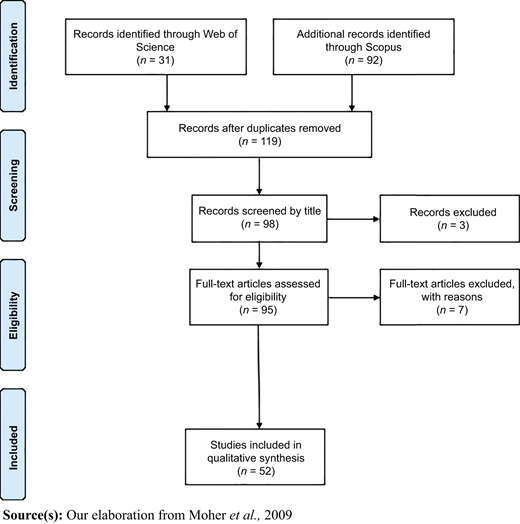
Initial scoping of the current state of research and broad search of the literature: during this process, we used the keywords “cognitive”, “decision”, “bias”, “making”, “process”, and “transformation” in order to set the boundaries of our search. We looked for academic articles containing all these terms, focusing on the field of management (Cardinal et al., 2017), and we did not set a specific timespan. Our search procedure was comprehensive and can be easily reproduced. As a first result, a total of 31 studies were retrieved from Web of Science and a total of 92 studies were retrieved from Scopus. Finally, we removed any duplicates from the analysis (Linnenluecke et al., 2019), thus resulting in a total of 119 studies.
Decision about inclusion and exclusion criteria. in this phase, we carried out filtering based on the relevance of the title and on the quality of work (Linnenluecke et al., 2019), ultimately excluding 21 studies. Furthermore, we excluded the following: (1) records that were not journal articles – we limited our review to peer-reviewed journals, excluding other types of work, such as books and chapters, conference papers, abstracts and proceedings, editorials, research notes, working papers and dissertations (Keupp et al., 2012) and (2) records that were not in English. This process resulted in 52 final studies.
The last set of papers included in the qualitative synthesis contained 52 journal articles published between 1984 and 2019, resulting in the following Boolean phase of the advanced search:
TI ( ( cognitive AND decision ) AND ( bias OR making ) ) AND ( TS ( transformation OR process OR information ) )
Figure 1 illustrates our systematic literature review strategy, conducted according to PRISMA standards (Moher et al., 2009):
Main findings
Starting from the systematic analysis of existing studies, we developed a framework in which we highlight the key components of decision-making and also the different nature of biases affecting the strategic decisions. Especially, as shown in the following sections, we found that many scholars focused on cognitive biases considered “useful measurements for detecting process improvement actions” (Barberà-Mariné et al., 2019, p. 2890).
Key components of the decision-making process
The results of our screening show that decision-making has been widely studied over time, mainly through qualitative research. Previous studies primarily investigated the extent to which determined biases can form the basis for effective strategic decisions. Decision-making includes specific processes, identified by Fama and Jensen (1983) as initiation, ratification, implementation and monitoring. Schwenk (1984) focused on the composition of the simplification process, made up of goal formulation and problem identification, the generation of alternatives and evaluation and selection. Fiol and Lyles (1985) explored the applications of organizational learning and organizational adaptation. Simon (1993) stated that the decision-making process is made up of the following: determination of the occasion of decision, which shapes possible courses of action, evaluation of the alternatives and selection among these alternatives. Fredrickson (1986) studied the relationship between strategy and structure and claimed that a specific organizational structure is adopted when overall strategy is not institutionalized. Authors like Baum and Wally (2003) focused on the association between centralized and decentralized strategic decision-making processes and the level of firm performance; specifically, they demonstrated that decision-making is more useful in dynamic markets. Eisenhardt and Zbaracki (1992) interpreted decision-making processes as a political system in which “powerful people get what they want” (p. 27). According to Barr et al. (1992), main managerial activities can be classified into three categories as follows: attention to environmental transformations, interpretation of stimuli and matching of perceived problems with solutions. To summarize, previous studies focused on different phases of the decision-making process that typically relies on (1) identification of the initiatives to achieve; (2) collection of relevant information; (3) selection of the strategy from among several alternatives; (3) implementation of specific actions and (5) finally, control of the results.
General factors influencing strategic decisions
Simon (1993) and Cyert and March (1963) recognized that the “bounded rationality” of decision-makers typically faces cognitive limitations. This means that individuals tend to interpret transformations according to their values, perceptions and biases. Also, Eisenhardt and Zbaracki (1992) suggested that strategic decisions are driven by boundedly rational and political processes. Thus, strategic decision-makers are considered cognitively limited. Audia et al. (2000) stated that firms tend to make use of effective past strategies, finding that earlier success has a positive influence on decision-makers' satisfaction. Typically, executives tend to use tactics to accelerate the decision-making process and to integrate key decisions and tactical planning; in this case, the association between fast decision-making and performance has been evaluated (Eisenhardt, 1989). While Wiersema and Bantel (1992) explored the association between demographic characteristics of top-management teams and strategy-related organizational outcomes, Forbes (2005) associated decision-making performance with the age of decision-makers. Particularly, the higher the age, the greater the possibility to identify information value. In addition, older decision-makers tend to be less confident in their decisions. The role of diversity has also been studied with the aim of exploring its influence on group processes. According to Knight et al. (1999), there is a positive association between functional diversity and interpersonal conflicts within the team. In particular, the authors claimed that “group processes play an important role in shaping a manager's mental models” (p. 459). Broadly speaking, the process can be influenced by several elements, such as analytical planning techniques, defined policy options, decision and implementation of organizational processes (Whittington, 1996), environmental instability and quality of decision implementation. For instance, collecting information and using analytical techniques increases the effectiveness of decisions. Furthermore, both environmental instability and quality of decision implementation “play important roles in influencing decision effectiveness” (Dean and Sharfman, 1996, p. 389). Citroen (2011) emphasized the crucial value of information in decision-making and identified a link between the use of complete information and correct strategies. Finally, political behavior, interpretation of broader context and the presence of process capability represent potential determinants in the decision-making process (Elbanna, 2006).
The role of cognitive biases
Starting from the assumption that managers interpret the environmental transformations they face according to their experiences, values and perception, thus affecting the decision-making process, several authors have investigated the association between specific individual characteristics and the formation of strategic decisions within organizations. For instance, with regard to entrepreneurial cognition changes over time (Forbes, 2005), many authors have demonstrated that entrepreneurs are not cognitively homogeneous; Forbes claimed that younger managers are more overconfident than their older counterparts. Moreover, the interpretation of specific events is different on the basis of certain types of cognitive biases which are defined as “common types of mental shortcuts used to make judgments” (Simon et al., 2000). In turn, cognitive biases create specific team abilities and tendencies (Wiersema and Bantel, 1992). More broadly, “different individuals may utilize biases and heuristics to different degrees” (Busenitz and Barney, 1997, p. 23), and this means that strategic decisions are correlated with the use of biases and heuristics (Busenitz and Barney, 1997). Specifically, the authors claimed that entrepreneurs are more overconfident than managers in large organizations; in addition, entrepreneurs tend to manifest higher representativeness in decision-making than managers in large organizations. According to Amason (1996), the decision-making process entails cognitive conflicts that, on one hand, improve the quality of a decision and affective conflicts that, on the other hand, erode it. Hunt et al. (1989) investigated the relationship among analytic, intuitive and mixed-in-type cognitive styles and the individual frequency in selecting or supporting analytic advisors over three stages of the simulated decision process. Olson et al. (2007) studied the cognitive diversity with the aim of demonstrating that constructive disagreements derive from diverse perspectives and positively influence decision-making. The same cognitive diversity is explored by (Meissner and Wulf, 2017) who identified possible ways for improving strategy process outcomes. Miller et al. (1998) found a negative association between cognitive diversity and comprehensiveness, and they claimed that executive diversity has an indirect impact on firm performance. According to Simon et al. (2000), a correlation between the perception of risk and decisions emerges during the decision-making process; in this case, the levels of risk depend primarily on cognitive biases. Even Keh et al. (2002) studied the negative relationship between risk perception and the evaluation of opportunities. In particular, the authors identified illusion of control and belief in the law of small numbers as cognitive biases influencing opportunity evaluation as perceived by entrepreneurs. Also, Simon et al. (2000) studied cognitive biases like overconfidence and the illusion of control. Hodgkinson et al. (1999) claimed that cognitive mapping needs to be carried out before making choices, in order to reduce biases. Crossan and Berdrow (2003) explored the impact of organizational learning on strategy, focusing on the exploration and exploitation phases. Moreover, they found that organizational learning is related to cognitive and behavioral changes and that there is greater strategic consensus when leadership practices discourage interpersonal conflict. Khatri and Ng (2000) investigated the role of intuition in strategic decision-making processes, and they demonstrated that it is more often used in highly unstable environments. Halpern (1989) emphasized that speed and accuracy characterize decision-making in highly reliable organizations where the need to mitigate human errors is high. To summarize, responses to environmental transformations involve interactions among people with different cognitive frames, and possible inertial responses derive from lock-ins of existing frames or failure of new ones (Kaplan, 2008). Table 1 provides an overview of the main effects of specific cognitive biases on strategic decisions as studied in existing literature:
Discussion and model proposal
In the previous sections, we discussed potential interrelations among “environmental transformations”, “cognitive biases,” and “strategic decisions”. In this sense, the study crystallizes the current state of research about key factors influencing decision-making processes. Specifically, we found that extant work looked at the role of determinants in strategic decisions, mainly focusing on cognitive biases (Busenitz and Barney, 1997; Crossan and Berdrow, 2003; Hodgkinson and Healey, 2011). Previous authors like Merendino et al. (2018) argued that despite the unconscious intuitive nature of the decision-making process, it has become more “data driven” and even more focused on evidence. For instance, according to Janssen et al. (2017), the quality of data influences decision-making, also reducing its risk in the case of big data. In addition, even though Citroen (2011) suggested that the value of information in decision-making is crucial, the identification of transformations does not depend merely on data and observations but also on cognition. If we refer to the advent of big data, it becomes more difficult to find the right information amidst the vast amount of data available. However, other authors like Simon et al. (2000) assumed that cognitive biases play a crucial role in influencing the interpretations of certain critical events. In fact, when transformations occur, managers tend to formulate and implement strategic decisions in accordance with their values, experiences and biases. In addition, the interpretation of specific events is different on the basis of certain types of cognitive biases used to make judgments.
When it comes to decision-making, we propose a model that combines analysis, decision, onboarding and control. Specifically, the initial phase of analysis refers to the detection of trends and transformations, and it is particularly important due to current information overload and to the existence of potential cognitive biases. In fact, managers need to pay particular attention to the collection and selection of data processes in order to opt for the best strategic decisions. For these reasons, analysis represents a relevant source of competitive advantage, especially during environmental transformations. Once information gathering is complete, the decision-making process is more rapid and focused on the execution of viable strategic options. Moreover, the phase of onboarding requires the involvement of relevant groups of stakeholders who create collective consensus, thus facilitating the implementation of strategic decisions. Finally, control is useful to monitor executed actions and activities.
Conclusions and implications
Decision-making always has elements of uncertainty and lack of information (Nutt and Wilson, 2010). Nowadays, information overload and the existence of certain cognitive biases influence the decision-making process, especially during environmental transformations. In fact, the complex nature of environmental transformations requires decision-makers who are able to manage their cognitive biases (Helfat and Peteraf, 2015) with the aim of properly investigating changes (Schneier, 1979) as well as implementing effective strategic decisions. Also, as suggested by Citroen (2011), the value of information in decision-making is crucial; in fact, there is a link between the use of complete information and correct strategies. But, nowadays, with so much information to choose from, evaluating the right strategic decision is becoming increasingly difficult. For this reason, we believe that exploring the interrelations between “cognitive biases” and “strategic decisions” during “environmental transformations” represents a crucial area of research. Our findings offer interesting implications for academia and business, especially in the fields of decision-making and strategy. On one hand, we extend our knowledge on cognitive biases and strategic decisions by proposing our decision-making model (analysis, decision, onboarding and control). Moreover, we argue that in time of environmental transformations, the process of analysis is even more problematic due to the enormous amount of information available. On the other hand, we warn practitioners that the environmental transformations have the potential to “disrupt” not only their cognition but also determined decision-making processes (especially, the analysis).
Future research
Starting from the development of our proposed model, future studies can identify a specific context of environmental transformation in which cognitive biases have a great influence on strategic decisions. For instance, the advent of big data represents an illustrative context for evaluating the role of cognition and decision-making. In fact, according to Speier et al. (1999) and Citroen (2011), information overload affects strategic decisions. In this sense, the emergence of big data and the shift toward data-driven organizations are disrupting the balance between rational and intuitive decision-making (Calabretta et al., 2017). For these reasons, we encourage future studies to investigate the particular conditions in which cognitive biases represent a relevant limitation in the formulation and implementation of strategic decisions. Especially, focusing on the context of digitalization and on the role of big data, future research might explore the role of specific cognitive biases in each proposed decision-making process.