This study sought to understand how the success rate of strategy execution can be improved through the application of enterprise engineering principles and practices.
Considering the complexity/greyness of the study area and limited literature in the new domain of enterprise engineering application as it relates to implementation, a structured literature review (SLR) was used as the basis for a Delphi study. A two round Delphi study was conducted with experts in the field to determine and validate the critical dimensions in strategy execution. Thirty-one and twenty-five experts participated in Delphi Round 1 and 2 respectively.
There is a relationship between the design of an enterprise and seven specific themes that were synthesised in the study. These seven themes are aggregated to three dimensions – namely: (1) ontological essentials, (2) basic requirements and (3) consequential/resultant elements for effective strategy execution. By explaining the relationship of these dimensions, from an enterprise ontology perspective – this article demonstrates that most of the commonly cited causes of strategy execution challenges, for example performance culture, communication and the like, are in fact consequential and not ontological. Such insights position this study as a foundational piece on the application of enterprise ontology to understand and aid strategy execution.
This study extends existing knowledge about the influence of organisational design on strategy execution by presenting a new theoretical lens that challenges the conventional view of organisations. For practitioners and managers, this entails (1) clarity on specific elements to be considered for enhancing strategy execution frameworks and (2) visibility of consequential dimensions that can easily cloud the conceptualisation of the “to be” or desired framework.
1. Introduction
Even though several interventions have been recommended and administered, extant literature on strategic management show that a significant number of strategies still fail in execution (Sull et al., 2015; Speculand, 2017; Radomska and Cyprian, 2020; Zhang et al., 2023; Nkone et al., 2024). It should be noted that the case for lack of success or competency in strategy execution (strategic initiatives implementation) is well reported so is the need for more pragmatic ways of getting things done (Bossidy et al., 2011; Radomska, 2014; Tawse and Tabesh, 2021; Plavlov and Micheli, 2023; Dietz and Mulder, 2024a, b). An investigation into why CEOs fail and are replaced also showed that a significant number of cases failed on strategy execution (MacLennan, 2011; Speculand, 2017; Mpete and Maier, 2024). Fortune magazine as quoted by MacLennan (2011) reported a thought-provoking observation that investors rarely have problems with companies’ strategies but are rather looking for successful execution as corroborated by Radomska and Cyprian (2020) and Bawtree and Young (2022).
It should be noted that the world has been changing rapidly in the past 2 decades with the advent of disruptive technologies and events. Such a disruptive world environment demands the creation of flexible strategies and implementation models (Speculand, 2017; Bawtree and Young, 2022; Plavlov and Micheli, 2023; Grasso, 2024). Consistent with the advocates of enterprise engineering (EE), the authors of this article submit that EE is a necessary contribution to future strategy execution frameworks as it focuses on the core (the essence level) of the organisation. The referred to “essence level” of the organisation, also called the “ontological layer” (Dietz, 2006), is relatively stable, less complex and independent of implementation (Janssen, 2016; Hoogervorst, 2018).
EE is an emerging discipline which seeks, among its focus areas, to cover the gap of “intervention without a complete picture” of the enterprise design elements. EE has been defined variously in literature but for this article it is described as a “… body of knowledge, principles, and practices to design an enterprise” (Janssen, 2016). Wherein the enterprise itself is a complex social-technical system concerning human beings and technology that interact in support of the common mission. For simplicity, the words “enterprise” and “organisation” are used interchangeably in this article so are the terms “strategy execution” and “strategy implementation”. We acknowledge that some authorities have attempted to distinguish between “execution” and “implementation” arguing that strategy execution is more comprehensive and measurable than strategy implementation (Bossidy et al., 2011; Radomska and Cyprian, 2020). This study uses the term “Strategy Execution” (SE) and defines it as – the process of operationalising the strategy to ensure the desired future state of an enterprise is achieved and sustained. In other words, SE translates the strategic intent into action (Rumelt, 2011) for an organisation to achieve the desired state.
The objective of this study was to establish the extent to which enterprise engineering principles and theoretical foundations can be useful in developing a framework to aid SE and by extension improve the success rate of projects.
1.1 The problem
Current SE frameworks have consistently failed to address the problem of executing strategy (PMI, 2021; Bawtree and Young, 2022; Nkone et al., 2024). There is also limited theoretically grounded evidence on why companies are failing to deliver or execute strategic initiatives (Patten, 2015; Friesl et al., 2021; Plavlov and Micheli, 2023). To make matters worse, there is little investment in research (time and effort) to understand the challenges and the underlying reasons on why SE has a high failure rate (de Oliveira et al., 2019; Tawse and Tabesh, 2021; Twun, 2022).
Where there is some progress in developing theory around SE – it is largely discipline biased. Further to this, the current approaches are largely experience and case-based implementation frameworks – aided by heuristics that are not theoretically grounded nor firmly backed by empirical evidence (MacLennan, 2011; Janssen, 2016; de Oliveira et al., 2019; Friesl et al., 2021).
1.2 Our approach to addressing the strategy execution challenge
Extant literature has shown that there is limited research in conceptual analysis of implementation processes specifically SE frameworks (Tawse and Tabesh, 2021; Dietz and Mulder, 2024a, b). Past research on SE has generally oscillated in three paths (1) success factors/barriers to SE (MacLennan, 2011; Patten, 2015; Alharthy et al., 2017; Nkone et al., 2024), (2) measuring the SE effort (Amoo et al., 2019) and (3) use of prescriptive frameworks/models to operationalise strategy (Hourani, 2017; Radomska and Cyprian, 2020). Few researchers have attempted to explicitly define core SE constructs – thus leading to different conceptualisations based on different assumptions (Sull et al., 2015; Friesl et al., 2021). This era of SE literature was more prescriptive than analytical. It is important to note that several authorities have reflected on the work on the barriers to SE both in the public sector and private sectors as the nuances of such environment calls for this distinction (Radomska and Cyprian, 2020; Eresia-Eke and Soriakumar, 2021; Vigfússon et al., 2021). An interesting classification was done by Vigfússon et al. (2021) whose findings led to the categorisation of these barriers into five (5) buckets, what they referred to as the 5Ps Model: [A] Purpose related, [B] Principles related, [C] Process related, [D] People related and lastly [E] Performance-related barriers. An example of a “principles”-related barrier would be “No guidelines to implement and that of a “people-related” barrier would be “limited commitment and understanding” (Vigfússon et al., 2021).
More recent research has focused on strategy transition, strategy as practice, use of complex systems theory and the application of soft systems approaches to address SE challenges (Amoo et al., 2019; Jackson, 2019; Jarzabkowski et al., 2019; Friesl et al., 2021; Obembe et al., 2021; Zhang et al., 2023; Plavlov and Micheli, 2023; Dietz and Mulder, 2024a, b). Although this more recent era of SE literature extensively covers the analytical side, unlike EE these theoretical lenses do not adequately focus on the “enterprise” itself as a housing system through which strategy is launched.
Based on the above account, this article beings by exposing the SE gap and the implications thereof. It then builds the case for harnessing from the enterprise engineering approach. This is done by explaining the theory of EE, specifically enterprise ontology focusing on the ontological layer [the deepest layer in an organisation]. A brief explanation is given on “enterprise ontology” interrogating the concept of transactions as the basis of modelling an enterprise at its deepest layer. The importance of the “construction model” of this organisation is also discussed and finally the errors in the construction of a typical enterprise are presented and explained.
The subsequent sections of this article present the research method (the Delphi study), present the study findings and conclude with the article’s contribution.
2. Theoretical background
2.1 The strategy execution gap
It has been stated in several other articles that there is limited research in the realm of SE as compared to strategy formulation (Amoo et al., 2019; Tawse and Tabesh, 2021; Eresia-Eke and Soriakumar, 2021; Nkone et al., 2024). In addition – the notion of complexity of an enterprise itself as a system and the resultant effect on influencing decisions in an enterprise has been highlighted in recent studies (Jackson, 2019; Plavlov and Micheli, 2023). It has further been highlighted that there is a perception that strategic execution is simple and should be delegated to lower levels of the organisation, implying that most leaders agree on the importance of execution but view it as a tactical side of business (MacLennan, 2011; Speculand, 2017; Bawtree and Young, 2022; Mpete and Maier, 2024) and therefore delegate implementation to operational levels while they focus on the so-called “bigger issues” [referring to strategy development or formulation]. Hence little to no resources, training or efforts are channelled to execution initiatives. However, the consequences of poor execution are felt the most by the CEO or the leadership as explicitly stated by Bossidy et al. (2011), namely that … “execution is the job of a business leader”.
Further to this, the enterprise as the housing (system of interest) from which a strategy is launched rarely receives the level of attention and rigor that technical systems do. Pennock and Rouse (2016) argue that at a high level an enterprise is no different from a typical engineered system such as a metallurgical process plant. On the other hand, an enterprise is considered a “social-technical system” because of the human element (Janssen, 2016; Jackson, 2019). To illustrate with an example, should a request be made to modify or introduce enhancements to a technical system like the metallurgical process plant mentioned above – to improve efficiency or for other reasons, it is a requirement in the engineering profession to fulfil the basic engineering steps. For example, in this case – to understand the impact of enhancements to a process plant, one should always refer to the engineering drawings, process flow diagrams (PFDs), piping and instrumentations drawings (PI&Ds) among many process/plant documents and related artefacts. Thereafter then carryout different mandatory steps – such as a conducting a Hazard and Operability study (HAZOP), a design review and the like. Such a level of detail creates a state of “being in control” and that is what makes technical systems resilient and easy to manipulate with high confidence levels. Because an enterprise has structural parts that are intentionally designed for a purpose, such as an organogram or technical processes, it can be considered to have a technical side to it.
Another important realisation from extant literature is that SE research has generally been conducted in silos in different disciplines including management science, financial science, industrial engineering, information management, marketing management, social science and others (Lapalme, 2017). To an extent, this has been driven by the fact that “strategy execution” is a subject without clear boundaries (MacLennan, 2011; Lapalme, 2017). This absence of a clear “home” limits the benefits inherent in centralised joint research efforts and introduces discipline bias and hence unintended complexities that arise when general application of theory is sought. The fact that SE research has been conducted in silos explains the span of the importance of SE – which sees no discipline (Lapalme, 2017). Considering the above, it can be argued that to better understand SE one has to find a fitting domain to house and develop theoretical foundations.
It is prudent to mention that the quality of a strategy has a bearing or at least an influence on successful execution of the strategy thereof (Rumelt, 2011; Trafford and Boggis, 2017). On the contrary, the current SE frameworks do not adequately consider the “strategy itself” as a foundational pillar (Rumelt, 2011; Friesl et al., 2021).
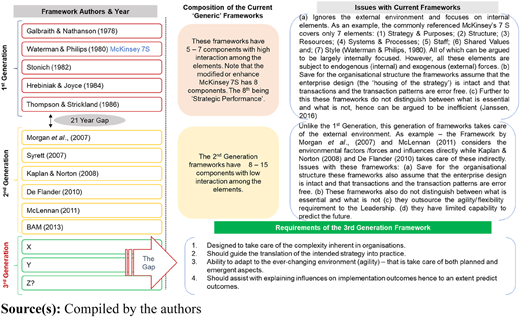
Several SE frameworks have been developed in the past 5 decades. The dominant generic frameworks cited in industry and academic publications are summarised in Figure 1. Note that there are other frameworks that various researchers have synthesised, which are not shown in this view that would be considered third-generation frameworks, however some of those are more prescriptive and/or sector based. For example, the “MERIL – DE model for closing the strategy execution gap in the public sector” by Olivier and Schwella (2017). The other frameworks that evolved in the past decade are generic; however, they focus on select dimensions of implementation – for example, the “introductory framework for strategy execution effectiveness” by Tawse and Tabesh (2021). Also shown in Figure 1, are issues with the current frameworks and the requirements of the “To Be” third-generation frameworks of SE. It should be mentioned that Figure 1 is not exhaustive as several important works that help to understand or enhance the current and inform future frameworks have not been included. Of note is the work by Friesl et al. (2021) where the authors acknowledge the absence of a unified body of research on SE and the fragmented literature.
2.2 The case of enterprise engineering (EE)
Enterprise engineering elements emerged from industrial engineering and the early adoption of the principles were in software engineering in the late 1990s (Janssen, 2016). In simple terms, EE can be defined as the engineering process applied to enterprises (Dietz et al., 2013; Fernandes and Tribolet, 2021). EE is a relatively new discipline that represents a paradigm shift in the way organisations are viewed. Organisations have traditionally been viewed as a “black Box” (Dietz et al., 2013). The metaphor of the “black box” relates to typifying a system that is known eternally – the exterior is visible, but nothing much more than that (Janssen, 2016). EE advocates and is about finding the construction elements inside the “Black Box” hence the paradigm shift from the “Black Box” to the “white box” perspective. EE theory is anchored on three notions: (1) viewing an organisation as a “complex social-technical system” – hence the reference to the systems approach and acceptance of enterprises as organised complexities (Dietz et al., 2013; Jackson, 2019); (2) the “enterprise design requirement” wherein an enterprise is described as an intentionally created cooperative of human beings with a certain societal purpose (Pennock and Rouse, 2016). This implies the design element is critical and confirms the view that action can be aimed at changing existing enterprise situations into the preferred one; (3) “communication” is a necessary and sufficient basis to frame the relationship between “actor roles” in an enterprise. In EE, communication is defined as the sharing of thoughts, and information as the means for communication (Dietz et al., 2013). The enterprise functions are based on the defined rules of communication (Dietz et al., 2013), and these rules are applied even at the deepest layer of the organisation.
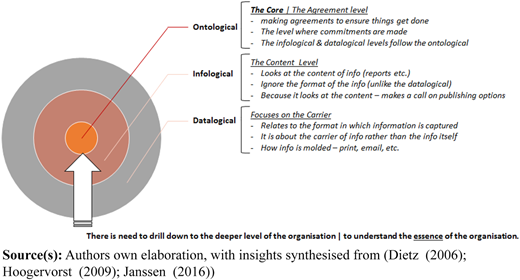
To reveal this deepest layer, the “cooperation” within the organisation should be analysed. In this context, the referred cooperation includes how people communicate and share information including agreements people enter (written or otherwise). In practice, cooperation in enterprises is about making agreements and decisions to transact. There are three basic levels at which communication and information exchange take place in organisations. These are datalogical, infological and ontological as shown in Figure 2 (Dietz, 2006; Hoogervorst, 2009; Janssen, 2016; Dietz and Mulder, 2020).
Ontological level – also referred to as the deepest layer represents the “essence” or the fundamentally important level. This is the level where commitments are made (i.e. agreements are made and transactions initiated). This level reveals the deep structure of the organisation that is more stable over the life cycle of the business (Gonçalves et al., 2013).
Infological level – has to do with content of the information, the information that is critical to perform coordination and production activities agreed at the ontological layer. It follows that infological layer is subordinate to the ontological layer.
Datalogical level also referred to as the “document level” concerns activities dealing with the transmission, transformation or storage of data. The focus is on the carrier rather than the data itself. This layer is subordinate to the infological layer and the ontological layer.
It has been shown above that infological and datalogical outputs are both derived from earlier decision at the deepest layer. On the contrary, the ontological output is original and not derivable from other facts. To understand SE and its sustenance, this study focused on analysis of an enterprise at the ontological level to reveal the “essence” of the enterprise. This study does not discount the various efforts in addressing SE challenges but posits that a deeper explanatory theory is required to give experience and best practice meaning and to provide a basis for objectively understanding enterprises.
The deepest layer in an enterprise is the “ontological construction of the organisation” and is the cooperation level as clarified by Janssen (2016, p. 29) who states that “… the construction of an organisation is made up of all arrangements (agreements/transactions together with their patterns and interrelationships)”.
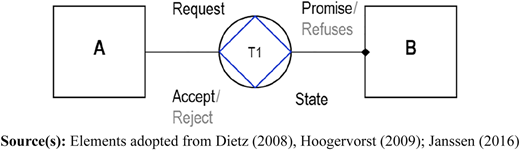
This led the authors of this paper to interrogate the referred to concept of transactions as building blocks of an organisation (Fernandes and Tribolet, 2021, p. 321). EE is characterised by a “basic transaction pattern” involving actor roles, production and coordination acts. Key terms that repeat in all the models and are foundational in transactions include (1) Actors and Actors Roles (including “elementary actor role” and “composite actor roles”); (2) Production Acts and Coordination Acts and; (3) Transaction Initiators and Executors. The Elementary Ontological Transaction (EOT) pattern is summarised by these coordination activities: Initiator: makes a request; Executor: promises or declines to transact; Executor: performs the “state and offers” the product or service asked for; and Initiator: accepts or rejects.
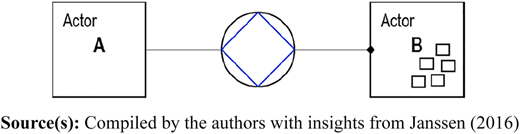
Modelling at the ontological layer starts with understanding the basics transaction notation as shown in Figure 3. This figure shows that a basic transaction pattern has two actors (actor A and actor B) and a transaction (T1). The circle containing the diamond is the transaction symbol. The circle in this view represents the four coordinating activities of the transaction [“request”; “promise”; “state” and “accept”]. The diamond represents the product or result. The small diamond shape or a small square on actor role B – boundary indicates the actor role (composite or elementary) that “promises” or takes care of execution of the transaction (Janssen, 2016).
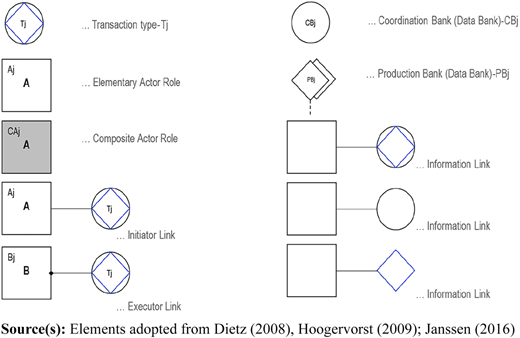
In addition to the transaction with the symbol shown in Figure 3, the other important symbol is the information bank especially in this era where data is “everything” and digital is everywhere (Lamarre et al., 2023). The information bank refers to information that is necessary to enable the carrying out of a transaction (Janssen, 2016). In other words, the information or communicative facts required for the coordination activities (request, promise, state and accept), e.g. client information is contained in the coordination bank. In the same manner for the production facts – the results are contained in the production bank. Figure 4 shows the other important notations in EE nomenclature. Also important is to show the symbol of the composite actor role (that is a role that consists of several actor roles). Note that an elementary actor role only performs one transaction, hence the term – “elementary” (Hoogervorst, 2009).
Note that this study is about addressing the challenges of SE, as such, modelling of an enterprise using these notations is beyond the scope of this study. Nevertheless, appreciation of these notations and modelling methodology for enterprise engineers provides visibility of the inner workings or construction of an enterprise at the ontological later (where it matters) and therefore shows the value of EE in aiding SE.
2.3 The organisation construction model
Visibility of the construction (the construction model) of an organisation at ontological level is important for various reasons: (1) It shows the transactions (at least the main transactions) in an organisation or a system of interest – for example a department under study (Dietz et al., 2013); (2) “Processes” are derived from the “construction” not the other way round – for example the construction of a car determines if the steering will be on the right or left (Janssen, 2016); (3) It reveals key actor roles in transactions and by extension forms the basis of job descriptions – that function as descriptions of actor roles and therefore organisational functions (Janssen, 2016). It should be noted that no explicit case has been found in literature where the Human Resource function uses the construction model as the primary source to create role descriptions. It should also be highlighted that role clarity is essential for successful SE (Bossidy et al., 2011; PMI, 2021); (4) “Structure” (the organogram for the various organisational functions) follows from its construction. Janssen (2016) gives an illustration of a scenario where it is found that there are too many transactions between departments in an organisation which compels the leadership to question whether it would not be more convenient to merge the departments; (5) visibility of the construction of an organisation is the basis through which sustainable governance structures are built (Hoogervorst, 2009; Dietz and Mulder, 2024a, b). For example, an organisation can identify transactions which objectively require additional management at a specific level, be it ExCo or Board level or at the level of transactions that need to be managed in clusters as they are logically related (Janssen, 2016); (6) The construction model is useful in clarifying external relationships with customers and suppliers especially for transactions that lie at the boundary of the organisation (Janssen, 2016). For example, clarifying on the question of who monitors and controls supplier performance or the obligations of the client (customer)? (7) Visibility of the construction model also helps determine which transactions require ITC support and which processes can be candidates for automation with information banks being part of the integrated ICT solution (Janssen, 2016). Lastly, (8) it reveals the construction flaws (that is the basic errors in the construction of an organisation (Dietz et al., 2013).
At their most elementary level, organisations consist of actor roles (elementary actor roles) and transactions that are connected by way of a universal pattern – which is referred to as the construction model of the organisation (Janssen, 2016) with the basic transaction shown in Figure 3 at the core and the related notations shown in Figure 4 completing the universal pattern of cooperation. Authorities in EE argue that the root causes of challenges in organisations can be revealed by checking for 22 errors and then re-engineering the desired enterprise as necessary (Dietz et al., 2008; Janssen, 2016).
2.4 Errors in construction of enterprise/elementary construction flaws (ECFs)
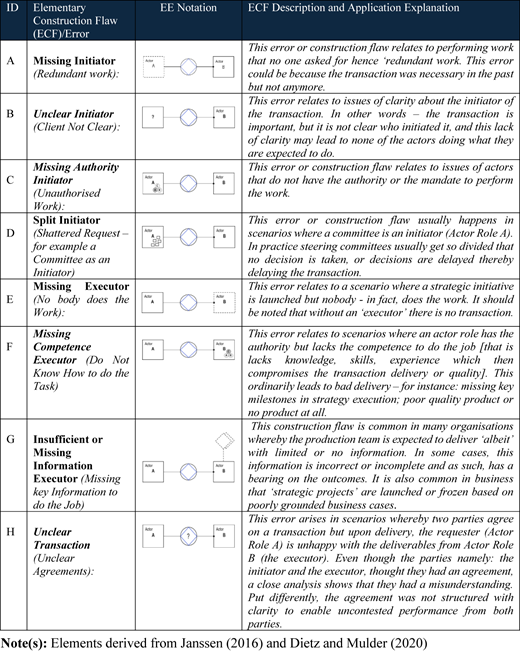
The concept of errors (construction flaws) in EE is based on the notion that an enterprise has an optimum architecture related to the purpose of the organisation and is governed by the universal laws of cooperation as explained in Section 3.2. As such, it follows that the first step in analysing an organisation is to check the status by drawing/sketching the “As Is” “Construction Model” and checking against the known 22 elementary construction flaws (ECFs)/errors. It should be mentioned that these 22 errors are not exhaustive but what is known now. A sample of the errors (eight of twenty-two) are outlined in Table 1 as derived from various authorities in EE. This view shows the application of the notation in modelling enterprises at ontological level.
With the examples of “elementary” construction flaws (ECFs) given above, it is apparent that EE, if applied correctly gives an objective view of the status of the enterprise before administering the desired strategic initiatives. We argue that an EE-based approach is valuable in checking readiness for SE and by extension, to an extent it influences the desired outcomes assuming all other factors are constant and the strategy itself is a “Good Strategy”. Inferring from the discussion above, unlike other disciplines or approaches, it can be argued that enterprise engineering; (a) will bring visibility and clarity on the construction, the construction elements and construction flaws (if any) of the system of interests (in this case the enterprise); (b) is more likely to track real problems as opposed to problems that are assumed to exist; and (c) is more objective in identifying the need and areas for change and the impacts. Consequently, this will allow for ease of integration or enhancements to existing systems should that requirement arise.
3. Methodology
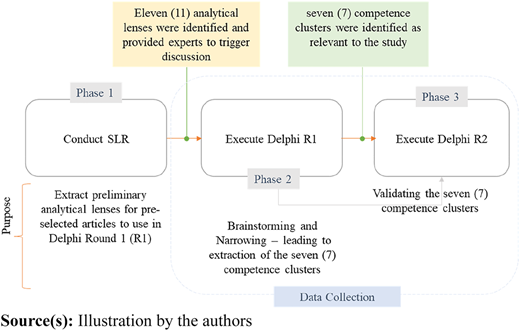
The study used a qualitative approach guided by three phases as shown in Figure 5. Phase 1, the structured literature review (SLR) was used to establish the preliminary analytical lenses. The review adopted procedures proposed by Al-Tabbaa et al. (2019) while examining primarily five repositories (EBSCO, Google scholar, ScienceDirect, Springer and Wiley). Of these repositories, only articles written in English from science indexed journals with high impact factor were considered.
The research instrument used for data collection was the Delphi study, as shown in phase 2 as presented in Figure 5. Delphi technique involves an iterative process of collecting and distilling the anonymous opinions and perspectives of experts using a series of questionnaires with the researcher being the facilitator (Linstone and Turoff, 2002, 2011). In framing this study and consistent with the discussion in the literature review section, we submit the overarching proposition that,
An organisation can be designed/engineered or re-engineered for strategy execution.
The research instrument: the Delphi technique was preferred because of the complexity of SE and the need to build theory in a relatively new area, namely – EE with regard specifically to its application in aiding SE. This choice is in alignment with the common application of the Delphi technique as documented by various authors. For example, the Delphi study (1) provides a structured way of finding consensus in areas of uncertainty or in situations lacking in causation especially where multiple stakeholder groups are potentially involved (Linstone and Turoff, 2011); (2) encourages and fosters knowledge sharing from different disciplines between practitioners and academics (in both directions) (Brady, 2015); (3) by design, aided by the advancement in electronic communications and the digital evolution the Delphi method allows researchers to eliminate issues of geographic proximity and hence get inputs from various locations throughout the world (Avella, 2016); and lastly (4) the Delphi method is well positioned for building practice theory because it allows experts to contribute without knowledge of who else is participating and this is done mostly via online questionnaires which increases geographical reach while keeping costs low (Brady, 2015).
The Delphi technique has previously been used in similar management theory development studies, and these include its use to understand and generate ideas; to promote collaborative decision making; forecast and set priorities (Skulmoski and Hartman, 2007). In addition, new trends are emerging where Delphi is being applied which aligns with the intention of this study. The includes (1) articulating core concepts – developing clarity and meaning for concepts that are still to be adequately defined like SE (Avella, 2016); (2) building capacity – allowing participants to co-create new concepts and solutions as enabled by the iterative nature and group communication process inherent in Delphi (Brady, 2015); and (3) Driving change – bringing new solutions to the forefront and stimulating debate and commitment among participants to reach convergence and action. Consequently, a Delphi study was the preferred research instrument for this research (Strang, 2017).
The questionnaires were designed to ensure the research question was answered:
How can the success rate of SE can be improved through the application of EE principles and practices.
The questions were grouped into four main categories: Category A: questions exploring the extent to which the success of SE is depended upon the design of the enterprise. Category B: questions exploring the fundamentals elements that determine the success of SE in any enterprise. Category C: questions exploring useful EE principles/elements required to narrow the SE gap and lastly Category D: questions that exploring the significance of re-engineering specific components of the enterprise on successful SE and how that can be useful to influence the success of the intended strategy.
Data collection: Eighty geographically dispersed experts were contacted with a response rate target of 15–20% consistent with most studies (Skulmoski and Hartman, 2007; Avella, 2016). Consistent with finings of Linstone and Turoff (2011), the authors of this article did not find any consensus in literature on what constitutes an expert panel nor the size of the Delph study panel. Delphi sizes found in literature vary from 4 to 171 (Skulmoski and Hartman, 2007; Brady, 2015). The criteria used to select the experts: included any of these credentials at a minimum: 10 years’ experience in executing or advising on SE at management level; having published at least two articles related to the topic under study [strategy execution] in journals with an impact factor of 3; having at least an advanced tertiary qualification/s in the strategic management area (master’s degree or higher) and lastly having written and published a book in SE.
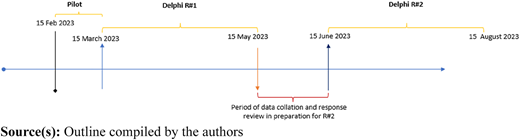
Ethics clearance was sought from the affiliated university ethics clearance board which allowed the data collection to proceed. Data was conducted from 15 February to 15 August 2023 as depicted in Figure 6.
The pilot questionnaire was sent to three respondents who all participated. Even experienced researchers conduct test runs (pilot studies) to make sure that questions are clear and will effectively solicit the desired information (Leedy and Ormrod, 2019). In this study, the pilot exercise was important to address three issues (1) to eliminate ambiguous questions as well as generating useful feedback with respect to the quality of the questioning and the structure of the questionnaire, (2) to determine how long it will take to administer the questionnaire and (3) to ensure a seamless Delphi Round 1 as the platform used for this study (https://rethinking-strategyexecution.com/) was purposely built for the research.
In Round One (1) – statements/questions were presented raw as developed from the structured literature review and opinion was sought from the experts based on their personal experiences in industry/academia. This included both closed and open-ended statements/questions. In this round 31 (n = 31) experts participated which equates to a response rate of 38,75%. In Round Two (2) – the responses of experts from round 1 were summarised and formulated into a series of more specific questions that participants were asked to comment on or respond to. This process had 25 (n = 25) participants, which equates to a response rate of 31.25%. Although Delphi Round 2 was within the target, the slightly lower response rate in this round was attributed to the conflicting schedules of some of the participants particularly those at senior/director level.
The average years of experience of the panellists was 24 years with a combined experience base of 745 years of knowledge. The experts were from 11 counties spread from most regions of the world (Canada, Namibia, Netherlands, Philippines, Singapore, Saudi Arabia, South Africa, Vietnam, USA, UAE, United Kingdom, Zimbabwe). The experts were from various backgrounds and industries – that included academia, management consultants, engineering consultants, telecoms, manufacturing, banking, IT, NGOs, specialised engineering companies. The profiles of the experts (the Delphi panellists) are outlined in Table 2.
Data analysis: This study used the deductive approach as it sought to evaluate and validate initial concepts generated in phase 1 and phase 2 of the methodological approach presented earlier (see Figure 5). According to Leedy and Ormrod (2019) deductive reasoning starts with one or two premises. Flowing from the proposition presented earlier (on page 9), the two premises, below guided the study,
In any enterprise setting, there exist fundamental elements that drive execution and
There is a relationship between enterprise design and SE.
We analysed the data manually following the Corley and Gioia method (Corley and Gioia, 2004).
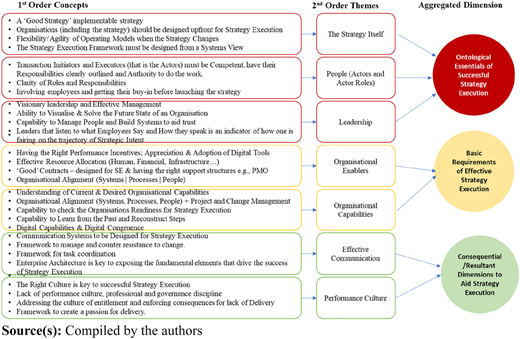
The first step entailed organising and categorising the raw data from the Delphi R1 looking for similarities and differences between these categories [first-order empirical concepts]. This process lead to lesser number of categories which we then labelled using shorter phrases. Thereafter we then proceeded to second-order cording that lead to the seven themes presented in Figure 7.
Table 3 summarises the definitions of the aggregate dimensions synthesised in this study.
From Figure 7, four competence clusters were repeated more frequently by the experts. These are (1) People, (2) Effective Communication (3) Performance Culture and (4) Effective Leadership. This study was not about extracting key drivers of SE or another study to rank factors that aid SE, but it was about demonstrating how EE can be useful in aiding SE. As such, the next sections and the discussion part will centre on demonstrating the value of EE on aiding these aggregated themes. Consensus in this study was defined as an agreement of 70% or more among the experts.
4. Study findings
This section provides a brief overview of the study findings reflecting on the outcomes from the three phases presented earlier in Figure 5. Across these stages, large amount of data was generated, not all of which will be shown in this article. For this article, the findings are presented around themes emanating from the research propositions, as presented earlier under the Methodology section.
In any enterprise setting, there exist fundamental elements that drive execution and
There is a relationship between enterprise design and SE.
4.1 The relationship between enterprise design and strategy execution
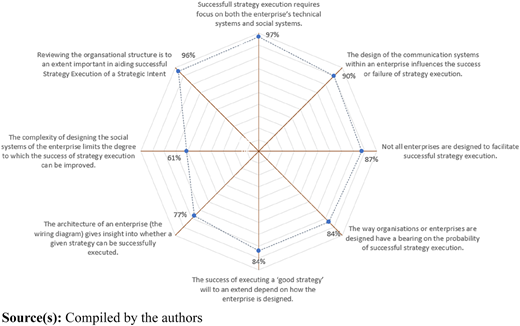
Overall, the experts agreed that there is a relationship between enterprise design and SE. Overwhelming agreement was reached in Delphi Round 1 on the criticality of designing communication systems and the overall organisational design as outlined in Figure 8. There was also an agreement that not all enterprises are designed to facilitate SE implying the converse is true – that is an enterprise should be designed for SE. The experts could not entirely agree on whether social systems could be fully designed for SE, and this is consistent with the organisational complexity theory as advocated by Jackson (2019) and Plavlov and Micheli (2023). On the contrary, this can also be viewed as “black box” thinking as will be reflected on later in this article.
4.2 Basic conditions of any successful strategy execution effort
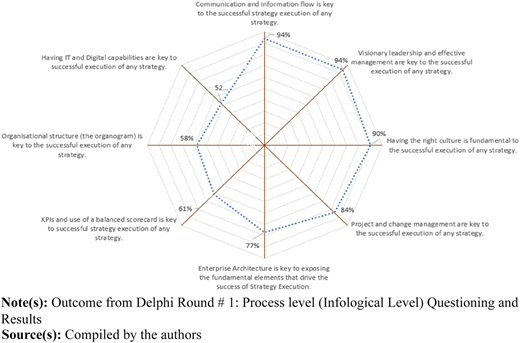
This section presents the results of the study on this attribute via two charts, Figures 9 and 10. Figure 9 shows outcomes from Delphi Round # 1: Process level (infological level questioning and results). When the panel of experts were questioned on the basic conditions of any successful SE effort, surprisingly they did not agree on the importance of organogram (organisational structure); key performance indicators (KPIs) and use of a balanced score card and IT/digital capabilities. On the contrary, there was agreement on communication and information flow; enterprise architecture; project and change management; the “right” culture and visionary leadership. According to one of the participants citing Peter Drucker “… because culture eats strategy for breakfast – that is, we [meaning business leaders] build strategy but we don’t have the organisational culture to deliver on it”.
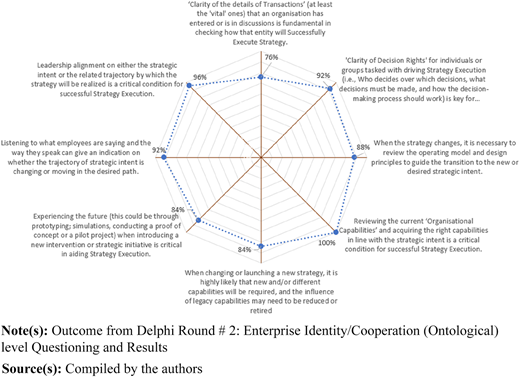
Figure 10 shows outcomes from Delphi Round # 2: Enterprise Identity (Ontological) level questioning and results.
When the panel of experts were questioned on the basic conditions of any successful SE effort viewed from the core of the organisation (the ontological) layer, there was consensus on all the constructs asked: leadership alignment on strategic intent, checking the pulse of employees, the need to experience the future before launching a strategy [this includes elements like simulation, rapid prototyping alike]; the need to check capabilities against the intended strategy; the need to review the operating model and related design principle in line with strategic intent.
4.3 Importance of clarity of an organisations’ construction at the ontological layer
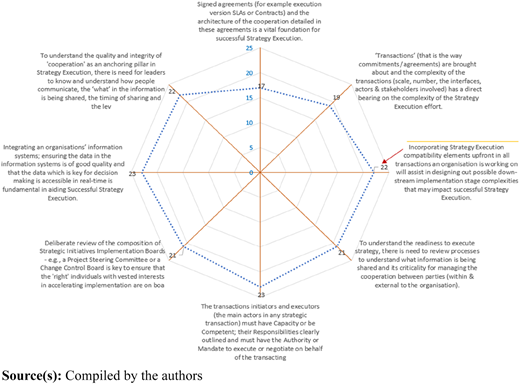
In Delphi Round 2, most of the experts agreed on the importance of clarity of an organisation’s construction at the ontological layer, see Figure 11. With a target consensus of 70%, 68% (17 of 25) agreed on all elements listed in Figure 11, with a slight deviation on the importance given to signed contracts and their related architecture. Surprisingly when the same experts were asked about same question differently [Incorporating Strategy Execution compatibility elements upfront in all transactions [by extension contracts/agreements] an organisation is working on will assist in designing out possible down-stream implementation stage complexities that may impact successful Strategy Execution] – there was consensus – 88% (22 out of 25):
4.4 Experiences of some elementary construction flaws
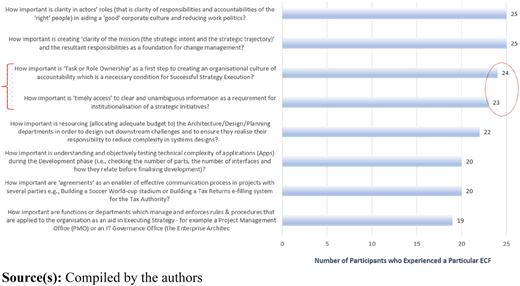
This section was meant to test if the panel of experts had experienced a sample of the construction flaws or errors that enterprise engineers argue to be the root causes of challenges in organisations. A sample of eight of the twenty-two errors were queried to ascertain the experience of the experts. The questions used to check for these errors are shown in Figure 12.
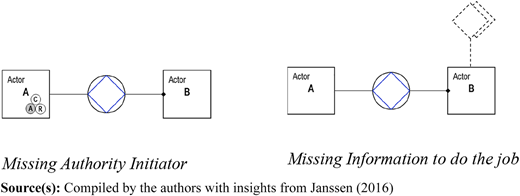
By way of an illustrating example, reading from the top of the bar chart, questions 3 and 4 in Figure 13 above are related to the error of “missing authority” – [authority to do the job] and missing information executor [missing information to do the job] respectively as shown below (see Figure 14).
96% of the experts experienced and/or acknowledged the “missing authority” construction flaw. 92% also experienced and/or acknowledged the “missing information to do the job” error. These findings demonstrate the need of – and the practical application of enterprise engineering in aiding SE, by examining the organisations’ construction at the deepest level (the transaction or ontological layer).
5. Discussion
As stated in the foregoing, four dominant competence clusters (second-order themes) emerged from this study: Effective communication; culture, people and effective/collective leadership. This section discusses these competence clusters from an enterprise engineering perspective guided by the three aggregate dimensions. Viewed from the surface, these competence clusters/success factors are not new (Vigfússon et al., 2021). What is of concern is that these elements have been viewed as “complex” and hence invisible and “untouchable” – the black-box mentality (Janssen, 2016; Hoogervorst, 2018). By extension SE is also considered “complex” and critical for the survival of organisations (Plavlov and Micheli, 2023), even though it is left to the middle-level managers to “take care of it” (Bossidy et al., 2011; Trafford and Boggis, 2017; Bawtree and Young, 2022; Christie and Tippman, 2024). This study adds an enterprise engineers’ perspective to the existing wider research efforts to understand what “really” influences successful SE. Because this study is meant to demonstrate the application of EE in aiding SE, this article will only elaborate on two dimensions: ontological essentials and the consequential dimensions.
5.1 Ontological essentials
This study is about showing the value of EE, specifically the case for visibility and clarity in the ontological layer and how that can aid SE. Three, second-order themes are discussed under this aggregate dimension: (1) effective communication, (2) performance culture and (3) leadership. However, to show that impact in subsequent levels of the organisation, for illustration purposes one second-order theme is discussed under this consequential dimension: organisation culture.
Importance of effective communication in SE
The definition of SE adopted in this study puts communication at the centre of translating the strategic intent into action. This spans from clarity in the communication, what information is being communicated, how it is communicated, to which audience and the timing thereof. Hence it is not surprising that this came up as a dominant theme. What is not adequately addressed in literature is the link of communication with the “essence” of the organisation (Dietz and Mulder, 2024a, b). Consistent with EE literature, the Delphi study showed that experts were aware of the elements extracted from the structured literature review concerning effective communication and confirmed them as relevant. For example, the need to prioritise management communications and to communicate only that which is necessary to drive the SE can be linked to “role clarity” a composite error in enterprise engineering. This was confirmed by experts as shown in Figure 12 (reading from the top of the bar chart, error number 1 – this was the most prevalent error highlighted by the participants). A “composite error or construction flaw in this case includes several elementary construction flaws (ECFs) or elementary errors as covered in the ECF sample shown in Table 1. Typical errors associated with role clarity shown in Table 1 include: error B – Unclear Initiator, error C – Missing Authority Initiator and error E − Missing Executor. As stated before, to an extent – the root causes of challenges in organisations can be revealed by checking the as is” against the 22 errors (Janssen, 2016; Hoogervorst, 2018). Other dimensions of execution include the speed of communication or the speed at which information is relayed and the credibility of that information. Credibility of information motivates action while speed encourages quick decision making and hence both enhance successful SE (Chirwa and Boikanyo, 2022). By way of an example, again referring to Table 1, error G [missing key information to do the job] is a typical construction flaw associated with speed of communication. Enterprise engineers advocate for real-time information banks to allow for quick decision making and that element was confirmed by the experts as shown in Figure 7. As such, revealing the wiring diagram or construction model at the ontological layer will assist in knowing which communication-related errors exist that need to be attended to aid SE. It should be noted that there are other dimensions of effective communication that have a bearing on effective communication that cannot be adequately addressed by EE. These include but are not limited to flexibility of formal channels of communication; provision of feedback in communication and channels of communication. Information flow and clarity of that communication are considered critical contributors to successful SE (Sull et al., 2015; Hove, 2016; Vigfússon et al., 2021; Lamarre et al., 2023; Nkone et al., 2024).
Importance of people on SE
Another aggregated theme that came out strongly from the study is that of having “right” people. To avoid scenarios where strategies are “pushed” or “imposed”, the researchers advocate for an approach where the employees or execution teams are given the opportunity to exercise their own judgement (Brun and McAuliffe, 2023). However, they can at a minimum do that if their roles and responsibilities are clearly defined and so are the decision rights of their superiors and themselves (Janssen, 2016; PMI, 2021; Christie and Tippman, 2024). The enterprise engineering toolbox ensures job descriptions are clear, and they are not open to different interpretations (Dietz and Mulder, 2024a, b). A job description that evolves from the construction model of an enterprise will list the essential actor roles for the specific job and the competence required for the role clear as opposed to vague job descriptions (Janssen, 2016). If job descriptions are checked against the construction model by an experienced and competent enterprise engineer –ECFs may be revealed, for example error C, D and F in Table 1. It is also important to note that some participants put emphasis on the notion that people naturally do not want change. We argue that if there is clarity on what needs to be done, even if change may be resisted – it will be inadvertently embraced. The findings of this study also show the usefulness of information banks in aiding the agility and speed of delivery of the execution team, hence reinforcing the relationship between the actors (people) and the technology (Lamarre et al., 2023).
Importance of collective leadership to SE
The leadership theme has been cited in many studies as a vital integrator of all the efforts and its over-arching nature ensures and complements a well-designed enterprise (Jarzabkowski et al., 2019; Bawtree and Young, 2022; Brun and McAuliffe, 2023). Leadership is required to influence a culture of execution by ensuring the organisation enters the right deals (transactions); the “right people” are employed and a “culture assessment” is done before launch of strategic initiatives and sustained through-out (Bossidy et al., 2011; Hough et al., 2011; Speculand, 2017; Mpete and Maier, 2024). Critical is leadership that knows the value of a collective strategy, shared perspective and commits to collective accountability – where outcomes and implications of decisions are shared (Bossidy et al., 2011; Trafford and Boggis, 2017; Brun and McAuliffe, 2023; Grasso, 2024). By way of an example, such collective leadership will eliminate construction flaws related to roles and responsibilities of committees and other forums tasked with steering strategic initiatives/projects. In practice, steering committees usually get so divided that no decision is taken, or decisions are delayed thereby delaying transactions. This organisational flaw (error) is termed – Split Responsibility Executor (Shattered Execution) and is represented by the notation shown below.
5.2 Consequential/resultant dimensions
5.2.1 Importance of organisational culture to strategy execution
Almost all participants of this study highlighted the need for a performance culture to support SE. This referred to “culture” entails shared values (i.e. what is important) and beliefs (i.e. how things work) that interact with an organisation’s structure and control systems to produce behavioural norms (i.e. the way things are done in an organisation) (Hough et al., 2011). Put differently “culture” is the personality and character of the organisation (CMI, 2015). But again, this is high-level language, on the contrary – the enterprise engineer seeks to go deeper to locate that which influences “ … the way things are done in an organisation” (Dietz and Mulder, 2020). Extant literature shows that an organisations’ culture can be viewed from many angles and the characteristics are reflected in several overlapping dimensions which makes this area (organisational culture) inherently complex (Jackson, 2019; Plavlov and Micheli, 2023). Though limited, literature has shown evidence of some work done on the relationship between organisational culture and SE (Reddy and Scheepers, 2019; Nkone et al., 2024). Much of this effort focuses on effects/impacts of culture on execution and dimensions that should be looked at to check readiness for execution from an organisational culture perspective. Themes or titles like – “challenges of adapting organisational culture … “, “influence of organisational culture on … ”, “effects of organisational culture” alike – dominate extant literature on organisational culture in relation to SE. This study acknowledges these efforts and the need to look at an enterprise from a bird’s eye view but departs from that notion and goes “under the hood” of the enterprise. That is to expose and analyse the wiring diagram [design] of the organisation at the ontological layer. The desired outcome being to understand the inner workings of the organisation (“white box” perspective) and as such, extract elements that influence SE.
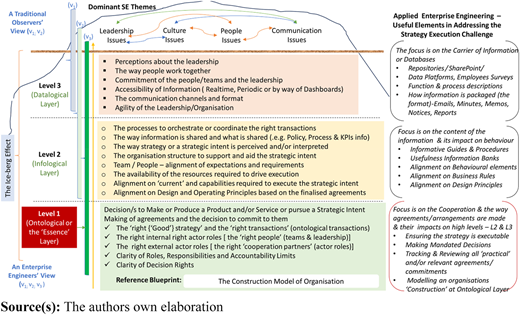
For illustration purposes, the analysis of the underlying drivers of the dominant SE themes as observed by a traditional observer is mapped against enterprise engineers’ perspective. See Figure 15. The argument here is that if an organisation has engaged the “right” people (competent, accountable and the right match for the role); their responsibilities clearly laid out; the related support systems (for example real-time information banks alike); the “right” transactions (the agreements and commitments) related to the strategic intent correctly structured and finalised, infused with right leadership – an execution culture naturally evolves all other things being equal.
This view shows how EE has inherent methodological capability of tracing or at least making the root cause of some common challenges and/or issues of SE visible.
6. Conclusions: implications, limitations and recommendations for future research
SE competence is not by chance or limited to one dimension nor a preview of a few elite organisations. An organisation should be intentionally checked for execution readiness and intentionally designed or redesign for effective delivery. Extant literature and the results of the Delphi study are consistent in terms of dominant aggregated themes; however, further interrogation of the surface issues as shown in Figure 10 highlights the domino effect of having the “right people” (actor roles) and the right “cooperation partners” (also actor roles); clarity of these in terms of competence requirements, responsibilities; decision rights and accountability limits. It is also important for organisations to engage in the “right transactions” (this applies and is specific to ontological transactions). In most organisations, the issues that are seen by an ordinary observer as constraining implementation are described in simplistic terms. For example, some see these organisational challenges as – culture issues yet perception of solving such, is considered complex as the underlying problems lie deeper in the essence level of the organisation (the ontological layer – the layer where commitments/agreements are made). Put differently, the study has shown the indirect impact of clarity of roles and responsibilities; clarity of decision rights; the impact of information systems and entering into correctly framed agreements on successful SE assuming that the actors are competent; have the mandate to perform their tasks (or the transactions) and all other things being equal.
In conclusion, this study has shown the issues and limitations in theoretical foundations of the existing SE frameworks. In addition, it has shown how EE can be useful in increasing the SE success rate by reviewing and error proofing the construction model of the organisations at the deepest layer. Consequently, this study supports – as TRUE, the overarching proposition that “ … an organisation can be designed/engineered or re-engineered for strategy execution”.
6.1 Theoretical implications
This research challenges and extends existing knowledge about the influence of organisational design on SE by presenting the case for enterprise ontology. This new theoretical lens challenges the conventional view of organisations [“black box” thinking] by taking the x-ray view [“white box” thinking] to aid understanding while acknowledging the limits inherent in complex socio-technical systems like enterprises. We believe by organising and synthesising the valuable but fragmented extant literature on SE into seven themes and then linking them into three aggregate categories, the broader audience will gain a more nuanced understanding of the complex phenomena of SE. This paper therefore serves as a foundation to develop a generic enterprise engineering-based SE framework. The authors of this article submit that it is useful to enhance existing frameworks with ontological considerations. This entails (1) providing clarity on specific elements to be considered for these enhancements (2) preventing consequential dimensions from clouding the conceptualisation of the “to be” ideal framework.
6.2 Practical implications
This study demonstrates how enterprise engineering can be useful in aiding successful SE and by extension aid project delivery. A key take-away include the need to check for execution readiness at the ontological layer by checking for and eliminating any construction flaws (errors) that will later reflect as “common” challenges – for example lack commitment [people issues] and an organisational culture that does not aid SE [culture issues]. From a practical perspective, this study will reignite analysis of the impact of enterprise design on organisational performance and hence follow the same design-based analysis and/or trouble shooting as is done in technical systems. The clarification of the dimensions synthesised in this article and their related second-order themes will also provide additional guidance to equip practitioners to better identify implementation deficiencies. For example, for one to check readiness for SE, the starting point is the ontological considerations: namely, “the strategy Itself” [purpose clarity and correctness]; People [Actor Role clarity and correctness]; Leadership [visionary leadership that is fitness for purpose] – a leadership that fosters a culture of collective leadership in executing strategic initiatives. Thereafter, the basic conditions [Enablers and Capabilities] for SE will need to be checked for their existence. The ontological construction model will also need to be checked for construction flaws and these errors addressed in the “To Be” [desired] model. Only then can an intervention be made. This article therefore positions EE as an emerging discipline that aims to uncover the hood (the “black box”) of the organisation and close the gap of interventions without clarity of the inner workings or a complete picture of the enterprise.
6.3 Limitations and recommendations for future research
The fundamental limitation inherent in Delphi studies because of its expert orientation is that it is difficult to draw conclusions for universal application unless at least there is a representative sample of cross-sectional case studies. This includes modelling the ontological “As Is” drawings in various settings/industries. Another limitation is that the synthesis of the aggregated dimensions leans more to the hard systems thinking and yet organisations have an equally significant and if not more social component (Jackson, 2019; Plavlov and Micheli, 2023; Dietz and Mulder, 2024a, b).
Due to this largely qualitative nature, the study findings are not meant to be generalised, instead these findings are meant to demonstrate how existing issues in SE have their genesis or roots in the construction model (or the design of an enterprise). Nonetheless, this study adds to the ongoing effort to expand theory of SE from a scientific footing. As such, future research will be required in a couple of directions. Researchers should consider practical application of the principles highlighted in this study in select organisation and industries to check the efficacy of the theory across industries. The design of social component of the enterprise will also need to be further interrogated. Quantitative studies will need to be carried out to test the industry specific models that cascade from these theoretical insights.