This article considers how organizations can become central coordinating stakeholders in innovation ecosystems without relying on direct control over key resources, technologies or partners. Drawing on Niklas Luhmann's systems theory, attention is shifted from ecosystem-level control mechanisms to a decision program of expectation management internal to organizations that allows them to cultivate rationality and legitimacy in becoming central to an ecosystem while preserving other stakeholders' autonomy.
Secondary analysis is applied to an established qualitative case study of Carlsberg's development of the Green Fiber Bottle using Luhmannian systems theory, causally relating expectations, complexity, rationality, legitimacy and coordination, and developing a causal loop diagram. This causal loop diagram is applied to the case and illustrates how Luhmann's concepts can be traced through concrete organizational decisions and interactions.
The analysis suggests that a decision program for expectation management can serve as the internal engine that increases rationality for organizations. When combined, rationality and legitimacy reinforce one another and enable organizations to coordinate with autonomous stakeholders, while establishing them as reference points within an innovation ecosystem, allowing them to attain keystone-member centrality.
This article contributes by explaining ecosystem centrality as an outcome of internal organizational processes rather than direct control over key technologies, resources or partners. It introduces expectation management as a program that links organizational rationality and legitimacy, and offers a causal loop diagram that explains how organizations can become central ecosystem stakeholders while preserving other stakeholders' autonomy.
Introduction
The concept of an innovation ecosystem is used by business strategists to account for how organizations can coordinate with one another while capturing value in dynamically evolving environments (Adner, 2017; Kapoor, 2018). Innovation ecosystem literature often emphasizes the importance of outward orientation: organizations are expected to scan their environment, identify opportunities and align their strategies accordingly (Adner, 2006; Jacobides et al., 2018; Talmar et al., 2020). Collaborative innovation only increases this complexity (Ritala and Almpanopoulou, 2017), as organizations must coordinate activities while remaining autonomous, which requires forming expectations about how other actors will behave and how interdependencies will unfold.
Furthermore, ecosystems are often taken to contain a keystone member: an actor that structures the environment for others, and influences or even controls value capture and distribution (Dedehayir et al., 2018; Dhanaraj and Parkhe, 2006; Pushpananthan and Elmquist, 2022). Keystone members play a central role in ecosystems “by providing a stable and predictable set of common assets” (Iansiti and Levien, 2004, p. 11). The ecosystem's keystone member is thought of as “the firm to whose vision of structures and roles others defer. It sets, and often enforces, the governance rules, determines timing, and often reaps the lion's share of gains” (Adner, 2017, p. 48). Furthermore, keystone members are often considered to be responsible for “both creating and sharing value” (Basole, 2009, p. 147), frequently introducing a platform of interaction “to maintain their connections and be able to distribute value” (Wulf and Butel, 2017, p. 174).
An example of an organization operating as a keystone member in an innovation ecosystem is found in the well-known case study of Carlsberg's attempt to develop the Green Fiber Bottle (Bogers et al., 2020; Chesbrough et al., 2018). Seeking to reduce the environmental impact of its packaging, Danish brewery Carlsberg identified a need for a fully biodegradable bottle. However, it did not want to become a packaging company, nor did it possess the capabilities required to develop and manufacture such a product independently. Instead, the initiative required coordination with a range of external actors, including material specialists, research institutions and manufacturing partners. Despite depending on collaborators to develop the novel packaging, Carlsberg emerged as a central coordinating force in the innovation ecosystem, shaping the development trajectory of a biodegradable bottle.
What is unique is that Carlsberg achieved this keystone-member centrality without doing some of the things they might have been expected to do. One could say that ecosystem stakeholders accepted Carlsberg's vision of structures and roles. However, Carlsberg neither determined the developmental timing of innovation activities, nor exercised direct control over critical technological development. Instead, they remained dependent on upstream partners for creation of the Green Fiber Bottle and its production processes. They never owned the product or technology for production, as they relied on others to create value while refusing to vertically integrate or make substantial financial investments in the project. And they refrained from exercising hierarchical control over ecosystem stakeholders, becoming central to the ecosystem while affording other stakeholders substantial autonomy. This raises the question: how can an organization become a central coordinating stakeholder within an innovation ecosystem despite lacking direct control over key technologies, resources and partners?
Existing innovation ecosystems literature provides rich insight into inter-organizational coordination (Adner and Kapoor, 2010; Talmar et al., 2020; Walrave et al., 2018), and explains many of the mechanisms keystone members might employ to affect change such as Click or tap here to enter text.value creation (Basole, 2009; Iansiti and Levien, 2004), value distribution (Altman et al., 2022; Dedehayir et al., 2018) and the management of interdependencies (Autio and Thomas, 2014; Furr and Shipilov, 2018). These mechanisms focus on ecosystem-level dynamics and the ways organizations use them to shape ecosystem outcomes. However, they say less about how organizations internally develop the capacity to undertake coordinating roles in innovation ecosystems where stakeholders retain substantial autonomy under conditions of uncertainty and interdependence. Understanding this organizational dimension is particularly important in the Carlsberg case, where keystone-member centrality emerged without some of the conventional sources of ecosystem control.
To address this question, this article draws on Niklas Luhmann's systems theory (Luhmann, 1995, 2018). Key to Luhmann's theory is the idea that social systems are autonomous and operationally closed, yet still capable of coordination through the stabilization of expectations. Rather than focusing on ownership, authority or direct control, a Luhmannian perspective directs attention toward internal processes through which organizations construct expectations, respond to disappointment, develop rationality and become legitimate reference points for others. In this way, ecosystem centrality emerges not primarily from control over resources or partners, but from the capacity to stabilize expectations and serve as a legitimate reference point for others. This provides a way of explaining how an organization such as Carlsberg could become a focal coordinating actor despite lacking direct control over critical technologies, resources and partners.
This article argues that the key to developing an innovation ecosystem strategy that allows an organization to become central lies not in outward orientation but in the organization's internal decision programs, specifically its program for managing expectations. Organizations that increase their internal complexity and account for more of their environment are better equipped to have accurate expectations of what might happen next. This helps them establish better-informed innovation ecosystem strategies, and build crucial legitimacy that makes them more strategically influential in the eyes of other ecosystem stakeholders.
To illustrate these dynamics, the article introduces a causal loop diagram (CLD) that models how expectation management, rationality and legitimacy recursively interact with one another. Through secondary analysis, the CLD is applied to the established case study of Carlsberg's Green Fiber Bottle project to illustrate how an organization can emerge as a central coordinating actor in an innovation ecosystem while preserving stakeholder autonomy.
This article contributes to organizational sciences in three ways. First, it introduces expectation management as a program through which organizations develop the rationality required for establishing a coherent ecosystem strategy. Second, it shows that rationality and legitimacy coevolve to enable effective ecosystem coordination. And third, it offers a process model explaining how organizations can emerge as central ecosystem stakeholders while preserving other stakeholders' autonomy.
Case: Carlsberg and the green fiber bottle
The Carlsberg brewery was founded in 1847 in Copenhagen, Denmark. Carlsberg reports that, as an organization, their identity has long been shaped by the legacy left by its founder, J.C. Jacobsen, who was described as “being visionary, challenging, open and magnanimous” (Carlsberg Foundation, 2014, p. 16). This identity is institutionally reinforced through the Carlsberg Foundation, which holds majority voting rights and explicitly frames the company's activity around the “three Ps” that are described by the Foundation's chairman, Flemming Besenbacher, in saying
One is of course profit. We are here to create value for our shareholders, that’s for sure. The next P is purpose. We are a purpose-driven company. And the final P is for planet. I do not believe that you can run a company in the twenty-first century without taking care of the planet (Chesbrough et al., 2018, p. 6).
This identity persists today and is visible in the “Brewing for a better today and tomorrow” strategy introduced to Carlsberg by CEO Cees ‘t Hart. Speaking of this legacy and its importance in the organization's contemporary strategy, ‘t Hart said “[w]hen I joined Carlsberg, it became clear to me that at Carlsberg, the purpose has always been there. The founder's mentality permeates the business” (Chesbrough et al., 2018, p. 5). In cultivating this internal narrative that emphasizes long-term stewardship and contribution beyond immediate commercial returns, Carlsberg has been able to enjoy a high degree of legitimacy as a market actor and sustainability-oriented innovator, improving several beverage and production processes over the years (Bogers et al., 2020).
Evidence of the fact that this concern with sustainability is true legitimacy and not just an external constraint or branding exercise can be seen in Carlsberg's Green Fiber Project. This project worked to innovate “a fully biodegradable bottle made from molded paper pulp. Its development depends on the establishment of the manufacturing technology. Impulse drying, an innovative way of drying, has the potential to improve significantly the manufacturing process of the Green Fiber Bottle, towards a sustainable packaging” (Didone et al., 2017, p. 1). The project required several external stakeholders – ecoXpac, a small Danish company, the Technical University of Denmark, BillerudKorsnäs, a Swedish packaging company and the Innovation Fund Denmark – and was initiated by Carlsberg after they had assessed their environmental footprint and found packaging accounted for roughly 40% of the organization's total impact. This audit represents self-reflection by Carlsberg and, having considered itself in relation to its environmental aims, the outcome produced a form of organizational disappointment: Carlsberg's self-understanding as a responsible, future-oriented company no longer cohered with the environmental consequences of its existing packaging practices.
However, this disappointment did not immediately yield a clear solution. While Carlsberg possessed expertise in brewing and packaging requirements, it knew it did not want to enter the packaging business. Carlsberg recognized their business strategy and saw that attempting to expand into packaging would dramatically increase internal complexity, hiking operational costs and decision burdens beyond what the organization could sustain. In this sense, disappointment was twofold: disappointment with the environmental status quo, and disappointment with the limits of Carlsberg's own capacity to resolve the issue unilaterally.
Rather than giving up, Carlsberg chose to encourage other organizations to innovate and develop a product or production technique that would provide the market with the environmentally sustainable packaging they sought. In this way, Carlsberg responded to disappointment by learning and refining their understanding of the relationship between their sustainability ambitions, organizational structure and the broader ecosystem in which packaging innovation would have to occur.
After learning and consideration, Carlsberg concluded that they were unwilling to financially invest in the project but were willing to contribute accumulated expertise in packaging and technical requirements to innovation partners. They were also willing to commit themselves as guaranteed customers for the novel packaging should it materialize. Carlsberg wanted to operate as partners with other ecosystem stakeholders rather than simply transact as a customer. In this way, the result of their learning was not a detailed blueprint for a solution, but a reimagining of themselves, allowing for clearer articulation of their environmental and organizational goals, and of their own role within their innovation ecosystem. Carlsberg recognized that while they could not control outcomes directly, they could control their effects on their environment, and meaningfully shaping coordination between external stakeholders by stabilizing expectations and articulating what counted as progress, feasibility and sustainability.
After some time and discussion with various stakeholders, Carlsberg partnered with ecoXpac, the Technical University of Denmark, BillerudKorsnäs and the Innovation Fund Denmark. To serve as a partner in collaborative innovation, Carlsberg recognized that they needed to allow others to capture value in the ecosystem. As a result, Carlsberg changed their typical business practice of protecting their first-mover advantage through nondisclosure and exclusivity agreements, instead favoring an open approach that they felt was more appropriate given the uncertainty and complexity of the project. Carlsberg was willing to give knowledge away and allow partners to commercialize the technology they helped develop beyond their immediate use, but Carlsberg retained a right of first refusal. This required Carlsberg to cooperate across organizational boundaries as they participated in the innovation process (Chesbrough and Bogers, 2014).
Furthermore, this openness was an expression of their enhanced understanding of themselves and their innovation ecosystem. It was not merely an outward stance but an internal organizational reconfiguration that expanded Carlsberg's capacity to process complexity while interacting with partners. And by externalizing aspects of the innovation process, Carlsberg reduced the internal complexity it would otherwise have had to absorb to achieve its aim, thereby maintaining operational viability. At the same time, its legitimacy combined with improved understanding allowed this openness to function as a coordinating mechanism that increased Carlsberg's ecosystem influence. Partners aligned with Carlsberg not because they were compelled to do so, but because Carlsberg's framing of the problem resonated with their own interests and purpose. The sustainability ambition provided a shared reference point, while the credibility Carlsberg's legitimacy afforded them ensured that collectively binding decisions, like the commitment to purchase the green fiber bottles in the future if they could be successfully innovated, could be trusted to be stable, allowing for participation that would be meaningful and worthwhile.
As coordination increased, Carlsberg's decision premises became increasingly represented in the ecosystem. Carlsberg's parters in innovation now sell the Green Fiber Bottle project's novel packaging to other companies, expanding their offerings using the production processes enabled by Carlsberg's knowledge sharing. This, in turn, stabilized Carlsberg's position: more ecosystem developments appear as consistent with Carlsberg's organizational and environmental aims, providing them with further possible packaging options. Competing approaches to packaging do not disappear, but they become less central as Carlsberg's framing gains resonance within the ecosystem.
The Green Fiber Bottle thus illustrates how an organization can become a central coordinating actor in an innovation ecosystem, possessing the loudest voice in the room. To consider what makes this case unique, innovation ecosystems literature will be surveyed next, with attention paid to keystone members and how the control mechanisms they often employ relate to Carlsberg's situation.
Innovation ecosystems literature
For organizations to generate competitive advantage, they need to create more value than their rivals (Brandenburger and Stuart, 1996; Porter, 1985). This typically necessitates that these organizations innovate (Schumpeter, 1909, 1934) before capturing the value they have created (Adner and Zemsky, 2006; Teece, 1986). Neither of these things is straightforward. As more organizations have specialized, they often lack the resources required to innovate and commercialize complex value propositions alone (Appleyard and Chesbrough, 2017; Baldwin, 2012; Kapoor and Furr, 2015). And when these organizations bring an innovative product to market, they often encounter dynamic environments where traditional concepts like first-mover advantage seem not to translate, making value capture challenging (Martin, 1984; Rumelt et al., 1994; Teece, 2006).
All of this has led business strategists to invoke the concept of an innovation ecosystem to account for how organizations can coordinate with one another as they innovate and capture value (Adner, 2017; Jacobides et al., 2018). In business strategy literature, the ecosystem construct is used to make interdependencies between organizations more explicit, highlighting coordination with and dependency on one another (Adner and Kapoor, 2010; Moore, 1996). Innovation ecosystems are seen as “the collaborative arrangements through which firms combine their individual offerings into a coherent, customer-facing solution” (Adner and Zemsky, 2006, p. 98). Innovation ecosystems focus on an innovation and link its production to its components, complementary products or services, and a set of coordinating organizations that must work together to produce said innovation (Brusoni and Prencipe, 2013; Iyer et al., 2006; Jacobides et al., 2018).
To that end, innovation ecosystem strategy considers how organizations “change their behavior or attempt to assert influence on the behavior of others, based on the analysis of their ecosystem setting” (Talmar et al., 2020, p. 8). Organizations are advised to strategically participate and position themselves within an ecosystem based on an ecosystem's modularity (Baldwin, 2008); value creation structure (Adner and Kapoor, 2010) and the roles assumed by organizations within that structure (Dedehayir et al., 2018). Organizations should consider the ecosystem's alignment strategy (Walrave et al., 2018); distribution of relative bargaining power (Adner, 2006; Autio and Thomas, 2014); and interdependencies between innovating stakeholders (Adner and Feiler, 2019). These activities require organizations to form expectations about how other actors will behave and how interdependencies will unfold.
Furthermore, some authors stress the role of so-called keystone members in innovation ecosystems. The ecosystem's keystone member is “the firm to whose vision of structures and roles others defer. It sets, and often enforces, the governance rules, determines timing, and often reaps the lion's share of gains” (Adner, 2017, p. 48). Keystone members emerge as central stakeholders “by providing a stable and predictable set of common assets” (Iansiti and Levien, 2004, p. 11). There are several different mechanisms that keystone members might use to shape ecosystem outcomes and become central, like value creation (Basole, 2009; Iansiti and Levien, 2004), value distribution (Altman et al., 2022; Dedehayir et al., 2018) and the management of interdependencies (Autio and Thomas, 2014; Furr and Shipilov, 2018). Through these, keystone members can affect control over ecosystem dynamics and outcomes, influencing them to their advantage (Gawer and Cusumano, 2014; Wulf and Butel, 2017).
These approaches provide a rich insight into inter-organizational interactions and broadly emphasize that coordination within an innovation ecosystem is shaped through external analysis and strategic design. Organizations are expected to look outward before looking inward, positioning themselves relative to others, anticipating value flows and shaping interactions to their advantage (Adner, 2012; Talmar et al., 2020). However, they focus on ecosystem-level dynamics and say less about how organizations internally develop the capacity to undertake coordinating roles in innovation ecosystems where stakeholders retain substantial autonomy under conditions of uncertainty and interdependence.
This is relevant in the case of the Green Fiber Bottle (Bogers et al., 2020; Chesbrough et al., 2018), where Carlsberg emerged as a stakeholder possessing keystone-member centrality in their innovation ecosystem without employing many of the mechanisms associated with keystone membership influence. Carlsberg didn't own or control the critical technology required for developing the Green Fiber Bottle. They didn't vertically integrate; they resisted exercising hierarchical control over partners and refrained from making substantial financial investments in the project. Nevertheless, ecosystem participants increasingly oriented their activities around Carlsberg's expectations and ambitions as they became central to the innovation ecosystem while affording stakeholders substantial autonomy. This raises the question: how can an organization become a central coordinating stakeholder within an innovation ecosystem despite lacking direct control over key technologies, resources and partners?
To address this question, this article turns to Niklas Luhmann's systems theory (Luhmann, 1995, 2018). Luhmann's theory begins with the assumption that organizations are autonomous but capable of coordination through the stabilization of expectations. Luhmann also sees organizations as operationally closed but related to their environments. Thus, a Luhmannian perspective directs attention toward internal processes through which organizations construct expectations and relate to their environments, emphasizing how coordination arises while preserving autonomy. In doing so, Luhmann provides a way of explaining how an organization such as Carlsberg could internally develop the capacity to become a focal coordinating actor despite lacking direct control over critical technologies, resources and partners.
Luhmannian concepts and ecosystem strategy
Luhmann's perspective starts internally, so the argument laid out in this article begins by exploring how organizations internally orient themselves toward being sensitive to their environments, thereby enabling organizations to generate innovation ecosystem strategies. Thereafter, the argument considers how these concepts scale in an innovation ecosystem, allowing one organization to become the loudest voice in the room. The notion of “voice” used in this article does not refer to intentional expression or agency, but to the extent to which an organization's expectations are taken up and reproduced within its environment through coordination.
Throughout his work, Luhmann developed these concepts in different contexts. Below they are brought together from seminal Luhmannian works including Social Systems (1995), Introduction to Systems Theory (2002) and Organization and Decision (2018). Luhmann's concepts of complexity, rationality and legitimacy are explored below and combined to construct a framework for examining how organizations form and stabilize expectations under conditions of complexity, and how this shapes coordination within innovation ecosystems.
Ecosystem interpretation from a Luhmannian perspective
From a Luhmannian perspective, systems, like organizations, are autonomous, operationally closed and possess their own unique meaning (Luhmann, 1995, p. 34). Their meaning is how systems select and relate elements, thus differentiating themselves from their environments and producing their structure (Luhmann, 1995, p. 286). For Luhmann, systems exist through their structures (Luhmann, 1995, p. 48), and as a result relate to one another through their structures. Furthermore, structures allow for structural coupling – that is, the causal connection between a system and its environment through which irritations are transmitted (Luhmann, 2002, pp. 84-85). As a system differentiates itself from its environment, it reduces what irritates it in its environment so that there is “an increase in sensitivity to what has been determined (what is capable of being connected internally) and an increase in insensitivity to everything else” (Luhmann, 1995, p. 183). Therefore, for Luhmann, systems do not directly relate to each other's meaning, but instead interpret one another through their meaning and the compatibility of their structures (Luhmann, 2002, pp. 90-93). This is made more challenging by the fact that the process of forming themselves makes systems more insensitive to their environment, producing further barriers (Valentinov, 2014).
As a result, it is not a trivial matter for an organization to generate an innovation ecosystem strategy based on other organizations when its mode of operation limits its capacity to perceive them. Nevertheless, it is possible. And to show how, we will explore how concepts like complexity, rationality and legitimacy interact with one another in Luhmann's systems theory. These same concepts will be used thereafter to show how keystone-membership centrality can emerge through the implementation of a program of expectation management as they scale across an innovation ecosystem.
Complexity and innovation
In Luhmannian systems theory, systems form themselves by distinguishing themselves from their environment. This process is asymmetrical, with the environment presenting tremendous complexity through a seemingly endless set of possibilities that can be actualized, and a system functioning by reducing this complexity to facilitate its reproduction and continued operation (Luhmann, 1995, pp. 181-182). By distinguishing themselves, systems produce selections and relations through the manifestation of their meaning (Luhmann, 1995, p. 61), which in turn produces their structure (Luhmann, 1995, p. 286). On this view, systems interact with their environment through their structure (Luhmann, 2002, p. 88), so that it is their structure that determines what they are filtering and what they are sensitive to in their environment. By operating as an environmental filter the system's structure further reduces complexity, limiting possible future selections and directing the system toward permissible selections through the establishment of expectations (Luhmann, 1995, pp. 283-284). In doing so, Luhmann saw a system's structure as “the general representation of the continuous activation of recursive orientations in a system” (Luhmann, 2002, p. 244), representing the recursive nature of a system's operations. From this perspective, this stability and recursion of a system's operations restricts the system's environmental sensitivity, limits the set of possibilities it can actualize and provides it with its coherence, thereby affording it legitimacy (Luhmann, 1983, p. 167).
But this does not mean that a system cannot change, or do new things, or expand its environmental sensitivity. Luhmann considers a system's process of meaning making to be permanent, but its structure to be temporary (Luhmann, 1995, p. 44). A system's expectations are shaped by its structure, and therefore affect the manifestation of the system's meaning – but they do not determine its meaning. Rather, Luhmann thought the system's structure exists as a snapshot, representing its coherence both into the past and the future. And through the expectations it establishes, it allows for different possible selections and relations (Luhmann, 1995, p. 293). As a result, a system's meaning making process can amend its structure, reshaping it while retaining coherence as long as the amended structure is within the bounds of the expectations and possibilities afforded by past selections and relations.
Thus, on Luhmann's view, for a system to innovate and do something new, or for the system to become sensitive to more of its environment, it needs to change its structure. In doing so, a system must produce new distinctions so that its meaning can be manifested through an amended structure that allows for more new selections and relations (Pretorius et al., 2026). And for this to happen, the system needs to increase the number of possible selections and relations it can expect and actualize. Thus, from this perspective, innovation and increased environmental sensitivity are associated with increases in a system's complexity (Luhmann, 1995, pp. 23-24).
This selective sensitivity becomes particularly consequential in the context of innovation ecosystems, where effective strategy depends on forming expectations about how other actors will behave and how interdependencies will evolve. Because such expectations are shaped by a system's existing structure, limits on sensitivity also constrain the range of possible expectations an organization can form about its environment. As a result, without increasing its internal complexity, an organization may struggle to anticipate or incorporate the dynamics required for effective ecosystem coordination.
Applying this to an organization operating in an innovation ecosystem suggests that an organization seeking to innovate or develop an ecosystem strategy would need to increase its complexity and reimagine its structure through its meaning, thereby allowing for increased environmental sensitivity and the production of new operations. This helps explain how an organization such as Carlsberg can respond to the challenge of developing an innovative product by expanding the complexity of its expectations rather than its organizational boundaries, allowing Carlsberg to develop expectations regarding how different ecosystem stakeholders and interdependencies might evolve.
Rationality and its limits
Luhmann describes the concept of rationality as “the question of how one can build the difference between system and environment into the self-description of a social system” (Luhmann, 1995, p. 171). For a system to be rational requires that the system reflect on the difference between system and its environment, and use this difference self-referentially (Luhmann, 1995, p. 355), so that Luhmann viewed rationality “as the reentry of a difference within what is different, as the inclusion of an open system/environment difference within a system that determines itself by this very difference” (Luhmann, 1995, p. 474). Causally, from this perspective, this means that for a system to be rational is for that system to observe its own distinction in relation to its environment and use this reflection to “control its effects on the environment by checking their repercussions upon itself” (Luhmann, 1995, p. 475). Luhmann calls this second-order observation – the observation of an observer (Luhmann, 2002, p. 111) – and when this second-order observation becomes part of the initial meaning-making process, it is termed re-entry (Luhmann, 2002, p. 54).
For Luhmann, this process involves contingency, understanding how selection might change the environment before being filtered through the system's structure once again such that the system is irritated before making a further selection (Luhmann, 1995, p. 450). This connection also requires the ability to perceive possible outcomes, thereby involving a system's structure (Cihan, 2026). Furthermore, this requires the system to be able to expect how future selections will affect the system as filtered by the system's sensitivity, thus involving the system's structure and meaning. And so, Luhmann would say that rationality involves a system amending its meaning and its structure to include the internal distinction between its difference and its environment, affording the system the potential to produce information (Luhmann, 1995, pp. 40-41). In this way, rationality allows a system to reduce environmental complexity through its structure while increasing the complexity that can be apprehended (Luhmann, 1995, p. 171), acquiring an understanding and expectation of how its selections may affect itself through its environment.
Ultimately, from this perspective, increased rationality allows a system to account for more aspects of its environment (Luhmann, 2002, p. 136), and use this added complexity and understanding to select from its potential selections. But what triggers this increase in rationality? Luhmann says that it is the disappointment that comes from unmet expectations that triggers the decision to respond, either by updating expectations and learning, or by insisting on holding to existing expectations.
One is almost forced to react to disappointment. One can do so by adapting the expectation to the disappointment (learning) or, conversely, by retaining the expectation despite the disappointment and insisting on behavior conforming to the expectation. The mode of reaction chosen can be structured into the system, and on this depends how far in and what way one must concern oneself with the causes of deviation (Luhmann, 1995, p. 293).
Here we see Luhmann highlight that systems can build into their structures a program deciding how to respond to disappointment. Luhmann describes programming as “fixing conditions for the action's correctness by providing either conditions that trigger action or goals that action should aim for or both” (Luhmann, 1995, pp. 203-204). In this way, systems can establish within their structure a program that defines how they should manage their expectations in the face of disappointment (Luhmann, 2018, p. 225), and by choosing to either learn or insist, they can implement a strategy for either maintaining or enhancing their rationality.
While greater rationality may be highly appealing, perfect rationality is impossible on Luhmann's view, as it would require the system to internally observe its differentiation between itself and its environment, which would produce a paradox (Luhmann, 1995, p. 33). Nevertheless, systems can increase their rationality at the cost of increased internal complexity – thereby taxing the system's capabilities and making it difficult to increase rationality.
Through rationality in Luhmann's theory, we can see how a system can account for more aspects of its environment and be better equipped to understand how its selections may affect itself through changing its environment. This highlights the importance for organizations in innovation ecosystems of generating ecosystem strategies that consider many moving pieces in an organization's environment. But at the same time, on Luhmann's view, their structure restricts what they are sensitive to in their environments, while also constraining what they may select next so that they are more likely to make recursive selections, thereby inhibiting innovation.
Organizations that enhance their rationality can account for more aspects of their environment within their own structures, making it easier for them to generate ecosystem strategies based on their environments, while also affording them greater opportunity to innovate. But rationality comes with an additional benefit – allowing a system to remain legitimate while innovating. This is particularly relevant in the Carlsberg case, where the challenge was not simply to participate in an ecosystem, but to develop sufficiently accurate expectations about how different actors would contribute, enabling coordination without direct control.
Building legitimacy for coordination
For Luhmann, systems relate to their environment and one another through their meaning, using their meaning to interpret irritations produced by those systems with which they are structurally coupled in their environment. Luhmann considered systems as unable to relate to one another directly because they are operationally closed (Luhmann, 1995, p. 33). As a result, their meaning-making processes cannot directly interact with one another, and so they rely on interpreting one another through their structures (Luhmann, 2002, p. 85).
On this view, with structures being the outworking of a system's meaning, it is only through recursive selection in a structure that a system can come to interpret another system's meaning consistently. And so, for Luhmann, those systems that can consistently reproduce their operations according to their meaning are perceived as more legitimate both internally and externally (Luhmann, 1983, p. 167). From this perspective, legitimacy plays a crucial role in enabling coordination between systems. Structures produce expectations, and expectations produce decisions (Luhmann, 1995, p. 294). These expectations can be produced within a system, but Luhmann also saw them as being produced through structural coupling, when one system has expectations of another (Luhmann, 2002, p. 91).
Luhmann noted that a decision represents “a structure of meaning” (Luhmann, 1995, p. 296) so that it becomes incorporated into a system's structure, and is used as the premise for future decisions (Aal, 2025). One type of decision is a collectively binding decision, which serves to stabilize operations for multiple systems by providing a shared point of orientation, producing as a decision premise for future decisions, thereby allowing for coordination (Luhmann, 1995, p. 383). Luhmann saw the stability of a decision as crucial, as without this it could not serve as a decision premise. And thus, legitimacy affords systems credibility in their decision-making, making it crucial for coordination.
As previously mentioned, systems can change their structure based on their meaning. They might do this for a variety of reasons, not least as a response to their changing environments. Because a system's structure connects both to its past and its future, legitimacy reflects the degree to which its meaning maintains coherence over time (Luhmann, 1995, p. 347). This temporal coherence allows systems to use their meaning-making processes to adjust their structures in response to environmental changes while retaining stable decision premises (Roth et al., 2026).
As a result, systems that are better equipped to anticipate potential environmental irritations can make selections that are more coherent over time, affording them greater legitimacy as they maintain a clearer and more consistent distinction between themselves and their environment. Here, rationality serves a system by helping it to account for more of its environment and understand different contingencies, selecting its selections accordingly. Rationality can increase a system's legitimacy by enabling it to avoid contradictory or unstable selections when confronted with complexity.
In the context of innovation ecosystems, organizations coordinating with other organizations evaluate one another from the perspective of legitimacy – or, how consistently they can manifest their meaning through their structure. Organizational legitimacy, in this context, depends on their ability to maintain internal coherence across time, preserving a stable identity that others can interpret. Thus, legitimacy is a matter of organizational intelligibility – how well an organization can interpret itself in relation to its environment and be interpreted by organizations in its environment.
Because organizations relate to one another through their structures, legitimacy is also the tool that facilitates structural coupling across organizations in an innovation ecosystem. When systems perceive one another as consistent, they are better equipped to interpret one another and reach shared decisions (Pretorius et al., 2025), thereby enabling coordination between systems that would otherwise be incapable of translating meaning between one another. This provides a way of understanding how Carlsberg could influence the direction of the ecosystem despite lacking formal authority, as its stability and coherence made it a reliable reference point for other actors.
Structural coupling has another role to play, though. Systems that observe their own operations enhance their rationality through second-order observation, reflecting on their process of distinction. However, through structural coupling, systems encounter a wider range of irritations that may lead to disappointment when expectations are not met. In such instances, self-observation can allow the system to reflect on its existing distinctions and revise its expectations in drawing new distinctions (Kaczmarczyk, 2026; Roth et al., 2026). In this way, when combined with self-observation, structural coupling creates the conditions under which systems can learn about the limits of their own modes of operations, thereby facilitating even greater self-understanding. This dynamic is evident in the Carlsberg case, where engagement with external partners exposed mismatches between sustainability ambitions and organizational capabilities, prompting self-observation and the revision of expectations regarding its role within the innovation ecosystem.
Limitations might mean borrowing legitimacy for coordination
Operating from this perspective, when a system's environment changes, as is the case in innovation ecosystems, it may struggle to interpret new complexity and respond without compromising the coherence of its meaning. This is especially true for systems whose internal rationality is insufficient to interpret how their selections will affect their own future operations in the face of this increased complexity. Facing this quandary, systems that wish to coordinate with others in their environment may borrow structural distinctions from more coherent systems as a compensatory measure. While this can provide short-term stability and allow for alignment, Luhmann warned that it can also blur system boundaries and destabilize meaning reproduction in systems, thereby undermining legitimacy and operational autonomy (Luhmann, 1981, p. 23). In such cases, systems become over-coupled – too dependent on inputs they cannot selectively filter – so that they are increasingly shaped by the operations of more legitimate systems in their environment.
This dynamic reinforces the recursive nature of legitimacy in innovation ecosystems. Systems with greater rationality and legitimacy become reference points as others adopt their structures to maintain coherence. Yet this borrowing reinforces the dominance of the more rational and legitimate systems, expanding their influence and further legitimizing their operations. Over time, the ecosystem can become increasingly structured around the operations of a few highly rational systems, while less coherent systems become dependent and progressively less capable of autonomous innovation. From this perspective, the emergence of a central coordinating actor does not require direct control, but can arise as other organizations orient themselves toward those actors whose expectations and structures appear most coherent, thereby potentially explaining how Carlsberg's role became amplified over time.
These dynamics will be explained in the form of a CLD next.
CLD: ecosystem dominance through rationality
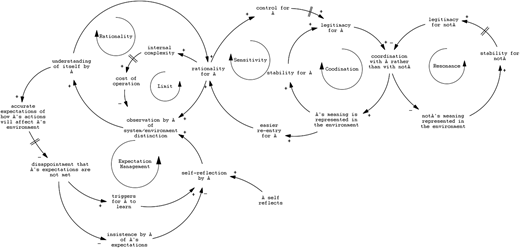
Figure 1 below is a CLD. A CLD is a visual tool used to illustrate how variables in a system causally interact with one another over time. Variables connect via arrows that indicate causality, and each arrow carries a polarity: a “+” indicates that variables change in the same direction (an increase in one leads to an increase in the other, and vice versa), while a “–” indicates a relationship that inverts (an increase in one leads to a decrease in the other, and vice versa). Some arrows have delay marks that represent that there is a time delay in the causal relationship between the variables. When these causal links form closed paths they create feedback loops that either reinforce change (reinforcing loops) or counterbalance the system's behavior (balancing loops). CLDs make the structure of dynamic relationships visible, illustrating patterns of behavior as they emerge from recursive interactions.
The CLD is made up of four reinforcing loops – Rationality, Sensitivity, Coordination and Resonance – and two balancing loops – Expectation management and Limit. This CLD considers how a system – we'll call this system A – may behave in an innovation ecosystem. In this CLD, the Expectation management balancing loop represents an organization's program for managing expectations, responding to disappointment either through learning or insistence. Each of the CLD's loops will be described next.
To demonstrate the real-world applicability of this model, this article applies the developed CLD to an established Berkeley–Haas case study called “Sustainability Through Open Innovation: Carlsberg and the Green Fiber Bottle” written by Chesbrough et al. (2018). Utilizing this well-documented teaching case allows for a secondary analysis of the systemic drivers involved in an organization's attempts to develop a coherent ecosystem strategy and enhance their rationality as they collaborate while innovating. After explaining each loop, the CLD's variables and feedback loops are mapped onto the case narrative, demonstrating how expectation management, rationality and legitimacy interact in practice to shape coordination within an innovation ecosystem, and how the model's mechanisms can be traced through Carlsberg's organizational decisions.
Rationality (reinforcing loop)
Our narrative begins with the reinforcing loop labeled rationality. A self reflects, producing the input for our system so that there is greater self-reflection by A. This self-reflection by A results in greater observation by A of the system/environment distinction. The more A reflects on and observes its distinction, the more A can begin to understand itself and understand how its selections affect itself as it changes its environment. This allows A to increase its rationality, so that it’s better equipped to account for its process of distinction, which in turn deepens A's capacity to observe its system/environment distinction. The rationality loop is central to the CLD, and is prevalent in the Carlsberg case, interacting with several of the other loops. They are articulated below.
Limit (balancing loop)
A's increase in rationality has a cost – increased internal complexity. More internal complexity taxes A's capabilities by making operations more costly, thereby reducing the extent to which A can observe its system/environment distinction. This limit produces a balancing loop that means that rationality cannot increase infinitely. At some point, the weight of greater complexity causes the system to reduce how much it observes its system/environment distinction, thereby capping its rationality.
The Rationality and Limit loops can be seen in the Carlsberg case when, after improving their self-understanding, they recognized that entering the packaging business would require them to dramatically increase their internal complexity, hiking operational costs in an unsustainable way. This limit dissuaded Carlsberg and drove them to seek an alternative solution that would still be strategically viable.
Expectation management (balancing loop)
The Expectation management loop is a balancing loop that represents a system's program for managing expectations, establishing how a system might structurally respond to disappointment. As A improves its understanding of itself, it is better equipped to account for its process of distinction and meaning-making. This results in A increasing how many accurate expectations A might hold of how A's actions will affect A's environment. This reduces the number of disappointments A is likely to face. With fewer disappointments come two effects: there are fewer triggers for A to learn, and there is more insistence by A of A's expectations. This makes sense: if A holds correct expectations, then A should insist on retaining expectations as there is no need to update them. But with less need to update expectations in response to disappointment comes less self-reflection by A, thereby reducing A's observation of its system/environment distinction.
Conversely, if we flip the narrative, we can see that if A has less understanding of itself, A would have a less coherent self-description and understanding of how its selections affect its environment. This results in A holding less accurate expectations of how A's actions will affect itself through its environment, thereby producing more disappointments when A's expectations are not met. More disappointments mean more triggers for A to learn, but also less insistence by A on holding preexisting expectations. Once again, these two variables play against one another dynamically and feed into the degree to which A self-reflects, so that when there are more triggers to learn, eventually A is likely to override its insistence and self-reflect more, thereby leading to more observation by A of A's system/environment distinction.
The Expectation management loop can be seen in action in the Carlsberg case when they assessed their environmental footprint and found packaging accounted for roughly 40% of their total impact. Interacting with the Rationality loop, this disappointment triggered learning and revision of their expectations, increasing Carlsberg's rationality and leading them to consider their role in the packaging industry.
Sensitivity (reinforcing loop)
With A's increase in rationality, A can account for more of its environment and its own distinction. This allows A to better understand itself and its possible selections considering how its selections will affect its environment and therefore itself through its structure. This allows A to have more control over itself and its environment. More control for A means more legitimacy for A, as A can produce selections and relations more coherently, thus allowing for great recursion in its operations.
More legitimacy for A means that systems are more likely to coordinate with A, rather than systems with less legitimacy – here referred to as notA. If systems are coordinating more with A, then more of A's selections, and thus meaning, will be represented in A's environment, serving as decision premises for future decisions. This makes it easier for A to distinguish its distinction in relation to its environment so that re-entry is easier. This allows A more rationality as it can account for even more of its environment more easily.
The Sensitivity loop interacted with the Rationality loop when Carlsberg chose to approach other organizations and encourage them to innovate a product or production technique that would provide the market with the environmentally sustainable packaging they sought. Increased rationality allowed Carlsberg to be more sensitive to more of the innovation ecosystem, engaging meaningfully with other ecosystem stakeholders and improving their understanding of their sustainability ambitions, organizational structure and environment.
Coordination (reinforcing loop)
As A's meaning becomes more represented in its environment, it faces fewer irritations that provoke selections that may deviate from previous selections, and therefore A enjoys greater stability. This stability reinforces A's legitimacy, prompting more ecosystem coordination with A and further embedding its meaning and decision premises into A's environment.
The Coordination loop interacts with the Sensitivity loop in the Carlsberg case when internally coherent and intelligible expectations increase the likelihood that other ecosystem stakeholders will adopt or align with them, so that more of Carlsberg's expectations are represented in their environment. This is evident when Carlsberg made the choice to operate as a partner with ecoXpac, the Technical University of Denmark, BillerudKorsnäs and the Innovation Fund Denmark. Carlsberg opted not to enforce nondisclosure or exclusivity agreements and instead favored an open approach to knowledge sharing. They allowed their partners to commercialize the technology this knowledge had helped produce. All of this required Carlsberg to operate across organizational boundaries. In doing so, the Coordination loop interacted with the Rationality loop, as Carlsberg increased their internal complexity to further account for how ecosystem stakeholders operated.
Resonance (reinforcing loop)
Finally, if ecosystem stakeholders are coordinating with A instead of notA, then there is less of notA's meaning and selections as decision premises represented in A's environment. This means there is less stability for notA, and as a result notA's legitimacy decreases as these systems have to make more selections or incorporate more decisions into their structures that are either new, thus reducing recursiveness of operations, or cohere less with notA's structure and meaning. Loss of legitimacy for notA means more coordination with more legitimate systems like A rather than less legitimate systems like notA.
The Resonance and Coordination loops interacted as Carlsberg coordinated more and more with innovation ecosystem stakeholders. Carlsberg's meaning was increasingly represented in the ecosystem as their knowledge sharing proliferated and the Green Fiber Bottle project's novel packaging was sold to other companies. This expansion of offerings further developed production technologies, stabilizing Carlsberg position even more as re-entry is made easier when more of Carlsberg's meaning is represented in its environment. For example, more of what Carlsberg considered acceptable was replicated in new products, producing more packaging options for Carlsberg.
Discussion
Contemporary organizations often innovate together with other organizations in ecosystems. For this to be successful, innovation ecosystems literature suggests that organizations develop strategies by scanning their environment and aligning their strategies with other stakeholders to seize opportunities and capture value (Adner, 2017; Jacobides et al., 2018; Talmar et al., 2020). Furthermore, the role of a keystone member in innovation ecosystems is often invoked, with these stakeholders playing an integral role in shaping ecosystems, directing resource flows and influencing value capture (Dedehayir et al., 2018; Dhanaraj and Parkhe, 2006; Iansiti and Levien, 2004).
The case of the Green Fiber Bottle presents an interesting case where an organization, Carlsberg, emerged with keystone-member centrality without employing many of the ecosystem control mechanisms typically employed. Carlsberg never owned the Green Fiber Bottle product or the technology necessary for its production; they never determined the developmental timing of innovation activity but rather remained dependent on partners for the creation of the Green Fiber Bottle. They didn't make substantial financial investments in the project and refrained from exercising hierarchical control over ecosystem stakeholders. Nevertheless, Carlsberg became central to the ecosystem while affording other stakeholders substantial autonomy. This raises the question, how can an organization become a central coordinating stakeholder within an innovation ecosystem despite lacking direct control over key technologies, resources and partners?
To address this question, this article considered how key Luhmannian concepts like rationality, complexity, meaning, second-order observation, re-entry, system structure, expectations and legitimacy might interact with one another to allow an organization to become a focal coordinating actor despite lacking direct control over key technologies, resources and partners. After surveying Luhmann's theory, these concepts were combined into a CLD, illustrating causal dynamics and elucidating how organizations might internally develop the capacity to undertake coordinating roles in innovation ecosystems where stakeholders retain substantial autonomy under conditions of uncertainty and interdependence.
The value of the Luhmannian perspective becomes clearer when translated into the Carlsberg case. Rather than assuming that coordination emerged through mechanisms of control often employed by keystone members, the framework shows how Carlsberg was able to form increasingly complex and stable expectations about how different actors and interdependencies in the ecosystem might evolve. These expectations were not derived from direct access to organizations or systems in Carlsberg's environment, but from iterative internal processing of disappointment and learning. In this sense, Carlsberg's coordinating role can be understood not as the result of control or visibility, but as the outcome of its capacity to construct and stabilize expectations that other actors could align with. This results in the following three findings.
First, this article argues that a program of expectation management can serve as an engine that drives rationality in organizations. Luhmann holds that systems embed in their structures programs that can provide “either conditions that trigger action or goals that action should aim for or both” (Luhmann, 1995, pp. 203-204). In this sense, Luhmann distinguishes between conditional programs, which specify how a system should respond under particular conditions (Luhmann, 2018, p. 215), and purpose programs, which orient decision-making toward desired outcomes (Luhmann, 2018, p. 219). This distinction helps to clarify how expectation management may operate. Conditional programs stabilize responses to disappointment based on prior experience, whereas purpose programs orient expectations toward future states of affairs (Liu, 2026). Thus, a decision program for expectation management can be structurally embedded in an organization that specifies how to react when expectations are disappointed (Cihan, 2026); either by learning and revising expectations, or by insistence and retaining them. Such a program may take the form of either a conditional or a purpose program, depending on whether responses are organized around past experience or future-oriented goals. This results in treating disappointment as structural information, allowing organizations to enhance their rationality programmatically, thereby developing the capacity to produce a coherent innovation ecosystem strategy while remaining operationally stable. By beginning with looking inward rather than outward, organizations participating in innovation ecosystems can produce coherent and effective ecosystem strategies – ones that position the organization based on how others structure themselves. Viewing expectation management in this way also connects this contribution to emerging work on Luhmannian decision-making semantics, which further explores how decision premises structure organizational responses under conditions of complexity (Aal, 2025; Grothe-Hammer and Berthod, 2017; Roth et al., 2026).
Second, the article argues that rationality and legitimacy must coevolve to enable coordination. Legitimacy complements rationality by ensuring that a system's meaning is intelligible to others. Systems that maintain coherence across time and can communicate their distinctions more effectively are more likely to be selected for coordination (Pretorius et al., 2025). At the same time, rationality reinforces legitimacy by allowing a system to anticipate the effects of its selections and pre-emptively adjust selections to ensure internal coherence. This becomes particularly relevant in high complexity contexts, like innovation ecosystems. Rationality and legitimacy work alongside one another to allow an organization in an innovation ecosystem to increase their complexity and learn from disappointments so that they can retain their legitimacy in the face of environmental complexity. Coordination is then enabled as legitimacy stabilizes selections both internally and externally, producing decision premises that can become collectively binding. In the Carlsberg case, this coevolution helps explain how the organization became a coordinating actor: as its expectations became more accurate and internally coherent, its actions became more predictable and intelligible to others, increasing its legitimacy. This legitimacy made it easier for other ecosystem participants to align their decisions with Carlsberg's, even in the absence of formal authority or control.
Finally, the article argues that resonance loops explain how centrality in an innovation ecosystem can emerge while preserving stakeholder autonomy. As more actors coordinate with a legitimate, rational system, that system's meaning is increasingly represented in the environment. Representation begets stability for the focal system, gradually gaining it prominence within the innovation ecosystem. Over time, less-coherent actors may borrow distinctions to enable them to participate, producing a dependence on more legitimate and rational stakeholders. Thus, more rational and legitimate systems' centrality can recursively increase over time. What ecosystem strategy literature often attributes to keystone orchestration can be re-described in Luhmannian terms as resonance: recursive embedding of one actor's decision premises through legitimacy-based coordination that preserves stakeholder autonomy.
From this perspective, structural coupling provides the mechanism through which this process unfolds. As organizations become coupled, they form expectations about one another and orient their decisions accordingly. Systems whose expectations are more coherent and intelligible are more likely to be selected as reference points, leading others to align with their distinctions and reproduce their expectations in practice. This reproduction generates resonance loops that amplify a system's meaning across the ecosystem. Voice, in this sense, refers to the extent to which an organization's expectations are taken up and reproduced within its environment. What appears as dominance, or the loudest voice in the room, is thus a structural outcome of feedback, not an intention realized through outward control. This dynamic can be observed in the Carlsberg case, where other actors increasingly oriented themselves toward Carlsberg's expectations and distinctions, not because of imposed coordination, but because these provided stable and interpretable reference points. Carlsberg's dominance thus emerges as a consequence of recursive alignment processes, rather than deliberate orchestration alone.
Together, these three insights demonstrate how a program of expectation management can help an organization to develop the capacity to become a central coordinating actor in an innovation ecosystem despite lacking direct control over key technologies, resources and partners. By cultivating rationality and legitimacy, organizations become stable reference points for coordination, allowing them to shape ecosystem structures while preserving stakeholder autonomy.
These insights also have practical implications. Rather than focusing primarily on analyzing and positioning within an ecosystem, managers should attend to how their organization forms and updates expectations about other ecosystem stakeholders. This involves embedding decision programs that treat disappointment as information and systematically revising expectations while maintaining coherence. From this perspective, influence in an innovation ecosystem is achieved not through control, but through becoming a reliable and intelligible reference point for coordination.
Managerial implications
For managers, this article suggests that decision programs for expectation management should be intentionally designed to specify when to learn and when to insist, using disappointment as information rather than as failure. That is not to say that it’s always right to respond by learning and increasing rationality – greater rationality comes at a cost. But a deliberate choice should be made that coheres with the organization's strategy. Organizations operating in innovation ecosystems would be well served by investing in rationality-building routines that increase environmental accounting without eroding boundary coherence. Finally, legitimacy should be pursued as structural reliability, with stable decision premises valued and reproduced over time, recognizing that ecosystem coordination principally requires intelligibility, rather than access.
Conclusion
This article showed that organizations can develop ecosystem strategies that allow them to become central in an innovation ecosystem by internally programming how they manage expectations. Treating disappointment as structural information can increase rationality, enabling organizations to anticipate how their selections will affect themselves through their environment. As rationality and legitimacy coevolve, organizations become more intelligible to others, allowing coordination to emerge without requiring shared meaning. The CLD and the Carlsberg case illustrate how these reinforcing dynamics can also generate resonance, through which a system's decision premises become environmentally represented, producing centrality while preserving other stakeholders' autonomy. A coherent ecosystem strategy that produces legitimacy and allows an organization to develop the capacity to become central begins inside the organization: through expectation management that sustains coherence, enables coordination and shapes ecosystem structure over time.