The goal is to analyze how tourism is associated with changes in population health, measured through the regional burden of disease. Although tourism is a strategic driver of economic growth, its implications for public health remain poorly investigated. The objective is to study whether and under what conditions tourist flows generate health benefits or risks.
Health is measured using Disability-Adjusted Life Years (DALYs) provided by the Global Burden of Disease project. Using panel data for 20 Italian regions from 2008 to 2021, we analyze tourism intensity, average length of stay and spatial concentration of arrivals. The application of a hybrid within-between model allows us to distinguish between short-term and long-term structural differences.
The results show a dual impact. In the short term, longer stays and concentrated arrivals are associated with an increase in DALYs, signaling pressure on health services and the local environment, while a greater number of arrivals is associated with a reduction in DALYs. In the long term, regions with structurally high tourism intensity tend to be associated with worse health outcomes; however, higher per capita income seems to mitigate these negative effects. Policies should focus on redistributing flows, reducing concentration and strengthening the resilience of local health systems. Redistributive policies and sustainable management approaches can transform tourism into a lever for creating both economic and health value.
The contribution lies in the use of DALYs, a measure never applied in tourism studies, and in the adoption of a model that separates temporal dynamics from structural differences.
1. Introduction
Italy is a country with a strong tourist vocation (Formica and Uysal, 1996). The tourism sector constitutes a significant economic activity, contributing up to 18% of the national Gross Domestic Product (GDP) (Ministry of Tourism, 2025). This sector has a pivotal role in mitigating the income gap between Italian provinces, reducing the overall income disparities and promoting a more equitable distribution of wealth (Comerio and Pacicco, 2024). Nevertheless, tourism affects health outcomes.
In fact, tourism is no longer viewed solely as a driver of GDP and employment, but as a socioeconomic system capable of generating both benefits and costs for host communities. Recent tourism research has moved beyond purely economic considerations, increasingly recognizing the complex trade-offs between economic value, environmental pressure and residents' well-being. Empirical evidence shows that tourism development affects residents' well-being, with heterogeneous effects depending on territorial characteristics and tourism intensity (Ivlevs, 2017; Badulescu et al., 2022; Bornioli et al., 2022; Bulchand-Gidumal et al., 2025). In particular, the growing literature on overtourism highlights how the spatial and temporal concentration of tourist flows can increase pressure on urban environments and public services, reducing residents' quality of life (García-Buades et al., 2022; González-Marín et al., 2023).
Systematic reviews indicate that the domains adversely impacted encompass self-reported health, safety, quality of the physical environment and social relations (Nopiyani and Wirawan, 2021). On a global scale, international tourism has been identified as a relevant factor in facilitating the rapid global spread of infectious diseases when not managed successfully. Together with environmental disruption, unsafe practices such as sex tourism and the growing movement of vulnerable populations, amplify health risks for both residents and travelers (Richter, 2003). Research on tourism in the European Union suggests that urban and younger residents do not appear to receive substantial benefits from this sector. Indeed, findings suggest that tourism arrivals tend to be associated with a decline in residents' overall life satisfaction, with this effect being particularly pronounced in countries exhibiting high tourism intensity levels. It could be argued that both younger and older residents do not get particular benefits from tourism, and in some cases, tourism can impact older residents more. This phenomenon has been consistently observed across various studies (Ivlevs, 2017; Badulescu et al., 2022; Bulchand-Gidumal et al., 2025; Bornioli et al., 2022). At the national level, particularly in Spain, findings show that tourism arrivals have a short-term negative effect on residents' health, while positive impacts are verified in the long term (Godovykh and Ridderstaat, 2020; Kim et al., 2013). Moreover, overtourism has been shown to affect residents' quality of life adversely, provoke feelings of withdrawal and encourage support for reducing tourism and gentrification, as evidenced by studies conducted in Barcelona (García-Buades et al., 2022; González-Marín et al., 2023).
In the context of Italy, the scarce extant literature on the nexus between tourism and health outcomes underscores the heterogeneity of the impact of this phenomenon, contingent on site-specific characteristics, people's attitudes, perceptions of the impacts of tourism, satisfaction with specific aspects of life and environmental domains (Abbafati et al., 2025), indicating that the impact of tourism is influenced by various cultural, historical and societal factors (Bimonte and Faralla, 2016; Bimonte and D'Agostino, 2021; Biagi et al., 2020; Firza et al., 2024; Magazzino et al., 2021).
Despite these advances, most studies focus on subjective well-being and residents' perceptions, while the relationship between tourism and population health remains comparatively underexplored. This represents a relevant gap, as health is a core dimension of territorial sustainability and system resilience, especially in an aging society (Richter, 2003; Turcato et al., 2023).
Recent contributions to tourism management and governance emphasize the need for integrated, evidence-based approaches that distinguish short-term pressures from long-term structural dynamics. In this perspective, the impacts of tourism depend crucially on the capacity of destinations to manage flows, coordinate public and private actors, and ensure the resilience of essential services, including healthcare. When tourist arrivals are unevenly distributed or overly concentrated, system-level costs may arise, potentially worsening health outcomes (Ezza et al., 2019). From a public management perspective, this implies that tourism intensity per se may be less informative than the way tourist flows are organized across space and time, because concentration can amplify congestion and overload of local services, while a more balanced distribution may mitigate negative externalities.
The importance of destination governance and management strategies has been stressed by recent sustainability-oriented tourism studies regarding Italy. Evidence highlights the role of organizational networks among sustainable tourism stakeholders (Blasi et al., 2024), the spread of circular practices in hospitality and food-waste management (Lagioia et al., 2024) and residents' views of sustainable hospitality in rural areas (Cammarota et al., 2025). Other work documents place-based tensions such as tourism-driven displacement in urban settings (Esposito, 2023) and sustainable approaches to regenerating cultural and industrial heritage (Cerquetti et al., 2022; Chiodi et al., 2025). Yet, although this literature deepens understanding of sustainability challenges and governance trade-offs in Italian destinations, it seldom links tourism dynamics to synthetic population-health measures that are comparable across territories and sensitive to the severity of conditions.
Robust empirical evidence linking tourism management to comprehensive and comparable health outcomes remains lacking. Existing tourism studies do not adopt burden-of-disease measures such as Disability-Adjusted Life Years (DALYs), which combine premature mortality (YLLs) and disability (YLDs) into a single indicator of health loss (Devleesschauwer et al., 2014; Kim et al., 2022; Ferrari et al., 2024). This limitation is especially relevant from a public management perspective, as DALYs allow moving beyond partial indicators toward a synthetic measure with clear implications for welfare, productivity and healthcare sustainability.
This approach highlights the idea that health could be considered as a type of capital, like human and physical capital: everyone is born with an expected number of years of good health to be spent during their lifetime. It shifts current health debates from life expectancy to the burden of disease, which is particularly significant in high-income countries where people live longer, and chronic diseases tend to prevail (Abbafati et al., 2024). Furthermore, the burden of disease incorporates disease severity by weighting prevalence according to the severity of the condition. The second innovation refers to the fact that the present study will concentrate on all 20 Italian regions, thereby offering a more comprehensive perspective of the observed phenomenon. Using a mixed-effects model with a within-between specification (Mundlak, 1978; Bell et al., 2019), our study's analytical design distinguishes short-term intra-regional effects (within-effects) from long-term structural differences (between-effects), allowing us to highlight different temporal dynamics and mechanisms that coexist in the 20 regions. This provides new evidence for destination governance, showing how tourism management strategies, particularly those aimed at reducing concentration and redistributing flows, can mitigate health-related costs and support more sustainable development paths.
This study contributes to the management literature in three main ways: first, by introducing DALYs as a comprehensive measure of population health into tourism research; second, by empirically distinguishing short-term dynamics from long-term structural mechanisms through a within–between framework and third, by reframing tourism governance as a health-relevant domain within complex service systems.
The article is organized as follows: in the “Data and Methods” section we present details on data collection and processing. In section “Results,” we report the main findings of our research. In section “Discussion,” we discuss our results also underlying their relationship with existing literature. The final sections are devoted to “Policy Implications” and “Conclusions.”
2. Data and Methods
2.1 Health and covariates
The Global Burden of Disease (GBD) Study coordinated by the Institute of Health Metrics and Evaluation (IHME), from Washington University, is the only project in the world that, thanks to its vast amount of data and extremely sophisticated computational methods, can quantify health needs based on information relating to approximately 375 diseases and injuries, 88 risk factors and over 3,000 sequelae. It does so for 204 countries and territories and in a trend perspective, specifically from 1990 to the present, with forecasts to 2050. GBD is crucial for evidence-informed decision-making and capacity building.
Quantifying health demand based on health needs is essential for managing demand and planning services according to health objectives. Finally, thanks to its complex and sophisticated use of data sources, the GBD overcomes many privacy-related limitations in the use of health data and provides readily usable information for evidence-based health policies.
The Global Burden of Disease Study quantifies population health loss using DALYs, which combine YLLs due to premature mortality and YLDs due to morbidity:
Where YLL quantifies premature mortality and is calculated as the product of the number of deaths in each age group (a) and the standard life expectancy at that age obtained from the GBD reference life table
where.
= number of deaths at age a,
= standard life expectancy at age .
YLD, on the other hand, quantifies the nonfatal component of the disease burden and is calculated using the following formula:
where.
is the prevalence of health outcome ,
is the disability weight for outcome .
DALYs are reported as counts, rates and age-standardized values per 100,000 population by sex, location and year, and quantify the health gap between the current status of populations and an ideal scenario in which everyone lives in full health to a standard life expectancy (WHO, 2020; Devleesschauwer et al., 2014; Ferrari et al., 2024).
In this article, age-standardized DALYs (per 100,000 population) will be considered, which are obtained by weighting the age-specific rates with the GBD standard population weights to remove the effect of an aging population, particularly relevant in the Italian context.
Concerning the covariates, the Italian National Institute of Statistics, ISTAT, produces information on tourist flows and income. The first pertains to arrivals and to the number of nights referring to people (i.e. customers) who checked into an accommodation facility (a hotel or other nonhotel establishment), and to the number of customers who stayed overnight, indicating the total number of nights that customers spent in said facilities (ISTAT, 2025). The second is information on the average family income. In particular, the data refer to the total income of an individual or family, calculated by including income from all sources (work, capital, land, buildings) and the imputed component deriving from ownership of the main residence in which they live.
The hypothesis underlying the use of this indicator is that an increase in tourist flows can lead to an increase in income, which in turn could have a positive effect on health. This assumption is corroborated by extensive scientific literature (Adler et al., 1993; Feinstein, 1993) and an in-depth study conducted on the topic (Godovykh and Ridderstaat, 2020).
2.2 Methods
2.2.1 Calculation of tourism concentration index
To measure the geographic concentration of tourist arrivals within each region, we calculated an annual Gini concentration index at the regional level. This index measures inequality in the distribution of arrivals across the municipalities (i) within region (r) for each year (t). Values range from zero representing perfect equality (arrivals are distributed evenly across all municipalities, spreading the burden of tourist arrivals in the region evenly), to one representing perfect inequality (all arrivals in the region are concentrated in a single municipality). A higher index value indicates, given the amount of tourist arrivals, a greater “burden” of tourist flows being borne by a smaller number of municipalities within the region in that year.
For each region-year combination, the index was computed using the standard formula for the Gini index of a discrete probability distribution. Let denote the number of tourist arrivals in municipality of region , in year . Let denote the number of municipalities in region in year .
The Gini index () for region in year has been calculated using the following formula, based on the mean absolute differences:
where is the mean number of arrivals per municipality in region and year .
2.2.2 Statistical analysis: within-between hybrid model
To analyze the relationship between tourism indicators, economic factors and population health (DALYs), we employed a linear mixed-effects model with a within-between specification, also known as the Mundlak–Chamberlain device (Mundlak, 1978; Bell et al., 2019). This approach decomposes the effects of time-varying covariates (e.g. annual changes in tourism flows) into two distinct components by including both the covariates themselves and their region-specific averages (means) as regressors in the model. This allows us to estimate:
Within-region effects: the association between year-to-year deviations from a region's long-term average level of a covariate and changes in DALYs within that same region (e.g. how a temporary change in tourist arrivals is associated with health outcomes in a given year, holding regional averages constant).
Between-region effects: the association between regions' long-term average levels of covariates and their average DALYs, capturing stable differences across regions (e.g. how regions with consistently high tourism intensity tend to be associated with higher DALYs).
This approach is considered to be more flexible than traditional fixed-effects models (which focus only on within-region effects) or random-effects models (which assume within- and between-region effects are identical, an assumption often violated and leading to biased estimates; Bell and Jones, 2015). The within-between model explicitly relaxes this assumption, providing unbiased estimates of both types of effects while accounting for unobserved regional heterogeneity.
The generic specification of our model is formalized by the following equation:
where:
is the Disability-Adjusted Life Years rate (per 100,000, age-standardized) for region at time for all causes and both sexes.
is a vector of time-varying covariates for region at time .
is a vector of the entity-specific means (over time) of the covariates.
is a vector of within-effects coefficients accounting for the expected change in the outcome for a one-unit change in a covariate within a given region, relative to that region's own mean over time.
is a vector of between-effects coefficients. They represent the difference in the average outcome associated with a one-unit difference in the long-term average of a covariate between regions.
is the region-specific random intercept, accounting for time-invariant unobserved heterogeneity between regions ().
is the so-called idiosyncratic error term () capturing short-term residual within-entity variation that is assumed to be independently and identically distributed with mean zero and constant variance.
The model was estimated using Restricted Maximum Likelihood (REML) in R (version 4.4.2) with the “panelr” package.
Model fit was assessed using the Akaike Information Criterion (AIC), Bayesian Information Criterion (BIC) and pseudo-R2 values for both fixed and total effects. The Intraclass Correlation Coefficient (ICC) was employed to quantify the proportion of total variance in the null model attributable to stable differences between regions.
To evaluate the robustness of the estimated associations and to rule out that the observed statistical significance is due to the specific sample realization, we conducted a series of univariate randomization tests. This procedure assesses the null hypothesis that there is no systematic relationship between each variable of interest and the outcome, conditional on the model.
The test was carried out separately for the covariates: Gini (concentration index for arrivals), arrivp (proportion of the number of arrivals) and nightpp (average number of nights spent for each arrival), generating 1000 random placebo datasets, randomly assigning the values to each region-year observation. The values of all other variables in the model were held constant as observed. The empirical Type-I error (empirical false positive rate) over the 1000 trials was compared with the theoretical value (0.05). Furthermore, to mitigate potential bias from the structural breaks in both tourism and public health during the COVID-19 pandemic, we re-estimated our model on a sample excluding the years 2019–2021, with 2019 being the year when the first cases of atypical influenza started being reported. Nonetheless, the analysis is subject to endogeneity concerns, which preclude definitive causal inference. In the absence of stronger identification strategies, the results of this model are therefore presented and discussed strictly as conditional correlations and partial associations between the variables of interest.
3. Results
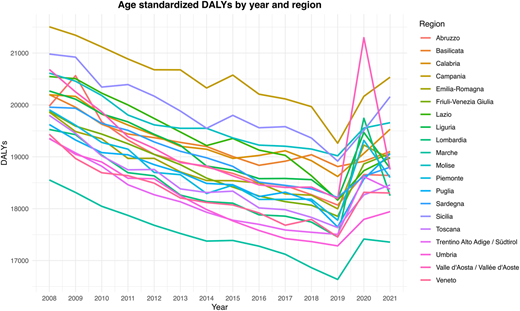
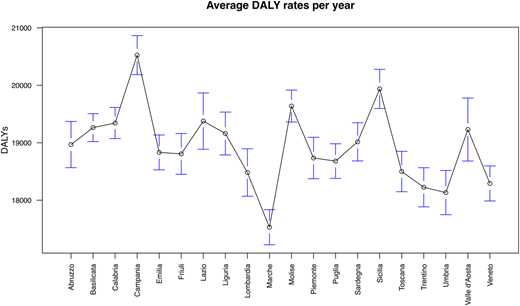
Age-standardized DALYs rates have been slowly decreasing in all Italian regions since 2008, with a remarkable exception for the COVID-19 pandemic period, where all DALYs have increased (Figure 1). The average DALY rates for the timeframe considered in this article (2008–2021) show some structural differences (Figure 2) with some regions (Marche) showing very low DALYs and some (Campania) presenting very high average disability adjusted life years.
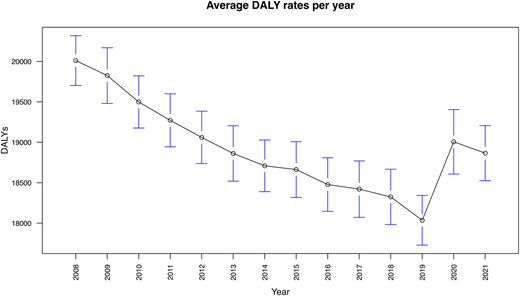
The average age-standardized DALYs over all the Italian regions confirm for Italy the trend to a reduction of the burden that has presented an inversion in the path only for the pandemic period (Figure 3).
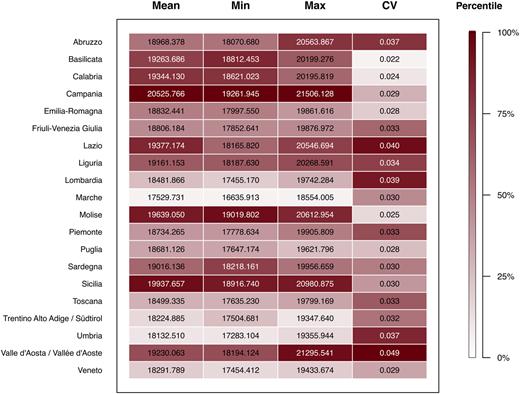
Figure 4 reports descriptive statistics for age-standardized DALY rates. For each region, the mean, range (minimum and maximum) and coefficient of variation (CV) over the study period have been displayed. Values are color-coded as a heatmap according to their percentile rank within each column.
Overall, regional mean DALY rates cluster in a relatively narrow interval (17,500–20,500 per 100,000 people), suggesting a fairly homogeneous burden of disease across the entire Italian peninsula. However, the usual north-south gradient is present with Campania (average DALY equal to 20,526), Sicilia (19,938), Basilicata (19,264) and Calabria (19,344) presenting the largest mean DALY rates in Italy. Campania consistently records the highest values (see also Figure 1), with a maximum exceeding 21,500, with the only exception during the pandemic period. On the other hand, Marche (17,530), Trentino-Alto Adige (18,225) and Veneto (18,292) present the lowest means, with therefore comparatively better health outcomes or probably lower exposure to risk factors.
Regional age-standardized DALYs rates remained relatively stable over the 14-year period (CV between 0.02 and 0.04), reinforcing the presence of regional differences rather than a convergence toward equal values, with Basilicata and Calabria presenting the lowest variability (CV 0.022–0.024), while Lazio, Lombardia and Umbria showed somewhat higher variability (CV 0.037–0.040). Valle d’Aosta is an outlier, with the highest variability (CV: 0.049), likely reflecting its small population size and consequent sensitivity to annual fluctuations.
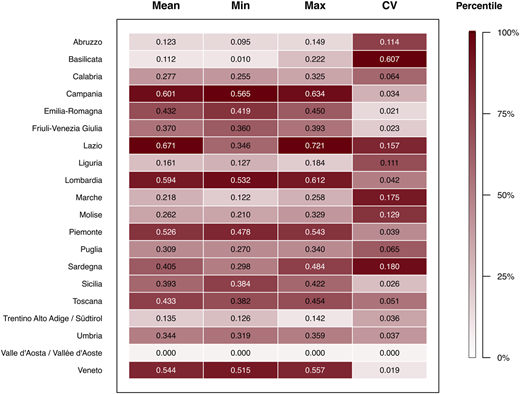
Figure 5 reports descriptive statistics (mean, minimum, maximum and the coefficient of variation) of the concentration index of arrivals over the study period for each region. Values are color-coded as a heatmap according to their percentile rank within each column.
The concentration index presents an average value over the time window taken into consideration, which varies substantially between regions. The average index over the 14 years goes from relatively small values, such as 0.112 for Basilicata (excluding Valle d’Aosta, which represents a peculiar case in the Italian framework having just one municipality), 0.123 for Abruzzo, 0.135 for Trentino Alto Adige, 0.161 for Liguria, to high concentration values for regions such as Lazio (0.671) and Campania (0.601). For these regions, tourist arrivals are highly concentrated in a few key municipalities (e.g. Rome for Lazio, Naples for Campania). Lombardia (0.594) and Veneto (0.544) also show high concentration, likely due to the presence of major metropolitan or internationally renowned destinations.
Considering the coefficient of variation, Veneto (0.019), Emilia-Romagna (0.021), Friuli-Venezia Giulia (0.023), Sicilia (0.026), Campania (0.034) and Piemonte (0.039) show a stable value of the concentration of arrivals by municipality.
On the other hand, Basilicata (CV: 0.607) shows the highest CV, with a very volatile spatial concentration of arrivals over the observational period, oscillating between near-perfect equality (0.010) and moderate concentration (0.222).
Sardegna (CV: 0.180), Marche (CV: 0.175) and Lazio (CV: 0.157) also present high CVs, showing that tourism in these regions is highly dependent on a few municipalities.
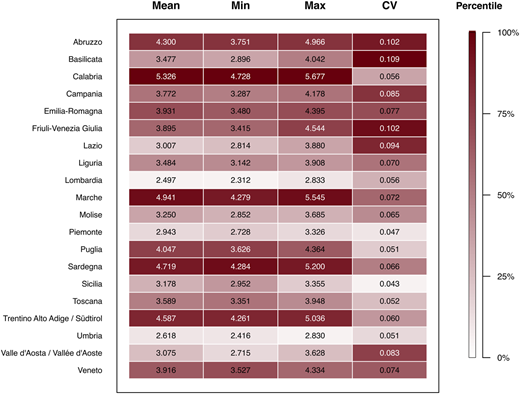
Regional patterns in tourist stay durations are summarized in the heatmap of Figure 6, which presents mean, range and coefficient of variation statistics for average nights per arrival across the Italian regions (2008–2021). Color-coding for the cells is based on the percentile ranking of the values within each column. Regions like Calabria, Marche, Sardegna and Trentino Alto Adige are destinations where visitors tend to stay longer, with the highest mean values for the average number of nights (above 4.5 nights for all the aforementioned regions). On the other hand, Lombardia and Umbria have the lowest means, with shorter average durations of stays. The coefficient of variation (CV) is generally low across regions, with Sicilia (CV: 0.043) and Piemonte (CV: 0.047) showing particularly limited variability in length of stay, while Basilicata and Friuli-Venezia Giulia present higher dispersion.
The within-between hybrid model using DALYs as a function of tourist arrivals (in terms of number of arrivals, average stay and burden on the different municipalities within each region, measured as the concentration of arrivals over the municipalities) was estimated using the “wbm()” function in the “panelr” R package according to the following equation:
where:
is the age-standardized DALY rate (per 100,000 people) for region in year for all causes and both sexes;
is the grand intercept;
coefficients represent the within-effects, estimating the relationship between deviations from a region's own mean and the outcome;
coefficients represent the between-effects, estimating the relationship between a region's long-term mean characteristics and the outcome;
is the region-specific random intercept, assumed to be normally distributed with zero mean and variance ();
is the idiosyncratic error term, assumed to be normally distributed with zero mean and variance ();
is the average number of nights spent for each arrival in region i and year t;
is the average number of nights spent in region i;
is the proportion of the number of arrivals in region i and year t every 1,000 inhabitants;
is the average proportion of the number of arrivals in region i every 1,000 inhabitants;
is the total income of an individual or family in region i and year t in thousands of euros;
is the average income of an individual or family in region I expressed in thousands of euros;
is the concentration index for arrivals by municipality in region i and year t;
is the average concentration index of arrivals in region i.
The model was fitted to a panel dataset of 20 statistical units (regions) over a 14-year period (2008–2021), resulting in a pseudo- = 0.79. The intraclass correlation coefficient (ICC) indicates that 49% of the total variance is accounted for by the grouping structure (differences between regions).
Considering the within-effect estimates (Table 1), which are relative to short-term fluctuation, the average number of nights spent by a tourist is associated positively with the outcome.
Namely, a one-night increase in the average stay of a tourist, relative to a region's long-term average, was associated with an average increase of 1306.27 (p-value < 0.001) in the number of DALYs, all other things being equal. This corresponds to approximately 4.8 additional days of healthy life lost per person each year, or roughly 13,000 total years of healthy life lost annually in a region of one million inhabitants. An increase of one arrival per 1,000 inhabitants, relative to a region's long-term average, was associated with a significant decrease of 0.31 DALYs per 100,000 people (p-value < 0.001). The short-term association between Income and DALYs is negative (b = −29.39, p-value = 0.076) but not significant. As expected, a one-unit increase in the Gini index of tourist concentration, relative to a region's long-term average, was associated with a significant increase of 1547.87 DALYs per 100,000 people (p-value = 0.041). Considering that the Gini index is limited to vary between zero and one, a more realistic 0.1 unit increase in the concentration is associated with approximately 155 additional DALYs per 100,000 population. This translates to roughly 13.6 h of healthy life lost per person annually, or about 1,550 total years of healthy life lost in a region of one million inhabitants.
The between-effects estimates (Table 2) of how differences in the long-term averages of covariates between regions are associated with differences in their long-term average DALY rates suggest that:
Regions with a long-term average tourist stay, which is one night longer than other regions, did not show a statistically different average DALY rate, b = −187.71, p-value = 0.182.
Regions with a long-term average of one more arrival per 1,000 inhabitants were on average associated with a significantly higher average DALY rate by 0.15 units (p-value = 0.037).
Regions with a higher long-term average per capita income were associated with a significantly lower average DALY rate by 146.69 units every 100,000 people (p-value < 0.001). To contextualize this result, regions with a long-term average per capita higher by 1,000 euros showed roughly 1,467 fewer years of healthy life lost (1,467 DALYs) per one million population, or about 12.9 h less of healthy life lost per person per year.
Regions with a long-term average Gini index one unit higher had a significantly higher average DALY rate by 1721.41 units (p-value = 0.028). Therefore, a 0.1-unit increase in the long-term average Gini index is associated with approximately 172 additional DALYs per 100,000 population, which corresponds to about 1,720 additional years of healthy life lost in a region of one million population per year, or about 15.1 h of healthy life lost per person annually.
The random effect structure confirms substantial heterogeneity across regions; the standard deviation of the region-level random intercepts was 411.7.
The estimated coefficients show robustness to the exclusion of the COVID-19 pandemic period (2019–2021). The qualitative conclusions are coherent with those obtained, including the COVID-19 period, which strengthens the credibility of the identified relationships by indicating they are not driven by the peculiar and exceptional conditions of the pandemic years. The direction, magnitude and statistical significance of the core tourism variables are stable for the within effects. The coefficients for nightpp and arrivp retain their strong statistical significance (p-value <0.001) and their respective positive and negative signs. The coefficient for Gini remains significant and shows an increase in magnitude and significance (p-value = 0.041 vs p-value = 0.002). The coefficient for Income, which was marginally nonsignificant in the main model (p-value = 0.076), remains so in the restricted model (p-value = 0.106) and shows a change in sign, suggesting that this short-term relationship is not a robust feature of the data.
The long-term relationships are robust as well. The significant between-effects for imean(arrivp) (p-value = 0.037 vs p-value = 0.061), imean(Income) (p-value < 0.001) and imean(Gini) (p-value = 0.028 vs p-value = 0.027) are coherent in both magnitude and p-value. The null result for imean(nightpp) is also consistent, remaining nonsignificant in both models with and without COVID-19 years (p-value = 0.182 vs p-value = 0.286).
The randomization inference placebo test (Table 3) confirms the robustness of the obtained primary results. The empirical Type I error rates for all variables considered in the permutation were closely aligned with the nominal 0.05 level (range: 0.042–0.051, see Table 3), suggesting proper test calibration and evidence that the significant within-effects of tourism variables and the specific pattern of between-effects on DALYs observed in the main model represent plausible associations rather than random noise. The convergence between the actual model results and the permutation test strengthens the support for the robustness of our key associations, particularly for the dynamic within-effects of tourism on population health outcomes.
4. Discussion
Tourism spending plays an important role in the Italian economy, contributing to GDP growth and employment stability. It has experienced substantial growth over the years, continuing the trend and having relevant indirect effects on GDP (OpenEconomics, 2023). However, as has been demonstrated in the literature, tourism has heterogeneous effects on health.
Our study provides a nuanced picture of the association between tourist flows and the regional disease burden in Italy, measured through age-standardized DALYs. By adopting a within–between modeling strategy, the analysis clarifies that tourism may affect population health through two distinct levels: short-term pressures linked to temporary fluctuations in tourism dynamics, and long-term structural differences associated with persistent tourism specialization. To the best of our knowledge, this is the first study to apply DALYs as a synthetic and comparable measure of population health in the tourism management literature.
Specifically, findings show that, in the short term, an increase in the average length of tourist stays for a constant level of tourist arrivals is significantly associated with an increase in DALYs. This could suggest that periods of high tourist concentration may put pressure on local health services, worsen the quality of the physical environment and increase exposure to health risk factors, as already reported in the literature (Nopiyani and Wirawan, 2021; García-Buades et al., 2022). From a destination management perspective, this finding seems to support the argument advanced in the Introduction: it is not merely the presence of tourism that matters, but the temporal and spatial configuration of flows, which determines whether local services can absorb additional demand without compromising residents' health outcomes.
Conversely, the increase in arrivals, when considered as an indicator of more widespread and less-concentrated tourist flows, is associated with a slight but significant reduction in DALYs. This result may reflect a more equitable distribution of tourist arrivals across the territory, which could reduce local congestion and, consequently, the negative impact on residents' health. In fact, the significance of the concentration index coefficient confirms that the strong polarization of flows in specific areas, i.e. overtourism, is a critical factor for public health, in line with studies conducted in urban contexts such as Barcelona (González-Marín et al., 2023). Taken together, these short-term results contribute to management theory by empirically supporting the idea that destination performance cannot be assessed solely in terms of aggregate volume, because concentration and stay patterns act as means able to shape externalities. The opposite signs observed for arrivals at the short-term and long-term levels highlight a key interpretive nuance: when arrivals increase temporarily within a region, this tends to be associated with a decrease in the DALYs, whereas regions with persistently high levels of arrivals display higher average DALYs. This points to a distinction between short-term redistribution of flows and long-term structural pressure linked to tourism specialization.
In the long term, structural differences between regions show a more complex picture. Regions with a higher average number of arrivals per 1,000 inhabitants have a significantly higher average level of DALYs, suggesting that tourism intensity may be associated with a deterioration in health. However, average per capita income emerges as an important protective factor: regions with higher income levels show significantly lower average DALY values, consistent with established evidence on the role of income and socioeconomic status as determinants of health (Adler et al., 1993; Feinstein, 1993). The negative effects of tourism intensity can be mitigated when tourism generates widespread wealth and improves the economic conditions of the local population, as has been observed in studies of other countries (Godovykh and Ridderstaat, 2020). Our finding reinforces a public management interpretation: tourism can be viewed as a development driver, whose net welfare effect depends on governance capacity, redistribution mechanisms and the resilience of essential services.
Plausible mechanisms that could explain the negative effects on health focus on pressure on health services. Long stays or seasonal, possibly unexpected, peaks increase demand for care and reduce capacity for residents, leading to temporary deterioration in health indicators (Turcato et al., 2023; Ezza et al., 2019). Alternatively, there could be increased air pollution, noise and inadequate waste management (Sadeghian, 2019; Azarmi et al., 2019; Gazta, 2018; Giulietti et al., 2018). The short-term effect of longer stays becomes nonsignificant in the long run, plausibly because destinations adapt through institutional and organizational responses aimed at absorbing demand changes. This dynamic is consistent with the mechanism of adaptation, whereby repeated exposure to seasonal congestion may trigger service reallocation, which can reduce long-term marginal impacts even if structural differences persist.
From an economic standpoint, if the income generated by tourism is not redistributed, housing inequalities and access to services will worsen, negatively impacting mental health and access to care (Cró and Martins, 2024; Paramati and Roca, 2019). In addition, seasonal and precarious work, seldom associated with the tourist sector, can increase job vulnerability and exposure to occupational injuries, leading to an increase in stress, risk of accidents and scarce social protection (Abbafati and Rosano, 2024). Finally, high international mobility increases the risk of importing/transmitting pathogens, especially in the absence of adequate surveillance and prevention systems (Richter, 2003; Farzanegan et al., 2021). It can be consistently stated that tourist concentration can be recognized as an intermediate determinant of health, exacerbating pre-existing inequalities and negatively affecting the psychosocial well-being of host communities. Although these dimensions are not directly measured in our quantitative analysis, they provide an essential interpretative framework for understanding the observed results and suggest that the effects of tourism on health do not derive exclusively from the volume of flow, but from the interaction between tourist pressure, the environmental context and the institutional capacity to govern the territory. Indeed, the heterogeneity observed between Italian regions reflects the variety of historical, cultural and infrastructural contexts that characterize the country according to previous studies (Bimonte and Faralla, 2016; Bimonte and D'Agostino, 2021; Firza et al., 2024), pointing out that the impacts of tourism are strongly influenced by the regional economic structure, infrastructure capacity, the type of tourism and demographic size and age composition.
These findings allow a direct connection between management theory and empirical evidence. The within–between design shows that short-term changes in tourism (e.g. longer stays) are associated with immediate health losses, while persistent tourism intensity is linked to structural differences in regional health burden. This distinction advances management research by empirically separating the congestion effects from structural specialization effects, which are often discussed in destination governance debates. More specifically, these results provide empirical support to recent management theories emphasizing the governance of complex service systems, showing that the way tourism flows are organized (rather than their mere volume) directly affects system capacity and health outcomes. This strengthens the link between theory and practice by demonstrating that destination management strategies can actively shape health-related externalities.
From a managerial and policy perspective, the results suggest that destination strategies should prioritize flow redistribution and concentration management as explicit health-protective interventions. Mechanisms may include measures to spread demand across seasons and locations (e.g. event scheduling, pricing and booking policies, mobility management), while system-level mechanisms can include scaling healthcare capacity in peak periods, strengthening emergency preparedness and reinforcing inter-organizational coordination between tourism operators, municipalities and health authorities. In this sense, tourism management is not only an economic planning issue but also a component of territorial health governance.
This study has several strengths, including the innovative use of DALYs as a metric of health, which overcomes the limitations of the subjective indicators used in previous literature (Ivlevs, 2017; Biagi et al., 2020). In addition, assuming that health can be treated as a capital corresponding to the stock of years in good health available to everyone, DALYs represent the loss of health capital associated with tourism and therefore call for greater attention, even alarm, to the possible negative spillovers of tourism. In a context characterized by an aging population, including the working population, the loss of health capital could predispose to a subsequent loss of GDP through the reduction of productivity. Furthermore, the analysis covers all Italian regions, allowing territorial heterogeneity to be captured and distinguishes between short- and long-term effects, thereby offering a comprehensive view of the associations between tourism and health. The findings contribute to management practice by providing an evidence base for designing differentiated policies: short-term operational responses to peaks versus long-term structural strategies for regions with high tourism specialization.
However, there are some limitations. The use of aggregated data at the regional level exposes the analysis to the risk of ecological fallacy, preventing the identification of individual dynamics. Furthermore, the relationship between tourism and health can be bidirectional, with possible endogeneity issues that have not been fully resolved. Finally, the model does not distinguish between specific disease categories, nor does it include environmental and social variables that could mediate the observed relationship.
Future research should further address potential endogeneity concerns by exploiting quasi-experimental designs or instrumental variable strategies, particularly because of the bidirectional relationship between tourism development and population health. In addition, research could focus on micro-level data (municipal or individual) to better understand causal mechanisms, integrating environmental indicators such as air pollution and noise with socioeconomic and health-related factors like service access and inequalities. Finally, applying spatial analyses to detect spillover effects will improve understanding of tourism's impacts on health and support sustainable tourism policies that protect residents' well-being.
5. Policy implications
The results of the study highlight the need for sustainable tourism management in Italy. The findings suggest that tourism policies cannot be designed solely to achieve economic growth but must be integrated into a cross-sectoral governance framework that explicitly includes the protection of public health, the environment and social equity. In particular, there is a compelling need to move beyond a quantitative view of tourism simply focused on the total number of arrivals, in favor of strategies that consider the spatial and temporal distribution of flows, as well as the capacity of territories to absorb their health and environmental impacts. From a decision-making perspective, these findings imply that tourism policies should be evaluated not only in terms of economic returns but also with respect to their impact on system capacity and population health outcomes.
A first area of intervention concerns the management of tourist concentration. Empirical evidence shows that the polarization of tourist flows in a few municipalities is associated with an increase in the burden of disease, suggesting the urgent need for policies aimed at redistributing tourist demand through seasonality adjustment measures, the promotion of alternative destinations and the regulation of access to the most congested areas. Such measures would help reduce pressure on local health services and the physical environment, limiting residents' exposure to risk factors related to air pollution, noise pollution and urban degradation, which are widely recognized as intermediate determinants of health (Giulietti et al., 2018; Azarmi et al., 2019; Sadeghian, 2019).
A second, closely related area concerns strengthening the capacity of healthcare systems in areas with high tourist intensity. The results suggest that unexpected increases in the average length of stay can be negatively associated with health in the short term, likely through a temporary overload of healthcare facilities and emergency services. This points to the need to integrate tourism pressure indicators into territorial health planning systems, providing for flexible mechanisms to adapt service provision during peak periods (Ezza et al., 2019; Turcato et al., 2023). In this perspective, continuous monitoring of the impacts of tourism on health should become an integral part of destination management strategies.
Another often overlooked issue is access to healthy foods, which are difficult to find and, when available, are expensive in areas with high tourist impact. In fact, increased demand for these foods can lead to higher food prices and a redefinition of the supply, which is often geared more toward tourists and therefore standardized and of low quality. This can negatively affect the eating habits of the local population, exposing them to metabolic risk factors and contributing, in the medium to long term, to an increase in chronic noncommunicable diseases. Sustainable tourism policies also require measures to regulate local markets, such as strengthening local food distribution, incentives for retail outlets targeting residents and, where urgent, price controls on necessities, in line with an approach focused on the social determinants of health (Adler et al., 1993; Marmot, 2005).
Our results also highlight the importance of redistributive policies that can transform the economic benefits of tourism into widespread improvements in living conditions and health for the entire population. Indeed, our findings seem to suggest that income plays a protective role against DALYs. This could implicitly suggest that tourism can only become a health promoter when its benefits are widely shared. In their absence, tourism risks amplifying social and territorial inequalities, negatively affecting the well-being of host communities (Richter, 2003; González-Marín et al., 2023).
Ultimately, the policy implications of sustainable tourism point to the need for integrated monitoring tools. Traditional economic indicators should be complemented by measures relating to health, the environment and equity. Only a coordinated and locally tailored approach can mitigate the health costs of intensive tourism while harnessing its potential as a lever for sustainable and inclusive development.
6. Conclusion
Tourism is not neutral concerning health: it can generate both economic and social benefits and significant health and environmental costs (Schneider, 2022). This study highlights that tourism is associated with the health of residents that depends heavily on tourism characteristics such as concentration, short-term variations, unexpected shocks, type, etc., and on the capacity of communities and policymakers to transform tourism growth into social and economic capital. The temporal and territorial distribution of flows is crucial: overtourism amplifies negative health impacts, while sustainable management policies can reduce them. Using DALYs allows tourism-related losses of health capital to be captured within an integrated perspective, particularly in contexts characterized by high concentration and infrastructure overload.
The implications for health policies and tourism governance are particularly significant, as an intersectoral approach emerges that goes beyond silo thinking and addresses socioeconomic determinants. Monitoring health indicators in areas with high tourism pressure could become an integral part of tourism policy evaluation systems, on a par with traditional economic indicators. Although the analysis focuses on Italy, the mechanisms highlighted in our research could constitute a framework highly transferable internationally, particularly in countries that are heavily dependent on tourism and have marked territorial disparities, such as Spain and Greece.
Concerning effective policies, they need to have a multisectoral nature, tailored to specific areas and based on continuous monitoring and impact assessment. The regional differences, in fact, suggest that uniform national-level policies are likely to be ineffective: territorial calibration is needed that considers social vulnerability and local infrastructure provision. The integration of the suggested measures could mitigate the health costs of tourism while preserving its economic and social benefits, turning it into a tool for sustainable growth that benefits host communities and the environment.