The research aims to measure public value in cultural organizations according to the triple bottom line (TBL) approach. Moreover, it addresses the gap in literature regarding the relationship between public value and sustainable tourism by proposing composite indices that integrate the economic, social and environmental dimensions involved.
The research adopts a qualitative approach. In the first phase, multiple case studies were conducted on four Italian institutions. In the second phase, an analysis of financial statements, social reporting, sustainability reporting and gender documents from 2019 to 2024 was conducted to extract data. The analytical process involved coding and triangulating evidence to highlight TBL-aligned indicators across economic, social and environmental dimensions.
Findings indicate that museums achieving equilibrium across economic, social and environmental dimensions support sustainable tourism. The multiple case study analysis reveals that an economically resilient cultural institution can allocate greater resources to social and environmental programmes, positively impacting public value.
The single-country focus may limit generalizability to diverse governance and funding systems. The study also mainly relies on secondary data sources, limiting insights into long-term impact. Future research could expand the geographic area considered and conduct a survey to highlight different perceptions and demands regarding all the stakeholders involved.
This framework advances the methodology behind public value measurement, supporting evidence-based policy and management decisions on sustainable tourism.
The study contributes to the literature on measuring public value through the application of the TBL approach. It examines how the previously neglected environmental dimension can integrate economic and social data to better measure public value in museum sector.
1. Introduction
“Tourism can power economies, create jobs, and inspire global collaboration” stated Gloria Guevara (2025), Interim CEO of the World Travel and Tourism Council, at the WTTC Global Summit 2025. This statement presents tourism as a significant global industry currently facing multiple challenges, including balancing economic growth, ensuring social impact and managing resources efficiently. Without cultural heritage, which is currently regarded as a driver of socio-economic development and regeneration, there would be less tourism (Torres-Díaz et al., 2025). However, its exploitation must be sustainable in order to ensure its preservation for future generations (Pai et al., 2025). Cultural heritage constitutes a significant resource that must be preserved and protected over time, as it represents a powerful vehicle for the dissemination and sharing of the culture of a place, a people or a nation (Gillman, 2010). The management of this heritage has attracted considerable attention in recent years (Carbone, 2016; Ernst et al., 2016; Boniotti, 2023; Magliacani, 2023) following the acknowledgement of its protection as one of the Sustainable Development Goals outlined in the 2030 Agenda. Specifically, Target 11.4 of SDG 11 calls for increasing “efforts to protect and safeguard the world's cultural and natural heritage” (UN, 2015).
Sustainable tourism aims at minimizing any negative impact, while at the same time maximizing benefits for host communities, the environment and visitors (Oliveira et al., 2024). Cultural sites play a vital role in fostering communities through public value creation, and the design of programs aimed at reinforcing social cohesion and local development (Scott, 2013; Simone et al., 2021). Indeed, museums have embraced digital tools not merely to modernize their infrastructures but also to reshape how cultural heritage is managed, exhibited and interpreted (Parry, 2007), with implications for curatorial strategies, visitor engagement and institutional missions (Marty, 2014; Cerquetti et al., 2024). Tourism can be redefined “smart” because it integrates AI, machine learning, big data, Internet of Things and augmented/virtual reality to optimize both human and material resource management, reshape cultural heritage curation, and enhance visitor engagement through the advancement of interactive experience (Díaz-Parra et al., 2022; Álvarez-García et al., 2023; Tufo and Esposito, 2025).
Methodological contributions, such as repertory grid analysis (Caldwell and Coshall, 2002), demonstrate the need to capture the cognitive and subjective dimensions of visitor experience, this way integrating assessment frameworks traditionally based on objective metrics. Studies of organizational change in the museum sector (Abraham et al., 1999, 2002) identify the internal processes (leadership, governance capacity and stakeholder engagement) that enable institutions to respond to external pressures, including regulatory interventions and changes in environmental policies. Early critiques of museum functions (Yorke and Jones, 1987) effectively described the transition from static repositories to audience-centred institutions, a shift that has since become a key normative and practical concern.
Insights from academic literature on tourism and hospitality highlight how cultural organizations generate and sustain demand (Santos et al., 2026). Structural models of visitor experience (Huang et al., 2025) demonstrate how experiential, perceptual, and contextual factors interact to shape satisfaction and revisit intention, suggesting pathways towards devising target-based policies. The growing role of digital platforms and user-generated content in mediating visitor choice (Sánchez-Franco and Rey-Tienda, 2024) implies that institutions must adopt more transparent, accessible and strategically oriented digital communication practices. Methodologies aimed at decision support and innovation management (Kitsios and Grigoroudis, 2020) provide tools to evaluate service innovation and prioritize investments, while crisis-focused studies (Pappas and Brown, 2021) highlight how adaptability, trust and resilient governance underpin organizational continuity when it is under stress.
Macro-level contributions (Dieke, 2003; Haley and Haley, 1997) present such micro- and meso-level processes within broader socio-economic dynamics, emphasizing tourism policies, capacity building and international cooperation as levers for regional development (Ciuffreda and Simonetti, 2024). Yang et al. (2023) found that visitor motivation, when supported by opportunities for interaction and participation, leads to a higher perceived value. Visitor knowledge plays a moderating role, indicating that museums should also consider to boost the access to educational and interpretative tools.
The nature of public value is changeable, requiring the engagement of visitors in educational practices that also contribute towards the creation of meaning (Scott, 2010b). Building on the model by Scott (2006), Yocco et al. (2009) measure public value through individual, social, and economic factors within the museum sector. However, they are silent on the environmental factor. Therefore, the present research aims at measuring public value in cultural organizations by adopting the triple bottom line (TBL) perspective. Indeed, it broadens the theoretical framework on public value through economic, social, and environmental dimensions, which have not yet been widely adopted in the study of cultural heritage.
Thus, the research question is:
How to measure public value in museums by adopting the TBL approach?
The analysis focuses on current practices and policies, as well as on their effectiveness in promoting sustainable tourism, while also considering the role of accounting and finance in cultural organizations. To this purpose, the methodology adopted is that of a multiple case study analysis of successful public museum ventures. Based on this evidence, the research formulates policy recommendations for improving tourist experience, mainly aimed at policymakers, managers and scholars.
The article is structured as follows: the next section presents the literature background, including a review of existing studies on public value, digitalization and sustainable tourism from an accounting and management perspective. This is followed by an overview of the research context, a detailed description of the methodology (with emphasis on the multiple case study approach), the findings, and finally the conclusions, which present the relevant practical and social implications.
2. Literature background
2.1 Public value in museums
The concept of public value, as articulated by Moore (1995) through his strategic triangle, emphasizes the need to align the environmental, operational and administrative capacities (and the corporate mission) in order to create value for the public (Virtanen and Jalonen, 2024). According to this framework, public value is seen as “the value created by government through services, laws regulation and other actions” (Kelly et al., 2002, p. 4). Stoker adds further elements by arguing that public value is “more than a summation of individual preferences of the users or producers of public services ... [it] is collectively built through deliberation involving elected and appointed government officials and key stakeholders” (2006; p. 42). These definitions highlight that public value is a multidimensional and evolving concept, realized through the shared purpose and operational capacity of public institutions.
In the context of cultural organizations, this conceptualization has been the focus of extensive scholarly inquiry into the nature and measurement of the public value such institutions generate for communities. Museums are increasingly viewed as active creators of public value, in terms of educational provision, social cohesion, common identity and wellbeing enhancement, alongside fiduciary responsibility towards their funders and the broader public (Scott, 2010a; Yocco et al., 2009; Meyrick and Barnett, 2021; Righettini and Ibba, 2022).
Scott (2006) classifies three primary dimensions of museum-generated value: individual, social and economic. Individual value refers to the benefits directly experienced by visitors, such as personal enrichment and learning. Social value includes contributions to the social and cultural fabric, including civic engagement, identity reinforcement and cultural continuity. Economic value refers to museums' activities on local and regional economies, including employment, and financial sustainability. Building on the tripartite model by Scott (2006), Yocco et al. (2009) focus on individual, social and economic factors for measuring public value within the museum sector, this way bridging theory and practice.
The application of public value theory requires cultural organizations to maintain a strategic focus on stakeholder expectations. Weinberg and Lewis (2009) argue that legitimacy and social support of a museum are contingent upon the alignment of its mission with community values, while any difference in this regard risks the erosion of public trust and corporate reputation. Further elaborating on the notion of stakeholder heterogeneity, Goodwin and Pekarek (2025) demonstrate how different groups prioritize different value indicators, ranging from curatorial and collection excellence to interpersonal experience and accessibility. This affects the level of stakeholder engagement after the disclosure of corporate social responsibility reports (Esposito and Ricci, 2021).
Empirical research confirms the cross-national applicability and utility of the public value framework. In Turkey, Herguner (2015) highlight how focusing on public value helps reach a balance between managerial efficiency and the pursue of cultural missions. Grüb and Martin (2020) report that Austrian citizens perceive cultural organizations primarily as generators of collective social value, underscoring the civic dimension of their activities. In Sweden, Thomson et al. (2014) analyse the role of public value in guiding museum policies and management through periods of institutional transition. Widening conceptual boundaries, Scott (2008) introduces the categories of values to capture intergenerational benefits, elements that are often overlooked in conventional analytical paradigms.
Digital transformation has emerged as a strategic enabler for enhancing the public value of museums. Criado and Gil-Garcia (2019) observe that digital technologies expand access, foster engagement and improve transparency and accountability. Righettini and Ibba (2022) present a case study of the Uffizi Galleries during the COVID-19 pandemic, illustrating how digital platforms facilitated public interaction and cultural participation during times of lockdown, this way reinforcing the civic role played by the Galleries.
Crucially, Scott (2013) highlights the benefits of public engagement in decision-making processes, which contributes to boost institutional legitimacy and responsiveness. However, Najda-Janoszka and Sawczuk (2023) identify significant organizational and cultural barriers that limit participation, including entrenched hierarchical structures, weak mechanisms for stakeholder identification and limited opportunities for co-creation. Case studies reviewed by Kershaw et al. (2020) underscore that collaborative museum-community practices generate both symbolic and functional value, thereby reinforcing the role of museums as vital civic institutions operating within broader public ecosystems. Public value in museums constitutes a multidimensional and evolving concept, realized through the shared purpose and operational capacity of cultural organizations.
2.2 Sustainable tourism and public value
Public museums stand at the intersection of cultural mission and institutional obligation, yet they are increasingly required to implement sustainable tourism policies and practices that extend beyond heritage conservation to encompass technological innovation, public participation and economic sustainability. Christensen and Mohr (2003) highlight that annual reports by museums often fail to present the full extent of their institutional impact, limiting communication to financial compliance. Ellwood and Greenwood (2016) argue that assigning economic value to heritage assets may obscure their cultural and symbolic significance, this way leading to the adoption of evaluation approaches that reflect the different interests of the stakeholders involved. Esposito et al. (2021), while analysing Italian virtual museums, describe how digital accounting environments support new governance forms based on stakeholder engagement and emotional connection, particularly under conditions of resource scarcity.
In order to evaluate activities performed by cultural organizations, the authors consider public value from a TBL perspective, which offers a structured approach integrating economic, social and environmental dimensions. Originally developed for the private sector, the TBL framework has been adapted for its use in cultural organizations to assess the impact of their activities. Moss and Alt (2020) demonstrate in their study of a museum in the United States how architectural and operational choices can embody TBL principles, in order to align economic viability, environmental sustainability and community engagement. Within this framework, sustainable tourism is defined as a form of tourism activity that generates net benefits for the local economic, cultural, social and natural environments and that is viable in the long term (Dwyer, 2018). Esposito and Tufo (2024) consider it as a balance to be achieved among economic prosperity, environmental protection and social equity.
However, Cavalheiro et al. (2020) argue that many sustainable tourism strategies remain oriented towards consumer demand rather than social outcomes, raising questions about long-term alignment with public value. Cultural organizations operating within this landscape are expected to contribute to local development while maintaining their cultural mission (Holden and Baltà, 2012; Ayadi et al., 2025). Economic evaluation studies, such as the one by Tohmo (2004), highlight that museums contribute to regional economies not only through direct revenue but also through their perceived social value, as captured by analyses focusing on the willingness to pay by consumers.
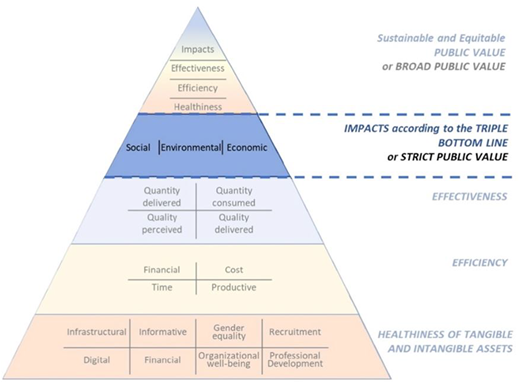
Drawing on the literature review, public value is a multifaceted integration of economic, social and environmental dimensions, which can be created or destroyed for stakeholders (Esposito and Ricci, 2015). Under some conditions, it can turn into public disvalue, compromising the trust-based relationship with citizens (Esposito et al., 2025b). Starting with the pyramidal structure proposed by Deidda Gagliardo (2002, 2015), Deidda Gagliardo et al. (2025) and Papi et al. (2025), Figure 1 presents the theoretical framework as applied under a TBL perspective.
3. Research context
The research focuses on a context characterized by a global market related to museums, historical sites, zoos and parks. This ecosystem includes a wide range of services, such as ticketing, membership, retail, food services, events, educational and digital services, whose overall value (estimated between 91.4 and 103.6 bn USD depending on the methodologies adopted) is supported by the recovery of tourist figures, the proliferation of immersive experiences and the integration of digital solutions. The analysis of pre- and post-pandemic trends reveals a marked contraction in 2020 and 2021, followed by a gradual recovery over the 2022–2024 period, with reported values of 56.6 bn USD in 2022 and 58.2 bn USD in 2023 (UNWTO, 2024).
From a geographical perspective, 2024 underscores the leadership of North America, which accounts for approximately 36% of the global market value, followed by Europe and a rapidly expanding Asian context (The Business Research Company, 2025). This distribution reflects different funding models: a greater reliance on public support in Europe and a more significant role played by philanthropy and sponsorships in the United States. The concentration of demand across major cultural hubs is highlighted by visitor figures at leading international institutions, reaffirming the centrality of Europe and the USA as museum hubs, alongside the increasing strength of Asian institutions.
The Italian context reveals clear signs of post-pandemic recovery, with increased revenues and attendance figures in 2024 compared to 2023, driven by ticketing and ancillary services. This recovery is supported by a mix of public and private funding aimed at innovating both on-site and digital experiences. Between 2011 and 2019, profits from cultural organizations, monuments, archaeological areas and museums in Italy rose from approximately 117 to 242 mln EUR. Profits increased from approximately 53 mln EUR in 2020 to 89 mln EUR in 2021, with a 68% growth rate (The Business Research Company, 2025). In 2024, ticket revenues slightly increased and now represent 34% of total revenue, compared to 33% in 2023 (Osservatorio Innovazione Digitale nei Beni Culturali, 2025). Cultural tourism in Southern Italy accounted for 53% of total tourist flows in 2024 and increased by 4.1% compared to 2023. In particular, the Campania region highlights a substantial level of cultural demand, with approximately 10.5 million tourists, representing 26% of the total recorded in Southern Italy (SRM, 2025). In 2021, the Lazio region recorded the highest number of museum visitors, accounting for approximately 32.1% of the national total, followed by Campania with 24.9% and Tuscany with 15.7%.
Digital services remain a structural challenge: only 41% of the sample considered provides audio guides, of which 71% are free or included in the ticket price, while 29% require the payment of an additional fee (Osservatorio Innovazione Digitale nei Beni Culturali, 2025). Only 31% provide a mobile app, which is either free or included in the ticket price in 92% of cases. Virtual reality (VR) or augmented reality (AR) experiences are available in only 20% of cases and are mostly free or included in the ticket price. The empirical part of this research focuses on Italian cultural organizations due to the outstanding character of the cultural heritage in this country. Italy ranks, in fact, as the country with the highest number of UNESCO World Heritage sites (UNESCO, 2025a), and hosts more than 4.500 museums, archaeological sites, monuments and similar cultural institutions (ISTAT, 2024).
4. Methodology
The research adopts the Framework for Cultural Statistics by UNESCO (2009, p. 24; 2025b) and applies it to the Cultural Heritage sector. The nature of this research is qualitative (Ellinger et al., 2005; Baškarada, 2014; Flick, 2022, 2024).
During the first step, the multiple case study method was employed to examine how and why specific phenomena recur within particular contexts, to allow for the contextualization of general models within site-specific settings (Stake, 2013; Yin, 2009), while also addressing the need for more practice-oriented theory development (Edmondson and McManus, 2007).
As to the second step, an analysis of audited financial statements covering the period 2019–2024 was carried out, in order to extract a set of key economic and financial parameters (e.g. revenues, EBITDA, EBITDA margin, net financial position and equity), which were then standardized for cross-case comparison and econometric assessment.
4.1 Multiple case-studies selection
The authors developed the analysis in a single country (i.e. Italy) to avoid the results being affected by political, cultural and regulatory differences existing across different countries. They did not select the cases to highlight the impact of different national contexts, but rather on the basis of their similarity and peculiarity. In particular, all selected institutions are science-oriented museums with a strong focus on science, technology and innovation, which share a common educational and public engagement mission aimed at promoting scientific literacy among diverse audiences. The decision to analyse multiple case studies enhances data reliability and observational rigour (South et al., 2024). Moreover, a comparative analysis leads to a broader understanding of the subject being investigated, thus enabling the identification of a greater range of potential solutions. Both in the private and in the public sector, a multiple case study methodology “shaped both by the research design (that is, the relationship between objective and method) and by the doing of the research” (Stewart, 2012: p. 73). The selected museums also display a capacity for heritage preservation, scientific research and science-focused activities, experience-based and interactive exhibitions, and the use of digital tools and innovative technologies, working as intermediaries between academia and society. The identification of these case studies is coherent with the logic of the multiple case study methodology because it allows to carry out an in-depth analysis of a number of case studies able to meet the criteria necessary to achieve the research purpose (Yin, 2017; Gustafsson, 2017). The multiple case studies are selected from different geographical areas of Italy to provide a better and more significant sample and are presented in Table 1.
4.1.1 Città della scienza (Naples)
Città della Scienza, managed by Fondazione IDIS – Città della Scienza, is a major science hub located in the Bagnoli district of Naples. The first exhibition spaces opened in 1996; the Foundation, established in 1987 as a non-profit entity, is committed to the promotion of scientific culture, public engagement with science, open collaboration and the cross-contamination across different cultural areas. The site is organized as a multi-functional centre integrating an interactive Science Centre, advanced training facilities, a Business Innovation Centre (BIC), convention and event spaces. The Science Centre, considered the first interactive science museum in Italy, is designed as a place of experimentation, informal learning and dialogic engagement with science and technology. Its pedagogical approach privileges hands-on interactivity and direct experimentation with natural phenomena and technological systems, this way facilitating experiential learning across different age groups. Within the complex, Corporea is structured around thematic islands that focus on different bodily systems, offering several interactive stations, open laboratories and other activities that allow visitors to investigate health-related phenomena and biomedical technologies. The 3D Planetarium operates as a three-dimensional sky simulator, supporting astronomy learning through scientific shows and curriculum-related programming in astrophysics and space technology. The D.RE.A.M. FabLab works as a laboratory devoted to research, experimentation and technical training in digital manufacturing and making-oriented practices, while the Business Innovation Centre provides incubation services and specialized facilities aimed at supporting the development of new projects and enterprises. The on-site congress centre hosts conferences, professional events and large-scale public programs.
4.1.2 Galileo Museum (Firenze)
The Istituto e Museo di Storia della Scienza Galileo is a specialized research and exhibition institution that hosts one of the most important collections in the world of scientific instruments, historic telescopes and archive material illustrating the development of early modern science. Established from the institutional legacy of Istituto e Museo di S. della Scienza, the museum is located in Palazzo Castellani and is both a centre for academic research on science history and an active public museum. Its permanent collection includes over one thousand instruments and an extensive documentary and library corpus, while its educational output is based on a prolific program of learning activities, workshops and public events. In 2024, the museum reported visitor and participation figures that confirm its strong national and international profile. The curatorial practice of the Galileo Museum focuses on object-based scholarship, conservation-led display and teaching events. The institution aims at increasing its online presence and improving the quality of its international research partnerships, positioning itself as a node between academic research, heritage preservation and public outreach.
4.1.3 Leonardo da Vinci museum (Milano)
The Museo Nazionale della Scienza e della Tecnologia Leonardo da Vinci is the largest cultural organization devoted in Italy to the history of science and technology, and one of the foremost technical and scientific museums in Europe. Housed in the historic complex of San Vittore al Corpo, the museum boasts an exhibition area of approximately 50,000 m2 and combines extensive historical collections with interactive learning stations and specialized laboratories. The museum permanent display covers a broad spectrum of domains (from transport and energy to telecommunications, space and particle physics) and include the largest and most significant array of machine models built from drawings by Leonardo. Its research and educational infrastructure include a large library and archives, a centre for informal learning (CREI), and a range of laboratories and outreach programs aimed at schools, families and specialist audiences. In recent years, the museum has set for itself a hybrid mission that combines conservation and scholarship with experience-based public engagement, research activities and corporate partnerships. Its operational model relies on a mixed funding base, which includes institutional support, project-based income, ticketing and commercial activities, all of which allows viable year-on-year planning and asset management.
4.1.4 MUSE (Trento)
Museo delle Scienze (MUSE) is a science and natural history museum devised as a research-oriented public institution, with a territorial system of sites scattered across the Trentino region. Opened in 2013 in its present headquarters designed by Renzo Piano, MUSE integrates research departments, laboratories, learning activities and extensive exhibition spaces that emphasize ecology, biodiversity and the man–environment interaction, with a specific focus on mountain ecosystems and Alpine research. The cultural organization operates according to a museum/laboratory model that links scientific research, environmental monitoring and educational programs, while managing a network of territorial sites, field stations and outreach projects across the province. From a financial point of view, MUSE combines public funding, project revenue and philanthropic support to run research projects, temporary exhibitions and long-term educational programs. In 2024, the MUSE system recorded consolidated visit volumes in the mid-hundreds of thousands, due to both local engagement and national tourism flows. Under its current strategic orientation, the institution prioritizes research integration, territorial impact and inclusive access, while expanding its range of collaborations with universities, research centres and international partners to boost its role as a hub for science communication and sustainable education.
4.2 Data collection
In line with the observations by Yin (2009) and Stake (2013), a mixed-methodology approach was employed in this study, while all the relevant data were collected through secondary sources. The advantage is the development of convergence among lines of inquiry, specifically via a process of triangulation (Yin, 2003). The findings obtained through the multiple case studies methodology are more convincing and accurate if based on different sources of information, following the method of mutual confirmation. As a result, the potential bias was mitigated by expanding the information base and diversifying the data (Patton, 2002).
In order to facilitate comparative analysis, the authors divided the study into four standardized sections to harmonize the assessment across cases: Core Offer, Education Activities, Competitor Museums and Space and Key Economic-Financial Indicators (e.g. EBITDA margin, Net Financial Position ratio, Equity). The EBITDA and the Net Financial Position were subsequently standardized using financial ratios, according to recent accounting and management literature (Hodsoll, 1998; Hausmann, 2007; Ellwood and Greenwood, 2016).
4.3 Validity and reliability of data
Data were initially aggregated and then subjected to triangulation. More specifically, the triangulation technique gives greater credibility, accuracy and validity to the results of qualitative research (Bans-Akutey and Tiimub, 2021). In fact, analysing multiple sources makes it possible to measure the same phenomenon in different ways, thereby increasing the value of the results obtained. Indeed, triangulation is to qualitative research the equivalent of the reliability tests performed in quantitative research (Modell, 2005; Jonsen and Jehn, 2009; Creswell and Creswell, 2017).
In order to properly run a case study, Patton (2014) has identified four types of triangulations. More specifically, these four typologies concern the triangulation of data sources, methods and perspectives on the same dataset, as well as between different evaluators. Triangulation of data sources and methods was performed for the purposes of this study. Firstly, multiple data sources were cross-referenced, including direct observations and a review of documents and digital information provided on the website and social media platforms of the museum being analysed. This approach allowed a thorough comparison of data, thus facilitating a comprehensive understanding of the phenomenon and enhancing the reliability and credibility of the findings from different sources. Secondly, methodological triangulation, which combines various data collection techniques, was employed to mitigate the limitations inevitably related to individual methods and therefore ensure a more refined dataset. This dual approach contributed to a well-rounded and robust analysis of the multiple case studies considered.
4.4 Data analysis
Data analysis enables researchers to capture and understand the true meaning of the information collected (Creswell and Poth, 2016). Since the data collected are of a qualitative nature, it is necessary to adopt an approach that considers the Grounded Theory (Charmaz, 2006). This theory enables the identification of key points that will later be transformed into codes (Bryant and Charmaz, 2011). Then, it is necessary to collect the selected codes in order to identify the concepts that make the gathered data useable. Finally, starting from the concepts, it is necessary to form categories by fundamentals in order to formulate and discuss the results.
This approach was implemented based on previous studies on the subject (Strauss and Corbin, 1998; Yin, 2009). At the end of this process, the data analysis was divided into three phases: cross-analysis of the raw data, extrapolation of themes from the raw data and finally interpretation of the data. In the first phase, the raw data were analysed to understand and evaluate the phenomenon. Preliminary conclusions were thus obtained, which led to the exclusion of unnecessary data with relation to the research question being addressed. The second phase involved encoding the data through identification, naming, extrapolation and classification. Data were classified here according to the source. Finally, the third phase involved interpreting the data to assess their relevance with regards to the aims of this study.
5. Findings and discussion
This section provides a comprehensive analysis of public value according to the TBL framework, examining the economic, social and environmental dimensions generated by Città della Scienza (Naples), Museo Nazionale della Scienza e della Tecnologia Leonardo da Vinci (Milan), Galileo Museum (Florence) and MUSE (Trento). The study presents specific, measurable indicators for each dimension, while underscoring how institutional performance can help promote sustainable tourism (Esposito and Tufo, 2025).
5.1 Measuring public value: the economic dimension
Economic variables influence the ability of cultural organizations to create or destroy public value. As illustrated in Table 2, economic metrics such as the EBITDA margin and the net financial position ratio, underscore different performances across the four museums. The analysis of the institutions involved reveals marked differences in terms of financial stability and operational efficiency, which directly impact their capacity to pursue their institutional missions and to meet stakeholder expectations.
Città della Scienza exhibits fluctuating results, peaking in 2023 with an EBITDA margin of 35.25%, followed by a sharp drop to 13.63% in 2024. Nevertheless, this institution boasts an EBITDA margin in excess of 20%, a level broadly comparable to (or higher than) that observed among its peers within the sample chosen. In the same year, Città della Scienza reported a larger equity base and a higher level of debt compared to its competitors. These are signs of a complex economic profile, where relatively strong operating performance coexists with high structural debt and the progressive erosion of equity, which may limit long-term economic resilience.
The Galileo Museum operates on a smaller scale, while also displaying greater financial weakness. Although it achieved a positive EBITDA in 2023 (30%), it experienced losses in 2021 and has recorded limited equity and negative net financial positions over several years. This inevitably limits strategic flexibility and the possibility to provide socially valuable programs.
The Leonardo Da Vinci Museum stands out as the most financially robust case. In 2024, it recorded over €15.5 million in revenues and maintained an EBITDA margin of 29.2%, with consistently high margins (over 30%) from 2020 to 2023. In 2022, the Leonardo da Vinci Museum registered a better economic performance compared to its other competitors from the sample. This financial solidity enables the cultural organization to reinvest in infrastructure, technological innovation and educational services, reinforcing its dual role as a cultural organization and a driver of sustainable tourism.
MUSE also displays a stable economic profile, with EBITDA margins between 20 and 34% over the six-year period analysed. Revenues remained relatively steady, with a slight decrease in 2024 to approximately €12 million. A balanced financial structure, supported by a combination of public and project-based funding, makes it possible to promote educational and research activities with clear public value outcomes.
In this competitive landscape, economic performance becomes a vehicle to institutional agility and adaptive capacity. Museums with sustained profitability and balanced capital structures are better positioned to generate long-term public value through strategic investment and adaptive planning. Institutions with financial instability may struggle to pursue their public missions, particularly in times of uncertainty or exogenous stress.
5.2 Measuring public value: the social dimension
The social dimension of public value originates from a museum's ability to promote inclusion, education, identity and civic participation. Across the cases examined, variations emerge in terms of human capital development, educational programming and stakeholder engagement strategies through social accountability.
Città della Scienza, while traditionally strong in social engagement and STEM-focused outreach, experienced a staff reduction from 93 to 73 between 2023 and 2024. The institutional business model is organized into five operational units whose main goals are the dissemination of scientific culture, the promotion of industrial regeneration in Southern Italy and the creation of a bridge between the academic world and the labour market. This configuration supports a hybrid value proposition combining public engagement, education, innovation, incubation and revenue diversification. Despite the workforce contraction, this structural model allows Città della Scienza to maintain a high degree of social relevance and to support regional development goals through science education and professional training.
The Galileo Museum maintains a relatively stable workforce, slightly increasing from 50 to 56 staff between 2021 and 2024. Its educational approach, based on experiential learning and historical interpretation, targets specific stakeholders, so it may lack the breadth and adaptability observed in larger institutions.
The Leonardo Da Vinci Museum reports the largest increase in personnel, from 129 staff members in 2021 to 174 in 2024. This growth supports the development of interactive exhibits, digital art installations and experimental programmes focused on contemporary themes such as AI. The institution exploits its scale and reputation to reach a diverse audience and to foster active learning experiences.
MUSE also exhibits an upward trend in staffing, growing from 89 to 127 employees between 2021 and 2024. Its decentralized institutional model enables the delivery of education and outreach across the Trentino region. Programmes are oriented towards civic education, environmental awareness and innovation, aligning with regional needs.
Table 3 synthesizes the main elements of the value proposition, workforce evolution and social accountability over time for each museum, offering insight into how institutions invest in human capital and foster inclusive stakeholder engagement.
Overall, institutions that invest in human capital and inclusive educational programmes are more likely to foster social value and enhance their reputation within the community. Conversely, reductions in staff and/or outreach capacity may lead to lower levels of social relevance and public trust.
5.3 Measuring public value: the environmental dimension
Environmental considerations have become a critical component in the measurement of public value, particularly within the domains of sustainable tourism and responsible cultural management. The case studies examined explore different degrees of integration of environmental objectives in both their operational practices and mission-driven programming. Table 4 details the physical footprint and competitive context of each institution.
Città della Scienza, with the largest exhibition area in the sample at 65,000 square metres, is located within an urban redevelopment zone in Naples. While the museum events cover science and innovation, there is limited evidence of a strong environmental orientation in its institutional strategy.
The Galileo Museum, with a more compact area of 5,000 square metres, is located within the bustling urban core of Florence. While its environmental footprint is naturally lower, the institution lacks a visible agenda on sustainability, which could limit its contribution to the broader environmental dimension of public value.
The Leonardo Da Vinci Museum, covering 50,000 square metres, focuses primarily on technological history and innovation. Although the physical infrastructure offers opportunities for sustainable operations and energy-efficient design, environmental considerations remain secondary in its core offerings (Esposito et al., 2025a).
MUSE presents the most explicit integration of environmental sustainability into its institutional mandate. Its programmes focus on biodiversity, ecology and the human–nature relationship, with a particular emphasis on Alpine and mountain ecosystems.
Larger sites, such as Città della Scienza and Leonardo da Vinci Museum, can diversify their environmental programs (e.g. green labs, outdoor exhibitions), but they also face higher energy and maintenance costs. Conversely, smaller sites, like Galileo Museum, benefit from lower energy intensity per square metre but have fewer opportunities to expand their sustainable projects.
6. Conclusions
6.1 Research implications
The study contributes to the literature on public value measurement according to the TBL approach. Although Yocco et al. (2009) measure public value through the analysis of individual, social and economic factors, this study introduces the environmental dimension, which had been largely overlooked by previous literature.
The multi-case study analysis reveals that financially resilient museums can allocate greater resources to social and environmental programmes, thus positively impacting public value. By contrast, institutions with narrow economic margins struggle to support an inclusive educational offering and environmental innovations, creating potential trade-offs between TBL dimensions. In order to answer the research question “How to measure public value in museums according to the TBL approach?”, the authors propose indicators and metrics tailored to the economic, social and environmental domains. This framework advances the measurement of public value, supporting evidence-based policy and management decisions for sustainable tourism.
The findings substantiate and extend Scott (2006) tripartite model by evidencing that economic and social factors, although essential, are insufficient to fully encapsulate public value without considering the environmental dimension at the same time. Moreover, this study corroborates the importance of inclusive stakeholder participation and community involvement as emphasized by Ebbers et al. (2021) and Kershaw et al. (2020), underscoring their key role in the achievement of institutional legitimacy and adaptive capacity. Therefore, this research bridges theoretical frameworks with empirical insights, providing a nuanced understanding of the multifaceted and evolving nature of public value with relation to cultural organizations.
6.2 Practical implications
The data spanning from 2019 to 2024 explored the significant impact of the COVID-19 pandemic on the capacity of museums to create or destroy public value. The pandemic represented a structural shock that disrupted revenue streams, workforce stability and stakeholder engagement. These findings directly connect theory to practice, exploring how TBL principles help analyse public value dynamics in actual museum management.
From an economic and financial perspective, institutions such as MUSE and Museo Nazionale della Scienza e della Tecnologia Leonardo da Vinci restored and even exceeded their pre-pandemic revenue levels by 2023 and 2024 while preserving strong EBITDA margins and stable equity. By contrast, Città della Scienza and Galileo Museum displayed prolonged volatility in key financial indicators and, in some cases, a marked decline in equity. These divergent recovery paths highlight the need for performance monitoring systems that integrate equity-to-asset ratios (Vignieri and Santoni, 2026), net financial leverage ratios and traditional profitability measures. Such systems “capture the economic value generated by the production and dissemination of digital content” (Bertacchini and Morando, 2013). They also help ensure that reinvestment in social and environmental programmes does not undermine long-term financial viability, innovation capacity or the institution's public mission.
From a social standpoint, cultural organizations endowed with robust economic foundations expanded their human capital and diversified educational offering to address evolving social needs (Bryson et al., 2017). Both the Leonardo da Vinci Museum and MUSE increased staffing levels and introduced new pedagogical formats, thereby enhancing inclusion and community engagement. On the other hand, a workforce reduction, such as that observed at Città della Scienza between 2023 and 2024, may compromise the capacity to attract broad participation and to contribute to regional development targets. The various forms of social accountability reporting reveal the constraints cultural organizations often meet when engaging in more complex and collaborative activities, which require a clear and systematic definition of the social value they generate.
As to the environmental angle, although increasingly central in cultural policy discourse, it remains only partially integrated into the strategies of the museums analysed. With the exception of MUSE, the other cultural organizations maintain a limited alignment between operational practices and environmental targets.
Findings indicate that achieving a balanced performance in financial, social and environmental dimensions supports sustainable tourism.
6.3 Limitations and future research
The present study has some limitations. Firstly, the focus on a limited sample of four Italian museums limits the extension of the findings to different institutional and geographic contexts. Secondly, the limited availability of data calls for a deeper investigation into the factors that underpin the public plus-value (Bryson et al., 2014) or disvalue (Esposito et al., 2025c). Thirdly, although the metrics used for the TBL dimensions were not easily extracted due to the complexity of these organizations, including that of their accounting systems, it was decided not to increase excessively the number of measures to be considered, in order to avoid overextending the findings beyond the scope of the study itself.
Future investigations should aim to extend comparative analyses across international samples and adopt mixed-method approaches to deepen the insight into stakeholder perceptions, governance practices and interactions between museums and their communities. Furthermore, a survey engaging the different stakeholders who create or destroy public value (in a context characterized by digital transformation, demographic change and polycrises in general) should be developed.