The aim of this Special Issue is to explore how to manage the tension between social mission and economic value in a sharing economy. Six feature articles emphasize the value creation innovation model and the paradox of social innovation legitimacy, and the motivation for participation in social value creation. Based on the unity of opposites between means and ends, we propose an internal transformation mechanism and a process model for economic and social value, so as to investigate the positive effects of a sharing economy on the transformation of the dual values. We review six articles and briefly introduced their contributions to the new value model, legitimacy, and participation willingness in a sharing economy. Finally, we put forward some future research directions, e.g. new social problems that may arise from a sharing economy.
Introduction
With the continuation of the coronavirus disease 2019 (COVID-19) pandemic, hybrid organizations, such as social enterprises (SEs), are having a difficult time surviving, and there is a decline in the ability to solve social problems. To improve the viability of hybrid organizations and creatively solve increasingly complex social problems, it is necessary to manage the “means-ends” relationship between the economic and social goals of hybrid organizations. A sharing economy provides new thinking for the unity of “means-ends” because the symbiosis concept of a sharing economy offers an effective operating mechanism for the duality of innovative market economy means and social goals (Roh, 2016). For example, the ownership in a sharing economy is split into eminent domain and use rights, which has altered people's thinking of private property rights and fostered social cooperation and sense of integrity (Böcker and Meelen, 2017). Furthermore, the zero marginal cost society of a sharing economy provides effective micro-mechanisms for new types of organization, such as hybrid organizations (Rifkin, 2014). A sharing economy also provides a platform for the extensive interaction and participation of social micro-subjects; therefore, it can provide new theoretical and practical foundations for realizing both economic and social value.
However, the existing literature has focused on the case study and theoretical construction of new paradigms of a sharing economy and has investigated social innovation and entrepreneurship in a sharing economy mainly from two aspects. The first is based on resources and environmental protection goals, e.g. introducing successful models such as Didi, Airbnb, Uber, etc. through case studies, emphasizing the sharing mechanism of a sharing economy on social environmental protection and resource conservation, for which theories including the theory of bilateral market, the resource-based view and ecology, etc. have become the main interpretation theories (Battino and Lampreu, 2019; Böcker and Meelen, 2017; Grinevich et al., 2019; Lan et al., 2017). The second is to emphasize how social subjects, including disadvantaged groups, participate in social governance and thus enhance the social participation capabilities of socially disadvantaged groups, e.g. analysing the consumers' value co-creation mode and how the disadvantaged can participate in community governance, etc. (Böcker and Meelen, 2017), based on a variety of theories, such as the value co-creation theory, the theory of planned behaviour, the innovation diffusion theory, the motive theory, the theory of social interaction and participation in governance, etc. (Ma et al., 2019)
It is necessary for theoretical studies to further examine solution modes of a sharing economy that focus on social issues and how to promote social innovation and entrepreneurship by means of sharing values and concepts to verify the relationship between social innovation and social value creation and understand various problems, such as how social innovation and entrepreneurship and sharing values and concepts can realize interactive promotion. Thus, it is necessary to explore how we can break through the conceptual limitations of the “means-ends” relationship in the economy and society, so as to not only improve the survival ability of social organizations but also prompt enterprises and organizations to return to their essential attributes: social subjects. Among them, how enterprises, as major social subjects, integrate into the grand social system to maintain the economy–society duality balance (Stubbs, 2017) within a reasonable level of tension is becoming a focus in the theoretical study of sharing economies.
In this paper and the Special Issue as a whole, we aim to deepen our understanding of how social value is created in a sharing economy. Furthermore, we identify the “means-ends” relationship and theoretical mechanisms leading to economic and social value in sharing economies. Our discussion not only provides a deeper insight into this ambidextrous paradox but, likewise, links them to and highlights the contributions of the six subsequent papers included in this Special Issue. Finally, we conclude by suggesting several avenues for further research.
1. Social value creation in a sharing economy
1.1 Social value realization in a sharing economy
Creating social value has become a hot topic in theoretical studies in recent years. It is generally believed that social value is created “by catalyzing social change and/or catering to social needs” (Mair and Marti, 2006). Zahra et al. suggested clarifying the meaning of social value creation by integrating “insights from research on organizational effectiveness” (Zahra et al., 2009). Along with this thinking, we analyse the specific social value creation processes and benefits from the perspectives of public sector organizations, for-profit organizations and nonprofit organizations. First, public sectors or public management studies attach much importance to social public needs, such as education and medical care. This social value is the actual benefits of an organization's goal after subtracting the costs involved in the process (Kelly et al., 2002). Relevant studies emphasize the value and importance of collective decision-making and argue that as long as such collective decision-making or social goals can be achieved, it is as good as having achieved social value (Quin, 2017). Second, nonprofit organizations engage in voluntary public welfare or mutual assistance activities, which can make up for the shortcomings of the government and other public departments and help them provide more effective social services to meet social needs while creating social value. However, the above two public sectors have no stable ways to generate revenue and rely on the economic system. Therefore, the social value creation function of enterprises and other for-profit organizations is important. This type of organization, aiming to maximize economic value, mostly focuses on the surplus of producers and consumers. Traditional for-profit organizations are criticized for not caring about the demands of other stakeholders (Freeman et al., 2007), and the corporate social responsibility (CSR) movement has strengthened enterprises' attention to social value (Jay, 2013). Corporate social performance (CSP) or social influence (Margolis and Walsh, 2003) and the role of positive external elements, such as value transfer in the process of solving social problems, have been emphasized (Santos, 2012). Theoretical studies based on the concept of sustainable development have addressed the issue through paradigms of active social changes, such as CSR, the bottom of the pyramid (BoP) and SE (Mair et al., 2016; Zahra and Wright, 2016).
Therefore, increasingly more organizations are beginning to pay attention to economic value and social value simultaneously. Dual economic and social goals are becoming a major problem in the management of public departments, for-profit organizations and nonprofit organizations. From the perspective of organizational strategy management, some studies focus on various concepts, such as blend value (Emerson, 2003), shared value (Porter and Kramer, 2011), inclusive growth (George et al., 2012), organizational duality (Lubatkin et al., 2006) and hybrid organization (Battilana and Lee, 2014). There have been three research perspectives in theoretical studies, i.e. instrumental logic, integration view and paradox. First, from the perspective of instrumental logic, the exchange theory advocates a trade-off between the two major value goals, while the win-win theory advocates that enterprises can profit in assuming social responsibilities by eliminating or mitigating the tension between value goals. Second, the integration view attempts to go beyond instrumental logic, hoping to simultaneously achieve related goals by balancing different demands (Gao and Bansal, 2013). However, it often only stalls on the concept due to the complex problems involved in the system, to which effective countermeasures lack (Hahn et al., 2018). Last, according to the organizational paradox theory, in theoretical studies, we must first recognize that these two value goals have long existed in enterprises and are interrelated and contradictory. Therefore, the paradox theory advocates treating the tension of contradiction as an organizational opportunity and finding innovative ways to solve complex problems, such as sustainable development, through the exploration of the relationship between the relevant elements of the contradiction (Hahn et al., 2018; Smith and Lewis, 2011), which is becoming the focus of theoretical studies.
As a new economic mode, a sharing economy can innovatively look at the paradoxical relationship between economic–social values and enterprises and society and thus provide new insights for an in-depth understanding of the essence of the enterprise–society interaction. Instrumental CSR regards social value as a means, and the goal is to increase capital, while traditional social entrepreneurship defines the economy–society relationship as a simple means-ends relationship, which is nothing but another extreme of instrumental CSR. In fact, the economy–society relationship is not a simple means-ends or ends-means relationship, and society should not implement instrumental positioning regarding an enterprise's value creation while the enterprise itself also should not implement instrumental positioning regarding participation in solving social problems. Both enterprises and society should pay more attention to the rational return to values. From a philosophical point of view, any practical activity is the unity of ends and means instrumentality. The ends always reflect the needs of a certain material life or spiritual life and define the direction of the means; means/instrument are the practical conditions for realizing ends and are also the practical force ensuring that the ends can be realized. Therefore, both pure instrumental rationality and pure value rationality are not self-sufficient and cannot solely stipulate or realize the overall nature of the enterprise–society interaction (Hong-Jun, 2020). The unity of opposites between ends and means is essentially the unity of subjective will and objective laws, requiring us to act according to laws, so that the formation of the ends and realizing the means conform to the laws. A sharing economy represents the development trend of social economic relations, provides realistic conditions and new forces for the creation and realization of economic value and social value (Ma et al., 2019) and conforms to the nature and laws of the economy–society interaction.
The sharing economy mode can effectively combine market means and social value to achieve the unity of opposites of means and ends of economic and social relations. Therefore, the organizational symbiosis ecosystem of a sharing economy provides an effective operating mechanism and other micro-foundations for social innovation and entrepreneurship. Specifically, first, the idea of symbiosis in a sharing economy transcends the traditional logic with competition as the core and argues that in terms of value, collaborative sharing or sharing is possible, which is a new transcendence of the cognition of value categories, i.e. the value preferences of different value subjects are multi-dimensional rather than mono-dimensional and usually include economic, social and environmental value preferences. Based on this, business organizations can integrate the efficiency principle of market logic with the ethical principle of social logic to realize the dynamic interaction and balance of the dual logics of an organization (Sabadoz, 2011) and form the relatively balanced region and symbiotic space of dual-system logic. Second, the zero marginal cost of a sharing economy means that enterprises' various production resources can be re-allocated, while their zero or close to zero marginal cost can also generate great social marginal benefits (Rifkin, 2014). For example, the emergence of new types of corporate organizations, such as new platform-based enterprises and benefit corporations (B-corps), can not only save social resources but also focus on social value, allowing more social entities to share value and gain benefits. Finally, the interactive participation of all subjects provides new possibilities for social innovation. A sharing economy can mobilize multiple actors throughout society, including consumers, employees and other idle resource subjects, to create value jointly (Lamberton and Rose, 2012). On the one hand, this multi-party participation establishes a broad foundation for innovation initiatives, and on the other hand, it also provides an innovative mechanism for equal participation. Because joint participation in a sharing economy must be realized with the help of non-economic factors, such as social relations, informal behaviour constraints of social norms and honesty and reciprocity, social norms and market rules have become the principles of economic exchange and consumption. Therefore, the interaction mechanism in a sharing economy manifests as a coordinated behaviour. These rules, which have informal execution mechanisms and reciprocal mechanisms and reflect collective and social needs, are the social innovation foundation of the economic system.
1.2 Dual-value realization mode in sharing economy development
Building on the prior literature about the relationship of social value and economic value and on our discussion above on the relationship of the two subjects in a sharing economy, we now propose an integrative theoretical framework for the relationship between the organizational model and the development model. In Figure 1, we identify the transformation process of the means-ends relationship of the economic and social relations during the evolution of the social economic development model.
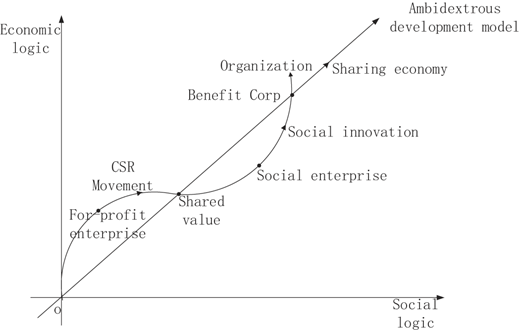
As shown in Figure 1, the abscissa axis represents social logic and social value goals, and the ordinate axis represents economic logic and economic value goals; the 45° straight line represents the balance of social value and economic value in different economic development models, which is a unity of ends and means instrumentality; organizational evolution, especially an organization's value proposition and other business models, is represented by the curves, i.e. the organizational models of economic and social value creation. From the perspective of a dynamic process, point O means that economic value and social value are zero, i.e. an individual social model in self-sufficiency or with no market exchange, which is the primitive value model of human society, in which human activities are mainly for survival and the development of individuals. Therefore, point O is also the starting point of economic development and the primitive mode of social organization. The survival and interaction of humans prompt the germination and development of market exchange, i.e. economic transactions can efficiently solve the needs of human survival and security; therefore, the profit-seeking-based for-profit organizations are the first to develop rapidly. Market exchange first meets the value goals, such as individual survival, while the overall value of society is not valued and thus a relatively low priority. In the commodity economy model in which capital seeks profits, economic goals are highly regarded and maximized. While the economy prospers, various problems, such as the ecological environment and social carrying capacity, can emerge. When social and environmental issues become increasingly dire, theoretical models, such as the CSR movement, the BoP theory and the stakeholder theory, have become key concepts for the sustainable development of corporate organizations. These theories emphasize social value and attach importance to solving conflicts that often arise between business operations of enterprises and the healthy development of society. For example, Porter (2011) put forward the concept of shared value (Porter and Kramer, 2011) and proposed a new definition for corporate purpose (McManus, 2019).
To solve social problems, traditional social organizations have developed rapidly. To promote the survival of social organizations and achieve, to a greater extent, social welfare, some people innovatively propose social entrepreneurship and advocate solving social problems through economic means, and SEs have been developed rapidly as a hybrid organizations (Battilana and Lee, 2014). From an individual economy to a sharing economy, especially with the further development of the latter, innovative solution models for social problems are constantly promoted, providing a foundation for the paradoxical development of the dual goals of economy and society and breaks through the development model in which economy and society compete. B-corps, as new organizational forms that combine profitability with social responsibility and traditional corporate characteristics with social responsibility, have been favoured by enterprises and social organizations (Emerson, 2003). New forms emerging in the development of a sharing economy (e.g. B-corps) are breakthroughs in transitioning individual goals to social goals, representing advanced forms of the unity of the opposites of means and ends. At the advanced stage of a sharing economy, social resources and social value can be widely shared, and the corresponding needs can be quickly converted and realized. In the future, society can develop to an even higher level of economic scale or means, in which diverse value goals can be created and fairly distributed.
Value sharing and B-corps represent the unity of means/instrumentality and ends. The curve above the straight line in Figure 1 represents the economic benefit aspect in the process of organizational development, in which organizational development is regarded as an effective instrument capable of solving people's basic needs, such as survival, manifesting as the instrumentality of human economic activities. The curve below the straight line represents social development or the social value in human activities, manifesting as the social purposiveness of organizational development. Purposiveness and instrumentality are mutually promoting and uniting (the intersection of the curve and the straight line is the uniting point of purposiveness and instrumentality). First, instrumentality promotes purposiveness, and instrumental means is the actual force that guarantees the realization of the purpose. Human activities regard corporate organizations as an instrument to obtain performance growth and profits, but in this process, social development goals are also achieved, manifesting as a win-win in the economy and society. Therefore, from the perspective of social development, corporate organizations can be regarded as “the instrument of the ends”. Second, purposiveness can also promote the realization of instrumentality and is the basis of a higher form of instrumentality, while social development provides realistic soil for enterprise organizations. Last, from a dynamic perspective, the short-term goals of society, such as survival and security, are tools for long-term goals, such as shared value and B-corps, manifesting as “the instrument as the tool”. Therefore, organizational development is the unity of “the instrument as the ends” and “the instrument as the tools”, with a relationship of unity of opposites, which can be mutually transformed. Obviously, this dual-unity feature (the spiralling upward curve in Figure 1) is beneficial for avoiding the emergence of corporate de-embedding (i.e. for-profit organizations are obsessive on instrumentality), and social responsibility (i.e. social organizations excessively emphasize on purposiveness) can solve not only the coexistence of high economic growth and environmental damage but also the problems of social stability and poverty, thereby serving as an effective strategy and guarantee for the long-term dynamic balance of economy and society.
In short, a sharing economy is transcended from an individual private economy, representing a transformation from low-quality balance to high-quality balance. Its core driving force is entrepreneurship and social change and innovation. On the one hand, entrepreneurship promotes social change, and social entrepreneurship can help disadvantaged groups in society fight for more benefits and form a stable new balanced ecology; on the other hand, a sharing economy provides a new platform and means to realize the common goal of society, including economic, environmental and social goals, promoting social change and development.
2. The innovation of social value creation
Social innovation and entrepreneurship in a sharing economy provides an effective innovation model for the unity of opposites and the mutual transformation of the dual goals of economic value and social value. Figure 1 focuses on social innovation and entrepreneurship in the development of a sharing economy and is a theoretical model based on the existing literature and the six articles in this Special Issue. Focusing on the core topic of social value and its creation methods in a sharing economy, this Special Issue addresses three topics: (1) the value innovation model in a sharing economy and how to create social value innovatively; (2) the breakthrough of a sharing economy on the legitimacy paradox of social innovation and entrepreneurship and how SEs break legitimacy dilemmas in dual-value goals and (3) social value creation motivation and mechanism innovation, the roles of altruistic factors and situational factors in social entrepreneurship, specific social value creation models and the realization of the dual goal mechanism in SEs.
2.1 Value innovation models in a sharing economy
How is social value created innovatively? Traditional economic models lack the balance of and attention to economic value and social value. The sharing economy model is an innovative economic development model, changes the concept of property rights in the traditional economic sense and the consumption concepts of consumers, and creates more value through the reuse or full use of idle resources. A sharing economy can increase consumer surplus, expand public demand for products and thus create more value for producers, thereby achieving value co-creation. Therefore, value creation is no longer a single-dimensional static process led by enterprises but a multi-dimensional and ecological co-creation process. Moreover, a sharing economy can accelerate the frequency of resource circulation through the Internet and realize value creation with low transaction costs and more efficient resource allocation, thus enhancing the overall welfare of consumers and society and promoting economic and social development (Martin et al., 2015). With the emergence of Internet platforms, sharing platforms facilitate all-round interactions among subjects to jointly create value and thus innovate the value creation model, i.e. the platform business model, of which the interactivity and the procedural nature in the internet platforms realize the co-creation and win-win of economic value and social value (Selloni, 2018).
Specifically, through three value creation steps, i.e. integrating resources, matching supply and demand, and driving co-creation, the sharing platform creates economic value for an organization; in the sharing platform system, each participating subject in a sharing economy benefits from the social interaction, entertainment, self-management and innovation supported by the platform. Moreover, this all-party act contributes to other economic entities and thus achieves the effective use of social resources while prompting industry transformation and social progress and creating social value. Social innovation is not an isolated process; it can be constructive, utilized by multiple parties or destructive. Next, we introduce disruptive innovation first in this Special Issue and then constructive innovation and other value innovation models of business.
A sharing economy and disruptive innovation jointly promote social innovation and realize the dual economy–society value. Both a sharing economy and disruptive innovation focus on low-end segments of the mainstream markets or nonconsumers of mainstream products and services. Both a sharing economy and disruptive innovation reduce transaction costs. A sharing economy proposes new and highly flexible business models to acquire idle resources at very low costs (Widtfeldt Meged and Zillinger, 2018). Many projects in a sharing economy are in line with the characteristics of disruptive innovation and therefore can be regarded as disruptive innovation projects (Dogru et al., 2019).
The article by Si, Chen, Liu and Yan (part of this Special Issue) focuses on disruptive innovation and a sharing economy. Built on the literature above, they adopt the case of bike sharing in China as an example of a disruptive innovation-based sharing business model that aims to create and deliver both economic and social value. This sharing business model case represents a type of social innovation with the duality of a sharing economy and disruptive innovation. This duality adds to the complexity of the case and makes the research more comprehensive, which can help us to better understand how disruptive innovation-based business projects create, deliver and capture value in a sharing economy and to learn lessons from the failure of some bike-sharing companies in China.
The creation and acquisition of dual-value goals in the era of a sharing economy requires business model innovation, and an SE is an organization type and sustainable business model that tightly combines corporate business model innovation with social innovation. The most prominent feature of SEs is innovation. On the one hand, unlike traditional nonprofit organizations, SEs must continue to innovate and find market space; on the other hand, they must provide services that are needed, but often lacking, by society or certain groups and thus need to be produced and serviced innovatively by social entrepreneurs (Martin and Osberg, 2007). Under the conditions of a sharing economy, the core logic of SEs is to drive the operation of the value co-creation logic loop through internal and external factors in the industry, thereby promoting innovation in the value co-creation business model. Different business models differ in degree of innovation and performance. Moreover, there are inherent legitimacy paradoxes in innovation and entrepreneurship (Suddaby et al., 2018), which are often coupled with the paradox of economic value and social value of social entrepreneurship, under which the performance of business model innovation by SEs needs to be analysed and verified by considering specific social situations.
The article by Wang and Zhou (also part of this Special Issue) focuses on how business model innovation and legitimacy affect the performance of new SEs during different development stages. They find that during the first stage (start-up stage), social entrepreneurial organizations do not easily obtain legitimacy, especially normal legitimacy. SEs should focus on changing traditional operating methods by innovating their organizational routines. In the second stage (early growth stage), SEs should integrate social elements into their economic activities and promote responsible consumption by satisfying the pursuit of value by its social consumers. Moreover, SEs should also consider the expectations and demands of different stakeholders to promote the participation of and cooperation between interested parties. Therefore, SEs in the early growth stage should emphasize the value of organizational routine innovation by focusing on careful resource allocation and their continuous innovation ability. This will lead to a multi-win value-sharing situation while allowing the enterprise to obtain legitimacy resources through business model innovation to promote the development of its innovation activities.
2.2 A sharing economy's breakthrough on the legitimacy paradox of social innovation
Social entrepreneurs support, participate in, and implement various social innovations previously unknown to the public. Establishing a new enterprise or organization requires matching the norms, values, beliefs and definitions of social construction. Therefore, the legitimacy and appropriateness of social innovation should be widely recognized by society. The paradox of legitimacy commonly occurs with social innovation and entrepreneurship because innovation implies low public recognition and acceptance. For example, CSR, as a social innovation concept, has not been readily accepted by many companies, and the adoption of CSR standards is basically voluntary, lacking legitimacy and a strong compliance mechanism, causing traditional CSR to always be in a legitimacy dilemma. In another example, when GE's (General Electric Company) relations with the government and the public became very tense, the company put forward the “Ecomagination” innovation strategy, hoping to alleviate and eliminate this tension and obtain the recognition of the government and the public. However, this strategy caused doubt in internal shareholders, i.e. the company had to address the conflict between internal legitimacy and external legitimacy. Therefore, social innovation comes with the legitimacy paradox and the internal legitimacy and external legitimacy conflict. These legitimacy paradoxes and conflicts could severely weaken the dual-value creation function of social innovation and may cause double damage to social value and corporate value (Hong-Jun, 2020).
The all-around interactive participation of a sharing economy, zero marginal cost and the concept of symbiosis value provide the possibility for social innovation to break through the legitimacy paradoxes. First, platform-based enterprises allow more subjects, including consumers, employees and other related subjects, to participate in value creation and acquisition to jointly foster social innovation, providing the cognitive legitimacy of innovation and entrepreneurship; second, sharing and symbiosis also benefit the legitimacy of social innovation and entrepreneurship, especially the construction of moral legitimacy; and finally, a sharing economy is based on social norms, such as social relations, informal constraints on behaviours and integrity and reciprocity, allowing relevant subjects to have a stronger willingness to tap unused resources to jointly innovate value creation (Lamberton and Rose, 2012), in which the willingness of such resource lenders also reduces the legitimacy pressure of social entrepreneurship to some extent. The relationship between social innovation and legitimacy has already been addressed (Onsongo, 2019); however, it is still necessary to conduct an in-depth analysis of which subjects and which legitimacy elements are influenced by social innovation and affect the growth of organizations.
According to the theory of value co-creation, the experience value of sharing economy products (e.g. functional value, altruistic value and social value) affects customer behaviour and emotional loyalty (Ma et al., 2019). However, in a sharing economy, how multiple subjects jointly participate in value co-creation and enhance the willingness of social value creation requires in-depth analysis of some microscopic processes. For example, the legitimacy of a SE in the eyes of customers is essential for an SE's sustainability. This is because when there are conflicts between SEs' social missions and economic profitability, SEs must put their social missions first, which means that their products and services may not be as competitive as those of for-profit firms in terms of price and/or quality. Therefore, in this section, we focus on describing how SEs obtain a legitimacy evaluation by their internal and external stakeholders.
The article by Chen, He, Wang and Xiong (also part of this Special Issue) focuses on how customer socialization strategies can help SEs establish different types of organizational legitimacy and how different types of organizational legitimacy in turn can encourage customer behaviour. They find that SEs' customer socialization strategies can enhance customer-perceived organizational legitimacy. Three types of legitimacy, including relational legitimacy, market legitimacy and social legitimacy, are highly accumulative, which in turn affect customer behaviours. To be sustainable, SEs should use customer socialization strategies proactively to achieve the three types of organizational legitimacy.
To break through the legitimacy paradox of social innovation and entrepreneurship, social innovation and entrepreneurship generally establish associations through technological innovation or business model innovation. To enter a market and gain competitive advantages and to overcome the potential legal conflict between a social mission and economic performance, SEs must carry out business model innovation management (Mongelli and Rullani, 2017). The interaction between organizational innovation and powerful institutions is an evolving process in regard to establishing legitimacy. In business model innovation, SEs can gain broad cognitive legitimacy by creating a common vision with their stakeholders. How do business model innovation and legitimacy affect the performance of new SEs? The article by Wang and Zhou (part of this Special Issue, mentioned above) provides some new ideas. They use hierarchical regression analysis and fuzzy-set qualitative comparative analysis (fsQCA) to explore the relationships among business model innovation, an organization's legitimacy and SE performance in China. In China, increasingly more commercial enterprises have recognized that only the enterprises that can solve poverty, global warming and other issues are most likely to be successful in the future; therefore, SEs have implemented disruptive innovation and created new social contracts in business. This is also reported by Si et al. (part of this Special Issue, mentioned above); that is, the dignity and legitimacy of many sharing economy companies and entrepreneurs will be largely satisfied by legitimacy-building activities in China.
2.3 Social value creation motivation and participation mechanism innovation
Regarding the creation of social value, the existing literature proposes that the empowerment model of social value creation is more demanding on the initiative of entrepreneurs and emphasizes entrepreneurs' individual characteristics, such as altruism. For example, in the field of social entrepreneurship, a theory that originated from the empathy–altruism hypothesis and the theory of positive emotions has become the main interpretation of the mechanism for the generation of social entrepreneurial intention (Staub and Vollhardt, 2010), which argues that social entrepreneurs are more demanding on non-rational factors, such as emotion, and mainly examines the motivation, emotions, values, behaviour orientation and ability of social entrepreneurs (Saebi et al., 2019). In recent years, the contextual factors of social value creation have attracted attention (Hollow, 2020; Roundy, 2019), and related studies examine how contextual factors stimulate entrepreneurs' deep-seated unconscious impulse and energy, analyse various team behaviours, such as interpersonal interactions and person–situation interactions, explore the effect of the promotion of entrepreneurial ecosystems, such as social and moral responsibility in the community, on entrepreneurs' social entrepreneurial action (Pret and Carter, 2017), and show that community public works and the rural entrepreneurship ecosystem, with mutual support and cooperation, also contribute to entrepreneurship (Schad et al., 2016). A sharing economy has provided an effective community context and platform mechanism for stimulating individuals' altruistic motives. Roos and Hahn (2017) find that the more consumers participate in the sharing economy over time, the more altruistic they become (e.g. caring for others and the environment) (Roos and Hahn, 2017). Altruism (e.g. altruistic motive) has further prompted the creation of economic value and social value, realizing their balance and co-creation.
First, the article by Wu, Wang, Wei and Zheng (part of this Special Issue) focuses on the feelings arising from individual participation in a sharing economy. This feeling is sharing achievement and includes sustainability, enjoyment and economic benefits because it can make participants feel they have contributed to the environment, society and the economy and reflect their value (Bacq and Alt, 2018). Based on this concept, they test the positive relationship between sharing achievement and social entrepreneurial intention, and perceived social worth mediates the relationship between them. Moreover, they also consider the role of social entrepreneurial self-efficacy, which not only has a moderating effect on the relationship between perceived social worth and social entrepreneurial intention but also positively moderates the overall mediation model. Therefore, participating in sharing activities is a factor that people need to focus on when they contemplate becoming social entrepreneurs.
Second, the article by Yu, Ye and Ma (also part of this Special Issue) focuses on prosocial motivation and social entrepreneurship intentions in the Chinese work–family context. By identifying the role of creativity and family-to-work support, they obtain two important results. One is how the communal mechanism (“want to do”, i.e. prosocial motivation) and the agentic mechanism (“can do”, i.e. creativity) are interwoven in the formation of social entrepreneurship intentions. The other is how context affects the relationship between prosocial motivation, creativity and social entrepreneurship intentions. These findings suggest that our understanding of the social entrepreneurship phenomenon can be deepened from the family embeddedness perspective.
Third, the article by Liu, Xiao, Jiang and Hu (also part of this Special Issue) focuses on social entrepreneurship from altruistic motivation to behaviour and then to organization establishment and subsequent development. They explore the relationships among social network, resource bricolage and relation strength, and the latter is positively moderated by marketization degree and the social class of social entrepreneurs. They consider the social entrepreneurship motivation effect in the Chinese social and market context. The results suggest that social entrepreneurs can build stable collaboration relationships with external stakeholders, such that they can initiate interactions between value co-creation and value sharing with available external resources. Then, with the advancement of social entrepreneurial activities, social entrepreneurs can transform existing but static network resources into usable and dynamic entrepreneurial resources. Therefore, a network of individuals is not directly equal to available resources; they suggest that a personal network of social entrepreneurs, that is, “owned” social capital, will be transformed by the intermediate role of resource bricolage into relation strength, that is, “used” social capital.
3. Conclusions
Social value creation is a hot topic, and the essence of the topic is to explore the relationship between social mission and economic value (Santos, 2012; Zahra and Wright, 2016). In mainstream studies, the dual-value goals are viewed as conflicting and, when improperly managed, are prone to dual-value competition. Existing studies on tension management are conducted from three perspectives, i.e. instrumental logic, integration view and paradox. Paradoxical tension management of dual-value logic has become the main research perspective for discussing the nature, methods and results of the paradox (Schad et al., 2016). The latest investigations focus on tension management strategies for economic value and social value, such as specific strategies (acceptance, differentiation, balance and integration) and symbiotic strategies that enhance the flexibility of organizational structure (Siegner et al., 2018; Smith and Besharov, 2019). Therefore, integrated thinking and the idea of symbiosis have become the primary logic of dual-value tension management. Regarding the issues of how to realize the mutually beneficial symbiosis of economic value and social value and the dynamic competitiveness and sustainable development of an organization (Smith and Lewis, 2011), a sharing economy has offered new insights and management solutions. On the one hand, a sharing economy has changed people's concept of property rights, and the concept of sharing and symbiosis has spawned an organizational culture and strategy for mutually beneficial cooperation and co-creation and increased the possibilities and means for individuals to participate in the governance of social issues. On the other hand, a sharing economy is a breakthrough in the individual economy, and the sharing economy and B-corps interact with each other in the innovative creation of social value. In short, a sharing economy and social innovation interact in the development of the economy and society from low-quality balance to the high-quality balance and provide new situations and opportunities for the unity of economic value and social value and their paradox management.
Social innovation, disruptive innovation, business model innovation, etc. make full use of the new sharing economy to break through the legitimacy paradox of innovation and entrepreneurship and the legitimacy dilemma of dual-value goals. Furthermore, SE, as the most ideal form of organization to realize dual values, achieves social value through commercial activities and improves strategic agility, such as sensitivity and collective commitment, through resources integration and innovative activities (Mair and Marti, 2006). Focusing on the theme of social innovation and entrepreneurship in a sharing economy, this Special Issue includes six articles. It is our hope that the six feature articles included in this Special Issue spark even more interest in the topic and help to improve our understanding of social innovation and entrepreneurship in a sharing economy.
Some limitations of this Special Issue should be noted, offering opportunities for future research. First, how does a sharing economy unify dual values, and how are the dual values coordinated in different organizations and transformed in an orderly manner at different stages of development? In the future, we need to reveal the micro-dynamic processes using specific case studies, refine the core concepts of the theory and interpret specific mechanisms; we need to investigate how the relevant subjects find new development opportunities in diverse symbiosis relations (e.g. internal, inter-organizational, organization–external environment, etc.); we also need to examine how different types of organizations generate symbiosis energy and achieve mutually beneficial symbiosis of dual values through the dynamic evolution of symbiosis units, symbiosis interface, and symbiosis mode.
Second, from the perspective of participants or stakeholders, we need to analyse how social innovation and entrepreneurship solve the legitimacy paradox and new social problems by integrating more social resources; in the future, it is necessary to study how to achieve the sustainable development of enterprises and society through interactive participation among multiple subjects of innovation in the cooperative construction of unique business models; we need to study the supporters of social entrepreneurship and analyse the formation of co-entrepreneurs or entrepreneurial teams, the generation of their shared values and how entrepreneurs can use various legitimacy strategies to overcome the paradox of initiative embeddedness and implement social innovation processes, such as the dual-value symbiosis model.
Third, in the context of uncertainties, such as the COVID-19 pandemic, how can companies discover and identify social entrepreneurship opportunities by paying attention to social issues? Under the backdrop of uncertainty, we need to examine why and how entrepreneurs pay attention to unfair but stable balances and analyse how corporate organizations can guide more subjects to share the use rights of resources under resource constraints to create and realize social value when some individuals are neglected or marginalized under these balances; we also need to analyse how platform enterprises, in a sharing economy, consider the interests of different subjects and create more economic value and social value at a higher level through business model innovation.
Fourth, regarding the interaction between a sharing economy and social innovation, on the one hand, we need to analyse how a sharing economy promotes social innovation and entrepreneurship and study how the related mechanisms of a sharing economy promote the co-creation of social value; on the other hand, we also need to examine how social entrepreneurship promotes value co-creation and the further development of a sharing economy. By analysing why social entrepreneurs are attracted to low-quality or sub-optimal balances, we are able to discover or identify new opportunities that are lurking in these balances, use them to promote or create a new balance so that the participants in the social system can reach a balance with a higher degree of satisfaction and create a permanent transition from a low-quality balance to a high-quality balance in order to achieve an advanced form of a sharing economy.
Fifth, regarding new social problems caused by a sharing economy, on the one hand, we must pay attention to the egoism and the drift of social missions in the sharing economy and their damage to social value; on the other hand, we need to focus more on the disorderly development of sharing economies in developing countries. Furthermore, we should also pay attention to the management of a sharing economy and the problems caused by ineffective management, such as wastes of social resources and new environmental pollution.