


This study adopts the dynamic capabilities perspective to analyze environmental performance in family firms and explores the moderating effects that both family involvement in the Top Management Team (TMT) and long-term orientation (LTO) exert on the relationship between dynamic capabilities and environmental performance.
The authors test the hypotheses on a database of 748 family tourism firms, using hierarchical regression analysis.
The authors' results show that both variables have a beneficial effect on building the dynamic capabilities to be applied to improving environmental performance. However, the moderating effect of family involvement is revealed to be more complex than that of LTO. Having a high degree of family managerial involvement positively moderates the effect of dynamic capabilities on environmental performance but only in family firms with highly-developed dynamic capabilities; conversely, in family firms with lower levels of dynamic capabilities not having this family involvement in the TMT is better.
This study helps advance the research on Spanish family tourism firms by adopting an approach that unveils the heterogeneity in dynamic capabilities among said firms, driven by the firms' idiosyncratic features in terms of family involvement in the TMT and their LTO. The article also provides practical insights for family business owners, managers and advisors and outlines important directions for future research.
1. Introduction
Environmental performance has become an important issue for family-owned tourism firms. The impact of the tourism industry on its natural surroundings means tourism firms must integrate sustainability principles into their management processes and strategies (Arcese et al., 2020; Fores, 2019). Good environmental performance can involve a variety of aspects, such as preventing environmental pollution, reducing waste, minimizing the consumption of materials, energy and water, enhancing equipment efficiency, maximizing the use of renewables, extending product life and ensuring that both resources and products can be recycled (Miroshnychenko et al., 2022; Forés, 2019; Le Breton Miller and Miller, 2016).
Recently, there has been growing interest in the analysis of dynamic capabilities as a way of understanding tourism firms' green transformation, a change involving the creation of new business models and strategies that pursue social and environmental objectives (Duarte-Alonso et al., 2020; Shang et al., 2020; Reyes-Santiago et al., 2019). Dynamic capabilities can be understood as higher-order integration capabilities (Lawson and Samson, 2001), which reflect the capacity of the firm to integrate, renew, reconfigure and transform its internal and external resources, allowing it to create new capabilities, adapt to environmental challenges and create value to ensure a sustainable competitive advantage (Teece, 2007; Zahra et al., 2006; Eisenhardt and Martín, 2000; Teece et al., 1997).
A firm's ability to achieve good environmental performance relies on continuous adaptation to environmental changes, flexibility, an innovation perspective, the proper management and reconfiguration of its resources and the acquisition and integration of new resources; therefore, dynamic capabilities are essential to enhance environmental performance (Duarte-Alonso et al., 2020; Reyes-Santiago et al., 2019; Sharma and Sharma, 2011). Creating the dynamic capabilities needed to improve the environmental performance of the family firm may require capital investment, compliance with various external directives, consideration of stakeholders' expectations, integration of new knowledge, or the hiring of new personnel from outside the family (Memili et al., 2018). Additionally, a long-term perspective is needed as it takes time to achieve the desired environmental performance outcomes (Sharma and Sharma, 2011).
However, despite the prevalence of family ownership in tourism and the growing interest in the analysis of dynamic capabilities and environmental performance in the context of family firms (Miroshnychenko et al., 2022; Camisón et al., 2020; Samara et al., 2018), the strategic implications of family ownership and management in this context remain unexplored in the literature (Randolph et al., 2022; Camisón et al., 2020; De Massis et al., 2016). To the best of our knowledge, there are no empirical studies that combine these topics. As in many other economic sectors, family-owned firms dominate the tourism and hospitality industry all around the world (Memili et al., 2020). It is thus worth examining this ownership structure, which not only determines the family's ability to maintain control over the business and its future development, but also influences both the firm's economic sustainability and its non-economic values (Camisón et al., 2020; Le Breton-Miller and Miller, 2016).
There is a growing body of family firm literature that seeks to determine the extent to which the ownership and management structure of the family firm affects environmental performance (e.g. Ernst et al., 2022; Samara et al., 2018). However, the results of this previous research are not entirely conclusive as the published studies use different approaches to measure the constructs or report contradictory findings about the direction of the effect (e.g. Ernst et al., 2022; Miroshnychenko et al., 2022; Abeysekera and Fernando, 2020).
Therefore, these discrepancies in the literature justify further study of the effect of family managerial involvement on the environmental performance of family firms. In addition, family firm owners are thought to have a longer-term orientation than other blockholders (Le Breton-Miller and Miller, 2006). As a result, they implement strategies aimed not only at benefiting a wide range of stakeholders, but also at preserving the firm's legacy for future generations; such strategies include those linked to environmental protection (Dou et al., 2019; Le Breton-Miller and Miller, 2016; Berrone et al., 2012; Arregle et al., 2007). In other words, a family firm that has a long-term orientation (LTO) is likely to foster the deployment of dynamic capabilities aimed at improving environmental performance.
However, as far as we are aware, there are no studies that jointly analyze the management structure and the LTO of the family firm, despite the fact that both of these characteristics have been shown to exert an important influence on the strategy and actions that family tourism firms implement to improve their environmental performance. In order to analyze how dynamic capabilities can help improve the environmental performance of family firms, we must take into account these firms' specific features. This study thus draws on the dynamic capabilities approach to analyze the effects of dynamic capabilities on the achievement of superior environmental performance and to examine how family firm characteristics linked to family involvement in management and LTO moderate this relationship. To this end, after conducting an in-depth review of the theoretical background, an empirical analysis is carried out on a database of 748 family tourism firms, using hierarchical regression analysis. In terms of practical implications, family firm managers and owners can benefit from a better understanding of how family firm characteristics can help boost the potential of dynamic capabilities to improve environmental performance.
We focus on the tourism industry because of the importance of the quality of natural resources for its sustainable development, the competitive challenges it faces and its complexity (Camisón et al., 2020; Aragón-Correa et al., 2015). Said complexity is partly due to the variety of corporate governance models in this industry, including entrepreneurs, families, institutional investors and financial companies. This marked heterogeneity of governance and management structures makes family tourism businesses a suitable case for assessing how said structures can influence the relationship between dynamic capabilities and environmental performance (Miroshnychenko et al., 2022; Ernst et al., 2022). .
This study makes two important contributions to the literature. First, we analyze the development of dynamic capabilities as an important antecedent of environmental performance in tourism family firms. In this respect, our study contributes to the environmental sustainable development literature by incorporating the dynamic capabilities perspective.
Second, we contribute to the debate about family firms and environmental performance by offering an explanation of why environmental performance may vary among family firms, relating to the contingent effect of two of the defining characteristics of family firms. Accounting for these two family firm traits allows us to add to the body of research on family firm heterogeneity (Neubaum et al., 2019), showing that not all the defining characteristics of a family firm have the same influence when it comes to the allocation of assets and the achievement of environmental results.
The results will provide more practical knowledge on how the idiosyncratic characteristics of the family management structure and its strategic orientation moderate the effect of dynamic capabilities on environmental performance, clarifying the mechanisms through which family firms enhance their dynamic capabilities to ultimately translate strategies and objectives into green actions.
The remainder of this article is structured into four sections. First, we develop the theoretical framework within which we analyze the effects of dynamic capabilities on environmental performance and the moderating role of family involvement in the Top Management Team (TMT) and LTO, based on which we formulate the main hypotheses. Second, in the methodology section, we describe our sample and explain the variables, measures and research methods used to test our hypotheses. Third, we present the results from a multiple linear regression analysis of our database of family-owned tourism firms. Finally, the paper concludes with a discussion of the main results and provides some practical and managerial recommendations, as well as suggesting some future research areas linked to the limitations of our study.
2. Theoretical approach and hypotheses
Dynamic capabilities are defined as the “firm's ability to integrate, build, and reconfigure internal and external competences to address rapidly changing environments” (Teece et al., 1997: 516). Various different studies have applied this approach to the analysis of the phenomenon of family firms (e.g. Barros et al., 2016; Chirico et al., 2012). Dynamic capabilities can therefore be drivers of the business model innovation needed to achieve social and environmental objectives, as has been confirmed in recent meta-analyses and bibliometric studies (e.g. Buzzao and Rizzi, 2021; Amui et al., 2017) for both large and small firms (Filser et al., 2021; Eikelenboom and De Jong, 2019).
This theoretical approach offers a new perspective that is complementary to both classical agency theory (Jensen and Meckling, 1976) – associated with the study of family firms' ownership, governance and management structures – and its behavioral-based extensions; namely, the stewardship (Davis et al., 1997) and socioemotional wealth (SEW) approaches (Gómez-Mejía et al., 2007).
Applying dynamic capabilities theory to the study of family firms implies that it is not family firms' structures per se or their objectives and orientation that determine their results, but rather how these assets are applied to the creation and transformation of new capabilities and knowledge (Teece et al., 1997).
Teece (2007) developed the concept further, stating that dynamic capabilities are underpinned by microfoundations consisting of distinct new skills, processes and activities that enable the firm to sense and seize opportunities and minimize threats and also to enhance, combine and reconfigure business assets. In practice, these dynamic capabilities of sensing, seizing and transforming are applied continuously and simultaneously (Elf et al., 2022).
When the owning family is involved in the running of the firm, a unique bundle of resources and capabilities are created, which shape the firm's sensing, seizing and transforming capacities (Tiberius et al., 2021). Although this “familiness” incudes various family-influenced features, the ones most commonly studied in relation to their effects on dynamic capabilities include family human capital (e.g. Cabrera-Suárez et al., 2018), social capital (e.g. Su and Daspit, 2021; Sánchez-Famoso et al., 2014) and patient financial capital (e.g. Heider et al., 2022).
Family human capital comprises the unique background, skills, motivations and cognitive knowledge inherent in each member of the business family (Koentjoro and Gunawan, 2020; Cabrera-Suárez et al., 2018). Both the process of individual formation of this human capital (Cabrera-Suárez et al., 2018) and the way in which it is incorporated into the family business through socialization (Koentjoro and Gunawan, 2020) are important for the building of dynamic capabilities (Chirico and Salvato, 2008). This unique social system promotes shared perceptions and views that can enhance the process of knowledge transference and integration (Chirico and Salvato, 2008). Family human capital also helps ensure consistency in the decisions and approaches taken and flexibility in innovation management (De Massis et al., 2015).
Therefore, family firms must establish learning mechanisms that encourage the preservation, development, sharing and integration of knowledge, so that it flows naturally between family members and the family business (Cabrera-Suárez et al., 2018; Chirico and Salvaro, 2008).
Family social capital consists of the unique resources embedded in and accessible through the network of family-based relationships (Su and Daspit, 2021). Social capital provides external knowledge and financial resources that are critical for knowledge exploration (Daspit et al., 2019). Additionally, external relationships provide legitimacy and enhance the firm's reputation, which can help it achieve its aims (Bendell, 2022).
Family financial capital refers to the endowment of economic resources that family members are willing to contribute to support the business (Sirmon and Hitt, 2003). Thus unique form of financial capital may limit the firm's sources of external financial capital due to family members' desire to avoid sharing equity with non-family members (Heider et al., 2022).
Although we recognize the importance of these structural, relational and cognitive facets of familiness, this study does not focus on exploring how they evolve and interact to create higher-order capabilities, but rather on how the resulting dynamic capabilities affect environmental performance. That said, we do acknowledge that there are certain family firm characteristics that can act as barriers to or triggers for the application of dynamic capabilities to environmental objectives. Specifically, given their importance in the strategic management of family firms, we focus on family involvement in the TMT (Su and Daspit, 2021) and LTO (Randolph et al., 2022; Lumpkin and Brigham, 2011). By exploring the potential effect of these family firm characteristics in terms of enhancing, leveraging and applying dynamic capabilities, we can shed light on the divergence between the ability and willingness of a family firm to innovate (De Massis et al., 2014; Chirico and Salvato, 2008).
2.1 Direct effect of dynamic capabilities on environmental performance
Studies focusing on environmental issues emphasize that firms can position themselves as “green”, thereby gaining a competitive advantage, by voluntarily and proactively incorporating environmental objectives and strategies into their business models (Oliveira-Dias et al., 2022; Pieroni et al., 2019; Hart and Dowell, 2011). Doing so allows them not only to deal with the increase in stakeholders' requirements and statutory regulations, but also to seize new strategic opportunities presented by the need for good environmental performance (Da Giau et al., 2019).
Achieving good environmental performance requires firms to transform existing processes and develop new capabilities to respond to internal and external stakeholders' requirements and meet green challenges (Singh et al., 2011; Hart and Dowell, 2011). In the face of these complex emerging sustainability challenges, firms cannot simply rely on incremental changes to their operations (Hart and Dowell, 2011). To ensure good environmental performance, firms need to integrate key stakeholders into their strategy and tackle issues related to green products, limits on non-renewable and polluting resources and environmental regulations (Singh et al., 2011; Boronat-Navarro and García-Joerger, 2019; Eikelenboom and De Jong, 2019).
Teece (2007) identified three types of dynamic capabilities: sensing, seizing and reconfiguring. Sensing capabilities are needed to identify environmental problems and the underlying environmental needs and to gather information about the possible solutions, accounting for customers' needs, suppliers' requirements, competitors' performance, the evolving regulatory framework and potential technological opportunities (Oliveira-Dias et al., 2022; Mousavi et al., 2018).
Sensing could entail the adoption of new digital solutions to detect novel environmental opportunities and threats (Oliveira-Dias et al., 2022), leading to the incorporation of new energy efficient technology or a cleaner production technique (Pace, 2016; Hoffmann et al., 2016). The more varied the external sources from which a firm can identify innovative and profitable solutions to environmental problems (such as reducing the amount of materials used in products and processes, using environmentally friendly materials, designing products to be easily dissembled and recycled, making production processes more energy efficient or less polluting), the greater the potential impact on the firm's environmental performance (Mousavi et al., 2018; Dangelico et al., 2017; Hoffmann et al., 2016).
In the tourism industry, sensing capabilities are particularly important for hotels operating in multiple foreign markets because of the uncertainty and diversity of the business environment, making decisions regarding environmental aspects riskier, more costly and more complex (Leonidou et al., 2015).
Seizing is a capability that involves the mobilization of resources and capabilities to address an opportunity and capture value from it through novel management and service provision processes (Oliveira-Dias et al., 2022; Teece, 2007). Examples of innovation processes that can put sensed knowledge into use include outsourcing and cooperation alliances with a variety of partners (Dangelico et al., 2017), the training and integration of specialized human resources (Dangelico et al., 2017; Souto and Rodriguez, 2015) and continuous experimenting with new clean technologies (Wu et al., 2013).
Reconfiguring refers to the continued renewal and orchestration of resources to keep the organizational structures and processes of the firm in line with the shifts in the business environment. Reconfiguration also could refer to making processes relating to environmental and social issues transparent to stakeholders (Singh et al., 2011).
According to Dangelico et al. (2017), reconfiguring could involve creating a new green division, bringing in environmental specialists and radically changing the relationships along the supply chain. Wu et al. (2013) point to the importance of boosting this capacity by performing audits and risk analysis focused on the factors that can potentially cause environmental impacts and by introducing standard environmental management systems such as ISO 9000 and ISO 14001.
Although most studies analyzing the effect of dynamic capabilities on environmental performance are theoretical reviews (e.g. Amui et al., 2017), exploratory studies, or content analyses (e.g. Wu et al., 2013), the number of empirical studies on the topic has grown in the last five years. For example, Reyes-Santiago et al. (2019), drawing on a sample of 126 Mexican hotels, conclude that dynamic capabilities have a positive and significant effect on improving the environmental performance of hotel companies. Furthermore, based on a study involving structured interviews with 56 owners and managers of tourism firms in the wine industry, Duarte-Alonso et al. (2020) find that dynamic capabilities can be an excellent instrument for channeling resources to improve the environmental sustainability of this niche tourism market. Therefore, on the basis of the above arguments, we hypothesize that:
Dynamic capabilities are positively associated with environmental performance.
2.2 Moderating effects
2.2.1 Moderating effect of family managerial involvement
One of the characteristics of family firms that differentiate them from other forms of business ownership is the involvement of the family in different positions in the business, especially managerial positions, in order to maintain control of the company in the hands of the family (Ernst et al., 2022; Le Breton-Miller and Miller, 2016). Family involvement in governance or management boards has been identified as a key mechanism that can foster learning or dynamic capabilities (Camisón et al., 2020; Barros et al., 2016; Berrone et al., 2012), given the family's commitment to continuity and focus on long-term returns (Carnes and Ireland, 2013). Also, family involvement in management allows access to social capital resources derived from family members' closer interactions with the main stakeholders over the long term (Fitz-Koch and Nordqvist, 2017; Arregle et al., 2007), which in turn can impact environmental outcomes.
However, although the “stewardship view” predominates in analyses of family management that focus on its LTO (which in this study is included as an independent variable separate from family TMT involvement), we take a “stagnation perspective”, which seems to be the dominant view in the literature on the effect of family involvement on innovation (Miller et al., 2008). In this regard, recent research (e.g. Miroshnychenko et al., 2022; Ernst et al., 2022; Le Breton Miller and Miller, 2016) finds that family involvement in the management of the firm can encourage conservative behavior by family members, who have much of their wealth tied to the family firm due to their dual status as owners and managers (Ernst et al., 2022; Rees and Rodionova, 2015; Molly et al., 2010; Gómez-Mejía et al., 2007). Family involvement in management has also been associated with aversion to risk-taking and higher debt (Ernst et al., 2022; Comino-Jurado et al., 2021; Abeysekera and Fernando, 2020), which can run counter to economically rational investment decisions and hinder the availability of financial resources for green innovation (Matzler et al., 2015). Family TMT involvement can also weaken the potential benefit of family human capital, as consistency is at risk of becoming path dependence if innovation processes are not embraced by the family and the business (Heider et al., 2022).
Therefore, family involvement in the TMT can undermine the positive effects of dynamic capabilities on environmental performance. In this sense, the hiring of family managers is an example of the typical conservative nature of family businesses (Miroshnychenko et al., 2022; Gómez-Mejia et al., 2010). This conservatism can lead to resistance to change (Ward, 2016), blocking more innovative attitudes (Deman et al., 2018) that allow the development of dynamic capabilities to make improvements that go beyond economic performance. In addition, keeping management in the hands of the family can make it difficult to hire people who bring outside experience and novel ideas to reinforce the influence of dynamic capabilities on environmental performance (Dal Maso et al., 2020) and to open up avenues for innovation and technological collaborations (Nieto et al., 2015). The involvement of family members in the TMT and their implicit desire for cohesiveness and control can mean there is less emphasis on external knowledge acquisition and on building social capital through new external relationships, which in turn restricts the development of dynamic capabilities (Su and Daspit, 2021).
Moreover, a high level of family involvement in the TMT could result in a lack of professionalism, creating intra-family conflicts and asymmetric family altruism (Samara et al., 2018). If managerial attention is diverted to aspects or objectives that are more personal than business related, this can undermine the effect of dynamic capabilities on environmental performance. Furthermore, family members' emotional ties to existing assets (König et al., 2013), especially when those family members hold management positions, can hamper the application of new resources and organizational structures to objectives that may require a novel approach, such as those related to environmental performance enhancement (Abeysekera and Fernando, 2020). Therefore, we hypothesize the following:
Family involvement in the TMT negatively moderates the relationship between dynamic capabilities and environmental performance.
2.2.2 Moderating effect of long-term orientation
Our baseline hypothesis suggests that environmental performance may be enhanced by dynamic capabilities, because this ability of the firm to adapt to changes in the competitive arena is considered essential to ensure its long-term survival (e.g. Teece, 2007). It is precisely this LTO that could motivate the family firm's owners to invest in, accumulate and transform resources and capabilities (Dou et al., 2019; Memili et al., 2018; Zahra et al., 2004). Since family firm behavior and objectives are shaped by the family's desire to preserve SEW (Gomez-Mejıa et al., 2007), long-term oriented family-centered goals are “particularly demonstrative of the strategic idiosyncrasies characterizing family firms” (Randolph et al., 2022, p. 103,128).
In general, compared to their non-family counterparts, family firms tend to have a longer-term orientation (Schepers et al., 2020; Hoffmann et al., 2016; Lumpkin and Brigham, 2011; Zahra et al., 2004). However, not all family businesses have equally strong LTO (Memili et al., 2018; Lumpkin and Brigham, 2011). There are even studies showing that actions focused on short-term efficiency prevail in many family firms (Dolz et al., 2019). For these reasons, LTO is a variable worth accounting for when exploring the heterogeneity of family firms (Memili et al., 2018).
LTO is reflected in the family owner's desire to pursue intra-family succession (Chrisman et al., 2012), to devote patient financial and intellectual human capital and assign a longer investment horizon to business initiatives and to create a robust and unified family identity (Heider et al., 2022; Dou et al., 2019). Davis et al. (1997) show that LTO encourages good stewardship aimed at firm-level rather than individual-level objectives. Authors such as Memili et al. (2018) and Chrisman et al. (2005) also point out that LTO may reduce the tendency to engage in altruism toward family members and instead focus on actions that support long-term value for the family, the firm and the larger community in which the family business is embedded in order to build a good reputation that helps ensure its future continuity.
The LTO of the owning family may enable the firm's decision-makers to better analyze, evaluate and act on information, thus guiding a family firm's decision-making process (Dou et al., 2019; Le Breton-Miller and Miller, 2006). This is particularly important when facing complex situations or when there are conflicting interests among shareholders and stakeholders. Family firms with strong LTO prioritize the achievement of non-economic goals that will help preserve the family's wealth for the next generations (König et al., 2013). Consequently, LTO can support the allocation of resources to projects that require innovation and risk-taking, but which benefit a wide range of stakeholders and also ensure the family firm's survival (Dou et al., 2019; Zahra et al., 2004).
Therefore, LTO can reinforce the firm's strategic and managerial decisions on how to allocate resources and develop capabilities for superior environmental performance (Schepers et al., 2020; Lumpkin and Brigham, 2011). Even though family owners sometimes develop a deep emotional attachment to the firm's existing competencies that can constrain the orchestration and deployment of new resources and capabilities (Dou et al., 2019; Zahra et al., 2004), having an LTO and the possibility of losing SEW (Chrisman and Patel, 2012) can prompt family businesses to develop new capabilities that contribute to improved environmental performance (Randolph et al., 2022; Dou et al., 2019; Memili et al., 2018). In other words, LTO leads family business managers to invest in dynamic capabilities for environmental purposes as a means of ensuring the longevity and resilience of the firm (Randolph et al., 2022; Tiberius et al., 2021). Based on the above arguments, our hypothesis is as follows:
LTO positively moderates the relationship between dynamic capabilities and environmental performance.
Figure 1 depicts our conceptual model.
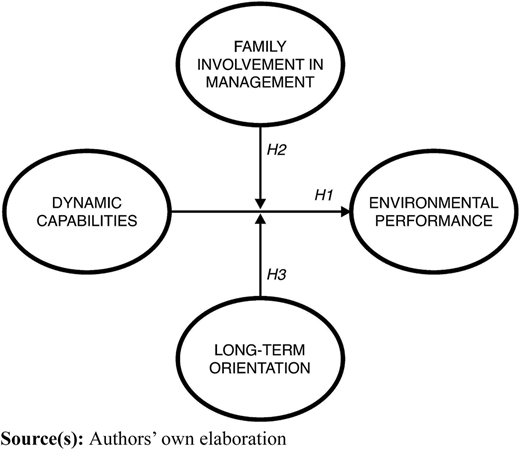
The moderating role of family firm characteristics in the relationship between dynamic capabilities and environmental performance
The moderating role of family firm characteristics in the relationship between dynamic capabilities and environmental performance
3. Methodology
3.1 Data
The database used in this research comes from a primary study on the Spanish tourism industry. The sample selection was based on the universe of Spanish tourism companies listed by the Central Business Directory (Directorio Central de Empresas) in its 2009 update. The final result of the field work, after different data cleaning processes (contacts not achieved, no activity), was 1,019 companies, representing a 95% confidence level and a margin of error of ±3.1%.
This initial sample was selected using a stratified random sampling procedure with proportional allocation to ensure the representativeness of the sample in terms of activity (four groups), size (taking the number of employees as a measure of firm size) and location. The data were obtained using a questionnaire which was administered in 2009 through personal interviews with the CEOs or General Managers. Using this primary source, we classified the companies in the sample as either family or non-family firms. Of the total sample, 748 (73.4%) were family firms, the focus of this study. We classify a company as a family firm if the founder and/or their descendants hold majority ownership and control the strategic decisions (e.g. Molly et al., 2010; Westhead and Cowling, 1998). This sample also represents the situation of Spanish family firms, which, according to previous studies (e.g. Instituto de la Empresa Instituto de Empresa Familiar, 2023; Galve Górriz and Salas Fumás, 2003) account for somewhere between 65 and 89% of all business entities in Spain.
3.2 Variables
3.2.1 Dependent variable: environmental performance
This construct is composed of five items adapted from previous studies (e.g. Zhu and Sarkis, 2007) related to reduced consumption of materials and energy, lower global/general environmental impact and improved efficiency (Table A1). These items were measured with a seven-point Likert-type scale reflecting managers' perceptions of the firm's level of achievement of the environmental objectives (1 = “very low”, 2 = “low”, 3 = “quite low”, 4 = “average”, 5 = “quite high”, 6 = “high” and 7 = “very high”) as compared to competitors in each firm's specific tourism subsector. The measurement of this variable has been shown to be consistent and reliable, with a Cronbach's Alpha of 0.897, well above the 0.7 threshold proposed by Hair et al. (1998).
Measurement of the variables
| Construct | Items |
|---|---|
| Dynamic capabilities | α = 0.931 Sensing capability The firm continually expands its portfolio of technological competencies The firm promotes internal knowledge development through R&D&I The firm works to identify and acquire external knowledge The firm continuously scans the environment to identify trends in its relevant technologies The firm, is able to process and assimilate external knowledge and combine it with internal knowledge to usefully apply it to new applications Seizing capability The firm has the capacity to exploit and apply knowledge to the development of product innovations The firm has the capacity to exploit and apply knowledge to the development of process innovations The firm effectively integrates new technological knowledge with the existing knowledge base Transforming capability The firm continually renews its innovation management approaches and practices to improve its competitiveness The firm strives to improve its innovation management in order to increase its ability to adapt to changes in the environment The firm continuously analyses the redesign and reconfigurations of its technology management processes to optimize their alignment with changes in the environment The firm continuously adjusts its management of R&D&I to meet the needs and opportunities arising from new technologies or new markets |
| Environmental performance | α = 0.897 Reduction in the consumption of materials for service provision Reduction in energy consumption for service provision Reduction in the time required for service provision Reduction in the environmental impact Improvement of the equipment efficiency |
Source(s): Authors' own elaboration
3.2.2 Independent variables
3.2.2.1 Dynamic capabilities (DYNCAP)
The construct was formulated to include the three aspects first identified by Teece (2007) and subsequently applied in later literature on this issue (Fitz-Koch and Nordqvist, 2017) ( Appendix). Dynamic capabilities were measured using seven-point Likert-type scales, reflecting managers' perception of their firm's endowment of capabilities. In each question, respondents had to compare their firm's position and strength to that of competitors in their specific subsector (from 1 = “much worse”, to 7 = “much better”). The measurement of this variable has been shown to be consistent and reliable, with a Cronbach's Alpha of 0.931 (Hair et al., 1998).
3.2.2.2 Family involvement in management (INVOLTMT)
This variable captures the percentage of the TMT composed of family members (Sirmon et al., 2008; Klein et al., 2005).
3.2.2.3 Long-term orientation (LTO)
We measured LTO using a seven-point Likert-type scale that captures the importance the family firm attaches to providing work and wealth for the next generations of the family. This measurement is in line with the idea proposed by Berrone et al. (2012) or Gómez-Mejía et al. (2010) when they propose that LTO in family firms is related to ensuring the business is passed on to future generations.
3.2.2.4 Control variables
Drawing on previous related studies (e.g. Fores, 2019; King and Lenox, 2002), we also included a number of control variables which could have an effect on environmental performance.
Return on Assets (ROA) can be expected to strongly influence the investment in dynamic capabilities, according to agency and behavioral theories. The sign of this effect is controversial: on the one hand, better performing firms are expected to have more resources to invest in innovation (Chrisman and Patel, 2012); on the other hand, behavioral studies based on a risk-taking perspective point in the opposite direction, arguing that poorer performance serves as a trigger for taking risks and innovative projects. Following Becerra et al. (2020), we measure ROA using a seven-point Likert-type scale that compares the firm's performance to that of its competitors.
Size (SIZE) has an influence on a firm's ability to achieve innovation-related economies of scale and is therefore often considered a predictor of environmental performance (e.g. King and Lenox, 2002). In our study, Size is measured as the total number of employees.
Age (AGE) can influence dynamic capabilities by allowing the firm to draw on accumulated experience (Forés and Camisón, 2016). We measured it as the number of years since the first establishment was opened.
Tangible resources (TANRES) are expected to have an influence on the environmental performance of family-owned tourism companies. We measured this variable as the number of years since the last major renovation/refurbishment of its physical assets (Camisón and Forés, 2015).
The strategic archetypes correspond to the typology put forward by Miles et al. (1978), with three dichotomous variables that capture the defender (DEF), prospector (PROS) or analyzer (ANAL) strategy profiles, leaving the reactor profile as a reference variable.
Quality Management Certifications (QMCERT) captures the number of quality certificates that the firm holds, such as EMAS, ISO 14001 or other environmental certifications involving the adoption of voluntary environmental and energy management systems (Testa et al., 2014).
Hierarchy levels (HIERARCHY), measured as the number of hierarchical levels between the chief executive officer (CEO) and customer service employees, are related to the propensity to adopt more flexible structures and decision-making processes that are needed for environmental purposes (Broekaert et al., 2016).
Finally, four dummy variables were included to capture the various subsectors of tourism firms in the sample, which presumably display different patterns of environmental performance. They are accommodation firms (HOTEL), restaurants (RESTA), travel agencies and tour operators (TOUR) and transport organizations (TRANSP), with complementary firms as the reference subsector.
Table 1 shows the descriptive statistics and correlations among the study variables. There is a low level of correlation (below 0.6) between the variables (see Table 1) (Podsakoff et al., 2003), which confirms the discriminant validity of the model.
Descriptive statistics and correlations of the study variables
| Variables | μ | σ2 | 1 | 2 | 3 | 4 | 5 | 6 | 7 | 8 | 9 | 10 | 11 | 12 | 13 | 14 | 15 | 16 | 17 |
|---|---|---|---|---|---|---|---|---|---|---|---|---|---|---|---|---|---|---|---|
| 1. ENVPERF | 3.6786 | 1.3663 | 1.000 | ||||||||||||||||
| 2. ROA | 3.8611 | 0.9955 | 0.197*** | 1.000 | |||||||||||||||
| 3. SIZE | 28.5657 | 127.8244 | 0.158*** | 0.115*** | 1.000 | ||||||||||||||
| 4. AGE | 1990.3817 | 20.6166 | −0.086*** | −0.008 | −0.038 | 1.000 | |||||||||||||
| 5. TANRES | 2004.4408 | 4.5763 | −0.046 | 0.040 | −0.013 | 0.175*** | 1.000 | ||||||||||||
| 6. DEF | 0.3422 | 0.4747 | −0.092*** | −0.029 | −0.037 | 0.023 | 0.066** | 1.000 | |||||||||||
| 7. PROS | 0.0682 | 0.2522 | 0.084** | 0.113*** | 0.011 | −0.015 | 0.028 | −0.195*** | 1.000 | ||||||||||
| 8. ANAL | 0.3463 | 0.4760 | 0.156*** | 0.080** | 0.018 | −0.066** | 0.037 | −0.525*** | −0.197*** | 1.000 | |||||||||
| 9. QMCERT | 0.1719 | 0.4014 | 0.166*** | 0.092*** | 0.074** | −0.111*** | 0.022 | 0.002 | 0.235*** | 0.053* | 1.000 | ||||||||
| 10. HIERARC | 1.8163 | 0.9140 | 0.001 | 0.065** | 0.164*** | −0.049* | 0.089*** | −0.023 | 0.049* | 0.100*** | 0.073** | 1.000 | |||||||
| 11. HOTEL | 0.3061 | 0.4612 | 0.125*** | 0.088** | 0.167*** | −0.142*** | 0.034 | −0.057* | 0.131*** | 0.053* | 0.166*** | 0.171*** | 1.000 | ||||||
| 12. RESTA | 0.4064 | 0.4914 | −0.138*** | −0.077** | −0.106*** | 0.040 | 0.026 | 0.097** | −0.094*** | 0.016 | −0.090*** | −0.074** | −0.550*** | 1.000 | |||||
| 13. TOUR | 0.0976 | 0.2969 | 0.096*** | 0.024 | −0.034 | 0.079** | 0.011 | −0.009 | 0.018 | −0.012 | −0.075** | −0.034 | −0.218*** | −0.272*** | 1.000 | ||||
| 14. TRANS | 0.0441 | 0.2054 | 0.089*** | 0.033 | 0.038 | −0.007 | −0.044 | −0.004 | −0.058* | 0.049* | 0.062** | −0.027 | −0.143*** | −0.178*** | −0.071** | 1.000 | |||
| 15. DYNCAP | 0.0000 | 0.9147 | 0.372*** | 0.209*** | 0.101*** | 0.026 | 0.039 | −0.168*** | 0.236*** | 0.194*** | 0.184*** | 0.120*** | 0.128*** | −0.170*** | 0.119*** | 0.012 | 1.000 | ||
| 16. INVOLTMT | 0.0000 | 0.9865 | −0.128*** | −0.090*** | −0.177*** | 0.150*** | 0.084** | −0.024 | −0.006 | −0.068** | −0.109*** | −0.117*** | −0.201*** | 0.117*** | 0.109*** | −0.041 | −0.057* | 1.000 | |
| 17. LTO | 0.0000 | 0.7188 | 0.096*** | 0.006 | 0.034*** | −0.075** | 0.031 | −0.011 | −0.030 | 0.059* | 0.033 | 0.008 | 0.048* | −0.071** | 0.028 | 0.006 | 0.074** | −0.015 | 1.000 |
Note(s): *** Correlation significant at the 0.01 level (bilateral)
** Correlation significant at the 0.05 level (bilateral)
* Correlation significant at the 0.1 level (bilateral)
Source(s): Authors' own elaboration
3.3 Method of analysis and validity tests
To test the research hypotheses, we ran a hierarchical regression analysis using SPSS 25.0. Before incorporating the moderating effects, the main variables were mean-centered to reduce multicollinearity (Cohen et al., 2003). The variance inflation factors (VIFs) confirmed that multicollinearity is not a problem: the highest VIF is 2.36, i.e. below the recommended threshold of 10 (Cohen et al., 2003). As we use self-reported data, we checked for common method bias using Harman's one-factor method (Podsakoff et al., 2003). We conducted a principal component analysis including the dependent, independent and control variables. The analysis resulted in seven factors with eigenvalues greater than 1 and the first factor accounted for only 15.39% of the total variance. Thus, common method bias is unlikely to be an issue affecting our data. Residual analysis as well as other graphs and statistics provided by the SPSS program have been used to ensure that the basic assumptions for linear regression analysis (linearity, independence, homoscedasticity, normality and no collinearity) are met.
4. Findings
Table 2 displays the results of the model for each of the relationships under analysis. As can be seen, the F-test of significance is acceptable for all the models estimated. For the complete model including both direct and moderating effects, the value of R2 indicates that it explains 20.6% of the variance in environmental performance. An F-test is used to check the significance of the change in R2. The addition of independent variables in Model II and the interaction terms in Model III increases the variance explained by 8.1 and 0.9%, respectively (see Table 2).
Estimation results
| Model I | Model II | Model III | Collinearity | ||||||
|---|---|---|---|---|---|---|---|---|---|
| (1) | (2) | (1) | (2) | (1) | (2) | Tolerance | VIF | ||
| Constant | 38.557* | 1.852 | 38.569* | 1.929 | 38.680* | 1.943 | |||
| Control variables | |||||||||
| 1 | ROA | 0.143*** | 4.065 | 0.100*** | 2.936 | 0.101*** | 2.991 | 0.924 | 1.083 |
| 2 | SIZE | 0.123*** | 3.454 | 0.097*** | 2.820 | 0.107*** | 3.109 | 0.897 | 1.115 |
| 3 | AGE | −0.047 | −1.310 | −0.054 | −1.586 | −0.054 | −1.572 | 0.910 | 1.098 |
| 4 | TANRES | −0.050 | −1.406 | −0.047 | −1.397 | −0.048 | −1.414 | 0.928 | 1.078 |
| 5 | DEF | 0.022 | 0.487 | 0.010 | 0.245 | 0.007 | 0.164 | 0.583 | 1.716 |
| PROS | 0.069* | 1.741 | 0.002 | 0.042 | 0.002 | 0.045 | 0.705 | 1.419 | |
| ANAL | 0.157*** | 3.469 | 0.080* | 1.800 | 0.081* | 1.833 | 0.547 | 1.828 | |
| 5 | QMCERT | 0.106*** | 2.907 | 0.072** | 2.065 | 0.081** | 2.297 | 0.865 | 1.157 |
| 6 | HIERARCHY | −0.064* | −1.804 | −0.084** | −2.477 | −0.086** | −2.534 | 0.922 | 1.084 |
| HOTEL | 0.121** | 2.299 | 0.109** | 2.168 | 0.112** | 2.230 | 0.425 | 2.354 | |
| RESTA | 0.020 | 0.374 | 0.053 | 1.063 | 0.063 | 1.247 | 0.422 | 2.368 | |
| 7 | TOUR | 0.146*** | 3.436 | 0.120*** | 2.936 | 0.122*** | 2.995 | 0.645 | 1.551 |
| 8 | TRANSP | 0.097** | 2.490 | 0.097*** | 2.608 | 0.096 | 2.584 | 0.779 | 1.284 |
| Explanatory variables | |||||||||
| 5 | DYNCAP | 0.299*** | 8.229 | 0.299*** | 8.265 | 0.810 | 1.234 | ||
| 6 | INVOLTMT | −0.061* | −1.767 | −0.071** | −2.047 | 0.880 | 1.137 | ||
| 7 | LTO | 0.055 | 1.647 | 0.053 | 1.610 | 0.978 | 1.023 | ||
| Moderating effects | |||||||||
| 10 | DYNCAP X INVOLTMT | 0.071** | 2.127 | 0.942 | 1.061 | ||||
| 11 | DYNCAP X LTO | 0.061* | 1.838 | 0.981 | 1.020 | ||||
| F | 8.804*** | 12.591*** | 11.743*** | ||||||
| R2 | 0.135 | 0.216 | 0.225 | ||||||
| Adjusted R2 | 0.120 | 0.199 | 0.206 | ||||||
| Changes in R2 | – | 0.081*** | 0.009** | ||||||
| (1) Standardized regression coefficients | (2) t-values | ||||||||
| (3) Non-Standardized Beta | |||||||||
| *p < 0.1 | **p < 0.05 | ***p < 0.01 | |||||||
Source(s): Authors' own elaboration
Model I introduces the control variables. Model II tests H1, which is confirmed by the significant positive direct effect of the dynamic capabilities variable on the dependent variable environmental performance (β = 0.299, p < 0.01). Model III introduces the interaction terms. The interaction term between family involvement in the TMT and dynamic capabilities is positive and significant (β = 0.071, p < 0.05), contrary to what we hypothesize in H2. Consistent with H3, the interaction between LTO and dynamic capabilities is positive and significant (β = 0.071, p < 0.05). Therefore, our preliminary results predict a beneficial effect of both family TMT involvement and LTO on dynamic capabilities applied to improving environmental performance.
However, it is not immediately apparent from the model how these conditional effects influence the relationship between dynamic capabilities and environmental performance. As suggested by Cohen et al. (2003), we graph the main effect considering the conditional effects under study.
We introduce family involvement in the TMT as a dichotomous variable which takes a value of 1 if 50% or more of the members of the TMT are family members; and 0 otherwise.
We also introduce LTO as a dichotomous variable in which a value of 1 captures survey scores of 6 and 7 (high and very high, respectively, which are well above the mean of 5, indicating high enough) (see Table 1) and 0 otherwise.
The plot in Figure 2 confirms a positive moderating effect of family involvement on the relationship between dynamic capabilities and environmental performance. The slopes of both lines are positive, although when family involvement is high the positive effect is stronger. According to the plot, at lower levels of dynamic capabilities it is better to have low family involvement in the TMT in order to ensure these capabilities have a positive effect on environmental performance, but only up to the point where dynamic capabilities reach a value of 6. At this level, having a higher level of family involvement is more beneficial for the positive effect of dynamic capabilities on environmental performance.
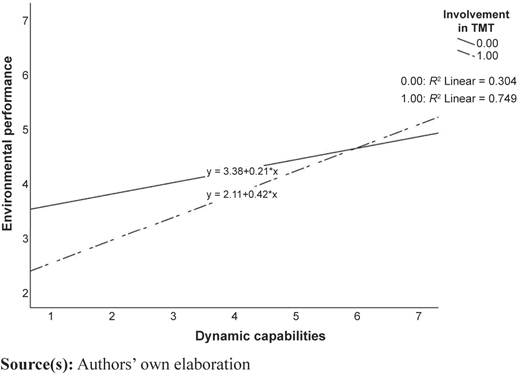
Moderating effect of family involvement in the TMT on the relationship between dynamic capabilities and environmental performance
Moderating effect of family involvement in the TMT on the relationship between dynamic capabilities and environmental performance
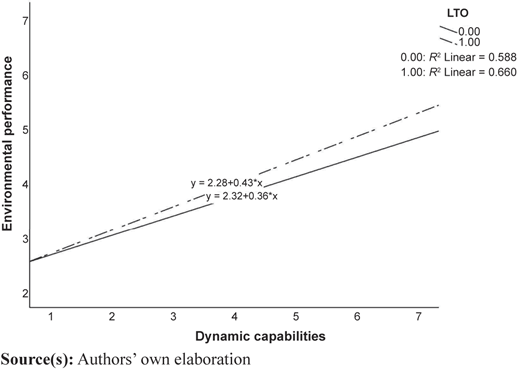
The plot of the interaction between dynamic capabilities and LTO in Figure 3 confirms that the positive effect of dynamic capabilities and environmental performance is higher when LTO is high, thus providing additional support for H3.
5. Discussion
Tourism firms strongly depend on natural resources and territorial assets (Fores, 2019; Molina-Azorín et al., 2009). Recent empirical literature (e.g. Scott et al., 2019) points out the negative impacts of conventional tourist activity on the natural environment in tourist destinations. For this reason, there is a pressing need to identify antecedents of better environmental performance by tourism firms, as it can contribute to the development of a more sustainable tourism model (e.g. Dembovska and Zvaigzne, 2021). This study shows that improvements in environmental performance rely on the three types of dynamic capabilities: the identification of environmental problems and needs as well as new environmental opportunities (sensing); the mobilization of resources and capabilities to address an opportunity and capture value from it through novel management and service provision processes (seizing); and the renewal and orchestration of resources to meet the challenges in the business environment (reconfiguring). Our findings thus corroborate the results of previous studies focusing on the hotel industry (Reyes-Santiago et al., 2019) or the wine industry (Duarte-Alonso et al., 2020), revealing a similar positive effect in different subsectors of the tourism industry.
This study also opens the black box of family firm heterogeneity by considering the effect of the family involvement in the management team and the firm's LTO, two crucial factors to analyze in the context of family ownership. The analysis of the direct effects of family firm characteristics shows that family involvement in the TMT has a significant negative effect on environmental performance. Family-controlled firms are more cautious than others when considering risky long-term investment strategies, such as those required for environmental purposes, preferring stability and control and entrenchment in their core competencies (Miroshnychenko et al., 2022; Ernst et al., 2022; Le Breton-Miller and Miller, 2016; Kellermanns et al., 2012; Block, 2012; Chrisman and Patel, 2012).
In contrast, the results show that LTO has a positive but non-significant direct effect on improving environmental performance. This is in line with the tenets of the dynamic capabilities approach (Teece et al., 1997), highlighting the need for the family's LTO to be supported by other firm resources (Zahra et al., 2004) and organizational capabilities, in order for it to have an impact on performance. Thus, after confirming the direct effect of dynamic capabilities on environmental performance, this study shows the positive moderating effect that LTO exerts on said relationship, as explained below.
After examining the direct effects of the two family firm characteristics on environmental performance and confirming the direct positive effect of dynamic capabilities on environmental performance, this study analyses the moderating role of the two family firm characteristics on the latter relationship.
On the one hand, family firms with stronger LTO generously invest in the future of their firm, have greater patience when it comes to the future return on those investments and focus on actions to improve environmental performance (Dou et al., 2019; Hoffmann et al., 2016; Le Breton-Miller and Miller, 2016; Neubaum et al., 2012). The results of the study show the positive moderating effect of LTO on the relationship between dynamic capabilities and environmental performance. In other words, managers with stronger LTO are likely to favor investment in dynamic capabilities for environmental objectives. This result lends support to the stewardship theory (Miroshnychenko et al., 2022; Le Breton– Miller and Miller, 2006), which suggests family managers with a longer-range outlook are likely to encourage the application of dynamic capabilities to enhance environmental performance.
On the other hand, the moderating effect of family involvement is revealed to be more complex. A close reading of our results (Figure 2) shows that having a high level of family managerial involvement positively moderates the effect of dynamic capabilities on environmental performance, but only in family firms which have highly-developed dynamic capabilities. Conversely, in family firms with lower levels of dynamic capabilities it is better not to have this family involvement in the TMT.
When the economic wealth (or short-term socioeconomic status) of family owners is threatened, family owners may make strategic decisions aimed at protecting said wealth, even at the expense of the SEW of other shareholders.
However, family firms that have more human, social and financial resources to devote to developing dynamic capabilities (normally bigger firms) are more likely to invest in the future wealth of the business (instead of the short-term economic wealth of the family). One way of doing so is to protect the environment that surrounds and supports their firm's activity, which in turn enhances their image and legitimates the family business model (Neubaum et al., 2012).
Based on these results, along with the positive moderating effect of LTO on the allocation of dynamic capabilities for environmental purposes, we can conclude that these two moderating elements that characterize family firm management are worth including as independent variables in analyses of family firms. Our findings also confirm those reported by Dou et al. (2019), namely, that family involvement in the ownership and management of the family firm will not always mean that the firm's objectives, strategies and resources are oriented towards the long term. However, our results contradict previous findings reported by Hoffmann et al. (2016), who empirically show that the family involvement in the TMT only positively impacts performance if it leads to LTO among management.
5.1 Academic and practical implications
This study contributes to the literature on family firms by revealing how the management and corporate governance structure can affect the application of dynamic capabilities in pursuit of environmental aims. The family business literature has made significant progress in the study of both the development of dynamic capabilities (e.g. Camisón et al., 2020; Barros et al., 2016) and the improvement of environmental performance (e.g. Ernst et al., 2022; Abeysekera and Fernando, 2020). However, to the best of our knowledge, there is still scarce research that jointly assesses how these specific features of the family business influence the impact of dynamic capabilities on environmental performance.
Regarding the firm's LTO and family involvement in the TMT, we do not assume that the two factors are of equal importance in family firms. Furthermore, by looking at the dominant logic (agency versus stewardship theory) potentially underpinning the involvement of family members in the TMT (which can lead to higher agency costs) and the firm's LTO (more closely linked to the preservation of the business for future generations), we can understand the different impacts on the environmental aims of the family business (Miroshnychenko et al., 2022; Memili et al., 2018).
This study also has practical implications for several different groups. First, for owners and managers of family firms and consultants serving this type of firm, it is worth noting that the combination of dynamic capabilities with family firm characteristics such as family management and long-term vision can help achieve superior environmental performance. Thus, family firms should be aware of the importance of developing innovative capabilities to generate a positive impact on the environment.
Creativity, proactivity and risk-taking in the assignment of family human, social and patient financial capital are needed to create new capabilities or transform the firm's existing ones to meet environmental aims, particularly given the impact it can have on the survival of the company (Reyes-Santiago et al., 2019; Teece, 2007). Moreover, the development of dynamic capabilities requires firms to use a different set of values, strategies and procedures, which in turn need to be supported by all areas of the firm.
By showing that LTO can enhance the exploitation of dynamic capabilities for environmental purposes, our results suggest that senior members of the family firm should seek to add value by fostering a long-term oriented culture. If family firm managers adopt short-term strategies and imitate the behavior of their non-family counterparts, it can prevent them from seizing this unique advantage (Seyed Kalali, 2022). It is therefore essential to exercise leadership and cultivate a long-term oriented culture in both the family and business spheres in order to integrate environmental aims along with other values that are key for competitiveness.
Second, those responsible for developing and implementing public environmental policies should be aware of the importance of adopting a long-term perspective in order to see the results of the implementation of environmental sustainability strategies and actions. In addition, they should account for the different features, configurations and motivations of family firms, which affect the achievement of environmental goals.
5.2 Limitations and future research lines
Despite our best efforts to minimize them, we should acknowledge the limitations of this study. First, regarding the database, the fact that this is a cross-sectional survey means causality cannot be inferred from our findings; therefore, it would be worth conducting another study in the future based on longitudinal data. That said, this type of cross-sectional study is frequently used in family firm research because it is difficult to get primary data from private family firms. Furthermore, as our study is focused on a single economic sector (tourism) and country (Spain), the conclusions should be extrapolated with care. Nevertheless, the tourism industry has some notable characteristics and it is especially relevant to the Spanish economy, which justifies the in-depth analysis.
Future studies should explicitly recognize the importance of firm size for the analysis of the relationship in question. In this sense, the interactions between the two moderator variables and dynamic capabilities were not significant for the whole sample; however, it would be interesting to control for firm size, since large companies could be expected to have more dynamic capabilities, and the interactions with LTO and TMT involvement could be significant in those cases.
The same reasoning could be applied to first generation family firms versus those that have become more professionalized – at both individual (e.g. professionalization of the CEO) and organizational levels (e.g. professionalization of the TMT and employees, existence of formal governance bodies and practices, etc.) (Stewart and Hitt, 2012) – as the latter type of firm might be more innovative.
In this vein, future studies should control for the professionalization of family firm managers—whether or not they are part of the owner family—in order to determine if it is the family culture or their lack of critical managerial capabilities that makes family involvement in management an obstacle to environmental innovation. Therefore, controlling for these variables in the analysis would open up an interesting future research line.
6. Conclusion
Family-owned tourism firms are currently facing the challenge of integrating sustainability principles into their strategic and management decisions in order to reduce the negative impacts of their economic activity on natural ecosystems. Our study reveals that dynamic capabilities are an essential element for family firms to improve their environmental performance, giving them a sustainable competitive advantage. Specifically, this research opens the black box of family firm heterogeneity by considering how family members' involvement in the TMT and LTO can have a beneficial moderating effect on the relationship between dynamic capabilities and improved environmental performance. To conclude, we hope that this work will provide the basis for further theoretical and empirical advances that help shed light on how certain idiosyncratic characteristics of family tourism firms can help them improve their environmental performance.
This research was funded by “Plan de promoción de la investigación de la UJI—Convocatoria 2021 de “Proyectos de investigación científica y desarrollo tecnológico” of the Universitat Jaume I (project ref. UJI-A2021-06) and by “Plan Estatal de Investigación Científica y Técnica y de Innovación 2021-2024” of the Ministerio de Ciencia e Innovación, with reference PID2020-119642GB-I00. The author José María Fernández Yáñez has been supported by the predoctoral grant PD-UJI/2019/13.

