


This article examines how the dynamic interplay between evolving employee needs and organizational demands affects talent management (TM) in consultancy firms. Building on the person–organization fit (POF), we develop a contingency perspective that integrates the career life cycle and social exchange theories. Thus, we propose the talent–organization fit (TOF) framework, which reconceptualizes fit as fluid, evolutionary and context-contingent.
Adopting a qualitative research design, we conducted semi-structured interviews and focus groups with 15 Human Resource (HR) professionals from three of the Big Four consultancy firms. Data were analysed using an open-coding approach informed by grounded theory principles, enabling the inductive identification of patterns across the employee career lifecycle.
We identify five building blocks of TM – technological orientation, job crafting, corporate social responsibility commitment, international opportunities and total rewards – whose salience changes across four career stages: recruitment, onboarding, development and maturity. We thus propose a typology of four talent archetypes (competent professional, dynamic learner, initiative taker and engaged long-term contributor), highlighting how talent alignment requires continuous recalibration to address both priorities specific to the career stage and broader contextual contingencies.
This study introduces the TOF framework, capturing the temporal evolution of employee needs, the contextual contingencies of knowledge-intensive environments and talent–firm reciprocity mechanisms. By reconceptualizing talent alignment as a continuous and adaptive process, this study advances TM theory by offering an evolutionary lens for designing stage-sensitive strategies and strengthening attraction, retention and engagement.
Introduction
As the global economy becomes increasingly competitive and knowledge-intensive, the ability to attract, develop and retain talent has become a crucial factor in determining firm performance and competitiveness (Banerjee and Sharma, 2025; Collings et al., 2019; Kraus et al., 2024; Vardi and Collings, 2023). For consultancy firms, in particular, for whom intellectual capital is the primary driver of value creation, effective talent management (TM) represents both a strategic necessity and a source of sustainable competitive advantage. Employer branding and career development policies are central to shaping how internal and external stakeholders perceive the firm (Padhi and Joshi, 2022). Indeed, the quality of career paths not only influences employee satisfaction and engagement but also determines the ability of firms to cultivate long-term commitment and retain top talent. In this sense, organizational reputation emerges as a key outcome of effective TM practices. By consistently aligning their actions with employee expectations, firms shape how they are perceived by both current and prospective employees. A strong employer reputation reflects the credibility and coherence of TM strategies that are capable of growing good leaders and providing a progressive environment over time, ultimately enhancing the organization's ability to attract, engage and retain talent in a competitive and knowledge-intensive environment (Yapp, 2009).
The escalating sensitivity about the importance of TM is particularly pronounced in the current business environment, where the long-standing paradigms governing corporate logics have been disrupted by the impactful implications of the pandemic, recent geo-political tensions and the overwhelming rise of artificial intelligence (e.g. Roppelt et al., 2024). These phenomena have prompted a profound and compelling reconsideration of work dynamics and TM practices (Vardi and Collings, 2023) because of their transformative effects on employees' perceptions and expectations regarding their careers and, ultimately, their influence on the very fabric of professional engagement.
Therefore, the most significant challenge faced by companies resides in the intricate process of both attracting and retaining talent, meaning that they must grapple with the dual challenge of navigating an environmentally driven paradigm shift in corporate dynamics while simultaneously adjusting to the recalibrated expectations and preferences of their employees.
Most prior studies exploring the crucial, yet delicate, mechanisms driving TM have adopted the person–organization fit (POF) theory, which emphasizes the mutual alignment between employees' attributes and organizations' needs, and how they complement and respond to each other (Chatman, 1989; Donald, 2023; Kaliannan et al., 2023; Kristof, 1996; Menter et al., 2024; Morley, 2007). Recent developments, however, reveal a noticeable ambiguity in terms of how this alignment can be achieved on a continuous basis. This limitation is particularly salient, as competitive arenas are in constant flux, intensifying the challenges to organizational survival and sustainable growth (Hoffman and Woehr, 2006) and making the examination of the transformative mechanisms driving TM no longer optional but imperative for understanding and shaping these intricate dynamics (Kaliannan et al., 2023; Rodríguez-Sánchez et al., 2020). While foundational, the traditional framework of POF emphasizes static compatibility between employee attributes and organizational values, thus assuming that, once alignment is achieved, it remains stable over time (Chatman, 1989; Kristof, 1996). This assumption neglects the fact that both individual needs and organizational expectations evolve, often in ways that reshape the meaning of “fit” itself (Donald, 2023; Vianen, 2018). Additionally, the focus on individual and organizational demands and needs suffers from being a micro-level approach that fails to account for broader contextual contingencies, such as industry dynamics, technological disruption, generational shifts and societal expectations around key themes like sustainability and inclusion, which critically shape how talent alignment is experienced and sustained (Cantoni et al., 2025; Montero Guerra et al., 2023; Schinnenburg and Böhmer, 2025). These observations point to the need for a renewed conceptualization of fit, one that is capable of capturing how alignment evolves over time and that responds to changing contextual pressures (Kristof-Brown et al., 2023).
To address these gaps, we propose the concept of talent–organization fit (TOF) as a conceptual evolution of POF. Building on and extending POF, TOF shifts the unit of analysis (McDonnell et al., 2017) and incorporates three dimensions often overlooked in traditional approaches: (1) fluidity, recognizing that both employees and organizations evolve over time; (2) temporality, acknowledging the shifting salience of needs and contributions specific to the career stage and (3) contingency, accounting for contextual factors such as industry characteristics, generational cohorts and technological disruption (Cantoni et al., 2025; Gallardo-Gallardo et al., 2020; Maley et al., 2024; Schinnenburg and Böhmer, 2025).
From a theoretical standpoint, TOF builds on contingency theory as a general foundation, emphasizing that effective TM requires alignment with both the needs of employees specific to their career stage and the broader contextual factors shaping organizations (Cantoni et al., 2025; Gallardo-Gallardo et al., 2020). Incorporating a career life cycle perspective addresses the static orientation of POF by recognizing that employee values, motivations and contributions shift significantly over time (Harsch and Festing, 2020; Low and Bordia, 2011). Complementing this, social exchange theory (Ahmad et al., 2023; Blau, 1964; Cropanzano et al., 2017) provides a behavioural mechanism to explain how employees respond to these adaptive strategies: when organizations demonstrate investment in their evolving needs through initiatives such as corporate social responsibility (CSR), international opportunities and flexible work arrangements, employees reciprocate with higher engagement, loyalty and long-term commitment (Chen et al., 2016). In the light of this, TOF advances a more fluid, temporally sensitive, and contextually grounded understanding of talent alignment, offering both theoretical refinement and practical guidance for organizations operating in dynamic and knowledge-intensive environments. Indeed, our study investigates consultancy firms as a critical context in which TM dynamics are particularly salient. These firms are not only knowledge-intensive and project-driven, but they also face acute global competition for talent (Sarra et al., 2022; Vardi and Collings, 2023). Therefore, this study aims to address the following research questions:
What factors contribute to talent attraction and retention in consultancy firms?
How do these factors evolve across the different phases of an employee's professional career?
To answer these questions, we employ an inductive, qualitative research design that captures the dynamics of talent evolution across the employee life cycle. Our findings identify five key building blocks of TM (technological orientation, job crafting, CSR commitment, international opportunities and total rewards) whose relative salience shifts across different career stages, capturing the dynamics of talent evolution across the employee lifecycle. In this, our research makes two primary contributions. First, it advances TM theory by conceptualizing TOF as a lifecycle- and context-sensitive framework that extends beyond the limitations of POF. Second, it provides actionable insights for practitioners, offering a typology of talent profiles specific to career stages that consultancy firms can leverage to design adaptive TM strategies, enhance employee engagement and secure long-term organizational competitiveness.
The remainder of the article is organized as follows. The next section offers a literature review on TM; the methodology is then outlined, and the results are reported. Later, we will discuss our findings and elaborate on our study's main contributions and implications. Finally, some conclusions are drawn, outlining potential avenues for future research.
Literature review
Talent management
Talent has been conceptualized in heterogeneous ways, reflecting its composite and multifaceted nature (Schinnenburg and Böhmer, 2025; Tsaousiotis et al., 2025). While definitions vary, most scholars agree that it encompasses a combination of innate abilities and acquired skills and knowledge (Kaliannan et al., 2023; Tahmasebi and Nijs, 2024; Yildiz and Esmer, 2023). Therefore, talented individuals are generally those capable of development, growth and leadership, consistently delivering exceptional results, and transferring knowledge across contexts (Kabalina and Osipova, 2022). Beyond skills and abilities, talent also involves leveraging diverse backgrounds and perspectives to bring unique and valuable insights to the firm (Tansley, 2011). Given this complexity, TM encompasses a comprehensive set of strategies designed to integrate workforce planning, recruitment, onboarding, performance management, and learning and development. The collective aim of these strategies is to sustain a firm's competitive advantage and ensure long-term success (Lewis and Heckman, 2006). Effective TM helps identify potential gaps between the current talent pool and the skills needed to achieve both current and future strategic goals (Di Prima et al., 2024). By aligning TM practices with organizational objectives, firms can ensure that they have the requisite skills, knowledge and experience to execute their strategies effectively (Kraus et al., 2024; Tafti et al., 2017). Moreover, attracting and retaining high-calibre talent is widely recognized as a key source of sustainable competitive advantage, driving employee engagement and job satisfaction, and thus enhancing organizational productivity and cultivating innovation capabilities (Chen et al., 2016). As such, TM is increasingly recognized as a continuous and strategic process, rather than a one-time intervention (Maley et al., 2024; Schinnenburg and Böhmer, 2025).
The Person–Organization fit
The POF framework has long provided a foundational lens for understanding TM (Chatman, 1989; Greguras and Diefendorff, 2009; Kristof-Brown et al., 2016; Morley, 2007; Vianen, 2018). POF is defined as the “compatibility between people and organizations that occurs when at least one entity provides what the other needs or they share similar fundamental characteristics, or both” (Kristof, 1996, p. 4). In particular, POF highlights two forms of compatibility: supplementary fit, in which individuals have similar characteristics to others in the organizational environment; and complementary fit, in which individuals bring unique characteristics that offset or complement the attributes of others, thereby fulfilling unmet needs (Muchinsky and Monahan, 1987; Ostroff et al., 2005). Under the POF perspective, the fit also requires the use of a needs–supplies lens, in which the organization fulfils the employees' needs for rewards, support or development, and a demands–abilities lens, in which the employees' knowledge, skills and abilities meet organizational requirements (Greguras and Diefendorff, 2009; Kaliannan et al., 2023; Ostroff et al., 2005). Psychological alignment, including emotional intelligence and cultural congruence, therefore plays a key role in the POF, with studies demonstrating that employees who are emotionally aligned with the firm's values exhibit higher job satisfaction and engagement (Chen et al., 2016; Hoffman and Woehr, 2006).
While the POF paradigm has long underpinned TM studies (Kristof-Brown et al., 2023), it nevertheless suffers from two major limitations. First, it conveys a static view of the individual–organization match, assuming a fixed, one-time alignment and overlooking the reality that both individuals and organizations evolve over time through career progressions, role transitions and personal life changes (Harsch and Festing, 2020; Low and Bordia, 2011). Second, the POF framework emphasizes the micro-level aspects of the individual–organization relationship, such as job characteristics and personal traits, while neglecting broader contextual contingencies such as industry dynamics, technological disruption, and societal pressures (e.g. Montero Guerra et al., 2023). Together, these limitations point to the need for a more dynamic and context-sensitive framework. We address this gap by drawing on two theoretically complementary perspectives, namely the life cycle perspective and social exchange theory. Based on these, we conceptualize TOF, which reconsiders fit as an evolving alignment shaped by the employee career life cycle and the shifting demands of knowledge-intensive organizational contexts.
Building on this need for a more adaptive lens, recent developments in TM and POF research highlight a growing consensus that there is a need for frameworks capable of capturing the temporal and contextual complexities that shape employee–organization alignment. Studies show that digital transformation and evolving work dynamics have significantly reshaped employee expectations and the nature of organizational demands, challenging the static assumptions underpinning traditional notions of fit (Montero Guerra et al., 2023; Roppelt et al., 2024; Schinnenburg and Böhmer, 2025). At the same time, contemporary TM scholarship increasingly emphasizes the importance of dynamic, multilevel models that account for generational shifts, CSR-oriented values, and changing priorities across the career lifecycle (Barakat et al., 2016; Gallardo-Gallardo et al., 2020; Thomas et al., 2025).
Despite these advances, existing research has yet to offer an integrative framework that simultaneously incorporates micro-level fit mechanisms, the temporal evolution of employee needs across career stages, and the broader contextual contingencies characteristic of knowledge-intensive environments. This reveals a clear conceptual gap: the field lacks a theoretically grounded and empirically informed model explaining how and why alignment must be recalibrated over time. The TOF framework proposed in this study addresses this gap by bringing together POF, career lifecycle theory and social exchange theory into a contingency-based model tailored to the dynamic and project-driven nature of consultancy firms.
The Talent–Organization fit: disentangling the talent–POF–life cycle connections
The relationship between TM, POF and the employee's career life cycle represents an important, yet underexplored, nexus that has emerged onto the research agenda in recent years (Chen et al., 2016).
Career life cycle research addresses the static orientation of the POF by highlighting the temporal dimension of fit. As individuals progress through various stages of their professional journeys, their values, motivations and needs change in response to contextual, organizational and personal developments (Harsch and Festing, 2020; Low et al., 2016). For instance, early-career employees tend to prioritize skill development, flexibility and purpose-driven work (Lukman and Kee, 2020; Thomas et al., 2025), while mid-career professionals may increasingly seek autonomy and leadership opportunities (Rodríguez-Sánchez et al., 2020). In later stages, employees often emphasize legacy, recognition and alignment with broader social and sustainability values (Barakat et al., 2016).
At the same time, organizations adjust their expectations as employees move across these stages. During an employee's early career, emphasis is placed on onboarding, mentoring and skill acquisition; for mid-career employees, organizations focus on retention, international mobility and succession planning; and in later stages, the attention shifts towards knowledge transfer, recognition and support for retirement transitions (Dam et al., 2015; Rücker, 2018). This dynamic reciprocity indicates that TM cannot be a uniform set of practices; rather, it must be tailored to evolving needs specific to the career stage to sustain engagement and performance (Harsch and Festing, 2020; Low and Bordia, 2011).
Neglecting the career life cycle perspective in TM may have significant consequences, as static approaches may inadvertently foster disengagement, attrition or misalignment if organizations fail to accommodate employees' evolving aspirations. This observation underscores a theoretical misalignment in traditional TM literature: although POF remains a valuable construct, it tends to ignore the temporality of fit. Thus, TM strategies that are sensitive to the life cycle enable organizations to maintain ongoing alignment by adjusting talent practices as careers progress.
To complement the life cycle perspective and, specifically, to address the importance of advancing the POF through a context-specific lens, we draw on social exchange theory (Blau, 1964), which can be used to explain the behavioural mechanisms underpinning employees' responses to TM practices. This theory posits that when employees perceive organizational investments, such as structured career development, flexible work arrangements, international opportunities and CSR initiatives, as signals of recognition and support, they feel obliged to reciprocate with greater commitment, performance and loyalty (Chen et al., 2016). This reciprocity reinforces the psychological contract between an employee and their organization, ensuring that adaptive, context-sensitive TM strategies translate into sustained engagement and retention (Hakanen et al., 2018).
Building on these insights, we propose a theoretical evolution from the static POF framework to a more adaptive, contingency model. Anchored in contingency theory, TOF conceptualizes fit as a fluid, temporally evolving and context-contingent alignment between employee aspirations and organizational needs. In this evolutionary lens, the career life cycle perspective addresses the temporal dynamics of fit, while social exchange theory explains why employees reciprocate when organizations demonstrate investment in their evolving needs. By integrating the temporal dimension of career progression with contextual contingencies, TOF provides a more comprehensive framework for understanding talent alignment, offering both theoretical refinement and practical guidance for consultancy firms on how they can attract, develop and retain talent in dynamic, knowledge-intensive environments.
In this scenario, TM practices, particularly in knowledge-intensive industries such as consultancy, can significantly enhance organizational reputation, as organizations become able to develop strong leaders and to offer a stimulating and forward-looking environment. Reputation can be understood as a collective perception held by internal and external stakeholders regarding the organization's values, credibility and attractiveness as an employer. In the context of TM, reputation reflects how consistently and credibly organizational actions align with employees' expectations across different career stages.
From our conceptualization, reputation results from the perceived alignment between individual values and organizational attributes. When employees experience a strong and sustained fit, this alignment contributes to the shaping of a positive organizational image over time. Similarly, within a social exchange framework, reputation reflects the long-term evaluation of the reciprocity between organizational investment and employee responses, as consistent and meaningful support fosters trust, commitment and positive perceptions, eventually resulting in higher employee engagement and better positioning to attract and retain high-quality talent (Yapp, 2009).
This new paradigm sets the stage for the empirical exploration that follows.
Methodology
Research setting
The consultancy industry provides a fitting research setting in which to investigate the evolutionary dynamics of TM from a POF perspective, and it is particularly intriguing for multiple reasons. First, this industry is knowledge-intensive, relying on the intellectual capital of high-potential individuals (Vardi and Collings, 2023). Given their customer-centric and project-based nature, consulting firms are often characterized by both short-term and long-term employment contracts, and they value consultants for their degrees, industry knowledge, and significant experience in specialized areas. Thus, the effectiveness of POF is particularly evident, as it shapes the entire employment relationship. Second, the consultancy industry is exposed to high external dynamism, as it is driven simultaneously by the numerous technological changes shaping market demands and by customer expectations (Tavoletti et al., 2022). Finally, the consultancy industry is inherently fragmented: while dominated by big players, there is also a thriving market for smaller, niche consultancy companies and boutiques offering specialized solutions in response to demands for specific, high-value services. Therefore, effective TM is particularly crucial to ensure survival and competitiveness in this highly dynamic and fragmented industry (Sarra et al., 2022).
Data gathering
Given that our aim was to explore how the meaning and perceived salience of TM practices shift across employee career stages and organizational contexts, we adopted a qualitative research design consistent with theory-building objectives (Corbin and Strauss, 2008; Eisenhardt, 1989). This approach aligns with our conceptual interest in POF as a dynamic construct influenced by time and context. In particular, qualitative methods enable us to explore nuanced, evolving interpretations of talent and alignment from the perspective of multiple stakeholders, making them especially suited to capturing the contingency-based nature of TM, as emphasized in recent literature (Gallardo-Gallardo et al., 2020; Harsch and Festing, 2020). We employ a qualitative approach based on semi-structured interviews and focus groups, which are ideal for investigating the context-specific nature of TM (Gallardo-Gallardo et al., 2020; McDonnell et al., 2011).
Qualitative data gathering was performed with the involvement of 15 Human Resource (HR) professionals from three of the Big Four consultancy firms (Edgley et al., 2016), deliberately chosen to capture multifaceted perspectives on TM. The three participating firms were selected using a purposive sampling approach (Patton, 2002), with the aim of gaining rich insights from organizations with a mature and structured approach to TM. The selection of Big Four consultancy firms was deliberate, as they represent paradigmatic cases in the consulting industry, characterized by complex HR systems, intense competition for talent and global exposure (Edgley et al., 2016), thus making them particularly suitable for exploring the dynamic and evolving nature of TM practices. Within these firms, participants were identified using criterion sampling, based on their direct involvement in talent attraction, development or retention activities. HR professionals were selected across different hierarchical levels (from operational recruiters to strategic HR leaders) to ensure vertical diversity in the perspectives. The rationale was to capture both the macro-level logics that guide firm-wide TM strategies and the micro-level practices implemented during specific stages of the employee life cycle. For instance, HR managers offer a broad organizational perspective with their overarching responsibilities, while specialists in employer branding and recruitment operations provide more nuanced insights into the intricacies of attracting talent. Similarly, while talent attraction and acquisition leaders bring strategic perspectives on overarching talent strategies, partners contribute a high-level, strategic viewpoint. Therefore, this diversity ensured a well-rounded sample, offering insights at both strategic and operational levels. Table 1 reports the list of HR professionals interviewed.
HR professionals interviewed
| Consulting firm | Role (to guarantee anonymity we use fictitious job titles related to areas of specialization) | Seniority in the company |
|---|---|---|
| EY, Deloitte, PWC | Partners | >10 yrs |
| EY | Talent Attraction & Acquisition Lead | >8 yrs |
| EY | Expats Manager | >5 yrs |
| Total Reward Manager | >8 yrs | |
| Talent Acquisition Manager | >7 yrs | |
| Employer Branding Specialist | >3 yrs | |
| Digital Communication Specialist | >3 yrs | |
| Change Management Specialist | >5 yrs | |
| EY | HR Analytics & Project Consultant | >4 yrs |
| Deloitte | HR Innovation, Technology & Analytics Lead Manager | >8 yrs |
| PWC | HR Manager | >9 yrs |
| PWC | HC Employer Branding Experience & Recruiting Operations Specialist | >8 yrs |
| PwC | Employer Branding Team | >5 yrs >1 yr >3 yrs |
The study involved two sequential rounds of data collection: semi-structured interviews, followed by three focus groups.
The initial round comprised semi-structured interviews, each lasting approximately one hour. These were guided by a flexible protocol designed to elicit participants' perceptions and experiences regarding talent attraction, development and retention across different career stages. The aim was to explore how talent-related practices evolve throughout the employee life cycle, without imposing predefined categories. The interview questions were deliberately broad and open-ended to encourage in-depth reflection and allow key themes to emerge naturally (Corbin and Strauss, 2008). The participants were first invited to describe their role and experience with TM processes, and they were subsequently asked questions regarding TM and retention during the different phases of an employee's life cycle. The complete interview protocol is available in Appendix. Additional probes were used to explore examples, organizational initiatives and perceived challenges. The interview structure was intentionally adaptive, allowing the interviewer to follow emergent leads and encourage elaboration on context-specific experiences.
After this initial round, three intra-company focus groups were conducted to discuss emerging patterns and validate key insights. These sessions encouraged collective reflection among the HR professionals, using illustrative quotes and preliminary themes from the interviews as stimuli. For example, participants were asked to react to statements such as “Younger hires are increasingly asking about the firm's international mobility options” or “Many employees value non-financial aspects of compensation more than expected.” This step enabled the research team to deepen the understanding of evolving talent needs and to capture potential divergences or confirmations across roles and firms.
Data analysis
All the interviews and focus group discussions were audio-recorded and transcribed verbatim. The transcripts were analysed using an inductive, open-coding approach consistent with grounded theory principles (Corbin and Strauss, 2008), allowing categories to emerge from the data rather than imposing pre-existing frameworks. To enhance rigour and reduce interpretive bias, the authors first coded the transcripts independently, identifying first-order concepts and tentative themes (Barratt et al., 2010). This phase was followed by collaborative review sessions, during which coding discrepancies were discussed and resolved through iterative consensus-building (Seuring and Gold, 2012). The coding process was iterative and recursive, involving continuous refinement of the coding scheme through merging, splitting, and renaming codes as new insights emerged. The codes were grouped into higher-order categories, enabling the identification of cross-cutting themes related to the evolving nature of TM across the employee life cycle. While the initial codes were grounded in the participants' language and narratives, the axial coding process gradually led to the development of conceptual categories that synthesized insights across interviews and focus groups (Timmermans and Tavory, 2012). Throughout the process, the team engaged in memo writing and reflective note-taking, which helped to track analytical decisions and maintain transparency.
This iterative analysis ultimately led to the identification of five core dimensions (technological orientation, job crafting, CSR commitment, international opportunities and total rewards), which emerged inductively from the data and became the building blocks of the proposed TOF framework.
Results
The findings reveal that complex, dynamic forces shape talent evolution across career paths. Specifically, they highlight how the needs of both a company and its employees evolve over time across four phases of the professional life cycle (recruitment, onboarding, development and maturity).
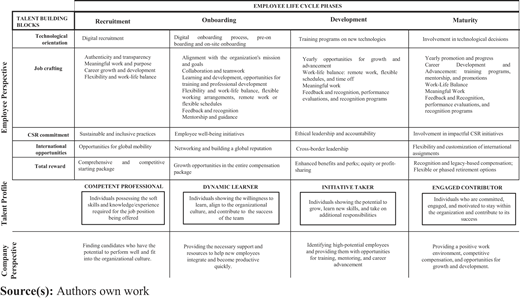
Each phase is defined by shifting company expectations and talent profiles, as well as by evolving employee-driven factors. From this analysis, five talent building blocks emerged: technological orientation; job crafting; CSR commitment; international opportunities; and total reward. A detailed breakdown of these findings, organized by the four life cycle phases, is provided in the following sections and highlighted in Table 2.
Recruitment phase
During recruitment, firms aim to identify high-potential candidates who not only have the required skills and experience but also fit well with the organizational culture. This process places the emphasis on finding professionals who have the necessary knowledge and experience for the position but who also have soft skills that align with the company's values and work environment.
From the candidate's perspective, a digital recruitment process signals a modern, innovative culture. Applicants increasingly value a seamless, transparent hiring experience that reflects a forward-thinking approach, enhancing both their experience and their perception of the company's commitment to innovation and adaptability in meeting both current and future workforce expectations. “One candidate put it best: “The process felt custom-made – quick, intuitive, and a true glimpse into the company's tech-savvy spirit.” Our digital-first approach doesn't just streamline hiring; it gives candidates a first-hand look at our innovation, setting the perfect tone for the workplace they're joining.”
The findings suggest that candidates prioritize authenticity and transparency, seeking employers who align with their values and provide a clear sense of purpose. This purpose, ideally, extends beyond the immediate job scope, allowing candidates to feel they are engaging in work with genuine purpose and impact, while also being offered rapid career progression and opportunities for substantial personal development. Additionally, candidates emphasize the importance of flexibility, recognizing its critical role in achieving a healthy work–life balance amid evolving workplace expectations. “Today's candidates are really focused on finding more than just a paycheck – they want a genuine connection with the company.” This reinforces the importance of tailored professional experiences.
Additionally, sustainability, international mobility, and holistic compensation packages (including both financial and non-monetary benefits) are critical factors in candidates' decision-making processes. “As one applicant noted, ‘I'm looking for a place where the values aren't just words on a website. I want to feel like my work has a purpose and contributes to something meaningful.’ They also ask a lot about growth opportunities; they're thinking long-term and want to know there's room to develop and advance. And flexibility is a big part of the conversation too; candidates expect the organization to support a healthy work–life balance. Authenticity, purpose, career growth, and flexibility have become non-negotiables for attracting the best talent.”
The interviewees also confirmed that candidates are seeking positions/jobs that go beyond just work and encompass aspects such as sustainability, international opportunities and reward. Specifically, the modern purpose-driven candidate is highly alert to the sustainable orientation of the organization, on both an environmental and a social level. “Today's candidates aren't just job hunting – they're purpose hunting. They want to know their work fuels a company that's walking the talk on sustainability and inclusivity. For them, it's about joining a team that values people and the planet as much as profits. Aligning with these values has become the new gold standard for attracting top talent.” Moreover, candidates increasingly look at international mobility opportunities to add value to their career, as testified to by one of the interviewees who stated that “today's candidates are craving a world beyond borders – they're not just looking for a job; they're looking for a passport to new perspectives.”
While candidates place significant emphasis on non-economic compensation, this does not diminish the importance of financial rewards. On the contrary, they are increasingly aware of their value, and seek work environments that invest in their professional growth – through both competitive salaries and meaningful non-monetary benefits. This dual focus reflects a desire for holistic value in the workplace, where personal development and fair economic recognition are equally prioritized. “Top talent seeks a strong starting package as a sign of respect and recognition, a clear message from the company: “We value and invest in you from day one.”“
To summarize, in this dynamic landscape organizations must strike a balance between economic and non-economic rewards to attract top talent, as the question is no longer just “Are you qualified for the job?” but “Does this organization align with your vision for your career and life?”.
Onboarding phase
Once the employee is selected, the onboarding phase begins. During this phase, the company's objective is to provide all the necessary support and resources to help new hires integrate quickly and become productive. In return, the organization expects employees to demonstrate a willingness to learn, to align with the organizational culture and to contribute to the team's success.
For employees, a digital-first approach remains crucial, especially for pre-onboarding and on-site integration. As was noted: “New hires love our tech-driven onboarding – it's like having a digital guide that makes their first weeks seamless and keeps them connected from day one. It sets the stage for a truly modern workplace.”
During this phase, job crafting focuses on engagement and flexibility: employees value clear communication of the company's mission and goals, which fosters a sense of inclusion: “When people know they're working towards a shared vision, it sparks a sense of purpose that makes onboarding feel like stepping into something meaningful.” Indeed, “onboarding here isn't just learning processes; it's about connecting with a network of teammates ready to support each other.”
Regular feedback and mentorship are also crucial for boosting confidence and helping new employees grow professionally: “New hires appreciate the steady feedback – it feels like guidance that's shaping their success, not just critique.” Another interviewee added that “with mentorship built into onboarding, new hires feel they have a partner guiding them through the first steps – it's like having a personal navigator”.
Beyond professional development, flexibility and work–life balance are highly valued by new employees, who view these as signs that the organization is honouring its promises, thus fostering trust and satisfaction. “Candidates value that onboarding respects their need for balance, with flexible options that make it easy to integrate work with life.”
Attention to work–life balance is closely linked to the growth in awareness regarding social sustainability: initiatives designed to support employees' mental and physical well-being play a critical role in engaging employees and creating a positive work experience, fostering motivation among new hires. “New hires are quick to notice our focus on well-being as they feel we care about them as people, not just as workers.”
While economic rewards are important, new employees prioritize professional growth during onboarding, seeking clear pathways for career development. As highlighted by one interviewee: “New hires love seeing an opportunity for growth from the very start – it's like being handed a map with endless possibilities. Knowing there's room to rise energizes them, turning onboarding into the launchpad for their future success.”
In conclusion, onboarding serves not only as a process of integration but also as a strategic framework for promoting long-term success. By aligning new hires with the firm's core values, facilitating their professional development and providing a balanced and supportive environment, onboarding plays a critical role in shaping employees' initial experience.
Development phase
The development phase is crucial for talent retention, as employees who are well-trained and highly skilled are increasingly attractive to competitors in the job market. To retain top talent, consultancy firms must therefore identify high-potential individuals and invest in their growth through tailored training programmes, mentorship and competitive career advancement opportunities.
From the company's perspective, ideal employees are those who demonstrate potential for further development, take on new responsibilities, and play an increasingly proactive role in advancing the firm's strategic priorities. Simultaneously, employees in the development phase prioritize constructive feedback and transparent performance evaluations. They also seek a balance between professional development and personal well-being as essential components of fulfilment.
“Employees genuinely appreciate that we prioritize their growth and find it motivating to know that each year brings new opportunities to advance. They value continuous feedback and recognition – it makes them feel like their efforts matter.” Another interviewee added: “One team member mentioned, “It's inspiring to work in a place where leaders stand by their values and take responsibility – it sets a standard we all want to live up to.” Knowing that integrity is a core part of our culture makes them proud to contribute and grow here.”
Although employees focus on non-economic factors, financial rewards remain important. At this stage, options like profit-sharing or equity plans enhance their sense of ownership in the company's success. “Employees appreciate the enhanced benefits and equity options – it's more than just compensation; it's about feeling like they have a real stake in the company's success. Profit-sharing turns their hard work into shared wins, making them truly invested in our growth.” Therefore, the development phase is a pivotal moment at which the alignment of organizational and individual goals drives mutual success.
By fostering an environment that prioritizes professional growth, meaningful work and well-being, companies not only retain top talent but also nurture a workforce that is intrinsically aligned with the corporate mission and long-term direction.
Maturity phase
Employees in the maturity phase are deeply committed to the organization's values and goals, and their alignment with the company motivates them to contribute meaningfully to its success. To sustain their employees' loyalty, firms must provide competitive compensation, along with tailored opportunities for both personal and professional consolidation. Mature employees also value inclusion in decision-making, especially regarding organizational changes, as it reinforces their sense of belonging and their role in shaping the company's future. Indeed, as one interviewee observed, ‘Seasoned employees love being at the table for big tech decisions – “It's like steering the ship, not just sailing on it”, one veteran said. Their input shapes the tech future, making them feel like true visionaries in our journey.’
When it comes to compensation, while the economic component of the compensation package remains important, it is no longer sufficient on its own to retain mature employees, as they value a work–life balance and a strong sense of purpose, viewing these factors as essential to their overall job satisfaction and long-term engagement. “Employees in their maturity phase appreciate the whole journey – yearly promotions, growth-focused training programmes, balanced work–life options, meaningful projects, and recognition that truly acknowledges their contributions. It's a career experience that keeps them engaged, valued, and continually progressing.”
Furthermore, mature employees are more focused on their future, whether in terms of career progression or retirement. They appreciate opportunities that help them transition smoothly into these stages. Such efforts are seen as a testament to the company's commitment to their long-term well-being. “Seasoned professionals appreciate legacy-driven rewards and the freedom of a flexible retirement path – it's like the company saying, “Your impact endures, and you choose the pace to pass the torch.” It's recognition that honours their journey and lets them shape their next chapter.”
As they progress in their careers, the sense of purpose of employees extends beyond the organization, and increasingly they are drawn to companies that demonstrate a strong commitment to social and environmental sustainability. This alignment with the company's sustainability efforts fosters pride and a deeper connection to the organization's mission: “Employees love when their CSR efforts are celebrated – it's like a badge of honour that shows their impact goes beyond the bottom line. Recognition in this area makes them feel part of something bigger, a force for good within the company.”
In conclusion, retaining mature employees requires a thoughtful balance of meaningful engagement, purpose-driven opportunities and recognition of their evolving needs. By fostering a work environment that values their contributions and supports their growth, organizations not only secure their loyalty but also harness their experience and insights to shape future strategic directions.
Discussion
This study advances the TM literature by addressing the two primary limitations of the POF paradigm. While POF has long served as a foundational lens for understanding alignment between employees and organizations (Chatman, 1989; Kristof, 1996; Kristof-Brown et al., 2023; Vianen, 2018), its static orientation and micro-level focus make it increasingly inadequate in today's dynamic business environment. Drawing on contingency theory as our overarching framework, complemented by the career life cycle perspective and social exchange theory, we develop the TOF framework to reconceptualize fit as a fluid, temporally evolving, and context-contingent process, capturing the evolving alignment between individual aspirations and organizational requirements across the employee career life cycle. TOF therefore addresses the key limitations in the traditional POF approach, which often assumes a static match between fixed individual traits and stable organizational values.
Three key elements distinguish TOF from prior models. First, TOF introduces fluidity, emphasizing that both the employee and the organization evolve over time in response to career progression. Second, it incorporates temporality by explicitly linking TM practices to specific stages of the career life cycle, highlighting how needs, motivations and engagement levers change. Third, TOF applies a contingency perspective, emphasizing that effective TM requires alignment not only with individual attributes but also with broader contextual factors, including industry structures, generational expectations and societal demands for sustainability and inclusion. These conceptual advances contribute to ongoing debates in TM research by advocating a more developmentally attuned, life-cycle-sensitive, and industry-aware approach. In contrast to static or universalist models, the career life cycle perspective supports the design of TM strategies that align with shifting employee priorities and contextual realities. This framework is especially salient for consultancy firms in which knowledge intensity, fluid career trajectories, and performance-driven structures demand a more adaptive and nuanced view of talent fit. Simultaneously, social exchange theory adds a crucial behavioural mechanism: when organizations invest in adaptive, stage-sensitive TM strategies, employees perceive these as signals of support and reciprocate with engagement, loyalty and better performance (Blau, 1964; Chen et al., 2016). Our findings directly reflect the three theoretical pillars introduced earlier, namely POF, the career lifecycle and social exchange theory, showing how TOF extends each of them.
First, our conceptualization contradicts the static assumptions of traditional POF: alignment is not a fixed state but a fluid and continuously negotiated process shaped by shifting employee priorities across career stages. Second, the lifecycle perspective offers a clear temporal reconfiguration of the 5 TM building blocks, demonstrating that motivations, expectations and contributions evolve in predictable patterns. Third, recurring references to reciprocity, perceived investment and trust highlight the centrality of social exchange mechanisms: employees respond positively when firms tailor TM practices to their stage-specific needs. Our findings also highlight organizational reputation as a key outcome of TM practices. The five building blocks identified in this study not only respond to evolving employee needs across the career lifecycle, but also contribute to the shaping of a coherent and dynamic employer reputation across career stages. As organizations continuously recalibrate their TM strategies to sustain alignment, they reinforce perceptions of credibility, consistency and purpose, which collectively build a strong organizational reputation over time. In this sense, reputation reflects the effectiveness of TOF, capturing the extent to which organizations are able to sustain alignment across the employee lifecycle.
In sum, our study substantiates the theoretical lens of TOF by revealing how perceptions of talent attraction and retention evolve across career stages in consultancy firms, demonstrating that the relative importance of the five building blocks of TOF (technological orientation, job crafting, CSR commitment, international opportunities and total rewards) shifts across the employee life cycle and is embedded in contextual contingencies. For example, early-career professionals prioritize technological sophistication, skill acquisition and CSR, mid-career employees privilege autonomy, structured leadership opportunities and international mobility as critical levers of retention (Tyskbo, 2025). In contrast, later-career professionals value legacy, recognition and flexible arrangements for transitioning towards retirement. These patterns illustrate that the TOF framework occurs in practice, confirming the need for organizations to adopt dynamic and stage-sensitive TM strategies.
This study offers several interesting insights into the TM strategies of consulting companies, especially with regard to the evolving meaning of each TM building block. Technology, initially a source of excitement and career differentiation for younger employees (Grenčíková and Vojtovič, 2017), and particularly reflective of generational affinities with digitalization, becomes a pragmatic tool for efficiency and strategic contribution in later career stages (Montero Guerra et al., 2023). Thus, transitioning through career stages, employees focus on tools that streamline decision-making and facilitate high-impact strategic contributions, rather than on exploratory engagement with emerging technologies, suggesting that consultancy companies should recalibrate their digital talent strategies to ensure continued alignment.
Job crafting, initially linked to exploration and skill development, later shifts towards leadership, influence and mentoring opportunities, giving value to autonomy and challenge as enablers of personal and professional growth (Zhang and Parker, 2019). Similarly, CSR evolves from a broad desire for purpose-driven work in the early career stage to a demand for targeted, high-impact contributions in later stages (Barakat et al., 2016). The total rewards package also demonstrates temporal variation, with financial elements critical at entry and retirement but complemented by non-financial rewards such as flexibility, visibility and autonomy during the mid-career stage (Rodríguez-Sánchez et al., 2020). It is, therefore, imperative to consider this nuance in order to secure long-term employee commitment and loyalty, and to avoid pure monetary-focused compensation (Chen et al., 2016; Rücker, 2018).
Finally, international opportunities represent a strategic asset throughout the professional life cycle: while often associated with career acceleration in the early stages, they become strategic platforms for network building in the mid-career stage and capstone experiences in maturity (Baluku et al., 2018).
Therefore, our research emphasizes that talent alignment is not fixed but rather is a dynamic, evolving process shaped by individual career paths and changing organizational needs. From a theoretical standpoint, these findings extend the POF by illustrating how talent alignment must be understood as a contingency-based process of continuous recalibration rather than a static match. Therefore, the TOF is a novel framework that integrates contingency theory's contextual sensitivity, the temporality of the life cycle perspective, and social exchange theory's behavioural mechanism of reciprocity. This synthesis advances scholarly debate by offering a multidimensional and adaptive model of TM that more accurately reflects contemporary workforce and organizational realities (Greguras and Diefendorff, 2009; Harsch and Festing, 2020; Krishnan and Scullion, 2017).
An integral component of the TOF framework is the notion that talent is not static but is a continuously evolving concept. TOF inherently recognizes talent as a dynamic, multifaceted construct that is reshaped over time in response to changing professional identities, organizational demands and external environmental factors. This evolution is integrated into the framework, highlighting the idea that talent is inherently fluid (Harsch and Festing, 2020). Figure 1 illustrates this evolving definition of talent across the professional life cycle, connecting it to the changing expectations of the organization and the strategic imperatives of TM.
 The diagram illustrates the transition from the Person-Organization Fit (POF) to the Talent-Organization Fit (TOF) perspective. It starts with the definition of POF, highlighting the compatibility between people and organizations. The diagram identifies three gaps in POF: micro-level focus ignoring the conditions of the fit, static view ignoring the temporality of the fit, and limited adaptability ignoring the behavioral mechanisms of the fit. These gaps lead to three theories: Contingency Theory, Career Lifecycle Perspective, and Social Exchange Theory. These theories converge to form the TOF, which views fit as context-dependent, shaped by individual-organization match and broader contingencies. TOF reconceptualizes fit as fluid, evolving as both employees and organizations change over time. It incorporates a constructive and intentional view of fit, sustained through mutual reinforcement.
From the POF to the TOF perspective. Source: Authors’ own work
The diagram illustrates the transition from the Person-Organization Fit (POF) to the Talent-Organization Fit (TOF) perspective. It starts with the definition of POF, highlighting the compatibility between people and organizations. The diagram identifies three gaps in POF: micro-level focus ignoring the conditions of the fit, static view ignoring the temporality of the fit, and limited adaptability ignoring the behavioral mechanisms of the fit. These gaps lead to three theories: Contingency Theory, Career Lifecycle Perspective, and Social Exchange Theory. These theories converge to form the TOF, which views fit as context-dependent, shaped by individual-organization match and broader contingencies. TOF reconceptualizes fit as fluid, evolving as both employees and organizations change over time. It incorporates a constructive and intentional view of fit, sustained through mutual reinforcement.From the POF to the TOF perspective. Source: Authors’ own work
From the POF to the TOF perspective
Based on the four stages of the employee life cycle, we therefore develop four archetypes of talent: the competent professional, the dynamic learner, the initiative taker and the engaged long-term contributor. The competent professional is sought mostly during the recruitment phase, and this term refers to a person who possesses the soft skills and know-how required for the job position being offered. Moving to the onboarding phase, talent shifts towards the dynamic learner, that is, an individual who shows a willingness to cooperate, learn and transfer skills and knowledge, and who demonstrates a growing inclination to add value beyond their core tasks and support the firm's broader objectives. In the development phase, talent as a construct evolves into the initiative taker, which refers to a person who has reached a professional maturity that enables them to take on new responsibilities and embark on new projects. Finally, the maturity phase is based on the engaged long-term contributor, who is a fully trusted employee, willing to stay within the firm.
Simultaneously, the organizational requirements to manage and sustain the different archetypes of talent undergo changes throughout the life cycle, thereby necessitating the restructuring of the mechanisms that guarantee a sustained alignment between the individual and the organization. Indeed, as shown in Fig. I, finding candidates who have the potential to perform well and fit into the organizational culture is a primary objective in the recruitment process to attract competent professionals; during onboarding, the company has to provide the dynamic learner with the necessary support and resources to help them successfully integrate (Lukman and Kee, 2020). When the employee enters the development phase, the firm has to detect those high-potential employees who may become initiative takers, and provide them with opportunities for training, mentoring and career advancement. Finally, during maturity, the firm needs to ensure a positive work environment, a competitive total reward and opportunities for growth and development that can together keep the psychological contract binding the long-term contributor to the organization (Höglund, 2012; Rücker, 2018).
Contributions and implications
This research provides significant contributions to both theory and practice. From a theoretical standpoint, our study advances the POF framework by introducing TOF, conceptualizing fit as dynamic, temporally evolving and contingent upon context. While traditional POF theory predominantly characterizes alignment as a static, trait-based phenomenon (Cable and DeRue, 2002; Chatman, 1989; Donald, 2023; Greguras and Diefendorff, 2009; Kaliannan et al., 2023; Kristof, 1996; Morley, 2007; Vianen, 2018), TOF explicitly integrates temporal and contextual dimensions, recognizing that employee aspirations and organizational needs shift substantially across different stages of the career life cycle (Gallardo-Gallardo et al., 2020; Harsch and Festing, 2020; Schinnenburg and Böhmer, 2025). Thus, TOF provides a conceptual lens for understanding and theorizing TM as an adaptive alignment process, rather than as a one-time, static match.
Moreover, building on prior suggestions that individual talents should be a privileged unit of analysis (McDonnell et al., 2017), this study delineates four distinct archetypes of talent: the competent professional, the dynamic learner, the initiative taker and the engaged long-term contributor. These archetypes provide a structured theoretical tool for examining the micro-foundations of talent evolution (Kabalina and Osipova, 2022). By specifying how talent archetypes are manifested at each career stage, we enrich the ongoing scholarly dialogue on how organizations can design context-sensitive TM practices (Lukman and Kee, 2020; Rodríguez-Sánchez et al., 2020). These four archetypes empirically validate the TOF framework. They illustrate fluidity, namely that talent profiles evolve across stages; temporality, meaning that distinct motivational priorities emerge at each stage; and contingency, the idea that profiles are shaped by industry-specific demands and societal expectations. Thus, the archetypes provide concrete evidence for the multidimensionality of TOF, bridging theory and practice.
From a practical standpoint, TOF provides consultancy firms with valuable guidance to craft stage-tailored and contextually grounded TM strategies (Sarra et al., 2022; Vardi and Collings, 2023). For instance, firms seeking to attract early-career talent should invest in digital-first recruitment and onboarding systems, skill development programmes and visible CSR commitments. To retain mid-career professionals, firms must prioritize leadership development, international mobility and flexible job crafting opportunities. For late-career employees, recognition, mentoring opportunities and support for legacy-building and flexible retirement planning are essential for securing long-term commitment. By tailoring TM strategies in these ways, firms can strengthen their psychological contract with employees, reducing turnover and enhancing both engagement and organizational competitiveness.
Managerially, TOF offers consultancy firms a clear, stage-based blueprint for designing context-sensitive TM systems. Digital-first recruitment, CSR signalling, and skill acceleration programmes are essential for young entrants; personalized job crafting and international rotations become critical for mid-career professionals; and recognition, autonomy and legacy-building activities sustain senior employees. These findings identify not only what matters at each stage, but why it matters, providing actionable guidance for redesigning HR policies, key performance indicators (KPIs) and career architectures in a way that enhances commitment and retention across the entire lifecycle.
Accordingly, organizations can recalibrate their KPIs to align with the TOF life cycle approach. This involves adopting stage-specific KPIs, such as employee skill development metrics in early careers, internal mobility and autonomy indicators for mid-career professionals and recognition and legacy-orientated metrics for senior employees. Such tailored TM practices and measurement approaches ensure that talent strategies remain dynamically attuned to employees' evolving needs, ultimately reducing disengagement and attrition risks.
By integrating these theoretical advancements and practical insights, our study not only enhances scholarly understanding of talent alignment but also provides strategic direction for HR professionals aiming at fostering sustained competitive advantage through adaptive and context-sensitive TM practices.
Limitations and future research avenues
The study presents some limitations that offer interesting avenues for future research. First, our focus on a linear progression of employee life cycle stages, while it is in line with prior studies (e.g. Low and Bordia, 2011; Low et al., 2016) and provides a contingency perspective on TM strategies, may not fully address the diversity of non-traditional career paths, such as re-entry or job rotations. Hence, future studies might expand the life cycle model to account for more varied career experiences. Second, as we extend the POF framework to a TOF perspective, we maintain the important role of alignment. However, an excessive focus on fit may foster homogeneity, unintentionally reinforcing groupthink and pressures for conformity, and thus overlooking potential trade-offs and restricting autonomy and creativity.
Cognitive dissonance and misalignment may represent productive vehicles of innovation and strategic agility. While this aspect goes beyond the scope of our study, we encourage future research to explore the potential benefits deriving from a work environment that challenges the status quo. In this sense, different socio-demographic characteristics of employees, such as generation (Grenčíková and Vojtovič, 2017), may play a crucial role. Indeed, the weights assigned to the different TM factors may differ as a function not only of the career stage but also of individual characteristics.
Finally, as talent is context-specific (Gallardo-Gallardo et al., 2020; McDonnell et al., 2011), we believe that our understanding of its micro-foundations could be further enriched by extending this framework and investigating other research settings combining different firm sizes – both SMEs and large companies – and different industries beyond consultancy, while at the same time offering a comparative public–private perspective.
Conclusions
Our research accentuates the conclusion that talent alignment is influenced by multiple factors, including technological orientation (Montero Guerra et al., 2023), job crafting (Hakanen et al., 2018; Oprea et al., 2022; Zhang and Parker, 2019), CSR commitment (Barakat et al., 2016), international exposure (Baluku et al., 2018) and total reward system. However, these factors do not exert a uniform influence across all career stages. Instead, they shift in prominence as professionals progress in their careers, demanding a more agile and responsive approach from organizations seeking to optimize talent retention and development.
The strategic implications of our findings highlight the necessity for consultancy firms to embrace a career-stage-sensitive TM approach. Firms that fail to acknowledge and address the shifting priorities of employees run the risk of disengagement, increased turnover and diminished competitive advantage. Conversely, those capable of proactively adapting their talent approaches by integrating structured career development pathways, fostering meaningful work engagement (Oprea et al., 2022), and ensuring holistic reward structures will enhance their ability to attract, retain and develop top-tier professionals. As firms recognize and integrate these elements into their TM practices, they can strengthen both their internal stability and their reputation, which emerges as a key outcome of sustained alignment between employee needs and organizational strategies, ultimately reinforcing their ability to attract, engage and retain talent in a dynamic and competitive consultancy environment.
Appendix
The interview protocol
| Area | Questions |
|---|---|
| Study purpose, consent |
|
| Participant background |
|
| Early career expectations and employer appeal |
|
| Initial experiences and integration processes |
|
| Mid-career needs and organizational strategies |
|
| Late-career motivation and support |
|
| Overall evaluation and additional input |
|

