The purpose of this study is to improve the understanding of the interplay between formal control mechanisms, silence and trust in controlling challenging financial accounting outsourcing (FAO) initiatives in the municipal sector. Specifically, it examines the role of silence and trust through the lens of behavior and outcome controls in established inter-organizational relationships.
The article adopts a case study approach to investigate the control of FAO using data from semi-structured interviews and extensive archival materials.
The results show that challenges around progressing FAO result in the use of different forms of silence between various organizational levels, thus hampering the use of control mechanisms and the development of trust. The forms of silence used are opportunistic, acquiescent and technical silence. When accounting systems malfunction, it becomes impossible to exercise formal control, which, in turn, increases organizational silence, decreases trust across all levels and fosters managerial frustration regarding the monitoring of the FAO process.
This study adds to the interorganizational control literature by linking different forms of silence and trust to formal control mechanisms.
The recommendation is to use management control mechanisms at both strategic and operational management levels and to establish open communication channels to improve coordination and control to support FAO in the public-sector context.
Considering the limited prior research on challenging accounting outsourcing, this study contributes by analyzing two challenging accounting outsourcing cases and the role of silence/silencing and trust therein.
1. Introduction
Financial accounting outsourcing (FAO), defined as the practice of contracting all or part of the accounting processes to a third-party service provider (Asatiani et al., 2019), presents inherent risks and the emerging interorganizational relationships (IORs) are characterized by complexity (Stouthuysen et al., 2019). Conflicting interests may arise not only between the partners but also at multiple levels within an organization (Dekker et al., 2019; Huy, 2001). Additionally, joint projects are frequently confronted with various technical and performance issues (Smith et al., 2001). Accountants and managers may also encounter challenges related to the control and coordination of the FAO process (Faituša et al., 2020; Smith et al., 2001).
The interorganizational control (IOC) literature addresses concerns related to collaboration and coordination in IORs by acknowledging the necessity for formal controls that encompass both behavioral and outcome controls, as well as informal (social) controls, which include trust and relational norms (Dekker et al., 2019; Dekker, 2004). Previous IOC literature in the private sector has primarily focused on the roles of formal control and social control (trust) (Agndal and Nilsson, 2019; Dekker et al., 2019; Langfield-Smith, 2008), whereas research on IOCs in the public sector remains relatively underdeveloped and warrants further exploration (Van Veen-Dirks and Giliam, 2020). Nevertheless, scholars assert that the interplay of trust and formal control is crucial for organizational success, including within the public sector (Van Veen-Dirks and Giliam, 2020; Argento and Peda, 2015). However, the “mum effect,” which refers to the reluctance to communicate undesirable information (e.g. Rosen and Tesser, 1970), has not been examined within the IOC context. For instance, in the context of information systems projects, Keil and Robey (1999) provided detailed evidence of challenges stemming from employees’ unwillingness to share negative project status information. Scholars have also identified both organizational silence and vendor silence in IT projects and offshore outsourcing endeavors (Jain et al., 2011). Researchers contend that strategies for mitigating silence can facilitate the early identification of potential problems and enable managers to implement timely corrective measures.
Silence may manifest at the individual level as resistance to accounting practices and control or as support for various organizational changes (d’Astros et al., 2024; Dupret, 2019). Silent resistance may simultaneously enable and constrain the emergence of alternative practices in contexts characterized by control (d’Astros and Morales, 2024). Such silence may diminish both trust and management control (d’Astros and Morales, 2024) and play a crucial role in controlling FAO. Formal control may encourage silence across organizational levels (Morrison, 2011). Conversely, trust in the organization and its supervisors can reduce the use of silence (Dedahanov and Rhee, 2015). Furthermore, management accounting, traditionally perceived as serving the flow of information, official reporting and informal interactions (Roberts and Scapens, 1985), can also trigger the use of silence and operate with silence at all organizational levels to ease conflicts, promote unity or ensure support (d’Astros et al., 2024).
Researchers in human and employment relations have examined silencing as a tactic used by managers to impose silence on employees by concealing information and suppressing their voices (Farjaudon and Morales, 2013). By withholding information from managers, employees can, in turn, undermine management control (d’Astros and Morales, 2024). Furthermore, trust in managers diminishes acquiescent silence, which underscores the role of operational-level managers (Dedahanov and Rhee, 2015; Huy, 2001). Additionally, trust in the organization can be correlated with acquiescent silence (Dedahanov and Rhee, 2015). In the interorganizational context, Jain et al. (2011) integrated the concepts of vendor silence and cultural adaptation within cross-cultural teams to develop a process framework that illustrates how the silence of the service provider can be mitigated in offshore outsourcing.
Consequently, previous literature indicates that silence plays a significant role in shaping the implementation of planned controls and the interaction among actors; however, research on this topic remains limited (d’Astros et al., 2024). To address this gap, the research question of this study is articulated as follows:
How do silence, trust and formal control mechanisms interplay in the context of a challenging financial accounting outsourcing within the municipal sector?
For an outsourcing organization, the interplay between silence, trust and formal control is characterized by inherent tensions related to transaction costs and control issues, as the accounting function traverses organizational boundaries (Nicholson et al., 2006). Moreover, examining the interplay between silence, formal control and trust in FAO provides deeper insights than would be possible by examining each factor in isolation (Elharidy et al., 2013).
This study focuses on the roles of silence and trust as examined from the perspectives of behavioral and outcome control in established and ongoing IORs. The research investigates FAO within the municipal context at both strategic and operational management levels, as silence, trust and formal control may be used differently across various organizational levels (d’Astros et al., 2024). This is a comparative case study of two cities facing challenges regarding their FAO. The case organizations, designated as City1 and City2, are both clients of the same focal FAO service provider. The FAO service provider operates independently from local bureaucracy and is governed by an appointed executive board (Voorn et al., 2017). In total, 19 semi-structured interviews were conducted at the strategic and operational management levels, with all managers responsible for FAO oversight participating. We used a systematic process to identify the interplays of silence with formal control and trust based on qualitative data, including interview transcripts and archival data, to discern themes, patterns and relationships.
This research aims to extend the existing literature on IOC (Dekker et al., 2019; Ditillo et al., 2015; Argento and Peda, 2015) in three significant ways. First, by examining the interplay between silence, formal control and trust, our study contributes to the management control literature within IORs. Prior research on silence has predominantly focused on the intra-organizational context (d’Astros et al., 2024; Ebrahimi et al., 2023; Dedahanov and Rhee, 2015). Our findings indicate that challenges involved in FAO lead to the withholding of ideas and concerns at both strategic management levels (upwards and downwards) and operational management levels (upwards), resulting in a lack of trust among various organizational tiers and impeding the effective use of control mechanisms.
Second, IOC research illustrates that behavior monitoring as a form of ex-post IOR establishment encompasses reporting and checking devices (Dekker, 2004; Das and Teng, 1998). In the context of FAO, information technology assumes a critical role; without the ability to use reporting devices, behavior monitoring becomes challenging. If reporting and checking devices malfunction, organizational silence can be amplified and collaboration among operational-level managers undermined, thereby eroding trust in the outsourcing service provider. Finally, previous research in the municipal context proposes that planned behavior and outcome control mechanisms in the form of detailed contracts play a key role at the strategic level in both organizations (Krause and Swiatczak, 2021). Our findings show, however, that ex-post control (both behavior and outcome) is inadequate if there is silencing of the operational-level actors in the IOR. While ex-ante behavior control in the form of jointly accepted rules and regulations exists at a strategic level in both organizations, the use of ex-post behavior control in the form of reporting and checking devices, written notifications, financial audits, cost and quality control remains inadequate. The practical implications include a recommendation to use management control mechanisms at both strategic and operational management levels and to facilitate open communication channels for successful coordination and control for FAO in the public sector context.
The remainder of this article is structured as follows: Section 2 presents the relevant literature on formal control mechanisms, silence and trust. Section 3 explains the research design and methodology. Section 4 presents and analyzes the findings from the case organizations (City1 and City2). Section 5 discusses the relationship between the findings of this study and the existing IOC literature. Finally, Section 6 summarizes the findings, contributions, limitations and suggestions for future research.
2. Literature review
Public-private partnerships have been examined from various perspectives (Boyce and McDonald-Kerr, 2021). In recent years, there has been a notable increase in attention paid to the outsourcing of accounting functions and automation, primarily due to the transformative effects brought about by automation and new technologies (Faituša et al., 2020). A discernible trend is the shift from the outsourcing of routine accounting tasks, such as recording invoicing and preparing interim reporting, to the outsourcing of non-routine accounting tasks, including period-end accounting and the preparation of financial statements. Contemporary research also underscores the significance of temporary accountants as key drivers of firms’ digital transformation (Mancini et al., 2021). However, prior studies have identified several challenges associated with control and coordination issues (Dekker et al., 2019; Dekker, 2004). Additional challenges encountered in FAO include a lack of management commitment, an absence of a communication plan, failure to recognize outsourcing risks and an inability to secure external outsourcing experts (Power et al., 2004).
Managers seeking to mitigate potential risks and challenges associated with FAO must acknowledge the necessity of formal controls, which encompass both behavioral and outcome controls and also informal (social) controls that involve trust and relational norms (Dekker et al., 2019; Dekker, 2004). Das and Teng (1998) pointed out that behavioral monitoring can be executed through various reporting and controlling mechanisms. Information technology forms the foundation of such reporting (Faituša et al., 2020). However, it has been observed that silence may adversely affect both trust and management control (d’Astros and Morales, 2024), thereby prompting an exploration of the manifestations of silence within the FAO context. At the individual level, silence can manifest as a form of resistance to accounting and control mechanisms or as a means of endorsing various organizational transformations (d’Astros et al., 2024; Dupret, 2019). Silent resistance may either facilitate or obstruct the emergence of alternative practices in contexts characterized by control (d’Astros and Morales, 2024). Furthermore, Harris et al. (2025) emphasized that the centralization of power often silences marginalized voices.
2.1 The role of silence
Morrison and Milliken (2000) define organizational silence as a collective phenomenon in which employees withhold their opinions on and concerns over organizational issues. This phenomenon arises when a culture of silence is fostered within an organization (Morrison, 2014). In instances of performative silence, the decision-making process is suspended and actors may use silence to either support or resist organizational change (Dupret, 2019).
If leaders and organizations are to adapt their decisions in response to a rapidly changing business environment (Ashford et al., 2009), enabling the voices of employees is crucial. At the organizational level, employee voices can be viewed as informal and discretionary communication forms that encompass improvement suggestions, concerns, information about problems or opinions regarding work-related issues directed toward managers who possess the capacity to implement appropriate actions to foster improvement or change (Morrison, 2014). Furthermore, a high level of bureaucracy may inhibit discussions among actors at various organizational levels (Morrison, 2011). At the individual level, employee silence has been categorized in various ways, depending on the individual’s reasons for refraining from sharing ideas, information and concerns with others (Ebrahimi et al., 2023).
Researchers differentiate between quiescent and acquiescent silence (Morrison and Milliken, 2000; Pinder and Harlos, 2001). Quiescent silence manifests as disengaged behavior stemming from resignation, whereas acquiescent silence reflects self-protective behavior attributable to fear (Ebrahimi et al., 2023). Pinder and Harlos (2001) reported that employee quiescence constitutes a form of intentional withholding. In situations involving workplace injustice, it refers to an uneasy, deliberate state of mind that can be changed either independently or in response to others. A quiescent employee indicates dissatisfaction with the existing circumstances, essentially enduring them silently while acknowledging potential options for change but not pursuing them. However, quiescent employees may be inclined to voice their concerns to alter the conditions that triggered their silence. Conversely, employee acquiescence signifies a profound recognition of the organizational environment and a perception of the situation as predetermined, with a limited awareness of possible alternatives. In instances of injustice, acquiescence entails disregarding available options and a lack of motivation to pursue them (Pinder and Harlos, 2001). Van Dyne et al. (2003) expanded the concept of silence to include pro-social silence, when individuals withhold information due to pro-social intentions aimed at preventing harm to their organization. Accordingly, quiescent silence is driven by employee disengagement; acquiescent or defensive silence is motivated by self-protection; and pro-social silence is characterized by other-oriented behavior rooted in altruism and collaboration (Ebrahimi et al., 2023). Opportunistic silence is defined by Knoll and van Dick (2013) as the strategic withholding of ideas, information and concerns to benefit oneself.
Employees may use silence as a form of resistance against managerial strategies and objectives (Nechanska et al., 2020). Employee silence can involve the deliberate choice to refrain from sharing information on work-related matters or issues, which may be indicative of low motivation, low satisfaction, withdrawal, resistance or stress (Morrison, 2014). Silence can also represent a conscious, intentional and purpose-driven action (d’Astros et al., 2024). Trust in the organization is associated with acquiescent silence, while trust in the supervisor correlates with defensive silence. Furthermore, acquiescent silence is strongly linked to organizational commitment (Dedahanov and Rhee, 2015). Employee trust in supervisors and organizations mitigates silence and enhances engagement in contributing additional effort toward the organization’s success (Dedahanov and Rhee, 2015). In the context of IOR, the silence of service providers is influenced by vendor management policies, the openness of the environment and the level of shared knowledge (Jain et al., 2011).
Silence may also manifest as a failure to disclose information in accounting reports or through the selective involvement of only certain parties, thereby generating exclusive dialogues while marginalizing other groups (Nechanska et al., 2020). Accordingly, silence may be viewed as a materialized practice that produces power (d’Astros and Morales, 2024). Haraldsson (2016) found that forms of control influence compliance in accounting practices and contribute to a general reluctance to disclose information. From this perspective, management control encompasses the notion that accounting professionals are willing to discuss accounting information or produce relevant financial reports (d’Astros et al., 2024). This discussion is not always an open one; it often occurs in closed channels accessible only to certain individuals (d’Astros and Morales, 2024). Nevertheless, silence can facilitate engagement among individuals in organizational conversations (d’Astros et al., 2024).
2.2 The role of formal control
Organizations use formal control mechanisms to address concerns regarding appropriation and coordination challenges (Dekker et al., 2019; Dekker, 2004), particularly in outsourcing situations that cross organizational boundaries. IOC encompasses all formal mechanisms, including contracts, organizational structures, target setting and performance monitoring (Dekker et al., 2019; Anderson et al., 2015). Formal contracts delineate the rights and obligations of the collaborating parties and can be advantageous for controlling service providers in the public sector (Argento and Peda, 2015). Formal control in IORs is based on outcome and behavior controls, wherein detailed contracts are used to monitor performance through mechanisms such as specified norms, detailed rules and performance targets aimed at ensuring continuous supervision, performance measurement and evaluation (Ditillo et al., 2015; Langfield-Smith and Smith, 2003; Van der Meer-Kooistra and Vosselman, 2000).
Outcome control mechanisms specify the expected outcomes from the collaborating organizations and monitor the fulfillment of those performance objectives (Dekker et al., 2019; Dekker, 2004). Goal setting, as an ex-ante outcome control, establishes the pathway for task accomplishment, defines shared expectations and enhances the alignment of goals (Dekker, 2004; Das and Teng, 1998). Performance monitoring and rewards constitute forms of ex-post outcome control (Dekker, 2004). Ex-ante behavior control delineates the expected actions of collaborating parties, while ex-post behavior control monitors the fulfillment of these pre-specified actions. Behavior monitoring encompasses components such as reporting and checking devices, written notifications of any deviations from the agreement, financial audits, cost control, quality management, dispute resolution clauses and provisions for legal action (Dekker, 2004; Das and Teng, 1998).
Formal control mechanisms are considered effective means to manage increased information processing requirements (Dekker, 2004). Interorganizational formal controls are selected and implemented at the organizational level (Dekker et al., 2019; Anderson et al., 2015; Dekker, 2004). According to Van Veen-Dirks and Giliam (2020), local government does not extensively use outcome controls; instead, behavior controls, such as decision-making by strategic-level managers, tend to prevail and assume great importance in the public sector.
2.3 The role of trust
Ex-ante social control mechanisms are associated with partner selection, as well as goodwill and competence trust. Following implementation (ex-post), trust is cultivated through joint decision-making, problem-solving and partner development (Dekker, 2004). Within the IOC literature, trust is regarded as the primary mode of social control (Argento and Peda, 2015; Dekker, 2004). Through repeated interactions, individuals engaged in interorganizational activities begin to exchange ideas and information, address conflicts and solve shared problems, including those arising between local governments and external service providers (Dekker et al., 2019; Argento and Peda, 2015; Vélez et al., 2008). Scholars have posited that trust emerges through learning and adaptation processes, thereby strengthening the relationships between collaborating parties, enhancing the durability of these relationships and facilitating knowledge sharing among them (Cuganesan et al., 2017; Van der Meer-Kooistra and Vosselman, 2000).
Trust, as a form of social control, is considered an informal mechanism (Dekker, 2004; Langfield-Smith and Smith, 2003; Ouchi, 1979). It is particularly effective in addressing unforeseen events and issues not expressly covered in contract terms (Argento and Peda, 2015). The IOC literature encompasses outcome, behavior and social control, extending beyond the purely transactional economic perspective of IOC and proves beneficial in addressing appropriation concerns and coordination challenges in IOR (Dekker, 2004). The role of trust within the IOC context has also attracted scholars interested in the public sector (Krause and Swiatczak, 2021; Van Veen-Dirks and Giliam, 2020; Ditillo et al., 2015). Krause and Swiatczak (2021) found that trust enhances the utilization of outcome control. Research conducted by Van Veen-Dirks and Giliam (2020) on the interplay between control, trust and perceived risk in public sector joint ventures demonstrated that trust serves as a foundational element for collaboration and is a critical factor in successful outsourcing. Ditillo et al. (2015) argue that the reliance on trust-based control cannot be solely elucidated by transactional characteristics, as suggested by traditional IOC literature, but is more accurately explained by the formality of the political processes related to decision-making in the public sector.
The distinction between competence trust and goodwill trust is deemed significant in the governance of strategic alliances (Langfield-Smith, 2008). Competence trust pertains to a partner’s capacity to fulfill contractual obligations, while goodwill trust is defined as the perception of a partner’s intention to uphold the agreement (Langfield-Smith, 2008). A service provider’s strong performance bolsters both goodwill trust and competence trust; conversely, failure to align with the outsourcing organization’s strategic objectives diminishes goodwill trust in the service provider (Cäker and Siverbo, 2011).
The literature on IOC has frequently examined the concept of trust in relation to the interactions between individuals (Dekker et al., 2019; Argento and Peda, 2015). However, trust can exist at both organizational and individual levels among the parties involved in outsourcing alliances (Dekker et al., 2019). Trust serves as a critical link between control and behavior in an interorganizational context. A heightened degree of trust correlates with more profound collaboration and enhanced information sharing (Dekker, 2004). A foundational level of trust, often established through reputation or prior experience, is deemed essential for initiating new partnerships. Nonetheless, trust primarily develops through interpersonal connections and emerges and expands through collaborative experiences (Dekker et al., 2019), particularly during the outsourcing process.
2.4 The interplay between silence, trust and formal control in interorganizational control
IOC broadly encompasses formal control mechanisms designed to manage coordination requirements. Nevertheless, scholars have underscored the importance of informal, relational control as a complement to formal control mechanisms (Dekker, 2004). In their investigation of buyer-supplier collaborations as a form of relational IOC, Dekker et al. (2019) discovered that individuals responsible for interorganizational collaboration can significantly enhance organizational performance alongside formal IOC mechanisms. However, as the diversity and intensity of joint activities increase, the influence of relational control (including trust) on performance diminishes. Furthermore, trust can either substitute for or complement formal control mechanisms (Krause and Swiatczak, 2021; Argento and Peda, 2015). For instance, strong trust between customers and service providers can diminish the necessity for stringent formal control (Argento and Peda, 2015; Dekker, 2004). Trust at the organizational level enhances employees’ self-confidence in expressing their concerns regarding organizational changes (Dedahanov and Rhee, 2015). Conversely, low trust in the prospects for change within organizations can undermine employees’ self-confidence and contribute to quiescent silence (Ebrahimi et al., 2023). Employees with diminished trust in the organization often feel unsafe sharing their ideas and concerns, opting instead for acquiescent silence (Dedahanov and Rhee, 2015).
Silence may serve as a mechanism for individuals seeking to resist management control by withholding information from management accountants, for example. This form of resistance does not eliminate management control but complicates addressing performance issues (d’Astros and Morales, 2024). Conversely, trust in organizations and supervisors may reduce acquiescent silence and enhance organizational commitment (Dedahanov and Rhee, 2015). From an organizational perspective, silence can be used to suppress accounting professionals by avoiding uncomfortable topics, addressing problems that arise from discussions and mitigating uncertainties that may induce anxiety (d’Astros et al., 2024). In relation to formal control, silencing is used by dominant coalitions to centralize decision-making authority and hinder challenges to their strategic agenda (d’Astros et al., 2024). Limitations imposed on the scope of management accounting tools reinforce control, eliminate alternative claims and shift the balance of power, even though the vested interests underlying these dynamics often remain unnoticed. Farjaudon and Morales (2013) identified the processes of silencing and centralization of power using accounting tools. Users of management control may actively work to limit opportunities for voicing concerns on specific issues, as well as suppress the voices of certain organizational actors (Farjaudon and Morales, 2013).
The overview of the potential interrelations between formal control, trust and silence underscores the complexity of their relationships. Accordingly, exploring how silence, formal control and trust interplay within the FAO context provides a more comprehensive understanding than examining each factor in isolation (Elharidy et al., 2013). Furthermore, while previous research has addressed the relationship between trust and control in public sector interorganizational contexts (Argento and Peda, 2015), there is still much to learn about the interplay between silence, trust and formal control in IOC. Different forms of silence (quiescent, acquiescent, opportunistic and pro-social) may support or hinder trust and formal control mechanisms (d’Astros and Morales, 2024; Dedahanov and Rhee, 2015). Such silence may play a central role in controlling FAOs. As noted above, the research question of this study is:
How do silence, trust and formal control mechanisms interplay in the context of a challenging FAO within the municipal sector?
3. Research method and case study design
We conducted an in-depth case study of two cities. As the aim is to increase the understanding of the interplay between silence, trust and formal control mechanisms in controlling challenging FAOs in the municipal sector, we approached cities that the media had suggested had experienced challenges with outsourcing. Both City1 and City2 faced challenges after the outsourcing decision, such as malfunctioning financial reporting systems, delayed invoice payments and erroneous financial statements. Moreover, the two cities used the same service provider but differed in size. Additionally, a project team was involved in City1, whereas the outsourcing process was managed almost single-handedly by the Chief Financial Officer in City2. The implementation of the new FAO service was challenging and delayed in both City1 and City2. While we focus on ex-post formal and informal control mechanisms, it is also necessary to understand what was planned ex-ante to comprehend the ex-post interplay of silence, formal control and trust.
3.1 Research setting
The focal service provider (hereafter SP) was established in 2018. The newly established company provides financial accounting, reporting, information and communication technology (ICT) services to public sector organizations. The company was formed through a merger of three regional financial and ICT service providers and serves 33 municipal customers. The annual operating expenditure of City1 is approximately €400m. This represents City1’s second outsourcing engagement, with the ongoing service commencing at the beginning of 2019. City1 tendered among the six FAO service providers operating in the public sector. This is the first outsourcing of City2, effective from 2018. The annual operating expenditure of City2 is approximately €200m. City1 had a detailed agreement, while City2 initially had no agreement whatsoever. At the beginning of the IOR, trust existed at both strategic and operational levels in City1, whereas trust was based on the size and experience of the service provider and existed only at the strategic management level in City2.
3.2 Data collection
The data collection process adhered to established best practice in case study analysis (Yin, 2013) and integrated semi-structured interviews conducted at both strategic and operational management levels within the case organizations, alongside data obtained from archival documents. Furthermore, examining the relevant IOR from the service provider’s perspective clarified the dynamics involved. A comprehensive analysis was performed on two contracts, including all attachments and various public and nonpublic reports, as well as the minutes from city boards and audit boards. Additionally, we scrutinized articles from local newspapers reporting on the challenges affecting FAO in the respective cities. Table 1 details the data sources used in this study. To safeguard the participants’ anonymity, only their job titles and select details regarding their location are disclosed. Other identifiable organizational characteristics have been significantly generalized in the case descriptions.
In total, 19 semi-structured interviews were conducted, spanning approximately 18 h, with each interview lasting between 30 and 60 min, using the Microsoft Teams online application. With the consent of the interviewees, the interviews were recorded, transcribed and subsequently coded through an iterative process, during which the researchers reviewed the transcripts and documents multiple times to identify passages pertinent to 1) forms of silence, 2) outcome and behavior control, 3) competence and goodwill trust and 4) the interplay among these factors.
3.3 Data analysis
The theoretical foundations of this case study are grounded in concepts of behavior control, outcome control, trust (including goodwill and competence trust) and the dynamics of silence. We approached our data on the two cases (City1 and City2) through an in-depth analysis focused on controlling the IOR. Initially, we categorized all interviews by case and informant, distinguishing between the two management levels (operational and strategic). At the designated management levels within the two case organizations, a total of ten directors and managers were interviewed, with six individuals interviewed twice and three briefly for a third time. We determined that data saturation had occurred when subsequent data collection yielded no novel or relevant insights into the phenomenon. Following the methodology proposed by Eisenhardt (1989), we conducted theory-driven coding, which proved instrumental in identifying initial codes that facilitated the analysis of informant meanings. For this purpose, we used three general ex-ante behavior control codes: planning, procedures and rules and regulations. Additionally, we designated three general codes – interplay, behavior monitoring and monitoring capacity – as indicators of ex-post behavior control. Finally, two general codes were integrated with the IOC code of ex-post outcome control: appropriation concerns and performance monitoring. The analysis phase included researcher and data triangulation. This process continued until no new codes emerged. Subsequently, we grouped our codes at a more general level and further labeled them as formal and informal control mechanisms, while also identifying the forms of silence and trust affecting the identified control mechanisms. Table 2 presents examples of the findings related to both initial and general codes and after that, codes pertaining to silence, trust and IOC.
Regarding trust and the emerging forms of silence, the study examined the ways in which formal control was reinforced or weakened.
4. Findings
This section describes the interplay between silence, formal control and trust. It is based on structuring our findings from behavioral and outcome control perspectives in both cases separately to illustrate the impact of organizational differences on the interplay between the three dimensions. This analysis does not provide a comprehensive description of the outsourcing process but does highlight the most essential observed forms of silence and compares the cases in terms of their differences.
4.1 City1, a larger and more experienced outsourcer, with an outsourcing team
4.1.1 The interplay between behavior control, silence and trust.
The strategic-level managers and a lawyer reviewed the detailed contracts and the specifics of the collaboration partner’s behavior were deemed to be clearly established. However, despite the detailed planning, strict rules and standardized operating procedures, the SP dictated the operational models and frequently refused to respond to related inquiries made by the operational-level managers. This behavior can be interpreted as opportunistic silence and, simultaneously, as a factor that impeded the monitoring of the SP’s behavior. Additionally, the operational-level management of City1 considered the completed responsibility allocation tables provided by the SP to be businesslike yet at too general a level to suit the municipal environment. This perception appeared to decrease the managers’ competence trust in the SP:
In practice, [SP] largely dictated the operational models, leaving limited room for influence from our side. Exercising control over their activities proved challenging in practice. Our organization complied rather rigidly with their instructions, while [SP] responded only when strictly necessary, indicating a prolonged prioritization of their own interests. (Financial Manager, City1).
Creating the responsibility allocation table with the current service provider seemed more aligned with a corporate approach, and the responsibility allocation tables were at a higher level. Our previous service provider provided very detailed tables, giving the impression that they had worked extensively and in great detail with municipal actors (Financial Manager, City1).
Challenges were identified concerning the integration of information systems and technical interfaces. The integration was planned ex-ante, but challenges in using the reporting devices arose after implementation. This technical silence seemed to decrease competence trust in the SP, particularly among the operational-level management:
When the technology failed to function for several months at the outset, we had no opportunity to discuss the financial situation or to consider whether the process was proceeding as agreed. This created significant challenges also in relation to elected officials, as there was essentially nothing to report (Administrative Director, City1).
The management of financial accounting is taken away from us and handed over to the service provider [SP][…] In this setup, they [SP] rely on the support from the system suppliers. From our perspective, if there are any issues, it can be quite a rough ride at times [to reconcile everything between the parties]. You may feel like you are more at the mercy of the service provider than you would like to be. (Financial Manager, City1).
It seems that those with the greatest expertise in financial accounting practices, the operational-level managers, had not ensured that the service met technical performance expectations. The operational-level managers did not want to share their opinions with the strategic-level managers (acquiescent silence). This can be seen as a sign of distrust in the supervisors or a sign of silencing/opportunistic silence on the part of strategic-level managers, as they did not want dissenting opinions on the planned outsourcing process:
We faced a challenging situation when, for example, we could not get any accounting reports from the financial software for the first couple of months (Financial Manager, City1).
Sometimes, silence is also interpreted as a sign of trust at the strategic management level. Everything is fine when I have not received any specific information (Administrative Director, City1).
4.1.2 The interplay between outcome control, silence and trust.
The target for FAO was set at the strategic management level and was nonspecific, which made performance monitoring, as the ex-post outcome control, very challenging. Trust in the service provider may have increased silence, as outsourcing was justified to the decision-makers (politicians) in fairly general terms:
The starting point for the cooperation was good. The planned outsourcing increases the service volumes of the service provider and thereby improves cost efficiency. Outsourcing also strengthens skills and opportunities for operational development. This is in line with the approach recommended by the government (CFO, Minutes, City1 Board, 12 March 2018).
The ex-post outcome control in the form of performance monitoring is used through daily monitoring at the operational level. The silence ends and trust reduces when a deviation in the system is detected (formal control):
Practically speaking, monitoring is employed through our daily work, especially in the financial services. We can immediately notice if there are any deviations (Financial Manager, City1).
Our examination of archival material, including the minutes of the city board and audit board of both cities in the two years following FAO implementation, did not provide any results. The minutes did not mention the actual challenges, even though the administrative director of City1 remembered otherwise. This can be seen as organizational silence. Officials omitted information about the challenging outsourcing from their reporting to the city boards. However, the city board is responsible for the municipality’s finances and therefore, we would expect that information on the malfunctioning of the accounting information system should be reported to them.
4.2 City2, a smaller and inexperienced outsourcer lacking an outsourcing team
4.2.1 The interplay between behavior control, silence and trust.
Due to an inadequate contract, of which the operational management was unaware, ex-ante behavior control mechanisms did not exist. That, in turn, meant ex-post behavior control was difficult to introduce. The impossibility of exercising behavioral control diminished trust in the process and the silence of the SP further exacerbated this lack of trust. Additionally, the operational managers experienced frustration due to their inability to monitor the outsourced service:
The process appeared to be excessively centered on a single individual, and among those of us currently involved, there seems to be little clarity as to whether any agreements have been formally documented in writing or who has formally endorsed them (HR manager, City2).
When the SP does not respond at all to inquiries concerning accounting processes, let alone to the very existence of the contract, it becomes difficult to trust the actor or to consider how we could control them in any meaningful way (Controller, City2).
Responsibility allocation tables were not even discussed at the beginning of the service implementation process, indicating the opportunistic silence used by the SP toward the operational-level managers. In the case of City2, all customers appear to have been offered the same solution without any negotiations taking place. That situation jeopardized ex-post behavior monitoring:
We have created, for example, a responsibility allocation table for human resources. However, it would certainly be much easier to implement these tables if we had agreed from the beginning on where the boundary [between organizations] lies and who is responsible for what (HR Manager, City2).
They [SP] dictate how transactions and tasks are conducted and what information systems are to be used. The same practice does not really work for everyone (HR Manager, City2).
The implementation and operational readiness of new reporting and checking devices following the outsourcing were delayed by several months, leading to additional interest expenses due to payment delays, among other issues. Furthermore, it was impossible to submit financial reports to the municipal board or council or to various municipal actors. The lack of understanding of the municipal context also appeared evident, particularly in relation to City2:
There is the issue of how the technical interfaces are managed and how they are monitored. Previously, we used quite advanced reporting tools and methods for obtaining information compared to the current ones in the municipal sector. There [in SP] was a lack of understanding about how these outsourcing changes affect our current practices (Inspection Manager, City2).
4.2.2 The interplay between outcome control, silence and trust.
Moreover, when the outsourcer lacks experience, the objective of outsourcing is presented to the political decision-makers by the strategic management in a highly superficial manner.
The most significant benefits of business process outsourcing are as follows:
Ensuring continuity in financial accounting management from the perspective of information systems and professional expertise.
Significant reduction in risks related to personnel.
Continuation of on-site support within the same premises.
An important external factor for the city group’s rental income. (Minutes, City2 Board 6 Nov. 2017, City2).
Formal control mechanisms later dictated by the SP appeared to undermine trust between the collaborating partners:
The processes were characterized more by administrative maneuvering than by transparency. The emphasis was placed on standardizing procedures rather than on participation or collective leadership, which in turn reduced individual engagement. It feels quite frustrating to just start using the reporting system (Director of Inspection, City2).
In several respects, the delineation of roles in monitoring still appears to be partly unclear, an issue that has not been addressed at all within our organization. In addition, although structures such as the client steering group, the general steering group, and various development groups across “SP”s service areas are in place, indicating that formal mechanisms are not lacking, there nevertheless remains a perception that our input is not always taken seriously (Director of Inspection, City2).
Regarding City2, the exclusion of the operational level from all FAO discussions (opportunistic silence) resulted in a situation where there were no performance measurement tools, which made ex-post outcome control impossible. After the implementation, City2 faced severe challenges, which resulted in incorrect financial statements to the tune of millions of euros. Operational-level managers seemed to raise the issue only because the error had already been reported in the media:
We had a significant financial statement issue immediately in 2018, which I can tell you about, as it was also in the public eye (Inspection Manager, City2).
4.3 Comparison of the findings
As described above, opportunistic silence was used by the SP toward operational-level managers of both cities and by strategic-level managers both toward political decision-makers to conceal challenging outsourcing and toward operational-level managers to avoid any form of contestation. This was particularly evident in City2, where outsourcing was assigned to a single individual due to the small size of the organization. At the operational management level, acquiescent silence is used to disengage from changes occurring within the organization and to resist the change by withdrawing from all communication with supervisors. The reason for this may stem from the opportunistic silence initially used by strategic-level managers.
Both cities appeared to face challenges related to reporting and checking devices (technical silence). This can be interpreted as a contributing factor to organizational silence if the collaborating parties lack active communication channels between organizational levels. Both acquiescent silence and opportunistic silence have led to technical silence, which hindered the enactment of behavioral control by undermining the effective operation of reporting and monitoring arrangements. In City2, the absence of an outsourcing team and consequently the lack of integration of operational-level management into FAO resulted in prolonged technical silence, which culminated in more serious difficulties, including issues with financial statements and the payment of purchase invoices.
Joint development groups (ex-post social control) were used to build trust and all actors working with FAO were given a voice:
We have service meetings with the service provider, and we have invited the entire finance team to participate in them. We discuss matters that have gone well and not so well, and engage in a dialogue (Financial Manager, City1).
However, once the service is under control, it is important to ensure that these development groups bring up all the problems (Controller, City2).
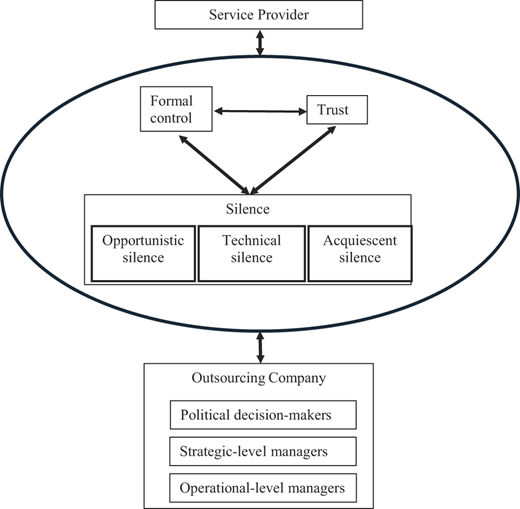
In both challenging cases, trust developed as the SP learned the accounting practices and the development groups began to function effectively. Figure 1 illustrates the interplay of different forms of silence, formal control, and trust. In the outsourcing company, various management levels play a crucial role in either supporting or hindering the FAO.
5. Discussion
Various forms of silence, trust and formal control mechanisms play an important role in managing and significantly influencing IORs, such as in FAO in the municipal sector, as demonstrated in Figure 1. Silence may be interpreted as an indication of trust, suggesting that operations are proceeding smoothly. However, the findings of this study indicate that different forms of silence interplay with trust outcome and behavioral control mechanisms in the FAO context. For instance, the exclusion of operational-level managers from FAO discussions is perceived as silencing or opportunistic silence used by strategic-level management. This exclusion resulted in failures in goal setting and rendered ex-post behavioral and outcome control mechanisms ineffective. Moreover, opportunistic silence diminished both intra- and interorganizational goodwill and competence trust between the collaborating organizations. Furthermore, malfunctions in supporting information systems hindered access to reports, contributing to technical silence and complicating the enactment of behavior monitoring in both case organizations.
The silence exhibited by operational-level managers, whether as pro-social silence to prevent harm to the organization (Van Dyne et al., 2003) or acquiescent silence (to self-protect), was evident in City2. Consequently, silence may either facilitate or obstruct interorganizational change, which aligns with Dupret’s (2019) findings regarding intraorganizational change. Both opportunistic silence and acquiescent silence contributed to technical silence by preventing the identification, communication and timely resolution of problems affecting supporting information systems. Accordingly, the planned behavioral control was rendered inoperative. Following significant challenges, acquiescent and opportunistic silence prevailed, particularly in City2, as used by the CFO in both upward and downward communication within the organization. In City1, there appeared to be open discussion channels between organizational levels. However, operational-level management felt that they were not taken seriously by the SP. Essentially, the service provider had devised a robust communication model intended to facilitate joint development and active collaboration. Nonetheless, it became apparent that the operational-level managers from both organizations did not share a common understanding or language.
The findings of this study indicate that officials at the strategic level of management used opportunistic silence both upwards (in the form of a failure to disclose information in accounting reports) and downwards (by generating exclusive dialogues) to benefit themselves. The officials did not appear to share all necessary information with the operational-level managers, who possess a comprehensive understanding of accounting practices. Accounting knowledge empowers the operational level (Hopwood, 1987) and the actions of strategic-level managers to silence operational-level managers may signify a desire to retain power. This finding aligns with prior research on silence (Nechanska et al., 2020; Dedahanov and Rhee, 2015; Knoll and van Dick, 2013). At the operational level, exclusion from open discussions resulted in organizational or collective quiescent silence, as operational-level managers perceived a lack of viable options for implementing changes. This supports the findings of Dedahanov and Rhee (2015). The rationale for these forms of silence may be attributed to the high bureaucracy within municipal organizations, which may inhibit open discussions across various organizational levels, as stated by Morrison (2011).
When considering the typical reasons for outsourcing, such as promoting economies of scale and accessing expertise (Van Veen-Dirks and Giliam, 2020; Cäker and Siverbo, 2011), it is surprising that ex-post control mechanisms are relatively scarce. Goal setting as an ex-ante outcome control should enhance goal congruence (Dekker, 2004). However, when deciding to outsource, managers were unable to anticipate all appropriation concerns and coordination requirements associated with the IOR with the service provider, as suggested in prior IOC literature (e.g. Dekker, 2004; Langfield-Smith and Smith, 2003; Van der Meer-Kooistra and Vosselman, 2000). Furthermore, the results of this research reveal that the service provider’s reluctance to discuss issues and efforts to balance the diverse objectives of multiple customers resulted in goal incongruence.
One critical element that can enhance the management of appropriation concerns and coordination of tasks in IORs is improved information exchange and more effective joint problem-solving (Dekker et al., 2019). However, the necessity to share information in outsourcing and IORs is common (Dekker, 2004), which increases the power of silence (Dupret, 2019) and may hinder the effectiveness of both formal and informal control mechanisms. Additionally, formal communication channels may mitigate the negative implications of silence (Pinder and Harlos, 2001). Accordingly, the findings of this research indicate that formal control alone does not guarantee the success of formalized accounting operations (FAO). Rather, we propose that the interplay between silence, formal control and trust significantly influences the chances of FAO being successful. Given the bureaucratic nature of municipalities, to mitigate the effect of silence between organizational levels, we suggest that officials at the strategic-level management actively manage open and official communication channels within the organization. All organizational levels should be adequately informed (Dekker et al., 2019) and the roles of silence and trust should be taken into consideration. Moreover, decision-makers could be better equipped with knowledge regarding the challenges inherent in interorganizational collaboration.
6. Conclusions
The present article has investigated the interplay between silence, formal control and trust in managing challenging FAOs. This study is grounded in a case analysis of two Finnish cities, each of which faced multiple challenges following the implementation of outsourced accounting services after the city boards made the outsourcing decisions. This case study has provided a comprehensive understanding of the phenomenon within a real-life context and at both the operational and strategic levels of the collaborating organizations.
The current research contributes significantly to the existing IOC literature. First, this study elevates the discussion of the interplay between silence, formal control and trust to the interorganizational level, whereas prior research on silence has predominantly concentrated on the intra-organizational context (d’Astros et al., 2024; Ebrahimi et al., 2023; Dedahanov and Rhee, 2015). Our findings indicate that challenges in FAOs lead to the withholding of ideas and concerns regarding strategic-level management (organizational silence) both upwards and downwards. An additional consequence may be a lack of trust among different organizational levels, complicating the application of control mechanisms. Second, according to the IOC literature (Dekker, 2004; Das and Teng, 1998), behavior monitoring as a form of ex-post IOR establishment involves reporting and checking mechanisms. In the context of FAOs, technology plays a crucial role and without the capability to use reporting devices, behavior monitoring becomes challenging. The malfunctioning of accounting systems results in the inability to exercise formal control, which, in turn, exacerbates organizational silence at all levels and generates managerial frustration concerning the monitoring of the FAO process. Consequently, improved integration of operational-level managers into the implementation process will be critical. Finally, contrary to earlier IOC literature (Krause and Swiatczak, 2021), which posits that planned behavior and outcome control mechanisms in the form of detailed contracts are paramount, our findings suggest that ex-post control (both behavior and outcome) is insufficient due to the silencing of operational-level actors involved in the IOR. While ex-ante behavior control in the form of jointly accepted rules and regulations exists at the strategic level in both cases, the application of ex-post behavior control through reporting and checking devices, written notifications, financial audits and cost and quality control remains inadequate.
As a case study, the present research has the usual limitations. Although we strive for a deeper understanding of the phenomenon, studying silence is difficult. Further, as silence is the absence of behavior, it is quite difficult to analyze (Van Dyne et al., 2003). Observations were not possible in the selected cities, and, given the retrospective approach, would not likely have yielded much additional or relevant evidence. Accordingly, this study relies on semi-structured interviews, exploring the perceptions of accounting and HR practitioners as well as the service provider regarding maintaining control and monitoring of the FAO after the implementation. However, the interviewees’ perceptions are not easily verified and could be inaccurate. Nevertheless, we have confidence in our data because the interviewed practitioners have first-hand knowledge of the challenges that arose. Additional research would be required to fully understand the interactive role of silence, formal control and trust in challenging FAO or similar contexts. One interesting dimension to explore would be the role of silence in challenging outsourcing processes triggered by rapid legislative changes related to municipally owned corporations. In addition, given the technical requirements of FAOs, a promising avenue for future research concerns the integration of FAO-related information systems and technical infrastructures.