The order in which financial statements are presented is discretionary and tends to remain unchanged. However, anecdotal evidence suggests that firm-level incentives affect placement decisions. The purpose of this study is to investigate the determinants and consequences of the placement of financial statements.
We incorporate hand-collected and database data for annual results of listed South African firms from 2012 to 2019 in multivariate regression analyses.
Reporting a loss is associated with different placement decisions, and, relatedly, changing from a profit to a loss is associated with changes in placement. Furthermore, changes in the placement of financial statements tend to coincide with executive turnover. Finally, placement decisions have short-term and long-term pricing consequences.
As placement decisions lead to different economic outcomes, consistent investment decisions require processes that are robust to this impression management tool. Furthermore, regulators may wish to consider whether placement decisions should remain discretionary. However, preparers looking to assist optimal decision-making might use the findings to justify closer attention to placement decisions.
We show that impression management through the placement of financial statements is generalisable and has long-term pricing consequences. Considering that several characteristics of our research setting substantially reduce the likelihood of effective impression management, the placement of financial statements seems to be a powerful impression management tool.
1. Introduction
Under International Financial Reporting Standards (IFRS), an entity must include a balance sheet (BS), income statement (IS), statement of changes in equity (SCE) and cash flow statement (CF) in a complete set of financial statements (IASB – International Accounting Standards Board, 2020, 2024). However, IFRS does not specify any presentation order. The discretion to alter the presentation order of financial statements is not often used, as placement decisions of previous years appear to be the most important determinant of placement (Mulford and Conde, 2017). Furthermore, auditors do not believe that placement of financial statements is a conscious decision (Mulford and Conde, 2017).
However, anecdotal evidence from conversations with professional investors contradicts these arguments. This suggests that firms with negative earnings lead with the BS, irrespective of prior years’ decisions, and that they emphasise cash flow information by placing the CF directly before or after the IS. Changes in the sign of earnings induce earnings volatility; therefore, if negative earnings are an incentive to change the placement of financial statements, earnings volatility might also be associated with these placement decisions. Furthermore, professional investors comment that they associate executive turnover with changes in placement decisions. All these examples reflect fluctuations in firm performance and structure. Impression management theory suggests that preparers will take deliberate action to influence how stakeholders perceive and react to these fluctuations (Clatworthy and Jones, 2001; Godfrey et al., 2003). Therefore, it is plausible that placement of financial statements represents conscious and systematic actions by preparers to influence stakeholders.
At the financial statement level, one available impression management tool is the order in which financial statements are presented, which impacts the emphasis of specific information (Merkl-Davies and Brennan, 2007). Another tool is the proximity of different financial statements, which affects the ease of acquiring and processing interrelated information (Hodge et al., 2010; Blankespoor et al., 2020) [1]. Impression management could be used to focus attention on more important aspects of financial reports and derive benefits for the firm (e.g. lower cost of capital) but could also be used to extract private gains (e.g. higher management compensation) (Merkl-Davies and Brennan, 2007; Libby and Emett, 2014). Nevertheless, irrespective of assumptions around motivation, when impression management alters the order or proximity of information, it changes disclosure processing costs (Blankespoor et al., 2020; Chen et al., 2021; Barth et al., 2024). As disclosure processing costs affect investors irrespective of sophistication, impression management can have meaningful economic consequences even in efficient markets (Blankespoor et al., 2020). This study therefore seeks to determine whether the order and proximity of financial statements are associated with reporting a loss, earnings volatility and executive turnover.
It is well established that firms engage in impression management (Cardoso et al., 2018). For example, Godfrey et al. (2003) find that newly appointed CEOs engage in graphical impression management for key financial variables, and Leung et al. (2015) document that firms with poor financial performance reduce narrative disclosures to distract attention away from negative news. However, there is limited evidence of using the placement of the financial statements themselves as an impression management tool.
To our knowledge, three archival papers investigate placement decisions at the financial statement level. Collectively, they find that cross-sectional differences in placement are associated with characteristics such as firm size and capital intensiveness, and that changes in presentation order towards the end of the twentieth century were linked to the internationalisation of accounting (Ding et al., 2003; Barua and Kim, 2017; Mulford and Conde, 2017). However, prior research does not reveal firm-level catalysts associated with changes in placement decisions or whether differences in placement are associated with divergent capital market outcomes.
It is not obvious that placement of financial statements has capital market consequences. IFRS only requires that financial statements be presented with equal prominence (IASB – International Accounting Standards Board, 2020, 2024), as the standard-setters argue that financial performance can only be understood by considering financial statements in their entirety (IASB – International Accounting Standards Board, 2020: BC22). This suggests that placement of financial statements should be an ineffective impression management tool in an efficient market that is at least semi-strong (i.e. all public information is priced by investors). However, the order and proximity of information determine disclosure processing costs (Blankespoor et al., 2020). Even in an efficient market, disclosure processing costs prevent some public information from being accurately priced, as rational investors will seek to minimise costs and could therefore choose to rather process information about alternative investment opportunities (Blankespoor et al., 2020). Furthermore, both sophisticated and unsophisticated investors make suboptimal decisions when disclosure processing costs are high (Hirshleifer and Teoh, 2003; Libby and Emett, 2014; Blankespoor et al., 2020). Financial reporting initiatives, such as integrated reporting standards, are intended to reduce these costs by improving the connectivity between financial and nonfinancial information (Lee and Yeo, 2016; Barth et al., 2024). Specifically, integrated reporting reduces disclosure processing cost by increasing information proximity (Reimsbach et al., 2018).
Therefore, although the underlying information is unchanged, disclosure processing costs imply that altering the placement of financial statements could remain an effective impression management tool. Moreover, because rational investors minimise cost, increasing disclosure processing cost could result in some public information never being fully processed (Blankespoor et al., 2020). This creates the possibility that placement decisions as an impression management tool could have long-term capital market consequences.
Our sample consists of annual results announcements from 2012 to 2019 for South African firms listed on the Johannesburg Stock Exchange (JSE). We investigate the order of the IS and BS, the proximity of the IS and BS, and the proximity of the IS and CF in these announcements. Country-level characteristics and internationalisation in financial reporting can affect the placement of financial statements (Ding et al., 2003). Moreover, institutional factors can reduce impression management incentives (Venter et al., 2013). In South Africa, integrated reporting has been mandated since 2010 (Barth et al., 2017) and is designed to reduce disclosure processing costs through greater connectivity (Lee and Yeo, 2016; (Reimsbach et al., 2018; Barth et al., 2024). This creates a cultural effect whereby reduced disclosure processing cost becomes the expectation of investors and the goal of preparers. As impression management will only have a long-term impact in efficient markets when disclosure processing costs are high (Blankespoor et al., 2020), the reporting culture engendered by integrated reporting may reduce the benefits (and therefore the use) of impression management in South Africa. Furthermore, deep capital markets in South Africa attract sophisticated investors, but the number of JSE-listed firms has been fewer than 400 since 2012 (Van der Merwe and Bernard, 2021). This reduces busy news days (and the peaks on these days) compared to markets with more firms. Investors face lower disclosure processing costs, as they are less pressed for time when results are released and can better assimilate complicated information (DeHaan et al., 2015; Blankespoor et al., 2020). Therefore, several characteristics of our setting reduce the likelihood of effective impression management.
Nevertheless, we find that firms reporting a loss place the BS ahead of the IS to deemphasise negative earnings and place the IS and CF adjacently to emphasise cash flow as an alternative performance measure. Relatedly, firms with greater earnings volatility induce closer attention to the details of their earnings information by placing the IS before the BS. They are less likely to place the IS and CF adjacent to each other, increasing the disclosure processing cost of detecting disparities between the volatility of earnings and the volatility of cash flows, as such disparities can reflect earnings management (Jayaraman, 2008). While placement decisions exhibit strong serial correlation, we find that short-term earnings volatility is associated with changes in the order and proximity of these financial statements. Furthermore, we find that a simultaneous change in CEO and CFO is the most consistent catalyst associated with changes in the placement of financial statements.
Our capital market investigations show that placing the IS before the BS is associated with lower earnings value relevance [2]. As we find that firms with greater earnings volatility place the IS before the BS, we attribute the decrease in earnings value relevance to lower quality earnings that lack predictive power (Dichev and Tang, 2008; Venter et al., 2014). Furthermore, we find that proximity of the IS and BS is associated with higher earnings value relevance, while proximity of the IS and CF increases cash earnings value relevance. As these inferences derive from price specifications, impression management at the financial statement level has a long-term impact on firm value. We also find that changes in placement are priced negatively over the short term. This potentially reflects that breaking serial correlation in placement decisions increases short-term disclosure processing cost. Therefore, firms should consider both short-term and long-term consequences when reviewing the placement of financial statements.
Collectively, our findings contribute new evidence that impression management through placement of financial statements occurs; reporting a loss and earnings volatility are incentives in determining the placement of financial statements; earnings volatility and executive turnover overcome tendencies to retain historical placement; and impression management at the financial statement level has long-term pricing consequences. The placement of financial statements appears to be a powerful impression management tool, as several characteristics of our South African research setting imply that effective impression management is less likely to occur. This suggests that impression management theory could explain phenomena in contexts where such effects were not previously expected.
Investors will be interested in our findings, which reveal the existence and systematic use of a strong impression management tool. As impression management could be used to extract private gains for management (Merkl-Davies and Brennan, 2007; Libby and Emett, 2014), consistent investment decisions require investment processes that are robust to differences in the placement of financial statements. The catalysts associated with changes in placement decisions that we identify may aid investors in developing stronger processes.
Those charged with governance will also be interested in our findings, which reveal the consequences of placement decisions that are generally left to the discretion of top management (Zhang, 2019). The catalysts that our results reveal identify circumstances in which it may be appropriate to intervene in these decisions. Furthermore, given the long-term pricing consequences of different financial statement orders and proximity outcomes, our findings are also of interest to regulators who might wish to consider whether placement decisions should remain discretionary. For example, our results suggest that greater regulation of the format of results announcements could reduce the incidence of well-known information processing errors (such as the accrual anomaly) and thereby improve economic outcomes.
However, impression management may also be used to assist decision-making and derive benefits for the firm (Merkl-Davies and Brennan, 2007; Libby and Emett, 2014). We find that changes in placement are relatively rare. Therefore, preparers will be interested in our findings, which reveal pricing outcomes associated with discretionary changes in the placement of financial statements. These suggest that a careful evaluation of placement decisions may be justified to reduce disclosure processing costs and thereby improve investor decisions.
2. Background, literature review and hypotheses development
IFRS specifies that a complete set of financial statements includes a BS, IS, SCE and CF presented with equal prominence (IASB – International Accounting Standards Board, 2020, 2024). However, standard-setters do not specify a presentation order, arguing that financial performance can only be understood with reference to the full set of financial statements (IASB – International Accounting Standards Board, 2020: BC22). Therefore, placement of financial statements is a discretionary decision, which can be subject to impression management.
Impression management in financial reporting occurs when managers direct attention to specific aspects of reports to influence how stakeholders perceive and react (Clatworthy and Jones, 2001; Godfrey et al., 2003). At the financial statement level, impression management manifests as the order in which information is presented or as the proximity of interrelated information (Merkl-Davies and Brennan, 2007; Hodge et al., 2010; Blankespoor et al., 2020). However, the underlying information remains unchanged, and some therefore argue that placement mainly influences decisions of unsophisticated or inexperienced investors (Maines and McDaniel, 2000; Elliott, 2006). Others show that even very sophisticated investors are affected by differences in placement of identical information (Hirshleifer and Teoh, 2003; Libby and Emett, 2014).
However, the existence of disclosure processing costs explains why impression management can alter economic outcomes, even when markets are efficient and investors act rationally (Blankespoor et al., 2020). Specifically, impression management that alters the order or proximity of information affects three elements of disclosure processing costs, namely, awareness, acquisition and integration costs (Blankespoor et al., 2020; Chen et al., 2021; Barth et al., 2024). As investors have limited resources, they also face opportunity costs. Therefore, when impression management increases the cost of obtaining a deep understanding of a specific firm, rational investors may choose to allocate their resources elsewhere (Blankespoor et al., 2020). The implication is that impression management works by changing the disclosure processing costs which influence accurate price formation. As disclosure processing costs affect investors irrespective of sophistication, impression management can have meaningful economic consequences even in efficient markets (Libby and Emett, 2014; Blankespoor et al., 2020).
Several studies conclude that placement of information is an impression management tool (Cardoso et al., 2018). For example, Bowen et al. (2005) investigates impression management manifesting as the placement order of different earnings metrics; specifically, how close to the top of a press release specific earnings metrics are reported. They find that greater emphasis on an earnings metric is associated with a stronger market reaction relative to other earnings metrics. Similarly, Bartov and Mohanram (2014) conclude that information ordering within the IS can manage impressions, as placing gains or losses from early debt extinguishment closer to the top of the IS increases their value relevance. Regarding information proximity, experimental evidence shows that displaying related earnings and cash flow information adjacently improves investors’ ability to accurately forecast cash flows (Hodge et al., 2010) and that presenting gross carrying amounts of assets and liabilities that are in the same hedging relationship next to each other improves investors’ ability to distinguish between firms with different economics (Koonce et al., 2019). All these studies reflect that placement of information within financial statements can alter investor decisions by altering disclosure processing costs. However, there is little evidence about the placement decisions of preparers at financial statement level or about the capital market consequences thereof.
To our knowledge, three archival studies investigate placement of financial statements directly. Ding et al. (2003) find that increased internationalisation prompted French firms to increasingly focus on the IS in the 1990s. Mulford and Conde (2017) use a sample of US firms and find that, in 2015, larger firms, firms with higher returns on assets and firms with higher asset turnover placed the IS ahead of the BS. In contrast, for S&P 500 firms in 2013, Barua and Kim (2017) find no association between return on assets and the order of the IS and BS. However, they conclude that larger firms and firms with a higher level of investment in tangible or intangible assets were more likely to place the IS first, while firms with higher gearing were more likely to lead with the BS. In spite of different findings, it therefore appears that the order of the IS and BS is associated with cross-sectional differences in firm-level characteristics, potentially reflecting divergent management incentives.
However, although Ding et al. (2003) find that changes in the order of the IS and BS are associated with country-level changes, other existing studies investigate a single sample year (Barua and Kim, 2017; Mulford and Conde, 2017) and do not provide evidence of firm-level characteristics that are associated with changes in placement decisions [3]. However, as mentioned earlier, anecdotal evidence from professional investors suggests that firms that report a loss lead with the BS. Firms that report a loss are priced differently from those that report a profit (Hayn, 1995; Venter et al., 2014) and have incentives to use placement decisions to emphasise different attributes of their finances. For example, related research shows that firms which report a loss choose to disclose pro forma earnings to highlight strong cash flows (Leung and Veenman, 2018).
Therefore, firms that report a loss might manage impressions by deemphasising the loss and emphasising other, more positive, information. If preparers assume that some investors process information sequentially, there are two ways in which the placement of financial statements could increase disclosure processing costs to deemphasise a loss. Firstly, the BS is more likely to appear ahead of the IS. Secondly, the two statements are more likely to be interspersed with other statements. If firms expect investors to search directly for information, the impact of reporting a loss could be mitigated by increasing the proximity of (decreasing the distance between) cash flow and earnings information. This reduces disclosure processing costs, and investors would be more likely to process cash flows (an alternative performance measure) accurately (Hodge et al., 2010; Leung and Veenman, 2018; Blankespoor et al., 2020). Therefore, we investigate the following related hypotheses:
Reporting a loss is associated with placing the BS before the IS.
Reporting a loss is associated with lower proximity between the IS and the BS.
Reporting a loss is associated with higher proximity between the IS and the CF.
When earnings fluctuate between positive and negative numbers, reporting a loss is associated with earnings volatility. Investors incorrectly extrapolate earnings components with different persistence at the same rate (Sloan, 1996; Hirshleifer and Teoh, 2003). Preparers of firms with volatile earnings could manage investor impressions by altering the placement of financial statements to change disclosure processing costs. If firms expect investors to process information sequentially, they might induce attention to the IS by placing the IS ahead of the BS. This will ensure different earnings components are processed before investor attention wanes. However, sophisticated investors use disparities between the volatility of earnings and cash flows to detect earnings management (Jayaraman, 2008). If firms expect these investors to search directly for information, they might increase disclosure processing costs (i.e. increase the cost of detecting earnings management) through decreased proximity of the IS and CF[4]. Therefore, we also investigate the following hypotheses:
Earnings volatility is associated with placing the IS ahead of the BS.
Earnings volatility is associated with lower proximity between the IS and the CF.
Prior direct evidence of the firm characteristics associated with the placement of financial statements only considers decisions for a single sample year (Barua and Kim, 2017; Mulford and Conde, 2017). However, in related research, Godfrey et al. (2003) find that newly appointed CEOs use graphical impression management to emphasise negative financial variables in the year of their appointment and positive financial variables in the year thereafter. Consequently, the placement of financial statements could represent an alternative or simultaneous impression management tool to graphical impression management when new executives are appointed. However, financial reporting quality depends on the collective characteristics of the top management team (Zhang, 2019), where the CEO and CFO are primarily responsible for the financial reporting process (Dao et al., 2014). Therefore, changes in placement decisions are more likely when a simultaneous change in CEO and CFO significantly alters the collective characteristics of top management. Our hypothesis is therefore:
Changes in the ordering and proximity of financial statements are associated with a simultaneous change in the identity of the CEO and CFO.
Our first three hypotheses (H1–H3) reflect the incentives of placement decisions. Preparers are unlikely to change placement decisions unless they perceive a benefit. However, it is possible that perceived benefits of placement decisions could be temporary or unrelated to capital markets. Classical theory suggests that in efficient markets (of semi-strong form), rational investors should be unaffected by impression management, as the underlying information is unchanged (Blankespoor et al., 2020). Therefore, if financial statements can only be understood in their entirety (IASB – International Accounting Standards Board, 2020: BC22), there should not be any pricing differences of accounting information because of variance in the order or proximity of financial statements.
Nevertheless, impression management that changes the order or proximity of information can increase disclosure processing costs, even in efficient markets (Blankespoor et al., 2020). Irrespective of whether information is processed sequentially or through directed searches, higher disclosure processing costs result in suboptimal decisions (even for sophisticated investors) and lower value relevance (Blankespoor et al., 2020; Barth et al., 2024) [5]. The impact of disclosure processing costs can be temporary and disappear when investors have had more time to process information (Blankespoor et al., 2020). However, if placement decisions reflect an informational objective, the pricing consequences of better decisions by investors could be observed over long periods. Therefore, it is possible that impression management through placement of financial statements could have capital market consequences. Our final hypothesis is stated as follows:
Ordering and proximity of financial statements are associated with pricing differences of accounting information.
3. Research methodology
3.1 Determining the placement of financial statements
In South Africa, a results announcement often precedes the release of the annual report, sometimes by several weeks. Results announcements contain all the financial statements required by IFRS, frequently combined with management commentary. However, the financial statements might be condensed and notes required by IFRS are typically omitted. Therefore, results announcements are not the equivalent of earnings announcements, which frequently omit financial statements (Miao et al., 2016), nor of annual reports, which contain detailed financial statements. However, results announcements are often the first public document that reflects annual financial performance. Even when results announcements and the annual report are released simultaneously, disclosure processing costs may cause investors to focus on the shorter document (the results announcement) (Blankespoor et al., 2020). Consequently, we focus our investigations on the first document that investors see (the results announcement), where impression management is most likely to occur [6].
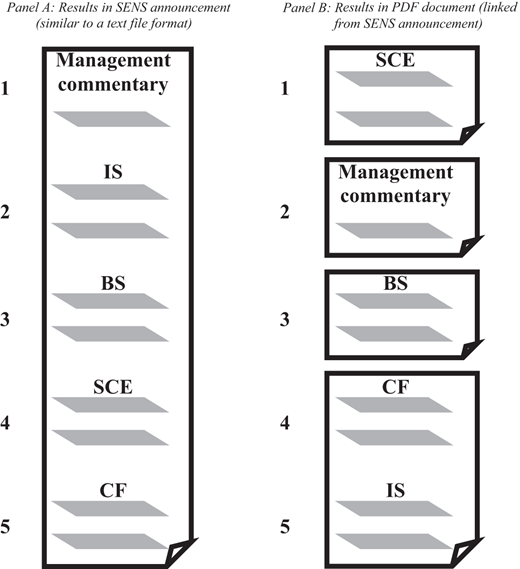
We source results announcements from the Stock Exchange News Service (SENS) of the JSE, which are free to view on various websites and also distributed through paid-for investment services [7]. For most observations, the SENS announcement itself contains the results announcement (similar to a text file format), while in other cases, the SENS announcement links to a PDF document. Figure 1 contains a hypothetical example and illustrates the implications that the two different formats have for the coding of information ordering and proximity. Panel A reflects a SENS announcement format, where page breaks are not evident in the results announcement, while Panel B contains the same information in a PDF document, where page breaks limit the amount of information that can appear on a single page. To ensure consistency of coding across the two potential formats, Figure 1 shows that, in both cases, the financial statements are first numbered in the order in which they appear in the results announcement in normal reading order (i.e. reading from top left to bottom right) [8].
Thereafter, information ordering means that the number for the IS is smaller than the number for the BS (i.e. the IS is closer to the top of the document than the BS). Information proximity means that the IS and the other financial statement of interest (either the BS or the CF) appear directly adjacent to each other in the results announcement (irrespective of order). In other words, the statements specified in the relationship are not separated by any other components in the results announcement, namely, other financial statements or management commentary. To determine information proximity, we deduct the number of the statement of interest (either the BS or the CF) from the number of the IS. If the resultant difference is one or negative one, information proximity is coded as one (and zero otherwise).
3.2 Method: ordering and proximity decisions and changes therein
We investigate the association between placement decisions and firm-level characteristics using the following logistic regression (firm and time subscripts are suppressed) [9]:
where Place is an indicator variable set to one (zero otherwise) for each placement decision. Therefore, Place is alternatively set to one if the IS precedes the BS (ISBS); the IS and BS are placed adjacent to each other (ISBSdis); and the IS and CF are placed adjacent to each other (ISCFdis).
The first set of variables reflect firm-level characteristics from prior research on the order of the IS and BS (detailed variable definitions appear in the Appendix). These include firm size (Size); firm profitability (ROA); leverage (LEV); asset turnover (TO); investment in intangible assets (MTB) [10]; and investment in tangible assets (Tang) (Barua and Kim, 2017; Mulford and Conde, 2017). We also include a control for “Big 4” audit firms (Audit), as Mulford and Conde (2017) find that firms audited by a "Big 4" auditor have a higher frequency of leading with the IS than other firms.
The second set of variables reflects earnings-related firm-level characteristics and are the variables of interest for H1 and H2. An indicator variable (Neg) is set to one if basic earnings are negative. Short-term earnings volatility is captured by an indicator variable (Sign), which is set to one if the sign of earnings in the current reporting period differs from that of the immediately preceding period. Long-term earnings volatility (Vol) is a continuous variable reflecting the three-year standard deviation of IFRS earnings divided by the three-year standard deviation of headline earnings. All JSE-listed firms are required to report headline earnings, which are regulated and audited but are also smoother and more persistent (i.e. less volatile) than IFRS earnings (Venter et al., 2014; Howard et al., 2019). Higher values for Vol reflect greater long-term earnings volatility.
The third set of variables control for additional firm-level characteristics. All investors, irrespective of sophistication, are affected by increased disclosure processing costs, but unsophisticated investors are more susceptible to impression management (Hirshleifer and Teoh, 2003; Libby and Emett, 2014; Blankespoor et al., 2020). Therefore, firms with more unsophisticated investors are more likely to manage impressions, and we include several measures to control for investor sophistication. These include a measure of the demand for information intermediation (Follow); the free float percentage (Float), which excludes large shareholders that are more likely to be sophisticated [11]; and the public shareholder percentage (Public), which excludes shareholders with inside information who are less likely to be influenced by impression management irrespective of sophistication [12]. Skilled directors are more likely to be aware of impression management. Therefore, we include director qualifications (Qual), which is an accurate proxy of skill (Fedaseyeu et al., 2018). We use financial designations and business management qualifications, as these require exposure to financial reporting quality and communication strategies. Stronger corporate governance also limits the use of impression management (Mather and Ramsay, 2007; Osma and Guillamón-Saorín, 2011). As board independence is the most important corporate governance characteristic associated with financial reporting quality (He et al., 2009; Rubin and Segal, 2019), we control for the percentage of independent directors (Indep). We also control for board size (BoardSize), as large boards are typically less effective in monitoring management (Osma and Guillamón-Saorín, 2011). Finally, we also include year- and industry-fixed (level two) effects.
To investigate changes in placement decisions, we adjust Model (1) to a change specification:
where ΔPlace is an indicator variable set to one (and zero otherwise) for changes in each of the placement decisions. Therefore, ΔPlace is alternatively set to one if the IS precedes the BS in either the current year or the immediately preceding year, but not in both (mISBS); the IS and BS are placed adjacent to each other in either the current year or the immediately preceding year, but not in both (mISBSdis); and the IS and CF are placed adjacent to each other in either the current year or the immediately preceding year, but not in both (mISCFdis). In Model (2), Δ denotes change, with the result that the independent variables largely reflect first differences from Model (1) and are therefore similarly specified [13]. However, to investigate H3, we also include Change, which is set to one if the identity of both the CEO and the CFO changes in the same reporting period.
3.3 Method: pricing consequences of ordering and proximity decisions
A value relevance model specified as a level (price) model reflects whether information is priced over the long term, while a change specification reflects the timeliness with which changes in information are priced (Barth et al., 2001). We are interested in long-term pricing consequences and therefore adapt a level specification from prior research (Barth et al., 2001; Venter et al., 2014) to be estimated through OLS (firm and time subscripts are suppressed):
where P is share price; BPS is book value per share; EPS is basic earnings per share; and other variables are as previously defined [14]. Using per-share variables reliably compensates for scale effects in financial data (Barth and Clinch, 2009; Aledo Martinez et al., 2020). Firms that report a loss are priced differently from those that report a profit (Hayn, 1995; Venter et al., 2014). We follow prior research by including Neg and interactions with other variables where pricing may differ for firms that report a loss (Dunn et al., 2016). To investigate the proximity of the IS and CF, we disaggregate earnings in Model (3) into operating cash flow per share (CPS) and accruals per share (ACCPS). We follow prior research (Hirshleifer et al., 2009) and compare operating profit to funds from operations to ensure internal consistency in the calculation of cash earnings and accruals. We also include year- and firm-fixed effects in Model (3) [15].
4. Sample and data
Our initial sample is all tickers (dead and live) for South African firms listed on the JSE, reporting between 1 January 2012 and 31 December 2019. Data for headline earnings, the identity of the CEO and CFO and the order and proximity of financial statements are hand-collected from annual results announcements. Data for public shareholding, board size, number of independent directors and director qualifications are hand-collected from annual reports. Data for all remaining variables are from the LSEG Workspace database [16]. Panel A of Table 1 contains the sample reconciliation. After applying restrictions, the resultant sample is 1,873 firm-years (334 unique firms) for the level specifications and 1,863 (332 unique firms) for the change specifications.
Panel B of Table 1 reflects a relatively stable sample distribution across years and shows that the IS preceded the BS (ISBS) for 68% of sample firms in 2012, but for 58% of firms by 2019. However, most firms place the IS and BS adjacent to each other (ISBSdis) throughout. Panel B also shows that 19% of ISs and CFs were placed adjacent to each other (ISCFdis) in 2012, decreasing to 13% in 2019. Collectively, it appears that the BS is increasingly placed first, with the IS immediately thereafter. Therefore, the decrease in proximity between the IS and CF (ISCFdis) implies that the SCE is being inserted between the IS and the CF[17]. Trends for two other elements of results announcements in Panel B, namely, management commentary and a highlights statement, show that management commentary (Comment) preceded the financial statements 34% of the time in 2012, increasing to 75% in 2019, while 70% of sample firms included a highlights statement (High) in their results announcement in 2012, increasing to 80% in 2019 [18].
Therefore, consistent with Ding et al. (2003), we identify time trends in placement decisions. However, inconsistencies with their results suggest that country-level differences exist. Panel C of Table 1 reflects that changes in placement decisions are rare. For example, the order of the IS and BS (mISBS) changes for 4% of our firm-year observations. This reflects strong serial correlation in the placement of financial statements.
Descriptive statistics for the main model specifications are displayed in Table 2. Sample firms are generally profitable, with 19.4% of firm-years reflecting a loss (Neg). Short-term earnings volatility (Sign) is observed in 9.1% of firm-years, reflecting strong serial correlation within earnings. Mean and median longer term earnings volatility (Vol) is consistently above one, which indicates, as expected, that headline earnings are smoother and more persistent than IFRS earnings. Simultaneous change of both the CEO and the CFO (Change) is a rare occurrence, affecting only 5.6% of firm-years. However, the overall descriptive evidence aligns with our expectations.
5. Detailed findings
5.1 Cross-sectional differences in placement decisions
The first column of Panel A in Table 3 considers only variables from prior research. Consistent with prior research (Barua and Kim, 2017; Mulford and Conde, 2017), larger firms, those with higher asset turnover, and greater investment in tangible and intangible assets are more likely to place the IS before the BS (p < 0.100 throughout), while highly leveraged firms are less likely to do so (p = 0.058). Although firm profitability appears to have no information ordering effect at the financial statement level (p = 0.165), we find, consistent with Mulford and Conde (2017), that having a “Big 4” auditor is associated with placing the IS before the BS (p < 0.001). This may reflect the correlation with firm size, as Smith (2022) finds that 82% of the 200 largest firms listed on the JSE are audited by “Big 4” auditors. An alternative explanation is that “Big 4” firms are more likely to develop financial reporting templates and apply these to their clients, which is unlikely to happen with smaller audit firms (Francis et al., 2014; Smith (2022)). Moreover, financial reporting comparability between firms is more similar for firms audited by the same “Big 4” audit firm than those audited by the same non-“Big 4” audit firm (Francis et al., 2014) [19]. Therefore, results for Audit could reflect the difference between consistent application of audit practice by “Big 4” firms and more varied application in the rest of the sample.
The remaining columns of Panel A display the full results for Model (1) and reflect differences across firms. Our first hypothesis is that firms will use impression management in the form of different placement decisions to deemphasise a loss. Column two shows that firms that report a loss (Neg) are likely to deemphasise this by placing the IS after the BS (p < 0.001). Once firms that report a loss are controlled for, firms that earn high returns on assets are also less likely to place the IS first (p = 0.007). Therefore, firms that report a loss seek to manage the impressions of their shareholders by diverting attention to other financial metrics. Firms with a high return on assets are potentially earning excess returns and might divert the attention of other stakeholders, such as labour and government, to other information. Consequently, different objectives can result in the same financial statement order.
We also expected that firms that report a loss would place the IS as late as possible (increasing the distance between the IS and BS) and adjacent to the CF (emphasising cash flow as an alternative financial performance measure). Column three of Panel A shows that Neg is unexpectedly associated with finding the BS and IS adjacent to each other (p = 0.027). Arguably, basic earnings do not represent the only potential input into relevant return and turnover metrics (e.g. revenue is important for turnover ratios). Therefore, the incentive to deemphasise reporting a loss through lower proximity could be outweighed by other considerations. However, results in column four are consistent with expectations, as Neg is associated with a greater likelihood that the IS and CF are placed adjacent to each other (p = 0.017). This is also consistent with prior research findings that firms which report a loss choose to disclose pro forma earnings to highlight strong cash flows (Leung and Veenman, 2018). Collectively, findings therefore suggest that reporting a loss is a strong incentive for preparers to engage in impression management. Preparers appear to increase the disclosure processing costs of acquiring knowledge of the loss by placing the IS later in the results announcement, while reducing the disclosure processing costs of integrating more positive information from the CF.
Consistent with our second hypothesis that firms with greater earnings volatility will place the IS before the BS, the second column in Panel A reflects short-term earnings volatility (Sign) as positive and significant (p = 0.021). The final column of Panel A shows that CFs are less likely to be adjacent to ISs when long-term earnings volatility (Vol) is greater (p = 0.061). These findings suggest that firms respond to the incentives that earnings volatility create. Firstly, firms use impression management to minimise incorrect extrapolation of earnings components with different persistence (Sloan, 1996; Hirschleifer and Teoh, 2003) by leading with the IS and thus directing closer attention to earnings. Secondly, as disparities between the volatility of earnings and the volatility of cash flows can reflect earnings management (Jayaraman, 2008), firms increase the distance between the IS and CF to increase the cost of detecting it.
Few control variables are significant. However, in column two, firms with a greater proportion of outside investors (Public) are more likely to place the IS ahead of the BS (p < 0.001), and this is also true for firms with a greater demand for information mediation (Follow, p = 0.006). Earnings represent the most important output of the accounting system (Dichev, 2008). Therefore, these firms expect enough investors to process information sequentially to induce attention to earnings by emphasising the IS. In addition, in columns three and four, having more skilled directors (Qual) is associated with greater proximity of interrelated statements (p < 0.050). The IS and BS are interrelated as investors evaluate earnings relative to BS metrics (Previts et al., 1994; Nissim and Penman, 2001), while the incorrect interpretation of the relationship between earnings and cash flows leads to suboptimal decision-making (Sloan, 1996; Hodge et al., 2010). Directors with greater financial skill therefore appear to be aware that better decisions require interrelated information to be presented closer together.
Collectively, the findings in this section suggest that firms make use of impression management when firm profitability fluctuates. By implication, preparers see benefits from influencing disclosure processing costs and ultimate investment decisions. As preparers could use this influence in a self-interested manner (Merkl-Davies and Brennan, 2007; Libby and Emett, 2014), investors may wish to develop investment processes that are robust to this form of impression management. Greater awareness of the catalysts associated with the placement of financial statements will assist investors in doing so. Potential catalysts are investigated further in the next section.
5.2 Longitudinal differences in placement decisions
Panel B of Table 3 displays results for Model (2) and reflects differences within firms. Most first differences are insignificant, because of the strength of serial correlation in placement decisions. However, in the first column, firms with short-term earnings volatility (Sign) are more likely to revise the order of the IS and BS (p = 0.085), while, in the last column, these firms are also more likely to revise the distance between the IS and the CF (p = 0.089). Therefore, the earlier cross-sectional differences for firms that report a loss reflect active changes in the placement of financial statements. Furthermore, consistent with our third hypothesis, simultaneous change in the identity of the CEO and CFO (Change) is consistently associated with changes in both information ordering (p = 0.004) and information proximity (p < 0.050) decisions.
We also consider if turnover of either the CEO or the CFO is associated with changes in the placement of financial statements. Untabulated results show that all associations with placement decisions are insignificant at conventional levels for changes of only the CEO (p > 0.113) and only the CFO (p > 0.183). These findings are consistent with the conclusion of Zhang (2019) that collective management characteristics matter more than individual identities for financial reporting outcomes.
Collectively, in spite of strong serial correlation, our findings imply that earnings volatility and simultaneous turnover of the CEO and CFO are catalysts associated with changing placement decisions. This suggests that investors should exercise greater vigilance against cognitive biases when these are present. Given that impression management decisions of executives may arise from self-interest (Merkl-Davies and Brennan, 2007; Libby and Emett, 2014), those charged with governance may also wish to consider whether greater intervention in the reporting process is warranted when these catalysts are present.
5.3 Use of fixed effects
Models without firm-fixed effects reveal variations across firms, while including firm-fixed effects reveals variations within firms (Breuer and deHaan, 2024). Our first research question considers differences across firms, and we therefore do not include firm-fixed effects in Model (1). To consider differences within firms, we estimate Model (2) as first differences, which is equivalent to adding firm-fixed effects to Model (1). However, in untabulated results, we also consider differences within firms by introducing firm-fixed effects to Model (1). Neg becomes insignificant when the proximity of the IS and BS is considered (p = 0.167), while Sign has a negative and significant association with the proximity of the IS and CF (p = 0.035). However, inferences for the variables of interest remain otherwise qualitatively unchanged from Panel A of Table 3.
5.4 Pricing consequences of placement decisions
We investigate short-term pricing outcomes from placement decisions using five-day market-adjusted returns following the announcement of results. In Table 4, changing the order of the IS and BS reduces market-adjusted returns by 1.5% (p = 0.023), while revising their proximity results in a 1.2% decrease (p = 0.011). Changing the distance between the IS and CF results in a smaller reduction in returns of 0.8% (p = 0.126). One potential explanation is that changing placement increases disclosure processing costs (i.e. additional effort to acquire information). Another explanation is that market participants view changing the placement of financial statements as opportunistic, irrespective of long-term benefits. These costs could explain the serial correlation in placement decisions, as firms may be reluctant to accept the costs attached when these decisions are used to manage impressions of investors.
Therefore, we consider the long-term pricing consequences of placement decisions in Table 5. The first column in Panel A reflects that ordering the IS ahead of the BS decreases earnings value relevance (p = 0.022). When stratifying the sample, the coefficient for earnings is higher when the IS follows the BS. In the final column, this presentation order continues to be associated with a higher coefficient for earnings when we exclude financial services, real estate and firms reporting a loss. Table 3 reflects that greater short-term earnings volatility and greater demand for information mediation are associated with the IS appearing before the BS. Earnings without predictive power are of lower quality (Dichev and Tang, 2008; Venter et al., 2014), and more complex earnings create information asymmetry. Therefore, we conclude that the observed decrease in earnings value relevance reflects lower earnings quality.
In Panel B, increased proximity of the IS and BS is associated with higher value relevance for earnings. Information proximity of these statements reduces the disclosure processing costs related to metrics that reflect efficiency (e.g. turnover ratios) and profitability (e.g. return on equity). Reduced disclosure processing costs in determining these ratios could increase their use and importance in investor decisions, reflecting higher earnings value relevance.
Panel C of Table 5 reflects that increased proximity of the IS and CF significantly increases cash earnings value relevance (p = 0.002). Accruals are value-relevant throughout (p < 0.050), and their pricing is unaffected by the proximity of the IS and CF. Stratified results reflect that cash earnings are only priced when these statements are adjacent. These results confirm investors’ focus on accrual earnings (Penman and Yehuda, 2009) and offer archival data supporting experimental findings that proximity between earnings and cash flow information mitigates against the accrual anomaly (Hodge et al., 2010).
Collectively, value relevance results imply that placement decisions have pricing consequences that do not reverse. This finding should be evaluated against the background that characteristics of the South African setting, such as the smaller number of busy news days, which suggest that impression management should be less effective. Furthermore, longer term pricing consequences from impression management require a change in disclosure processing costs that is large enough that investors direct their limited resources rationally towards or away from a specific firm (Blankespoor et al., 2020). Consequently, the placement of financial statements appears to be a powerful impression management tool. However, changes in placement decisions are associated with negative short-term returns. Therefore, preparers should carefully weigh any potential long-term benefits of changing the placement of financial statements against the expected short-term increase in disclosure processing cost.
5.5 Supplemental analyses
From our hand-collection process, we also have data on other components that appear in the results announcement, namely, the presence (absence) of highlight statements (High) and the ordering of management commentary (Comment). Prior research provides extensive evidence that the presence of these elements, as well as their content, is used to manage impressions (Godfrey et al., 2003; Cardoso et al., 2018). Therefore, we also consider whether reporting a loss and earnings volatility are associated with these impression management tools.
The first column of Table 6 shows that reporting a loss significantly decreases the likelihood of a highlight statement (p = 0.009), although earnings volatility is insignificant (p = 0.921). This is consistent with earlier findings that firms deemphasise a loss by presenting the IS lower down in results announcements. As a highlight statement is typically presented close to the top of a results announcement, omitting such a statement when a loss is reported is consistent with reducing emphasis.
The second column of Table 6 reflects that short-term earnings volatility makes it more likely that management commentary precedes the financial statements (p = 0.089), although reporting a loss is insignificant (p = 0.570). This appears to reflect the additional complexity that earnings volatility induces, as control variables show that larger firms (Size, p < 0.001), those with higher demand for information mediation (Follow, p = 0.003) and those with larger boards (BoardSize, p < 0.001) are all more likely to place management commentary before the financial statements [20]. Our measures are simplistic, given that these components are narrative elements of results announcements. However, taken together, these findings suggest that reporting a loss and short-term earnings volatility are also associated with the use of impression management tools other than the placement of the financial statements themselves, such as management commentary [21].
Finally, our data also permits us to determine whether the BS and CF are placed adjacent to each other (BSCFdis) [22]. The proximity of these two financial statements is likely to be a consequence of other placement decisions. Consistent with this expectation, the third column of Table 6 shows that firms that report a loss are less likely to place the BS and CF adjacent to each other (p = 0.001). In combination with our earlier results (cf. Table 3), this implies that firms that report a loss prefer to order the financial statements as BS-IS-CF ceteris paribus, permitting them to avoid leading with the IS (ISBS), while ensuring proximity between the IS and BS (ISBSdist) and between the IS and CF (ISCFdis). In the case of short-term earnings volatility, firms are more likely to place the BS and CF adjacent to each other (p = 0.043). Our earlier results (cf. Table 3) suggest that firms with greater earnings volatility prefer to lead with the IS. Taken together, this therefore implies that firms with greater earnings volatility prefer to order the financial statements as IS-BS-CF ceteris paribus[23].
Overall, findings from the supplemental investigations are consistent with expectations created by the main investigation results. Consequently, these provide further evidence of the internal consistency of our inferences.
6. Summary and conclusion
It is well established that firms manage impressions (Cardoso et al., 2018), but little evidence exists around the placement of financial statements as an impression management tool. Disclosure processing costs, which affect all investors, imply that managing impressions can have economic consequences, even in efficient markets (Blankespoor et al., 2020). We use disclosure processing costs to identify situations where the placement of financial statements could potentially be used to manage impressions. Consistent with predictions, we find that loss-making firms increase the disclosure processing costs of identifying a loss (by ordering the IS later than the BS) and decrease the disclosure processing cost of integrating alternative performance metrics (by placing the IS and CF adjacent to each other). Furthermore, we predict and find that firms use information ordering (by placing the IS ahead of the BS) to reduce the disclosure processing costs associated with volatile earnings, while firms with volatile earnings also increase the proximity between the IS and CF to increase the disclosure processing costs of detecting earnings management. Moreover, we present evidence that impression management at the financial statement level has long-term capital market consequences.
As impression management could be used self-interestedly (Merkl-Davies and Brennan, 2007; Libby and Emett, 2014), investors who want to make consistent investment decisions should develop investment processes that are robust to this form of impression management. Importantly, we find that short-term earnings volatility and executive turnover are the most consistent catalysts associated with changes in placement of the financial statements. These findings could be a useful aid for investors seeking to control their susceptibility to impression management through placement of financial statements. Furthermore, those charged with governance do not typically intervene in the financial reporting process, which is left to the discretion of top management (Zhang, 2019). As individuals charged with governance seek to safeguard the interest of others, they may wish to use our findings to identify when greater oversight of the financial reporting process is justified.
However, impression management could also be used in the interest of the firm (Merkl-Davies and Brennan, 2007; Libby and Emett, 2014). The evidence in this paper suggests that, although changes in placement decisions are relatively rare, preparers are actively considering the placement of their financial statements in certain circumstances. The capital market consequences that we identify suggest that more frequent reviews of placement outcomes by preparers could be warranted.
Importantly, the characteristics of our South African research setting suggest that effective impression management is unlikely (Venter et al., 2013). Specifically, the low number of busy news days compared to other markets lowers disclosure processing costs, as investors have time to absorb information (DeHaan et al., 2015). In addition, as integrated reporting has long been mandated, preparers and investors alike are aware of the importance of integrating interrelated information for decision-making (Barth et al., 2024). Against this background, the fact that we do find long-term capital market consequences suggests that the placement of financial statements is a particularly powerful impression management tool. Our findings may therefore be relevant in other markets where better incentives for managing impressions are present. Furthermore, given the strength of placement outcomes as an impression management tool, regulators may wish to consider if these decisions should remain discretionary. For example, our results suggest that greater regulation of the format of results announcements could reduce the incidence of well-known information processing errors (such as the accrual anomaly) and thereby improve economic outcomes.
However, given the sparse extant research evidence, much remains unknown. For example, stock-based executive compensation can be a potential incentive to manage impressions (Merkl-Davies and Brennan, 2007). As differences in the placement of financial statements alter long-term capital market outcomes, it is possible that placement decisions are associated with management compensation outcomes. Furthermore, the increasing sophistication of technology may reduce disclosure processing costs and thereby the effectiveness of even the strongest impression management tools. However, as Blankespoor et al. (2020) comment, academics were already of the opinion that disclosure processing costs were immaterial in the 1970s, and yet the impact of disclosure processing costs is still observed in modern markets. Therefore, the likelihood that current and future technological changes will successfully reduce disclosure processing costs to negligible levels remains unknown. In addition, the time trend in the order of the IS and BS for our South African sample conflicts with the trend identified for French firms by Ding et al. (2003). This would suggest that country-level differences exist, were it not for the fact that much of our results on firm-level characteristics are consistent with the extant evidence for US firms (Barua and Kim, 2017; Mulford and Conde, 2017). This suggests that further research in other markets is necessary to accurately assess the determinants and consequences of using the placement of financial statements to manage impressions. These and other questions, we leave to future research.
Thanks to Maryke Henning, Denice Pretorius, Elmar Venter, Kevin McMeeking (the associate editor) and two anonymous reviewers for helpful comments and suggestions.
Appendix
Notes
For more comprehensive reviews of impression management, refer to Merkl-Davies and Brennan (2007), Libby and Emett (2014) and Blankespoor et al. (2020).
An amount is value-relevant if it has an association with the market value of equity in a theoretically predicted direction (Barth et al., 2001).
Mulford and Conde (2017) speculate that firms might seek to deemphasise a loss by placing the BS ahead of the IS, but do not present evidence thereof.
There is no clear theoretical reason that earnings volatility would incentivise proximity management of the IS and BS, as the correlation between the volatility of earnings and the volatility of returns is inherently positive.
Although prior research considers pricing consequences when the location of specific items in financial statements is managed (e.g. Bowen et al., 2005; Bartov and Mohanram, 2014), to our knowledge, there is no existing evidence of pricing consequences when impression management takes place at the financial statement level.
We cross-check a selected number of results announcements with annual reports and find no differences between the order in which financial statements are placed in the results announcement and the annual report.
We primarily source results announcements from ShareData (sharedata.co.za).
Our coding is consistent with prior research that investigates information ordering (Bowen et al., 2005; Barua and Kim, 2017; Mulford and Conde, 2017; Chen et al., 2021) and information proximity (Hodge et al., 2010; Barth et al., 2017; Landau et al.,2020) in the financial reporting context. As links to an external PDF document in SENS announcements are not implemented by all sample firms and were not permitted prior to 2019, using alternative measures that would only apply to PDF documents, such as the number of pages separating financial statements, would eliminate the major part of our sample.
Although OLS often produces similar results to logistic regression for binary dependent variables (Hellevik, 2009), logistic regression is more appropriate than OLS when investigating accounting or economic choices (Stone and Rasp,1991; Hellevik, 2009).
Prior research uses expenditure on research and development to measure investment in intangible assets (Barua and Kim, 2017). However, the market-to-book ratio is a reliable alternative measure of the degree of investment in intangible assets (Clausen and Hirth, 2016).
In limited instances (12 firm-year observations), the free float percentage at the reporting date is not available, and we use the free float percentage at the end of the previous month.
The public shareholder percentage (Public) includes the shareholding of all outside shareholders and is a broader measure than Float. However, there are no instances where both variables are significant in the same regression, eliminating potential concerns around multicollinearity.
We omit Neg from Model (2) as this variable is entirely subsumed by Sign in a first differences specification. Other variables which are not specified as first differences in Model (2) reflect low annual variability.
P is specified six months after the reporting date, as value relevance peaks six months after the reporting date in markets with semi-annual reporting cycles (Veith and Werner, 2014). To control for corporate actions, P is determined as the share price at the reporting date adjusted by a firm-specific total return index.
As none of the sample firms change industries, industry-fixed effects are subsumed in firm-fixed effects.
LSEG Workspace is the brand name of the Worldscope/Datastream database at the time of writing.
Untabulated results reflect that the CF is never placed first in results announcements.
When a results announcement does not include management commentary, Comment is also coded as zero so that Comment reflects both inclusion and information order.
Smith (2022) does not find a similar difference in comparability between South African firms audited by the same “Big 4” auditor and those audited by the same non-“Big 4” auditor. However, she cautions that this may be due to a lack of power, as 82% of the top 200 JSE-listed firms included in her sample are audited by “Big 4” auditors. In contrast, we use a wider sample of South African firms, and the descriptive statistics in Table 2 reflect that only 70% of our sample firms have a “Big 4” auditor.
Guest (2008) shows that board size correlates positively with firm complexity.
In untabulated results, we also consider change specifications with mHigh and mComment as the dependent variables. Most variables, including executive turnover (Change) and short-term earnings volatility (Sign) are insignificant. We attribute this to the fact that our measures cannot capture the narrative character of these elements. This may result in their retention within a results announcement even when their content is altered to manage impressions.
We do not develop a formal hypothesis in this regard, as it is not theoretically apparent why proximity of the BS and CF (or lack thereof) would affect disclosure processing costs.
In untabulated results, we also consider a change specification with mBSCF as the dependent variable. These show that short-term earnings volatility (Sign) is a significant determinant of changes in the proximity of the BS and CF (p = 0.016). As reporting a loss creates a strong ordering and proximity preference for the other financial statements, this finding is not unexpected. However, executive turnover (Change) is insignificant in this specification (p = 0.241). It therefore appears that new management teams do not view the proximity of the BS and CF as a primary consideration in revising the placement of financial statements.