This study explores the evolution from Factor Investing to Smart Beta through a systematic literature review, highlighting their differences and practical implications for researchers and practitioners. This research helps investors optimize portfolio construction through innovative strategies.
The study employs bibliometric and content analysis from 301 articles published between 1998 and 2023. The bibliometric analysis identifies influential authors, publication trends and key contributions. The content analysis focuses on two topics, Factor Investing and Smart Beta strategies, and highlights their underpinnings and practical applications.
The results indicate a significant shift from traditional Factor Investing to Smart Beta strategies. Factor Investing focuses on the origins and diffusion of factors and their use in portfolio construction, whereas Smart Beta strategies emphasize rule-based approaches combining the advantages of both active and passive strategies. The study highlights how Smart Beta is reshaping investor preferences and portfolio construction methodologies and that Smart Beta strategies offer a cost-effective and transparent alternative to traditional active management.
This research highlights the practical applications of Smart Beta strategies in portfolio management. Professionals can use Smart Beta to enhance portfolio performance through strategic factor combinations, improving diversification and risk-adjusted returns, especially during market crises.
This study contributes to the literature by systematically distinguishing between Factor Investing and Smart Beta, offering a comprehensive review of their evolution. It bridges the gap between academia and practice, providing valuable insights into the ongoing developments in investment strategies.
1. Introduction
Factor Investing is a well-established topic academic and professional finance, aimed at influencing risk and return through the systematic use of specific factors (Koedijk et al., 2016; White and Haghani, 2020; Ang et al., 2006). These factors, such as market (Sharpe, 1964), value (Basu, 1977), size (Banz, 1981), momentum (Jegadeesh and Titman, 1993), and liquidity (Amihud et al., 2005), form the basis for constructing portfolios. However, the exact number of factors that can consistently generate positive risk premiums remains debated (Cochrane, 2011; Hou et al., 2020).
Smart Beta, in contrast, is a practical application of Factor Investing. It uses a rule-based approach to portfolio construction, offering a middle ground between active and passive strategies. Smart Beta portfolios are designed to outperform traditional market-weighted indices by systematically tilting exposure toward factors. While Factor Investing provides the factor’s foundation, Smart Beta operationalizes this in a way that is accessible and implementable for practitioners, providing tangible benefits such as enhanced risk management and portfolio optimization.
Although the literature often overlaps the concepts of Factor Investing and Smart Beta (Koedijk et al., 2016; Zurek and Heinrich, 2021), recent studies highlight important differences (Shimizu and Shiohama, 2019) and the distinction between them is crucial for practitioners. Understanding how Factor Investing has evolved into Smart Beta allows professionals to leverage these strategies more effectively, particularly in optimizing portfolios and managing risk in a transparent, cost-efficient way. For instance, Factor Investing encompasses aspects such as the use of factors in finance and portfolio allocation, identifying the nature of factors, and employing multi-factor strategies. In contrast, Smart Beta refers to rule-based strategies that blend the advantages of active and passive portfolio allocation strategies.
This paper addresses the lack of a universally accepted definition for Factor Investing and Smart Beta, clarifying these terms and review their historical development. Through a comprehensive bibliometric and content analysis of 301 papers published between 1998 and 2023 sourced from the Web of Science Core Collection as of February 2023, it explores their features, practical implications, and evolution over time. This systematic review contributes to the literature by (1) highlighting influential authors, journals, countries, and contributions, (2) delineating the main features and exploring the research frontier, (3) exploring the differences between Factor Investing and Smart Beta and (4) fostering dialogue between academics and practitioners.
To our knowledge, this study is the first to offer a qualitative and quantitative analysis of the literature distinguishing between Factor Investing and Smart Beta and examining their developmental trajectory. Therefore, the novelty of this research lies in providing a comprehensive, systematic review that traces the evolution of these strategies, combining academic theory with real-world application. By identifying the distinct benefits of integrating Factor Investing into Smart Beta products, this study contributes a fresh perspective that helps bridge the gap between theory and practice, making it relevant for both scholars and practitioners.
2. Data and methodology
A hybrid review methodology was employed to synthesize diverse literature effectively, drawing on both bibliometric analysis and systematic content analysis (Paul and Criado, 2020). Given the evolution of techniques to analyze literature, this paper combined bibliometric analysis (Young, 1983; Patel et al., 2022) and content analysis (Ibrahim et al., 2022). This dual approach allows for a comprehensive evaluation of the evolution of Factor Investing and Smart Beta, combining quantitative and qualitative data.
The bibliometric analysis is grounded in established theoretical frameworks. Indeed, bibliometric analysis, as outlined by Young (1983) and Goodell et al. (2023), has become an essential tool in the era of big data (Bornmann and Mutz, 2015), thanks to its approach based on statistics measures (Broadus, 1987; Zabavnik and Verbič, 2021). It offers a systematic approach to reveal trends, major research themes, and key journals, authors, and countries (Crane, 1972). This method involves five steps: (1) data extraction, (2) defining the unit of analysis, (3) selecting appropriate measures, (4) organizing the data, and (5) interpreting the results (Börner et al., 2003; Zupic and Cater, 2015). These steps allow the research methodology to trace the development of the topic.
The research process began by identifying comprehensive keywords from existing literature, focusing on financial and macroeconomic terms aligned with the theories of systematic risk and factor premiums. This initial step ensures that the literature synthesis was both rigorous and methodologically sound. The bibliometric analysis was conducted using data from the Web of Science (WoS) Core Collection, a recognized source for academic research (Harzing and Alakangas, 2016; Zabavnik and Verbič, 2021). I targeted relevant keywords within the “topic” category of the WoS Core Collection, including terms such as “factor invest*”, “style invest*”, “smart beta*”, “thematic invest*”, “multi-factor portfolios”, “factor-based”, “factor risk premium” or “multi-Factor Investing.”
In February 2023, our data extraction yielded 652 results. After filtering for articles in English from specific macro-areas such as “Business Finance” and “Economics,” the final database comprised 301 articles published between 1998 and 2023. Articles are authored by 629 researchers across 109 different sources. Notably, 255 of the articles were multi-authored, reflecting a high level of collaboration, as indicated by an average collaboration index of 2.31. For the bibliometric analysis, I used Bibliometrix, an R package developed by Aria and Cuccurullo (2017), which includes a web interface (Biblioshiny) for conducting citation and co-citation analyses. This allowed us to build networks of co-occurrence and co-citation, revealing the most influential authors, journals, and articles. Importantly, these analyses are theoretically grounded in well-established network models, reinforcing the study’s methodological rigor.
By integrating these methodological approaches with established theoretical frameworks, I ensure that the study is not only empirically robust but also deeply rooted in the academic foundations of quantitative finance. This dual focus strengthens the study’s contribution to the field by linking empirical findings to key theories in asset pricing and portfolio management.
To further ensure the robustness of our results, the paper conducted a meticulous selection process for the papers and datasets. The back-office work was both extensive and demanding. Keywords were chosen carefully to identify the most relevant terms to obtain a comprehensive and exhaustive list of papers. This process involved reviewing the literature and employing text-mining techniques on selected papers to generate a refined list of keywords. Text mining proved to be an excellent solution for identifying the most appropriate search terms and ensuring that no significant contributions were overlooked.
In addition to using the Web of Science Core Collection as our primary source, other databases such as Google Scholar and Scopus have been explored. While valuable, Web of Science provided the most extensive and comprehensive dataset, which is why it was chosen as the primary source for this study [1].
3. Bibliometric analysis
3.1 A systematic overview
The bibliometric analysis reveals the evolution of literature production over time. The first mention of Factor Investing appeared in 1998 [2], but the literature remained sparse until the early 2000s. From 1998 to 2009 scientific production was limited or even absent in some years. Significant growth in publications began only around 2010, with a marked increase in the number of articles, peaking at 43 in 2020, 49 in 2021, and 43 in 2022. This growth is attributed to key works by influential authors, such as Fama and French (2015), and the proliferation of factors (Hou et al., 2020). The Compound Annual Growth Rate (CAGR) during 1998–2014 averaged nearly 13%, with two publications annually. From 2015 to 2022, the CAGR rose to over 17%, with an average of around thirty-two publications per year [3].
3.2 Network analysis
The exploration of Factor Investing is clarified using science mapping, a method introduced by Small (1997) and expanded by Börner et al. (2003) to identify connections within scientific research and to illustrate both the structure and dynamic evolution of a field. Science mapping is a technique that helps visualize how different research topics are related and how knowledge develops over time. This process involves three primary analyses: (1) conceptual structure, which identifies the main themes and trends; (2) intellectual structure, which traces the influence of key authors; and (3) social structure, which looks at collaboration patterns among authors, institutions, and countries.
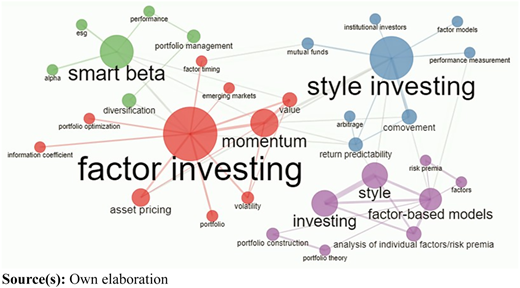
The conceptual structure analysis mostly uses co-occurrence analysis to uncover how often certain keywords appear together in the literature, thereby revealing connections between keywords and primary research themes (Callon et al., 1991; Wang et al., 2014). This method helps to map out the key topics in a research area. Co-occurrence results show four distinct clusters for different research focuses (Figure 1). The purple cluster addresses portfolio construction and factors, connecting to the blue cluster. Key terms include “Factor Investing,” “style investing,” and “Smart Beta,” each belonging to interconnected clusters. Factor Investing is the central theme, with the largest sub-network in terms of keywords and frequency. Style investing and Smart Beta, while related, are distinct, sharing many keywords but differing in focus. The red cluster covers topics linked to Factor Investing and portfolio strategies. The blue cluster emphasizes style investing, and the green cluster addresses current questions about Smart Beta, focusing on diversification and its link to other strategies. These findings indicate that Factor Investing, and Smart Beta are interconnected yet distinct themes.
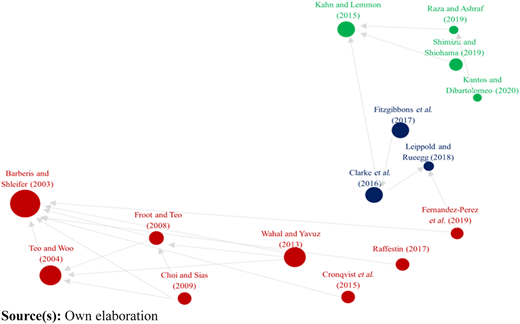
The intellectual structure of the field (Figure 2) traces the evolution of the literature by examining direct citation networks. This method involves analyzing which papers cite which others, allowing us to track the development of key ideas and identify major influences within the research field. By mapping these citations, I can see the pathways through which ideas spread and evolve over time. This analysis identifies three key research phases in the evolution of factor investing. Early studies (2000s) focused on individual style factors and their impact on returns, with foundational works by Barberis and Shleifer (2003) and Teo and Woo (2004) (red markers). Later, research shifted to integrating factors into portfolios, emphasizing practical applications (e.g. Clarke et al., 2016; Fitzgibbons et al., 2017) (blue markers). More recently, studies by Kahn and Lemmon (2015, 2016) have distinguished traditional factors from Smart Beta, a topic that will be further analyzed (green markers).
This figure illustrates the evolution from early Factor Investing to Smart Beta. Factor Investing represents the older research strand, with studies focusing on individual factors and returns. Over time, the field evolved to analyze multifactor portfolios, exploring the interactions between multiple factors and their effects. Simultaneously, advancements in algorithms enabled a shift from classical factors to Smart Beta strategies, i.e. strategies representing rule-based investment portfolios designed to outperform capitalization-weighted benchmarks by leveraging factors as principles. This shift marks the progression from foundational research to advanced investment applications, as detailed in Section 4.2.
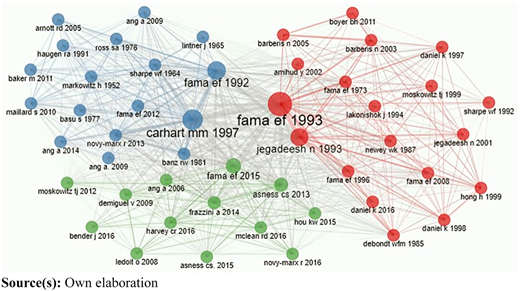
Co-citation analysis (Small, 1973) is another important method used in this study (Figure 3). Co-citation analysis measures how frequently two papers are cited together by other works, which helps identify groups of papers that form the intellectual backbone of the research field. This method allows us to detect key studies that have significantly influenced the development of Factor Investing and Smart Beta. The analysis of the papers reveals three closely related clusters of influential research, with a notable contribution from Fama and French (1993) (red cluster). The blue cluster includes notable work by Carhart (1997) on mutual funds, and Fama and French (1992) on stock return factors. The third cluster, though smaller, highlights Fama and French (2015) for extending their three-factor model.
Finally, the social structure analysis examines collaboration patterns between authors and institutions, focusing on co-authorship networks (Peters and Van Raan, 1991). It identifies the most active and influential countries and institutions in the field (Table 1). The US, France, and the UK represent over 30, 9, and 9% of the total research output, respectively. A majority of publications are single-country efforts (67% SCP – Single-Country Publications), with the US producing the most SCPs. However, international collaboration is also notable, with 41% of UK publications and 37% of French publications involving multi-country efforts. These countries are prominent for their active international collaborations. Additionally, the US and the UK are the most cited countries, underlining their substantial influence on the field.
3.3 Authors’ analysis
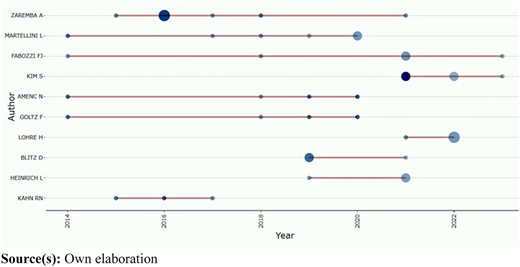
Despite covering the years from 1998 to 2023, there is a notable concentration of prolific authors starting from 2014. Figure 4 shows the activity timelines of the top ten most productive authors, with bubble sizes representing the number of publications for each author. Six authors published papers in 2021, and nine authors have been active since 2020. Frank J. Fabozzi stands out as the most active author from 2014 to 2023. Adam Zaremba and Lionel Martellini have the highest document counts over five years (seven and six respectively). This shows a pattern of increasing activity in recent years, with most authors contributing one or two articles annually, reflecting some heterogeneity in scientific output [4].
Table 2 ranks the top ten authors by their total number of citations, with Andrei Shleifer and Nicholas Barberis leading the field with 483 citations each. Locally (within the scope of this study), Shleifer, Barberis, and Melvyn S. Teo are the most cited, with 36 and 26 citations respectively. Following them in total citations are Nicole Choi, Richard W. Sias (190 citations), Zeno Adams, and Thorsten Glück (187 citations). Hence, while some authors are both highly prolific and highly cited, there are also notable disparities between the most cited and the most prolific authors. This underscores the importance of considering both the number of publications and citation when identifying key contributors.
3.4 Journals’ analysis
Out of the 109 sources analyzed, five journals published 113 articles overall. Several journals contributed to the literature, but some showed consistent interest in recent years. Notably, newer journals have become more active, with the Journal of Portfolio Management standing out with 62 papers since 2014, including fourteen publications in 2019 and ten in 2022. Similarly, the Journal of Asset Management, the Journal of Investing, and the Journal of Investment Management also contributed significantly, especially since 2016 and 2019, although with more moderate growth. Finally, the Journal of Financial Economics published ten papers, showing so far steady contributions [5].
Finally, Table 3 ranks the top ten journals based on total citations, a key indicator of a journal’s influence. The Journal of Financial Economics, the Journal of Portfolio Management, and the Journal of Banking and Finance lead the rankings (941, 332, and 223 total citations, respectively).
While the citation count drops for journals beyond the top positions, the Journal of Financial Economics, Journal of Portfolio Management, and Financial Analysts Journal continue to lead in average citations per year. Two of the top five active journals by articles also rank in the top ten by citations, reflecting both their high activity and influence. The other three active journals are in the top twenty, highlighting their growing impact on the field. Therefore, some journals are both prolific and highly cited, while others, despite publishing fewer papers, maintain a significant influence due to their high citation counts.
3.5 Documents’ analysis
The documents’ bibliometric analysis has two aims. First, it identifies the most frequently cited references in the literature, including older, foundational works that are crucial for understanding the topic. This approach ensures that key documents, which might miss due to keyword limitations, are still included in the analysis. Second, bibliometric analysis ranks the most cited papers, providing insights into which studies have the greatest impact on this research area.
Using reference publication year spectroscopy (Marx et al., 2014), I analyzed 7,016 references to identify the most influential works, based on both total citations and how their influence has developed over time. Significant citation activity began around 1985, with the number of citations consistently exceeding fifty per year. From 1990 onward, citations regularly surpassed one hundred annually. The most cited references are relatively recent, with the majority published in the 1990s or later (Table 4, Panel A). Most influential works include Fama and French (1992, 1993) (81 and 126 local citations, respectively). Notable contributions also come from Carhart (1997) (94 local citations) and Jegadeesh and Titman (1993) (80 local citations).
Instead, Table 4 (Panel B) ranks the top ten documents based on both total citations and local citations (citations within this specific data set). The most cited papers overall are Barberis and Shleifer (2003) and Choi and Sias (2009) (483 and 190 total citations, respectively). Barberis and Shleifer (2003) introduced an influential theoretical model for analyzing factors, while Choi and Sias (2009) explored the behavior of institutional investors, particularly their tendency to herd. In terms of local citations, Barberis and Shleifer (2003), Teo and Woo (2004), and Wahal and Yavuz (2013) are among the highest ranked, focusing on key topics such as value and momentum strategies and factor co-movement.
3.6 Data and methods analysis
Most research has concentrated on the US market (Raffestin, 2017; Leippold and Rueegg, 2018; Mateus et al., 2020), though some studies on European markets (Bertrand and Lapointe, 2015; Boucher et al., 2021) or specific countries (Silvasti et al., 2021). Comparative studies frequently examine differences between US and Europe (Shimizu and Shiohama, 2019; Raza and Ashraf, 2019). Moreover, most of the literature focuses on stock markets (Leippold and Rueegg, 2018; Mateus et al., 2020), despite a growing interest in bond markets (Houweling and van Zundert, 2017; Bektić, 2018). Data typically come from well-known financial databases such as CRSP, Compustat, Datastream, and Bloomberg, usually with monthly frequency.
About methodologies, the diversity of approaches in this field makes difficult to provide an exhaustive description. However, certain theoretical foundations are widely shared. Most studies build on the Fama and French (1992, 1993, 2015) multi-factor models and the Capital Asset Pricing Model (Sharpe, 1964). A large literature also draws on Barberis and Shleifer (2003), with a focus on portfolio optimization rooted in Markowitz’s (1952) modern portfolio theory. Finally, commonly models include the Fama-MacBeth (1973) regression models, with several techniques, e.g. pooled regressions, fixed effects models, correlation analysis, decile or quintile analyses, and vector autoregression models (Cronqvist et al., 2015; Bektić, 2018).
4. Content analysis
Building on the bibliometric findings, this section systematically analyses the main contributions and the evolution from Factor Investing to Smart Beta. It uses citation network (Figures 2 and 3) to trace developments of papers and highlight their historical progression and unique features.
The analysis is divided into two parts: the first explores the historical development of Factor Investing, focusing on key factors (value, size, momentum, liquidity) and their role in portfolio construction; the second examines Smart Beta, its distinctions from Factor Investing, practical applications, and the profitability of multi-factor strategies.
4.1 Factor investing
Factor Investing forms the foundation of modern investment strategies. Initially designed to address risk-return anomalies (Markowitz, 1952; Sharpe, 1964), it evolved into a structured approach leveraging economic and financial factors for portfolio diversification and optimization. This strategy effectively manages risks, with literature emphasizing its role in achieving diversification and generating positive risk premiums (Cochrane, 2011; Hou et al., 2020).
4.1.1 Historical evolution and factor identification
Factor Investing has evolved through key contributions like Markowitz’s (1952) diversification, Sharpe’s (1964) Capital Asset Pricing Model (CAPM), and Ross’s (1976) Arbitrage Pricing Theory (APT). However, its recognition grew only in the 2000s with relevant studies by Fama and French (1993) and Barberis and Shleifer (2003), demonstrating how systematic factors such as value, size, momentum, and volatility explain return anomalies, laying the foundation for efficient investment strategies.
In particular, the seminal Fama and French’s three-factor model (1992, 1993) incorporated factors like value and size alongside market risk, later expanded into the five-factor model (Fama and French, 2015) with profitability and investment factors, further solidifying the underpinnings of Factor Investing. Barberis and Shleifer’s (2003) work on “style investing” introduced behavioral elements, fueling the proliferation of factors into what Hou et al. (2020) term a “zoo of factors,” reflecting the growing field’s complexity and importance.
Today, factors are grouped into three categories (Connor, 1995; Shimizu and Shiohama, 2019): (1) Macroeconomic factors, tied to economic indicators like inflation and GDP growth; (2) Statistical factors, using methods like principal component analysis for diversification; (3) Fundamental/Style factors, including value, size, and momentum (Fama and French, 1993; Jegadeesh and Titman, 1993) [6].
4.1.2 A consolidated network and portfolio approaches in factor investing
The bibliometric network underscores the central role of Factor Investing in investment research. Over time, studies by Leippold and Rueegg (2018), Fernandez-Perez et al. (2019), Fitzgibbons et al. (2017) highlighted two main approaches to implement factor strategies: “mix” strategies, where factors are applied separately, and “integrated” strategies, where factors are combined. While integration improves the risk-return tradeoff, mixed strategies remain simpler and more transparent.
Further contributions by Hou et al. (2020) and Fitzgibbons et al. (2017) have deepened the understanding of factor-based returns, solidified the research framework and contributed to a stable network of research. However, the focus on factors has also spurred the development of advanced strategies like Smart Beta, marking the next phase in investment strategy evolution.
4.2 Smart Beta
Smart Beta represents a significant shift from Factor Investing, forming a distinct research network. It combines the transparency and replicability of passive management with rule-based methodologies, offering targeted factor exposure to improve diversification and stability (Jacobs and Levy, 2014; Kahn and Lemmon, 2016). Bridging active and passive management, Smart Beta delivers cost efficiency and systematic factor application, emerging as a practical alternative for portfolio management.
4.2.1 Growth and differentiation: a consolidated network in Smart Beta
While Factor Investing and Smart Beta share principles and use factors to enhance returns or reduce risks (Koedijk et al., 2016), they have followed different evolutionary paths. Barberis and Shleifer (2003), as well as Teo and Woo (2004) indirectly connect these fields, being the first significant study that unites them and has been cited by both research strands, while later works emphasize Smart Beta’s distinct identity.
More specifically, unlike Factor Investing, which seeks to outperform markets through factor-based models, Smart Beta uses a rules-based framework, i.e. whose rules depend on specific factors, to build portfolios diverging from market-cap-weighted indices, achieving superior diversification and stable returns (Jacobs and Levy, 2014). Its uniqueness lies in blending active and passive strategies, providing transparency, replicability, and customizable factor exposures in a “smart” algorithm procedure (Kahn and Lemmon, 2016).
4.2.2 New Smart Beta strategies and applications
In recent years, Smart Beta has emerged as an independent framework, distinct from Factor Investing, with various contributions. It is often compared not long to Factor Investing but to alpha strategies, which rely on active management to generate outperformance (Jacobs and Levy, 2014; Kantos and Dibartolomeo, 2020). While alpha strategies focus on outperforming market benchmarks through skill and judgment, Smart Beta offers a more systematic, cost-efficient approach, leveraging algorithmic models for competitive returns, especially during market turmoil (Foglia et al., 2021) [7].
Smart Beta research is highly applicable across various markets. For example, Cai et al. (2018) demonstrated superior Sharpe ratios in the Chinese A-share market, while Raza and Ashraf (2019) found Smart Beta strategies outperformed traditional Shariah-compliant portfolios during crises. Furthermore, other research explored herding risks in Smart Beta portfolios (Krkoska and Schenk-Hoppé, 2019) [8] and the benefits of combining active, passive, and Smart Beta strategies for more robust portfolios (Bellord et al., 2019). Finally, performance persistence has also been analyzed. Following the Hunter et al. (2014)’s approach, Mateus et al. (2020) found that half of Smart Beta ETFs consistently delivered excess returns compared to traditional ETFs – even after accounting for costs – with persistent performance over the following year, offering better predictability in returns [9].
5. Discussions and implications
5.1 General implications for practitioners
The wide literature on Factor Investing and Smart Beta offers valuable insights. A key takeaway is the importance of integrating Smart Beta with alpha strategies to maintain competitiveness and optimize returns, as suggested by Kahn and Lemmon (2015, 2016). Studies by Raza and Ashraf (2019), and Silvasti et al. (2021) confirm that Smart Beta strategies are profitable within traditional management frameworks and recommend them to global investors and traditional managers, particularly those managing passive stock market portfolios. These strategies are particularly advantageous for funds, ETFs, and alternative portfolios.
Practical applications of these strategies extend beyond fund managers to retail investors and asset owners. Research by Cronqvist et al. (2015) and Zaremba (2015a,b) highlights the benefits of quality investing and international diversification, while Bektić (2018) emphasizes the effective use of momentum in ETFs and the exploitation of the low beta for improved risk-adjusted returns.
Furthermore, the growing literature on multi-factor Smart Beta portfolios [10] further underscores their benefits. Studies by Hitaj and Zambruno (2016) demonstrate their advantages for hedge fund portfolios, while Raffestin (2017) recommends co-movement strategies to enhance diversification. Ghayur et al. (2018) discuss blending multiple factors to create optimal portfolio strategies. Moreover, Bellord et al. (2019) urge asset owners to transition from traditional passive indices to Smart Beta strategies, particularly by integrating ESG criteria to address environmental, social, and governance issues. Authors like Pastor et al. (2021) also underscore the benefits of incorporating ESG into multi-factor strategies.
Lastly, practitioners focused on long-term performance and crisis resilience can benefit from the findings in this literature. For example, Mateus et al. (2020) show that Smart Beta strategies are effective in selecting funds with persistent performance, while Briere and Szafarz (2021) highlight the appeal of these strategies for investors with low to moderate risk aversion, particularly in times of market turbulence, such as financial crises or pandemics (Foglia et al., 2021).
5.2 Practical implications for practitioners
The evolution of Smart Beta holds significant benefits for practitioners. Understanding these strategies allows portfolio managers and asset owners to make more informed decisions regarding portfolio construction and risk management. Practitioners benefit from knowing how these strategies have evolved because it provides insight into new methodologies that offer cost-efficiency and customized exposure to specific risk factors, essential for optimizing returns in today’s highly competitive and volatile financial markets.
For example, Smart Beta represents a key innovation, offering a transparent, rules-based approach that sits between active and passive management. This evolution allows practitioners to harness the performance potential of multiple factors while benefiting from lower costs compared to traditional active management.
Moreover, this transition directly addresses practical needs in the market. Practitioners can now implement multi-factor strategies through Smart Beta products, which are increasingly available in the form of ETFs and other investment vehicles. These products allow for factor tilts that align with specific investment goals, such as reducing volatility or enhancing returns. Moreover, by incorporating ESG into Smart Beta, practitioners are better equipped to meet the growing demand for sustainable investing, without sacrificing performance.
Furthermore, understanding and applying these evolving strategies helps practitioners respond to market changes and crises more effectively. Recent literature shows that Smart Beta strategies have proven to be resilient during market downturns, offering an alternative to traditional asset allocation approaches that may struggle during periods of high volatility. This resilience is particularly relevant for investors looking for long-term stability and consistent performance, especially in unpredictable markets.
Lastly, practitioners gain valuable insights from Smart Beta strategies, which offer innovative investment approaches, advanced risk management, and portfolio solutions suited for various market conditions. This knowledge helps them stay competitive and meet client expectations in complex financial markets.
6. Conclusion
This study examined Factor Investing and Smart Beta through a systematic literature review, highlighting differences and practical implications for researchers and practitioners. The findings suggest how Smart Beta strategies have emerged as a practical solution, allowing investors to optimize portfolio construction through rules-based approaches that combine the benefits of both active and passive strategies.
Through a bibliometric analysis, this paper identified key trends, influential authors like Shleifer Andrei and Barberis Nicholas, and major journals, such as the Journal of Portfolio Management, as critical contributors to this field. The content analysis highlighted two dominant research areas: Factor Investing and portfolio allocation versus Smart Beta strategies. Despite the heterogeneity in issues, data, methods, and markets, this paper emphasized the core features of these approaches and how they have evolved over time.
The review also provided practical implications for portfolio managers and investors, showing how understanding Smart Beta offers actionable insights for optimizing asset allocation and risk management in real-world scenarios. Smart Beta strategies not only offer a cost-effective alternative to traditional active management but also allow for greater customization of factor exposures, aligning with specific investment goals, such as ESG integration or reduced volatility.
This study also identified future research areas, including exploration of the macroeconomic context and advanced research techniques. For instance, the integration of Smart Beta with alternative alpha strategies and the development of more sophisticated factor models represent promising research directions.
Finally, the study acknowledges potential limitations. First, the choice of keywords for the dataset inevitably influence the analysis. This limitation is partly addressed by including co-citation and spectroscopy analysis. Anyway, future research could use alternative data sources (Scopus or Google Scholar) as primary sources. Additionally, incorporating working papers, non-academic publications, industry analyses, and other sources could enhance the depth of content evaluation.
I am deeply grateful to the anonymous referee for his invaluable feedback and thoughtful suggestions. His thorough review and insightful observations have been instrumental in enhancing the depth, rigor, and overall quality of this manuscript.
Notes
However, selecting an alternative dataset would not have led to significant changes in the paper’s findings, as the results are consistent across different databases.
As a clarification, the concept of factors is much older and goes back to Sharpe (1964) who considers the market as a potential and only factor influencing yields.
The CAGR was used to measure the rate of growth of the literature over the selected period. CAGR represents the average annual growth of the number of publications over a specified period, assuming that the growth happens at a consistent rate each year. It is a useful measure because it smooths out the effects of volatility or irregular growth during the period, providing a more stable view of overall growth.
These findings align with Lotka’s Law, which suggests that as the number of articles authored by an individual increases, the frequency of high-output authors decreases. Few authors write many papers, while most write only a few (Lotka, 1926). Among the 629 authors in this study, 546 are “occasional authors” with just one article, 65 have written two, and only 10 have written three. Only eight authors, including Zaremba and Martellini, have written four or more papers, classifying them as “core” authors in the field.
Publication trends also reflect Bradford’s Law, which divides journals into three zones: Core, Middle, and Minor (Bradford, 1934). The top five journals belong to the Core zone, representing 5% of all sources but contributing 37% of the total publications. The Middle zone consists of 17% of sources, with 18 journals producing 89 publications. The remaining 86 sources in the Minor zone contributed a total of 99 articles, highlighting the dominance of the top journals in the field.
Fundamental factors are well-established and extensively applied in equity markets (Basu, 1997; Fama and French, 1993; Jegadeesh and Titman, 1993; Kaur et al., 2024). They have also been studied in bond markets, where factors like term structure, credit quality, and momentum significantly influence fixed-income investments (Jostova et al., 2013; Houweling and van Zundert, 2017).
Additionally, integrating ESG criteria into Smart Beta strategies enhances risk-adjusted performance while addressing environmental, social, and governance issues (Yasmine and Kool, 2022; Pastor et al., 2021).
This builds on Amenc et al. (2014)’s findings, that demonstrated the Smart Beta profitability but did not fully account for the risk of herding.
Pure factor and Smart Beta ETFs focus on specific factors, like value or low volatility, offering targeted exposure to individual risk premiums. Unlike market-cap-weighted or sector-blended ETFs, they isolate single factors for precise strategies or tactical asset allocation.
Multi-factor Smart Beta portfolios combine multiple factors to optimize risk-adjusted returns, balancing risks and benefits for consistent performance across market conditions. This cost-effective, diversified strategy offers a superior alternative to traditional index tracking.