Throughout the world, school grade structures are most variable during the early adolescent years when students can find themselves in a variety of school models. This paper investigates the impact of two popular school models in the United States (middle school and K-8) on the self-esteem and self-concept of early adolescents. Based on mixed method longitudinal research conducted over the 2004-2005 academic year, the study finds differences in levels of self-esteem amongst sixth grade students at the beginning and end of the school year, with students in K-8 buildings having higher increased levels of self-esteem when compared to students in other models. Gender analysis reveals girls are more negatively impacted by middle school environments than boys. Both quantitative and qualitative analysis reveals greater feelings of anonymity amongst middle school students and more negative attitudes toward their own social behavior. Overall results point to serious implications in school design and timing of transition for early adolescents.
Introduction
When comparing school structures around the world and even within the United States, it is evident that the greatest disagreement amongst educators regarding grade span composition pertains to early adolescent students. While very young children generally find themselves in similar primary school buildings and older adolescents attend secondary schools with surprising organizational consistency, early adolescents find themselves in a vast array of possible grade span structures. Schools in the United States are particularly inconsistent in their treatment of early adolescents who may be placed in a wide assortment of institutions, including: middle schools, junior high schools, and K-8 environments.
It is unfortunate that schools are most variable during early adolescent years when youth themselves are also most unpredictable in their own development. The 20th century’s infatuation with the study of adolescence in the West found its roots with G. Stanley Hall’s interpretation of the adolescent as one going through a time of sturm un drung or storm and stress (1904). Even though the evidence of this characterization has been debated by psychologists, sociologists, and anthropologists, all fields realize the importance of healthy environments for healthy adolescent development. Consequently, any possible disconnect between school environmental context and adolescent development may contribute to difficulties for youth who are already experiencing developmental discontinuities in their own personal lives.
The primary goal of this study is to investigate the impact of two different popular United States school models for middle grade students (middle school and K-8) on the self-esteem and self-concept of early adolescents. This study is part of a larger longitudinal research project investigating the influence of three models (these two and a model common in the United Kingdom) on several variables, including: self-esteem/self-concept, academic achievement, school attendance, and problematic behavior. This project does not seek to prove that any one school model is the making or breaking point for all students. Instead, it will look for trends and patterns that are related to specific school contexts that may influence the socio-emotional development of early adolescent students.
Learning Environments and School Models
Theoretical frameworks supporting the necessity for studying learning environments and their relation to human development, among others, are evident in such perspectives as Bronfenbrenner’s (1979) ecological theory of human development and the developmental niche perspective proposed by Super and Harkness (as cited in Segall et al, 1999). These conceptual frameworks lay the foundation for understanding the influence of environmental contexts on all aspects of the developing human, including elements of socio-emotional development such as self-concept and self-esteem. Others like Vygotsky (1962) and Bruner (1990) have illustrated the importance of socio-historical context on cognitive development, learning, and meaning in our lives. They subsequently call for the understanding of the people, context, and tools involved in learning and general developmental processes.
Within this broader analysis of environmental context has been an ongoing debate since the mid-twentieth century focused on the appropriate school model for young adolescents. This debate was in response to the apparent ineffectiveness of large junior high schools which mirrored too closely the large high school model in its class sizes, departmentalization, and tracking. Professional educators raised grave concerns in the 1960’s and 1970’s about the developmental appropriateness of such impersonal spaces that did not seem to meet the needs of the whole child (Wiles & Bondi, 2001). School reform for preteens over the following decades focused on the transformation of junior high schools into middle schools, based on recommendations of several prominent documents, most notably The Middle School We Need (ASCD, 1975) and Turning Points: Preparing American Youth for the 21st Century (Task Force on Education of Young Adolescents, 1989). Recommendations which became the basis of a sound middle school philosophy encouraged schools to: create small communities for learning, foster socio-emotional adolescent health, teach a core academic program, empower teachers and administrators who are especially trained for working with young adolescents, and work collaboratively with families and communities (Felner et.al., 1997). Middle school reformers have generally interpreted these guidelines as including necessary features such as: team teaching, flexible class schedules, an integrated curriculum, a focus on advising, and common planning times for teachers.
Substantial research has found that when schools take a comprehensive and integrative approach to implementing middle school philosophy reforms, student achievement and overall development improve in these middle schools more than students in traditional junior high schools. Because of these results, school districts have been quick to transform their junior high buildings into middle schools. However, a longitudinal study of almost 100 schools in Illinois found that even highly motivated middle schools struggle to create and maintain the types of reforms necessary to actually meet the needs of Turning Points (Felner et.al., 1997). These reforms require additional staff training, resources, and commitment on the part of teachers and administrators alike. Therefore, the extent to which these schools are middle schools in philosophy and not merely in name is widely variable. Yet the preponderance of data from longitudinal research reveals that “reforms implemented independently of one another are likely to produce little or no significant rise in student achievement, especially for disadvantaged youth” (Lipsitz et al, 1997, p. 519). Nevertheless, school systems continue to create large middle school buildings, already knowing the problems associated with large numbers of young adolescents, necessitating more complicated implementation of the reforms called for in Turning Points.
Self-esteem and Self-concept
The latter part of the twentieth century saw an increased interest in understanding the link between self-esteem and characteristics associated with successful adolescent development, especially within educational contexts (Humphrey, 2004). Influenced by earlier theoretical constructs of adolescence, such as G. Stanley Hall’s (1904) interpretation of adolescence as a time of storm and stress and Erik Erikson’s (1950) emphasis on the importance of the development of self-image during adolescence, researchers set out to investigate the relationship between self-esteem and self-concept with other behaviors and attitudes (Simmons et al., 1973). The majority of the school-related research has validated the assumption that high selfesteem is associated with positive educational achievement (Marsh, Byrne, & Yeung, 1999), that ability levels may influence depressive symptoms and levels of self-esteem (Humphrey, Charlton, & Newton, 2004), and that a positive self-esteem is desirable for children’s personal development (Branden, 1994). Even though some analysts view the vast amount of evidence as correlational, not proving causality (Baumeister et al, 2005), the relationship between self-esteem, academic achievement, and personal and social adjustment requires continued investigation.
Nonetheless, the task of measuring self-esteem has been problematic with disagreements regarding the cultural validity of instruments used to examine self-esteem (Holaday et al., 1996). The general definition of self-esteem has been broadly defined as a “positive or negative attitude toward … the self” (Rosenberg, 1965, p. 30), but to what degree socio-cultural context influences the “positive or negative attitude” remains uncertain. Western cultures have been shown to interpret self-esteem similarly when compared to other vastly different cultures (Chan, 2000); however, any difference in sociocultural context, including the influence of geography, ethnicity, and gender may impact one’s self-esteem (Abbas, 1993). Furthermore, part of understanding self-esteem includes an investigation of self-concept or “a multidimensional and dynamic system of beliefs” (Cole et al, 2001, p. 1723). Whether one feels positively or negatively about oneself will be influenced by what dimensions of oneself one chooses to include in the self-analysis. Consequently, while the focus of this research is on measuring self-esteem, we often include reports of selfconcept as part of this equation.
School Transitioning
The two primary issues imbedded in the exploration of school environments for early adolescents concern school transitioning and characteristics of school structure. School transitioning involves both the timing of transitioning and the degree to which students should be transitioning from one school to another during early and then later adolescence. The second issue addresses the need to understand the best school structure for pre-teens, including school size, grade span structure, and patterns of student interaction during the academic day.
Previous research related to early adolescent transitioning has produced various results, but the general pattern of significant outcomes has found that when compared to early adolescents in K-8 environments, students in middle school settings exhibit characteristics more often associated with adjustment problems. Generally, research shows that the more students are forced to transition from one school environment to another, the more negative are the effects on students. These undesirable effects of transitioning include: declines in academic achievement (Alspaugh, 1998; Becker, 1987; Blyth, Simmons, & Carlton-Ford, 1983; Gronna, 1999; Wren, 2003); psychological problems such as lower self-esteem (Richardson, 2000); and changes in social behaviors, such as a decrease in participation in extra-curricular activities and increased feelings of personal anonymity (Blyth et al., 1983). Transitioning to a new school setting during early adolescence has even been shown to increase students’ perception of school related stress and thus increase depressive symptoms for those students who went through a transition (Rudolph et al., 2001) but not for students who remained in a stable school environment.
Researchers of transition studies often conclude that students who transition more often in their adolescent years than students educated in consistent environments experience difficulties as a result of other simultaneous challenges facing them biologically, socially, and academically at this time in their lives. This perspective supports research that has found middle school transition to be most problematic for girls (Blyth et al, 1983; Simmons et. al., 1979) who are simultaneously experiencing more developmental change than boys at this time (Simmons et al, 1987). Much of the negative evidence for girls includes detriments to their academic, social, psychological, and behavioral development, whereas other research has found more problems associated with academic achievement for boys rather than girls, with girls experiencing greater psychological distress and possible internalization of stress, resulting in physical symptoms (Chung et al.,1998). What is most important here is the fact that students in middle/junior high schools must transition more often in their adolescent years than students schooled in multi-age environments and are therefore possibly more susceptible to these negative effects.
School Grade Structure
In addition to transitioning, much of the research on school age-grade composition has discovered that there is a lack of fit between student needs and the environment of the middle-grades schools (Eccles & Midgley, 1990), including “an increased amount of teacher control, a decrease in teacher efficacy and in the quality of teacher/student relationships, and an increase in between-class ability grouping” (Eccles et. al., 1993, p. 567). In particular, analysis of longitudinal data by Eccles and her colleagues has found that this mismatch between students’ needs and school environment has contributed to a decrease in academic motivation, a more negative selfimage, and an increase in behavioral problems during the middle school years (Eccles et. al., 1991; 1993; Eccles & Roeser, 1998). Research by Anderson and colleagues (2000) has also found that age-specific schools introduce students to what some researchers refer to as “institutional discontinuities” including departmentalization and tracking when class sizes get too large.
In spite of the 1989 and 1995 reports from the Carnegie Council on Adolescent Development, calling for major reform of middle grades schools that are not developmentally appropriate, school systems in the United States continue to create traditional middle schools, often even larger than the already too overcrowded schools critiqued in the reports (Carnegie Council on Adolescent Development, 1989; 1995). Research investigating the most developmentally appropriate configuration for middle school aged students continues to find that the composition of students’ ages within a school influences academic achievement and social development.. In particular, a study by Clark and Clark (1982), investigating the impact of various school age-grade structures found that the smaller the grade-span in a school, such as the 6-7 grade span model, was the most detrimental for early adolescent development. A more recent study of 232 schools in an urban mid-west school system found that “as grade span configuration increases so does achievement” (Wren, 2003, p. 10). Therefore, by the nature of the structure, even ones that follow an appropriate middle school philosophy, middle schools must contend with issues of gradespan and large class sizes. However, both of these characteristics have been found to lower academic achievement and increase feelings of personal anonymity (Blyth et.al, 1983). Consequently, a new move promoting “Elemiddle” schools combines the grade-span configuration of K-8 schools with the benefits of middle school philosophy (Hough, 2003; 2005).
SES, Ethnicity and School Structure
An increasing amount of evidence reveals that the negative influences associated with transitioning to middle/junior high schools are most problematic for students from lower socioeconomic status (SES) homes who tend to excel academically when remaining in K-8 settings (Becker, 1987). Students from lower SES homes, whether urban or rural, generally have difficulties transitioning to middle school as a result of other instabilities already present in their lives (Howley et al, 2000; San Antonio, 2004). The realities of extra stresses related to low income, responsibilities at home when parents work extra shifts, and less time or access for participation in extra-curricular activities, all exacerbate stresses associated with transition to middle school. Furthermore, an analysis of research by Howley (2002) has also found that grade configuration and size of a school (or class size) most negatively influences students from lower SES. Smaller schools tend to focus on student “outcomes” (e.g., achievement, attendance) but larger schools with less grade-span configurations tend to emphasize school “inputs” (e.g., teacher salaries, materials, staffing).
Understanding the impact of ethnicity as a factor in influencing students’ ability to transition smoothly into middle school has been more complicated than just looking at SES. Of the few studies in the United States that have focused on the ethnicity of middle school students when transitioning to middle school, negative implications have often been found for minority students. Gutman and Midgley (2000) found that African American students experienced a decline in grade point average as they progressed from elementary to middle school. However, Wampler et al (2002) found that the influence of junior high was more variable in their sample of Hispanic, African-American and Euro-American seventh grade students from the southwest. In this case, the students who demonstrated greatest academic grade decline were Hispanic students, whereas the African-American students, who on average started with lower grades, actually experienced the least amount of decline in grade point average from sixth to seventh grade. Problems associated with school transition for minority students in Wampler’s study were often coupled with depressive effects and other socio-emotional problems. In the end, the extra stresses and strains placed on students as a result of being a member of a minority or low SES population may add to the stresses experienced from transitioning to middle school and therefore should be part of future research studies.
Given these research findings and theoretical and practical implications of the importance of school socio-cultural context, the primary goal of this study is to investigate the impact of these two different popular school models on the socio-emotional development of middle grade students. Specifically, the impact that these two environments may have on sixth grade students’ self-concept and selfesteem is of primary interest.
Methods
Research Design
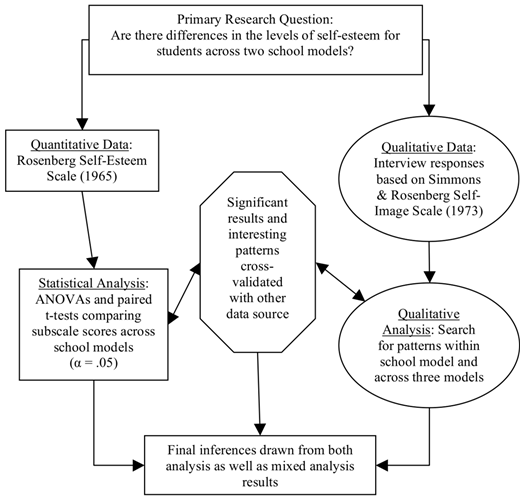
Researchers used a “multistrand concurrent mixed method” design (Tashakkori & Teddlie, 2003) to explore similarities and difference in self-esteem across the two school models (K-8 and middle school). The “multistrand concurrent” component refers to collecting both quantitative and qualitative data using separate procedures but at the same time (rather than one procedure following the other). The “mixed method” component indicates the researchers addressed one primary research question using both quantitative and qualitative methods (see Figure 1 for a visual representation of the research design).
Site Selection and Description
The Cleveland Municipal School District (CMSD) was chosen as the location for this project because it provided researchers with a rare opportunity to investigate different models of middle level education, as the school district included both K-8 and middle school buildings during the time of this study.1 Two middle and two K-8 schools were chosen for the study. Schools were chosen with the assistance of CMSD administrators who could select schools that represented a broad spectrum of the population, were from similar SES backgrounds, and also with similar histories of development as K-8 or middle school buildings. Using one school district for the sample allowed researchers to minimize and more easily control for the problems associated with differing student and social contextual variables in dissimilar districts (i.e. socioeconomic status, culture, and percentage of minority students). Cleveland’s large, urban, and historically multi-ethnic working class population provided adequate demographics to investigate school structure and transition issues for students who may more keenly experience transition challenges. In order to control for SES, all schools chosen for the study reported 100% of students qualifying for the free and reduced lunch program. Even though some schools enrolled higher numbers of minority students than others, all schools represented the ethnic diversity illustrative of Cleveland’s urban district. The student body of the four schools ranged in total daily enrollment from 567 to 889 students, but the number of students per grade level varied greatly between the two types of schools, with middle schools averaging 270 students per grade and K-8 buildings averaging 70 students per sixth grade class.
Participant Selection
A total of 103 sixth grade students (41 males, 62 females) in four schools in Cleveland, Ohio constituted the study’s sample. The diverse ethnic composition of the schools represented the multicultural diversity of the city of Cleveland with students from an assortment of backgrounds, with 22% of the middle schools and 34% of the K-8 schools classifying themselves as “white” students and 78% of the middle schools and 66% of the K-8 classifying themselves as “nonwhite minority” (representing a varied mix of Hispanic, African-American, Middle Eastern, Asian, and often a mixture of several). Of this total sample, 45 were enrolled in two different middle schools and 58 were in two K-8 buildings. The imbalance of student representation in different school models occurred as a result of parent/student consent form return rates. The mean consent form return rate for K-8 schools was 41% (33.3% and 48.5% for the two schools separately), and the mean rate for the middle schools was only 8.1% (8.6% and 7.5% for the two schools separately). In addition to the entire sample utilized for research surveys, a sub-sample was interviewed in order to qualitatively investigate differences in self-perception and of others in school. As a result of the reality of circumstances of conducting research in school settings, this sub-sample was also a sample of convenience. In each school, researchers chose students for interviews from the larger sample based on availability during the school day in order to avoid significant interruption to their daily academic lives. Students who were available during free periods, study halls or other less academically sensitive periods, by default became this sub-sample.
Investigations with students (surveys and interviews) took place at the beginning and end of the 2004-2005 academic year in order to measure changes in socioemotional measures influenced by that year’s attendance in their particular school. As a result of the time factor, the sample size diminished over the course of the school year as a result of student school drop-out, school transfer, and daily absence. Through the longitudinal nature of this investigation, researchers anticipate following this student sample over a four year time-span, not desiring, yet expecting a further decline in the number of participants. The challenges associated with acquiring adequate student participation must be kept in mind when analyzing the data and drawing conclusions.
Data Sources
Rosenberg Self-Esteem Scale
The Rosenberg Self-Esteem Scale (Rosenberg, 1965) was administered to the entire sample of students and consists of 10 items using a 4-point Likert scale (see Appendix A). Summing responses yields a Global Self-Esteem score ranging from 4 to 40 (higher values indicate stronger global self-esteem). Previously reported test-retest reliability ranged from .82 to .88, with Cronbach’s alpha for various samples ranging from .77 to .88 (Blascovish & Tomaka, 1993).
Simmons and Rosenberg Self-Image Scale
The Simmons and Rosenberg Self-Image Scale (Simmons, Rosenberg, & Rosenberg, 1973) is a one-on-one interview guide. This interview was administered to a sub-set of students within the larger sample. The Scale includes five subscales: (a) self-consciousness, (b) stability of self, (c) self-esteem, (d) perceived self-image, and (e) depressive affect. Collectively, these items contribute to a global understanding of the self, contributing to self-image. For each question, the interviewer marks a number indicating the nature of the verbal response. For example, the first question on the selfconsciousness scale asks:
“Let’s say some grownup or adult visitor came into class and the teacher wanted them to know who you were, so she asked you to stand up and tell them a little about yourself. Would you like that, not like it, or wouldn’t you care?”
As the student responds to this question, the interviewer indicates which of the three responses the student gives; each response has its own numerical value. These quantitative values can then be used to compare students’ responses across school models. Furthermore, each question also provides the opportunity for expanded discussions related to the topic, permitting the interviewees to explain their answers, add further details, and even take the interview in various directions.
Data Analysis
Researchers entered quantitative data from both scales into SPSS for comparisons based on school model. We evaluated statistical significance based on a level of significance (a) of 0.05 and reported effect sizes where appropriate. Qualitative data included verbatim transcripts from the one-on-one interviews using questions on the Simmons and Rosenberg Self-Image Scale (Simmons, Rosenberg, & Rosenberg, 1973). We approached data analysis with the goal of blending the quantitative and qualitative data (Creswell & Plano Clark, 2007), primarily exploring ways in which those students we interviewed supported the quantitative differences emerging from statistical analysis. Our first round of data analysis, however, involved exploring the two data sets independently:
- 1)
We used the quantitative data to compare the students’ self-esteem and self-image scores across school models, from fall to spring, and by gender, and
- 2)
Two researchers independently read all of the interview transcripts for important themes related to self-image and self-esteem. We then came together to discuss our individual findings as a form of triangulation (Creswell, 1998).
This parallel mixed analysis (Tashakkori & Teddlie, 1998) was followed by an iterative approach to exploring both data sets together. We wanted to determine whether the quantitative data supported themes found in the interviews, and we also wanted to determine whether any interview data supported or expanded upon the statistical results. This form of data analysis allowed us to both enhance our descriptions of students’ self-esteem and self-image in each school model and legitimate findings from each data source (Onwuegbuzie & Teddlie, 2003). The iterative approach to comparing results from both data sources is one of the benefits of the mixed-methods design used here: we enhanced statistical results with the students’ own words and descriptions, and we used the quantitative data from the entire sample to determine whether trends in the interview data might be seen for the larger group of students. We could only do this, however, when survey questions corresponded to interview questions; we could not statistically explore every trend in the interview data.
Results
Global Self-Esteem
Global self-esteem was measured at the beginning and end of the academic year in order to assess students’ initial self-perceptions as they entered sixth grade, and again later, as they felt the impact of nearly completing the school year. Global self-esteem was investigated using two types of scoring methods which have been used in the past with the Rosenberg survey. Some investigators have utilized a total 40 point composite score as a dependent variable, while others have combined items into a six point Guttman scale. While both methods of scoring have been found to be reliable, the 40 point scale was utilized for this particular analysis.
In the fall, the K-8 students had a slightly higher self-esteem score mean (M = 30.81, SD = 4.69) than the middle school students (M = 30.49, SD = 4.16), however these differences were not statistically significant. The impact of contextual differences amongst the two groups of students in this study necessitated a second analysis as to whether there was actually a change in levels of self-esteem over the course of the academic year. Therefore, a paired T-test was utilized to investigate whether global self-esteem changed over the course of the sixth grade for the two school types. The analysis found that while the mean self-esteem scores did rise over time for both school types, this increase was only significant for the K-8 students [t (37) = -2.26, p=.030)].
As a result of gender differences often found in other studies of adolescent self-esteem, further statistical analysis was conducted to investigate whether males or females more heavily influenced the difference in the rise of self-esteem within this student population. A paired t-test revealed that the rise in self-esteem was statistically significant for K-8 females [t (26) = -2.124, p = .045], with the selfesteem of the girls increasing from fall (M = 30.04, SD = 4.89) to spring (M = 32.25, SD = 4.35). However, girls at the middle schools and boys at both settings did not rise significantly. These latter results indicate that a more substantial portion of the positive change in selfesteem over time may be largely the result of a change in the female population in K-8 schools.
A portion of the interview conducted with the smaller sample of students includes a six item self-esteem subscale. One question of this section proved to show significant difference between the fall and spring discussions for middle school students alone. This item asks students: “Everybody has some things about him/her that are good and some things about him/her that are not so good or bad. Are more of the things about you: good, not so good/bad, or about the same?” With a low score of one being “good” and a score of three being “bad,” the middle school students’ mean score changed from 1.63 in the fall to 2.25 in the spring. A t-test comparing these fall and spring mean scores revealed significance [t (7) = -2.36, p = .049)].
Whereas many students in both groups chose not to elaborate on their answer for this topic, when they did, the middle school students’ additional comments reveal an attitude that is not as strongly present in the K-8 students’ responses. When a few K-8 students chose to add commentary on their “not so good” traits, they usually revealed an understanding that improvement was desirable. One such K-8 girl indicated that she “was working on [her] temper with [her] brother.” However, several middle school students’ statements about their behavior were more matter-of-fact, as if this was simply the way they were. The most obvious came from a girl who flatly stated: “My attitude everywhere [is bad]. I don’t know why it’s so bad. I’ve always been this way. I like having a bad attitude. It’s my personality.” Consequently, both the quantitative and qualitative analysis of the selfesteem interview results reveal additional evidence to the survey data that sixth grade middle school students struggle with their self-esteem more than the K-8 students.
Impact of Self-Perception on Self-Esteem
Thus far, the quantitative analysis of the data has revealed that participation in certain school structures collected in this particular urban American environment may influence the degree to which the self-esteem of sixth grade students, especially girls, rises throughout the academic year. Further evidence that the middle school environment may negatively influence students’ ability to increase their level of selfesteem at the same rate as K-8 students came from students’ interpretations of their teachers’ opinions of them. During fall and spring interviews, students were asked to describe what they thought were their teachers’ perceptions of them. Their responses revealed notable differences between the middle school and K-8 students’ views of others perceptions of them, and thus how they most likely view themselves.
A first look at the students’ discussions for this particular interview item revealed a simple difference in the amount of information provided by the two groups. The K-8 students included a greater number of personal traits in their opinions of themselves with an average of 2.6 items per response. However, the middle school students averaged only 1.8 traits per response. What is most striking in the middle school interviews is the number of students (40%) who said they could not answer this question, revealing a sense of anonymity in the school. For instance, when asked about teachers’ perceptions, one student stated: “I do not know what they would say because they do not know me yet;” and another student simply threw up his arms with “I have no idea.”
When comparing fall and spring interviews, this middle school feeling of anonymity did dissipate over the course of the year. However, their earlier interpretation of being unknown was now largely substituted with negative perceptions amongst the middle school students. For example, the middle school students’ negative characteristics of themselves increased from 28% in the fall to 53% in the spring. However, the percentage of negative characteristics for K-8 students were substantially lower in both fall and spring with only a slight increase in negative opinions from three percent (3%) to eight percent (8%). The negative characteristics offered by middle school students in the spring were also more elaborately expressed than their answers in the fall. As an example, one girl did not simply say that her teachers would view her as too talkative, but instead said: “They’d say I’m too talkative and annoying and I ask too many questions. They think I ask stupid questions. Lots of teachers don’t like me.” Another student could have simply indicated that her teachers thought she was disrespectful, but instead went on to list in detail: “My music teacher would say I’m disrespectful; my art teacher would say I’m disrespectful; science [teacher] would also say so; and math [teacher] would say [I’m] good in math, but only a little good.” These sorts of negative details actually brought the average number of characteristics provided by middle school students from three in the fall to four in the spring.
Analysis of this particular section of the interview also revealed gender differences similar to the quantitative analysis of global self-esteem. Even though the numbers of students involved in this gender analysis are small, the poignancy of their answers warrants attention. The anonymity feeling at the beginning of the year was greatest amongst the middle school girls with 50% of them (3 of 6) indicating that they did not know how their teachers perceived them. However, only one of the K-8 girls was uncertain about her teachers’ attitudes toward her. These feelings of anonymity changed for the middle school girls to disparities in negative and positive attitudes by the springtime. Whereas all six of the K-8 girls had positive traits attributed to themselves, only three of the middle school girls had these sentiments. Furthermore, three of the six middle school females exclusively revealed negative characteristics of themselves and none of this group included solely positive traits. However, five of the 6 K-8 girls were completely positive about themselves and none were totally negative. For instance, one completely positive girl guessed her teachers would say, “She’s smart and a good leader,” and another K-8 girl with a mixed response indicated that the teachers would say she was not noisy in class, but that “she could probably do better with her school work.”
Thus far, the feelings of anonymity revealed by middle school students were primarily aimed at their teachers. However, a similar sensitivity of loneliness was expressed by middle school students’ attitudes about friends and friendships at school. Researchers conducted an analysis of the number of times students mentioned “friends” in anyway during interviews and discovered another striking difference between the two groups of students. Of the 18 K-8 students interviewed, all of them said the word “friend” at least once. Of the 15 middle school students, only six used this word in responses. Furthermore, of the 17 instances that the word friend was uttered amongst middle school students, six, or 35% were negative in tone. Conversely, of the 59 instances that the word was used by K-8 students, only four, or seven percent (7%) were used with a negative connotation. This sense of isolation, confirmed by students at the middle schools who talk about “few friends” or how difficult it is to make friends, is possibly one of the strongest contributors to what might be a sense of anonymity experienced by middle school students that their peers at K-8 schools do not experience.
Content of Self-Perceptions
In addition to the differences found in feelings of anonymity, and the range in details and value associated with selfcharacterizations, the content of the students’ self-perceptions also revealed notable differences. Students’ perceptions of their teachers’ opinions of them fell into two categories: perceptions of their skills/abilities and perceptions of their social behaviors. Differences were not evident amongst the reported number of skills or abilities, but they did differ in the types of social behaviors reported. The number and opinion of abilities voluntarily reported by K-8 and middle school students were especially similar in both the fall and spring interviews. During fall interviews, none of the students in either setting disclosed negative remarks about their abilities (whether they were academic or non-academic skills) and 25% of the K-8 and 33% of the middle school characteristics represented positive attitudes about abilities (e.g. “I get good grades.”). During the spring, the percentage of positive skill attributes was exactly equal (31%) for both groups and only one of the K-8 students revealed any negative comments about a skill, with middle school students still being silent in this category.
On the other hand, students’ comments demonstrated vast differences in their perceptions of their social behaviors. K-8 students’ inclusion of positive social behaviors declined from 72% in the fall to 61% in the spring, and only 39% of the middle school students included positive social traits in the fall and this number declined to a mere 16% by the springtime. Likewise, the percentage of negative social behavior characteristics that K-8 students attributed to themselves was small and remained the same at three percent (3%) over the course of the year. However, the percentage of responses by middle school students increased substantially from 17% (6 of 36) of reported negative traits in the fall, to 53% of traits in the spring (19 of 36) of traits in the spring.
These results, with the middle school students characterizing themselves in much more negative social terms than the K-8 students complement the earlier reported comments when the middle school students largely saw their “bad” traits as primarily personality traits that were unchanging. They revealed little worry about trying to improve upon these social behaviors that they clearly understood as unacceptable, but chose not to worry about changing. Likewise, one other item revealing differences in attitudes regarding social behavior is derived from another sub-section of the Simmons and Rosenberg SelfImage Index that includes a measure designed to appraise the characteristics associated with one’s self-perception, or components of the self-concept. This short paper and pencil ranking item was included for all students in the spring after demonstrating effectiveness with the smaller group in the fall. Students were given a list of characteristics (smart, good-looking, truthful, athletic, well-behaved, hardworking in school, helpful, and funny) and asked to rank themselves (very, fairly, not very, or not at all) for each one. Only one item, well-behaved, resulted in statistically significant differences between the two school groups. The results of an ANOVA determined that the K-8 students felt they were significantly more well-behaved compared to the middle school students (F(1,86) = 4.133, p = .045), with K-8 students averaging 3.38 as their well-behaved score and middle school students averaging 3.00 points. This analysis of the “content of the self-image” table corroborates all other evidence thus far, both qualitative and quantitative, indicating middle school students view their own social behavior in much more negative terms than K-8 students and this self-perception increases in strength over the course of sixth grade.
The Impact of Self-Consciousness on Self-Image
Interviews conducted with the smaller sub-sample of the study’s participants were designed to attempt to measure various elements of the self-image to better clarify which components (if any) may be largely contributing to group differences. Looking at the data gathered in the fall concerning the elements of self-image, there was no significant differences in any of the elements between the K8 students and those in middle school. Additional analysis utilizing a t-test was completed to see if there was any change in these elements over the school year. A paired t-test conducted on four of the sub-scales of the Simmons-Rosenberg Self-Image Index (self-consciousness, stability of self, self-esteem, depressive effect) found no statistically significant differences between the fall and spring sub-scores of the middle school students. However, when analyzing the K-8 cohort, the students’ level of self-consciousness dropped from the fall to the spring, indicating a stronger sense of self for these students [t (7) = 2.6, p = .035)].
As with global self-esteem, an analysis was conducted to determine whether the difference in self-consciousness was the result of male or female influences. While the sample size was extremely small, limiting the degree to which the results can be generalized, several notable results may partially explain the change in the K-8 population. A paired t-test revealed that the K-8 girls became significantly less self-conscious in the spring (M = 10.75, SD = 1.71) when compared to their fall scores (M = 15.00, SD = 1.41) [t(3) = 4.977, p = .016]. This was not the case for the middle school population. No significant differences were found when analyzing the boy’s results.
When analyzing the individual components of the selfconsciousness section, two questions in particular stand out as being significantly different between the K-8 and middle school students. When asked how they would feel about talking in front of their class about their summer vacation and whether they would mind the teacher watching them do work, the two groups differed. The K-8 students decreased in their level of self-consciousness in regard to these two items over the course of the year, and the middle school students actually increased in their level of self-consciousness. In other words, K-8 students felt more certain of themselves by the end of the school year and the middle school students felt less certain of themselves at the end of the school year. These two significant self-consciousness questions (talking in front of the class and the teacher watching you work) refer to feelings regarding others watching you do some sort of skill. They measure assuredness of one’s performance of abilities. Middle school students may generally tell others that they feel very good about themselves, but given particular scenarios where they would be demonstrating these abilities, they appear less certain about their performance.
The self-consciousness section of the interview also revealed a level of mistrust or suspicion on the part of middle school students not seen in the K-8 interviews. As part of the “self-consciousness” subsection, the students were asked how they would feel if they were asked to stand up in class and speak to an adult in school who needed information about them. The vast majority of the K-8 students (86%) interpreted this question as a possibly difficult task because they might be nervous standing in front of many people, or in other words as a performance issue. However, 50% of the middle school students interpreted this dilemma as one involving the trust of a strange adult. These students revealed suspicion about the other adult with phrases such as: “Sometimes I like to keep things about myself to myself” and “I like myself to be personal. No one needs to know my business.” Furthermore, both groups grew in their mistrust over the course of 6th grade, but only 27% of the K-8 students revealed sentiments of mistrust and the middle school students increased to 64% with suspicious attitudes. Moreover, the choice of words and clarity of suspicion became even stronger in the spring with such responses as: “I would not trust them with the information,” “They might do something bad with the information,” and “They might find out where I live and I don’t like that.” Consequently, this increase in the level of selfconsciousness over the course of the year for middle school students may be contributing to the these same students’ inability to increase their level of self-esteem to the same significant extent as that found with the K-8 students.
Discussion And Conclusion
The mixed-method design of this research project has presented several key results regarding early adolescent self-esteem and the influence that socio-cultural environments may have on its development. Quantitative analysis found that the middle school sixth grade students in this study were unable to increase their level of selfesteem at the same rate as K-8 students, suggesting that the environmental characteristics of this type of school model may not be as conducive for socio-emotional development as the K-8 model appears to be. Furthermore, the results also suggest that girls seem to benefit most substantially from enrolling in a K-8 school, where their self-esteem levels rose significantly and their negative feelings of selfconsciousness declined over the year.
In addition to quantitative differences in global self-esteem, analysis of interviews with students did reveal qualitative differences in students’ self-perceptions depending on the school status of the student (K-8 or middle school). Interviews revealed striking differences between the middle and K-8 students’ self-analysis of their own social behavior, with middle school students revealing strong self-concepts that included negative behavioral characteristics. While K-8 students may have occasionally revealed negative attitudes about their behavior, it was never as strong and consistent as the middle school students’ attitudes throughout their interviews. It is interesting to note that even though this negative perception increased throughout the academic year, their global self-esteem scores did not decrease. Statistical analysis revealed less of an increase in global self-esteem for middle school as compared to K-8 students but they did not decrease. Consequently, it appears that when middle school students answer questions pertaining to their self-esteem (how do you feel about yourself), they may not be including characteristics related to social behavior. It could be that they focus on other traits, such as physical or ability characteristics.
Furthermore, it could be that the constant emphasis on behavioral management in large middle schools indirectly informs students that hey are expected to behave badly and thus their inappropriate behavior is “normal.” If poor social behaviors are normal, then it very well may not negatively influence their selfesteem. By contrast, if students in K-8 environments are looked upon more as the leaders of the student community and expected to behave well, then two results may surface: they may actually behave better (knowing it is expected); and if they do not behave well, then they might not reveal it in interviews, knowing it is unacceptable behavior. In any event, they do not include them as self-descriptors within these interviews.
The quantitative and qualitative evidence presented in this paper supports much of psychological research reviewed in this paper comparing middle/junior high schools with K-8 models. In particular, it supports previous literature indicating that middle schools may be more detrimental to socio-emotional development, especially selfesteem and feelings of anonymity to sixth grade students. Moreover, these effects may be most pronounced with female students. Students transitioning into middle schools spend substantial time during their sixth grade year adjusting to their new environment, new teachers, and new peer groups. While making these adjustments, middle school students’ perceptions of others influenced their feelings of anonymity. These adjustment issues are not as strongly felt by K-8 students.
This paper does not, however, work towards critiquing middle school philosophy in general. Middle school philosophy found its initiation as a response to the problems associated with junior high schools. Unfortunately, however, many middle schools have been unable to escape the negative effects associated with the biggest problem of junior highs – that is the sheer number of early adolescents, all within a two to three year age span, under one roof. These results reveal the difficulty in creating intimate, smaller learning communities within a large building. They also reveal the continued socio-emotional problems associated with transitioning from school to school during early adolescence, when healthy relationships with friends and teachers and other adults are essential for positive growth.
While this study has limited generalizabilty as a result of the convenience sample of students and schools, it does include significant results for the city of Cleveland and other large urban school districts under similar constraints. Furthermore, this paper’s limited focus on self-esteem may only scratch the surface of the effects of different school contexts on young adolescents. This research project has yet to explore more fully the reasons behind the self-image differences found in various schools. Continued interactions with these students may find that particular elements of school age-grade structure impacts student attitudes about themselves. The larger longitudinal study from which this paper derives its data also explores more detailed issues of peer relationships, behavioral and safety issues, and academic achievement. As the students progress through the school system, further explorations of these other variables may result in a fuller analysis of the impact of socio-cultural school context on the lives of young adolescent students.
Notes
1CMSD was in the process of converting its existing elementary and middle school buildings into K-8 structures, with the goal to eventually eliminate all middle schools.