This study emerged out of a year-long narrative ethnography that investigated the first year of ESL teachers. It describes key personal, contextual, and structural factors that influenced the teachers’ professional beliefs and practices. The focus of this study centers on the conversations of three middle school ESL teachers during new teacher support group meetings that were held as part of the research design. During these meetings, the teachers articulated their understandings of the unique position they inhabited in middle schools as teachers of culturally and linguistically diverse youth. Their interest in topics such as marginalization, school relationships, and the status of ESL teachers were important narrative threads. In addition, their experiences and thoughts on collaborating with mainstream middle school teachers emerged as an important theme. In the context of this particular North Carolina school system, these ESL teachers were marginalized experts and collaboration within mainstream classrooms illuminated the status of the ESL teachers and their students in the two middle schools where they worked. While this study highlights the experiences of first year ESL teachers and their students, the lessons learned apply to all middle school teachers who are working with culturally and linguistically diverse youth and their ESL teachers.
Introduction
Throughout the country classrooms are becoming more culturally and linguistically diverse while teachers remain overwhelmingly White, middle-class, monolingual speakers of English (Bartolomé & Trueba, 2002; Gay & Kirkland, 2003; Howard, 1999). According to National Center for Educational Statistics (NCES), the population of students of color reached 42.9 percent in 2004-2005 while white teachers made up 83.7 percent of the teaching force in 2003-2004 (NCES, 2007a; NCES 2007b). This is of particular importance in a state such as North Carolina, where the number of students officially designated as limited English proficient grew by over 600% between 1992 and 2002 (U.S. Department of Education, 2002). Demographics are shifting across the country as new migration patterns fundamentally change our schools nationwide (Suárez-Orozco, 2001; Suárez-Orozco & Páez, 2002). It is clear that we must work to diversify our teaching force to better represent students from diverse backgrounds (Howard, 1999; Suranna, 2003), but we must also better prepare all teachers to work with today’s students—and increasingly, language minority students. When we consider the shifting demographics occurring in our nation’s schools, both the research and teacher education agendas need to work to better understand and prepare teachers for this “new mainstream” (Gibbons, 2002; Villalva, 2008).
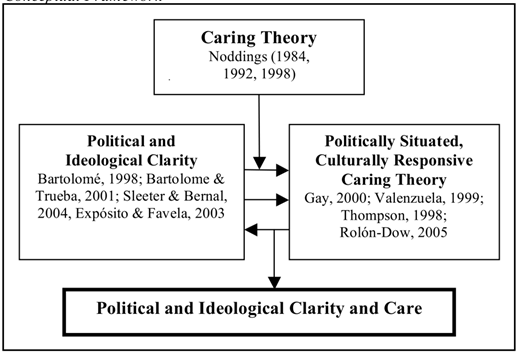
This year-long ethnographic study used the theoretical orientation of political and ideological clarity and care—a conceptual framework that combines Nel Noddings’ (1984) notions of caring theory with political and ideological clarity (Bartolomé & Trueba, 2001)—to investigate the critical first year of ESL teachers to describe key personal, contextual, and structural factors that influenced their professional beliefs and practices. The focus of this work centers on the conversations of three middle school ESL teachers during new teacher support group meetings that were held as part of the research design. During these meetings, the teachers articulated their understandings of the unique position they inhabited in middle schools as teachers of culturally and linguistically diverse youth. Their interest in topics such as marginalization, school relationships, and the status of ESL teachers were important narrative threads. In addition, their experiences and thoughts on collaborating (or co-teaching) with mainstream middle school teachers emerged as an important theme. In the context of this particular North Carolina school system, these ESL teachers were marginalized experts and collaboration within mainstream classrooms illuminated the status of the ESL teachers and their students in the two middle schools where they worked. While this study centers on the experiences of first year ESL teachers and their students, the lessons learned also, in important ways, apply to all middle school teachers who are working with culturally and linguistically diverse youth and their ESL teachers.
Literature Review & Conceptual Framework
Critical multicultural education (Banks & McGee Banks, 2001, 2004; Kubota, 2004; Sleeter & McLauren, 1995; Sleeter, 1996; Sleeter & Delgado Bernal, 2004; Ladson-Billings, 2004; Nieto, 1994, 1995, 2004; Freire, 1997; McLaren & Munoz, 2000), second language acquisition theory (Baker, 2000; Kubota, 2004; Cummins, 1993; Hawkins, 2004; Minami & Ovando, 2004), and political and ideological clarity and care (Noddings, 1984; Gay, 2000; Thompson, 1998; Valenzuela, 1999; Bartolomé & Trueba, 2001) grounded the larger study from which this article emerged. These literatures and theories will be briefly addressed, but due to the focus of this article, the first year teacher literature (Bullough, 1989; 1990; Bullough et al, 1991; Deal & Chatman, 1989; Grossman, 1990; Herbert & Worthy, 2001; Renard, 2003; Veenman, 1984), including studies on new teacher support groups (Harris, 1995; Hollingsworth, 1992; Rogers & Babinski, 2002), will be discussed in greater detail.
Critical Multicultural Education
Multicultural education grew out of the sociopolitical context of the 1960’s social protest movement “as a scholarly and activist movement to transform schools and their contexts” (Sleeter & Bernal, 2004, p. 240). However, much of multicultural education as redefined and enacted today fails to address power and racism explicitly or critically. For the purpose of this paper, I will use the work of Sleeter and McLaren (1995) to define critical multicultural education. They write that critical multicultural education links multicultural theory and critical pedagogy in a way that “seeks to construct counter hegemonic pedagogies, oppositional identity formations, and social policies that refuse, resist, and transform existing structures of domination primarily in school sites but also in other cultural sites within North American geopolitical arena” (Sleeter & McLaren, 1995, pp. 28).
This definition of critical multicultural education takes into account the criticisms of liberal and conservative multiculturalism and the work of scholars such as Nieto (1995), Ladson-Billings (2004), Kubota (2004), Banks & Banks (2004), and McLaren & Munoz (2000) that connect multicultural theory and critical pedagogy. Other authors such as Cummins (1993) and Kubota (2004) have brought a similar conceptualization of critical multicultural education to the context of second language classrooms. Kubota (2004) argues that critical multicultural education has an important place in second language classrooms, but she problematizes the assumption that second language learning and second language teachers are inherently multiculturalist. Cummins (1980, 1986, 1993, 1995) recommends that schools value the educational and personal experiences students bring with them to school, understand the process of language acquisition in order to provide effective language and content instruction, respect and continue to support students’ first languages, and seek a collaborative relationship with parents and community leaders. Drawing more directly from critical pedagogy and critical multicultural education, the work of Cummins (1993) and Kubota (2004) make even more explicit the connections between second language acquisition theory (SLA) and multicultural education.
Culture & Language — Second Language Acquisition Theory
Scholars have written about the interconnected nature of culture and language, as well as identity, ideology, and critical pedagogy. Sleeter and Bernal (2004) write, “Identity, values, experiences, interpretations, and ideologies are encoded linguistically; one knows the world and oneself through language” (p. 244). As Sleeter and Bernal (2004) assert, these issues resonate with ESL and bilingual educators who are aware of the political and ideological nature of working with culturally and linguistically diverse students and families. However, SLA theory often fails to take these issues of power, identity, culture, and ideology into account. Hawkins (2004) writes about the shortcomings of traditional SLA research. She argues that the research has carried with it assumptions that have had a significant effect on how we think about language and language learning today. This narrowly focused SLA research has generally come out of the fields of formal linguistics and cognitive psychology (Krashen, 1994; early Cummins, 1980; Chomsky, 1998; Hakuta, 1986) and has focused on the mental processes of individual learning.
Recent SLA scholars (Hawkins, 2004; Norton Pierce, 1995; Baker, 2000; Cummins, 1993; Auerbach, 1995; Corson, 1993) have begun to challenge and complicate this body of literature by examining language and language acquisition by providing an analysis of identity, culture, context, politics, ideology, and power. Hawkins (2004) suggests approaching issues of language learning from a variety of perspectives and disciplines. Norton Peirce (1995) argues that SLA researchers need a more comprehensive theory that will allow research to take into account the relationship between the learner and the social world as well as relations of power. In viewing social identities as multiple, changing, co-constructed, and contested, Norton Pierce creates a new and rich way to think about language learning and the context in which such learning takes place.
Conceptualizing Political & Ideological Clarity & Care
Both critical multicultural education and recent conceptualizations of SLA theory emphasize a need for political and ideological clarity, the first part of the conceptual framework for this study. Political and ideological clarity requires that teachers acknowledge their own political and cultural assumptions by explicitly and systematically addressing issues of difference (Valenzuela, 1999; Bartolomé & Trueba, 2001; Expósito & Favela, 2003; Howard, 1999; Rolón-Dow, 2005; Thompson, 1998). This can help teachers avoid deficit ideologies and perspectives that often result in “subtractive” teaching practices that are the norm in many of our schools today (Valenzuela, 1999).
The second part of the study’s theoretical framework involves political and ideological care. This part of the framework is grounded in caring theory as conceptualized by Nel Noddings (1984, 1992; 1998). Her theory of care is built upon “natural” notions of feminine nurturing and care to establish an ethic of care to be used in education. Her theory challenges the traditional “masculine” approach to educational structures that rely on hierarchy, separation, specialty, objectification, and the loss of relation in educational institutions focused on testing, sorting, labeling, and credentialing. In the era of No Child Left Behind, this caring perspective is of particular importance as even greater emphasis is placed on standardized testing (Goertz & Duffy, 2003).
Scholars such as Valenzuela (1999), Thompson (1998), Rolón-Dow (2005), and Gay (2000) have extended Noddings’ caring theory to explicitly address issues of race, class, and power. These authors argue that if a teacher truly and authentically cares for her students, then she must work against the subtractive curriculum out of a genuine respect for a student’s cultural integrity (Thompson, 1998). Gay (2000) writes that caring theory is one of the pillars of culturally responsive pedagogy and therefore, if a teacher is caring, then she must be culturally responsive. Thompson (1998), Valenzuela (1999), and Rolón-Dow (2005) argue that for teachers to care for their culturally and linguistically diverse students, they cannot pretend to be color-blind. Instead, they must attempt to learn, understand, and know their students’ historical, political, and personal situations. They must reject the assimilationist and deficit ideologies that oppress students and find ways to teach students and teachers to work for social justice and societal change. This kind of caring theory is authentic, politically situated, and culturally responsive.
Political and ideological clarity and care bring all of these literatures and theories together to form a comprehensive and complex lens through which to conduct and analyze educational research. In bringing these ideas together, a theoretical orientation is created that both heightens the importance of language, culture, and power in today’s schools, and grounds the work in a feminist, ideological, and caring perspective that respects the experience and perspective of teachers.
While this conceptual framework places significant importance on the individual beliefs of teachers, it is situated historically and politically, thus allowing larger, structural issues—like social, economic, and racist structures as well as institutional structures such as bureaucratic functions within schools including enrollment policies, scheduling, assignment of teachers, or disciplinary actions—to be included in the orientation to and analysis of classrooms. This ideological, caring, and politically situated view of schools listens to the voices of teachers and attempts to understand their beliefs and actions in relationship to the complex and changing environment in which they live and work (Coble, 2006; Gitlin, 1990; Hawkins, 2004). It is from this theoretical orientation and through the lens of middle school ESL teachers that the first year teacher literature, first year teacher support groups, and ultimately collaboration are examined in this article.
First Year Teacher Literature
Past first year teacher studies have rarely addressed issues of language and culture explicitly, but the first year has been well documented by researchers using a variety of theoretical perspectives (Bullough, 1989; 1990; Bullough et al, 1991; Deal & Chatman, 1989; Grossman, 1990; Herbert & Worthy, 2001; Harris, 1995; Hollingsworth, 1992; Rogers & Babinski, 2002; Renard, 2003; Veenman, 1984). In general, the first year of teaching is described in the literature as being difficult, frustrating, isolating, and disorientating for new teachers. For a variety of reasons (organizational, administrative, interpersonal), schools generally fail to support new teachers. First year teachers often get difficult class assignments, a schedule that provides little time for planning or reflection, and little or no mentoring (Herbert & Worthy, 2001).
Studies focused on second and foreign language teachers are far less frequently documented in the first year teacher literature (Richards & Pennington, 1998). This lack of studies focusing on first year teachers working with culturally and linguistically diverse students is obvious and problematic. There is a need to explore the first year of ESL teachers working with language minority students as well as mainstream teachers working with diverse learners—soon to be the majority in American classrooms (Kasarda & Johnson, 2006; Murdock, 2006). While there is little research to cite, first year ESL teachers, like all teachers, must grapple with the challenges and problems described above. In addition, there are a number of other unique demands that ESL teachers must face. They must have the professional knowledge required to teach English grammar and academic English, but they are also called upon to advocate for equitable treatment of ESL students in the mainstream classroom, and to serve as cultural brokers, community liaisons, and educators of mainstream teachers (Ovando et al, 2006).
Due to these demands, ESL can easily become highly subtractive (Valenzuela, 1999) if new teachers, in the survival stage of development (Veenman, 1984), can only manage to teach English language lessons at the expense of the native language and culture of their students (Valenzuela, 1999; Valdés, 1996). At the same time, there is also great potential in this first year when teachers are forming their initial identities as educators (Danielwicz, 2001). Providing support for new teachers, especially teachers working with culturally and linguistically diverse youth, is of great importance, considering the changing demographics in America’s classrooms. What becomes clear is that a pre-service teacher education program could never fully prepare novice ESL teachers for the complex and demanding contexts in which they will teach. The requisite professional knowledge and self-reflection demand continued support after graduation.
More specifically, some studies have explored ways to continue the support and the professional development of new teachers in the first year. These studies include research on support groups (Hollingsworth, 1992; Harris, 1995; Rogers & Babinski, 2002), mentoring programs (Montgomery, 1999; Feiman-Nemser et al, 1999), and administrative support (Renard, 2003). Of particular interest for this study is the research on new teacher support groups because this literature addresses the complex needs of new teachers and seeks meaningful ways for teacher educators to continue to support students after graduation. While teacher educators cannot control on site mentors or administrative support for new teachers after graduation, they can provide opportunities for new teachers to meet with other novice teachers and supportive university mentors for collaborative conversations.
Positioning Language & Culture in Today’s Classrooms
Drawing from all of these literatures and theoretical orientations, and carrying these perspectives into the classroom and into a new teacher support group, allowed this research to position language and culture within today’s teaching context from the lived experiences of middle school ESL teachers. Classrooms are complex and changing and therefore, our theoretical approach to educational research must reflect this diversity and respect those who work within these institutions on a daily basis. The theoretical framework for this research study attempts to consider the expertise developing in a variety of fields to find a conceptual perspective that can address the challenges in all of their complexity and through the stories of middle school teachers working with culturally, economically, and linguistically diverse students. This framework takes into account the ideological and political nature of teaching and learning, and attempts to address these issues of politics and power through a politically situated, culturally responsive, and caring theory.
Methods
This year-long qualitative research study focused on the experiences of four first year ESL teachers (3 middle school teachers and one elementary teacher) in a suburban North Carolina school system where the language minority student population is growing rapidly. While most of the data were collected between July 2005 to June of 2006, a pilot study the previous year (while the teachers were participating in their teacher training program) and follow-up during the fall of their second year of teaching also informed and provided context for the research. An important priority of the research was to use narrative inquiry and reflexive ethnography to build ethical, caring, and reciprocal research relationships in the field. In addition, the methods of this study were informed by the desire to highlight language and culture as well as the narratives and voices of teachers.
Narrative Inquiry
Narrative inquiry is grounded in Dewey’s view that experience is central and continuous to learning and Vygotsky’s theory that exchange and learning take place between the personal and the social (Clandinin & Connelly, 2000; Rushton, 2004). In addition, narrative inquiry pays close attention to the context in which narratives are lived out. These are the three dimensions of narrative inquiry: (1) the continuity of time (past, present, and future); (2) the interaction between the personal and the social; and (3) the context of place. Narrative inquiry allows the researcher to embrace the complexity of the teaching and learning context and to use the stories of teachers, students, and the researcher to capture, through narratives, the personal and social experiences of education.
One of the most appealing aspects of narrative inquiry is its collaborative and caring approach to research “participants.” While all research is plagued by unequal power relations, the goal of narrative inquiry is to build caring, intimate, and trusting research relationships. This approach allows the researcher to become invested in the lives of the participants in a way that complicates the process, but makes it richer with meaning. This caring approach to research allows a feminist ethic of collaboration and care to take priority (Hollingsworth, 1992; Noddings, 1984, 1992). Embracing such an approach requires wakefulness and a feminist ethic of care and collaboration. While narrative inquiry does not provide a specific recipe for doing this work, it does provide an interesting set of ideas that each researcher must make their own. Of primary importance in this study were narrative inquiry’s: 1) ability to work within the complexity of the teaching context (taking into account time, interaction, and place); and 2) prioritization of reciprocity and a feminist ethic of research relationships.
Reflexive Ethnography
Narrative inquiry as conceptualized by Clandinin and Connelly (2000) is a reflective and an ethical approach to educational research. It does not provide a specific recipe of methodology, but instead orients a researcher to the field in a particular way. They write, “We keep in the foreground of our writing a narrative view of experience, with the participants’ and researchers’ narratives of experience situated and lived out on storied landscapes as our theoretical methodological frame” (2000, p. 128). However, aspects of the work closely resemble reflexive ethnography as conceptualized by Davies (1999) such as the focus on ethical research relationships and the importance of contextualizing research in time and place.
A narrative approach with reflexive ethnography as an important aspect of its methodology is a powerful and compelling lens through which to conduct educational research. Reflexive ethnography is aligned well with narrative inquiry in a number of important ways. Davies (1999) takes into account the implications of postmodernist and post colonialist critiques. She argues that reflexivity, a process of self reference, is a possible way to address these critiques, while avoiding both self-absorption and solipsism. She writes, “I consider the implications of various postmodernist critiques for the practice of ethnographic research and suggest an epistemological perspective from which we can carry on social research while continuing to benefit from the sensitivity to issues of reflexivity and the general self-critique of the recent past” (1999, p. 6).
Reflexive ethnography provides an important orientation to the research as well as methodological tools with which to gather and analyze data. Davies (1999) describes methods such as participant observation, formal and informal ethnographic interviews, and biography and autobiography though the lens of wakefulness and reflexivity. This methodological approach provides the tools necessary to gather the authentic and meaningful narratives of the classroom. Narrative inquiry was used to guide and shape this study in order to capture both the individual and social stories that make up the rich expressions of the teachers’ beliefs and classroom practices (Clandinin & Connelly, 2000).
Positionality
As a narrative inquirer, it was important to explore my own narrative thread running through this research project. In past projects, it has been important to explore my own story because my experience was vastly different from the participants I was attempting to understand through my research. With this project, I discovered that, due to the many similarities I shared with the research participants, I had to even more thoroughly revisit my own storyline in order to better understand my reactions to, and interpretations of their experiences. Like the women participating in this research project, I am a white, middle-class woman. I was an ESL teacher for four years in western North Carolina. I have known the teachers participating in this research study since July of 2004 and I have worked with them throughout their teacher education program as an instructor, teaching assistant, and student-teacher supervisor and mentor. I have had to work to understand the impact this shared history has had on the research encounter.
Research Sites & Participants
The ESL teachers were selected because of their participation in a local university’s ESL teacher education program which emphasized social justice and equity in education. There were six women and one man in the ESL cohort selected and all were invited to participate in the study. Four teachers agreed to participate and also expressed a desire to continue their education as first year teachers through the support of a new teacher group. All of the participating teachers were white, middle-class females, and their ages ranged from early 20s to early 40s. The three middle school teachers spoke (to varying degrees) a second language. Each of the teachers happened to secure employment upon graduation in the same school system, yet each worked in unique contexts, including different grade levels, ESL program models, and student demographics. The names of all teachers and schools have been replaced with pseudonyms to protect their identities (note: Lynda was the fourth research participant who taught at the elementary level).
Data Collection
Between July of 2005 and June of 2006, ten new teacher meetings were held during the research period. These focus groups took place in a teacher’s classroom or at a local coffee shop and lasted one to two hours each. The teachers were asked to bring stories, resources, ideas, and challenges to these meetings to share with the group. In addition, a brief, semi-structured interview protocol was used at the beginning of each meeting and the teachers were asked to write a written reflection at the end. The rest of the time the teachers directed the conversation about their most pressing needs. These conversations were tape recorded and later transcribed. These meetings provided important data through the stories and voices of teachers. The meetings were also one important way the research attempted to reciprocate and contribute to the teachers and their students.
In addition to the monthly meetings, at least one individual formal interview (lasting between one and two hours) was conducted with each teacher. These interviews were tape-recorded and later transcribed. The interview protocol consisted of four general topics (oral history/background, decision to teach ESL, current teaching context, and feeling about participating in the research project), and the teachers took these interviews in a variety of directions due to the open ended nature of the interview questions.
During the data collection, over 50 classroom observations and/or informal interviews were also conducted. While one day-long observation with each teacher took place, the majority of observations lasted between one or two class periods (50 minutes to two hours), with an informal interview taking place before or after the classes (10 to 30 minutes). Some of these observations were conducted from the back of the classroom while taking detailed notes, but the majority of observations included my direct participation with the teachers and students as I assisted in the classroom however the teacher requested.
When I was directly participating in the classroom, I would take step back from time to time to record notes and tape-recorded my observations immediately after leaving the field. These recordings would then be transcribed and written into fieldnotes. At least once per month, I spent time in each teacher’s classroom, but if the teachers requested it, I would spend more time in classrooms. These classroom visits and observations were extremely important methodologically. While previous studies have used new teacher support groups to collect data (Harris, 1995; Hollingsworth, 1992; Rogers & Babinski, 2002), these studies have not followed the teachers into their classrooms to both corroborate and inform the researchers’ understandings of teachers’ beliefs and practice. These visits also provided important data and information about the school context and climate, teachers’ perspectives on their practice, and the lives, beliefs, and actions of students.
Analysis
In terms of analysis, narrative inquiry was instrumental in informing my approach because it acknowledges the complex nature of the research encounter. Close attention was paid to the three dimensional inquiry space by collecting past, present, and future narrative threads. The continuity of time was used as a way to organize and analyze the data and to avoid the ethnographic present (Clandinin & Connelly, 2000; Davies, 1999). Personal and social stories of the participants and the larger community were taken into account in order to tease out the multiple and interconnected nature of these narratives. Analysis relied on both micro and macro lenses in order to describe the individual and community voices, and present the personal and social experiences that impacted the teaching and learning context (Clandinin & Connelly, 2000). In addition, place played an important role not only collecting data, but also in its analysis. Context played an important role in the narratives collected. Analysis addressed the individual classroom, the school, the community, as well as the larger political and social climate in which the research took place.
Field reports were written throughout the data collection period to systematically look at the study’s progress and consider future plans for the inquiry (Glesne, 1998). Trustworthiness of this inquiry was established through a prolonged engagement in the field, persistent observation in multiple contexts, constant reflection as a researcher, and member checking (Davies, 1999; Glesne, 1998). While informal analysis was an ongoing part of this qualitative inquiry, a more formal and concentrated period of analysis began once the data collection phase ended (Davies, 1999; Glesne, 1998).
Once the data were collected, all transcriptions were finished and the data were organized chronologically, by teacher, and into an initial set of categories (beliefs, practice, context, challenges) so that relevant data were accessible and any emerging themes or theories could be tested and refined with supporting arguments and interpretations from the data (Davies, 1999). During a second pass through the data, formal coding began and new themes began to emerge. Some of these initial themes were arrived at deductively through lenses of the literatures and conceptual framework to interpret and understand the narratives (care, culturally responsive teaching, family, funds of knowledge, new teacher support group, parents, planning, race, racism, school climate, teacher beliefs, time, time-management). Other categories were discovered inductively through the review and comparison of the teachers’ experiences as captured in the data (collaboration, discipline, expert/expertise, immigration, Korean and Latino students, marginalized, mainstream, mentor, professional development, relationships, school administration, school structure, space, Spanish, student-centered).
As codes and themes emerged, all theories were retested for negative case examples (Glesne, 1998). During this process, the limitations of an initial focus on the individual beliefs of new teachers emerged. The role school structures and bureaucracies played—both overtly and covertly— in the lives of the teachers and their students became clear. With this new lens through which to analyze the data, a refinement of codes and themes created a more concrete understanding of the story of these teachers and their context. In addition, member checking was utilized to ensure that my assumptions, perspective, and subjectivities were countered by another’s understanding and interpretation of the story.
Analysis continued throughout the writing process and the selection of quotes to include in the manuscript was a final aspect of formal analysis. Once the initial themes were laid out and corroborated through member checking, the selection of representative quotes provided another opportunity to check and double check interpretations. Quotes were filed under each theme and this provided an opportunity to review, compare, confirm, and reject interpretations. I was able to quantify, in a sense, the strength of my analysis as I counted, charted, and selected quotes that best told the story.
While a major goal was to fill a gap in the research literature by focusing on the first year of ESL teachers, I was also committed to finding ways to reciprocate as a researcher and former teacher. One way this was accomplished was through the formation of the new teacher support group. These two aspects of the research were greatly influenced by the study’s conceptual framework—political and ideological clarity and care. This conceptual and theoretical perspective helped me understand both the need to fill the language and culture gap in the first year teacher literature, and orient the research, analysis, and writing in an ethical, situated, and caring manner. In this way, political and ideological clarity and care helped conceptualize and ground every aspect of the research encounter.
Marginalization or Collaboration
The major findings of this study began to emerge even during the first two or three new teacher support group meetings. The teachers’ interest in topics such as marginalization, collaboration, school relationships, and the status of ESL teachers became clear and important narrative threads. These themes continued to dominate our conversations and they told important stories about the unique position of first year ESL teachers in their schools and orientations to the field. These stories provide important information for ESL teacher educators, but they also provide insights for mainstream middle school teachers and middle grades researchers. These educators and researchers are beginning to understand the need to work effectively with both English language learners in their classrooms as well as the ESL specialists in their schools.
Teacher Generated Themes
The Unique Perspective & Marginalized Spaces of ESL
It became clear during our conversations and interviews that the teachers positioned themselves uniquely as ESL teachers. Part of this orientation or identity as ESL teachers seemed to stem from an understanding of themselves as teachers and advocates and from their ESL-specific role in classrooms. While all of the teachers spoke to this theme frequently during the study, Sarah best articulated this point in a December interview:
CG—Do you see ESL as being similar to or different from other teaching jobs… or somewhere in-between?
Sarah—It is hugely different […]. I wish we had training in counseling because I feel like I am half counselor, half teacher, and half advocate… and there is only one of me! ESL is very different. The PARS teacher [the district hired, full-time support person for new teachers] was saying that I see things from the side instead of from the front of the classroom and that this is why I am able to connect with students. I’m actually paying attention to what they are learning as opposed to, “What is my lesson today… you’re not getting my lesson… why aren’t you doing it my way?” I really appreciate that and I really am glad that I went into ESL for that reason because it is a whole different side of teaching. That makes me even more aware… even in my own teaching. I stop and make sure everyone gets it […]. I see that in a lot of core classes—the teachers don’t take this time. One kid is sleeping, another is writing a note, another is drawing… it’s hard for the person at the front to see any of that. [Interview, 12/14/05]
While many mainstream teachers do a lot of teaching, counseling, and advocacy work, Sarah points out how the position and perspective of an ESL teacher is unique. In seeing a classroom from the side (both literally when standing in the back of a mainstream classroom and figuratively when focusing on the individual needs of her students), the perspective is different and one’s motivations and actions in the school are different as a result. I do not want to argue here that mainstream teachers do not want to have this view of their classrooms or students, but the pressures and structures of their job are different and position them at the front of the room. They must teach a large number of students a set curriculum. They do not have the built-in flexibility of an ESL teacher or the experience of watching classrooms from the side or back of the room. What became apparent in talking with the middle school ESL teachers was the fact that the mainstream teachers’ status at the front of the room often marginalized not only certain students, but the ESL teachers as well. Sarah best described this occurrence in a group meeting:
As far as who feels included, that is a different thing. On the surface, you have the differentiated classes and everybody is all together […] but I feel like a lot of my kids are included in a lot of things but only on the surface. Even in my collaborative classes I’m supposed to be in there and we are supposed to be working together, but I feel like I end up just working with my kids in the corner, either literally or figuratively. [Focus group, 10/24/05]
This idea of a marginalized ESL space—of being in the corner—came up a number of times. The most illustrative discussion of this issue was raised in the September group meeting when we were setting up our next meeting. We had decided to meet in Kelly’s classroom at Pine Middle school and she was giving directions to her room:
Kelly—My classroom is in 025. The 0 means it’s in the dungeon.
Lynda—Oh yeah, I’m in the basement too.
Sarah—Well, I’m in the closet… and I have to share it.
Kelly—And Rebecca’s office is her car! [Focus group, 9/30/05]
While they all had relatively nice rooms, their descriptions of their locations say a lot. Kelly found some benefit of being tucked away in that she was able to do her work without interruption of passersby and Rebecca found that the drive from one school to the next gave her a taste of the world outside of school. She said, “I get in my car, drink a diet coke, and listen to NPR or some music… for those ten minutes, I get to be a regular person” (Focus group, 11/1/05). Sarah however, was frustrated by her small, closet-like office that she shared with five specialist teachers. The fact that the content teachers she worked with assumed she had a classroom of her own, “a home base,” just made her feel even more marginalized in her school. Interestingly, her awareness of her unique perspective and marginalized space seemed to tie her even more closely to her students and to other marginalized students in the school:
It is funny because I have just become aware of how the main homeroom teacher is up in the front of the room with the “good” kids and I always go immediately to the back of the room with all the misfits… because they are the ones I see he isn’t paying any attention to […] that’s where the ESL kids are, the ones who get sent to the break room, the ones who are behaviorally/emotionally disabled. I guess I always automatically gravitated toward them, but now that I’m aware of it, I do it on purpose. [Interview, 12/14/05]
This combination of the unique perspective and marginalized spaces occupied by the first year ESL teachers colored their perspective of their schools, students, and other teachers.
Relationships with Other Teachers
While the ESL teachers collaborated and got along with mainstream teachers to varying degrees, they rarely identified with those classroom teachers. Instead, they seemed to build relationships with other educators in their schools such as social workers, counselors, specialist teachers, and other ESL teachers who were not considered to be mainstream teachers. In fieldnotes from March 23rd, I wrote:
S is not building relationships with the teachers she is collaborating with, but she is building relationships with the counselor, social worker, and special education teacher. She said those teachers can really “look at the individual student instead of grades or the whole class or the curriculum.” She said that they relate because they care about these students and talk about them and see them as individuals and not just as problems. As a teacher she said she feels “totally marginalized” and that she has this status as “not a real teacher” because she works with “small groups of marginalized kids.” K has also expressed some of these thoughts too. I know she has talked about becoming good friends with the counselor at her school. She initially spent a lot of time with her dealing with a situation with one particular student, but now she talks with this teacher just about every day. She also considers Rebecca’s presence each day to be “a lifesaver.”
This relationship building with other educators was most striking in the narratives of Sarah and Kelly, but Rebecca also struggled some with her relationships with mainstream teachers. Rebecca was most likely to go to weekly social gatherings with their teaching colleagues.
It is very important not to misrepresent these complex issues as an “us versus them” dichotomy between specialist educators and mainstream middle school teachers. While the ESL teachers were often frustrated by the treatment their students received in many of the mainstream classrooms or by their own status in those classrooms, they understood the challenges those teachers faced. My fieldnotes and transcripts clearly show that Sarah and Kelly were very sympathetic to the demands put on mainstream teachers. Sarah stated in a February interview:
As an outsider it is easy to say that [content teachers] are lazy or horrible people, but the more I’m in it, the more I realize that they are doing it to cope and survive. Sometimes you get to the point where you cannot handle one more email or phone call or… one more student ruining class. At the same time, I have a lot of favorite students and I have a really hard time seeing what happens to them and I feel like I can’t even say much about it because I don’t want to jeopardize my relationship with that teacher. The relationships with teachers has turned out to be one of the hardest things… [Interview, 2/20/06]
She was understanding of the plight of the content teachers, but loyal to her own students at the same time. She realized that the same structures that got in the way of many mainstream teachers effectively working with her English language learners, were the same structures that made it difficult for her to work effectively with the core teachers. These relationships and structures seemed to be highlighted by the school’s use of collaboration.
Collaboration
Research shows that co-teaching and collaboration between mainstream classroom and special education teachers can be extremely effective models to better educate students with special needs (Bear & Proctor, 1990; Odom et al., 2005; Klingner et al., 1998; Marston, 1996; Patriarca & Lamb, 1994; Schulte et al., 1990). There are a number of ways these collaborative teaching relationships are structured and negotiated. In a truly collaborative teaching situation, both teachers would share planning and instructional responsibilities equally. A more common implementation of collaborative teaching results in the specialist teacher tutoring a small group of students within the classroom context.
It is important to note that while collaboration is widely implemented for English language learners, no research has been conducted to support the assumption that these practices are beneficial for students acquiring English in the mainstream classroom. In addition, Magiera and Zigmond (2005) point out that the benefits of these co-teaching arrangements seem to be dependent upon “optimal teaching conditions” where the involved teachers have been trained in co-teaching/collaboration and when the teachers are provided co-planning time. Collaboration, as experienced by the three first year middle school ESL teachers, corroborates this finding when applied to the ESL context.
All four of the first year ESL teachers collaborated in some way as part of their teaching day, but the practice of collaboration rarely worked well for the ESL teachers or their students. These encounters with their mainstream counterparts seemed to exacerbate their feelings of marginalization and frustration and failed to impact the classroom teachers’ practice or pedagogy. As first year teachers, they were novices, but they also believed that they had a certain expertise to share with their colleagues. However, due to the way collaboration was set up and implemented in the schools, the ESL teachers felt like marginalized experts. The following conversation at a new teacher support group meeting highlights some of these issues:
Sarah—The 6th grade team won’t tell me ahead of time when they have meetings. They’ll say, “Oh it’s on our team conference board, go look at it.” They don’t bother to tell me or include me. I’ve missed lots of meetings because I didn’t know. These are my kids… and I’m not included in discussions about their progress […]. I think really it's how the administration set that up for what I can tell… and from my experience so far. They put a mandate that we need to collaborate, but they haven't really supported it or said this is how it's going to work. They say, “You're working with her!” But they haven’t said how to work together… “You’re going to be doing teamwork together… you’re going to be doing planning together.” There hasn't been anything communicated explicitly. I mean, I wasn't even given the chance to introduce myself to the teachers I'm collaborating with. We never even got to meet each other before the first day of class. They’re like, “Oh… you're here. OK, go work with them.” So I feel like that set up the year and created a pattern for the rest of the year. I’m trying to fight that but it’s hard…
Rebecca—I don’t think it would matter. I mean honestly, you’re a second-rate citizen just by virtue of the trade. They think we’re resource teachers, specialist teachers. They figure if we had the skills, we’d be classroom teachers. This is the viewpoint… not that anyone would ever admit to this… that we are lesser… that if we could have been mainstream teachers we would have, but we didn’t have the skills or something as opposed to just caring about ELLs [English language learners].
Sarah—Ironically we have highly specialized skills and knowledge…
Rebecca—Yeah, yeah…
Sarah—We could probably provide a much better perspective on these particular kids…
Lynda—And better instruction…
Sarah—They’re asking what do I do with these kids… you know what am I doing with them? But they still see us as, “Oh, you in the back.”
Rebecca—We’re there because the state says we have to be there… whereas they are there to do a job. We are not the real teachers. They are the real teachers and we are just there to help out… like a glorified TA [teaching assistant]. [Focus group, 10/24/05]
Throughout the year, all three teachers frequently expressed their frustration with collaboration stemming from a variety of structural issues such as a lack of training, no designated co-planning time, and a general misuse of their time and expertise. While the ESL teachers had been trained in collaboration and had gained some positive experience with this model during their student-teaching, they were teaching in schools where they felt like little more than “glorified TAs.” Due to the ineffective implementation of collaboration and their sense of marginalization as ESL teachers, the first year teachers came to struggle with the task of collaborating with their middle school colleagues. This was particularly pronounced in Sarah’s experience. Field notes from a March 23 visit and interview make this point:
Her response to my question, “What’s going well?” was that she hasn’t been going to collaboration classes because she has been testing kids and that this has made life a lot easier for her. I commented that it seemed like collaboration would be easy because you don’t have to plan for it. She said, “If you don’t care that kids are falling behind and can’t keep up with the teacher then it is easy. But if you care, it is emotionally and psychologically hard because you see how unfair and messed up it is and how much more support they need and you can’t provide enough… at least how [collaboration] is currently set up.”
Sarah was troubled by the treatment of her students in the school, but was always quick to point out the program’s inadequacies instead of blaming the core teachers alone. She understood that the structures that got in the way of meaningful collaboration were the lack of training, zero co-planning, and insufficient time and resources. Still, she continued to try to find creative ways to get around ineffective collaboration set-up at her school. In September, she started sending “modification of the week” emails to all of the teachers of English language learners with tips and topics such as putting the agenda on the board, ways to be more aware of teacher-talk or lecture styles, and the importance of explicitly teaching key vocabulary. Within a few weeks, she began to get positive feedback from some teachers and administrators, teachers started suggesting topics for future emails, and a few teachers thanked her. This strategy made her presence, work, and her students more visible throughout the school. The impact of this work became even more visible toward the end of the first semester when she saw the impact of her emails:
One of the early [emails] suggested giving newcomers a buddy, I recently sent out another one saying that now it was time to incorporate them into other groups… helping them or pushing them to interact with the rest of the class more and using English more. I sent it out and didn’t think anything of it, but when I went into the classrooms that week, the newcomers had been moved and were no longer clustered together… they were integrated into the classroom. That’s when I realized they actually read and reacted to the emails! [Interview, 1/11/06]
In addition to these emails, she planned two workshops on differentiating instruction and collaboration for the faculty and began serving on the school’s Student Support Team (SST). Her more experienced mentor teacher was not interested in helping her plan the workshops, but she was determined to contribute to the school’s staff development. She recognized that she was a first year teacher, but she wanted to be seen as a professional and she wanted to share her knowledge. After these workshops she stated, “I’m finally being seen as a professional and expert… they [the teachers she is collaborating with] are finally seeing me as an educator who has some knowledge… something to contribute” (Interview, 1/11/06). While she wasn’t able to change the structure that got in the way of more meaningful collaboration on a day-to-day basis, she was able to find other ways to contribute and work with her students’ core teachers.
Unique Perspective, Place, & Position – Concluding Thoughts
The purpose of this article was to explore the teacher generated topics that these three middle school ESL teachers raised during new teacher support group meetings. Their interest in discussing the unique perspective and marginalized spaces of ESL, relationships with other teachers, and collaboration in the middle school setting allowed the research to explore narrative threads of importance to them. These discussions also provide a glimpse into their complex teaching lives and contexts. While their opinions and experiences were not uniform or static, there was a general sense of solidarity and mutual understanding communicated during the new teacher support group meetings where they found consistent support and mentoring.
I hope that these narratives can contribute to the field of teacher education and the preparation of future ESL teachers for the unique spaces occupied by teachers of culturally and linguistically diverse students. The lessons of this article also point out the need for mainstream teachers to be better prepared to meet the needs of their English language learners and to work collaboratively and productively with the ESL experts in their schools. The data on collaboration in this study provide new information about this common practice that is often poorly implemented and has not been adequately researched. Without training, administrative support, and thoughtful implementation, collaboration in the ESL context simply marginalizes both ESL teachers and their students instead of bringing them into an inclusive climate of learning and respect. The first year status of the ESL teachers in the study complicated this aspect of the research and it will be important to explore the experiences of more experienced ESL teachers as well as mainstream teachers who have experience co-teaching and collaborating in other contexts. More than anything, it is imperative to prepare future ESL and mainstream teachers to work together with English language learners.
Even with the best prepared and experienced ESL teachers, the growing numbers of English language learners and diverse youth in classrooms make language and culture a priority for all future teachers and teacher educators. All educators need opportunities in their teacher education programs to gain political and ideological clarity and care. Not only do mainstream teachers need to have knowledge about second language acquisition theory, the benefits of bilingualism, and ESL teaching methods, they (like ESL teachers) need to understand the larger geopolitical landscape that receives immigrant students in society and in our schools. Finally, future mainstream and ESL teachers need experience collaborating in meaningful and productive ways to bring both ESL students and their teachers out of the marginalized corners of classrooms and into an inclusive and validating class climate.
As classrooms become more complex and diverse, it is obvious that no teacher education program can adequately provide all of the skills and knowledge necessary for every teaching context. New teachers need opportunities to reflect on their practice with other teachers and teacher educators as they grow and develop as professionals. New teacher support group meetings could take a variety of forms, but the crucial ingredient is that these teachers find their own teaching voices and share both their challenges and expertise with one another. As more mainstream teachers are responsible for the education of English language learners in their classrooms, I see an opportunity to bring ESL and mainstream teachers together to learn from and with each other. This kind of supportive collaboration and reflection could have a tremendous impact on teachers’ development and potentially, teacher retention. Both the teachers and their students would benefit from this kind of dialogue occurring in the field of education. This is a worthy research agenda I plan to pursue in the future.