Middle school students perform well academically when their schooling environment meets their developmental needs (Eccles et al., 1993). Both school culture and student-teacher relationships are influential aspects of the school environment that impact academic expectations, school satisfaction, and academic performance. In the current study, we examined the relationship between perceptions of academic culture within a school, teacher regard, and academic aspirations among middle school students (N = 1,376). Results showed a significant mediation of teacher regard on the relationship between academic culture and academic aspirations. Both perception of school culture and perception of student-teacher relationships are relevant factors when considering middle school students’ academic aspirations. Implications for teacher education and teacher development programs are discussed.
Early adolescence is often marked by declines in grade performance and decreased academic interest. However, as adolescents age, academic achievement becomes increasingly important, as academic success influences educational aspirations and attainment, and eventual career trajectory (Qian & Blair, 1999; Rojewski, 1996). Prior academic achievement has a direct influence on a student’s academic aspirations and expectations for personal educational attainment (Hill et al., 2004). Given the direct relationship between academic aspirations and academic achievement, it is important to investigate factors that influence students’ aspirations for future educational attainment. Scholars have found that adolescent academic aspirations differ by race/ethnicity, gender, and socioeconomic status (Cunningham, Erisman, & Looney, 2007; Kao & Tienda, 1998). Additionally, researchers have found that parental expectations and involvement explain variance in academic aspirations (Cunningham et al., 2007; Hill et al., 2004); however, little research has explored the impact of academic school contexts on students’ aspirations.
According to the stage-environment fit approach (Eccles et. al., 1993), incongruence between the school environment and adolescent development during middle school may negatively impact student academic outcomes. If and when this incongruence is reconciled, there are positive trends in the academic performance and well being of middle school students. To understand the incongruence between early adolescent development and the school climate it is critical to understand students’ perception of their learning environment. Students, as members of the school community, can perceive a school’s academic culture differently and these perceptions may impact academic performance and achievement motivation, particularly during early adolescence (Koth, Bradshaw, & Leaf, 2008). Hence, investigations of the middle school environment, which includes school culture and interpersonal relationships among students and teachers, may shed light on the academic experiences of middle school students. In the present study, we examine the relationship between school culture, student-teacher relationships, and academic aspirations among middle school students.
School Environment: The Culture of a School
School climate is a multifaceted construct that includes individual’s perceptions of the academic and social culture of the school, as well as structural and organizational elements of classrooms, schools, and school districts. Anderson (1982) defines school climate across four dimensions: the ecology, the milieu, the social system, and the culture of the school. The ecology and environment of the school are represented by structural (e.g., the physical school building) and organizational elements (e.g., class size). Equally important, the cultural and social aspects of school climate are often recognized as the way individuals interpret a collective schooling experience. These dimensions encompass norms, values (e.g., teacher expectations), interpersonal relationships (e.g., mutually respectful student-teacher relationships), and organizational patterns (e.g. valuing diversity) (Cohen, McCable, Michelli, & Pickeral, 2009). Therefore, school culture is an important element of the schooling process. It helps define the organization of the school, the vision espoused, as well as the academic standards established and social skills promoted and developed in their students.
Scholars have consistently found that students’ perception of school climate is related to academic performance. For example, Brookover and colleagues (1978) found that both the school environment and perceptions of the academic culture of the school provided by students, teachers, and administrators account for unique differences in academic achievement among elementary school students. In a study of ninth-grade students, Benner, Graham, and Mistry (2008) found that student perceptions of the school and academic climate predicted GPA as mediated by teacher reports of student engagement. In this study, school climate not only had a direct effect on student outcomes, but also had an indirect effect through classroom specific mechanisms. These studies highlight the importance of student perceptions of the school climate when considering factors that impact achievement across grade levels. However, little research has explored students’ perceptions of school climate or culture as related to educational attainment goals during middle school.
School Environment: Relationships Between Students and Teachers
Given the multidimensional nature of school climate, the mechanisms through which school culture promotes academic success should be considered. Cohen and colleagues (2009) posit that interpersonal relationships within a school may be a distinct dimension of school climate that can function to build morale and connectedness among students and teachers. These positive student-teacher relationships are associated with a wide range of positive student outcomes. As students and teachers develop positive relationships, students become more engaged in learning and contribute to a school culture that supports academic success. For instance, Goodenow (1993) found that middle school students’ perceptions of support from their teacher were related to teacher expectations for subject-specific success. Similarly, 11-16 year olds who felt more support from adults and teachers at school were more academically engaged (Green, Rhodes, Hirsch, Suarez-Orozco, & Camic, 2008). In a nationally representative study of eighth and 10th graders, students tended to perform better academically when they perceived that there was greater cohesion between students and teachers (Stewart, 2007). These studies suggest that multiple aspects of academic well-being are promoted in schools where students perceive positive and supportive adult-student relationships.
This scholarship reinforces the relevance of student-teacher relationships when considering connections between school climate and student academic outcomes. However, there is some debate in the literature regarding whether perceptions of school climate influence student-teacher relationships or whether student-teacher relationships impact students’ perceptions of their school climate. On one hand, research supports the relevance of student-teacher relationships when considering school climate, suggesting that students who are more satisfied with school have more positive (supportive and caring) relationships with their teachers (Baker, 1999). Conversely, in a review of the literature, Koth, Bradshaw and Leaf (2008) found that student-teacher relationships influence how students perceive the classroom context. While it appears that the relationships students have with their teachers are impact their perceptions of the overall climate of the school, the directionality of this relationship has yet to be determined. Despite disparate findings regarding connections between school climate and student-teacher relationships, these findings support the stage-environment perspective that student-teacher relationships during middle school that are less personal, less positive, and less supportive are academically disadvantageous for middle school students (Midgley, Feldlaufer, & Eccles, 1989). When students perceive their teachers and other adults within the school are willing and available to support them academically and to help create a positive learning and social environment students will generally be more motivated, more engaged, and altogether higher achieving students.
Academic Aspirations
Students’ goals and expectations have consistently been linked to academic performance, particularly during middle school (Eccles, 2005; Eccles & Wigfield, 2002), yet little attention has been given to student academic aspirations with respect to both school climate and student-teacher relationships. Academic aspirations can be conceptualized as career- and education-based long-term goals that students attribute to their own future. Academic aspirations are conceptually different from scholarship on goal orientation structures (Ames, 1992) as they are not cognitive or affective inclinations, but rather specific academic objectives. Additionally, Gottfredson and Becker (1981) posit that aspirations are related to prior experiences that may create barriers or channels to future attainment. Thus, it is possible that students’ experiences in school and relationship with their teachers impact their academic aspirations.
Previous research has shown that students’ academic aspirations are influenced by and related to distinct dimensions of the school climate including school structure and school culture. For example, students who attend highly selective schools have higher future academic aspirations (Ahmavaara & Houston, 2007). In a study of Latino middle and high school students, perceived support from teachers and perceived school environment (as measured by perceived dangers and problems at school) were associated with student professional goals and academic aspirations (Valencia & Johnson, 2006). Similarly, among elementary school students from immigrant families, researchers found positive relations between academic aspirations and student’s perceptions of their teachers (Szalacha, Marks, Lamarre, & Coll, C., 2005). These studies underscore the relevance of school culture and students’ perceptions of their teacher for academic aspirations among middle-school students. However, few studies have simultaneously considered both student perception of their school culture and student perception of student-teacher relationships with regard to future academic-career goals.
Previous research has established that both structural and cultural elements of schools impact academic achievement (Baker, 1999; Brenner, Graham, & Mistry, 2008; Brookover, et.al., 1978; Goodenow, 1993; Koth, Bradshaw & Leaf, 2008). Moreover, studies have shown that student-teacher interactions relate to both school climate and student academic well-being. However, less focus has been given to how students’ perceptions of their school climate might impact their educational aspirations, with particular consideration given to the student-teacher relationship. In accordance with the tenants of the stage-environment fit approach, we suggest that the regard students have for their teachers may be one mechanism through which school context influences academic outcomes. In the current study, we examined the relationship between middle school students’ perceptions of academic culture, teacher regard, and students’ academic aspirations. As such, the following research questions were posed in this study: (1) Is school academic climate related to academic aspirations, such that a more positive perception of the school’s academic climate is related to higher academic aspirations? and (2) Do students’ perceptions of their teacher mediate the relation between academic climate and academic aspirations? We hypothesize that school climate is related to academic aspirations such that, the more positive students’ perceive their academic climate to be, the more education they will aspire to attain. Further, we expect that student perceptions of their teacher will mediate the relation between academic culture and academic aspirations.
METHOD
Participants
Participants were 1,462 seventh-grade students (51% male, M age = 12.3) from Wave 1 of the Maryland Adolescent Development in Context Study (MADICS). MADICS is a large-scale longitudinal study that focused on social and psychological adolescent development from seventh grade through emerging adulthood. Students were initially recruited in the seventh grade from public schools in Prince George’s County (PGC), Maryland. PGC is majority African American while maintaining a diverse range of socioeconomic status, making it a unique area to study. At Wave 1, 59.6% of the students sampled were African American and the annual income of the entire sample was distributed evenly about a mean of 45-49,000. One thousand three hundred seventy-six students with complete cases on all study variables were included in these analyses.
Procedures
Students were recruited during the fall of 1991 by sending letters home to 1,700 seventh-grade students in Prince George’s County Public Schools. Parents of each seventh grader gave permission for themselves, the seventh grader and an older sibling (if applicable) to participate in an interview and questionnaire. Each seventh-grade student participant completed a 50-minute face-to-face interview and a 30-minute self-administered questionnaire of the study items. For more information on MADICS procedures and measures please refer to the study website (www.rcgd.isr.umich.edu/pgc/).
Measures
Within MADICS, a wide range of data was collected on the students’ experiences in- and outside of school, including a wide range of social, cognitive, and affective measures. For the purposes of this study, we focused exclusively on three constructs: school academic culture, teacher regard, and academic aspirations.
School academic culture measured students’ general perceptions of the interactions between students at the school as well as with their schooling experience. Youth reported their perception of the academic culture within their school through seven items measured on a 5-point Likert type scale ranging from 1 (strongly agree) to 5 (strongly disagree). All items were reverse coded such that a higher response indicated more positive perception of school climate. We performed confirmatory factor analysis, with varimax rotation (factor loading cutoff score of .40) with 7 items that represented perceptions of school climate. One factor emerged including all seven items beginning with the stem “At the school I go to now”: “the academic program is very good,” “all kids are expected to do well in school work,” “staff cares about students as individuals,” “kids generally do good school work,” “there is good discipline,” “kids feel like they belong,” and “I would recommend to other kids.” We created a mean score from these items to indicate student’s perception of academic culture (See Table 1 for descriptives).
Teacher regard measured the interpersonal relationships students had with their teachers within their school. Youth also reported their perception of positive teacher regard. Positive teacher regard included three items on a 5-point Likert type scale ranging from 1 (strongly agree) to 5 (strongly disagree) that were recoded so that higher response indicated more positive perceptions of student-teacher relationships. Items include “You get along well with your teachers,” “Your teachers think you are a good student,” and “You are happy with your relationship with your teachers.” We created a mean score from these three items to indicate a student’s regard for their teacher (see Table 1).
Students also reported their academic aspirations by indicating how far they would like to go in school and how far they will actually go in school. These items were coded on a 9-point scale ranging from 1 (eighth grade or less) to 9 (JD, PhD, or MD) We created a composite score from these two items to indicate academic aspirations (see Table 1).
Data Analysis
In order to test the mediation of positive teacher regard between school climate and academic aspirations, we used the multiple regression technique outlined by Baron and Kenny (Kline, 1998). Assumptions to conduct this analysis (e.g., normality, linearity, homo-scedasticity, independence, and multicol-linearity) were tested and met. Analysis was run with and without univariate and multivariate outliers. Beta weights and significance levels were similar, thus all outliers were included in our final analysis.
RESULTS
Mediation Analysis
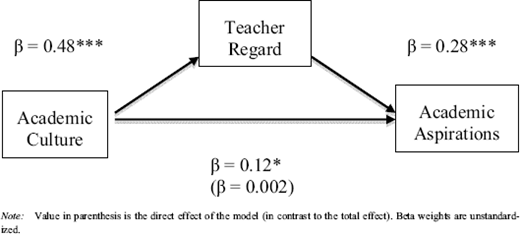
We examined if the effect of student perception of school academic culture on academic aspirations was mediated by student perception of positive teacher regard (see Figure 1). For this analysis we report the unstandardized Beta weights with the standardized Beta weight following in parentheses. In the first step, we examined if student perception of school culture predicts academic aspiration. Student perception of school culture was significantly associated with academic aspiration, (β = .11 [.07], p = .01). Next, we determined whether student perception of school culture significantly predicted student perception of teacher regard. Results showed that student perception of school culture was significantly associated with student perception of teacher regard (β = .48 [.37], p < .001).
Lastly, to address the potential mediation, we determined that students’ perception of teacher regard was significantly associated with academic aspiration (β = .28 [.13], p < .001), controlling for students’ perception of school culture. Thus, we can say that academic aspiration increases by .28 points for 1 unit increase in student perception of positive teacher regard, when controlling for the effect of student perception of positive school culture. By squaring the semipartial correlation we find that this uniquely explains about 1.4% of the variance of academic aspiration. Student perception of school culture was no longer significantly associated with academic aspiration (β = .04 [.02], p =.43), indicating there is a partial mediation of student perception of positive teacher regard on the relationship between student perception of positive school environment and student aspirations. Overall, the model is significant, F(2, 1,373) = 19.83,p < .001, with R2 at .019 and adjusted R2 at .018. Student perception of both the school culture and teacher regard predicts 2% of the variance in academic aspiration among middle school students.
Indirect Effect
To test the significance of the indirect effect of teacher regard on the relationship between school culture and academic aspiration we conducted a Sobel Test using the unstandardized regression coefficients and the standard errors. Results showed a significant indirect effect of positive teacher regard on the relationship between student perception of positive school culture and academic aspirations (Z = 2.44, p = .015). Thus, there is a significant indirect effect of student perception of teacher regard on the relationship between school culture and students’ academic aspirations.
DISCUSSION
In this study, we examined the relationship between school academic climate and academic aspirations among middle school students. More specifically, we explored how students’ perceptions of their relationship with their teachers impact the relationship between their perceptions of the school’s academic climate and the level of schooling they envision completing in the future. Consistent with the tenants of the stage-environment approach, we found that school academic culture and student-teacher relationships, two components of the middle school environment, are related to middle school students’ academic aspirations. Consistent with our hypothesis, we found that student perception of the academic climate of the school was an important indicator of aspirations. The more positive middle school students perceive their school’s academic culture, the more schooling they believe they will complete in the future. This is consistent with prior research that found students who have positive perceptions of their school climate also have more positive regard for their teachers (Baker, 1999). However, the effect of school climate was virtually eliminated when we consider how students’ feel about their relationship with their teacher. Students’ positive regard for teachers is related to higher academic aspirations, controlling for the perceptions of school climate.
It is clear from this study that interactions between students and teachers have a distinct influence on student academic outcomes and are a critical component of school climate. Previous work has highlighted the relevance of student-teacher relationships on performance indicators such as grades and test scores; however, the work presented here underscores the relevance of student-teacher interactions on academic aspirations and expectations, which has been shown to influence academic success (Wigfield & Eccles, 2002). Literature on academic goals and aspirations emphasize the importance of students’ perception of their capabilities as indicators of future success (Eccles, 2005). Students who have higher aspirations are more likely to put effort into academic endeavors and engage in classroom learning activities, which lead to higher levels of academic achievement.
In turn, students’ perceptions of their teachers have a profound impact on their academic aspirations above and beyond the students’ perception of their school’s academic climate. In line with research on the developmental appropriateness of the middle school context, students may benefit from positive and supportive adult relationships within a positive school environment such that they understand the utility of education and develop higher academic aspirations. Future research can build on these findings to further connect school environment, student-teacher relationships, academic aspirations, and educational attainment.
These findings highlight the importance of socializing teachers, not only to their role as disseminators of knowledge and facilitators of learning, but also to the importance of interpersonal interactions with their students, particularly during the developmental and academic transitions of middle school. In order to support teachers in these varying roles as educators, Cohen and colleagues (2009) highlight the need to bridge the gap between school climate research and policy and practice within teacher education. Teachers should be consciously committed to both forging meaningful relationships with their students, and creating an environment that is conducive to student learning and developmentally appropriate for the biological, social, and emotional transitions that occur during middle school (Eccles et al., 1993). In order to do this, Cohen and colleagues (2009) recommend that teacher education programs help future teachers develop these skills in tandem with content knowledge.
Limitations and Future Research
Even with the significant mediation effect of the model, there were still some limitations to this study. First, this model only explained a small proportion of the variance in academic aspirations, thus results should be interpreted with caution (Fan, 2001). Typically models that use academic aspirations as their dependent variable explain .11 to .18 of the variance (Kao & Tienda, 1998;,Rojewski, 1996); however, these models typically include demographic variables (race/ethnicity, gender) or parental involvement and aspirations rather than measures of school climate. To address this concern, future research may consider a more robust measure of academic aspiration to include nontraditional options such as trade school or direct employment. Additionally, we were limited in our measurement of school climate. Theory suggests that school climate is multidimensional and incorporates school structure as well as culture and norms within a school (Anderson, 1982, Cohen et al, 2009). Thus, future researchers should incorporate all four components of school climate when assessing the impact of climate on student academic well-being. Similarly, as mentioned above, educators should seek to understand the mechanisms through which student-teacher relationships influence academic aspirations and what components of the student-teacher relationship promote positive student outcomes. In light of prior research (e.g., Oian & Blair, 1999), further points to consider are the utility of this model across disaggregated student populations (e.g., racial/ethnic groups, gender, socioeconomic status), as well as the composition of the school (by race/ethnicity and socioeconomic status). Finally, this investigation focused on a cross-sectional analysis of student experience. Adolescence is a time when youth grow in independence and autonomy, but still need support from adult role models. During this time, relationships with adults, including teachers, are constantly shifting, as students’ relational needs are changing. Thus, extensions of this study should explore how school climate and teacher regard impact student academic outcomes across time.
Despite these limitations our model adds to the current body of literature by providing insight into the relation between academic culture, student-teacher relationships and academic aspirations. This line of research is useful when considering curriculum and school reform, as well as teacher preparation and professional development programs. Both the social and cultural school interactions play an integral role in the success and persistence of students throughout their academic careers. As our research show, it is not only important to train teachers (and future teachers) on content, but to also support them in developing skills that encourage positive relationships with their students and that support and reflect positive academic climates within their schools.
Acknowledgment: This study was presented at the American Education Research Association 2010 Annual Meeting.