These authors relate the ways in which curriculum integration is explored in 2 university middle grades programs. In these settings, curriculum integration is encountered both in the design and pedagogy of courses and as a discrete content area for preservice and inservice teachers. Background information about the courses, the application of unique knowledge components, the development of schematic meaning, and democratic principles are discussed within the framework of curriculum integration. The authors conclude with final thoughts and recommendations.
Across the past 2 decades, numerous associations and organizations (e.g., National Middle School Association, Carnegie Council on Adolescent Development) and researchers and educators (e.g., James Bean, Edward Brazee, Elaine Homestead, Richard Lipka, Mark Springer) have explicitly stated that young adolescents be given opportunities to experience curriculum integration. James Beane, a historian and scholar of and teacher on curriculum integration, in a position paper entitled “Organizing the Middle School Curriculum” succinctly explains that curriculum integration is a curriculum design that promotes personal and social integration through the organization of curriculum around significant problems and issues, collaboratively identified by educators and young people, without regard for subject area lines. Planning for curriculum integration begins with an organizing theme followed by the question, “what significant activities might be done to address the theme?” Projects and other activities involve “integration” and application of knowledge in the context of a theme. Content and skills are taught, learned, and applied as they are needed to work on particular themes. While knowledge is drawn from the traditional disciplines (among other courses) students move from activity to activity, or project to project, rather than from subject to subject during the school day (as in the multidisciplinary approach). With its emphasis on real-life themes, contextual application of knowledge, and constructivist learning, the curriculum integration approach is particularly well suited to help students integrate learning experiences into their developing schemes of meaning. For this reason, the term “integrative” is often used to describe this approach. In one variation of curriculum integration, teachers and students plan together to create a thematic curriculum based upon questions and concerns students have about themselves and their world. (Beane, 2000, p. 2)
The advocacy for curriculum integration is strong. And, yet, just how do teachers of young adolescents learn about this powerful curriculum design? There is a range of scholarly writings about curriculum integration that teachers can read, if they happen to come across them. There may be professional development opportunities for teachers interested in curriculum integration, if they have the support for and time to attend. There may even be accessible teachers that engage in curriculum integration with whom observations can be scheduled. And yet another approach to learning about curriculum integration is by studying and experiencing it in undergraduate and graduate teacher programs.
In this essay, we (Gert and Elizabeth) share how we provide middle grades teachers at two universities with opportunities to experience curriculum integration in teacher education programs. We first describe the general context of our courses. We then address how students prepare to apply their knowledge, the schema of meaning that was developing for students, and ways in which students experienced democracy. The essay concludes with our final thoughts.
Gert
I teach about and through curriculum integration in every class I instruct at the University of Maine, covering subject methods, middle school, curriculum, and assessment. In every course, teacher candidate (college students) questions and concerns shape the syllabi, along with required content standards. Candidates also collaborate with me on instructional activities and assessments. Together, we find ways to make curriculum and learning meaningful to the candidates in the class and to their students (middle school students) to the greatest possible extent and through any plausible method for any given classroom situation. I will use two significantly different courses as examples of how we incorporated curriculum integration; Teaching Science K-8 and Middle School Curriculum and Organization. Both classes discussed here are part of a master of arts (MAT) program. The MAT candidates earned a bachelor’s degree in a field other than education and return for a full year of 42 credits. They leave with a master’s degree and certification to teach kindergarten through eighth grade. The program includes practicum 1 day a week for 15 weeks and 15 full weeks of internship.
Teaching Science K-8
In the science methods class, the MAT candidates often need to learn substantial science content so they will have proficient knowledge of all the K-8 science standards. In addition, they need to learn how to use those standards. At least as importantly, they want to learn how to make the content meaningful and relevant to their future students. Candidates need to achieve a working understanding of engaging students in classroom work and, further, for the importance of meaning and relevancy to become central to their own educational philosophies. In order to achieve both of these goals, curriculum integration and democratic education become central to every other objective and activity we do within the course.
I start by asking candidates (ahead of the start of the semester, if possible) what questions or concerns they have about science and/or teaching science. Their questions range from a few simple questions about science content to larger questions regarding engaging students and making science concepts fun and comprehensible. I ask candidates to suggest how they will learn best and in what ways they would like to be assessed.
From there, I take one of two approaches to creating the syllabus. In the first approach, I start with a list of their questions—which we have collaboratively organized into topics and themes—and the list of required learning for the course, and create a weekly syllabus. I organize the syllabus around their topics and themes and add all of the required science content to that outline. The second approach starts with me organizing required content and their questions of it to organize the syllabus around the areas of science content required by Maine’s science standards. The areas are divided into physical science (universe and solar system, earth, matter and energy, force and motion) and life science (biodiversity, ecosystems, cells, heredity and reproduction, evolution). Because candidates have to learn an ample amount of science content so that their own misunderstandings and misconceptions can be addressed, I have found it to be more effective to organize around the areas of science described by the Maine standards.
I present the draft syllabus during the first or next class, and ask MATs about their questions and concerns, and assure that their preferences are represented fairly. Their feedback is used to create the next draft. The syllabus remains a draft throughout the semester, to allow flexibility in time spent on any concept and to adjust our curriculum, instruction, and assessment as candidates learn more about science content, teaching, and learning.
Throughout the course, MATs create numerous lesson plans and one complete unit of study. MATs must consider how they will significantly include student questions and concerns. This is required whether they teach Kindergarten, a self-contained class, or exclusively science on a more traditional middle school team. They must also integrate at least one other subject area and clarify connections to and applications in the real world. I urge them to develop their philosophy, aided by considerable research-based reading and discussion, to find their comfort zone with regard to integration of student input and real applications, and then to push at least a little beyond comfort. Their unit plans cover a wide range of student input and integration—from asking students what questions they have and how they would like to learn and apply their learning in teacher-generated units, to general outlines of lessons and units that will be planned with students, or even as part of integrative themes. The outlines include multiple resources and possibilities so candidates have many available options while planning with students. Regardless of the degree to which they will include students in planning curriculum, candidates realize that their plans are not and cannot be complete until they meet with and work with their students.
In addition to the integration of all of these practices in the classroom, I also use one or two class periods to specifically teach James Beane’s process for planning curriculum with students. We start with questions they have about themselves and the world, and develop several possible themes that include both personal and world aspects. We then discuss and map out some of the possibilities for using science concepts and standards within those themes. With a few rare exceptions over several years, the MATs universally see the power and value of such extensive student input, even though it may look quite different depending on the age of their students.
Evaluations from the class are consistently very positive. Students report not only having learned about science content and teaching science, but they also comment on helping students find meaning in science. MATs write how much more important and engaging the class became because of the opportunity to be part of the planning and assessment of the class.
Middle School Curriculum and Organization
Each summer, I teach the introductory middle school course at the University of Maine.
The course is 40 hours in 7 or 8 days, and is one of the first courses taken by the MATs. They enter the course with perceptions about middle school and curriculum formed during their own childhood and college experiences as students: quite traditional and teacher directed. A few practicing teachers usually join us, as well. I have three main goals in the class: (1) build community with and among the students, because they will spend the entire year together; (2) teach them about young adolescents and how to best meet their unique needs; and (3) expand their traditional educational experiences to consider the characteristics, possibilities, and power of meaningful curriculum.
Because the time period is so limited, I develop the syllabus before the class. After some initial community-building challenges for the candidates, however, I ask students what perceptions, questions, and concerns they have about middle school students and teaching, and about making curriculum meaningful. We develop common questions and list them on chart paper. We revisit the lists daily throughout the course to determine which questions and concerns we have addressed, identify changing perceptions, and pose additional questions that arise from the reading, discussion, and activities.
After a few days of learning about the characteristics of young adolescents and how middle schools can and should be responsive to those characteristics, curriculum becomes the main focus of the class. We read about, discuss, and live curriculum integration and democratic classrooms. We continue to build community throughout the course and take everything back to the questions and concerns of the MATs. We take at least an entire day to go through the Beane planning process to the point of developing themes, planning one theme, and determining which could be the standards of focus from all subject areas. Students find themselves somewhat surprised by how effectively and deeply a chosen theme can meet a plethora of standards from all subjects at many levels. They all read Mark Springer’s Soundings (2006) and we talk to him using Skype. We read many sections from James Beane’s A Reason to Teach (2005) and his early articles on curriculum integration. Each student is also required to choose an approved book or lengthier article about making curriculum meaningful to students.
Students in this particular class are a blend of K-8 MAT students, 7-12 MAT students, and practicing teachers from various levels. They teach or will teach in a variety of levels and situations. The ideal about which we speak and the way we operate reflects curriculum integration in a democratic classroom. Virtually all of the candidates incorporate this approach into their own philosophy, and some make it the foundation from which they incorporate other learning. We do, however, recognize that many of the students do or will not have an organization in their school that supports such extensive integration. Much of our discussion and several of our activities in the course focus on how to include students and make curriculum meaningful in any situation. The final assessment for the class is a paper that requires candidates to articulate their beliefs and plans to make curriculum meaningful to their students and discuss the kind of school, colleagues, and administration they will need to practice those beliefs.
Year after year, I receive almost perfect scores on evaluations from this class. Written comments from this class refer to the power and importance of building a classroom community, the engagement they feel through significant input and answering their own questions, and the perception that the activities are important. Overwhelmingly, students emphasize the development of a strong belief to include students in curriculum, planning, and assessment. Further, they express a sincere intention to incorporate these practices into future teaching. One student wrote the following comment:
It is the most powerful class I have ever taken. It will absolutely change the way that I’ll teach. I am amazed I had never considered giving kids such a strong voice and making my classroom a democracy. I can’t wait for the year to start so I can put everything that I’ve learned into practice.
Ongoing Support
I coordinated the K-8 MAT program at the University of Maine for 5 years. During that time, I observed a strong commitment in the candidates to meaningful curriculum and democratic classrooms. Many MAT graduates continue to contact me to tell me what they are doing and to ask for advice. One group extensively researched the possibility of starting a K-12 charter school where curriculum integration and democratic education would be the central organizing philosophy and practice. Even after much research and discussion we never found a way to start that school, but that particular MAT group and other graduates often mention the continued desire to start such a school.
After the middle school class, some of the 7-12 MATs continued to talk to me throughout the year about meaningful curriculum. A few occasionally sent a message to ask a question or tell me how they were integrating curriculum and including students. Most of the students who steadfastly stand by and work toward these ideals, however, are K-8 MAT students. All of the MAT candidates—K-8 and 7-12—left the middle school class with the same enthusiasm and commitment.
What differences in 7-12 and K-8 MAT experiences might be associated with the K-8 MATs displaying a longer, more definite commitment to curriculum integration and democratic classrooms? Part of the difference may be the schools in which they teach. Certainly the culture of many high schools can make it difficult to profess and practice progressive education. It is much easier to incorporate curriculum integration and democratic ideals in a self-contained elementary classroom or an interdisciplinary or integrated middle school team. High school teacher preparation also tends to be much different, with more of a focus on individual subjects and how to teach them, rather than on students, integration, and the larger picture.
I believe that most of the difference came from supporting the K-8 students over time and many experiences. I did not teach only their middle school and science methods courses. I taught them assessment, prepracticum, practicum, and supervised their internship. We met regularly to discuss philosophy, experiences, and future teaching. Through all of this, I emphasized strong professional community in the group, used assessment to support learning, and hopefully made curriculum meaningful for students. As they graduated and started jobs, they continued to contact me and each other. I still hear from several students, most of whom use curriculum integration and democratic education to a significant extent, no matter what their situation. Of course, actually experiencing the philosophy and practice as much as possible, with mentors to lead the way, is most effective. At the very least, the long-term contact and support seem to be enough to permanently influence their philosophy and practice.
Elizabeth
I have been teaching about and through curriculum integration for more than 15 years at my present and former universities. I had the good fortune to work alongside and collaborate with middle level classroom teachers and scholars on curriculum integration. These experiences influenced how I approach curriculum integration in teacher preparation courses.
At The University of Texas at San Antonio, one of the courses I teach is Mathematics/Science (or Language Arts/Social Studies/Reading) Approaches & Classroom Management Strategies, Grades 4-8, an undergraduate class for prospective middle level teachers. This course provides prospective teachers the opportunity to work with students in grades 4– 8 in school settings, design and teach developmentally appropriate curriculum, instruction, and assessment, and identify and implement effective classroom management strategies. I also teach Curriculum for Elementary & Middle School Children, a graduate course focusing on curriculum theory and models for practicing teachers.
Teaching Undergraduate and Graduate Classes
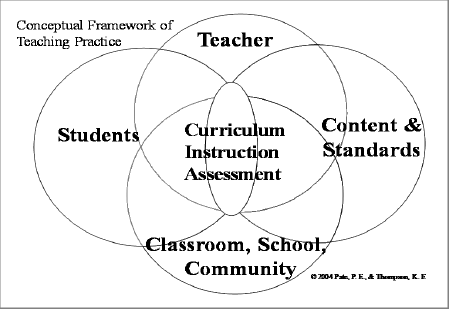
For both the undergraduate and graduate courses, I focus on personal and social integration of knowledge. I use systems thinking as a conceptual framework for both classes. Systems thinking is a theoretical perspective for learning about and understanding how groups of interrelated components form complex wholes. Systems thinking focuses on the study of how one component interacts with another component of the system—a set of elements that interact to produce behavior—of which it is a part. Instead of isolating smaller and smaller parts of the system being studied, systems thinking works by expanding its view to take into account larger and larger numbers of interactions as an issue is being studied (Aronson, 1998). The Conceptual Framework of Teaching Practice is a systems framework in which groups of interrelated components (teacher, students, classroom/school/community, content/standards, curriculum, instruction, assessment) form the complex whole— “middle school teaching” for the undergraduate class and “curriculum” for the graduate class (see Figure 1).
The Conceptual Framework of Teaching Practice provides us with a context for developing schemes of meaning. For example, one theme that we examine frequently is focused on answering the question: To what extent can I involve my middle level students in curriculum planning, instruction, and assessment?
Developing Themes
During the first session of each course, I ask students to individually write their responses to four questions: “What do I want to learn in this class?”, “How do I want to learn this information?”, “How do I want to be assessed?”, and “Why is it important to learn this information?” We then use a consensus building strategy to identify course themes. Consensus building is a strategy in which every member (students and teacher) in the group has input in decision making and one in which students’ voices are heard and respected. Consensus building allows for productive dialog, debate, and a better understanding of multiple points of view. In addition, Consensus building aids in negotiation skills, conflict resolution, and group processing. The consensus building process is similar to the curriculum integration planning process. Class meetings, in which we reflect on past learning and future directions, provide us with the venue for active listening, perspective taking, and problem solving.
Curriculum Models
Students from both courses always want to learn more about curriculum models appropriate for young adolescents—we examine curriculum models as a significant activity. Curriculum models refer to the type, presentation, format, and intent of curriculum. We explore individualized (web-based, learning centers, and contracts), subject-centered, parallel, interdisciplinary and multidisciplinary, service-learning, and, of course, curriculum integration.
Students learn through a multitude of activities that curriculum integration focuses on problems of life experience as well as mastering content from the subjects involved. They learn that in curriculum integration there can be collaboration with students and teachers on what is to be learned, why it is to be learned, how it is to be learned, and how it is to be assessed. Students learn that study is developed around student interests and concerns and mandated content and skills. They learn that in curriculum integration, subjects are utilized as needed to answer questions, understand issues, and solve problems. Students learn that middle school students become active, rather than passive, participants in their own learning. They learn that in curriculum integration they become facilitators and instigators rather than transmitters of learning. Students learn that decisions are made by middle school students and their teachers through consensus rather than teacher or majority rule. Students learn that the heart of curriculum integration is democracy.
Significant Activities
Once we identify themes, we then make decisions together about significant activities that we can engage in to address the themes. These activities involve “integration” and application of knowledge. Two significant activities often used are action research and service-learning.
Action Research. We sometimes use action research as a core activity when addressing a theme. Action research is the process of collecting data about teaching and using these data to make informed decisions about future actions. We begin the process by identifying “burning questions.” Kim, a prospective middle level teacher, asked “How can I bring democracy of learning into my classroom in the age of accountability?” In order to answer her question, Kim read about democratic classrooms, reflected on her reading, created working and technical definitions for key terminology, conducted interview research, created a flow chart to document her research process, used a pathfinder to document research strategies, wrote a five paragraph essay, created a storyboard, designed a content trailer, developed a PowerPoint, presented her research, and completed an action research checklist.
Service-Learning. Although we always explore service-learning (both teacher-led and democratic) as a curriculum model, we sometimes participate in democratic service-learning as another way to address a theme. Democratic service-learning occurs when the students and teacher (in this case, the course instructor) collaboratively make decisions and take responsibility for all aspects of the project. For example, in one semester, one of our undergraduate course themes focused on collaborative decision making between teachers and students. We collaborated with specialneeds middle school students and their teacher, Cheryl Park, at Brundrett Middle School. Table 1 is excerpted from the press release describing the project.
We experienced democratic service-learning in this project. Both sets of students (university and middle school) identified community needs, conducted interviews, took notes, and collaborated. They drew pictures, made posters, and made and addressed invitations. They researched disasters, participated in jigsaws, brainstormed, problem solved, discussed, and edited. They used technology, emailed, phoned, made nametags, wrote newspaper articles, chalktalked, made a banner, and created a collage. They watched video clips of disasters, met public figures, shared their learning, and created charrettes (illustrative portfolios on one topic used for educating and decision making). They educated the community, researched addresses, engaged in group work, documented their learning, translated English into Spanish, and created bibliographies. They identified visuals for the charrettes, translated technical definitions into their own words, created storyboards, summarized, made disaster awareness cards, and learned science, math, social studies, and language arts content. They met goals, reflected on their learning, publicized their project, and evaluated their work. They engaged in democratic service-learning to connect what they were learning in their respective classrooms with important issues and used that information to make a difference in the community.
Resources. For both courses, I require no textbooks to be purchased. Instead, as would happen in a middle level curriculum integration classroom, both the undergraduate and graduate students rely on multiple sources for learning and finding information relative to questions and concerns they have about themselves and middle school teaching. For those books of which I have multiple sets, we read and discuss the books together. For others, we use a jigsaw strategy in which students read specific chapters and share what they learned with others. Here are just a few of the numerous resources we use:
Curriculum Integration: Twenty Questions—With Answers (Nesin & Lounsbury, 1999). This 60-page book provides basic information about curriculum integration. We have multiple copies of the book which we read and discuss together. We use the book as a sounding board to help answer questions such as: “Does curriculum integration require a total team effort?,” “How does the student’s role change in curriculum integration?,” and “How does curriculum integration change my roles as a teacher?”
I also have an extensive library of James Beane’s writings and professional development materials, as well as personal communication artifacts we access as we are learning about democratic classrooms and curriculum integration. Among these are: A Reason to Teach: Creating Classrooms of Dignity and Hope—The Power of the Democratic Way (2005),
A Middle School Curriculum: From Rhetoric to Reality; Toward a Coherent Curriculum: 1995 Yearbook of the Association for Supervision and Curriculum Development (1995), Curriculum Integration: Designing the Core of a Democratic Education (1997), and two videotapes of teachers and students discussing issues around curriculum integration.
How we use these resources vary dependent upon the questions raised by university students.
Making Curriculum Integration Work: Teachers, Students, and the Quest for Coherent Curriculum (Pate, Homestead, & McGinnis, 1997). This book represents a journey taken by two middle school teachers and a university professor (me) as we sought a coherent curriculum. We defined a coherent curriculum as one that “encompasses meeting the needs of students and teachers, connecting the content, encouraging student voice, and relating schooling to real life, thereby ensuring that student learning is relevant and personally meaningful” (p. xiii). This book allows the class to take a glimpse into the day-to-day planning and decision making on a two-person curriculum integration team.
Teacher Reflections
Every semester, I anticipate that my undergraduate students will not have heard of curriculum integration nor had opportunities themselves to experience it. Every semester, I hope that my graduate students, a majority of them practicing middle school teachers, know about curriculum integration—but the majority do not. So, as we plan together to create a thematic curriculum based upon questions and concerns we have about themselves and our world, we constantly pause to reflect on our personal integration of knowledge. When asked to reflect on curriculum integration as a design appropriate for teaching young adolescents, many students stated they liked the concept. For example, one graduate student wrote:
As for curriculum integration, it is the ideal method of learning, I think, for students. I just have my reservations about it, particularly when it comes to math. I know my students seem to need a lot of practice in using the various math skills, but in curriculum integration, I’m not sure they would get enough opportunities to practice those skills. I think someday I will get very close to this style, if not achieve it, because I really do think it is ideal, otherwise.
However, many students were hesitant about their own level of teaching confidence and curriculum integration. One undergraduate student wrote, “I really like this curriculum. But, honestly, I would be terrified to implement it all on my own.” Other students expressed the need for continuing support. Yet another undergraduate student wrote:
If I had a mentor working very closely /me, I would love to try it. I think the students would love it. I’m not so sure how the district would feel though. Wow, there are a lot of ways to implement curriculum. I like all the methods we learned, but some are scary because I’m afraid I would be awful at implementing them, but I know they would make me an awesome teacher. I like how thinking about curriculum makes me really assess what I am teaching. I have to think.
I am constantly reflecting about how I teach about and through curriculum integration. I know that I need to locate additional resources for use in the classroom. I want to create a database of observation sites where we can personally or virtually visit classroom integration classrooms. I want opportunities for my students to become part of a national/international community of learners focused on curriculum integration with mentoring as a cornerstone. I want to collaborate with other teacher educators who are interested in teaching about and through curriculum integration.
Final Thoughts
In this essay we share how we “organize our curriculum”—how we teach about and through curriculum integration. We teach about and through curriculum integration because it is our lived philosophy—we practice what we preach. As Beane (2005) states “it is unfair to tell teachers to follow that road [democratic classrooms and curriculum integration] unless professors are walking it themselves.” We have similar, yet varying, approaches in the ways in which we help teachers experience and better understand curriculum integration. Even so, caring democratic communities are formed, and our students participate in diverse democratic societies. Our students question, synthesize, and engage in perspective-taking. Personal and social integration occurs, content is learned, and contextual application of knowledge is valued. Academic, personal, and cultural barriers are weakened and sometimes dissolved. Our students are respected as valuable and contributing members of society. Schooling, for our students, is relevant.