


Although there are increasing numbers of professional development (PD) materials intended to foster teachers’ mathematical knowledge for teaching within the topics of number and algebra, little attention has been given to geometry. In this article we describe the Learning and Teaching Geometry project’s approach to the development of PD materials aimed at supporting middle grades teachers to meet the challenges of teaching similarity. We discuss the design research approach of the project, including developing a mathematical learning trajectory, videotaping in classrooms, and selecting videoclips to support our learning goals. We use a sample videocase to illustrate the design process.
CONTENT RATIONALE
Outside of the United States, geometry is recognized as one of the most important components of the school mathematics curriculum (Atiyah, 2001; Royal Society & Joint Mathematical Council, 2001), yet in this country it is either missing or far removed from the mainstream curriculum with its heavy emphasis on number and algebra (Clements, 2003; Lappan, 1999; Wu, 2005). Importantly, there is evidence that fostering geometry skills may help to address the serious inequities in mathematical achievement that persist within our country between White students and students of color, and between middle-class students and students living in poverty (Berends, Lucas, Sullivan & Briggs, 2005; Lubienski, 2002; Symonds, 2004). In a study of 13,000 fourth graders who took the National Assessment of Educational Progress (NAEP) mathematics assessment in 2000, geometry was among the topics proving the most beneficial to minority students in closing the achievement gap (Wenglinsky, 2004). Perhaps one reason for this finding is the fact that geometry allows students to reason and represent mathematics using multiple modes of communication (Chval & Khisty, 2001; Khisty & Chval, 2002).
According to several recently published reports, similarity should be part of the mathematics that middle school students learn (Common Core State Standards for Mathematics, 2010; Lappan & Even, 1998; National Council of Teachers of Mathematics [NCTM], 2006; National Mathematics Advisory Panel [NMAP], 2008; Wu, 2005). For example, NMAP states, “By the end of Grade 7, students should be familiar with the relationship between similar triangles and the concept of the slope of a line” (NMAP, 2008, p. 20). The NCTM focal points highlights the importance of understanding scale factor, in addition to seeing a connection between similar triangles and slope (NCTM, 2006). The Common Core State Standards for Mathematics (2010) suggests that by eighth grade, students should understand similarity (and congruence) in terms of dilations, rotations, translations, and reflections.
Even when middle school curricula incorporate foundational geometric concepts such as similarity, teachers frequently lack the experience and professional development to use these materials with the mathematical fluency necessary to improve student learning (Clements, 2003). The explication of the content, instructional design, and typical student responses in curricular materials are inconsistent—sometimes they are very detailed, other times nonexistent. This inconsistency and variation adds to the challenges teachers face as they work to use curricular materials effectively with their students. To meet such challenges, they must draw upon their “mathematical knowledge for teaching” (MKT; Ball & Bass, 2000, 2003). This specialized teaching knowledge includes a deep understanding of the mathematical content regarding such things as: the mathematical structure and principles that could be used to solve the problems, developmentally appropriate and mathematically accurate definitions, and whether or not a solution method can be generalized beyond a specific case.
Teachers need far more opportunities to gain this type of specialized knowledge, particularly when they are faced with teaching new content in ways substantially different from the manner in which they learned it (NCTM, 2006). Although there are increasing numbers of professional development (PD) materials designed to help foster teachers’ mathematical knowledge for teaching within the topics of number and algebra (e.g., Barnett Goldstein & Jackson, 1994; Driscoll et al., 2001; Franke, Carpenter, Levi, & Fennema, 2001; Schifter et al., 1999a, 1999b; Seago, Mumme, & Branca, 2004; Stein, Smith, & Silver, 2000), little attention has been given to geometry.
In this article we describe one project’s initial efforts to tackle the need for specialized content-focused professional development materials. After a brief project overview, the paper will focus on the design research process of the Learning and Teaching Geometry project, highlighting the development of the foundation module—the foundational basis of the professional development materials. We discuss the design research approach of the project, including developing a mathematical learning trajectory, videotaping in classrooms, and selecting and ordering video clips to support our learning goals. We use a sample videocase to illustrate the design process.
THE LEARNING AND TEACHING GEOMETRY PROJECT
The purpose of the Learning and Teaching Geometry (LTG) project is not to develop a comprehensive geometry curriculum, nor to embrace any existing curricula. Rather, the main goal of the project is to build professional development materials that provide opportunities for teachers to expand their mathematical knowledge for teaching. In particular, the LTG materials are designed to engage teachers in learning about similarity through the use of videocases, in which specific and increasingly complex mathematical ideas are presented within the dynamics of classroom practice.
The LTG materials are intended for use in the professional development of middle school mathematics teachers, Grades 5-8. We are first creating a foundation module, to be followed by four extension modules. Each module will contain several activities in which teachers (a) explore the mathematics, (b) view, analyze and discuss video cases, (c) compare and contrast issues across cases, and (d) make links to their own instructional practice. Some of the video clips portray student thinking about particular concepts and tasks and some clips portray pedagogical issues and their impact on students’ opportunities to learn.
LTG is premised on the idea that using artifacts of practice within a well-structured PD program can promote mathematical knowledge for teaching (Ball & Bass, 2000; Ball & Cohen, 1999). This idea is supported by a variety of learner-centered, inquiry-based theoretical traditions, including constructivist and situative perspectives on learning (Cobb, 1994; Greeno, Collins & Resnick, 1996). These perspectives share the notion that engaging in challenging, problem-based, collaborative, and socially shared activities is likely to promote an expanded knowledge base (Borko et al., 2005; Marx, Blumenfeld, & Krajcik, 1998). Situative theorists further posit that the contexts and activities in which individuals learn are fundamental to what they learn. Thus, actual classroom situations and tasks are powerful contexts for teacher learning. Several research projects have demonstrated that artifacts of practice, such as classroom video and student work, are effective tools in professional development efforts to increase teachers’ opportunity to gain mathematical knowledge for teaching (Seago & Goldsmith, 2006). By bringing the everyday work of teaching into the professional development setting, artifacts of practice enable teachers to unpack the mathematics in classroom activities, examine instructional strategies and student learning, and discuss ideas for improvement (Ball & Cohen, 1999; Borko, Jacobs, Eiteljorg, & Pittman, 2008; Driscoll et al., 2001; Kazemi & Franke, 2004; Schifter et al., 1999a, 1999b; Seago et al., 2004; Sherin, 2004).
Video is particularly popular as an artifact of practice in teacher professional development due, in part, to its unique ability to capture the richness and complexity of classrooms for later analysis (Brophy, 2004). We have chosen classroom video as the primary medium for teacher learning in the LTG project because of the opportunities it provides for teachers to consider issues related to their own practice through viewing and discussing the practice of others (Abell & Cennamo, 2004; Seago, 2004). Video clips will serve as the centerpiece of each videocase; thus, selecting appropriate video clips from the set of available lessons is a critical component in the development phase of our project. Research suggests that video clips used in PD materials must be purposefully chosen to address specific teacher learning goals, and be embedded within activities that scaffold teachers’ progress toward those goals (Brophy; Borko et al., 2008). In other words, the conceptual and mathematical framework that guides the selection and sequence of video clips must be in line with the framework for the entire professional development program. In the case of the LTG materials, our goal is to engage teachers in “generative learning activities” that scaffold and support their changing levels of mathematical knowledge for teaching (Marx et al., 1998).
A DESIGN RESEARCH APPROACH
In the LTG project, both the materials development and research components (formative and summative) are guided by a design research approach, in which there are cycles of invention and revision (e.g., Cobb, Confrey, diSessa, Lehrer, & Schauble, 2003). In the spirit of Collins, Joseph and Bielaczyc (2004), we view the design process as one of “progressive refinement.” Our interest is not only in creating a set of materials, but in documenting the critical design elements, considering how these elements play out in multiple contexts, and accumulating a detailed body of knowledge related to the development, refinement, and use of professional development materials.
To create an initial draft of the foundation module, the LTG project team engaged in a six-phase design process: (1) conjecturing a sequence of activities based on a specified learning trajectory that would provide a mathematically robust experience for middle school teachers around learning and teaching similarity, (2) using a strategic videotaping process to film a number of classroom lessons in which teachers used these activities with their students, (3) selecting promising video clips from these lessons to map on to the learning trajectory, (4) designing PD modules by creating a framework for the materials that incorporate these video clips, (5) developing video case resources to promote teachers’ mathematical knowledge for teaching, and (6) revising materials based upon formative evaluation data.
In this article, we include examples of the design process drawn largely from the initial phases of our work, including developing a dynamic definition of similarity and selecting videocases that highlight this definition.
DEVELOPING DEFINITIONS TO SUPPORT A TRANSFORMATIONAL VIEW OF SIMILARITY
In the first year of the project, the LTG design research took the form of considering multiple definitions for similarity, as well as devising introductory and application geometry problems that matched our evolving definitions. We solicited advice and feedback from a team of mathematicians, using an asynchronous
online discussion forum over a 4-month period. Based on this iterative process— consisting of targeted questions, a systematic review of the responses, and follow-up questions—the LTG project was ultimately able to establish a consensus on the definition(s) of similarity that should be presented in the materials, the key conceptual ideas and their progression, and a set of introductory problems that align with these definitions and ideas.
Of central importance was the consensus that the LTG materials should be focused on helping teachers to recognize and appreciate a dynamic, transformational view of geometry in general, and of similarity in particular. Traditionally, congruence has often been defined for middle graders as same size; same shape, and similarity has been defined as same shape, not necessarily same size. Students often leave middle school with nothing more precise. These definitions are frequently found in American textbooks and classrooms and are not only imprecise, but may also lead students to faulty conceptions. For example, figures that are actually similar (or even congruent), but are oriented differently, may confuse students who do not recognize that rotations are allowable. As another example, a 3-4-5 triangle and a 5-12-13 triangle are both right triangles, so does that mean they have the same shape?
Our current working definition of congruence for the LTG materials is: two figures are congruent if one is equivalent to the other by a combination of translations, rotations, and/or reflections. Our working definition of similarity is: two figures are similar if one is congruent to a dilation of the other. These two definitions highlight the role of transformations and stand in contrast to the more traditional, static, numerical/measurement view of similarity.
The LTG materials propose a learning trajectory that is designed to help teachers move beyond conceptualizing similarity in static terms as a relationship between two discrete figures. Instead, teachers are guided through a series of ten, 3-hour sessions to a more precise dynamic conception of similar figures as part of a continuum or continuous family (see Figure 1).
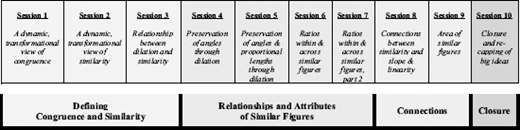
Geometric similarity was selected as the specific focus of the materials due to the fact that similarity connects a wide variety of critical mathematical topics, such as proportional reasoning, scale factor, linear functions, modeling, and transformations.
SELECTING VIDEOCASES TO HIGHLIGHT A TRANSFORMATIONAL VIEW OF SIMILARITY
In the second year of the LTG project, we videotaped mathematics teachers across the United States implementing one of three similarity problems designed by our research team. During the course of this videotaping effort, we learned of a middle school that used similarity problems from their own curriculum that looked very much like the ones our team created. This unique curriculum,1 developed by teachers at the school (including the videotaped teacher) in collaboration with a nearby university, incorporates open-ended problems to introduce similarity to sixth graders based on a dynamic, transformational approach. Videotaping lessons using this curriculum provided the LTG project with images of instruction where transformations play a central role in the students’ geometric thinking.
We intentionally filmed three lessons at this school, over 3 consecutive days, at the time when students were first introduced to the concept of similarity. The students worked on a series of problems that prompted them to reason about the mathematical relationships between similar figures, and also introduced them to dilations. Across the three lessons, the mathematical focus moved from the preservation of angles in similar figures to the attributes of dilation. We have tentatively selected a series of videoclips for the foundation module sessions that focus on angles.2
All videoclips for the LTG materials were selected based on a detailed process that ensured the videos would fit well with our specified learning trajectory and support opportunities for teachers to gain mathematical knowledge for teaching. The LTG project team identified possible clips by watching lessons, and writing and/or editing lesson notes, highlighting possible clips along with rationales and potential PD frames, and classifying the clips (according to where they might fall in the trajectory identified for the foundation module). We went through multiple iterations of this process, and in some cases shared selected clips at professional conferences in order to solicit feedback from other educators in the field. We also provided a DVD of potential video clips to our advisory board members and solicited their advice (in writing and in person) about the potential affordances and constraints associated with each clip.
Lastly, we piloted the foundation module several times, with a variety of teachers and facilitators, in order to generate both formative and summative evaluation data. The first pilot was facilitated by the principal investigator and lead materials developer (the first author of this paper), and four other pilots were conducted by facilitators in diverse locations across the United States. In this article, we will not discuss the details of the pilots, but rather take an up-close look at a sample videocase selected for initial inclusion in the foundation module. All of the clips discussed here come from the school in which the teacher used problems from her own curriculum to introduce similarity to sixth graders, focusing on angles and dilation.
A SAMPLE VIDEOCASE: FOCUSING ON ANGLES AND DILATION
In the first videoclip (selected from the first day of filming at this school), a class of sixth grade students are working on the “heart problem.” In the problem, eight hearts are shown, together with a broad question about what a child might notice about these hearts (see Figure 2). The clip begins with a student answering, “They were all different sizes. Some were stretched out vertically [or] horizontally. Some were small and some were big.” Gradually the class comes to a consensus that four of the hearts (A, E, F, & G) are “the same.” When the teacher pushes them to explain their reasoning, the students struggle to be more articulate. But eventually one student remarks, “Every angle on the bottom [of hearts A, E, F, & G] is a 90 degree angle.” After more discussion, the class agrees that both the top and bottom angles of these four hearts look the same. They decide to prove this notion by tracing and comparing the angles.
There are a number of mathematically interesting features of the heart problem. For example, the shapes the students compare are hearts, rather than more standard figures such as triangles or rectangles. The sides of hearts are curved and difficult to measure. By contrast, the angles in the hearts stand out and are relatively simple to measure, particularly by tracing, which is a measurement technique commonly utilized in this class. Not surprisingly, the students can articulate the similarities and differences between the angles, but have considerably more trouble using language to characterize the lengths.
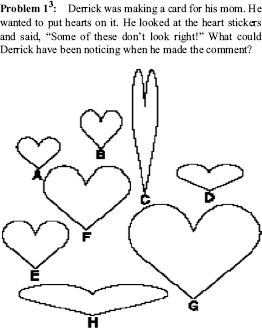
The teacher concludes the heart problem by summarizing what they know and what they still need to think about:
“We decided that those four hearts have the same shape. We know that the 90 degree angle has to match up and that little point at the top needs to match up.. We’re not too sure what’s happening with the length of the sides. We know some got bigger and some got smaller.. We still need to look at what we mean by “the same shape.” So let’s write that question down in our notes. “What do we mean by the same shape?”
In our current draft of the foundation module, this clip is used to motivate a conversation about how difficult it is for students to find the right language to express their emerging ideas about similarity. The heart problem helps to convey a lack of precision around the commonly used term “same shape,” and encourages a consideration of the affordances of students’ investigating standard and nonstandard shapes when they are first introduced to similarity. Another interesting aspect of this clip is the way the videotaped teacher provides a summary for an individual problem; viewers can consider the role such a summary plays in supporting students’ learning.
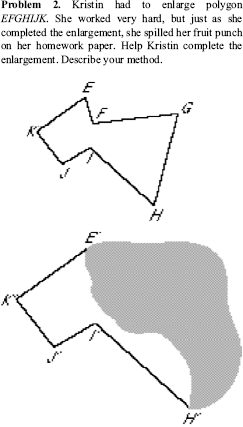
The fact that the heart problem leaves the videotaped students still puzzled over the definition of same shape leads nicely into the next problem. Problem 2 is a “spill problem,” involving a small rectangle that has been enlarged, with part of the enlargement missing (that is, covered by spilled juice). Like the heart problem, the spill problem is based on a nonstandard figure, but this time the figure involves straight lines that can be more easily measured. The spill problem requires students to keep two key variables related to similarity—corresponding side lengths and corresponding angles—in mind at the same time.
In the videoclip that we have selected from the spill problem, a student (Tyler) stands at the front of the room, reading aloud the answer written on his paper. The teacher responds, “Does everybody know exactly what Tyler did? If I gave you another figure to draw and enlarge—make it bigger—you would know how to use Tyler’s method to do that?” Students immediately say “no” and the teacher continues, “So what do we do?” The class agrees that they would like Tyler to show what he did by drawing and providing a more elaborated explanation.
Tyler demonstrates how he compared one pair of corresponding side lengths (KJ and K’J’) and found the larger length was 1.5 times the smaller length. When pushed to describe how he completed part of the “spill” portion of the polygon, Tyler at first has difficulty finding the right language. However, as he begins drawing, Tyler is able to show that he traced angle G and then expanded the two connected side lengths (FG and GH) by 1 ½ times their original lengths. At this point, the teacher again asks if everyone understands and a chorus of students say “yes.” However, she does not move on; rather she summarizes the main ideas from this problem. Specifically, the teacher highlights the ideas that: (1) each of the corresponding angles was congruent and (2) each of the corresponding side lengths was multiplied by 1.5 (using the smaller side lengths as the base unit).
As they consider this clip in the foundation module, teachers are prompted to notice Tyler’s use of tracing to complete the enlargement, a strategy used frequently among this group of students but not commonly seen in other middle school classrooms in the United States. Teachers can consider the affordances of using tracing paper as a measuring tool relative to other strategies students could use to solve this problem. The LTG materials encourage teachers to carefully examine the ways in which Tyler was prompted to continue explaining and clarifying his thinking, and how the videotaped teacher built on Tyler’s thinking in order to underscore two critical mathematical ideas.
Our third clip comes from Day 2 of the videotaped lessons and centers on a problem that introduces these students to the term “dilation.” Without offering a definition, the problem prompts students to explore attributes of a particular dilation in order to make sense of the term. The problem states that one pentagon has been dilated by 200% to get a larger pentagon (see Figure 4). Similar to the “spill” problem, the students have to draw in the missing sides. This problem builds on the students’ recent discoveries that similar figures have the same ratio between corresponding side lengths and the same measurements for corresponding angles; at this point ideas pertaining to the “center of dilation” and “lines of dilation” are brought in.
The class spends about 30 minutes working on Problem 3 in small groups before they discuss it as a whole class. The video clip selected from this problem shows a portion of the whole class work. At the beginning of the clip, the class focuses on the idea that all of the corresponding angles in the two pentagons are congruent. The teacher shifts their attention to the lines of dilation when she questions, “What’s the point of drawing all these lines here? What are these lines for?”
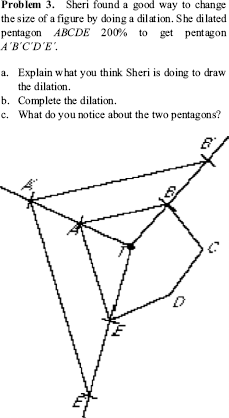
One student provides a partial response: “To know the distance between the prime [figure] and the regular [figure]. And to show that it’s the same angle and it’s straight.” The teacher picks up on the student’s language in this response to emphasize a connection between the lines of dilation and the congruent nature of the angles. She asks, “So somehow using this line [of dilation], I can make this angle the same as this angle? Yeah? How do I do that?” The students are not sure how to respond, so the teacher recaps what they have said about the problem so far, including what they understand and what they still have questions about.
The teacher points out that everyone seems to understand that using the lines of dilation enabled them to find the distance between the original figure and the dilated figure. However, she notes that they are still a bit confused about the relationship between the lines of dilation and the fact that the corresponding angles are the same: “We know something about if we use these lines, it will keep the angles congruent. But I’m not sure, do we know why?” Using gestures in combination with her questions, the teacher helps the class to see that the angles are “sliding” down the lines of dilation. At this point, the students quickly recognize the application of a familiar type of geometric transformation: a translation. The teacher summarizes, “If I take something and I translate it along this line, I’m going to the keep the angles the same.”
In the LTG materials, this clip is used to help teachers more deeply conceptualize what a dilation means and consider why certain properties are preserved when figures are dilated. The clip also help to promote a discussion about concepts related to similarity that are suggested by the problem, but not necessarily addressed within the clip itself, such as what the center of dilation is and how it can be determined. In addition, teachers are asked to consider the nature of this problem—in which students are expected to complete a dilation and understand its meaning without any prior knowledge of dilation. The clip can prompt discussion of whether and when such an experience is a good way for students to learn mathematical definitions. The underlying assumptions behind this curriculum’s approach to introducing dilations can be unpacked, as well as its affordances and limitations.
BRINGING IN THE TEACHER’s VOICE
As this sequence of video clips illustrate, the LTG materials propose to follow a mathematical storyline for learning and teaching similarity that supports dynamic, transformational, geometric thinking. Because the materials are being developed from the perspective of a design research project, they are subject to continual cycles of revision and refinement. Rich problems like the ones discussed above embody the spirit of our working definitions of congruence and similarity and our design process has adjusted to include them with our staff-constructed problems.
Based on our initial piloting of the foundation module, LTG project staff agreed that participating teachers needed more information about the videoclips described above— including information about the curriculum used by the videotaped teachers, the prior experiences of her students, the rationale behind her instructional decisions, and the logic behind the mathematical sequencing embedded within and across the problems. We decided to spend several hours conducting a videotaped inter view with the teacher, asking her to comment on these and other issues commonly raised by viewers of the videoclips. Presently, LTG staff is engaging in the process of selecting clips from the interview to include in the PD materials, based on a process similar to that used for selecting videoclips from lessons. These clips are intended to bring the videotaped teacher’s voice into the conversation, and provide more information for the LTG participants. We expect the interview clips might raise as many questions as they answer, but anticipate that they will foster our goal of promoting ’ mathematical knowledge for teaching as viewers grapple with complex issues teachers face around supporting a dynamic view of similarity for middle schoolers.
CONCLUSION
The goal of the LTG materials is to initiate inquiry into key content and pedagogical issues with respect to learning and teaching similarity. At the core of the LTG materials are videocases that help teachers move from an informal to a formal understanding of similarity, gain a facility with similarity in problem solving, and become more adept in supporting their students’ learning of similarity. By viewing real classroom video footage, the materials provide insight into (1) what an emerging understanding of similarity among middle school students looks like and (2) what instructional strategies can foster students’ understanding of similarity.
Presently, we are engaged in designing the foundation module of the materials including selecting and sequencing video clips, revising the mathematical storyline, and determining how the clips will be used for professional development purposes. As we have illustrated in this paper, some of the video clips portray student thinking about particular concepts and tasks and some clips portray pedagogical issues and their impact on students’ opportunities to learn. The clips offer a window into a variety of issues related to content, student thinking, and pedagogical moves, and seem likely to promote conversations in professional development regarding mathematical properties of similar figures, connections between similar figures, corresponding angles, and dilations, and the type of mathematical problems and teacher moves that can stimulate a deep understanding of these topics.
There are many challenges involved in creating resources for professional development. At this point in our design research, we are continuing to engage in processes around creation, testing and refinement, in an effort to produce materials that enable successful facilitation and support teacher learning. Our longterm plans include field testing the materials on a larger scale, and gathering qualitative and quantitative data around the facilitation of the materials and their impact on teachers’ mathematical knowledge for teaching.
Acknowledgment:
The Learning and Teaching Geometry project was supported by NSF Award No. 0732757. An earlier version of this paper was presented at the annual meeting of the American Educational Research Association, April 2009.
NOTES
For more information on the curriculum, visit the website: http://www.hawaii.edu/crdg/sections/math/
The foundation module has not yet been finalized and these clips are subject to change. They are described here for illustrative purposes to provide insight as to the mathematical focus of the LTG materials and the types of content and pedagogical issues that the videocases are likely to highlight.
All problems in this paper are taken from the Curriculum Research & Development Group, 1776 University Avenue, CMA 101, Honolulu, Hawaii 96822; http://www.hawaii.edu/crdg/curriculum/

