


People who experience mental illness often demonstrate limited help-seeking behaviours. There is evidence to suggest that media content can influence negative attitudes towards mental illness; less is known about how media impacts help-seeking behaviours. The purpose of this study is to identify if media plays a role in people’s decisions to seek help for their mental health.
The databases Academic Search Complete, CINAHL Plus with Full Text, MEDLINE, APA PsycArticles, APA PsycInfo, Social Sciences Full Text [H.W. Wilson] and Soc Index were systemically searched for papers in the English language that investigated the link between media and help-seeking for mental illness.
Sixteen studies met eligibility criteria. There was some evidence to suggest that various forms of media – including video and online resources – can positively influence help-seeking for mental health. Print media had some limited effect on help-seeking behaviours but was weaker in comparison to other forms of media. There was no evidence to suggest that media discourages people from seeking help.
This review identified that, given the heterogeneity of the included papers, and the limited evidence available, there is a need for more focused research to determine how media impacts mental health-related help-seeking behaviours.
Introduction
People who experience mental illness can experience a range of issues, including low mood (Ibrahim et al., 2020), difficulties with concentration (Iftikhar et al., 2022), impaired functioning (Lambert et al., 2020) and suicidal ideation (Saab et al., 2022). Once people engage with mental health services and access appropriate treatments, they can often see improvements in their overall mental health (Puffer et al., 2020; Malins et al., 2021) and are more likely to be provided with the education, resources and support they need to help maintain their well-being and reduce the risk of relapse (Coiro et al., 2017; Nolan and Petrakis, 2019). It is recommended that mental health care is accessed as early as possible to enhance recovery (Brown et al., 2019; Sinclair and Holden, 2013; Vusio et al., 2021).
However, people who experience mental illness often demonstrate limited help-seeking behaviours. In a longitudinal study, Doll et al. (2021) found that only 22.5% of individuals aged 16–40 with mental health problems sought help. Similar results were reported by Shafie et al. (2020), who found that only 32% of adults with mental illnesses seek help. Both Goodwin et al. (2016) and Zochil and Thorsteinsson (2018) reported that university students with mental health issues were less likely to seek help when compared with peers who demonstrated higher well-being scores. Sears (2020) found that between 15% and 26% of participants selected “no one” when provided with a range of help-seeking options. Regarding specific illnesses, low rates of help-seeking are evident for those who experience depression (Muhamad Ramzi et al., 2020), schizophrenia (Yalvaç et al., 2017), bipolar disorder (Humpston et al., 2021) and eating disorders (Fatt et al., 2020; Wales et al., 2017).
One of the most significant barriers to help-seeking is a stigma (Doll et al., 2021; Van der Burgt et al., 2021), defined as a combination of ignorance (lacking knowledge about mental health), prejudices (attitudes that people hold about mental health) and discrimination (behaviours towards those experiencing mental illness) (Thornicroft et al., 2007). Perceived public stigma (perceived stigma of the public towards individuals experiencing mental illness), personal stigma (people’s own stigma towards those experiencing mental illness) and self-stigma (the internalization of public stigma) are significant predictors of help-seeking behaviour (Nearchou et al., 2018). Owing to embarrassment, shame, concerns about status loss and social separation or a fear of being “labelled” based on “stereotypes”, people often demonstrate a reluctance to seek help for mental illness (Link and Phelan, 2001; Schnyder et al., 2017; Villatoro et al., 2022) and can also influence people to disengage from treatment (Andrade et al., 2014).
Stereotypes of mental illness are frequently presented through different forms of media (Foster et al., 2021). Mass media relates to a diverse range of communications where messages are mostly in one direction and includes radio, newspapers, books, websites, feature films and television (Danesi, 2014; Franklin, 2016; Kroon, 2010; Lianxiang, 1990). Mass media can entertain, but it can also educate, a concept referred to as “edutainment” (Chandler and Munday, 2011). Stereotypes of mental illness are also presented through social media (Robinson et al., 2019), defined as a form of communications media, which facilitates social interactions between people, who may be acquainted or strangers (Chandler and Munday, 2011).
The powerful sociocultural impact of media is well-established; it has the potential to both positively (Nwachukwu and Anorue, 2019; Dunn, 2020) and negatively (Srivastava et al., 2022; Turner & Lefevre, 2017) influence the general public about a wide range of topics. Owing to the general public’s familiarity with media, media-based interventions are commonly used as education strategies (Garcia, 2022; Goodwin et al., 2021). For example, in schools, film-based interventions, such as short videos and animations, have been used to teach young people about common mental health problems (Goodwin et al., 2021), sexual health (Aventin et al., 2019) and smoking (Zhao et al., 2019). In university settings, social media has been used to educate medical students by facilitating discussions and the sharing of resources (Guckian et al., 2021), while films have been used to educate pharmacy students about mental health issues (Bock et al., 2022). Mass media campaigns have also been used to educate the general public about topics as varied as smoking (Rigotti & Wakefield, 2012) and allergies (Moreira et al., 2022).
However, through media, misinformation is often presented to the public (Binnie et al., 2021; Foster et al., 2021). Issues related to mental health are frequently sensationalized with the aim of increasing sales/reaching larger audiences (Kelly, 2016). For example, newspapers often present “overwhelmingly dramatic and distorted images of mental illness that emphasize dangerousness, criminality, and unpredictability” (Stuart, 2006, p. 99), while TV shows and films frequently over-represent the unpredictability of people who experience mental illnesses (Srivastava et al., 2018). Although there is some evidence of positive reporting of mental illness across media (Carmichael et al., 2019), there is a disproportionate focus on mental health service users as violent and aggressive in film (Goodwin, 2014), video games (Ferrari et al., 2019), newspapers (Rodrigues-Silva et al., 2017; Srivastava et al., 2018), television (McMahon-Coleman and Weaver, 2020) and social media (Alexander et al., 2018). Excessive negative, unbalanced, portrayals of mental illness perpetuate harmful stereotypes (Harris et al., 2022). Consequently, people are presented with inaccurate or over-exaggerated depictions of mental illness. However, owing to a lack of knowledge in this area, media depictions of mental illness may be internalized and accepted as accurate, resulting in prejudice and discrimination (Kondo, 2008; Procknow, 2019; Ross et al., 2019; Tan et al., 2020).
Evidence suggests that media impacts attitudes towards help-seeking for mental illness. Burke et al. (2008) and Chandra and Minkovitz (2007) reported that young people’s negative perceptions of psychiatric hospitals were influenced by media, and it was suggested that such perceptions may act as a barrier to seeking help. Indeed, Chisholm et al. (2018) reported that, owing to media-driven stereotypes, the general public hold stigmatizing perceptions of mental health service users and engages in “social distance” from these individuals. Others have identified that the media’s depictions of mental illness are often grossly inaccurate, leading to stigma among the general public. It has been suggested that, as a result of this media-driven stigma, people may demonstrate a reluctance to seek help for their problems (Alexander et al., 2018; Vidourek and Burbage, 2019).
Media can also be used to positively influence attitudes towards help-seeking. For example, Keller et al. (2021) found that mean attitudes towards help-seeking improved following a screening of suicide prevention video; these results were statistically significant (p = 0.049). Similar results have been reported by King et al. (2018), Kosyluk et al. (2018), Ojio et al. (2019), Seidman et al. (2018) and Hurtado et al. (2019).
Although there is evidence that media can impact people’s attitudes towards help-seeking, little is known about how these attitudes translate into actual help-seeking behaviours. It is also unclear if there are differences in how various media can impact these behaviours. Therefore, the aim of this systematic review is to identify if media content plays a role in people’s decisions to seek help for their mental health.
Methods
This systematic review was guided by the Cochrane Handbook for Systematic Reviews of Interventions (Higgins et al., 2019) and reported according to the preferred reporting items for systematic reviews and meta-analyses checklist (Page et al., 2021). The review protocol was registered with the International Prospective Register of Systematic Reviews (registration number: CRD42021281378). Empirical studies of any design were eligible for inclusion provided that they focused on actual mental health help-seeking/help-avoiding behaviours where the decision to avoid or access help was influenced by media. Studies were excluded if they focused on attitudes towards help-seeking or intentions to seek help only. We also excluded intervention protocols, literature reviews, dissertations, conference proceedings, commentaries and editorials.
Eligibility criteria
The PICOS (Population, Intervention, Comparison, Outcomes, Study Design) framework was used to determine study eligibility. Empirical studies of any design were eligible for inclusion provided that they were conducted with any population who had been influenced to seek or to avoid help for mental distress by media. Studies with or without comparisons were included. All forms of media were considered eligible for inclusion, including entertainment media, social media and media-based interventions developed by researchers. Studies were excluded if they focused exclusively on attitudes towards seeking help for mental distress (rather than help-seeking behaviours) or where influences on help-seeking were unrelated to media. We also excluded literature reviews, theoretical papers, conference abstracts, editorials, letters to the editor, dissertations and study protocols.
Search strategy
We searched the following electronic databases for relevant studies: Academic Search Complete, CINAHL Plus with Full Text, MEDLINE, APA PsycArticles, APA PsycInfo, Social Sciences Full Text [H.W. Wilson] and Soc Index. We also reviewed the reference lists of potentially eligible studies to identify additional studies. The following keywords were used with all databases, truncated to maximize retrieval, combined using Boolean operators “OR” and “AND” and searched on title or abstract: (“mental health” OR “mental illness*” OR “mental disorder*” OR psychiatr* OR distress) AND (film* OR movie* OR “motion picture*” OR cinema* OR television OR TV OR video* OR media OR multimedia OR news* OR “video game*” OR “social media” OR radio OR book* OR music OR song* OR play* OR theatre OR comic*) AND (“help seeking” OR “help-seeking” OR “seek help” or “seek treatment” or “treatment seeking” or “treatment-seeking”). The following MeSH terms were used to search MEDLINE, combined with keywords using the Boolean operator “OR”: (“Mental Health”) AND (“Mass Media” OR “Communications Media” OR “Social Media”) AND (“Help-Seeking Behavior”). The search was limited to records published in English. No year limits were used to maximize retrieval. The search was last conducted on the 28th November 2022.
Study selection
Records identified from the search were transferred to Microsoft Excel, and duplicates were deleted. Titles, abstracts and full texts were then screened. Each record was screened by both authors, with conflicts resolved through discussion and consensus. Cohen’s Kappa statistic was used to determine the interrater reliability between reviewers for title and abstract screening and for full-text screening; agreement was reported as poor (<0.20), reasonable (0.21–0.40), moderate (0.41–0.60), good (0.61–0.80) or very good (>0.80) (Landis & Koch, 1977).
Data extraction and synthesis
Data were extracted by JG and cross-checked for accuracy by LB to minimize reporting bias. A standardized data extraction table was constructed using the following headings: author(s) (year); country; the aim of the study; study design; sample and setting; intervention (media) description; data collection process; key outcomes; key outcome measures; and key findings (Saab et al., 2018). Owing to the heterogeneity in study design, outcomes and outcome measures, a meta-analysis was not plausible. Instead, a narrative synthesis of findings is presented.
Quality assessment
Critical appraisal of the studies was performed to ensure the accuracy and consistency of data. The quality of quasi-experimental studies, qualitative studies, cross-sectional studies and randomized controlled trials (RCTs) were critically appraised using standard critical appraisal tools prepared by the (JBI) Joanna Briggs Institute (2019). Because JBI does not provide an appraisal tool for mixed methods designs, the Mixed Methods Appraisal Tool (Hong et al., 2018) was used to appraise two studies. Critical appraisal was completed by JG and cross-checked by LB. Discrepancies were resolved through consensus between the authors.
Findings
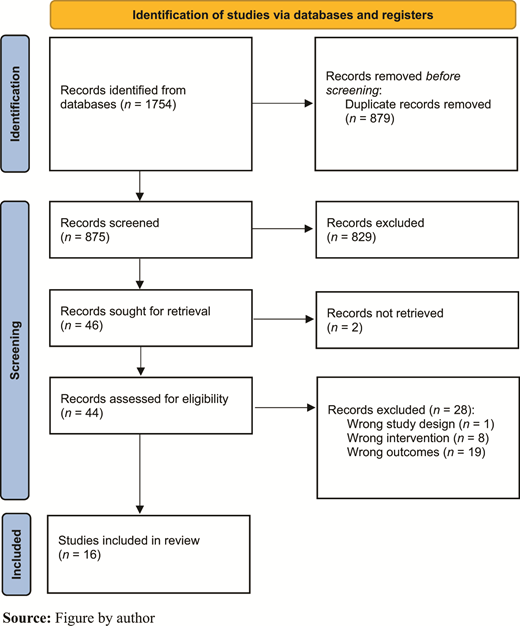
An initial search of the empirical literature identified 1,754 records (see Figure 1). Following removal of 879 duplicates, we screened 875 papers on title and abstract and excluded 829 irrelevant papers based on eligibility criteria. Two papers were inaccessible. The full texts of the remaining 44 papers were screened; 28 papers were excluded as they were either the incorrect study design (n = 1), focused on an intervention unrelated to media (n = 8) or did not focus on help-seeking behaviours (n = 19). No records were identified from reference list checks. Cohen’s Kappa for both title and abstract screening and full-text screening was 0.6, indicating good agreement. A total of 16 studies were included in this review.
Study characteristics
There were six quasi-experimental studies, four RCTs, two cross-sectional studies, two mixed methods studies, one pretest-posttest study, one qualitative descriptive study. Participants included community samples, women in the postnatal period, mental health service users, government organization employees, primary school students and secondary school students. Studies were conducted in Australia (n = 4), the USA (n = 4), the UK (n = 3), India (n = 3), Germany (n = 1) and Denmark (n = 1). Sample sizes ranged from 11 (Jansen et al., 2015) to 584,157 (Sugg et al., 2019). For those studies focusing on specific media interventions, six did not report on the language in which the intervention was presented; two focused on English language interventions, one addressed a bi-lingual (English and Spanish) intervention, while two studies reported on multi-lingual (English, Arabic, German; Hindi, Assamese, Gujarati and Telugu) interventions. In ten studies, participants were exposed to a media intervention in their own homes or communities as part of their regular routine; the remaining six studies focused on researcher-developed media-based interventions that were delivered in a more formal manner. Study characteristics are presented in full in Table 1.
Data extraction table
| Author(s) (year); country | Aim of study | Study design | Sample and setting | Intervention (media) description | Data collection process | Key outcomes | Key outcome measures | Key findings |
|---|---|---|---|---|---|---|---|---|
| Barker et al. (1993); United Kingdom (UK) | To explore the kinds of outcomes feasible for media-based interventions and how these outcomes relate to factors in the target audience | Pretest-posttest design | Representative national UK sample (adults) Pre-series N = 1,040 Post-series N = 544 | You in Mind, a series of seven 10 min television programmes on mental health, broadcast in 1987 | Pre-series surveys were collected as part of a regular process conducted by the Broadcasting Research Department of the BBC Post-series surveys were sent by post after 12 months | The decision to joining a self-help group. Engaging in help-seeking behaviours | Author-developed questionnaire. Yes/no responses: “Joined a self-help group”, “Attended classes or workshops” and “Sought professional help for your problem” | Three (6%) people sought professional help for their problems Two people (4%) rang the Samaritans |
| Birnbaum et al. (2017); United States of America (USA) | To explore how one might take advantage of Google AdWords to reach prospective patients with early psychosis | Quasi-experimental | The campaign ran in New York City for 14 weeks between April 11 and 18 July 2016. Ads were clicked 4,350 times, representing 3,257 users | Website with links to Northwell Health’s Early Treatment Programme | Recorded the number of clicks on links | The decision to seek help from Northwell Health’s Early Treatment Programme | The number of clicks to Northwell Health’s Early Treatment Programme | Fifty-seven (1%) of the sample directly contacted the Early Treatment Programme. Others obtained specific information/education around psychosis (n = 1,918; 44%) or completed a psychosis self-screener (n = 671; 15%) |
| Buist et al. (2007); Australia | “To assess the impact that education through participation in a depression screening programme has on mental health literacy and help-seeking behaviour in perinatal women” (p. 49) | Quasi-experimental | A total of 1,309 women in the postnatal period. The first group (n = 414) did not receive an educational booklet and were not screened for depression. Participants in the second group (n = 895) received the booklet and were screened for depression | An educational booklet: “Emotional Health in Pregnancy and Early Parenthood”. The booklet described symptoms of depression and when to get help, tips on things that will help and where to get help | An author-developed questionnaire: The Survey of Services Used questionnaire. This questionnaire included questions “relating to basic demographic information, problems during pregnancy, adequacy of support, any additional help sought, feelings of ante- or postnatal depression and anxiety, treatment sought for depression and perceived satisfaction with the treatment received” (p. 51) Participants were also asked about their perceptions of the educational booklet | Help-seeking behaviours in the perinatal period | Questions relating to help-seeking in The Survey of Services Used questionnaire | A significantly smaller percentage (p < 0.0001) of women who did not receive the booklet (n = 382; 43%) sought help, compared with those in the experimental group (n = 267; 65%) |
| Claassen et al. (2011); USA | To examine “emergency psychiatric treatment-seeking patterns following media exposure to four national terrorist or mass casualty events” (p. 287) | Quasi-experimental | Publicly funded emergency mental health facility in a large Southwestern (US) city. Visit rates per 1,000 Dallas citizens were analysed. Data for a 181-day window, including 90 days before and after each disaster, were used in analysis | Media events were included if they precipitated local front-page headlines (in Dallas Morning News – an English language paper) for more than five consecutive days and if emergency service psychiatrists identified them as specifically precipitating help-seeking in the study hospital. Four events qualified: the Oklahoma City bombing (1995), the Columbine High School (1999) and Wedgewood Baptist Church (1999) shootings and the terrorist attacks of 11 September 2001 | Data were taken from an administrative database created via structured medical record review | Overall visit rates at a mental health facility. Rates of anxiety-related visits were also examined | An interrupted time-series design was adopted. “The Ljung–Box test was used to detect significant visit patterning in the time-period around each disaster. Fluctuations in overall census and anxiety-related daily presentation rates during post-disaster weeks were fit using Autoregressive Integrated Moving Average modelling” (p. 289) | Overall, few significant deviations from pre-event patterns were observable during the week after any disaster. “No significant differences in pre–post disaster aggregated seven-day visit rates were observable for any of the four events. However, uniform, non-significant drops in visit volume were noted in aggregated three-day models and the four-disaster combined model showed a significant overall drop-in visit rate for this three-day post-disaster time-period compared to rates for the corresponding pre-disaster days” (p. 290) (p = 0.006). The three-event combined-event model; however, showed a significant increase in anxiety-related visits (t = 5.17; P = 0.006) for this time period. No significant relationship was found between intensity of local media coverage and rate of overall emergency mental health help-seeking or for anxiety-related visits |
| Collins et al. (2019); USA | “To understand the processes involved in effective social marketing of mental health treatment” (p. S228) | Quasi-experimental | California adults (n = 1,954) experiencing symptoms of probable mental illness surveyed between 2014 and 2016 during a major stigma reduction campaign | A state-wide English and Spanish media campaign focusing on mental health education and fostering contact, using in-person or video-based strategies | Data were collected using the information from those who took part in either the 2014 or 2016 California Well-Being Survey | Perceiving a need for help and help-seeking behaviours | Telephone interviews were conducted with participants. Mental health service use was assessed by asking respondents whether they had seen a health-care practitioner for problems with their mental or emotional health in the past 12 months | There was a significant positive association between campaign exposure and service use (odds ratio [OR] = 1.82; 95% CI = 1.17, 2.83), with 47.09% of those exposed to the campaign seeking help, compared with 36.39% of people not exposed to the campaign |
| Denkinger et al. (2022); Germany | To evaluate the feasibility and acceptance of a short film on help-seeking for mental health | Mixed methods | Recruitment took place in Germany; 134 participants (refugees) took part in the study | A 10-min psycho-educational short film: “Coping with Flight and Trauma”, featuring characters from refugee’s backgrounds, in addition to psycho-therapists providing information about psychotherapy. The film was presented in English, Arabic and German | Participants were asked to complete online surveys, pre- and post-intervention. Participants were then invited to take part in a telephone interview. A follow-up survey was sent after three months | Attendance at psycho-therapy | Participants were provided with a survey comprising ten statements on changes to help-seeking behaviours post-intervention | Ten participants (11.9%) started looking for a psychotherapist and nine participants (10.7%) actually started psychotherapy |
| Gaiha et al. (2014); India | To examine “the impact of a multi-state community-based awareness campaign on knowledge, attitude, treatment-seeking behaviour and acceptability” (p. 814) | Quasi-experimental | A community sample of approximately 3,000 persons in four states and a Union Territory in India comprising 20 locations | Four activities: dissemination of educational materials; Public meetings; Street plays (Aisa Bhi Hota Hai), including neighbourhood engagement through musical announcements and quizzes; and Mental health screening services. Activities were presented in Hindi, Assamese, Gujarati and Telugu | Data were collected by the researchers at the mental health screening service sites | Attendance at local mental health services | The number of people attending screening services was counted | Post-intervention, 1,176 persons sought treatment services for mental disorders and 66% (n = 777) received a preliminary diagnosis |
| Goyal et al. (2021); India | “To understand help-seeking processes, barriers and facilitators to help-seeking and the implications these have for mental health practice and referrals for treatment from the patient’s perspective” (p. 2) | Cross-sectional study | The sample consisted of 63 treatment seeking adults with a psychiatric diagnosis “recruited from outpatient mental health services of a tertiary centre in Southern India” (p.2) | N/A | Participants were interviewed about their help-seeking experiences | Factors that influence help-seeking for mental health concerns | Participants were asked questions about sources of information that influenced the decision to seek help | The primary source of information sought for available mental health services was media (95%; n = 61). The second most common source was family/relatives (32.8%; n = 21) |
| Griffiths et al. (2016); Australia | To report on the effectiveness of Mental Health Guru (MH-Guru), a two-module online mental health workplace induction programme | Two-armed randomized controlled trial | Participants were 507 employees from a large Australian multi-department government organisation | MH-Guru is an online psychoeducation workplace induction programme focusing on depression and generalized anxiety disorder. The programme is presented in a simple multi-media, interactive format containing graphics and video vignettes. Participants were assigned either to the online MH-Guru intervention or a wait-list control group | Participants completed online surveys on depression and anxiety literacy, personal stigma about depression and anxiety and help-seeking intentions for anxiety and depression at post-test, help-seeking attitudes and self-reported help-seeking behaviour. These were collected at baseline, one-week post-intervention and at six-month follow-up. However, due to an error in the wording of a question, the six-month data on help-seeking were not analysed | Self-reported help-seeking behaviour | The following question was included in the survey: “In the last two weeks, have you sought information or treatment for depression or anxiety” (p. 31) | The intervention group were more likely to seek help than the control group for depression (p = 0.024) and anxiety (p = 0.026). However, when data were reanalysed excluding help-seeking from the internet, statistical significance was not reached for depression (p = 0.07) or anxiety (p = 0.34) |
| Hay et al. (2007); Australia | To test the health benefits of a brief mental health literacy for eating disorders intervention | Randomized controlled trial | A community-based sample comprising 122 women with eating disorder symptoms | The intervention comprised information “about efficacious treatments, reputable self-help books and where to go for further information and/or services” (p. 316). The control group were provided with information about local mental health services only | Postal survey | Help-seeking for an eating disorder | Help-seeking was assessed with a self-report questionnaire. A list of interventions was provided and “respondents were asked to indicate which of these they had tried ever (at baseline) and during the past six-months” (p. 319) | There was a significant increase in help-seeking for problem eating over the 12 months from 12 (9.8%) at baseline to 42 (34%) at 12 months (P = 0.024) |
| Jansen et al. (2015); Denmark | “To describe service users’ perspectives on helpful and unhelpful aspects in their pathway to care” (p. 84) | Qualitative descriptive | Eleven service users enrolled in Opus, a specialized early psychosis treatment service | N/A | Individual interviews | The decision to access mental health care | Responses to qualitative interview questions | Four participants used the internet to gain knowledge about access. One participant stated: “I had just looked up the psychiatric emergency ward on the Internet … and I just went up there since I was in the area” (p. 88) |
| Mellotte et al. (2017); UK | “To understand more about the barriers that prevent veterans from seeking professional help and the enablers that assist veterans in seeking professional help” | Mixed methods | Participants (n = 18) were recruited from two specialist mental health services for veterans located in the South East of England | N/A | Qualitative data were collected through individual interviews | Help-seeking behaviours | Responses to qualitative interview questions | Nine participants found that media, including internet searches, leaflets, television programmes and magazine stories, helped them to identify where to go to seek help |
| Parikh et al. (2021); India | To evaluate “evaluated a classroom-based sensitisation intervention that was designed to reduce demand-side barriers affecting referrals to a school counselling programme” | A stepped-wedge cluster randomized controlled trial | Seventy classes in six secondary schools in New Delhi, India. The intervention group comprised 35 classes (average class size:53.1). The control group comprised 35 classes (average class size: 49.4) | Intervention group: “Classroom sensitisation session involving a brief video presentation and moderated group discussion” Control group: whole-school sensitisation (teacher-meetings and whole-school activities, including poster displays) | Researchers were responsible for processing referrals and conducting mental health assessments for the current and the host trial | Referral and self-referral proportions | Referred into the host trial of the first-step problem-solving intervention through three routes: self-referral by meeting a counsellor/researcher personally; depositing a referral slip in a drop-box; or referral by a teacher | A significantly higher proportion of students who completed a classroom sensitisation session (which involved a brief video presentation and moderated group discussion) were referred in each trial condition compared to those who completed whole-school sensitisation (teacher-meetings and whole-school activities such as poster displays. (Intervention group = 21.7%, control group = 1.5%, OR = 111.36, 95% CI 35.56 to 348.77, p < 0.001). The proportion of self-referred participants was also higher in the intervention group (98.1%) than the control group (89.1%) (p < 0.001) |
| Reavley et al. (2011); Australia | “To examine the associations between the use of information sources and professional help-seeking” (p. 1267) | Cross-sectional study | “The survey sample comprised 8,841 residents of private dwellings across Australia” (p. 1267) | Use of “the internet, fiction book (story), non-fiction book (factual account), newspaper or magazine, television, radio, pamphlet/leaflet/brochure, or other (which could be specified” (p.1268) | Survey interviews were carried out with respondents randomly selected from a stratified, multi-stage area probability sample of households | Professional help-seeking | Respondents were asked if they had accessed mental health information from “the internet, fiction book (story), non-fiction book (factual account), newspaper or magazine, television, radio, pamphlet/leaflet/ brochure or other (which could be specified” (p. 1268) in the past 12 months. Respondents were also asked if they had had consultations with general practitioners, psychiatrists, psychologists, mental health nurses, social workers, counsellors, or occupational therapists or any mental health service use | Respondents who had sought help for their mental health the past 12 months were more likely to get information from all sources except radio, including the internet, non-fiction books, pamphlets/leaflets/brochures (P < 0.001), television (P < 0.01) and newspapers/ magazines (P < 0.05) |
| Sharpe et al. (2017); UK | To assess the impact of a mental health booklet on help-seeking behaviours | Cluster randomized controlled trial | Participants were students from primary to secondary schools in England. Schools received both Targeted Mental Health in Schools (TaMHS) (funding and support) “and booklets (TaMHS + booklets, 162 schools) just TaMHS (TaMHS only, 162 schools) just booklets (Booklets only, 76 schools) and neither TaMHS nor booklets (No intervention, 77 schools)” (p. 317) | Two booklets were created: “How to Get Up and Go When You’re Feeling Low” (aimed at young people aged 8–11) and “I Gotta Feeling” (aimed at young people aged 11–14) | Pre- and post-surveys were completed using a secure online system | Help-seeking from a counsellor, peer mentor or another source in school | Participants were shown five booklets post-intervention and asked if they had seen them. Booklets comprised the two intervention booklets, two genuine booklets not distributed by the research team and one sham booklet. Help-seeking was assessed post-intervention, with participants asked if they had sought help from a counsellor, peer mentor or another source in school. Responses were measured on a four-point scale, from never to more than five times | There was no significant relationship between booklet uptake and mental health service use |
| Sugg et al. (2019); USA | To explore help-seeking patterns in young people following the release of 13 Reasons Why Season 2 and the deaths (by suicide) | Quasi-experimental study | National sample. A total of 584,157 participants’ data were collected | The release of 13 reasons Why, a popular English language fictional Netflix show that grapples with adolescent suicide | Anonymized crisis text line data were obtained from January 20 to 31 October 2018 | Use of a national crisis text service | Daily counts of crisis text usage | Crisis conversation volume was 42% higher after the release of 13 Reasons Why Season 2 for six of the 18 days of the study period |
Quality assessment
While blinding of participants was only conducted in one study (Parihk et al., 2021), all RCT studies met the criteria for inclusion. For both cross-sectional studies, confounding factors were not addressed. Although all seven quasi-experimental and pretest-posttest studies clearly stated the “cause” and “effect”, none of the studies included comparison groups who received similar care or treatment other than the exposure or intervention of interest. Furthermore, none of these studies had multiple outcome measurements for both pre- and post-intervention and only one study (Buist et al., 2007) included a control group. In one mixed method study, measures were not taken to effectively integrate and interpret the qualitative and quantitative components and results. Despite some limitations, no study was excluded as a result of critical appraisal.
TV and video-based media
Six studies reported on TV/video as influences, used as part of mass media campaigns or researcher-developed interventions. In Barker et al.’s (1993) pretest-posttest study, a series of seven 10-min national television programmes on mental health (You in Mind) were broadcast. The intervention did not have a significant impact of professional help-seeking, with only three participants (6%) of the 544 surveyed general public seeking professional help and only two participants (4%) ringing the Samaritans. More recently, in a quasi-experimental study, Sugg et al. (2019) evaluated the impact of the release of a TV show (13 Reasons Why: Season 2) on young people’s help-seeking patterns using a national sample. Use of a national crisis text line was 42% higher after the release of the TV show for six of the 18 days following its release. In an RCT study, Parikh et al. (2021) explored the effect of a classroom sensitization session on secondary school students’ help-seeking behaviours; this consisted of a brief video presentation and group discussion. As a control, a “whole school approach” to mental health was adopted (including activities such as teacher meetings). A significantly higher number of those in the intervention group (98.1%) sought help compared to those in the control group (89.1%) (p < 0.001). In Griffiths et al.’s (2016) RCT study, a psychoeducation workplace induction programme focusing on depression and generalized anxiety disorder (MH-Guru) was implemented for 507 employees from a large Australian multi-department government organisation. The intervention was interactive and included video vignettes. A wait-list control group was used. Although the intervention group were significantly more likely to seek help than the control group for depression (p = 0.024) and anxiety (p = 0.026), when help-seeking from the internet was excluded from analysis, significance was not reached for depression (p = 0.07) or anxiety (p = 0.34). Video-based strategies were also used as part of a state-wide media campaign in Collins’ et al. (2019) quasi-experimental study. Service use was significantly higher for those exposed to the campaign (47.09%) than those not exposed (36.39%) (Odds ratio = 1.82; 95% confidence interval = 1.17, 2.83). In Denkinger et al.’s (2022) mixed-methods study, the short video encouraged ten participants (11.9%) to start looking for a psychotherapist; a further nine (10.7) had actually started psychotherapy.
Print media
Four papers reported on print media, three of which focused on researcher-developed educational booklets and one of which focused on mass media (newspaper). In a quasi-experimental study, Buist et al. (2007) provided an educational booklet (“Emotional Health in Pregnancy and Early Parenthood”) to 895 women in the postnatal period; 414 women in the postnatal period were not provided with the booklet. This booklet provided information on depression and help-seeking resources. Significantly (p < 0.0001), more women in the intervention group (n = 267; 65%) sought help compared to those in the control group (n = 382; 43%). Educational booklets were also used in Hay et al.’s (2007) RCT study. A community-based sample, comprising 122 women with eating disorder symptoms, were given self-help books and information about mental health services. There was a significant increase observed in help-seeking for problem eating over the 12-month period: from 12 participants (9.8%) at baseline to 42 participants (34%) at 12-months (p = 0.024). Educational booklets had less of an impact on primary and secondary school students in Sharpe et al.’s (2017) RCT study. The authors used two booklets for different age groups: “How to Get Up and Go When You’re Feeling Low” (for those aged 8–11 years) and “I Gotta Feeling” (for those aged 11–14 years). There was no significant relationship found between booklet uptake and mental health service use. In a quasi-experimental study, Claassen et al. (2011) examined the relationship between local front-page newspaper headlines about four national terrorist or mass casualty events and emergency psychiatric help-seeking patterns. Overall, there were no significant differences in pre–post disaster aggregated seven-day visit rates for overall psychiatric emergency services for any of the four events. Help-seeking for anxiety-related issues, specifically, was non-significant following each event; however, this became significant (t = 5.17; P = 0.006) when the analysis was based on all four disasters combined. The authors also found that the intensity of local media coverage did not affect help-seeking behaviours.
Online media
In a quasi-experimental study, Birnbaum et al. (2017) explored the use of Google AdWords in encouraging people with early psychosis to click on a website link to an early treatment programme. The intervention ran in New York City for 14 weeks. Ads were clicked 4,350 times, representing 3,257 users. While only 57 (1%) people directly contacted the early treatment programme, 1,918 (44%) obtained specific information/education around psychosis and 671 (15%) completed a psychosis self-screener. In Jansen et al.’s (2015) qualitative descriptive study, four out of 11 participants (36%) enrolled in a specialized early psychosis treatment service (Opus) reported that they had used the internet to gain knowledge about accessing the service.
Theatre
Only one study addressed the impact of theatre on help-seeking. In a quasi-experimental study (Gaiha et al., 2021), approximately 3,000 members of a community sample were exposed to educational materials, public meetings and street plays. Following these activities, it was reported that 1,176 people (39%) sought help from professional mental health services, with 66% (n = 777) receiving a preliminary diagnosis.
Media in general as an influence
In two cross-sectional studies (Reavley et al., 2011; Goyal et al., 2021) and a mixed methods study (Mellotte et al., 2017), a specific media intervention was not examined; instead, participants were asked more open questions about what influenced their mental health seeking behaviours. Goyal et al. (2021) explored sources of information that influenced 63 mental health service outpatients’ decisions to seek help. The primary source of information sought was “media” (95%; n = 61). Of note, there was a large gap between this source and the second source, family/relatives (32.8%; n = 21). Similarly, 50% (n = 9) of participants (veterans) in Mellotte et al.’s (2017) study cited “media” – including internet searches, leaflets, television programmes and magazine stories – as an influence on how to seek professional help. Respondents to Reavley et al.’s (2011) study who had used mental health services in the past 12 months were more likely to get information from all sources except radio, including the internet, non-fiction books, pamphlets/leaflets/brochures (P < 0.001), television (P < 0.01) and newspapers/magazines (P < 0.05). However, it should be noted that unlike Mellotte et al. (2017) and Goyal et al. (2021), these respondents did not explicitly cite media as an influence on their decision to seek help.
Discussion
The aim of this systematic review was to identify if media content plays a role in people’s decisions to seek help for their mental health. Some caution is warranted regarding the interpretation of results. Only one study reported effect sizes (Griffiths et al., 2016). Several studies used designs where the impact of media could not be sufficiently measured, with confounding factors not identified (Barker et al., 1993; Claassen et al., 2011; Gaiha et al., 2021; Collins et al., 2019), while other studies included interventions comprising multiple components in addition to media (such as group discussions) (Giffiths et al., 2016; Parikh et al., 2021). Consequently, it was not always possible to isolate media as an influence, particularly where larger general public samples were included. Furthermore, the available evidence is heterogenous in terms of study designs, illnesses considered, study settings and samples included. There is a need to develop a specific research focus around mental health help-seeking and media to present a more consistent evidence base. When reporting findings, it is important that effect sizes are described, as this will facilitate an understanding of the relevance of effects and will help to determine the sample sizes of follow-up studies (Aarts et al., 2014). Transparent effect size reporting will also enable robust analyses of the impact of entertainment media received in domestic settings compared with researcher-developed interventions delivered in settings such as the workplace or in clinical environments.
However, overall, the evidence suggests that various forms of media can positively influence help-seeking. Despite a wealth of evidence to suggest that media negatively influences attitudes towards help-seeking for mental illness (Burke et al., 2008; Chisholm et al., 2018), we did not find any evidence to suggest that help-seeking is impeded as a result of media influence. It should be noted that the studies included within this review aimed to identify positive sources of influence on help-seeking; further research is warranted to explore if media influences negative attitudes about help-seeking translates into avoidant behaviours.
Despite limitations in research designs, the available evidence suggests that video-based interventions can encourage people to seek help for their mental health. There is a wealth of evidence to support the use of such interventions in challenging stigma and improving attitudes towards help-seeking (Ibrahim et al., 2020; Goodwin et al., 2021). The current review indicates that the potency of video-based interventions may extend beyond the influence on attitudes and might have the potential to encourage people to access professional help; we recommend that further research is conducted to support their use. Given the fact that people who experience mental health problems do not often seek help (Doll et al., 2021; Giffiths et al., 2016), there is a need to develop appropriate interventions to enhance help-seeking behaviours. The findings of the current review indicate that there may be potential for the use of video-based interventions in this area.
Print media, on the other hand, had little impact on help-seeking behaviours, particularly for young people (Sharpe et al., 2017). There was, however, some limited evidence to suggest that print media can encourage women to seek help in the postnatal period (Buist et al., 2007). Several studies have concluded that print media has a weak impact on attitudes towards mental health when compared to other forms, such as film/TV (Gaiha et al., 2014; Ni et al., 2014). Despite this, print media continues to be widely used as the primary method to disseminate information about mental health to the general public (Health Service Executive, 2018; Latha et al., 2020; Mental Health Foundation, 2021). Perhaps this continued use of traditional media owes to a lack of awareness about other modes of education and dissemination. To maximize help-seeking, it is paramount that education about mental health is communicated in the most appropriate and impactful of methods.
One such method is the use of online resources. The current review indicated that there is some limited evidence that the use of the internet can encourage people to seek help for mental distress. It is well-known that people enjoy a sense of anonymity when seeking information online and interacting with others in virtual environments (Blackburn et al., 2021; Deng et al., 2021). Given that help-seeking behaviours are often impeded as a result of stigma (Doll et al., 2021; Van der Burgt et al., 2021), online strategies and their associated anonymity should be considered when promoting help-seeking.
Only three studies indicated that interventions used were available in languages other than English. Excluding speakers of other languages from engaging in media-based mental health education has been cited as a reason why some population groups – such as Latinx – demonstrate low use of mental health services (Du Pont-Reyes et al., 2020; Du Pont-Reyes, 2022). When developing future media-based interventions, a more inclusive stance needs to be taken, and a diverse sample needs to be targeted.
This review has limitations. We only included published peer-reviewed literature. It is possible that many more studies reporting on the relationship between media and mental health help-seeking have been reported on through the greater literature. The wide heterogeneity of included studies can also be considered a limitation, as this only enabled us to make broad generalisations. Furthermore, included studies did not account for confounding factors.
Conclusion
The findings from this systematic review indicate that media inventions explored, such as video and online resources, may encourage people to seek help for mental distress. However, owing to limitations in research design, including inadequate controlling of confounding factors, small sample sizes, a failure to report effect sizes and a lack of control groups, these results should be interpreted with caution.
Despite the influence of media content on negative attitudes towards mental illness, no evidence was found to support the relationship between the potential for media to actively discourage people from seeking help; further research in this area is warranted. Such research should explore the impact of commercialized media on decisions to both seek and avoid seeking help, and the impact of researcher-designed media on enhancing help-seeking.
It is recommended that future research assessing the impact of media on help-seeking for mental illness adopts more robust methodologies, ensuring that confounding factors are controlled and larger sample sizes are used. Moreover, further qualitative research is warranted to obtain a more nuanced understanding of how media impacts the general public’s decision to seek help for mental illness.
Funding statement: This research received no specific grant from any funding agency, commercial or not-for-profit sectors.
Conflicts of interest: None to declare.

