The life and work of Carl Gustav Jung (1875–1961) have been described, analysed and interpreted many times, and several psychobiographical accounts have been written about him and his work. This psychobiographical study, however, aims at exploring his development based on Loevinger’s (1966, 1979) developmental stages.
The research methodology is qualitative and uses a hermeneutical interpretative research approach to psychobiography. Jung was purposefully sampled based on his extraordinary life as a psychiatrist. In the study, the authors collected primary and secondary data on Jung from the public domain and analysed the data through content analysis. Qualitative quality criteria were applied; ethical considerations were highlighted and limitations outlined.
Jung’s life developed through the stages of ego development until the integrative stage, which very few individuals usually reach. The integrative stage was strongly influenced by meaning-making and integration through intra-personal growth and development.
The study uses a psychobiographical single case study approach and cannot be generalised. It also contributes only very specific aspects of Jung’s life.
The psychobiography provides insights into C. G. Jung’s life through the application of Loevinger’s development theory.
This psychobiography is of value to individuals who are interested in the life of Carl Gustav Jung as well as in Loevinger’s stages of ego development.
As healthy development unfolds, autonomy, freedom, tolerance for difference and ambiguity, as well as flexibility, self-awareness, and skill in interacting with the environment increase while defences decrease. -Susanne Cook-Greuter.
1. Introduction
The year 2025 marked the 150th anniversary of the birth of Carl Gustav Jung, one of the most famous and influential psychiatrists of the 20th century (Parks, 2025; Bair, 2003; Goddemeier, 2011; Holt, 1980; Schaeppi, 2025). Jung was born on 26 July 1875 in Kesswill, Switzerland, and he died on 6 June 1961 in Küsnacht at Lake Zürich, Switzerland (Goddemeier, 2011). His family came originally from Mainz in Germany and left for Switzerland due to his grandfather’s profession as a medical doctor who was called to the University of Basel (Goddemeier, 2011; Schaeppi, 2025).
Jung studied medicine in Basel, Switzerland, from 1895, and he began working at a psychiatric hospital in 1900 as an assistant to the highly influential psychiatrist Eugen Bleuler (Ashok et al., 2012; Schaeppi, 2025). He gained his doctoral degree in 1902 (Goddemeier, 2011) and decided to become a psychiatrist, based on his deep interest in psychology, psychiatry and the spiritual, by unifying his biological and psychological knowledge (Fordham and Fordham, 2026).
In the past, there have been different approaches to Jung through psychobiography (Atwood and Stolorow, 1993; Holt, 1980; Runyan, 1996; Elms, 2005; Kőváry, 2015). In 1996, Runyan, one of the extraordinary pioneers in psychobiography, wrote about Carl Gustav Jung from a psychobiographical perspective. In 2005, Alan Elms, another pioneer in psychobiography, published an overview of more than 40 life histories which had been written about Jung, including autobiographies, hagiographies and pathographies, in addition to professional, intellectual, illustrated and religious biographies and joint Jung/Freud biographies (Elms, 2005). Besides that, Holt (1980) presented a psychobiography of Jung’s adult development from a theoretical Levinson perspective, and Kőváry published a psychobiographical account of Jung’s dream on Siegfried in 2015 (Kőváry, 2015). Recently, Atwood and Stolorow (1993) explored psychobiographical inquiry and emotional phenomenology as a generative unity through the exploration of Jung’s life, while in the 1990s, Atwood and Stolorow (1993) explored “the subjective world in Jung’s theory”. Winnicott (1964) analysed Jung’s autobiography shortly after his death, and Sedgwick (2008) explored Winnicott’s analysis of Jung, counter-arguing Winnicott’s viewpoints. Others have written extensively on Jung and his theoretical explorations (e.g. Papadopoulos, 1992), not necessarily from a psychobiographical perspective, but exploring the interrelationships of his life and his work (e.g. Fordham, 1975; Gaillard, 2003; Meredith-Owen, 2011; Saban, 2016; Shamdasani, 1995).
The question of how an extraordinary life develops has been of interest to many scholars. In 1931, Jung himself wrote an essay titled “The Stages of Life” (Jung, 1960), although he did not formulate a specific stage theory, as did Freud and Erikson (Armstrong, 2020). According to Murphy (2023), ego development theories focus on the dynamic development of the individual in their context, in which ego development is the process of developing a personality in this context. Ego development explores the process of growth and maturation across the lifespan while responding to the environment and developing an understanding of one’s own identity, abilities and role in the world (Murphy, 2023). The construct of the ego encompasses various processes, including cognitive and perceptual functions, as well as defense mechanisms and executive operations (Hauser, 2001) which operate on different levels of consciousness (Vaillant, 1998). According to Murphy (2023):
Ego development is a conceptual model to understand the progressive change of the personality in response to life experiences. The development encompasses forming of identity, expanding consciousness and individual ways for understanding and adapting to reality.
Healthy development of an individual takes place when the ego develops by integrating the changes that occur in all areas of life (Murphy, 2023). Furthermore, a mature ego development leads an individual to process and integrate the complexities of life, encouraging meaning-making and a complex understanding of the experiences in the world, as well as an appreciation of self and others (Loevinger, 1966). According to Erikson (1994), an individual needs to develop their own way through an ego synthesis which needs to be part of their life plan. The ego aims at mastering and integrating continuous experiences while making sense of them and reacting to external stimuli constantly (Loevinger, 1966). Consequently, healthy ego development is based on the inclusivity of others while integrating a theory of mind (Horney, 1991) and balancing personal autonomy with the capacity for inclusivity of others (Loevinger, 1966). Healthy ego development can further support the adaptation of defence mechanisms which are viewed as significant pathways to respond to stimuli during life (Vaillant, 1998; Loevinger, 1966). Ego development models consider the “collection of ego mechanisms, while the other model emphasises the centrality of a single ego process, comprising integrative activities”, such as thoughts, feelings, present and past ideas (Hauser, 1976, 2001). According to Hauser (1980), healthy ego development can either derive from the collection model of ego development, which includes adaptive strengths, cognitive processes, defences and perceptions of others, or from integrative or synthetic processes (Hauser, 2001; Loevinger, 1976a; 1976b; Hy and Loevinger, 1996; Loevinger and Blasi, 1976). Studies have focused on connecting ego development with individual behaviour and experience. For example, Loevinger’s (1976a, 1976b) model assumes that individuals find themselves in a continuum of developing the ego with regard to the self and the world, which again is connected to the perception of the self in the world, the social world of the ego and the relationship with regard to one’s feelings and thoughts (Armstrong, 2020; Candee, 1994).
In the following sections, the background, aims and purpose of this research article are discussed, with a presentation of Loevinger’s (1966, 1976a, 1976b) theory of ego development, the psychobiographical research methodology and the findings and discussion of ego development in Jung’s life.
2. The background, aims and purpose of this research
The researchers of this study support Runyan (1996) and his assumption that it is particularly important to understand the lives of psychologists to improve the understanding of their personal and theoretical development. According to Kőváry (2011), psychobiography can be used as an instrument to improve the understanding of self-awareness, human functioning and the human mind. In this article, the authors explore the life of Carl Gustav Jung and his ego development through the perspective of Jane Loevinger’s (1966, 1976a, 1976b) stages of ego development since there is a “rich and eclectic complexity to the integrative framework of Loevinger” (Broughton and Zahaykevich, 1988, p. 180).
Historically, developmental psychology focused primarily on children and adolescents. Only in recent decades has there been a serious inquiry into adult and lifelong psychological growth (Burman, 2016; Carr, 2025; Hoare, 2006; Kegan, 1982). This study consists of a psychobiography of Jung from the viewpoint of ego development theory to explore his ego development across his lifetime. Ego development is here defined as the maturation of an individual’s ability to organise their experiences, values and emotions, which emphasises openness, complex thinking, tolerance and objectivity throughout adulthood (Cook-Greuter, 2014; Hauser, 2001). It is influenced by contextual factors and is related to individual differences in adaptation and well-being.
The researchers explore ego development in Jung’s life using the ego development theory of Loevinger (1966, 1976a, 1976b, 1979, 1985, 1997), who merged the psychodynamic ego development model with cognitive and moral stage development models (Loevinger, 1976a, 1976b; Hopwood, 2025). Jung’s life has not yet been explored through Loevinger’s (1966, 1976a, 1976b) ego development theory. The following assumptions led to the choice of this theory:
It provides a structured approach and systematic framework to explore ego maturation across Jung’s lifetime from a holistic, positive and growth-orientated perspective.
Through Loevinger’s (1976a, 1976b, 1979, 1997) ego development theory, the understanding of Jung’s life and inner psychological development in the context of his life experiences and developments can be understood in depth.
The theory might help to bridge the understanding of the inner subjective experience of Jung and his symbolic production, such as his writings, dreams and self-reflections during his individuation process.
Finally, it is viewed as providing a theoretical approach to selected nuances of Jung’s ego development and the illumination that Jung’s personal crises and conflicts supported his development towards growth, creativity, innovation and mental health.
Based on the chosen approach, the overall research question is: “How does Jung’s life develop based on the ego development perspective of Loevinger?” In the following, the selected ego development theory is described, the research methodology outlined and the findings and discussion presented.
3. Ego development theory
One of the most influential lifespan frameworks for understanding psychological maturity, meaning-making and adaptive functioning is ego development theory (Loevinger, 1976a, 1976b; Hy and Loevinger, 1996). Ego development theory originally emerged from psychoanalytic tradition but has diverged toward cognitive–developmental perspectives (Hy and Loevinger, 1996). Loevinger’s stages have been described empirically (Hy and Loevinger, 1996). The theory of ego states theory recontextualises previous perceptions of the ego as a defensive structure and instead introduces ego as a system that organises perception, identity, interpersonal understanding and moral reasoning (Loevinger, 1976a, 1976b; Cook-Greuter, 2005). This developmental trajectory provides a valuable perspective through which the psychological life of Carl Gustav Jung can be examined, particularly in relation to mental health, symbolic meaning-making and identity transformation across adulthood.
Loevinger’s (1976a, 1976b) model remains a foundational one in ego development theory (Manners and Durkin, 2001; Mühlenbeck and Jacobsen, 2026; Osin et al., 2023; Westenberg et al., 2013) and practice (Binder, 2023; Peters, 2023; Pillay and April, 2022). Drawing from Sullivan’s interpersonal psychiatry and Erikson’s psychosocial stages, Loevinger conceptualised ego development as a sequence of qualitatively distinct stages, reflecting increasingly complex ways of interpreting the self and the social world (Loevinger, 1976a, 1976b; Hy and Loevinger, 1996). These stages are not rigid chronological markers, but developmental structures that shape how individuals experience conflict, identity, responsibility and emotional regulation (Loevinger, 1976a, 1976b; McAdams, 1985). Central to Loevinger’s framework is the idea that ego development reflects progressive differentiation and integration, meaning that individuals move from impulsive, externally controlled functioning toward autonomous, integrated and self-actualised modes of being (Loevinger, 1976a, 1976b).
Loevinger (1976a, 1976b, 1996) identified several core stages, these being the impulsive, self-protective, conformist, self-aware, conscientious, individualistic, autonomous and integrated stages (Loevinger, 1976a, 1976b; Hy and Loevinger, 1996). Early stages are characterised by egocentrism, rule-based morality and limited emotional insight. As development progresses, individuals demonstrate increasing self-reflection, tolerance for ambiguity, internalised standards and systemic thinking. Higher stages involve deep psychological integration, recognition of paradox and an expanded sense of identity that accommodates complexity and existential awareness (Table 1).
Mental health within this framework is not defined simply as an absence of symptoms but as the capacity to navigate and integrate contradictory and complex aspects of the self (Bonnett, 2016). Loevinger’s model (1966, 1976a, 1976b, 1997) therefore aligns with contemporary views of psychological well-being that emphasise resilience, coherence and adaptive meaning-making (Kam and Vriend Fluit, 2023; Osin et al., 2023). Ego maturity facilitates qualities such as flexible coping and interpersonal empathy (Hauser, 1976; Worth, 2022), qualities that are particularly relevant with regard to Jung’s lifelong engagement with inner conflict, symbolism and individuation (Anwar et al., 2024; Wong, 2025).
Cook-Greuter (1990–2011) expanded on Loevinger’s (1966) framework by refining later-stage development and emphasising meaning-making (Cook-Greuter, 2005). Cook-Greuter’s (2005) refinements build on Loevinger’s empirical base and highlight the emergence of self-transforming capacities in which identity became fluid, systemic awareness deepens, and individuals engage consciously with paradox and uncertainty (Cook-Greuter, 2005; Mubtaker, 2024). These post-autonomous stages involve metacognitive awareness, spiritual openness, and a recognition of psychological processes as evolving systems rather than fixed traits (Cook-Greuter, 2005).
Cook-Greuter’s work is relevant to Jung’s life because it situates psychological growth within a broader existential and spiritual context (Mühlenbeck, 2022). Higher ego stages are associated with contemplative awareness, symbolic cognition and integration of the shadow self, which are processes and behaviours that resonate strongly with Jungian individuation (Cook-Greuter, 2005; Mahaffey, 2026). Mental health at these levels reflects not only emotional stability but also an expanded capacity for existential meaning, self-transcendence, shadow integration and relational depth (Casement, 2025).
It is further assumed that progression is neither automatic nor universal. Development depends on life challenges, reflective capacity, social context and opportunities for self-examination (Manners and Durkin, 2001). Psychological crises, losses and transformative experiences may catalyse stage transitions by destabilising existing structures and requiring new modes of integration. This perspective aligns with Jung’s emphasis on confrontation with the unconscious as a catalyst for psychological renewal (Moraglia, 1994).
Empirical research supports ego development as a predictor of interpersonal competence, moral reasoning and psychological resilience (Manners and Durkin, 2001). Higher ego stages correlate with tolerance of ambiguity, emotional complexity and adaptive coping strategies (Helson and Roberts, 1994). These capacities suggest that ego development is deeply intertwined with mental health across the lifespan, particularly during adulthood when identity restructuring and existential questioning intensifies.
4. Research methodology
4.1 The research philosophy
The psychobiographical research methodology used is qualitative and hermeneutical–interpretative in nature, based on the Gadamerian research method (Alsaigh and Coyne, 2021; Fleming et al., 2003; Gadamer, 1960). The study is idiographic, referring to a subjective, meaningful approach which may not be generalised (Luthans and Davis, 1982) but is rich in understanding, meaning and descriptive language (Kafle, 2013). While using Gadamer’s philosophical underpinnings, this research is also interpretivist, based on cultural and historical interpretations which highlight the meaning in a certain sociocultural world (Alsaigh and Coyne, 2021; Crotty, 2000). Gadamer (1960) points out that, in hermeneutics, a dynamic dialogue with the text is understood through three aspects: the Vorverständnis (pre-understandings), the hermeneutic circle (revising of the Vorverständnis based on the engagement with the text), and the Horizontverschmelzung (fusion of horizons).
The researchers used Gadamer’s (1960) philosophy of hermeneutics when engaging with texts of and about Jung, discussing them using intersubjective validation and verification (Sousa, 2014) and through the dialogue with and about the text. Understanding is reached through an awareness of the researcher’s pre-assumptions and pre-understandings, the openness and Bildung (education and learning [Clark, 2008]) regarding meaning and change of meaning, the fusion of understanding included in the pre-understanding of text – and in this case, Jung’s writings and his life. The hermeneutic circle is the methodological approach in which the researchers gain understanding of the individual and his life, thereby revising previous understandings and new understandings of Jung’s life through the Horizontverschmelzung (Clark, 2008). The Horizontverschmelzung happened in this psychobiography not only between the researchers and text but also between both researchers, thereby creating an extended hermeneutic circle.
This research study further happens between cultures. Here, the cultures of the researchers in connection with their first language abilities (English, German, French) and their intersubjective perceptions (Chiu et al., 2010) are used to create a Horizontverschmelzung about Jung and his life’s developmental stages. It was therefore important that both researchers were able to consult texts in German, English and French.
4.2 Jung in psychobiography: sample and sampling
A psychobiography is presented which uses purposeful sampling (Palinkas et al., 2015) and a purposeful choice of theoretical and methodological application for the analysis of Jung’s ego development across his lifespan. Jung, as one of the most important psychiatrists of the 20th century, has been purposefully chosen as a subject in this psychobiography to increase the understanding of his development through his work and life. This is of primary importance since both of the researchers are (to become) psychologists.
4.3 Data collection and analysis
Jung’s publications are many and multifold. First, primary data and first-person accounts were used to understand his life’s ego development according to Loevinger (1976a, 1976b, 1979, 1997), such as his own works (e.g. Jung, 1869, 1968, 1976, 2003, 2010a, 2010b) as well as his autobiographical work (e.g. Jung, 1989, 2009, 2021; Jung and Jaffé, 2026). In addition, third-person publications were used, such as biographical accounts (e.g. SAP [The Society of Analytical Psychology], 2026; Schaeppi, 2025; Sedgwick, 2008; Winnicott, 1964) and interpretations of his life and work in previous psychobiographies (Kőváry, 2015). As according to Yin (2018), data was extracted, transformed and transferred for analysis.
4.4 Quality criteria, ethical considerations and limitations
The philosophical understanding was used to ensure quality criteria, such as rigour (Stenner et al., 2017), accepting that bias in research is unavoidable (Freshwater, 2005) and therefore is addressed through rigorous research and reflexivity. Ethical standards were used with regard to the American Psychological Association (APA, 2017) criteria and the code of conduct based on ethical principles of research in psychology (Baert, 2005). Ethical approval was provided by the University of Johannesburg, Johannesburg, South Africa. Code number: IPPM-2025-929.
This study was limited to one individual’s life, that of C.G. Jung, to selected theories and research methodology and to the hermeneutic interpretation of the two researchers and their understanding of Jung’s life and work. A further limit was the length restriction of the article imposed by the journal.
5. Findings and discussion
In this section, Jung’s life is presented according to its chronological development and analysed with regard to the Loevinger (1966, 1976a, 1976b, 1979, 1997) developmental stages. As a consequence of the vast amount of primary and secondary literature on Jung, this article could not take everything into consideration but provides only a small insight into his life-stage development. This offers a structured framework for interpreting Jung’s life narrative, which is influenced by early familial tensions, religious questioning, problems of self-realisation, his professional ruptures with Freud, and his prolonged engagement with inner imagery, all of which can be understood as developmental challenges requiring progressive ego restructuring (Jung, 1953; Shamdasani, 2012). Furthermore, his writings and personal reflections reveal increasing tolerance for ambiguity, symbolic thinking, and integrative awareness consistent with advanced ego functioning and the integration of Eastern and Western thought (Jung, 1953; Kelland, 2015).
5.1 C.G. Jung’s birth, childhood and teenage years: 1875–1895
C.G. Jung was born in Kesswil, Germany, and moved to Laufen at the Rhine Falls in 1876 and to Kleinhüningen, near Basel in Switzerland, in 1879 due to his father’s work opportunities (Jung, 1989; Wright, 1999). Jung (1989) points out that his earliest memories start around the age of two to three years. This period in his life might be described as the pre-social stage (Loevinger, 1966, 1979), in which Jung was still unaware of social norms and the impact of his actions. Rather than his own actions, his earliest memories of childhood describe actions of his father and an aunt who showed him nature and the mountains while his mother was away in hospital or recreation centres and being held by the maid (Jung, 1989). Jung highlighted later in his autobiography that his life was a story of “the self-realization of the unconscious” (Jung, 1989, p. 3), from the beginning to the end. He experienced a break of trust with his mother due to her time away and ascribed “reliability and powerlessness” to his father (Jung, 1989, p. 8). Further, he felt that he suffered during childhood, especially regarding experiences of parental conflict (Jung, 1989). However, Jung felt that the shadow sides of individuals push themselves to develop further and that they are a driving force for self-realisation and self-development (Kelland, 2015). At the same time, the shadow self may contain unmet needs and hidden desires of unconscious impulses which individuals project onto others if they do not deal with them consciously (Oppong, 2024).
Jung was the first surviving and fourth child born to a protestant father, Paul Achilles Jung (1842–1896), a pastor in the Swiss reformed church, and to “Emilie Preiswerk, his unhappy and unstable mother” (Bair, 2003, p. 7), who lived from 1848 to 1923 (London, 2026). The Jungs, as well as the Preiswerk family, were both very well-known and established with long family traditions of professions as medical doctors and religious leaders (Bair, 2003). However, the Jungs were less wealthy than the Preiswerks and less conventional and conservative and Roman Catholic, which was rather an exception in Basel at that time (Bair, 2003). Jung’s ancestral family members were considered eccentric and unstable (Oppong, 2024).
Before Jung’s birth, the parents had lost three children during or shortly after birth, and his mother was surprised that this child survived (Bair, 2003). However, from the time Jung was around three years old, she became withdrawn and depressed and had many hospital stays to recover from her unstable mental state (Bair, 2003). Jung had eczema during this time, attempted to jump from a bridge and had a “man eater dream” (Holt, 1980, p. vii). He later ascribed his eczema to his parents’ unhappy marriage.
Jung’s development and experiences in this period might be described as Loevinger’s (1966, 1979) impulse-ridden (self-protective) developmental stage. Jung became aware of his mother and himself and experienced her as a source of fulfilling his personal needs (feeding, later reading stories). His mother’s role, however, was replaced by his father and the maid when she was away and hospitalized, and Jung realised that he was carried by the maid and became suspicious when the word “love” was used, avoiding it in a self-protective way (Jung, 1989). Jung (1989) remembers a close relationship with his father during the time, the sharing of a bedroom with him during childhood and his closeness to the maid.
Jung was named after his paternal grandfather (Carl Gustav I Jung) as Karl Gustav II Jung, but during his university studies, he changed his name from Karl to Carl (Bair, 2003), which shows his strong connection to the ancestral line. Emilie, his mother, came from a family that often talked about spirits and ghosts. She was largely depressed and withdrawn but became excited only when she talked about her apparitions at night (Bair, 2003). While Jung felt guilty about the state of his mother, he grew very close to his father and often was alone with him, since his mother spent many months in retreats and rehabilitation or was withdrawn in her room (Bair, 2003; Jung, 1989).
Jung describes himself as a lonely child (Jung, 1989), noting that he enjoyed playing by himself without disturbance and enjoyed his mother reading to him (Jung, 1989, p. 17) during Loevinger’s (1966)impulse-ridden, self-protective stage. Jung especially enjoyed the stories about “exotic religions”, especially Hinduism (Jung, 1989, p. 17), and developed an early interest in religion and Eastern cultures.
The fact that he developed different rituals to play in and enjoy nature and liked not to be disturbed (Holt, 1980) can further be interpreted as normal development within the self-protective stage (Loevinger, 1966) in which the self is focused on itself and its development and is influenced by external validation and approval. During this time, Jung understood the basis of the structure of the rules he lived by and, through his own play in nature, gained some autonomy and independence (Loevinger, 1966, 1979). He enjoyed his own individuality and coped with the inner difficulties he experienced regarding his parental conflicts.
Jung’s sister was born nine years after him (in 1884), when Jung was already in primary school in Kleinhüningen between 1882 and 1886 (Holt, 1980). He describes the birth of the sister as a strong experience of shame (Jung, 1989) since he realised that his father and mother were in a sexual relationship. This speaks for the existence of Loevinger’s (1966)conformist stage, in which Jung developed through observation, introspection, social values and beliefs that he adopted while trying to fit into the family and societal norms to be accepted (Jung, 1989).
Since his sister was born weak and fragile, and his mother was overprotective, Jung could not develop a close and intimate relationship with his sister (Bair, 2003). Their relationship remained distant throughout their lives (Bair, 2003). Jung’s mother became very occupied with the new child, and Jung was still sharing a room with his father. She felt less depressed but still talked about ghosts and spirits that visited her at night (Bair, 2003), while Jung received external validation (Loevinger, 1966) from his father, school and peers while growing more independent and autonomous (Loevinger, 1966).
Jung then attended secondary school (Unteres Gymnasium) in Basel from 1886 to 1891. In 1987, aged 12, Jung began to have fainting spells after a boy had pushed him to the floor and he hit his head (Bair, 2003). The fainting spells appeared for about six months, during which time he did not go to school and stayed in a small village with a pastor where he felt fine and protected (Holt, 1980). While the fainting disappeared when he was away, it returned when he was back home. Only later, when he decided that he wanted to become independent from his parents one day, he managed to overcome the fainting and return to school (Bair, 2003), which might also indicate a part of the stage of conscientiousness (Loevinger, 1966).
The period from 1888 to 1890 was a time of self-discovery, and he developed an image of himself with two personalities. He described Personality No. 1 as the schoolboy and “Personality No. 2, the ancient, wise observer, a personality that lived 100 years earlier” (Kelland, 2015). This wise observer was related to his experience of eternal influences as a child, sitting on a stone by himself, asking philosophical questions to which he could not find answers (Jung, 1989, p. 20). Winnicott (1964) has explored Jung’s shadows (Meredith-Owen, 2011), diagnosing him with “childhood schizophrenia” (Winnicott, 1964, p. 319) from a psychoanalytical perspective. He identified Jung’s two characters as schizophrenic (Winnicott, 1964). At the same time, Jung seemed to be very aware of his personality and the different parts of himself as a person. He observed himself continuously and saw his own psyche as an object of observation.
At the age of 12 years, he also coped with his inner conflicts, shame and moral disturbances when he had a vision and vivid images, described as when watching God who put his faeces on a church roof (Jung, 1989). While first feeling disturbed about seeing what he should not see (the shadow, the unaccepted), he later interpreted this experience as God’s wish to see this vision (Kelland, 2015). He became conscious of the shadow early in his life and managed to turn it into personal growth, development and learning (Jung, 1989; Jung and Jaffé, 2026). He was therefore also aware of his urge to conform to a certain extent and be conscientious and autonomous in interpreting the event.
During his confirmation in 1890, Jung became disillusioned with formal religion, and the period that followed was one of strong intellectual growth (Holt, 1980) when he became more conscientious (Loevinger, 1966). From 1891 to 1895 he attended Oberes Gymnasium in Basel. In school, Jung felt detached from himself and experienced himself as different from the person he was at home, while he ascribed the experienced difference in personality to the interaction with his classmates (Jung, 1989). Between the ages of 17 and 19, Jung began to resolve the two personalities and to combine them within himself and made choices regarding his professional career (Holt, 1980). He entered Loevinger’s (1966) stage of conscientiousness, since he became more self-directed and purpose-driven. He prioritised his personal growth and started developing his own ideals, trainings and achievements measured through his inner standards rather than by external recognition. However, he also wanted to be taken seriously by others, started studying hard, achieving good grades and making friends (Bair, 2003). He became popular in school and, at the same time, at 15 years old, decided to avoid all family conflicts between the parents which included religious topics and the fading of the father’s faith (Bair, 2003). To avoid family conflict, Jung read in his father’s library. His father had a deep interest in philosophy, psychiatry and Nietzsche and Goethe, whom he both admired and saw as his starting point for his own work (Jung and Jaffé, 2026). This layer of awareness could be viewed as a new layer within the stage of conscientiousness which highlights his personal growth (Loevinger, 1966). However, it could also be part of Jung’s autonomous and individual stage, which was influenced by a strong sense of autonomy and personal values (Loevinger, 1966), the valuing of his independence and the pursuit of his personal goals.
5.2 C.G. Jung’s twenties: 1895–1905
In 1895, Jung entered the University of Basel to study natural sciences and medicine (London, 2026). He had high scholarly aspirations (Holt, 1980) while continuing his strong family tradition, conforming with family expectations and the environment (Fordham, 1975), according to Loevinger’s (1966) stage of conformity. At the same time, he became very interested in spirituality and began to participate in séances with his cousin, Helene Preiswerk (Helly), from 1998 to 1990 (London, 2026). His interest in spirituality connected him strongly to his mother and her family and brought him acceptance and connection (Loevinger, 1966, 1979).
Jung’s father died in 1896 (Holt, 1980), and Jung moved to Binningen near Basel. Coming from the university, Jung saw his father in bed, dying. He described the event unemotionally as clinical and “a matter of fact” (Jung and Jaffé, 2026, p. 51). Jung highlighted that his father struggled since he had lost his faith and that the father was disappointed and bitter regarding his loss of faith and the unhappy marriage with his mother, as well as his decision to study theology due to financial pressures (Jung and Jaffé, 2026). Jung could only study at the University of Basel because his father had begged them to give Jung the opportunity. With the death of his father, Jung struggled even more to finish his studies.
The beginning of his twenties is definitely a period in Jung’s life that provides him with conscientiousness, independence and autonomy (Loevinger, 1966). He valued his independence and focused strongly on his scholarly work and empiricism, entering the autonomous, adult world in 1898 (Holt, 1980). He became fascinated by psychosis and symbolism during this time (Bair, 2003; Jaffé, 2023; Jung and Jaffé, 2026).
He received a medical degree from the University of Basel in 1902 and began psychiatric residency at the Cantonal Psychiatric University Hospital and Clinic of Zürich (the Burghölzli Mental Hospital at the University of Zürich) under the direction of Professor Eugen Bleuler (1857–1939) (London, 2026). Bleuler, at this time, was one of the most important and influential psychiatrists (Jung and Jaffé, 2026).
In 1905, Jung received his doctoral dissertation from the University of Zürich (Holt, 1980), and he published it (Jung, 1978). He was very focused on his career and his achievements and enjoyed working with scientific rigour. His professional competence was particularly important to him, which built on his autonomous stage (Loevinger, 1966). On the one hand, Jung was conformist and wished to be accepted by others through his university career, as well as by his parents. However, even more, he displayed classical qualities of the conscientious stage since he was highly self-disciplined, with a strong achievement orientation, responsibility and his identity built around his competences. He nonetheless developed beyond the conscientious stage since he also focused on metaphysics and mythology (Holt, 1980).
During 1902–1903, Jung spent a winter semester in Paris with Pierre Janet at the Salpêtrière to study theoretical psychopathology and also visited London to study (Jung and Jaffé, 2026). The learning and collaboration supported him to develop further through this international cooperation.
In 1903 he married Emma Rauschenbach (1882–1955), with whom he had five children (SAP, 2026); their first child was born in 1904. From 1903, Jung carried on with experimental research on word associations research (Jung and Jaffé, 2026) at the Burghölzli Clinic for the next two years. From 1905 he had a lectureship in the medical faculty of the University of Zürich and published his work on dementia praecox (Jung, 2023). He valued his independence and autonomy and already saw how much his personal history and choices affected his life (Oppong, 2024).
5.3 C.G. Jung’s thirties: 1905–1915
Jung’s thirties began with his appointment as a lecturer in medicine (psychiatry) at the University of Zürich, where he worked from 1905 to 1913. In 1906 he began communication and correspondence with Sigmund Freud (1856–1939), and they became strongly connected (IAAP, 2026). He was self-driven, aiming to develop and grow and trying to tolerate differences, as usual in the stage of autonomy. At the same time, his second child was born. In 1907, Jung met Freud in Vienna, Austria, and became a close collaborator for the next five years (Fordham, 1975). His research from the 19th century onwards established him as a psychiatrist with an international reputation (Fordham, 1975).
In 1908, Jung’s third child was born, and he attended the first International Congress of Psychoanalysis in Vienna (London, 2026). A year later, together with Freud, he made his first trip to the USA and received an honorary Doctor of Laws degree from Clark University, Worcester, Massachusetts. In 1909, Jung resigned to research, write and work in his private practice as a psychiatrist in Küsnach near Zürich (Maraldi and Fernandes, 2019). The contact with Freud marked Jung’s transition into his new decade, partly mentored and protected by Freud. In 1910, he attended the Second International Congress of Psychoanalysis and became the first president of the International Psychoanalytic Association. His fourth child was born.
In 1912, Jung published his book The Psychology of the Unconscious (Jung, 2003) and returned to the USA to hold lectures at Fordham University in New York (London, 2026). At Fordham, he was granted an honorary doctorate for his research on word association (London, 2026).
Only a year later, in January 1913, his correspondence with Freud ceased, and Jung’s introversion period began (Holt, 1980). Aged 38 years, Jung was afraid that he had become psychotic since he experienced extreme dreams, so-called visions and hallucinations, which he struggled to make sense of (Incekara and Blom, 2024). According to the authors, however, Jung did not struggle to contain and comprehend his inner mental experiences and could manage to make sense of them and share them with the outside world and found meaning in them (Incekara and Blom, 2024). According to Shamdasani (2005), Jung found himself between semi-psychosis, visions and madness. Blair (2003, p. 293) points out that Jung’s work has been described as the “work of a lunatic” and that his theory was based on psychotic fantasies. Other researchers (Incekara and Blom, 2024) conclude that Jung had “anomalous perceptual experiences” which were:
[…] hypnagogic-hypnopompic experiences (hallucinations experienced during the intermediate states of wakefulness and sleep), hyperphantasia (extremely vivid mental imagery), unimodal hallucinations in various sensory modalities, compound hallucinations, personifications, and sensed presence.
Jung was aware of his vivid imagination and visions without losing his connection to reality (Jung and Shamdasani, 2020), and it might be assumed that these internal visions increased during disruptions to his friendship with Freud, which had been very important to him (Stein, 1998) and in which he did not experience conformity to his professional environment.
Jung became more internally driven, self-conscientious and focused for several years on introspection and self-awareness, as described in the conformist stage (Loevinger, 1966). Jung resigned from his academic position at the University of Zürich (Holt, 1980) and began to write publications which later were called The Red Book (Jung, 2009), marking his development into his conscientious stage. His professional contact with Freud continued while personal relations came to an end (Stein, 1998) and Jung became increasingly introverted (Holt, 1980), experiencing a confrontation with his unconscious mind. Shortly afterwards, he also resigned as president of the International Psychoanalytic Association in 1915, and his fifth child was born. During this time, the conscientious stage became an important part of his ego development, and his wife was a strong resource, supporting him and his work, even during his affairs with other women (Burton, 2025).
During this decade he met two important women in his life, Sabina Spielrein (1885–1942) and Toni Anna Wolff (1888–1953), who worked closely together with him (Jung, 1989). However, the break of the relationship with Freud began his strong inner crisis and conflict, recognising the complexity of the unconscious, moving further into his visions, phantasies and active imagination and away from conscientious loyalty to Freud and to the academic system towards stronger individualisation and differentiation. In The Red Book (Jung, 2009), he describes the strict loss of ego rigidity towards a more flexible ego, which might be viewed as a move towards individuality and structural transformation according to Loevinger (1966, 1997).
5.4 C.G. Jung’s forties: 1915–1925
Holt (1980) highlights that Jung found himself in a midlife crisis between 1914 and 1919 made up of a first phase of introspection from 1914 to 1916 and a second phase of his midlife crisis from 1916 to 1919 in which he began his first Mandala painting. He described active imagination while defining his basic concepts of the personal unconscious, collective unconscious, individuation, animus/anima, archetype persona and personality types (Holt, 1980). He founded the Psychology Club Zürich and wrote Seven Sermons to the Dead (Jung, 1989).
Regarding Loevinger’s stages of ego development, Jung moved further into conscientious, individualistic and autonomous stages of development since he increasingly focused on his own psychology (Jung, 2009), exploring the basic concepts of research more deeply. During this decade, Jung published his psychological types in 1921 (Jung, 1976), which are also described as the reservoir of consciousness (Beebe, 2017). The scientific development of his own analytic psychology connected to his recognition of his developmental processes and his inner work with contradictions, high tolerance for ambiguity and systems thinking. His ego development (Loevinger, 1966, 1997) was marked by an autonomous ego structure through the development of his concept of individuation. He seems to have settled within himself and developed further, based on his strong idea that individuals are born to develop themselves: “everyone’s ultimate aim and strongest desire lie in developing the fullness of human existence that is called personality” (Kelland, 2015).
His forties were very much influenced by different trips to Algeria and Tunesia (1920) and to the USA (1924–1925); his expeditions to Kenya, Uganda and the Nile (1925–1926); cruises through the Mediterranean (1933); and a focus on exploring non-Western cultures, even in Sinology, while building his Bollingen Tower (1923) at Lake Zürich. At the same time, he received different work appointments and worked at a camp for interned British soldiers (1917–1919).
His mother died in 1923. During the night of her death, Jung had a dream that frightened him about the death of a human soul. He woke up frightened, and on hearing about his mother’s death in the morning, he knew that this dream was a sign of his mother’s passing, which he experienced as catastrophic (Jung and Jaffé, 2026). Although far away from his mother when she died, Jung experienced her death with strong emotions and as an “inside event” that shook him and made him think deeper about his inner connections and spiritual experiences (Reichling, 2022).
5.5 C.G. Jung’s fifties and sixties: 1925–1945
During Jung’s fifties and sixties, his career evolved further, speaking at Harvard in 1936 and giving other famous lectures in 1937 about dream symbols and the individuation process (Jung, 2021). He further developed his writings on psychology and religion (Jung, 1960) with an integrative, unconventional approach (Goddemeier, 2011).
Especially during his fifties, Jung refined his psychological types, deepened his studies in alchemy and integrated Eastern and Western influences and intercultural symbolism. He developed the concept of synchronicity in 1928 (Jung, 2010a; Progoff, 1973) and became interested and inspired by philosophies between the East and the West, such as Richard Wilhelm’s work (Wilhelm, 2010). In this context, Jung also began studying alchemy in more depth (Marlan, 2021). Jung integrated philosophy, Christian gnosis, alchemy and mystics and constructed his own unconventional religiosity (Goddemeier, 2011; Marlan, 2021), returning to the idea that religion and mystical experiences can be investigated scientifically and empirically (Stein, 1998). He increasingly integrated his multiple frameworks, attempting to hold systemic complexity and accept the challenging aspects of his life, maturing into a multi-layered symbolic system. This highlights the tension of opposites, which might be seen as a sign that he moved beyond the stage of conscientiousness (Loevinger, 1966) towards a more complex and integrated understanding of self and others in which he no longer aimed for approval but coherence.
Jung believed that patients need to be treated individually and that their history and life story are the most important aspects when being treated (Goddemeier, 2011). He viewed psychoanalysis further as a dialogue between two partners, highlighting that many of his patients suffered from meaninglessness and the loss of the soul due to modern lifestyles (Goddemeier, 2011), which Jung aimed to understand in the societal complexity.
From 1928 onwards, Jung gained increasing international recognition, received different awards and prices, founded societies, became an editor of a journal (Holt, 1980) and from 1930 to 1934 lectured on interpretations of visions (Holt, 1980). In 1933, Jung became the president of the General Medical Society for Psychotherapy and was appointed lecturer at the Eidgenössische Technische Hochschule (ETH) Zürich. He delivered “A Study in the Process of Individuation” at the first Eranos Conference in Ascona, Switzerland, and a year later began seminars on Nietzsche’s Zarathustra (Jung, 1988) at the Psychology Club Zürich.
Jung was appointed titular professor at the ETH Zürich in 1935 – the same year his sister passed on – and he was invited to give the five Tavistock Lectures at the Institute of Medical Psychology, London, which were published (Jung, 2014). He visited India, received honorary doctoral degrees in the US, and in the UK (Oxford) and was appointed Honorary Fellow of the Royal Society of Medicine London. In 1942 he resigned from the appointment as professor at the ETH Zürich which is a further sign of approaching a more integrated internally based ego development (Loevinger, 1966, 1979, 1997).
During his sixties, Jung joined different academies and resigned from others. In 1944 he broke his foot and experienced his first heart attack with a near-death experience (Holt, 1980). He resigned from his professorship at the University of Basel and published on alchemy, symbolism and the collective unconscious (Jung, 1980). For his 70th birthday, Jung received an honorary doctorate from the University of Geneva (Bair, 2003).
5.6 C.G. Jung’s seventies and eighties: 1945–1961
The new decade of Jung’s life began with a second heart attack in 1946, and a year later, Jung retired to Bollingen (Bair, 2003). He approved the establishment of the C.G. Jung Institute in Zürich in 1948. Geyer (2004, p. 50) points out that Jung was:
[…] never really accepted by the Zurich cultural elite. He was considered boorish and uneducated (a reader of crime novels rather than modern literature and art) and of course a bit of a boat-rocker, even though he himself fitted into Swiss family culture more or less in the traditional way, and didn’t really question it.
To a certain degree, Jung was – for his entire life – a conformist, having a desire to fit in and be accepted. He had internalised the way family worked and internalised traditional family values which he did not criticise. His status and reputation were important to him, and he aimed at developing through introspection and self-awareness (Geyer, 2004). At the same time, his development presented enormous psychological growth which involves integration rather than elimination of conflict throughout his lifetime and therefore a representation of conscientiousness, autonomous individuality and Loevinger’s (1966)integrated stage.
Jung’s documented periods of emotional crisis, visionary experiences, and existential uncertainty do not necessarily signify pathology, as, for example, interpreted by Winnicott (1966); rather, they may represent developmental transitions towards greater psychological complexity (Moraglia, 1994) and might therefore be a sign of Loevinger’s (1966)integrated stage. This interpretation aligns with contemporary views of mental health as a dynamic process involving transformation, resilience and meaning-making rather than static equilibrium. Finally, Jung’s goals were the uncovering of patterns, unresolved conflict and potentiating the growth of the self (Ekstrom, 2004).
During Jung’s last years, he continued publishing his work, for example, on synchronicity (Jung, 2010a) and on the self in 1951 (Jung, 1979). He cooperated with Wolfgang Pauli on synchronicity in nature and the psyche (Jung, 2012) and wrote a highly controversial piece on a biblical text (Jung, 2010b). His reflections on synchronicity and interdisciplinary dialogues between the psyche and physics, symbolism and cosmological thought became deeper and more complex (Jung, 1989). He became increasingly aware of his identity constructions, the systemic aspects of identity development, deep relativism and comfort with paradoxical existential levels.
According to his wife Emma, Jung never had friends and was very lonely throughout his life, only having working relationships (Geyer, 2004). Jung experienced the recurrence of serious illness and did not attend the funeral of Toni Wolff, who died in 1953. In 1955, Jung received an honorary doctorate in natural sciences from the ETH Zürich on his 80th birthday, while, in the same year, he published his Mysterium Coniunctionis (Jung, 1977).
His wife Emma died on 27 November after a severe illness, and Jung felt extremely lonely after Emma’s death. One year after her death she appeared to him in a dream, and he knew she was still working on her spiritual development (Jung, 1989). He built a fourth extension of the Bollingen Tower in 1956 and highlights it in his autobiography (Jung, 1989, p. 225):
After my wife’s death in 1955, I felt an inner obligation to become what I myself am. To put it in the language of the Bollingen house, I suddenly realized that the small central section which crouched so low, so hidden, was myself! I could no longer hide myself behind the “maternal” and the “spiritual” towers. So, in that same year, I added an upper story to this section, which represents myself, or my ego-personality.
It was then that Jung started to write his memoirs and reflect deeply on his life, integrating further ideas, perspectives and thoughts (Jung, 1989). His development aimed at integrating different aspects of himself and his life; it was his time to “becoming myself” (Jung, 1989, p. 225). The same year, Jung began work with Aniela Jaffé on his memoirs (1989), Memories, Dreams and Reflections, which was published posthumously in 1962. Jung published on the self and the society in 1957 (Jung, 2006), and in 1958 he published his study of the unidentified flying object (UFO) phenomenon as a reflection of the modern myths (Jung, 1997). At this point in his life, Jung was very aware of his being in the world and the reason for it (Jung and Jaffé, 2026, p. 244):
In my case it was quite certain that I came into this world for the sake of awareness, for I was born with an inexhaustible drive for awareness. My ultimate goal is an ever-increased awareness.
Later on, Jung pointed out that the unconscious may at times be able to communicate things that the conscious does not know, that it is of supreme importance to understand the connections of the conscious and the unconscious, and that one develops an understanding of the shadow and the things beyond the conscious: “Our life means becoming conscious” (Jung and Jaffé, 2026, p. 252). He stated that life is also about communicating with the dead, integrating the shadow with the light during the lifetime and working with the conscious and the unconscious, questioning metaphysical certainties, and treating the psyche as a symbolic process rather than a fixed theory. He highlighted that many people might not understand some of the complexities of life during their lifetime (Jung and Jaffé, 2026, p. 252):
They also never understand why I say God is unconscious and needs man in order to become conscious. This becoming conscious can only be here, because here God touches his other side. He converges with this nowhere else, but here he is incarnated, here he merges with this dark brother. It is exactly the same with the dead. I often have the feeling and I have experienced it: the dead stand directly behind us and are waiting to see what sort of answer we will give them and how we will respond to life.
One might say that, at times, Jung reached the stage of Loevinger’s (1966) integration, since he became serene towards death, accepted his inability to know the unknown and had a non-defensive relation to mystery. He tried to integrate interdisciplinary thoughts and systemic influences.
On his 85th birthday in 1960, Jung was made an honorary citizen of Küsnacht, Switzerland, and began work on Man And His Symbols, which he completed ten days before his death (Jung, 1968) and which was published after his death on 6 June 1961.
5.7 Jung’s own work on ego development
During the last decade of his life, Jung developed his theoretical ideas further. His psychological system represents one of the most comprehensive explorations of human development, identity formation, and mental health in 20th-century psychology (Jones, 2013; Jung, 1989, 2003, 2009, 2021; McLeod, 2025). Although Jung did not frame his work explicitly within ego development theory, his conceptualisation of individuation, archetypes, and the dynamics between consciousness and the unconscious provides a rich parallel framework for understanding developmental transformation (Jung, 1966, 2014). Examining Jung’s theories alongside ego development reveals deep structural similarities in how both perspectives conceptualise psychological growth, integration, and mental well-being (Evers-Fahey, 2016; SAP, 2026).
At the core of Jung’s psychology is the individuation process, a lifelong movement towards psychological wholeness through integration of conscious identity with unconscious material (Jung, 1966, 2023; Moraglia, 1994; Tricarico, 2016). Individuation involves confronting shadow aspects of the personality, reconciling opposites and expanding the ego’s capacity to contain symbolic and emotional complexity (Henderson, 2018; Jung, 1966). This process mirrors ego development theory’s emphasis on progressive differentiation and integration, in which higher stages reflect greater tolerance for ambiguity, reflexivity and systemic awareness (Sullivan, 2023).
Jung’s ego is not the totality of the psyche but a central organising function within consciousness (Kelland, 2015). Unlike classical psychoanalysis, which often viewed the ego as defensive, Jung conceptualised it as a mediator between internal archetypal forces and external reality (McLeod, 2025; SAP, 2026). Healthy ego functioning requires flexibility and openness to unconscious material without fragmentation. This balance resembles Loevinger’s higher ego stages, where self-awareness and internal standards allow individuals to navigate complexity without rigid defences (Hy and Loevinger, 1996).
A significant convergence between Jungian psychology and ego development lies in the role of symbolic cognition. Jung argued that psychological growth depends on engagement with symbols, dreams, myths and creative expressions, which bridge conscious and unconscious domains (Jung, 1968). Similarly, advanced ego stages in Cook-Greuter’s (2014) framework involve metacognitive awareness and symbolic meaning-making, allowing individuals to perceive multiple layers of reality and identity. Jung’s lifelong dedication to dream analysis and active imagination reflects an advanced capacity for symbolic integration consistent with postconventional ego functioning (Davis, 2019; Jung, 1968, 1989; Jungian Center, 2026; Schlamm, 2020).
Jung’s model of psychological development also emphasises midlife transformation, a theme echoed in adult developmental psychology (Hoy, 1984; Moraglia, 1994). He proposed that early adulthood focuses on social adaptation and persona formation, whereas midlife invites confrontation with neglected aspects of the psyche (Moraglia, 1994). This shift parallels the transition from conformist or conscientious ego stages towards individualistic and autonomous structures (Loevinger, 1966, 1997), where identity becomes internally defined and existential questions emerge (Singer, 1994).
Mental health, from a Jungian perspective, is not simply emotional stability but the dynamic integration of opposites: rational and irrational, personal and collective, conscious and unconscious (Jung, 1966, 2014). Jung viewed neurosis as a failure of adaptation or symbolic integration rather than mere pathology (Jung, 1966, 2014; Kelland, 2015). This resonates with ego development theory’s view that developmental stagnation or rigidity can limit adaptive functioning, and it suggests that psychological crises and social support may serve as catalysts for growth when integrated meaningfully (Chen et al., 2021; Fillus, 2024).
Jung’s concept of the shadow aligns closely with ego development’s increasingly self-reflective capacity (McLeod, 2025; SAP, 2026). Early ego stages often rely on projection and external blame, whereas higher stages involve recognition and integration of internal contradictions. Jung’s insistence that confronting the shadow is essential for individuation parallels the movement toward ego maturity, where individuals assume responsibility for internal complexity and moral ambiguity (Kelland, 2015).
The self, in Jungian psychology, represents the organising principle of total psychological potential. It transcends the ego while guiding individuation towards wholeness (Jung, 1966, 2014). Cook-Greuter’s post-autonomous stages describe a similar shift in identity from ego-centred functioning to systemic and transpersonal awareness. Although the terminologies differ, both models describe a developmental movement towards expanded consciousness and integrative meaning-making.
Jung’s own life illustrates the interplay between ego development and psychological transformation (Boscaljon, 2025; Kelland, 2015). His break with Freud, visionary experiences, and intense self-exploration documented during his Red Book period reveal a period of ego destabilisation followed by reintegration (Jung, 1989, 2009; Kelland, 2015). From an ego development perspective, such experiences can represent a transition towards more complex identity structures capable of holding paradox and symbolic meaning rather than pathology (Hollis, 1993; Shamdasani, 2012).
Jung’s theories extend ego development into existential and spiritual domains, not least through active imagination (Schlamm, 2020). Whereas Loevinger’s framework (1966) emphasises structural cognition and interpersonal awareness, Jung situates development within a mytho-poetic landscape of archetypes and collective meaning (Jung, 1966). This expansion suggests that advanced psychological development involves not only cognitive complexity but also a recognition of one’s place within broader symbolic and cultural narratives through confrontation with the unconscious (Schlamm, 2020).
Jung’s work emphasises its compatibility with lifespan developmental psychology and notes that individuation resembles self-authorship and postconventional identity formation described in adult development literature (Jung, 1989; Moraglia, 1994). Jung’s (1969, 1989) emphasis on lifelong transformation challenges static models of mental health, reinforcing the idea that psychological maturity is an ongoing process shaped by reflection, crisis and integration (Ekstrom, 2004; Jung, 1989).
6. Conclusions and recommendations
This article aimed at analysing the life of Carl Gustav Jung through the lens of Loevinger’s ego development theory (1966, 1979) but also touches on Jung’s own developmental model and his aim to develop throughout his life. Ego development theory provides a lifespan framework for understanding psychological development and maturation, identity formation, growth and mental health in the life of Jung. Loevinger’s ego development stages offer a nuanced model of Jung’s development from a positive growth-orientated perspective, highlighting that he reached the final stage of an integrated perspective in his last decade of life. Further, this article supports Cook-Greuter’s work on inner growth with regard to a broader existential and spiritual aspect, contemplative awareness, symbolic cognition and integration of the shadow self throughout individuation and during the integrated stage of Jung’s life.
By applying Loevinger’s model (1966, 1979), this framework allows for an analysis of Jung’s life that situates his inner struggles, especially in childhood and in his thirties, creative breakthroughs throughout his entire lifetime, and philosophical and interdisciplinary insights.
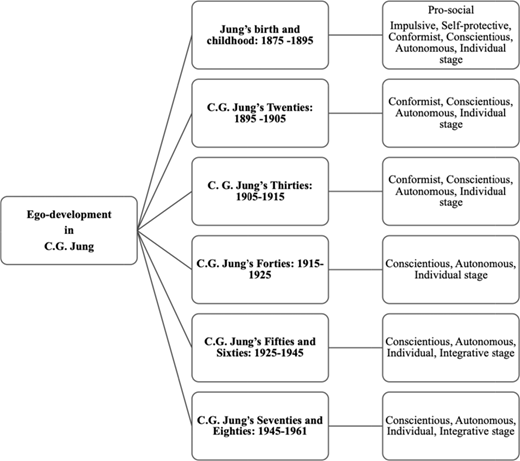
This psychobiography therefore moves beyond reductionist pathology toward an appreciation of psychological development as an integrative process and presents Jung’s life as what he wanted it to be: the consistent development of self through challenging and creative life phases through integrating the conscious and the unconscious. Figure 1 provides an overview of Loevinger’s ego development stages in the life of Jung.
Based on the vast material available on Jung’s life in autobiographic and biographic literature and with regard to theoretical contributions, further psychobiographical work is needed to explore his life on deeper levels. On a practical note, the present psychobiography may provide insight for individuals into how to develop, through introspection, the intense wish to explore unconscious patterns and their development throughout a lifetime. Jung’s life can be seen as an inspiration for anyone who would like to explore life deeply, grow and create meaning through creative and imaginary methods.
The authors thank Professor Jerome Carson for inviting us to submit an article to this special issue on “Psychobiography and Mental Health in the Life of Health Professionals”. The authors thank the University of Johannesburg for supporting the Open Access Publishing.