Skip to Main Content
Purpose

The purpose of this study is to enhance the accuracy and interpretability of predicting the thermal conductivity of foam concrete under multiple influencing factors. Unlike prior research that often relied on limited input variables and focused primarily on mechanical strength, this work integrates six machine learning models to evaluate performance across a broader parameter set. By identifying the most effective model and conducting sensitivity analysis through Shapley Additive Explanations (SHAP) values, the study aims to provide reliable predictive tools and theoretical guidance for optimizing foam concrete's thermal insulation properties in engineering applications.

Design/methodology/approach

This study collected a large amount of data on foam concrete thermal conductivity, incorporating density, water-to-cement ratio, supplementary cementitious materials (SCM), fine aggregate-to-binder ratio, curing time, and superplasticizer as inputs. Data were preprocessed through standardization, outlier removal and 5-fold cross-validation to ensure reliability. Six machine learning models – Gaussian Process Regression (GPR), Ensemble Tree, Linear Regression (LR), Neural Network (NN), Regression Tree (RT) and Support Vector Machine (SVM) – were trained and tested. Model performance was assessed using R2, root mean squared error (RMSE), mean absolute error (MAE) and mean absolute percentage error (MAPE). SHAP were applied to the optimal model to quantify feature contributions and enhance interpretability.

Findings

GPR outperformed other models in predicting foam concrete thermal conductivity, achieving R2 values of 0.97 (training) and 0.88 (testing), with low error metrics, demonstrating strong accuracy and generalization. Neural Networks and SVM also showed reasonable performance, while LR and RT performed poorly. Sensitivity analysis using SHAP revealed density (46.3%) and water-to-cement ratio (20.3%) as the dominant factors influencing conductivity, whereas SCM and superplasticizer had minimal effects. These results highlight GPR's robustness and confirm density and W/C as the key parameters governing foam concrete's thermal insulation performance.

Originality/value

This study extends existing foam concrete research by shifting focus from compressive strength prediction to thermal conductivity, a critical property for insulation performance. Unlike prior work limited to three or four variables, it integrates six input parameters and evaluates six machine learning models, offering a more comprehensive and multidimensional analysis. The inclusion of SHAP provides novel interpretability, clarifying feature contributions and enhancing model transparency. By combining broad parameter input with explainable artificial intelligence, this work delivers both methodological innovation and practical guidance for optimizing foam concrete’s thermal performance.

Foam concrete is a lightweight material typically composed of cement, fine aggregates, water and pre-formed foam, among other ingredients (Yao et al., 2023). Its unique properties grant it significant potential for application in various fields, particularly in both structural and non-structural components of buildings, such as walls, floors and roofs (Al-Ani et al., 2025). The thermal conductivity of foam concrete is a critical performance indicator that directly impacts its behavior in practical applications. Although existing studies have demonstrated that foam concrete performs well in terms of thermal insulation, these properties are influenced by a variety of factors (Feng et al., 2024). Therefore, accurately predicting the performance of foam concrete and optimizing it systematically is crucial to ensuring its widespread application in construction projects.

Foam concrete is widely applied in the construction industry, and its thermal conductivity directly influences its thermal insulation performance (Ding et al., 2024). This parameter is affected by various factors, with key factors including the density of foam concrete, water-to-cement ratio (W/C), supplementary cementitious materials (SCM) replacement ratio, fine aggregate-to-binder ratio (FA/Binder), curing time and superplasticizer (SP). The density of foam concrete affects its thermal conductivity, as higher density generally indicates a greater proportion of solid materials, lower porosity and a more compact structure, which in turn increases heat conduction pathways, thereby raising the thermal conductivity (Liu et al., 2024). The W/C of foam concrete significantly influences its pore structure and density. An increase in the W/C typically leads to higher porosity and a more loosely packed structure, thus lowering thermal conductivity (Mohamed et al., 2024). The SCM replacement ratio and FA/Binder alter the microstructure of foam concrete, thereby affecting its thermal conductivity (Raj and Somasundaram, 2021). The addition of SP modifies the flowability of the paste and disperses the cement particles, contributing to the densification of foam concrete. At the same time, it also alters the pore structure, affecting the thermal conductivity (Sun et al., 2024).

In recent years, advanced artificial intelligence (AI) techniques, such as deep learning, ensemble learning and hybrid intelligent systems, have been widely applied in civil and structural engineering (Wang et al., 2024c, 2025a, b). Machine learning, as a powerful data-driven analytical tool, can learn from large experimental datasets and automatically identify complex relationships between input variables and target properties, thereby significantly improving prediction accuracy and efficiency (Sun, 2024). Consequently, it has been extensively employed for the prediction and optimization of material properties (Soltani et al., 2025; Sun, 2024; Narang et al., 2022; Elhag et al., 2024). Machine learning can automatically identify the complex relationships between input variables and target performance by learning from large volumes of experimental data, greatly enhancing the accuracy and efficiency of predictions (Long et al., 2023; Yu et al., 2025a). Compared to traditional methods, machine learning not only handles a large number of variables but also enables performance prediction in situations where multiple influencing factors are intertwined (Wang et al., 2024a; Yu et al., 2025b), thereby providing more scientific and efficient decision support for the design and production of foam concrete (Amin et al., 2025). Therefore, machine learning offers a novel approach and method for the performance optimization of foam concrete, and existing studies have applied machine learning methods to the performance prediction of foam concrete. For instance, Nassar (2025) used XGBoost to predict the compressive strength and flexural strength of foam concrete, achieving an R2 of 0.9, which demonstrates its excellent accuracy. Salami et al. (2022) applied multiple models, including ANN, GEP and GBT, to predict the compressive strength of foam concrete, with GBT yielding the best performance. Amin et al. (2025) used DT, Bagging, AdaBoost and other models to predict foam concrete strength, finding the AdaBoost model had the highest accuracy. Current research typically uses 3–4 parameters to predict the mechanical properties of foam concrete, with limited focus on durability. Moreover, the accuracy of models incorporating more input parameters has not been fully validated. To address these gaps, this study expands on existing research by adding input parameters and employing six machine learning models—Gaussian Process Regression (GPR), Ensemble Tree (ET), Linear Regression (LR), Neural Network (NN), Regression Tree (RT) and Support Vector Machine (SVM)—to predict foam concrete performance and conduct comparative evaluations. To improve model interpretability and understand the influence of input parameters, the study uses Shapley Additive Explanations (SHAP) values, which quantify the contribution of each variable to the predictions, offering more intuitive decision support for optimizing foam concrete performance. Integrating SHAP enhances model transparency and provides more reliable predictions for foam concrete's thermal conductivity under multi-parameter conditions.

The scale of the database plays a crucial role in the accuracy of predictive models. A larger training dataset helps the model better capture the patterns in the data, thereby improving its predictive performance (Nanyonga and Wild, 2023). In this study, 141 thermal conductivity data sets were collected from published literature. All data were screened, and those that did not meet the experimental conditions were excluded. The remaining data were standardized. Using six different machine learning models, the collected data were trained and tested with a training-to-testing ratio of 70%:30%, yielding predictions for the flexural strength and thermal conductivity of foam concrete. In this research, the input parameters included foam concrete density, W/C, SCM replacement ratio, FA/Binder, SP content and curing time, while the output variables was the thermal conductivity of foam concrete. Table 1 provides detailed information about the input parameters when thermal conductivity was used as the output variable, including the maximum, minimum and median values within the data.

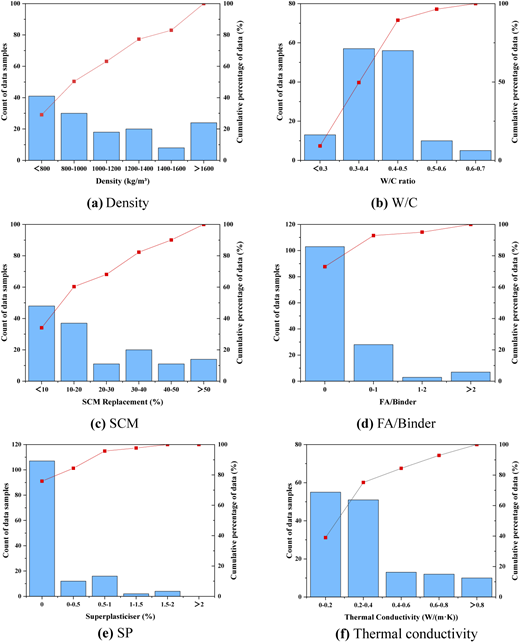
Figure 1 shows the distribution range of the thermal conductivity data. The density data were most densely distributed in the region below 800 kg/m3, with the number of samples decreasing as density increases (Figure 1a). Most of the W/C data were concentrated between 0.4 and 0.5, with fewer data at lower and higher ratios. The SCM replacement ratio data were concentrated in the low substitution region (<10%), with fewer samples at higher substitution rates, indicating that low substitution rate samples account for a larger proportion in the data (Figure 1c). The majority of data samples had an FA/Binder ratio of 0, suggesting that the FA content in this variable was relatively low (Figure 1d). SP content was mostly concentrated at 0%, with fewer data points in the other intervals (Figure 1e). Most of the thermal conductivity data were concentrated in the low thermal conductivity range (0–0.2 W/(m·K)), and as the thermal conductivity increased, the sample size gradually decreased, indicating that most studies focused on low-density, low-thermal-conductivity foam concrete (Figure 1f).

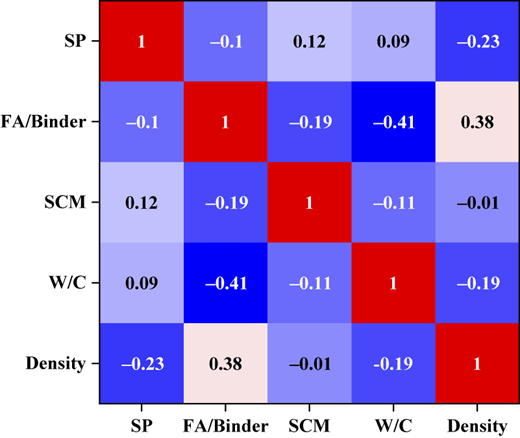
To avoid overfitting or computational instability in the model, this study conducted a correlation analysis on the parameters affecting the thermal conductivity (Figure 2) of foam concrete. It is clear that the correlations between the parameters were acceptable (i.e. <0.8), and thus the independence of each feature could be preserved during the machine learning modeling process, ensuring the accuracy of the prediction model.

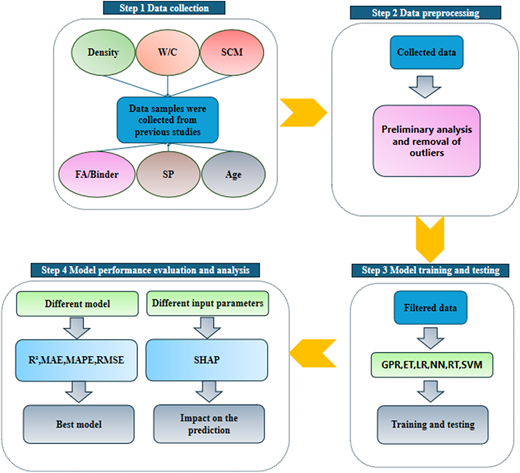
This study adopted a systematic approach to predict the thermal conductivity of foam concrete and evaluated the predictive models. As shown in Figure 3, the process was divided into four main parts: (1) data collection, (2) data preprocessing, (3) model training and testing, and (4) model performance evaluation and analysis.

A total of 141 datasets were systematically collected from previously published articles on the thermal properties of foam concrete (Maglad et al., 2023; Makul and Sua-iam, 2016; Ahmadi et al., 2023; Chung et al., 2019; Gökçe et al., 2019; Gencel et al., 2021; Vinith Kumar et al., 2018; Maglad et al., 2024; Jose et al., 2021; Özkan et al., 2024; Dora et al., 2025; Wei et al., 2024; Mydin et al., 2023; Azree Othuman Mydin et al., 2024; Bie et al., 2024; Xian et al., 2022; Shi et al., 2012; Changhui et al., 2024; Dianlong, 2017; Dingqiang et al., 2025; Ming et al., 2013; Tugen et al., 2024; Xiangming et al., 2019; Xing-xing et al., 2022; Yuejun et al., 2020). These data were carefully selected to ensure consistency in experimental conditions and methodologies, thereby ensuring the uniformity and reliability across different studies.

To reduce the impact of data heterogeneity from different sources on the results, several measures were implemented in this study. First, research data with clear experimental methods and consistent measurement standards were selected. Additionally, all numerical input data were standardized, and obvious outliers were excluded. These data processing steps ensured both the physical comparability and statistical consistency of the data, thereby enhancing the stability and generalization ability of the model training process.

To mitigate overfitting, this study used 5-fold cross-validation. The dataset was divided into five subsets, with one used for validation and the others for training in each experiment. This approach allowed evaluation on multiple data subsets, improving model generalization and reducing biases from specific data splits (Hu et al., 2025; Yu et al., 2025c). It also ensured stable and reliable model performance, providing more accurate assessment during training (Li et al., 2024; Sejuti and Islam, 2023).

3.3.1 GPR

GPR is a Bayesian non-parametric method (Shah et al., 2014) selected for its strength in handling uncertainty and fitting complex, noisy data often seen in concrete material studies (Ayyanar and Ali, 2024; Rayjada et al., 2023; Zhang, 2023; Wang et al., 2024b). Prediction is performed by modeling the training data with a Gaussian process. The core idea is to describe the correlation between data points through a covariance function. During prediction, not only the mean is provided but also the variance of the output. The core formula is as follows:

(1)
(2)
(3)
(4)

In this equation, m(x) is the mean function, typically set to 0, and k(x,x) is the kernel function, which defines the correlation between data points. K(X,X) represents the covariance matrix between the training data, while σn2 denotes the noise variance.

3.3.2 ET

ET is a machine learning approach that combines multiple decision trees to improve prediction accuracy and stability. Using ensemble techniques like random forests or gradient boosting, each tree is trained on different data subsets, and the final prediction is derived from majority voting or weighted averaging. The core formula is as follows:

Assuming there are T trees, with each tree's prediction denoted as ft(x), the ensemble prediction is given by:

(5)

The trees in ET are generated through random sampling of the data. For classification tasks, the final output is the majority class voted on by all the trees:

(6)

where I is the indicator function, representing whether the tree predicts the class y.

3.3.3 LR

LR is a statistical model used for predicting numerical outputs, assuming a linear relationship between the independent and dependent variables. The LR model finds the optimal model parameters by minimizing the loss function (usually the mean squared error), thereby making predictions. The core formula is as follows:

(7)
(8)

In this equation, y represents the target variable, x1, x2, …, xn are the feature variables, β0, β1, …, βn are the regression coefficients, and ϵ is the error term. X is the matrix containing all the feature data from the training set, y denotes the values of the target variable, and βˆ represents the estimated regression coefficients of the model.

3.3.4 NN

NN is a machine learning model that mimics biological neural networks, learning complex data patterns through multiple layers of nonlinear transformations. It consists of an input layer, hidden layers and an output layer, with neurons connected by weights and biases. The backpropagation algorithm optimizes the weights during training to minimize prediction errors. The core formula is as follows:

(9)
(10)
(11)
(12)

In this equation, W represents the weight matrix, x denotes the input, b is the bias, σ is the activation function, L is the loss function and η is the learning rate.

3.3.5 RT

RT is a tree-based algorithm used for predicting continuous output variables. It recursively divides the data into different regions, where the predicted value for each region is the average of the data points within that region. The RT selects the best splitting features and thresholds by minimizing the squared error within each node. The core formula is as follows:

(13)

In this equation, yˆ represents the predicted value, N is the number of samples in the node and yi denotes the true value of each sample.

3.3.6 SVM

SVM is a supervised learning method used for classification and regression analysis. SVM works by finding an optimal hyperplane that separates data points from different classes and maximizes the margin between them. For nonlinear separable problems, SVM utilizes a kernel function to map the data into a higher-dimensional space, where a linear hyperplane can then be found. The core formula is as follows:

(14)
(15)

In this equation, ω represents the hyperplane vector, b is the bias term, ξ,ξ* are slack variables used to tolerate certain prediction errors and C is the penalty factor, which balances margin maximization with error tolerance. μAi(x) is the membership function of input x to the fuzzy set Ai, and μBj(y) is the membership function of input y to the fuzzy set Bj. Their product represents the joint membership degree of x belonging to Ai and y belonging to Bj.

In order to evaluate the model accuracy, coefficient of determination (R2), root mean squared error (RMSE), mean absolute error (MAE) and mean absolute percentage error (MAPE) were used in this study. Table 2 summarizes the statistical evaluation metrics of different prediction models.

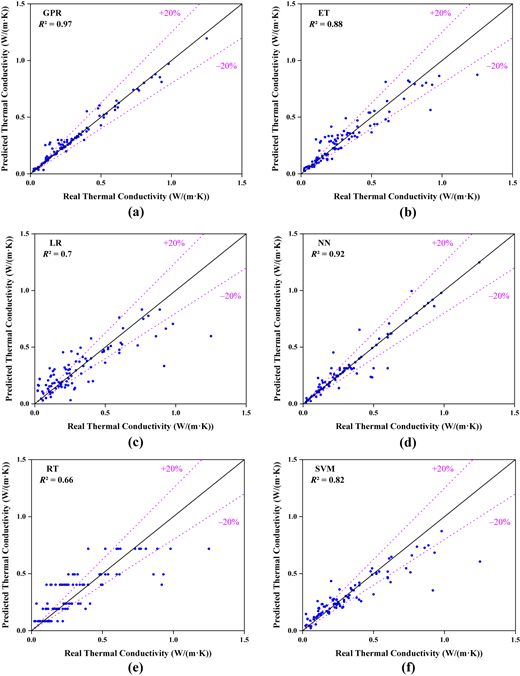
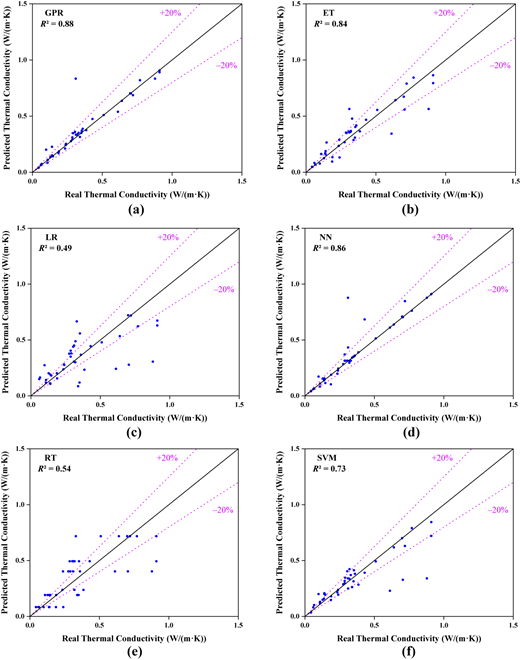
Figures 4 and 5 show the predicted vs. actual thermal conductivity values for six models in both training and testing phases. In the training phase, GPR and NN had the most concentrated points near the ideal line (y = x), indicating high fitting accuracy. SVM and ET also showed good fitting, while LR and RT displayed more scattered points, indicating poorer performance. In the testing phase, GPR and NN continued to perform well, with most points within the ±20% error range, showing strong generalization. ET and SVM had more dispersed points but were still close to the diagonal, while LR and RT had significant deviations, indicating unstable predictions and larger errors.

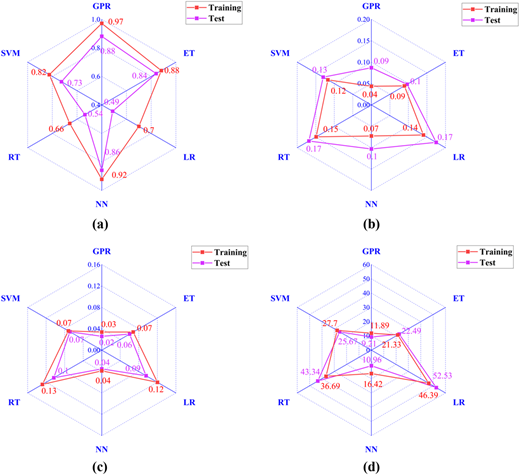
Figure 6 presents the specific R2, RMSE, MAE and MAPE values for the six models (GPR, ET, LR, NN, RT and SVM) during both the training and testing phases when predicting the thermal conductivity of foam concrete. It is clear that GPR performed the best. Its R2 value reached 0.9719 in the training phase and remained at 0.8814 in the testing phase, with RMSE and MAE values of 0.0437 and 0.0258, respectively, demonstrating its superior fitting ability, low error and good generalization capability. In comparison, ET and SVM also performed well in the testing phase; although their errors were slightly higher than GPR's, they maintained stability and were suitable for practical applications. However, LR and RT showed weaker performance in both the training and testing phases, particularly in the testing phase. LR had a MAPE as high as 52.53%, and RT's R2 was only 0.5363, indicating significant overfitting issues for both models, poor prediction accuracy and weak generalization ability.

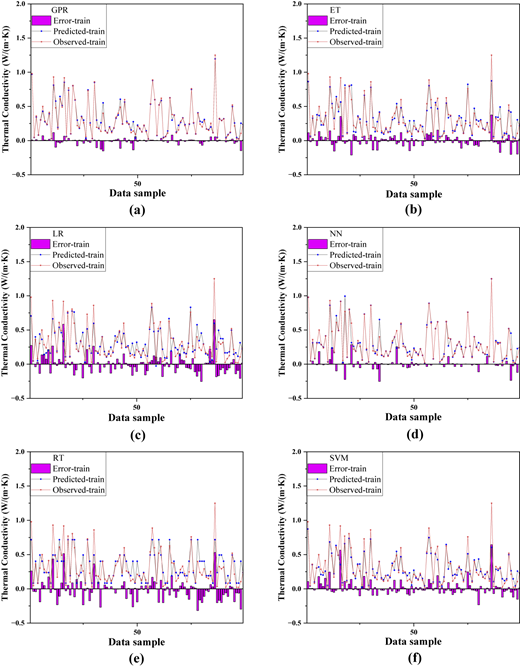
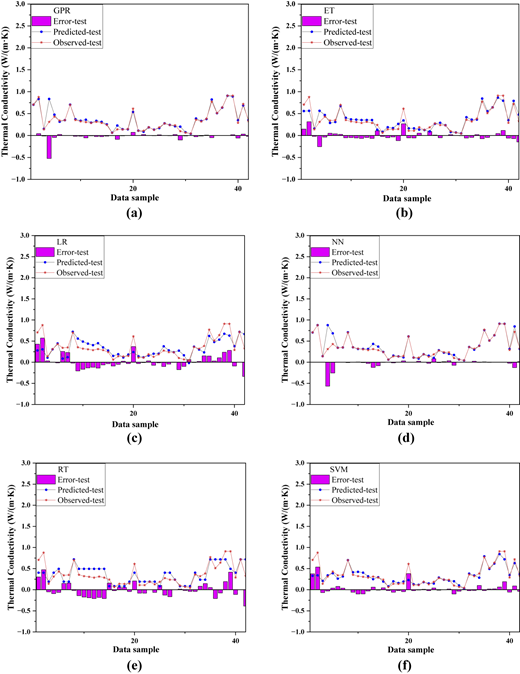
From Figures 7 and 8, the error plots reveal that GPR had low overall errors and stable predictions during both training and testing, indicating high accuracy, strong fitting and robust generalization. SVM's errors were moderate in training and slightly increased in testing, showing good generalization. NN had very low errors in training but significant error increases and fluctuations during testing, indicating overfitting. LR showed moderate training errors with larger fluctuations in testing, suggesting weak generalization. ET had higher errors in both phases, with considerable fluctuations in testing, indicating poor fitting and generalization. RT exhibited large errors and severe fluctuations in testing, reflecting weak performance and poor adaptability.

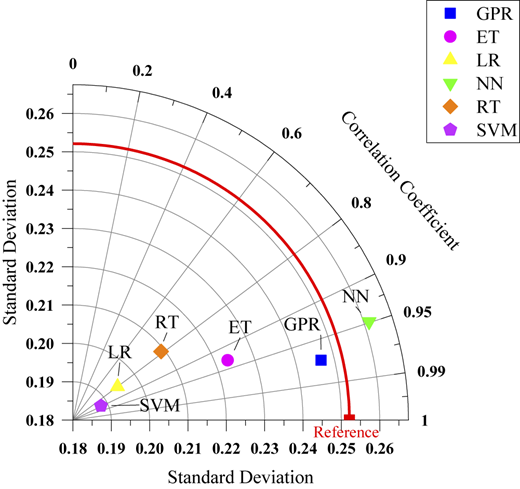
Figure 9 shows the Taylor diagram used for evaluating models’ predictive performance for thermal conductivity against reference values. GPR was closest to the reference, with a high correlation (close to 1) and a standard deviation consistent with the reference data, indicating its excellent accuracy and stability. NN, while also highly correlated, had a slightly higher standard deviation, making it less stable than GPR. ET and RT models deviated significantly, showing weaker predictive performance. LR and SVM had small standard deviations but risked underfitting. Overall, GPR provided the best balance of accuracy and stability.

Based on the comprehensive analysis above, GPR demonstrated the best fitting ability and generalization performance. Both SVM and NN also performed well; although NN showed some overfitting during the testing phase, the overall predictive performance remained satisfactory. The performance of ET was relatively average, with slightly higher errors, but there was no significant overfitting issue. LR and RT performed poorly in prediction, especially LR, which had weak generalization ability, and RT experienced severe overfitting, making them unsuitable for predicting thermal conductivity.

The results can be attributed to GPR, which, based on Bayesian optimization, accurately tunes key hyperparameters to better fit complex nonlinear relationships (Cheng et al., 2025). SVM performed well when parameters were adjusted, avoiding overfitting, but its generalization ability depends on the C value and kernel function. A larger C value can cause overfitting, while a smaller one may lead to underfitting. NN experienced overfitting, increasing testing errors. The LR model was too simplistic, failing to capture complex nonlinear relationships. ET and RT models, due to high randomness, performed poorly on some datasets. Therefore, GPR was the optimal model for predicting the flexural strength of foam concrete.

To further evaluate the robustness and generalization capability of the GPR model, different data-splitting ratios were adopted for model training and testing. In addition to the 60:40 division, the dataset was further divided into 70:30 and 80:20 ratios for comparison. The model performance under each partition was assessed using RMSE, R2, MAE and MAPE. The corresponding results are summarized in Table 3.

As shown, the GPR model maintained stable prediction accuracy across all data division ratios, with R2 values consistently above 0.90 and low RMSE and MAE values in both training and testing stages. These results indicate that the model exhibits strong robustness and reliable generalization performance, confirming its suitability for predicting the thermal conductivity of foam concrete.

SHAP is a model interpretation method based on game theory, which evaluates the contribution of features to prediction results by calculating their Shapley values. Positive contributions increase the predicted value, while negative contributions decrease it. SHAP provides transparent explanations for individual predictions (Rodríguez-Pérez and Bajorath, 2020) and assesses the global importance of features, thereby enhancing model interpretability and transparency (Flora et al., 2024; Scheda and Diciotti, 2022). Additionally, SHAP can reveal the interactions between features and potential biases, improving the reliability of the model. SHAP requires low correlation among input features (Indra et al., 2024). In this study, a correlation analysis was conducted prior to SHAP analysis, and the results indicated low correlation among input parameters, ensuring the accuracy of the analysis.

SHAP analysis was not limited to evaluating feature importance but was further employed to investigate the underlying physical mechanisms and the interactions among mix design parameters. Wang et al. (2023b) used SHAP to reveal both global and local effects of material variables on the compressive strength of recycled brick aggregate concrete. Following the same analytical approach, this study aims to elucidate how each variable affects the thermal conductivity of foam concrete.

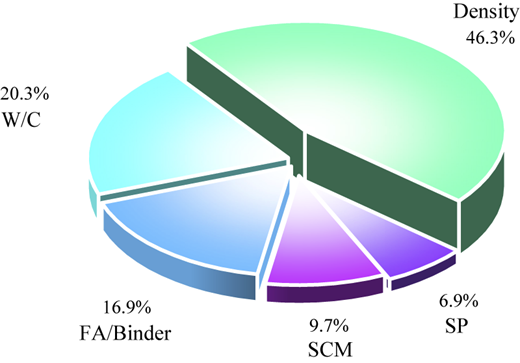
Figure 10 summarizes the global SHAP attributions for predicting the thermal conductivity of foam concrete. The percentage next to each variable indicates its relative contribution to the model output: density accounts for 46.3%, W/C for 20.3%, FA/Binder ratio for 16.9%, SCM replacement ratio for 9.7% and SP for 6.9%. These values quantify the average contribution of each parameter in shifting the model prediction from the baseline, thus reflecting its overall influence on model performance.

The density of foam concrete determines the volume fraction of air voids related to solid material. Thermal conductivity in foam concrete is primarily governed by porosity — a higher air content provides more insulation and reduces heat conduction paths, while denser materials contain more continuous solid phases that facilitate heat transfer. The W/C controls pore structure and hydration behavior. A higher W/C increases pore volume and connectivity and may reduce hydration density, thereby enhancing heat conduction through interconnected pores. Zhang et al. (2020) identified density and W/C as key factors influencing thermal conductivity. The FA/Binder ratio contributes 16.9%, reflecting the effect of the relative proportions of fine aggregate and binder. Since fine aggregate has a higher intrinsic thermal conductivity than the cement matrix, an increased FA/Binder ratio enhances solid-phase conduction and raises overall conductivity. The SCM replacement ratio contributes 9.7%, as SCMs primarily influence thermal behavior indirectly through pozzolanic reactions that alter hydration products and refine pore structures over time. Such effects are weaker in steady-state conductivity than those of density or W/C. SP shows the smallest contribution (6.9%) because it mainly improves the workability of fresh mixtures and has limited influence on the microstructure or thermal properties of the hardened concrete. Maglad et al. (2023) found similar limited effects of SCM on thermal conductivity, with Zhang et al. (2020) noting that SP had less influence than density or W/C.

In summary, SHAP provides a quantitative ranking of input parameters and links their statistical importance to the corresponding physical mechanisms. The dominance of density and W/C highlights their decisive roles in controlling the heat transfer performance of foam concrete, while SCM and SP exhibit secondary effects, consistent with previous experimental findings.

This study conducted a comparative analysis of the performance of different models in predicting the thermal conductivity of foam concrete under multiple input parameters. The optimal model for different output parameters was selected and subjected to sensitivity analysis. The conclusions are as follows.

  1. Compared to most of the existing literature focusing on the prediction of compressive strength of foam concrete, this study shifted the objective to the prediction of the thermal conductivity. The input parameters selected include density, W/C, SCM replacement ratio, FA/Binder, SP and curing time. This approach significantly enhanced the dimensional richness of the model inputs and more effectively captured the nonlinear relationships between the multiple performance characteristics of foam concrete.

  2. Through a comparison of six models—GPR, ET, LR, NN, RT and SVM—in predicting the thermal conductivity of foam concrete, this study found that the GPR model consistently outperformed the others in predicting thermal conductivity. The training phase produced R2, RMSE, MAE, and MAPE values of 0.97, 0.04, 0.03 and 11.89, respectively, while the testing phase yielded values of 0.88, 0.09, 0.03 and 9.21. GPR demonstrated excellent fitting ability and robustness in handling high-dimensional nonlinear relationships, making it well-suited for the complex and noisy data characteristics associated with foam concrete's input parameters.

  3. To enhance the interpretability of the model, this study employed the SHAP method to analyze feature contributions in the GPR model. The results indicate that the density and W/C were the primary factors influencing the thermal conductivity of foam concrete, while the SCM replacement ratio and SP had the least impact on the prediction outcomes. The contribution values of density and W/C were 46.3 and 20.3%, respectively, while the contributions of SCM replacement ratio and SP were 9.7 and 6.9%. This analysis provided a theoretical basis for the performance regulation of foam concrete in engineering practice.

5.2.1 Further experimental validation and model improvement

In future research, additional experimental tests on the thermal conductivity of foamed concrete will be conducted to enrich the dataset and further validate the robustness and generalization capability of the models. By including a wider range of mix proportions and curing conditions, the variability in thermal behavior can be more comprehensively captured. Furthermore, inspired by recent advances in AI, we plan to introduce more advanced prediction models, such as ensemble learning, deep learning and hybrid intelligent systems, to further enhance prediction accuracy and methodological innovation. Comparative analyses with these advanced algorithms will also be conducted to evaluate their applicability to foamed concrete.

5.2.2 Extension to multi-objective prediction

Although this study successfully developed and evaluated machine learning models for predicting the thermal conductivity of foam concrete, it primarily focused on a single thermal property. In future work, inspired by previous multi-objective studies (Wang et al., 2023a, 2024d), the dataset will be expanded to include mechanical and durability indicators such as compressive strength, density, water absorption and shrinkage. This will enable the establishment of multi-objective predictive models to jointly optimize thermal, mechanical and durability performance, providing a more comprehensive understanding of the structure–property relationships of foam concrete.
Ahmadi
,
S.F.
,
Reisi
,
M.
and
Sajadi
,
S.M.
(
2023
), “
Comparing properties of foamed concrete and lightweight expanded clay aggregate concrete at the same densities
”,
Case Studies in Construction Materials
, Vol. 
19
, e02539, doi: .
Al-Ani
,
H.K.K.
,
Hilal
,
A.A.
and
Hama
,
S.M.
(
2025
), “
Characteristics of fresh and hardened sustainable foamed concrete for structural applications
”,
Journal of Engineering
, Vol. 
2025
No. 
1
, 2998605, doi: .
Amin
,
M.N.
,
Ahmad
,
A.
,
Khan
,
K.
and
Qadir
,
M.T.
(
2025
), “
Precision assessment of the machine learning tools for the strength optimization of environmental-friendly lightweight foam concrete
”,
Journal of Environmental Management
, Vol. 
373
, 123462, doi: .
Ayyanar
,
D.
and
Ali
,
S.H.M.
(
2024
), “
Analysis of compressive strength of sustainable fibre reinforced foamed concrete using machine learning techniques
”,
Materials Research Express
, Vol. 
11
No. 
3
, 035701, doi: .
Azree Othuman Mydin
,
M.
,
Hamah Sor
,
N.
,
Bahrami
,
A.
,
Dulaimi
,
A.
,
Onuralp Özkılıç
,
Y.
,
Althoey
,
F.
,
Jagadesh
,
P.
,
Isleem
,
H.F.
and
Tawfik
,
T.A.
(
2024
), “
Residual durability, mechanical, and microstructural properties of foamed concrete subjected to various elevated temperatures
”,
Engineering Science and Technology, an International Journal
, Vol. 
55
, 101725, doi: .
Bie
,
Y.
,
Ba
,
S.
and
Chen
,
S.
(
2024
), “
Studies on foamed concrete micropores and their effects on stress distribution and heat conduction
”,
Journal of Building Engineering
, Vol. 
87
, 109152, doi: .
Changhui
,
J.
,
Ningshan
,
J.
,
Hui
,
L.
and
Chengkui
,
L.
(
2024
), “
Analysis of pore characteristics of foam concrete based on different mixing ratios of micro powder and fly ash
”,
Water Resources and Hydropower Engineering
, Vol. 
55
, pp. 
228
-
239
.
Cheng
,
H.
,
Wang
,
S.
,
Liu
,
J.
,
Huang
,
B.
and
Wang
,
Q.
(
2025
), “
Construction and demolition waste utilization and low-carbon scheme design for low-carbon concrete based on data cleaning and enhancement model
”,
Materials Today Communications
, Vol. 
49
, 113776, doi: .
Chung
,
S.-Y.
,
Abd Elrahman
,
M.
,
Kim
,
J.-S.
,
Han
,
T.-S.
,
Stephan
,
D.
and
Sikora
,
P.
(
2019
), “
Comparison of lightweight aggregate and foamed concrete with the same density level using image-based characterizations
”,
Construction and Building Materials
, Vol. 
211
, pp. 
988
-
999
, doi: .
Dianlong
,
Z.
(
2017
), “
An experimental study of the performance of the fly ash foam concrete
”,
Traffic Engineering and Technology for National
, Vol. 
15
, pp. 
35
-
38+3
.
Ding
,
X.
,
Yu
,
J.
,
Lin
,
J.
,
Chen
,
Z.
and
Li
,
J.
(
2024
), “
Experimental investigations of prefabricated lightweight self-insulating foamed concrete wall panels
”,
Structures
, Vol. 
61
, 106001, doi: .
Dingqiang
,
F.
,
Jianxin
,
L.
,
Kangning
,
L.
and
Zhisheng
,
P.
(
2025
), “
High-strength Co2 foam concrete: design, preparation and characteristics
”,
Journal of the Chinese Ceramic Society
, Vol. 
53
No. 
5
, pp.
1
-
12
.
Dora
,
S.
,
Kuznik
,
F.
and
Mini
,
K.M.
(
2025
), “
A novel Pcm-based foam concrete for heat transfer in buildings -experimental developments and simulation modelling
”,
Journal of Energy Storage
, Vol. 
105
, 114625, doi: .
Elhag
,
A.B.
,
Raza
,
A.
,
Kahla
,
N.B.
and
Arshad
,
M.
(
2024
), “
Reliability analysis of various modeling techniques for the prediction of axial strain of frp-confined concrete
”,
Multidiscipline Modeling in Materials and Structures
, Vol. 
20
No. 
5
, pp. 
869
-
890
, doi: .
Feng
,
S.
,
Gao
,
Y.
,
Xiao
,
H.
and
Xue
,
C.
(
2024
), “
Influence of fibers and bubble structure on thermal conductivity and mechanical performances of foam concrete
”,
Construction and Building Materials
, Vol. 
445
, 137956, doi: .
Flora
,
M.L.
,
Potvin
,
C.K.
,
Mcgovern
,
A.
and
Handler
,
S.
(
2024
), “
A machine learning explainability tutorial for atmospheric sciences
”,
Artificial Intelligence for the Earth Systems
, Vol. 
3
No. 
1
, E230018, doi: .
Gencel
,
O.
,
Benli
,
A.
,
Bayraktar
,
O.Y.
,
Kaplan
,
G.
,
Sutcu
,
M.
and
Elabade
,
W.A.T.
(
2021
), “
Effect of waste marble powder and rice husk ash on the microstructural, physico-mechanical and transport properties of foam concretes exposed to high temperatures and freeze–thaw cycles
”,
Construction and Building Materials
, Vol. 
291
, 123374, doi: .
Gökçe
,
H.S.
,
Hatungimana
,
D.
and
Ramyar
,
K.
(
2019
), “
Effect of fly ash and silica fume on hardened properties of foam concrete
”,
Construction and Building Materials
, Vol. 
194
, pp. 
1
-
11
, doi: .
Hu
,
Z.
,
Dang
,
C.
,
Wang
,
D.
,
Beer
,
M.
and
Wang
,
L.
(
2025
), “
Error-informed parallel adaptive kriging method for time-dependent reliability analysis
”,
Reliability Engineering and System Safety
, Vol. 
262
, 111194, doi: .
Indra
,
P.
,
Dam Duc
,
N.
,
Nguyen Thanh
,
T.
,
Tran Van
,
P.
and
Le Van
,
H.
(
2024
), “
Landslide susceptibility zoning: Integrating multiple intelligent models with shap analysis
”,
Journal of Science and Transport Technology
, pp. 
23
-
41
, doi: .
Jose
,
S.K.
,
Soman
,
M.
and
Evangeline
,
Y.S.
(
2021
), “
Influence of mixture composition on the properties of foamed concrete
”,
Materials Today: Proceedings
, Vol. 
42
, pp. 
399
-
404
, doi: .
Li
,
H.
,
Rajbahadur
,
G.K.
,
Lin
,
D.
,
Bezemer
,
C.P.
and
Jiang
,
Z.M.
(
2024
), “
Keeping deep learning models in check: a history-based approach to mitigate overfitting
”,
IEEE Access
, Vol. 
12
, pp. 
70676
-
70689
, doi: .
Liu
,
Y.
,
Zhao
,
Z.
,
Amin
,
M.N.
,
Ahmed
,
B.
,
Khan
,
K.
,
Arifeen
,
S.U.
and
Althoey
,
F.
(
2024
), “
Foam concrete for lightweight construction applications: a comprehensive review of the research development and material characteristics
”,
Reviews on Advanced Materials Science
, Vol. 
63
No. 
1
, 20240022, doi: .
Long
,
X.
,
Mao
,
M.-H.
,
Su
,
T.-X.
,
Su
,
Y.-T.
and
Tian
,
M.-K.
(
2023
), “
Machine learning method to predict dynamic compressive response of concrete-like material at high strain rates
”,
Defence Technology
, Vol. 
23
, pp. 
100
-
111
, doi: .
Maglad
,
A.M.
,
Othuman Mydin
,
M.A.
,
Dip Datta
,
S.
and
Tayeh
,
B.A.
(
2023
), “
Assessing the mechanical, durability, thermal and microstructural properties of sea shell ash based lightweight foamed concrete
”,
Construction and Building Materials
, Vol. 
402
, 133018, doi: .
Maglad
,
A.M.
,
Othuman Mydin
,
M.A.
,
Majeed
,
S.S.
,
Tayeh
,
B.A.
and
Tobbala
,
D.E.
(
2024
), “
Exploring the influence of calcinated eggshell powder on lightweight foamed concrete: a comprehensive study on freshness, mechanical strength, thermal characteristics and transport properties
”,
Journal of Building Engineering
, Vol. 
87
, 108966, doi: .
Makul
,
N.
and
Sua-Iam
,
G.
(
2016
), “
Characteristics and utilization of sugarcane filter cake waste in the production of lightweight foamed concrete
”,
Journal of Cleaner Production
, Vol. 
126
, pp. 
118
-
133
, doi: .
Ming
,
Z.
,
Fang-Gang
,
W.
,
Xu-Long
,
Z.
and
Fa-Zhou
,
W.
(
2013
), “
Research on the relationship between pore structure and thermal conductivity of foamed doncrete
”,
Journal of Wuhan University of Technology
, Vol. 
35
, pp. 
20
-
25
.
Mohamed
,
A.M.
,
Tayeh
,
B.A.
,
Majeed
,
S.S.
,
Aisheh
,
Y.I.A.
and
Salih
,
M.N.A.
(
2024
), “
Ultra-light foamed concrete mechanical properties and thermal insulation perspective: a comprehensive review
”,
Journal of CO2 Utilization
, Vol. 
83
, 102827, doi: .
Mydin
,
M.A.O.
,
Hamah Sor
,
N.
,
Althoey
,
F.
,
Özkılıç
,
Y.O.
,
Abdullah
,
M.M.A.B.
,
Isleem
,
H.F.
,
Deifalla
,
A.F.
and
Tawfik
,
T.A.
(
2023
), “
Performance of lightweight foamed concrete partially replacing cement with industrial and agricultural wastes: microstructure characteristics, thermal conductivity, and hardened properties
”,
Ain Shams Engineering Journal
, Vol. 
14
No. 
11
, 102546, doi: .
Nanyonga
,
A.
and
Wild
,
G.
(
2023
), “
Impact of dataset size and data source on aviation safety incident prediction models with natural language processing
”,
2023 Global Conference On Information Technologies And Communications (Gcitc)
,
1-3 Dec. 2023
, pp. 
1
-
7
.
Narang
,
A.
,
Kumar
,
R.
and
Dhiman
,
A.
(
2022
), “
Machine learning applications to predict the axial compression capacity of concrete filled steel tubular columns: a systematic review
”,
Multidiscipline Modeling in Materials and Structures
, Vol. 
19
No. 
2
, pp. 
197
-
225
, doi: .
Nassar
,
R.-U.-D.
(
2025
), “Machine learning approach for predicting the compressive and flexural strengths of fiber-reinforced concrete mixtures”, in
Civil and Environmental Engineering for Resilient, Smart and Sustainable Solutions
.
Özkan
,
I.G.M.
,
Aldemir
,
K.
,
Alhasan
,
O.
,
Benli
,
A.
,
Bayraktar
,
O.Y.
,
Yılmazoğlu
,
M.U.
and
Kaplan
,
G.
(
2024
), “
Investigation on the sustainable use of different sizes of sawdust aggregates in eco-friendly foam concretes: physico-mechanical, thermal insulation and durability characteristics
”,
Construction and Building Materials
, Vol. 
438
, 137100, doi: .
Raj
,
I.S.
and
Somasundaram
,
K.
(
2021
), “
Sustainable usage of Waste materials in aerated and foam concrete: a review
”,
Civil Engineering and Architecture
, Vol. 
9
No. 
4
, pp. 
1144
-
1155
, doi: .
Rayjada
,
S.P.
,
Raghunandan
,
M.
and
Ghosh
,
J.
(
2023
), “
Machine learning-based Rc beam-column model parameter estimation and uncertainty quantification for seismic fragility assessment
”,
Engineering Structures
, Vol. 
278
, 115111, doi: .
Rodríguez-Pérez
,
R.
and
Bajorath
,
J.
(
2020
), “
Interpretation of compound activity predictions from complex machine learning models using local approximations and shapley values
”,
Journal of Medicinal Chemistry
, Vol. 
63
No. 
16
, pp. 
8761
-
8777
, doi: .
Salami
,
B.A.
,
Iqbal
,
M.
,
Abdulraheem
,
A.
,
Jalal
,
F.E.
,
Alimi
,
W.
,
Jamal
,
A.
,
Tafsirojjaman
,
T.
,
Liu
,
Y.
and
Bardhan
,
A.
(
2022
), “
Estimating compressive strength of lightweight foamed concrete using neural, genetic and ensemble machine learning approaches
”,
Cement and Concrete Composites
, Vol. 
133
, 104721, doi: .
Scheda
,
R.
and
Diciotti
,
S.
(
2022
), “
Explanations of machine learning models in repeated nested cross-validation: an application in age prediction using brain complexity features
”,
Applied Sciences
, Vol. 
12
No. 
13
, p.
6681
, doi: .
Sejuti
,
Z.A.
and
Islam
,
M.S.
(
2023
), “
A hybrid Cnn–Knn approach for Identification of Covid-19 with 5-fold cross validation
”,
Sensors International
, Vol. 
4
, 100229, doi: .
Shah
,
V.S.
,
Shah
,
H.R.
,
Samui
,
P.
and
Murthy
,
A.R.
(
2014
), “
Prediction of fracture parameters of high strength and ultra-high strength concrete beams using minimax probability machine regression and extreme learning machine
”,
Computers, Materials \and Continua
, Vol. 
44
, pp.
73
-
84
.
Shi
,
X.
,
She
,
W.
,
Zhou
,
H.
,
Zhang
,
Y.
,
Shi
,
F.
and
Chen
,
W.
(
2012
), “
Thermal upgrading of hui-style vernacular dwellings in China using foam concrete
”,
Frontiers of Architectural Research
, Vol. 
1
, pp. 
23
-
33
, doi: .
Soltani
,
A.
,
Sabamehr
,
A.
,
Amani
,
N.
and
Bagchi
,
A.
(
2025
), “
Development of the hybrid damage detection method in updated numerical model of concrete structure
”,
Multidiscipline Modeling in Materials and Structures
, Vol. 
21
No. 
6
, pp. 
1382
-
1399
, doi: .
Sun
,
Y.
(
2024
), “
Forecasting ultimate bond strength between ribbed stainless steel bar and concrete using explainable machine learning algorithms
”,
Multidiscipline Modeling in Materials and Structures
, Vol. 
20
No. 
3
, pp. 
401
-
416
, doi: .
Sun
,
X.
,
Zhong
,
J.
,
Zhang
,
W.
,
Li
,
G.
,
Cao
,
H.
and
Gao
,
P.
(
2024
), “
Deformation and mechanical properties of foamed concrete under various components and pore structure
”,
Journal of Building Engineering
, Vol. 
94
, 109920, doi: .
Tugen
,
F.
,
Hang
,
Y.
and
Jian
,
Z.
(
2024
), “
Study on the effect of water/cement ratio on the performance of foamed concrete
”,
Journal of Hebei University of Engineering (Natural Science Edition)
, Vol. 
41
, pp. 
1
-
6
.
Vinith Kumar
,
N.
,
Arunkumar
,
C.
and
Srinivasa Senthil
,
S.
(
2018
), “
Experimental study on mechanical and thermal behavior of foamed concrete
”,
Materials Today: Proceedings
, Vol. 
5
No. 
2
, pp. 
8753
-
8760
, doi: .
Wang
,
S.
,
Xia
,
P.
,
Chen
,
K.
,
Gong
,
F.
,
Wang
,
H.
,
Wang
,
Q.
,
Zhao
,
Y.
and
Jin
,
W.
(
2023a
), “
Prediction and optimization model of sustainable concrete properties using machine learning, deep learning and swarm intelligence: a review
”,
Journal of Building Engineering
, Vol. 
80
, 108065, doi: .
Wang
,
S.
,
Xia
,
P.
,
Wang
,
Z.
,
Meng
,
T.
and
Gong
,
F.
(
2023b
), “
Intelligent mix design of recycled brick aggregate concrete based on Swarm intelligence
”,
Journal of Building Engineering
, Vol. 
71
, 106508, doi: .
Wang
,
L.
,
Yi
,
S.
,
Yu
,
Y.
,
Gao
,
C.
and
Samali
,
B.
(
2024a
), “
Automated ultrasonic-based diagnosis of concrete compressive damage amidst temperature variations utilizing deep learning
”,
Mechanical Systems and Signal Processing
, Vol. 
221
, 111719, doi: .
Wang
,
S.
,
Chen
,
K.
,
Liu
,
J.
,
Xia
,
P.
,
Xu
,
L.
,
Chen
,
B.
,
Wu
,
D.
and
Chen
,
W.
(
2024b
), “
Multi-performance optimization of low-carbon geopolymer considering mechanical, cost, and CO2 emission based on experiment and interpretable learning
”,
Construction and Building Materials
, Vol. 
425
, 136013, doi: .
Wang
,
S.
,
Liu
,
J.
,
Wang
,
Q.
,
Dai
,
R.
and
Chen
,
K.
(
2024c
), “
Prediction of non-uniform shrinkage of steel-concrete composite slabs based on explainable ensemble machine learning model
”,
Journal of Building Engineering
, Vol. 
88
, 109002, doi: .
Wang
,
S.
,
Xia
,
P.
,
Gong
,
F.
,
Zeng
,
Q.
,
Chen
,
K.
and
Zhao
,
Y.
(
2024d
), “
Multi objective optimization of recycled aggregate concrete based on explainable machine learning
”,
Journal of Cleaner Production
, Vol. 
445
, 141045, doi: .
Wang
,
S.
,
Wu
,
R.
,
Gong
,
F.
,
Xia
,
J.
,
Zhao
,
Y.
and
Zeng
,
B.
(
2025a
), “
Service life evaluation of marine concrete structures considering spatial and temporal characteristics: a Framework based on multi training-Mcs-Nls
”,
Engineering Structures
, Vol. 
322
, 119193, doi: .
Wang
,
S.
,
Xia
,
P.
,
Gong
,
F.
,
Zhao
,
Y.
and
Lin
,
P.
(
2025b
), “
A bayesian-physical informed conditional tabular generative adversarial network framework for low-carbon concrete data augmentation and hyperparameter optimization
”,
Engineering Applications of Artificial Intelligence
, Vol. 
152
, 110811, doi: .
Wei
,
J.
,
Wang
,
T.
,
Zhong
,
Y.
,
Zhang
,
Y.
and
Leung
,
C.K.Y.
(
2024
), “
Performance evaluation of foamed concrete with lightweight aggregate: strength, shrinkage, and thermal conductivity
”,
Materials
, Vol. 
17
No. 
15
, p.
3869
, doi: .
Xian
,
G.
,
Liu
,
Z.
,
Wang
,
Z.
and
Zhou
,
X.
(
2022
), “
Study on the performance and mechanisms of high-performance foamed concrete
”,
Materials
, Vol. 
15
No. 
22
, p.
7894
, doi: .
Xiangming
,
W.
,
Chao
,
D.
,
Jingjing
,
F.
and
Jinbo
,
Y.
(
2019
), “
Experimental study on the performance of foam concrete with dual blended fly ash and slag
”,
China Concrete and Cement Products
, No. 
7
, pp.
63
-
66
.
Xing-Xing
,
C.
,
Jun-Tao
,
D.
and
Feng-Lan
,
L.
(
2022
), “
Effect of water-cement ratio on the compressive strength and thermal conductivity of foamed concrete
”,
China Concrete and Cement Products
, No. 
11
, p.
68
-
71+75
.
Yao
,
T.
,
Tian
,
Q.
,
Zhang
,
M.
,
Qi
,
S.
,
Wang
,
C.
,
Ruan
,
M.
,
Xu
,
G.
and
Cai
,
J.
(
2023
), “
Experimental research on the preparation and properties of foamed concrete using recycled Waste concrete powder
”,
Construction and Building Materials
, Vol. 
407
, 133370, doi: .
Yu
,
Y.
,
Al-Damad
,
I.M.A.
,
Foster
,
S.
,
Nezhad
,
A.A.
and
Hajimohammadi
,
A.
(
2025a
), “
Compressive strength prediction of fly ash/slag-based geopolymer concrete using eba-optimised chemistry-informed interpretable deep learning model
”,
Developments in the Built Environment
, Vol. 
23
, 100736, doi: .
Yu
,
Y.
,
Jayathilakage
,
R.
,
Liu
,
Y.
and
Hajimohammadi
,
A.
(
2025b
), “
Intelligent compressive strength prediction of sustainable rubberised concrete using an optimised interpretable deep Cnn-Lstm model with attention mechanism
”,
Applied Soft Computing
, Vol. 
185
, 113993, doi: .
Yu
,
Y.
,
Rashidi
,
M.
,
Dorafshan
,
S.
,
Samali
,
B.
,
Farsangi
,
E.N.
,
Yi
,
S.
and
Ding
,
Z.
(
2025c
), “
Ground penetrating radar-based automated defect identification of bridge decks: a hybrid approach
”,
Journal of Civil Structural Health Monitoring
, Vol. 
15
No. 
2
, pp. 
521
-
543
, doi: .
Yuejun
,
W.
,
Shenrui
,
R.
,
Hao
,
Z.
,
Jian
,
L.
,
Junfeng
,
W.
and
Liulei
,
L.
(
2020
), “
Study on properties of foam concrete based on multivariate cementing system
”,
New Building Materials
, Vol. 
47
, pp. 
101
-
104+165
.
Zhang
,
D.
(
2023
), “
Prediction of concrete strength using Mcmc and Gpr methods
”,
Theoretical and Natural Science
, Vol. 
9
No. 
1
, pp. 
54
-
61
, doi: .
Zhang
,
X.
,
Yang
,
Q.
,
Shi
,
Y.
,
Zheng
,
G.
,
Li
,
Q.
,
Chen
,
H.
and
Cheng
,
X.
(
2020
), “
Effects of different control methods on the mechanical and thermal properties of ultra-light foamed concrete
”,
Construction and Building Materials
, Vol. 
262
, 120082, doi: .
Published by Emerald Publishing Limited. This article is published under the Creative Commons Attribution (CC BY 4.0) licence. Anyone may reproduce, distribute, translate and create derivative works of this article (for both commercial and non-commercial purposes), subject to full attribution to the original publication and authors. The full terms of this licence may be seen at http://creativecommons.org/licences/by/4.0/legalcode

Data & Figures

Figure 1
Six bar graphs showing the count of data samples and the cumulative percentage.The figure contains six bar graphs labeled Part a to f. Part (a) is labeled “Density”. The horizontal axis is labeled “Density (kilograms per cubic meter)” and shows six categories from left to right: “less than 800”, “800 to 1000”, “1000 to 1200”, “1200 to 1400”, “1400 to 1600”, and “greater than 1600”. The right vertical axis is labeled “Cumulative percentage of data (percent)” and ranges from 0 to 100 in increments of 20 units. One bar represents the count of data samples, and a line with square markers represents the cumulative percent. The approximate data values are as follows: less than 800: Count: 40, Cumulative percentage: 29. 800 to 1000: Count: 28, Cumulative percentage: 50. 1000 to 1200: Count: 18, Cumulative percentage: 65. 1200 to 1400: Count: 20, Cumulative percentage: 78. 1400 to 1600: Count: 8, Cumulative percentage: 85. Greater than 1600: Count: 25, Cumulative percentage: 100. Part (b) is labeled “W slash C”. The horizontal axis is labeled “W slash C ratio” and shows five categories from left to right: “less than 0.3”, “0.3 to 0.4”, “0.4 to 0.5”, “0.5 to 0.6”, and “0.6 to 0.7”. The left vertical axis is labeled “Count of data samples” and ranges from 0 to 80 in increments of 20 units. The right vertical axis is labeled “Cumulative percentage of data (percent)” and ranges from 0 to 100 in increments of 50 units. The bars represent the count of data samples, and a line with square markers represents the cumulative percentage. The approximate data values are as follows: less than 0.3: Count: 12, Cumulative percentage: 10. 0.3 to 0.4: Count: 58, Cumulative percentage: 50. 0.4 to 0.5: Count: 57, Cumulative percentage: 90. 0.5 to 0.6: Count: 9, Cumulative percentage: 97. 0.6 to 0.7: Count: 4, Cumulative percentage: 100. Part (c) is labeled “S C M”. The horizontal axis is labeled “S C M Replacement (percent)” and shows six categories from left to right: “less than 10”, “10 to 20”, “20 to 30”, “30 to 40”, “40 to 50”, and “greater than 50”. The left vertical axis is labeled “Count of data samples” and ranges from 0 to 100 in increments of 20 units. The right vertical axis is labeled “Cumulative percentage of data (percent)” and ranges from 0 to 100 in increments of 20 units. The bars represent the count of data samples, and a line with square markers represents the cumulative percentage. The approximate data values are as follows: less than 10: Count: 48, Cumulative percentage: 35. 10 to 20: Count: 36, Cumulative percentage: 60. 20 to 30: Count: 10, Cumulative percentage: 70. 30 to 40: Count: 20, Cumulative percentage: 85. 40 to 50: Count: 10, Cumulative percentage: 92. Greater than 50: Count: 13, Cumulative percentage: 100. Part (d) is labeled “F A slash Binder”. The horizontal axis is labeled “F A slash Binder” and shows four categories from left to right: “0”, “0 to 1”, “1 to 2”, and “greater than 2”. The left vertical axis is labeled “Count of data samples” and ranges from 0 to 120 in increments of 20 units. The right vertical axis is labeled “Cumulative percentage of data (percent)” and ranges from 0 to 100 in increments of 20 units. The bars represent the count of data samples, and a line with square markers represents the cumulative percentage. The approximate data values are as follows: 0: Count: 102, Cumulative percentage: 72. 0 to 1: Count: 27, Cumulative percentage: 95. 1 to 2: Count: 2, Cumulative percentage: 97. Greater than 2: Count: 7, Cumulative percentage: 100. Part (e) is labeled “S P”. The horizontal axis is labeled “Superplasticiser (percent)” and shows six categories from left to right: “0”, “0 to 0.5”, “0.5 to 1”, “1 to 1.5”, “1.5 to 2”, and “greater than 2”. The left vertical axis is labeled “Count of data samples” and ranges from 0 to 120 in increments of 20 units. The right vertical axis is labeled “Cumulative percentage of data (percent)” and ranges from 0 to 100 in increments of 20 units. Blue bars represent the count of data samples, and a line with square markers represents the cumulative percentage. The approximate data values are as follows: 0: Count: 108, Cumulative percentage: 77. 0 to 0.5: Count: 12, Cumulative percentage: 86. 0.5 to 1: Count: 16, Cumulative percentage: 96. 1 to 1.5: Count: 2, Cumulative percentage: 99. 1.5 to 2: Count: 5, Cumulative percentage: 100. Greater than 2: Count: 0, Cumulative percentage: 100 Part (f) is labeled “Thermal Conductivity”. The horizontal axis is labeled “Thermal Conductivity (watts per meter kelvin)” and shows five categories from left to right: “0 to 0.2”, “0.2 to 0.4”, “0.4 to 0.6”, “0.6 to 0.8”, and “greater than 0.8”. The left vertical axis is labeled “Count of data samples” and ranges from 0 to 80 in increments of 20 units. The right vertical axis is labeled “Cumulative percentage of data (percent)” and ranges from 0 to 100 in increments of 20 units. The bars represent the count of data samples, and a line with square markers represents the cumulative percentage. The approximate data values are as follows: 0 to 0.2: Count: 55, Cumulative percentage: 40. 0.2 to 0.4: Count: 52, Cumulative percentage: 75. 0.4 to 0.6: Count: 14, Cumulative percentage: 85. 0.6 to 0.8: Count: 13, Cumulative percentage: 95. Greater than 0.8: Count: 12, Cumulative percentage: 100. Note: All numerical values are approximated.

Dataset focusing on thermal conductivity as the output parameter

Figure 1
Six bar graphs showing the count of data samples and the cumulative percentage.The figure contains six bar graphs labeled Part a to f. Part (a) is labeled “Density”. The horizontal axis is labeled “Density (kilograms per cubic meter)” and shows six categories from left to right: “less than 800”, “800 to 1000”, “1000 to 1200”, “1200 to 1400”, “1400 to 1600”, and “greater than 1600”. The right vertical axis is labeled “Cumulative percentage of data (percent)” and ranges from 0 to 100 in increments of 20 units. One bar represents the count of data samples, and a line with square markers represents the cumulative percent. The approximate data values are as follows: less than 800: Count: 40, Cumulative percentage: 29. 800 to 1000: Count: 28, Cumulative percentage: 50. 1000 to 1200: Count: 18, Cumulative percentage: 65. 1200 to 1400: Count: 20, Cumulative percentage: 78. 1400 to 1600: Count: 8, Cumulative percentage: 85. Greater than 1600: Count: 25, Cumulative percentage: 100. Part (b) is labeled “W slash C”. The horizontal axis is labeled “W slash C ratio” and shows five categories from left to right: “less than 0.3”, “0.3 to 0.4”, “0.4 to 0.5”, “0.5 to 0.6”, and “0.6 to 0.7”. The left vertical axis is labeled “Count of data samples” and ranges from 0 to 80 in increments of 20 units. The right vertical axis is labeled “Cumulative percentage of data (percent)” and ranges from 0 to 100 in increments of 50 units. The bars represent the count of data samples, and a line with square markers represents the cumulative percentage. The approximate data values are as follows: less than 0.3: Count: 12, Cumulative percentage: 10. 0.3 to 0.4: Count: 58, Cumulative percentage: 50. 0.4 to 0.5: Count: 57, Cumulative percentage: 90. 0.5 to 0.6: Count: 9, Cumulative percentage: 97. 0.6 to 0.7: Count: 4, Cumulative percentage: 100. Part (c) is labeled “S C M”. The horizontal axis is labeled “S C M Replacement (percent)” and shows six categories from left to right: “less than 10”, “10 to 20”, “20 to 30”, “30 to 40”, “40 to 50”, and “greater than 50”. The left vertical axis is labeled “Count of data samples” and ranges from 0 to 100 in increments of 20 units. The right vertical axis is labeled “Cumulative percentage of data (percent)” and ranges from 0 to 100 in increments of 20 units. The bars represent the count of data samples, and a line with square markers represents the cumulative percentage. The approximate data values are as follows: less than 10: Count: 48, Cumulative percentage: 35. 10 to 20: Count: 36, Cumulative percentage: 60. 20 to 30: Count: 10, Cumulative percentage: 70. 30 to 40: Count: 20, Cumulative percentage: 85. 40 to 50: Count: 10, Cumulative percentage: 92. Greater than 50: Count: 13, Cumulative percentage: 100. Part (d) is labeled “F A slash Binder”. The horizontal axis is labeled “F A slash Binder” and shows four categories from left to right: “0”, “0 to 1”, “1 to 2”, and “greater than 2”. The left vertical axis is labeled “Count of data samples” and ranges from 0 to 120 in increments of 20 units. The right vertical axis is labeled “Cumulative percentage of data (percent)” and ranges from 0 to 100 in increments of 20 units. The bars represent the count of data samples, and a line with square markers represents the cumulative percentage. The approximate data values are as follows: 0: Count: 102, Cumulative percentage: 72. 0 to 1: Count: 27, Cumulative percentage: 95. 1 to 2: Count: 2, Cumulative percentage: 97. Greater than 2: Count: 7, Cumulative percentage: 100. Part (e) is labeled “S P”. The horizontal axis is labeled “Superplasticiser (percent)” and shows six categories from left to right: “0”, “0 to 0.5”, “0.5 to 1”, “1 to 1.5”, “1.5 to 2”, and “greater than 2”. The left vertical axis is labeled “Count of data samples” and ranges from 0 to 120 in increments of 20 units. The right vertical axis is labeled “Cumulative percentage of data (percent)” and ranges from 0 to 100 in increments of 20 units. Blue bars represent the count of data samples, and a line with square markers represents the cumulative percentage. The approximate data values are as follows: 0: Count: 108, Cumulative percentage: 77. 0 to 0.5: Count: 12, Cumulative percentage: 86. 0.5 to 1: Count: 16, Cumulative percentage: 96. 1 to 1.5: Count: 2, Cumulative percentage: 99. 1.5 to 2: Count: 5, Cumulative percentage: 100. Greater than 2: Count: 0, Cumulative percentage: 100 Part (f) is labeled “Thermal Conductivity”. The horizontal axis is labeled “Thermal Conductivity (watts per meter kelvin)” and shows five categories from left to right: “0 to 0.2”, “0.2 to 0.4”, “0.4 to 0.6”, “0.6 to 0.8”, and “greater than 0.8”. The left vertical axis is labeled “Count of data samples” and ranges from 0 to 80 in increments of 20 units. The right vertical axis is labeled “Cumulative percentage of data (percent)” and ranges from 0 to 100 in increments of 20 units. The bars represent the count of data samples, and a line with square markers represents the cumulative percentage. The approximate data values are as follows: 0 to 0.2: Count: 55, Cumulative percentage: 40. 0.2 to 0.4: Count: 52, Cumulative percentage: 75. 0.4 to 0.6: Count: 14, Cumulative percentage: 85. 0.6 to 0.8: Count: 13, Cumulative percentage: 95. Greater than 0.8: Count: 12, Cumulative percentage: 100. Note: All numerical values are approximated.

Dataset focusing on thermal conductivity as the output parameter

Close modal
Figure 2
A heatmap presents correlation values among five parameters: S P, F A slash Binder, S C M, W slash C, and Density.The heatmap presents a 5 cross 5 grid showing pairwise correlation values among five parameters. Along the left side, the rows are labeled from top to bottom as S P, F A slash Binder, S C M, W slash C, and Density. Along the bottom, the columns are labeled from left to right as S P, F A slash Binder, S C M, W slash C, and Density. The correlation values in the grid are as follows: Row 1 (S P): S P: 1; F A slash Binder: negative 0.1; S C M: 0.12; W slash C: 0.09; Density: negative 0.23. Row 2 (F A slash Binder): S P: negative 0.1; F A slash Binder: 1; S C M: negative 0.19; W slash C: negative 0.41; Density: 0.38. Row 3 (S C M): S P: 0.12; F A slash Binder: negative 0.19; S C M: 1; W slash C: negative 0.11; Density: negative 0.01. Row 4 (W slash C): S P: 0.09; F A slash Binder: negative 0.41; S C M: negative 0.11; W slash C: 1; Density: negative 0.19. Row 5 (Density): S P: negative 0.23; F A slash Binder: 0.38; S C M: negative 0.01; W slash C: negative 0.19; Density: 1. Diagonal cells show the value 1 for the pairings of S P with S P, F A slash Binder with F A slash Binder, S C M with S C M, W slash C with W slash C, and Density with Density. These cells display deep red shading. The cells with value 0.38 are pale pink in color. All the other cells display various shades of blue.

Correlation matrix among input parameters for thermal conductivity

Figure 2
A heatmap presents correlation values among five parameters: S P, F A slash Binder, S C M, W slash C, and Density.The heatmap presents a 5 cross 5 grid showing pairwise correlation values among five parameters. Along the left side, the rows are labeled from top to bottom as S P, F A slash Binder, S C M, W slash C, and Density. Along the bottom, the columns are labeled from left to right as S P, F A slash Binder, S C M, W slash C, and Density. The correlation values in the grid are as follows: Row 1 (S P): S P: 1; F A slash Binder: negative 0.1; S C M: 0.12; W slash C: 0.09; Density: negative 0.23. Row 2 (F A slash Binder): S P: negative 0.1; F A slash Binder: 1; S C M: negative 0.19; W slash C: negative 0.41; Density: 0.38. Row 3 (S C M): S P: 0.12; F A slash Binder: negative 0.19; S C M: 1; W slash C: negative 0.11; Density: negative 0.01. Row 4 (W slash C): S P: 0.09; F A slash Binder: negative 0.41; S C M: negative 0.11; W slash C: 1; Density: negative 0.19. Row 5 (Density): S P: negative 0.23; F A slash Binder: 0.38; S C M: negative 0.01; W slash C: negative 0.19; Density: 1. Diagonal cells show the value 1 for the pairings of S P with S P, F A slash Binder with F A slash Binder, S C M with S C M, W slash C with W slash C, and Density with Density. These cells display deep red shading. The cells with value 0.38 are pale pink in color. All the other cells display various shades of blue.

Correlation matrix among input parameters for thermal conductivity

Close modal
Figure 3
A flowchart illustrates a four-step process for data collection, preprocessing, model training, and performance evaluation.The flowchart is organized into four sections arranged in a clockwise pattern, connected by arrows. Step 1 Data collection: This section is labeled “Step 1 Data collection” at the top. Six oval shapes are arranged in two rows of three. The top row contains “Density”, “W slash C”, and “S C M” from left to right. The bottom row contains “F A slash Binder”, “S P”, and “Age” from left to right. Lines connect the three top ovals downward to a central rectangular box labeled “Data samples were collected from previous studies”. Lines also connect the three bottom ovals upward to the same box. A yellow arrow points from this section to the next on the right. Step 2 Data preprocessing: This section is labeled “Step 2 Data preprocessing” at the top. A rectangular box labeled “Collected data” is positioned at the top. A downward arrow connects it to another rectangular box labeled “Preliminary analysis and removal of outliers”. A yellow arrow points downward from this section to the next downwards Step 3 Model training and testing: This section is labeled “Step 3 Model training and testing” at the top. A rectangular box labeled “Filtered data” is positioned at the top. A downward arrow connects it to a rectangular box labeled “G P R, E T, L R, N N, R T, S V M”. Another downward arrow connects it to a rectangular box labeled “Training and testing”. A yellow arrow points from this section to the next on the left. Step 4 Model performance evaluation and analysis: This section is labeled “Step 4 Model performance evaluation and analysis” at the top. Two rectangular boxes labeled “Different model” and “Different input parameters” are positioned at the top. Downward arrows connect them to two rectangular boxes labeled “R squared, M A E, M A P E, R M S E” and “S H A P” respectively. Downward arrows from these boxes connect to two rectangular boxes labeled “Best model” and “Impact on the prediction” respectively.

Diagram illustrating the multi-stage process adopted to evaluate machine learning models

Figure 3
A flowchart illustrates a four-step process for data collection, preprocessing, model training, and performance evaluation.The flowchart is organized into four sections arranged in a clockwise pattern, connected by arrows. Step 1 Data collection: This section is labeled “Step 1 Data collection” at the top. Six oval shapes are arranged in two rows of three. The top row contains “Density”, “W slash C”, and “S C M” from left to right. The bottom row contains “F A slash Binder”, “S P”, and “Age” from left to right. Lines connect the three top ovals downward to a central rectangular box labeled “Data samples were collected from previous studies”. Lines also connect the three bottom ovals upward to the same box. A yellow arrow points from this section to the next on the right. Step 2 Data preprocessing: This section is labeled “Step 2 Data preprocessing” at the top. A rectangular box labeled “Collected data” is positioned at the top. A downward arrow connects it to another rectangular box labeled “Preliminary analysis and removal of outliers”. A yellow arrow points downward from this section to the next downwards Step 3 Model training and testing: This section is labeled “Step 3 Model training and testing” at the top. A rectangular box labeled “Filtered data” is positioned at the top. A downward arrow connects it to a rectangular box labeled “G P R, E T, L R, N N, R T, S V M”. Another downward arrow connects it to a rectangular box labeled “Training and testing”. A yellow arrow points from this section to the next on the left. Step 4 Model performance evaluation and analysis: This section is labeled “Step 4 Model performance evaluation and analysis” at the top. Two rectangular boxes labeled “Different model” and “Different input parameters” are positioned at the top. Downward arrows connect them to two rectangular boxes labeled “R squared, M A E, M A P E, R M S E” and “S H A P” respectively. Downward arrows from these boxes connect to two rectangular boxes labeled “Best model” and “Impact on the prediction” respectively.

Diagram illustrating the multi-stage process adopted to evaluate machine learning models

Close modal
Figure 4
A set of six scatter plots comparing predicted thermal conductivity against real thermal conductivity during the training phase.The figure contains six scatter plots labeled from Part (a) to (f). All graphs share the same axis structure: the horizontal axis is labeled “Real Thermal Conductivity (watts per (meter kelvin))” and ranges from 0.0 to 1.5 in increments of 0.5, while the vertical axis is labeled “Predicted Thermal Conductivity (watts per (meter kelvin))” and also ranges from 0.0 to 1.5 in increments of 0.5 watts per meter kelvin. Each graph contains a solid black diagonal line extending from (0.0, 0.0) to (1.5, 1.5). Two dashed magenta lines run parallel to the diagonal line: one labeled “positive 20 percent” extending from approximately (0.0, 0.0) to (1.2, 1.5), and another labeled “negative 20 percent” extending from approximately (0.0, 0.0) to (1.5, 1.2). Part (a) is titled “G P R” with “R squared equals 0.97” displayed. Blue data points are scattered closely along the diagonal line, showing a strong positive correlation between predicted and real values across the entire range from 0.0 to 1.2. The points are denser between 0.0 to 0.5 on both axes. Part (b) is titled “E T” with “R squared equals 0.88” displayed. The blue data points show more scatter than Part (a), particularly at higher conductivity values above 0.5, indicating moderate positive correlation. The points range from 0.0 to approximately 1.2 on both axes. Part (c) is titled “L R” with “R squared equals 0.7” displayed. The blue data points exhibit considerable scatter throughout the range, with the widest dispersion occurring between 0.5 and 0.8. Points extend from 0.0 to 1.3 on both axes. Part (d) is titled “N N” with “R squared equals 0.92” displayed. The blue data points are moderately clustered along the diagonal line, showing better correlation than Parts (b) and (c) but slightly more scatter than Part (a), particularly in the mid-range values. Points range from 0.0 to approximately 1.3 on both axes. Part (e) is titled “R T” with “R squared equals 0.66” displayed. The blue data points exhibit significant scatter throughout the range, with a notable horizontal clustering. Points extend from 0.0 to approximately 0.8 on both axes. Part (f) is titled “S V M” with “R squared equals 0.82” displayed. The blue data points are moderately clustered along the diagonal line, showing denser from 0.0 to 0.5 on both axes. The scatter increases at higher conductivity values above 0.6. Points range from 0.0 to approximately 1.2 on both axes. Note: All numerical values are approximated.

Regression analysis of thermal conductivity for each model in the training phase ((a) GPR, (b) ET, (c) LR, (d) NN, (e) RT and (f) SVM)

Figure 4
A set of six scatter plots comparing predicted thermal conductivity against real thermal conductivity during the training phase.The figure contains six scatter plots labeled from Part (a) to (f). All graphs share the same axis structure: the horizontal axis is labeled “Real Thermal Conductivity (watts per (meter kelvin))” and ranges from 0.0 to 1.5 in increments of 0.5, while the vertical axis is labeled “Predicted Thermal Conductivity (watts per (meter kelvin))” and also ranges from 0.0 to 1.5 in increments of 0.5 watts per meter kelvin. Each graph contains a solid black diagonal line extending from (0.0, 0.0) to (1.5, 1.5). Two dashed magenta lines run parallel to the diagonal line: one labeled “positive 20 percent” extending from approximately (0.0, 0.0) to (1.2, 1.5), and another labeled “negative 20 percent” extending from approximately (0.0, 0.0) to (1.5, 1.2). Part (a) is titled “G P R” with “R squared equals 0.97” displayed. Blue data points are scattered closely along the diagonal line, showing a strong positive correlation between predicted and real values across the entire range from 0.0 to 1.2. The points are denser between 0.0 to 0.5 on both axes. Part (b) is titled “E T” with “R squared equals 0.88” displayed. The blue data points show more scatter than Part (a), particularly at higher conductivity values above 0.5, indicating moderate positive correlation. The points range from 0.0 to approximately 1.2 on both axes. Part (c) is titled “L R” with “R squared equals 0.7” displayed. The blue data points exhibit considerable scatter throughout the range, with the widest dispersion occurring between 0.5 and 0.8. Points extend from 0.0 to 1.3 on both axes. Part (d) is titled “N N” with “R squared equals 0.92” displayed. The blue data points are moderately clustered along the diagonal line, showing better correlation than Parts (b) and (c) but slightly more scatter than Part (a), particularly in the mid-range values. Points range from 0.0 to approximately 1.3 on both axes. Part (e) is titled “R T” with “R squared equals 0.66” displayed. The blue data points exhibit significant scatter throughout the range, with a notable horizontal clustering. Points extend from 0.0 to approximately 0.8 on both axes. Part (f) is titled “S V M” with “R squared equals 0.82” displayed. The blue data points are moderately clustered along the diagonal line, showing denser from 0.0 to 0.5 on both axes. The scatter increases at higher conductivity values above 0.6. Points range from 0.0 to approximately 1.2 on both axes. Note: All numerical values are approximated.

Regression analysis of thermal conductivity for each model in the training phase ((a) GPR, (b) ET, (c) LR, (d) NN, (e) RT and (f) SVM)

Close modal
Figure 5
Six scatter plots compare predicted thermal conductivity against real thermal conductivity for six cases in the testing phase.The figure contains six scatter plots. labeled from Part (a) to (f). All graphs share the same axis structure: the horizontal axis is labeled “Real Thermal Conductivity (watts per (meter kelvin))” and ranges from 0.0 to 1.5 in increments of 0.5, while the vertical axis is labeled “Predicted Thermal Conductivity (watts per (meter kelvin))” and also ranges from 0.0 to 1.5 in increments of 0.5 watts per meter kelvin. Each graph contains a solid black diagonal line extending from (0.0, 0.0) to (1.5, 1.5). Two dashed magenta lines run parallel to the diagonal line: one labeled “positive 20 percent” extending from approximately (0.0, 0.0) to (1.2, 1.5), and another labeled “negative 20 percent” extending from approximately (0.0, 0.0) to (1.5, 1.2). Part (a) is titled “G P R” with “R squared equals 0.88” displayed. Blue data points are closely clustered along the diagonal line, showing a strong positive correlation between predicted and real values. Points range from 0.0 to approximately 1.0 on both axes, with minimal scatter throughout. Part (b) is titled “E T” with “R squared equals 0.84” displayed. The blue data points show moderate scatter along the diagonal line, with more density from 0.0 to 0.5 on both axes. Points range from 0.0 to approximately 1.0 on both axes, indicating a good but slightly weaker correlation than Part (a). Part (c) is titled “L R” with “R squared equals 0.49” displayed. The blue data points exhibit considerable scatter throughout the range, with most points clustered between 0.0 and 0.6 on both axes. Part (d) is titled “N N” with “R squared equals 0.86” displayed. The blue data points are moderately clustered along the diagonal line. Points range from 0.0 to approximately 1.0 on both axes, with some scatter at higher predicted conductivity values above 0.6. Part (e) is titled “R T” with “R squared equals 0.54” displayed. The blue data points show significant scatter with a horizontal clustering pattern, particularly around 0.4 to 0.7 on the vertical axis across various real conductivity values. Points extend from 0.0 to approximately 1.0 on the horizontal axis, indicating weak to moderate positive correlation. Part (f) is titled “S V M” with “R squared equals 0.73” displayed. The blue data points are moderately scattered along the diagonal line. Most points are concentrated between 0.0 and 0.6, with some extending to approximately 1.0 on both axes. The scatter increases at higher conductivity values, indicating moderate correlation. Note: All numerical values are approximated.

Regression analysis of thermal conductivity for each model in the testing phase ((a) GPR, (b) ET, (c) LR, (d) NN, (e) RT and (f) SVM)

Figure 5
Six scatter plots compare predicted thermal conductivity against real thermal conductivity for six cases in the testing phase.The figure contains six scatter plots. labeled from Part (a) to (f). All graphs share the same axis structure: the horizontal axis is labeled “Real Thermal Conductivity (watts per (meter kelvin))” and ranges from 0.0 to 1.5 in increments of 0.5, while the vertical axis is labeled “Predicted Thermal Conductivity (watts per (meter kelvin))” and also ranges from 0.0 to 1.5 in increments of 0.5 watts per meter kelvin. Each graph contains a solid black diagonal line extending from (0.0, 0.0) to (1.5, 1.5). Two dashed magenta lines run parallel to the diagonal line: one labeled “positive 20 percent” extending from approximately (0.0, 0.0) to (1.2, 1.5), and another labeled “negative 20 percent” extending from approximately (0.0, 0.0) to (1.5, 1.2). Part (a) is titled “G P R” with “R squared equals 0.88” displayed. Blue data points are closely clustered along the diagonal line, showing a strong positive correlation between predicted and real values. Points range from 0.0 to approximately 1.0 on both axes, with minimal scatter throughout. Part (b) is titled “E T” with “R squared equals 0.84” displayed. The blue data points show moderate scatter along the diagonal line, with more density from 0.0 to 0.5 on both axes. Points range from 0.0 to approximately 1.0 on both axes, indicating a good but slightly weaker correlation than Part (a). Part (c) is titled “L R” with “R squared equals 0.49” displayed. The blue data points exhibit considerable scatter throughout the range, with most points clustered between 0.0 and 0.6 on both axes. Part (d) is titled “N N” with “R squared equals 0.86” displayed. The blue data points are moderately clustered along the diagonal line. Points range from 0.0 to approximately 1.0 on both axes, with some scatter at higher predicted conductivity values above 0.6. Part (e) is titled “R T” with “R squared equals 0.54” displayed. The blue data points show significant scatter with a horizontal clustering pattern, particularly around 0.4 to 0.7 on the vertical axis across various real conductivity values. Points extend from 0.0 to approximately 1.0 on the horizontal axis, indicating weak to moderate positive correlation. Part (f) is titled “S V M” with “R squared equals 0.73” displayed. The blue data points are moderately scattered along the diagonal line. Most points are concentrated between 0.0 and 0.6, with some extending to approximately 1.0 on both axes. The scatter increases at higher conductivity values, indicating moderate correlation. Note: All numerical values are approximated.

Regression analysis of thermal conductivity for each model in the testing phase ((a) GPR, (b) ET, (c) LR, (d) NN, (e) RT and (f) SVM)

Close modal
Figure 6
Four radar charts comparing training and test values across six models: G P R, E T, L R, N N, R T, and S V M.The diagram consists of four radar charts arranged in a 2 by 2 grid, labeled (a), (b), (c), and (d). Each chart displays hexagonal radar plots with six axes radiating from the center, labeled clockwise from the top as G P R, E T, L R, N N, R T, and S V M. Each chart includes a legend indicating “Training” in red and “Test” in pink. Chart (a): The radial axis values range from 0 to 1.0 in increments of 0.2. The red line representing Training connects the following approximate values: G P R: 0.97, E T: 0.88, L R: 0.7, N N: 0.92, R T: 0.66, S V M: 0.82. The pink line representing Test connects the following approximate values: G P R: 0.88, E T: 0.84, L R: 0.49, N N: 0.86, R T: 0.54, S V M: 0.73. Chart (b): The radial axis values range from 0 to 0.20 in increments of 0.05. The red line representing Training connects the following approximate values: G P R: 0.04, E T: 0.09, L R: 0.14, N N: 0.07, R T: 0.15, S V M: 0.12. The pink line representing Test connects the following approximate values: G P R: 0.09, E T: 0.1, L R: 0.17, N N: 0.1, R T: 0.17, S V M: 0.13. Chart (c): The radial axis values range from 0 to 0.16 in increments of 0.04. The red line representing Training connects the following approximate values: G P R: 0.03, E T: 0.07, L R: 0.12, N N: 0.04, R T: 0.13, S V M: 0.07. The pink line representing Test connects the following approximate values: G P R: 0.02, E T: 0.06, L R: 0.09, N N: 0.04, R T: 0.1, S V M: 0.07. Chart (d): The radial axis values range from 0 to 60 in increments of 10. The red line representing Training connects the following approximate values: G P R: 11.89, E T: 21.33, L R: 46.39, N N: 16.42, R T: 36.69, S V M: 27.7. The pink line representing Test connects the following approximate values: G P R: 0.21, E T: 22.49, L R: 52.53, N N: 10.96, R T: 43.43, S V M: 25.67.

Radar plots for different machine learning models in thermal conductivity prediction ((a) R2, (b) RMSE, (c) MAE and (d) MAPE)

Figure 6
Four radar charts comparing training and test values across six models: G P R, E T, L R, N N, R T, and S V M.The diagram consists of four radar charts arranged in a 2 by 2 grid, labeled (a), (b), (c), and (d). Each chart displays hexagonal radar plots with six axes radiating from the center, labeled clockwise from the top as G P R, E T, L R, N N, R T, and S V M. Each chart includes a legend indicating “Training” in red and “Test” in pink. Chart (a): The radial axis values range from 0 to 1.0 in increments of 0.2. The red line representing Training connects the following approximate values: G P R: 0.97, E T: 0.88, L R: 0.7, N N: 0.92, R T: 0.66, S V M: 0.82. The pink line representing Test connects the following approximate values: G P R: 0.88, E T: 0.84, L R: 0.49, N N: 0.86, R T: 0.54, S V M: 0.73. Chart (b): The radial axis values range from 0 to 0.20 in increments of 0.05. The red line representing Training connects the following approximate values: G P R: 0.04, E T: 0.09, L R: 0.14, N N: 0.07, R T: 0.15, S V M: 0.12. The pink line representing Test connects the following approximate values: G P R: 0.09, E T: 0.1, L R: 0.17, N N: 0.1, R T: 0.17, S V M: 0.13. Chart (c): The radial axis values range from 0 to 0.16 in increments of 0.04. The red line representing Training connects the following approximate values: G P R: 0.03, E T: 0.07, L R: 0.12, N N: 0.04, R T: 0.13, S V M: 0.07. The pink line representing Test connects the following approximate values: G P R: 0.02, E T: 0.06, L R: 0.09, N N: 0.04, R T: 0.1, S V M: 0.07. Chart (d): The radial axis values range from 0 to 60 in increments of 10. The red line representing Training connects the following approximate values: G P R: 11.89, E T: 21.33, L R: 46.39, N N: 16.42, R T: 36.69, S V M: 27.7. The pink line representing Test connects the following approximate values: G P R: 0.21, E T: 22.49, L R: 52.53, N N: 10.96, R T: 43.43, S V M: 25.67.

Radar plots for different machine learning models in thermal conductivity prediction ((a) R2, (b) RMSE, (c) MAE and (d) MAPE)

Close modal
Figure 7
A set of six line graphs comparing observed and predicted thermal conductivity values across data samples.The figure contains six graphs and is labeled from Part (a) to (f). All graphs share the same axis structure: the horizontal axis is labeled “Data sample” and ranges from 0 to 100 in increments of 50 units, while the vertical axis is labeled “Thermal Conductivity (watts per (meter kelvin))” and ranges from negative 0.5 to 2.0 in increments of 0.5. Each graph contains a legend indicating three elements: magenta bars representing “Error-train”, a black line representing “Predicted-train”, and a red line representing “Observed-train”. Part (a) is titled “G P R”. The red line (observed) starts at 1,0 at 0 samples, closely tracked by the black line (predicted). Both lines oscillate between 0.0 and 1.2 across all data samples, reaching the peak at 1.2 at 86 samples. The lines end at approximately 0.03 near sample 100. Magenta bars appear at various points below the zero line, varying between 0.12 and negative 0.17 throughout. The lowest point reaches negative 0.17 at 33 samples. Part (b) is titled “E T”. The red and blue lines both start at 1.0 at 0 samples and track each other closely. Both lines oscillate between 0.0 and 1.2, reaching a peak of 1.2 at 86 samples. The lines end at approximately 0.03 near sample 100. Magenta error bars appear at scattered intervals below the zero line, varying between 0.3 and negative 0.2 throughout, with the highest point at 0.3 near sample 87. Part (c) is titled “L R”. The red and blue lines both start at 1.0 at 0 samples and track each other closely. Both lines oscillate between 0.0 and 1.2, reaching a peak of 1.2 at 86 samples. The lines end at approximately 0.03 near sample 100. Magenta error bars appear more frequently below the zero line, varying between 0.7 and negative 0.3, with the highest point at negative 0.7 near sample 87. Part (d) is titled “N N”. The red and blue lines both start at 1.0 at 0 samples and follow similar patterns. Both lines oscillate between 0.0 and 1.2, reaching a peak of 1.2 at 86 samples. The lines end at approximately 0.03 near sample 100. Magenta error bars extend below the zero line at various points, varying between 0.6 and negative 0.2, with the lowest point at sample 35. Part (e) is titled “R T”. The red line (observed) starts at 1.0 at 0 samples, while the blue line (predicted) starts at approximately 0.6. Both lines oscillate between 0.0 and 1.2, with the red line reaching a peak of 1.2 at 86 samples and the blue line showing a similar peak at approximately 0.8 at the same location. The lines end at approximately 0.5 near sample 100. Magenta error bars appear frequently below the zero line throughout the dataset, varying between 0.6 and negative 0.3, with the highest point at near sample 86. Part (f) is titled “S V M”. The red and black lines both start at 1.0 at 0 samples and track each other moderately well. Both lines oscillate between 0.0 and 1.2, reaching a peak of 1.2 at 86 samples. The lines end at approximately 0.5 near sample 100. Magenta error bars appear more frequently below the zero line, varying between 0.7 and negative 0.3, with the highest point at negative 0.7 near sample 87. Note: All numerical values are approximated.

Comparison of actual and predicted thermal conductivity in the training phase ((a) GPR, (b) ET, (c) LR, (d) NN, (e) RT and (f) SVM)

Figure 7
A set of six line graphs comparing observed and predicted thermal conductivity values across data samples.The figure contains six graphs and is labeled from Part (a) to (f). All graphs share the same axis structure: the horizontal axis is labeled “Data sample” and ranges from 0 to 100 in increments of 50 units, while the vertical axis is labeled “Thermal Conductivity (watts per (meter kelvin))” and ranges from negative 0.5 to 2.0 in increments of 0.5. Each graph contains a legend indicating three elements: magenta bars representing “Error-train”, a black line representing “Predicted-train”, and a red line representing “Observed-train”. Part (a) is titled “G P R”. The red line (observed) starts at 1,0 at 0 samples, closely tracked by the black line (predicted). Both lines oscillate between 0.0 and 1.2 across all data samples, reaching the peak at 1.2 at 86 samples. The lines end at approximately 0.03 near sample 100. Magenta bars appear at various points below the zero line, varying between 0.12 and negative 0.17 throughout. The lowest point reaches negative 0.17 at 33 samples. Part (b) is titled “E T”. The red and blue lines both start at 1.0 at 0 samples and track each other closely. Both lines oscillate between 0.0 and 1.2, reaching a peak of 1.2 at 86 samples. The lines end at approximately 0.03 near sample 100. Magenta error bars appear at scattered intervals below the zero line, varying between 0.3 and negative 0.2 throughout, with the highest point at 0.3 near sample 87. Part (c) is titled “L R”. The red and blue lines both start at 1.0 at 0 samples and track each other closely. Both lines oscillate between 0.0 and 1.2, reaching a peak of 1.2 at 86 samples. The lines end at approximately 0.03 near sample 100. Magenta error bars appear more frequently below the zero line, varying between 0.7 and negative 0.3, with the highest point at negative 0.7 near sample 87. Part (d) is titled “N N”. The red and blue lines both start at 1.0 at 0 samples and follow similar patterns. Both lines oscillate between 0.0 and 1.2, reaching a peak of 1.2 at 86 samples. The lines end at approximately 0.03 near sample 100. Magenta error bars extend below the zero line at various points, varying between 0.6 and negative 0.2, with the lowest point at sample 35. Part (e) is titled “R T”. The red line (observed) starts at 1.0 at 0 samples, while the blue line (predicted) starts at approximately 0.6. Both lines oscillate between 0.0 and 1.2, with the red line reaching a peak of 1.2 at 86 samples and the blue line showing a similar peak at approximately 0.8 at the same location. The lines end at approximately 0.5 near sample 100. Magenta error bars appear frequently below the zero line throughout the dataset, varying between 0.6 and negative 0.3, with the highest point at near sample 86. Part (f) is titled “S V M”. The red and black lines both start at 1.0 at 0 samples and track each other moderately well. Both lines oscillate between 0.0 and 1.2, reaching a peak of 1.2 at 86 samples. The lines end at approximately 0.5 near sample 100. Magenta error bars appear more frequently below the zero line, varying between 0.7 and negative 0.3, with the highest point at negative 0.7 near sample 87. Note: All numerical values are approximated.

Comparison of actual and predicted thermal conductivity in the training phase ((a) GPR, (b) ET, (c) LR, (d) NN, (e) RT and (f) SVM)

Close modal
Figure 8
Six line graphs comparing observed and predicted thermal conductivity values across data samples.The figure contains two graphs arranged side by side, labeled as Part (a) and (b). Both graphs share the same axis structure: the horizontal axis is labeled “Data sample” and ranges from 0 to 40 in increments of 20 units, while the vertical axis is labeled “Thermal Conductivity (watts per (meter kelvin))” and ranges from negative 1.0 to 3.0 in increments of 0.5. Each graph contains a legend indicating three elements: magenta bars representing “Error-test”, a black line representing “Predicted-test”, and a red line representing “Observed-test”. Part (a) is titled “G P R”. The red and blue lines both start at 0.7 at 0 samples and track each other moderately well. Both lines oscillate between 0.0 and 1.9, reaching a peak of 0.9 at 38 samples. A prominent magenta starts at 0 at 0 samples, extending down to approximately negative 0.7 at 4 samples, which is the lowest point. The bars vary between 0.1 and negative 0.2 throughout the plot except for the lowest point. Part (b) is titled “E T”. The red line (observed) starts at 0.7 at 0 samples, while the blue line (predicted) starts at 0.6. Both lines oscillate between 0.0 and 1.0, reaching a peak of 0.9 at 38 samples. The lines fluctuate around 0.3 to 0.4 through the middle samples. Magenta error bars appear frequently throughout, varying between 0.3 and negative 0.3. The highest point is reached at 20 samples. Part (c) is titled “L R”. The red line (observed) starts at 0.7 at 0 samples, while the blue line (predicted) starts at 0.25. Both lines oscillate between 0.0 and 1.0, with the red line reaching a peak of 0.9 at 38 samples and the blue line showing a similar peak at 0.6 at the same location. Magenta error bars appear frequently throughout, varying between 0.6 and negative 0.3. The highest point is reached at 2 samples. Part (d) is titled “N N”. The red and blue lines both start at 0.7 at 0 samples and track each other moderately well. Both lines oscillate between 0.0 and 1.9. The red line reaches its peak at 0.9 at 38 samples, while the blue at 0.7 at 4 samples. Magenta error bars appear at several intervals, varying between 0.1 and negative 0.6. The lowest point reaches approximately negative 0.6 at 4 samples. Part (e) is titled “R T”. The red line (observed) starts at 0.7 at 0 samples, while the blue line (predicted) starts at 0.25. Both lines oscillate between 0.0 and 1.0, with the red line reaching a peak of 0.9 at 38 samples and the blue line showing a similar peak at 0.6 at the same location. The red and blue lines almost follow the same path, except for sample values like 9–15, 35–38, et cetra, where the blue line is a little above the red line, while at sample values 6–7, 33–34, et cetra, where the blue line is below the red line. Magenta error bars vary between 0.4 and negative 0.4. Part (f) is titled “S V M”. The red line (observed) starts at 0.7 at 0 samples, while the blue line (predicted) starts at 0.25, reaching a peak of 0.9 at 38 samples. Magenta error bars appear at various intervals, varying between 0.5 and negative 0.1. The highest point reaches approximately 0.5 at 2 samples. Note: All numerical values are approximated.

Comparison of actual and predicted thermal conductivity in the testing phase ((a) GPR, (b) ET, (c) LR, (d) NN, (e) RT and (f) SVM)

Figure 8
Six line graphs comparing observed and predicted thermal conductivity values across data samples.The figure contains two graphs arranged side by side, labeled as Part (a) and (b). Both graphs share the same axis structure: the horizontal axis is labeled “Data sample” and ranges from 0 to 40 in increments of 20 units, while the vertical axis is labeled “Thermal Conductivity (watts per (meter kelvin))” and ranges from negative 1.0 to 3.0 in increments of 0.5. Each graph contains a legend indicating three elements: magenta bars representing “Error-test”, a black line representing “Predicted-test”, and a red line representing “Observed-test”. Part (a) is titled “G P R”. The red and blue lines both start at 0.7 at 0 samples and track each other moderately well. Both lines oscillate between 0.0 and 1.9, reaching a peak of 0.9 at 38 samples. A prominent magenta starts at 0 at 0 samples, extending down to approximately negative 0.7 at 4 samples, which is the lowest point. The bars vary between 0.1 and negative 0.2 throughout the plot except for the lowest point. Part (b) is titled “E T”. The red line (observed) starts at 0.7 at 0 samples, while the blue line (predicted) starts at 0.6. Both lines oscillate between 0.0 and 1.0, reaching a peak of 0.9 at 38 samples. The lines fluctuate around 0.3 to 0.4 through the middle samples. Magenta error bars appear frequently throughout, varying between 0.3 and negative 0.3. The highest point is reached at 20 samples. Part (c) is titled “L R”. The red line (observed) starts at 0.7 at 0 samples, while the blue line (predicted) starts at 0.25. Both lines oscillate between 0.0 and 1.0, with the red line reaching a peak of 0.9 at 38 samples and the blue line showing a similar peak at 0.6 at the same location. Magenta error bars appear frequently throughout, varying between 0.6 and negative 0.3. The highest point is reached at 2 samples. Part (d) is titled “N N”. The red and blue lines both start at 0.7 at 0 samples and track each other moderately well. Both lines oscillate between 0.0 and 1.9. The red line reaches its peak at 0.9 at 38 samples, while the blue at 0.7 at 4 samples. Magenta error bars appear at several intervals, varying between 0.1 and negative 0.6. The lowest point reaches approximately negative 0.6 at 4 samples. Part (e) is titled “R T”. The red line (observed) starts at 0.7 at 0 samples, while the blue line (predicted) starts at 0.25. Both lines oscillate between 0.0 and 1.0, with the red line reaching a peak of 0.9 at 38 samples and the blue line showing a similar peak at 0.6 at the same location. The red and blue lines almost follow the same path, except for sample values like 9–15, 35–38, et cetra, where the blue line is a little above the red line, while at sample values 6–7, 33–34, et cetra, where the blue line is below the red line. Magenta error bars vary between 0.4 and negative 0.4. Part (f) is titled “S V M”. The red line (observed) starts at 0.7 at 0 samples, while the blue line (predicted) starts at 0.25, reaching a peak of 0.9 at 38 samples. Magenta error bars appear at various intervals, varying between 0.5 and negative 0.1. The highest point reaches approximately 0.5 at 2 samples. Note: All numerical values are approximated.

Comparison of actual and predicted thermal conductivity in the testing phase ((a) GPR, (b) ET, (c) LR, (d) NN, (e) RT and (f) SVM)

Close modal
Figure 9
A polar diagram displays several model points positioned around a quarter-circle grid, with a red reference curve.The horizontal axis is labeled “Standard Deviation” and ranges from 0.18 to 0.26 in increments of 0.01. The vertical axis is labeled “Standard Deviation” and ranges from 0.18 to 0.26 in increments of 0.01. A curved axis labeled “Correlation Coefficient” extends from the origin toward the upper right, with values ranging from 0 to 1 in increments marked at 0.2, 0.4, 0.6, 0.8, 0.9, 0.95, and 0.99. A thick red curve labeled “Reference” extends from (0.18, 0.252) in the top left to (0.252, 0.18) in the lower right side of the chart. A legend in the upper right indicates six models with distinct markers: G P R (blue square), E T (magenta circle), L R (yellow triangle), N N (green inverted triangle), R T (orange diamond), and S V M (purple hexagon). The positions of the model markers are as follows: N N is positioned at (0.261, 0.202). G P R is positioned at (0.245, 0.195). E T is positioned at (0.223, 0.195). L R is positioned at (0.192, 0.187). R T is positioned at (0.205, 0.197) S V M is positioned at (0.188, 0.183) Note: All numerical values are approximated.

Taylor diagram for comparing the thermal conductivity prediction capabilities of different models

Figure 9
A polar diagram displays several model points positioned around a quarter-circle grid, with a red reference curve.The horizontal axis is labeled “Standard Deviation” and ranges from 0.18 to 0.26 in increments of 0.01. The vertical axis is labeled “Standard Deviation” and ranges from 0.18 to 0.26 in increments of 0.01. A curved axis labeled “Correlation Coefficient” extends from the origin toward the upper right, with values ranging from 0 to 1 in increments marked at 0.2, 0.4, 0.6, 0.8, 0.9, 0.95, and 0.99. A thick red curve labeled “Reference” extends from (0.18, 0.252) in the top left to (0.252, 0.18) in the lower right side of the chart. A legend in the upper right indicates six models with distinct markers: G P R (blue square), E T (magenta circle), L R (yellow triangle), N N (green inverted triangle), R T (orange diamond), and S V M (purple hexagon). The positions of the model markers are as follows: N N is positioned at (0.261, 0.202). G P R is positioned at (0.245, 0.195). E T is positioned at (0.223, 0.195). L R is positioned at (0.192, 0.187). R T is positioned at (0.205, 0.197) S V M is positioned at (0.188, 0.183) Note: All numerical values are approximated.

Taylor diagram for comparing the thermal conductivity prediction capabilities of different models

Close modal
Figure 10
A pie chart displays multiple three-dimensional segments separated slightly from one another.The pie chart is divided into five segments, each labeled with a parameter name and percentage value. Starting from the top and moving clockwise, the segments are as follows: Density occupies 46.3 percent of the chart. S P occupies 6.9 percent of the chart. S C M occupies 9.7 percent of the chart. F A slash Binder occupies 16.9 percent of the chart. W slash C occupies 20.3 percent of the chart.

Pie chart of SHAP feature contribution to thermal conductivity prediction

Figure 10
A pie chart displays multiple three-dimensional segments separated slightly from one another.The pie chart is divided into five segments, each labeled with a parameter name and percentage value. Starting from the top and moving clockwise, the segments are as follows: Density occupies 46.3 percent of the chart. S P occupies 6.9 percent of the chart. S C M occupies 9.7 percent of the chart. F A slash Binder occupies 16.9 percent of the chart. W slash C occupies 20.3 percent of the chart.

Pie chart of SHAP feature contribution to thermal conductivity prediction

Close modal
Table 1

Statistical description of the thermal conductivity experimental dataset (Min: minimum value, Max: maximum value, Mean: average value, Std: standard deviation, Q1: 25th percentile, Q2: median, Q3: 75th percentile)

ParameterMinMaxMeanStdQ1Q2Q3
Density(kg/m3)280.221001124.88466.518001,0001,500
W/C0.150.70.450.120.30.450.5
SCM(%)06718.515.89102040
FA/Binder04.20.660.8500.671.5
SP(%)020.550.6200.51
Thermal conductivity (W/(m·K))0.021.250.320.250.130.250.4
Table 2

Metrics for evaluating model performance

Evaluation metricsR2RMSEMAEMAPE
EquationR2=1i=1n(yiyiˆ)2i=1n(yiyi̅)2RMSE=1ni=1n(yiyiˆ)2MAE=1ni=1n|yiyiˆ|MAPE=1ni=1n|yiyiˆyi|×100
Range(−∞, 1][0, +∞)[0, +∞)[0%, +∞)
Optimal value1000%
Table 3

Performance of GPR model with different training–testing data ratios

GroupProportionStageRMSER2MAEMAPE
A16:4Train0.090.870.0622.03
Test0.080.920.0515.11
A2Train0.090.880.0633.06
Test0.050.970.0415.95
A3Train0.090.870.0620.54
Test0.070.940.0412.77
A4Train0.110.830.0722.79
Test0.090.900.0620.07
A5Train0.100.850.0521.23
Test0.040.980.0210.29
B18:2Train0.060.940.028.08
Test0.030.980.026.12
B2Train0.080.910.0417.89
Test0.050.960.0312.41
B3Train0.080.910.0517.89
Test0.040.970.039.40
B4Train0.070.940.0415.09
Test0.080.920.0619.23
B5Train0.080.920.0518.32
Test0.050.960.0312.16

Supplements

References

Ahmadi
,
S.F.
,
Reisi
,
M.
and
Sajadi
,
S.M.
(
2023
), “
Comparing properties of foamed concrete and lightweight expanded clay aggregate concrete at the same densities
”,
Case Studies in Construction Materials
, Vol. 
19
, e02539, doi: .
Al-Ani
,
H.K.K.
,
Hilal
,
A.A.
and
Hama
,
S.M.
(
2025
), “
Characteristics of fresh and hardened sustainable foamed concrete for structural applications
”,
Journal of Engineering
, Vol. 
2025
No. 
1
, 2998605, doi: .
Amin
,
M.N.
,
Ahmad
,
A.
,
Khan
,
K.
and
Qadir
,
M.T.
(
2025
), “
Precision assessment of the machine learning tools for the strength optimization of environmental-friendly lightweight foam concrete
”,
Journal of Environmental Management
, Vol. 
373
, 123462, doi: .
Ayyanar
,
D.
and
Ali
,
S.H.M.
(
2024
), “
Analysis of compressive strength of sustainable fibre reinforced foamed concrete using machine learning techniques
”,
Materials Research Express
, Vol. 
11
No. 
3
, 035701, doi: .
Azree Othuman Mydin
,
M.
,
Hamah Sor
,
N.
,
Bahrami
,
A.
,
Dulaimi
,
A.
,
Onuralp Özkılıç
,
Y.
,
Althoey
,
F.
,
Jagadesh
,
P.
,
Isleem
,
H.F.
and
Tawfik
,
T.A.
(
2024
), “
Residual durability, mechanical, and microstructural properties of foamed concrete subjected to various elevated temperatures
”,
Engineering Science and Technology, an International Journal
, Vol. 
55
, 101725, doi: .
Bie
,
Y.
,
Ba
,
S.
and
Chen
,
S.
(
2024
), “
Studies on foamed concrete micropores and their effects on stress distribution and heat conduction
”,
Journal of Building Engineering
, Vol. 
87
, 109152, doi: .
Changhui
,
J.
,
Ningshan
,
J.
,
Hui
,
L.
and
Chengkui
,
L.
(
2024
), “
Analysis of pore characteristics of foam concrete based on different mixing ratios of micro powder and fly ash
”,
Water Resources and Hydropower Engineering
, Vol. 
55
, pp. 
228
-
239
.
Cheng
,
H.
,
Wang
,
S.
,
Liu
,
J.
,
Huang
,
B.
and
Wang
,
Q.
(
2025
), “
Construction and demolition waste utilization and low-carbon scheme design for low-carbon concrete based on data cleaning and enhancement model
”,
Materials Today Communications
, Vol. 
49
, 113776, doi: .
Chung
,
S.-Y.
,
Abd Elrahman
,
M.
,
Kim
,
J.-S.
,
Han
,
T.-S.
,
Stephan
,
D.
and
Sikora
,
P.
(
2019
), “
Comparison of lightweight aggregate and foamed concrete with the same density level using image-based characterizations
”,
Construction and Building Materials
, Vol. 
211
, pp. 
988
-
999
, doi: .
Dianlong
,
Z.
(
2017
), “
An experimental study of the performance of the fly ash foam concrete
”,
Traffic Engineering and Technology for National
, Vol. 
15
, pp. 
35
-
38+3
.
Ding
,
X.
,
Yu
,
J.
,
Lin
,
J.
,
Chen
,
Z.
and
Li
,
J.
(
2024
), “
Experimental investigations of prefabricated lightweight self-insulating foamed concrete wall panels
”,
Structures
, Vol. 
61
, 106001, doi: .
Dingqiang
,
F.
,
Jianxin
,
L.
,
Kangning
,
L.
and
Zhisheng
,
P.
(
2025
), “
High-strength Co2 foam concrete: design, preparation and characteristics
”,
Journal of the Chinese Ceramic Society
, Vol. 
53
No. 
5
, pp.
1
-
12
.
Dora
,
S.
,
Kuznik
,
F.
and
Mini
,
K.M.
(
2025
), “
A novel Pcm-based foam concrete for heat transfer in buildings -experimental developments and simulation modelling
”,
Journal of Energy Storage
, Vol. 
105
, 114625, doi: .
Elhag
,
A.B.
,
Raza
,
A.
,
Kahla
,
N.B.
and
Arshad
,
M.
(
2024
), “
Reliability analysis of various modeling techniques for the prediction of axial strain of frp-confined concrete
”,
Multidiscipline Modeling in Materials and Structures
, Vol. 
20
No. 
5
, pp. 
869
-
890
, doi: .
Feng
,
S.
,
Gao
,
Y.
,
Xiao
,
H.
and
Xue
,
C.
(
2024
), “
Influence of fibers and bubble structure on thermal conductivity and mechanical performances of foam concrete
”,
Construction and Building Materials
, Vol. 
445
, 137956, doi: .
Flora
,
M.L.
,
Potvin
,
C.K.
,
Mcgovern
,
A.
and
Handler
,
S.
(
2024
), “
A machine learning explainability tutorial for atmospheric sciences
”,
Artificial Intelligence for the Earth Systems
, Vol. 
3
No. 
1
, E230018, doi: .
Gencel
,
O.
,
Benli
,
A.
,
Bayraktar
,
O.Y.
,
Kaplan
,
G.
,
Sutcu
,
M.
and
Elabade
,
W.A.T.
(
2021
), “
Effect of waste marble powder and rice husk ash on the microstructural, physico-mechanical and transport properties of foam concretes exposed to high temperatures and freeze–thaw cycles
”,
Construction and Building Materials
, Vol. 
291
, 123374, doi: .
Gökçe
,
H.S.
,
Hatungimana
,
D.
and
Ramyar
,
K.
(
2019
), “
Effect of fly ash and silica fume on hardened properties of foam concrete
”,
Construction and Building Materials
, Vol. 
194
, pp. 
1
-
11
, doi: .
Hu
,
Z.
,
Dang
,
C.
,
Wang
,
D.
,
Beer
,
M.
and
Wang
,
L.
(
2025
), “
Error-informed parallel adaptive kriging method for time-dependent reliability analysis
”,
Reliability Engineering and System Safety
, Vol. 
262
, 111194, doi: .
Indra
,
P.
,
Dam Duc
,
N.
,
Nguyen Thanh
,
T.
,
Tran Van
,
P.
and
Le Van
,
H.
(
2024
), “
Landslide susceptibility zoning: Integrating multiple intelligent models with shap analysis
”,
Journal of Science and Transport Technology
, pp. 
23
-
41
, doi: .
Jose
,
S.K.
,
Soman
,
M.
and
Evangeline
,
Y.S.
(
2021
), “
Influence of mixture composition on the properties of foamed concrete
”,
Materials Today: Proceedings
, Vol. 
42
, pp. 
399
-
404
, doi: .
Li
,
H.
,
Rajbahadur
,
G.K.
,
Lin
,
D.
,
Bezemer
,
C.P.
and
Jiang
,
Z.M.
(
2024
), “
Keeping deep learning models in check: a history-based approach to mitigate overfitting
”,
IEEE Access
, Vol. 
12
, pp. 
70676
-
70689
, doi: .
Liu
,
Y.
,
Zhao
,
Z.
,
Amin
,
M.N.
,
Ahmed
,
B.
,
Khan
,
K.
,
Arifeen
,
S.U.
and
Althoey
,
F.
(
2024
), “
Foam concrete for lightweight construction applications: a comprehensive review of the research development and material characteristics
”,
Reviews on Advanced Materials Science
, Vol. 
63
No. 
1
, 20240022, doi: .
Long
,
X.
,
Mao
,
M.-H.
,
Su
,
T.-X.
,
Su
,
Y.-T.
and
Tian
,
M.-K.
(
2023
), “
Machine learning method to predict dynamic compressive response of concrete-like material at high strain rates
”,
Defence Technology
, Vol. 
23
, pp. 
100
-
111
, doi: .
Maglad
,
A.M.
,
Othuman Mydin
,
M.A.
,
Dip Datta
,
S.
and
Tayeh
,
B.A.
(
2023
), “
Assessing the mechanical, durability, thermal and microstructural properties of sea shell ash based lightweight foamed concrete
”,
Construction and Building Materials
, Vol. 
402
, 133018, doi: .
Maglad
,
A.M.
,
Othuman Mydin
,
M.A.
,
Majeed
,
S.S.
,
Tayeh
,
B.A.
and
Tobbala
,
D.E.
(
2024
), “
Exploring the influence of calcinated eggshell powder on lightweight foamed concrete: a comprehensive study on freshness, mechanical strength, thermal characteristics and transport properties
”,
Journal of Building Engineering
, Vol. 
87
, 108966, doi: .
Makul
,
N.
and
Sua-Iam
,
G.
(
2016
), “
Characteristics and utilization of sugarcane filter cake waste in the production of lightweight foamed concrete
”,
Journal of Cleaner Production
, Vol. 
126
, pp. 
118
-
133
, doi: .
Ming
,
Z.
,
Fang-Gang
,
W.
,
Xu-Long
,
Z.
and
Fa-Zhou
,
W.
(
2013
), “
Research on the relationship between pore structure and thermal conductivity of foamed doncrete
”,
Journal of Wuhan University of Technology
, Vol. 
35
, pp. 
20
-
25
.
Mohamed
,
A.M.
,
Tayeh
,
B.A.
,
Majeed
,
S.S.
,
Aisheh
,
Y.I.A.
and
Salih
,
M.N.A.
(
2024
), “
Ultra-light foamed concrete mechanical properties and thermal insulation perspective: a comprehensive review
”,
Journal of CO2 Utilization
, Vol. 
83
, 102827, doi: .
Mydin
,
M.A.O.
,
Hamah Sor
,
N.
,
Althoey
,
F.
,
Özkılıç
,
Y.O.
,
Abdullah
,
M.M.A.B.
,
Isleem
,
H.F.
,
Deifalla
,
A.F.
and
Tawfik
,
T.A.
(
2023
), “
Performance of lightweight foamed concrete partially replacing cement with industrial and agricultural wastes: microstructure characteristics, thermal conductivity, and hardened properties
”,
Ain Shams Engineering Journal
, Vol. 
14
No. 
11
, 102546, doi: .
Nanyonga
,
A.
and
Wild
,
G.
(
2023
), “
Impact of dataset size and data source on aviation safety incident prediction models with natural language processing
”,
2023 Global Conference On Information Technologies And Communications (Gcitc)
,
1-3 Dec. 2023
, pp. 
1
-
7
.
Narang
,
A.
,
Kumar
,
R.
and
Dhiman
,
A.
(
2022
), “
Machine learning applications to predict the axial compression capacity of concrete filled steel tubular columns: a systematic review
”,
Multidiscipline Modeling in Materials and Structures
, Vol. 
19
No. 
2
, pp. 
197
-
225
, doi: .
Nassar
,
R.-U.-D.
(
2025
), “Machine learning approach for predicting the compressive and flexural strengths of fiber-reinforced concrete mixtures”, in
Civil and Environmental Engineering for Resilient, Smart and Sustainable Solutions
.
Özkan
,
I.G.M.
,
Aldemir
,
K.
,
Alhasan
,
O.
,
Benli
,
A.
,
Bayraktar
,
O.Y.
,
Yılmazoğlu
,
M.U.
and
Kaplan
,
G.
(
2024
), “
Investigation on the sustainable use of different sizes of sawdust aggregates in eco-friendly foam concretes: physico-mechanical, thermal insulation and durability characteristics
”,
Construction and Building Materials
, Vol. 
438
, 137100, doi: .
Raj
,
I.S.
and
Somasundaram
,
K.
(
2021
), “
Sustainable usage of Waste materials in aerated and foam concrete: a review
”,
Civil Engineering and Architecture
, Vol. 
9
No. 
4
, pp. 
1144
-
1155
, doi: .
Rayjada
,
S.P.
,
Raghunandan
,
M.
and
Ghosh
,
J.
(
2023
), “
Machine learning-based Rc beam-column model parameter estimation and uncertainty quantification for seismic fragility assessment
”,
Engineering Structures
, Vol. 
278
, 115111, doi: .
Rodríguez-Pérez
,
R.
and
Bajorath
,
J.
(
2020
), “
Interpretation of compound activity predictions from complex machine learning models using local approximations and shapley values
”,
Journal of Medicinal Chemistry
, Vol. 
63
No. 
16
, pp. 
8761
-
8777
, doi: .
Salami
,
B.A.
,
Iqbal
,
M.
,
Abdulraheem
,
A.
,
Jalal
,
F.E.
,
Alimi
,
W.
,
Jamal
,
A.
,
Tafsirojjaman
,
T.
,
Liu
,
Y.
and
Bardhan
,
A.
(
2022
), “
Estimating compressive strength of lightweight foamed concrete using neural, genetic and ensemble machine learning approaches
”,
Cement and Concrete Composites
, Vol. 
133
, 104721, doi: .
Scheda
,
R.
and
Diciotti
,
S.
(
2022
), “
Explanations of machine learning models in repeated nested cross-validation: an application in age prediction using brain complexity features
”,
Applied Sciences
, Vol. 
12
No. 
13
, p.
6681
, doi: .
Sejuti
,
Z.A.
and
Islam
,
M.S.
(
2023
), “
A hybrid Cnn–Knn approach for Identification of Covid-19 with 5-fold cross validation
”,
Sensors International
, Vol. 
4
, 100229, doi: .
Shah
,
V.S.
,
Shah
,
H.R.
,
Samui
,
P.
and
Murthy
,
A.R.
(
2014
), “
Prediction of fracture parameters of high strength and ultra-high strength concrete beams using minimax probability machine regression and extreme learning machine
”,
Computers, Materials \and Continua
, Vol. 
44
, pp.
73
-
84
.
Shi
,
X.
,
She
,
W.
,
Zhou
,
H.
,
Zhang
,
Y.
,
Shi
,
F.
and
Chen
,
W.
(
2012
), “
Thermal upgrading of hui-style vernacular dwellings in China using foam concrete
”,
Frontiers of Architectural Research
, Vol. 
1
, pp. 
23
-
33
, doi: .
Soltani
,
A.
,
Sabamehr
,
A.
,
Amani
,
N.
and
Bagchi
,
A.
(
2025
), “
Development of the hybrid damage detection method in updated numerical model of concrete structure
”,
Multidiscipline Modeling in Materials and Structures
, Vol. 
21
No. 
6
, pp. 
1382
-
1399
, doi: .
Sun
,
Y.
(
2024
), “
Forecasting ultimate bond strength between ribbed stainless steel bar and concrete using explainable machine learning algorithms
”,
Multidiscipline Modeling in Materials and Structures
, Vol. 
20
No. 
3
, pp. 
401
-
416
, doi: .
Sun
,
X.
,
Zhong
,
J.
,
Zhang
,
W.
,
Li
,
G.
,
Cao
,
H.
and
Gao
,
P.
(
2024
), “
Deformation and mechanical properties of foamed concrete under various components and pore structure
”,
Journal of Building Engineering
, Vol. 
94
, 109920, doi: .
Tugen
,
F.
,
Hang
,
Y.
and
Jian
,
Z.
(
2024
), “
Study on the effect of water/cement ratio on the performance of foamed concrete
”,
Journal of Hebei University of Engineering (Natural Science Edition)
, Vol. 
41
, pp. 
1
-
6
.
Vinith Kumar
,
N.
,
Arunkumar
,
C.
and
Srinivasa Senthil
,
S.
(
2018
), “
Experimental study on mechanical and thermal behavior of foamed concrete
”,
Materials Today: Proceedings
, Vol. 
5
No. 
2
, pp. 
8753
-
8760
, doi: .
Wang
,
S.
,
Xia
,
P.
,
Chen
,
K.
,
Gong
,
F.
,
Wang
,
H.
,
Wang
,
Q.
,
Zhao
,
Y.
and
Jin
,
W.
(
2023a
), “
Prediction and optimization model of sustainable concrete properties using machine learning, deep learning and swarm intelligence: a review
”,
Journal of Building Engineering
, Vol. 
80
, 108065, doi: .
Wang
,
S.
,
Xia
,
P.
,
Wang
,
Z.
,
Meng
,
T.
and
Gong
,
F.
(
2023b
), “
Intelligent mix design of recycled brick aggregate concrete based on Swarm intelligence
”,
Journal of Building Engineering
, Vol. 
71
, 106508, doi: .
Wang
,
L.
,
Yi
,
S.
,
Yu
,
Y.
,
Gao
,
C.
and
Samali
,
B.
(
2024a
), “
Automated ultrasonic-based diagnosis of concrete compressive damage amidst temperature variations utilizing deep learning
”,
Mechanical Systems and Signal Processing
, Vol. 
221
, 111719, doi: .
Wang
,
S.
,
Chen
,
K.
,
Liu
,
J.
,
Xia
,
P.
,
Xu
,
L.
,
Chen
,
B.
,
Wu
,
D.
and
Chen
,
W.
(
2024b
), “
Multi-performance optimization of low-carbon geopolymer considering mechanical, cost, and CO2 emission based on experiment and interpretable learning
”,
Construction and Building Materials
, Vol. 
425
, 136013, doi: .
Wang
,
S.
,
Liu
,
J.
,
Wang
,
Q.
,
Dai
,
R.
and
Chen
,
K.
(
2024c
), “
Prediction of non-uniform shrinkage of steel-concrete composite slabs based on explainable ensemble machine learning model
”,
Journal of Building Engineering
, Vol. 
88
, 109002, doi: .
Wang
,
S.
,
Xia
,
P.
,
Gong
,
F.
,
Zeng
,
Q.
,
Chen
,
K.
and
Zhao
,
Y.
(
2024d
), “
Multi objective optimization of recycled aggregate concrete based on explainable machine learning
”,
Journal of Cleaner Production
, Vol. 
445
, 141045, doi: .
Wang
,
S.
,
Wu
,
R.
,
Gong
,
F.
,
Xia
,
J.
,
Zhao
,
Y.
and
Zeng
,
B.
(
2025a
), “
Service life evaluation of marine concrete structures considering spatial and temporal characteristics: a Framework based on multi training-Mcs-Nls
”,
Engineering Structures
, Vol. 
322
, 119193, doi: .
Wang
,
S.
,
Xia
,
P.
,
Gong
,
F.
,
Zhao
,
Y.
and
Lin
,
P.
(
2025b
), “
A bayesian-physical informed conditional tabular generative adversarial network framework for low-carbon concrete data augmentation and hyperparameter optimization
”,
Engineering Applications of Artificial Intelligence
, Vol. 
152
, 110811, doi: .
Wei
,
J.
,
Wang
,
T.
,
Zhong
,
Y.
,
Zhang
,
Y.
and
Leung
,
C.K.Y.
(
2024
), “
Performance evaluation of foamed concrete with lightweight aggregate: strength, shrinkage, and thermal conductivity
”,
Materials
, Vol. 
17
No. 
15
, p.
3869
, doi: .
Xian
,
G.
,
Liu
,
Z.
,
Wang
,
Z.
and
Zhou
,
X.
(
2022
), “
Study on the performance and mechanisms of high-performance foamed concrete
”,
Materials
, Vol. 
15
No. 
22
, p.
7894
, doi: .
Xiangming
,
W.
,
Chao
,
D.
,
Jingjing
,
F.
and
Jinbo
,
Y.
(
2019
), “
Experimental study on the performance of foam concrete with dual blended fly ash and slag
”,
China Concrete and Cement Products
, No. 
7
, pp.
63
-
66
.
Xing-Xing
,
C.
,
Jun-Tao
,
D.
and
Feng-Lan
,
L.
(
2022
), “
Effect of water-cement ratio on the compressive strength and thermal conductivity of foamed concrete
”,
China Concrete and Cement Products
, No. 
11
, p.
68
-
71+75
.
Yao
,
T.
,
Tian
,
Q.
,
Zhang
,
M.
,
Qi
,
S.
,
Wang
,
C.
,
Ruan
,
M.
,
Xu
,
G.
and
Cai
,
J.
(
2023
), “
Experimental research on the preparation and properties of foamed concrete using recycled Waste concrete powder
”,
Construction and Building Materials
, Vol. 
407
, 133370, doi: .
Yu
,
Y.
,
Al-Damad
,
I.M.A.
,
Foster
,
S.
,
Nezhad
,
A.A.
and
Hajimohammadi
,
A.
(
2025a
), “
Compressive strength prediction of fly ash/slag-based geopolymer concrete using eba-optimised chemistry-informed interpretable deep learning model
”,
Developments in the Built Environment
, Vol. 
23
, 100736, doi: .
Yu
,
Y.
,
Jayathilakage
,
R.
,
Liu
,
Y.
and
Hajimohammadi
,
A.
(
2025b
), “
Intelligent compressive strength prediction of sustainable rubberised concrete using an optimised interpretable deep Cnn-Lstm model with attention mechanism
”,
Applied Soft Computing
, Vol. 
185
, 113993, doi: .
Yu
,
Y.
,
Rashidi
,
M.
,
Dorafshan
,
S.
,
Samali
,
B.
,
Farsangi
,
E.N.
,
Yi
,
S.
and
Ding
,
Z.
(
2025c
), “
Ground penetrating radar-based automated defect identification of bridge decks: a hybrid approach
”,
Journal of Civil Structural Health Monitoring
, Vol. 
15
No. 
2
, pp. 
521
-
543
, doi: .
Yuejun
,
W.
,
Shenrui
,
R.
,
Hao
,
Z.
,
Jian
,
L.
,
Junfeng
,
W.
and
Liulei
,
L.
(
2020
), “
Study on properties of foam concrete based on multivariate cementing system
”,
New Building Materials
, Vol. 
47
, pp. 
101
-
104+165
.
Zhang
,
D.
(
2023
), “
Prediction of concrete strength using Mcmc and Gpr methods
”,
Theoretical and Natural Science
, Vol. 
9
No. 
1
, pp. 
54
-
61
, doi: .
Zhang
,
X.
,
Yang
,
Q.
,
Shi
,
Y.
,
Zheng
,
G.
,
Li
,
Q.
,
Chen
,
H.
and
Cheng
,
X.
(
2020
), “
Effects of different control methods on the mechanical and thermal properties of ultra-light foamed concrete
”,
Construction and Building Materials
, Vol. 
262
, 120082, doi: .

Languages

or Create an Account

Close Modal
Close Modal