The purpose of this study was to explore the effects of green supply chain management, with a focus on green manufacturing (GM), green purchasing (GP) and corporate collaboration, on sustainability and competitive advantage, with the mediating role of green ambidexterity innovations (GAI).
This study used a survey design to collect data from 679 respondents, including healthcare administrators, supply chain managers, procurement officers, sustainability officers and other hospital staff involved in decision-making related to supply chain management and innovation across all public hospitals in Ghana.
The study reveals that GM negatively impacts GAI and does not directly lead to a sustainable competitive advantage (SCA). GP positively influences GAI but does not directly contribute to SCA. Cooperation with customers significantly boosts both GAI and SCA, highlighting the importance of involving patients and stakeholders in sustainability initiatives. The study also highlights GAI's mediating role in the relationship between GSCM and the outcome.
This study offers original insights by highlighting the complex interplay among green supply chain practices, innovation and SCA in healthcare, and by emphasising the pivotal role of customer collaboration in driving green innovation.
Introduction
Due to environmental concerns and competitive strategy, modern businesses use Green Supply Chain Management (GSCM) to improve sustainability and operational efficiency (Chaudhuri et al., 2023). As environmental awareness grows, stakeholders, regulators and consumers pressure businesses to adopt eco-friendly supply chain practices (Amoako et al., 2021). By integrating environmental considerations into procurement, production, distribution and waste management, GSCM helps firms reduce their environmental impact while remaining profitable (Belhadi et al., 2022). Sustainable supply chain management is now a competitive advantage for companies. Energy, resource and waste optimisation through GSCM boosts organisational performance. Green logistics and sustainable sourcing reduce costs and meet regulations (Aslam et al., 2020). Environmentally responsible supply chain practices boost corporate social responsibility (CSR), which is essential for brand credibility and customer trust (Al-Khawaldah et al., 2022). Supplier sustainability helps companies stand out in a competitive market.
GSCM significantly affects brand reputation and customer loyalty. Sustainable firms gain consumer trust and market share (Gelmez et al., 2024). Environmentally conscious consumers, ethical investors and business partners prefer sustainable supply chains. Sustainability investments make companies industry leaders and give them an edge over competitors (Majeed et al., 2025). Its sustainable competitive advantage (SCA) mechanisms are unknown despite these benefits. Research shows that sustainability efforts boost business success, but the role of innovation as a mediator needs further study (Baquero, 2024). Many organisations struggle to maximise the impact of GSCM initiatives due to a lack of strategic alignment between environmental sustainability and innovative business models. One must understand how innovation can bridge this gap to maximise green supply chain practices. GAI may boost GSCM. An organisation's GAI balances exploitative and explorative innovation with sustainability (Coelho et al., 2024). Exploitative innovation improves efficiency and drives the development of green technologies. Integrating both types of innovation helps companies adapt to market and environmental changes, strengthening their competitive position.
Firms can adapt to changing environmental regulations, consumer preferences and technological developments by improving their adaptability. Sustainable innovation helps companies survive and compete in a sustainable business world (Issa et al., 2024). GAI-using companies stand out with innovative green technologies, eco-friendly product designs and sustainable business models. Active innovation boosts market position and creates long-term value. Green Manufacturing (GM), Purchasing and Customer Cooperation make GSCM necessary (Muhammad et al., 2024). All dimensions contribute to sustainability and competitiveness. GM reduces waste, emissions, and resource inefficiency with cleaner production. GP sources raw materials and suppliers sustainably to reduce supply chain emissions. CWC collaborates with customers to promote transparency, sustainability and responsible consumption (Ejaz et al., 2024). Every GSCM component helps sustain sustainability, but how organisations use them in their innovation strategies matters. Companies that fragment green supply chains may not see long-term benefits. Organisations that synergise GSCM and GAI can gain SCAs. Green technology and process optimisation can boost performance, save money and differentiate companies.
GSCM should improve environmental sustainability and organisations' SCA. Through GM, Green Purchasing (GP) and Cooperating with Customers (CWC), GSCM should reduce environmental impact, improve operational efficiency and boost market competitiveness (Suanpong et al., 2025). Adding GAI, which balances exploitative and explorative innovation, should help firms maintain their competitive edge and meet sustainability goals (Chen and Hung, 2021). Research shows that GSCM strategies improve brand reputation, regulatory compliance and cost reductions, giving firms a competitive edge (Lu et al., 2024). Organisations, especially healthcare providers, can improve service delivery, cost efficiency and sustainability while reducing environmental risks by using GSCM and GAI.
Despite GSCM initiatives, many organisations, including Ghanaian public hospitals, struggle to gain competitive advantages. In resource-constrained environments, GSCM practices have had mixed effects on SCA (Khan et al., 2021a, b, c). Many companies focus on compliance-driven sustainability rather than on innovation to boost competitiveness, thereby preventing GSCM from fully delivering its benefits (Chen et al., 2024a, b). Training programmes and policy frameworks to promote GSCM adoption have not yielded SCAs (Ahmad, 2023). GAI mediates the GSCM-SCA relationship, especially in public healthcare institutions, but literature rarely mentions it (Ahmad and Khokhar, 2024). Thus, organisations fail to utilise GSCM to drive innovation and long-term competitiveness fully. Thus, this study examines how GAI mediates the relationship between GSCM and SCA in Ghanaian public hospitals to fill this gap. This study shows how GSCM and GAI build SCA in healthcare, contributing to the Natural Resource-Based View (NRBV).
Despite the increasing relevance of GSCM, there is a need for the existing literature to sufficiently explain how green supply chain practices are transformed into SCA because resource constrained public sector context. While the Natural Resource-Based View (NRBV) suggests that environmentally oriented capabilities such as GM and GP may be valuable, rare and inimitable resources, empirical evidence is mixed about whether these have a direct effect on competitive advantage. This implies that it is perhaps not sufficient to have green capabilities; instead, organisations also need to develop mechanisms that help them to strategically deploy and reconfigure these capabilities.
To fill this theoretical void, the current study combines Ambidexterity Theory and the NRBV. Ambidexterity Theory claims that firms become competitive and maintain competitive advantage when they are equally engaged in exploitative innovation (incremental efficiency improvements) and exploratory innovation (radical, future-oriented innovation). In the context of sustainability, this dual capability is conceptualised on the principle of GAI. GAI is a dynamic capacity enabling organisations to achieve the right balance between efficiency-driven environmental improvements and the discovery of new green solutions. Through this integration, GSCM practices are considered as the environmental resources (NRBV), while GAI is considered as the organisational mechanism that converts these resources into the strategic outcomes.
This theoretical integration is especially relevant in institutions that serve public healthcare because sustainability efforts are often compliance driven and limited by financial and technological resources. In such situations, GM and GP can be focused on regulatory compliance and cost management, which can crowd out the exploration of green innovation opportunities. By empirically examining GAI as a mediating mechanism, this study explains why some of the GSCM practices do not bring about competitive advantage unless they are accompanied by ambidextrous innovation capabilities.
Accordingly, this research work examines the mediating effect of GAI in the mediation of the relationship between GSCM practices, which are GM, GP and cooperation with customers in relation to SCA in Ghanaian public hospitals. By doing so, the study makes theoretical contributions by extending the NRBV using ambidexterity logic, and empirical contributions as it puts forward evidence from a developing country healthcare context, where sustainability and competitiveness pressures coexist. The purpose of this study was to explore the impact of GSCM, with a focus on GM, GP and customer cooperation, on sustainability and competitive advantage, with the mediating role of GAIs. The rest of the sections include: literature review and hypotheses development, methodology, results and discussions, implications for theory and practice, conclusions, limitations and future directions.
Literature review and hypotheses development
Theoretical framework
This study is based on Natural Resource-Based View (NRBV) and Ambidexterity Theory which can be used to offer a solid explanation of how environmental practices can be transformed into SCA. According to the NRBV, firms can attain sustained competitiveness through the development of environmentally oriented capabilities that are valuable, rare, difficult to imitate and non-substitutable. In this research GM, GP and cooperation with customer are conceptualised as such environmental capabilities as the means of improving resource efficiency and reducing ecological risks while improving stakeholder legitimacy.
Nonetheless, NRBV is not sufficient to understand why similar-green firms tend to have different competitive results. To overcome this limitation, the study adopts Ambidexterity Theory by emphasising the firm's capacity to engage both in exploitative and in exploratory innovation at the same time. Exploitative and exploratory green innovation are focused on efficiency improvements, cost reduction and incremental environmental improvements versus experimentation with new green technologies, processes and service models respectively. The simultaneous pursuit of both forms - which is referred to as GAI - is essential for the conversion of environmental capabilities into long-term competitive advantage.
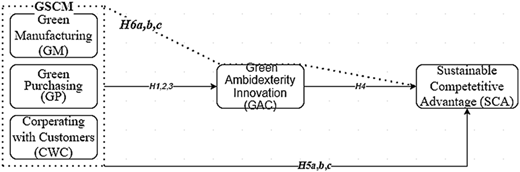
By combining both NRBV and Ambidexterity Theory, a causal mechanism where GSCM practices deliver the environmental resources and GAI is a dynamic capability that reorganize these resources into innovation outcomes used in gaining SCA is proposed in this study. In this integrated framework, GAI proposes how and why green supply chain practices have succeeded or failed in terms of their ability to create competitiveness, especially in public healthcare institutions where efforts to sustainably create health are often incremental and compliance-driven. Figure 1 depicts this conceptual framework, where GAI is argued to be the mediating mechanism between the GSCM practices and the SCA.
Green supply chain management
GSCM integrates environmental concerns into supply chain management to improve sustainability (Chatzoudes and Chatzoglou, 2023). GSCM promotes stakeholder cooperation, GM and purchasing to reduce environmental impact and maximise economic and social benefits (Birasnav et al., 2022). Environmental and consumer-compliant companies need GSCM to meet global sustainability goals (Chatzoudes and Chatzoglou, 2023). Environmental compliance, long-term profitability and operational efficiency improve with GSCM. Energy efficiency, waste reduction and resource optimisation lower supply chain costs (Bhatia and Gangwani, 2021). GSCM can boost brand loyalty and market competitiveness by strengthening relationships with eco-conscious customers, investors and stakeholders (Nureen et al., 2022). Because environmental issues affect global business dynamics, GSCM is essential for economic resilience and sustainability.
Green manufacturing
GM maintains product quality and efficiency while reducing waste, emissions and resource use (Hassan and Jaaron, 2021), and it uses energy-efficient production, cleaner technologies and waste recycling in manufacturing (Karuppiah et al., 2020). GM promotes sustainable development by reducing environmental impact and increasing productivity. GM practices enhance regulatory compliance, reduce production costs and improve image. Greener production and energy efficiency can save companies money and improve sustainability (Leong et al., 2019). GM encourages companies to try new materials and production methods to improve environmental and financial performance (Mao and Wang, 2019).
Green purchasing
Green products are eco-friendly goods and services (Khan et al., 2021a, b, c). Sugandini et al. (2020) recommend suppliers that prioritise ethical practices, eco-friendly materials and sustainable practices. The GP helps companies reduce carbon emissions and create ethical supply chains. GP improves cost, compliance and sustainability (Ghosh, 2019). GP improves supply chain transparency, supplier relations and market differentiation (Foo et al., 2019). Ahmad (2023) found that CSR improves GP ethics and sustainability.
Cooperating with customers
CWC at GSCM promotes green living, eco-friendly products and environmental awareness (Abdallah and Al-Ghwayeen, 2020). Customer engagement in sustainability efforts boosts brand loyalty and responsible consumption. Product development and lifecycle management require CWC. Companies can meet demand for green solutions by collecting customer sustainability preferences (Gelmez-Burakgazi, 2020). Collaboration boosts a company's long-term competitiveness by improving its sustainability reputation and differentiating its products in an eco-conscious market (Ali et al., 2022).
Sustainable competitive advantage
GSCM's mechanisms boost SCA, research shows. Sustainability reduces costs, enhances brand image and meets regulatory requirements (Khan et al., 2021a, b, c). GSCM increases customer loyalty and market opportunities (Teoh et al., 2023). Eco-conscious customers can be attracted by sustainability communication (Ramadan et al., 2020). Sustainability improves competitive advantage in innovation and strategic decision-making. Sustainability-driven innovation creates competitive advantages by creating hard-to-copy capabilities (Farooq et al., 2024). Sustainability initiatives that align with core business strategies often improve financial and non-financial performance, strengthening industry leadership and resilience to environmental and economic disruptions (Mahdi et al., 2019).
Green ambidexterity innovation
GAI enables an organisation to leverage its strengths and pursue new sustainable innovations (Martínez-Falcó et al., 2024). Firms need this dual capacity in a fast-changing, environmentally conscious world. Martínez-Falcó et al. (2024) argue that Green Ambidexterity enables companies to develop sustainable products and processes efficiently. GAI helps firms adapt to environmental and technological changes. Green innovation can help companies capitalise on sustainability trends, comply with regulations and benefit customers and stakeholders (Martínez-Falcó et al., 2024). Ambidextrous green strategies help firms anticipate sustainability issues and create long-term competitive solutions (Martínez-Falcó et al., 2024).
The Influence of green supply chain management on green ambidexterity innovation
GSCM promotes exploratory green innovations. Green logistics, sustainable procurement and waste reduction boost exploitation innovation and efficiency (Baquero, 2024). Renewable energy integration, closed-loop supply chains and green technology partnerships drive radical changes and eco-friendly product development in exploratory green innovation (Belhadi et al., 2022). GSCM promotes green business and sustainability by enabling both types of innovation. Legal and stakeholder support GAI. GSCM helps environmentally regulated companies innovate in a green way (Coelho et al., 2024). Test and implement green innovations with green suppliers and blockchain and AI (Muhammad et al., 2024). GSCM in core strategies may help firms innovate and meet sustainability standards. Research shows GAI improves firms' environmental adaptability. Green supply chains protect companies from climate change and resource scarcity (Suanpong et al., 2025). Adaptability is needed to compete in dynamic markets that require environmental sustainability. Through short-term operational efficiency and long-term environmental sustainability and innovation, GSCM promotes GAI.
GM is expected to influence the organisation's capacity for green innovation, as improved resource efficiency and pollution-prevention practices may free up the technological and managerial slack needed for both incremental and radical green innovations. Thus:
Green manufacturing positively influences green ambidexterity innovation.
GP exposes firms to environmentally responsible suppliers and new sustainable materials and technologies that have the potential to stimulate both incremental improvements and radical innovation. Therefore:
Green purchasing significantly influences green ambidexterity innovation
Cooperation with customers gives insights into their sustainability preferences, thus helping firms co-develop new green solutions. Hence:
cooperating with customers has a positive impact on green ambidexterity innovation
Impact of green ambidexterity innovation on sustainable competitive advantage
GAI improves operational efficiency and market differentiation, keeping firms competitive. Exploitative green innovation optimising resource efficiency, reducing emissions and using energy-efficient technologies can save money and improve compliance (Coelho et al., 2024). These savings give firms an edge, especially in industries where sustainability-related cost reductions boost profits. However, exploratory green innovation enables companies to create unique, eco-friendly products and services, thereby building brand loyalty and trust (Muhammad et al., 2024). Companies that offer biodegradable packaging, renewable energy and circular-economy models have an advantage over competitors because consumers value sustainability (Suanpong et al., 2025). These findings suggest GAI boosts brand differentiation, environmental performance and market growth. Green innovation-capable firms are also more environmentally resilient. New green technologies help companies adapt to regulatory changes and consumer preferences (Ahmad and Khokhar, 2024). As environmental concerns rise, Sarmad et al. (2024) found that long-term green innovation strategies help firms stay competitive. Thus, business success and sustainability depend on GAI. Firms that adopt both exploitative and exploratory green innovations should gain greater differentiation, improved resource efficiency and reputational benefits, leading to SCA. Thus:
Green ambidexterity innovation has a significantly positive impact on sustainable competitive advantage
The Influence of green supply chain management on sustainable competitive advantage
Researchers found that GSCM impacts firms' SCA. Sustainable logistics, waste minimisation and green procurement lower operational costs and improve regulatory compliance, making companies more competitive (Badi and Murtagh, 2019). Eco-friendly supply chains improve CSR, brand and stakeholder trust. By satisfying consumer demand for eco-friendly goods and services, GSCM differentiates firms beyond cost. Al-Awamleh et al. (2022) found that eco-conscious customers choose GSCM-integrated brands, increasing brand loyalty and retention. According to Trivellas et al. (2020), retail, manufacturing and hospitality customers trust and prefer sustainable companies. These findings show improvements in GSCM through digital transformation. AI, blockchain and big data analytics improve transparency, efficiency and sustainability in green supply chains (Nu'man et al., 2020). Companies can gain a SCA by tracking carbon footprints, optimising supply chain performance and identifying areas for improvement (Abdallah and Al-Ghwayeen, 2020). Firms need GSCM to compete in a sustainable global market. There are also direct ways in which GSCM practices can enhance competitive advantage by reducing waste, improving operational efficiency and ensuring regulatory compliance. Therefore:
Green manufacturing has a positive influence on sustainable competitive advantage
Green purchasing has a significant influence on sustainable competitive advantage
Cooperating with customers has a positive impact on sustainable competitive advantage
The Influence of GSCM on SCA Through GAI.
Innovative green ambidexterity affects GSCM and SCA. GSCM supports sustainability, while GAI differentiates and adapts firms to changing markets (Muhammad et al., 2024). Eco-friendly sourcing, energy-efficient logistics and waste reduction boost firms' competitiveness through exploitative and explorative green innovation (Suanpong et al., 2025). Innovation in green ambidexterity boosts GSCM competitiveness. Process and resource efficiency reduce costs, while sustainable product redesigns expand markets (Lu et al., 2024). High GAI helps firms lead the market, say Khan et al. (2021a, b, c). Green ambidexterity and GSCM make companies more environmentally resilient. Green supply chain innovations can help companies adapt to market changes and stay competitive as regulations tighten and consumer demand for sustainable products rises (Gelmez et al., 2024). Since GAI is the process by which the GSCM practices translate into the performance outcomes, we also suggest the following mediation hypotheses, as shown in Figure 1:
Green ambidexterity innovation mediates the relation between green manufacturing and sustainable competitive advantage
Green ambidexterity innovation mediates the relation between green purchasing and sustainable competitive advantage
Green ambidexterity innovation mediates the relation between cooperating with customers and sustainable competitive advantage
Methodology
The research design adopted in this study was a cross-sectional survey design to determine the relationships between GSCM practices, GAI and SCA in the Ghanaian public healthcare system. The study population included healthcare professionals involved in supply chain decisions, including administrators, procurement officers, supply chain managers, sustainability officers and operational supervisors. Data collection was conducted to ensure nationwide representativeness; in all 16 regions of the Ghanaian state, 253 district hospitals, 10 regional hospitals and five teaching hospitals were covered. The stratified sampling method was utilised, with the primary stratum comprising the hospital type and region. This method of sampling ensured that the proportions of each category were adequately represented and minimised the risk of regional and institutional sampling bias. Although the approach used is strong, some limitations should be noted. The cross-sectional design limits the question of causality in the examined relationships. Additionally, the focus on public healthcare institutions in Ghana is limiting the generalisability of the findings to other sectors or private healthcare systems.
A total of 850 questionnaires were issued via physical administration and via safe web-based survey links. From this, 679 valid responses were obtained, yielding a response rate of about 79.9%. To increase methodological rigour, screening questions were used to include only staff with direct or indirect connections to green supply chain processes in the study. All constructs were measured using a five-point Likert scale with a score range of 1 (Strongly Disagree) to 5 (Strongly Agree). A pilot test with 30 healthcare professionals was conducted to understand how to improve clarity, validate the content and enhance scale reliability, as the questionnaire items were designed based on validated scales from the literature.
Both measurement and structural models were analysed using Structural Equation Modelling (SEM) in SmartPLS, which enabled the examination of direct and mediating effects. Several measures were taken to address issues of methodological transparency and standard method bias. Procedural remedies involved training respondents to remain anonymous, conceptual separation of items and rearranging item order to minimise response patterning. Statistical tests, including the Harman single-factor test and full collinearity variance inflation factors (VIFs), were conducted and it was confirmed that common method bias was not a serious concern. Factor loadings, Cronbach's alpha, composite reliability, average variance extracted (AVE) and discriminant validity, based on the Fornell-Larcker criterion and the HTMT ratios, provided reliability and validity. Moreover, model fit statistics such as SRMR, NFI, RMS theta, were also evaluated to ensure that the SEM results are sufficient and strong.
Measurements
GSCM, GAI and SCA were key concepts of this study. For content validity, multiple-item scales from prior literature were used to measure each construct. In the context of GSCM, Chang et al. (2020) assessed GM, purchasing and customer collaboration. Sustainable logistics, waste management, green procurement and supplier collaboration were covered. Dzedzickis et al. (2020) measured GAI. An adapted five-item scale from Dzedzickis et al. (2020) assessed cost efficiency, sustainability differentiation and long-term competitive positioning (SCA). All items were scored on a 1–5 Likert scale from strongly disagree to agree strongly. To improve questionnaire clarity and reliability, a pilot test with 30 hospital employees refined wording and construct alignment.
Results and discussions
Factor loading
Factor loadings serve as important measures of construct reliability and validity. The measurement of the constructs shows that none of the reflective constructs under study has a factor loading below 0.7. These results are supported by the argument of Borsboom et al. (2021), who recommend best factor loadings of 0.7 or higher. The results show that the variable factor loadings have a strong fit and that the thresholds are within an acceptable range, as indicated in Table 1.
The construct reliability was 0.7 or higher, as in the model development. The Cronbach's alpha values for the construct were above 0.7. This means the constructs show a strong fit and are within an acceptable range. These results are supported by the best practices suggested by Antoni and Borghesani (2019) for a study to be considered valid. This analysis does not have multicollinearity because all variance inflation factor (VIF) values are below 5.
Convergent validity was also examined in this study, with the AVE serving as the indicator. The study shows that the AVEs for all constructs were 0.50 or higher. This is supported by Mbanaso et al. (2023) measurement of convergent validity of any instrument or construct, as in Table 1.
The study further uses the Fornell–Larcker criterion to investigate the discriminant validity of the constructs under study. The results show the correlation values for all constructs. The correlation between GAI and CWC = 0.437, GM and CWC 0.659, GP and CWC = 0.462. The correlation between all the constructs is not perfect, as it is not close to 1. This is a measure that shows discriminant validity. This supports Beck's (2023) argument that discriminant validity requires that any inter-construct correlation be 0.70 or lower. The correlation values of all the constructs show that the Fornell–Larcker criterion requirements of validity measure were met by all the constructs, as demonstrated in Table 2.
From the analysis, it was observed that all the construct correlation values of Discriminant validity – Heterotrait monotrait ratio were below 0.90 (see Table 3). Among those below 0.90, Discriminant validity – Heterotrait monotrait ratio were GAI &CWC = 0.483, CWC & GM = 0.725, GP & GAI = 0.844 and SCA & GP = 0.412. These results suggested discriminant validity acceptability (Ashworth, 2021).
To evaluate the quality and strength of the structural model, several model fit indices were examined, as shown in Table 4. The Standardised Root Mean Square Residual (SRMR) values for the saturated model (0.035) and the estimated model (0.034) are much lower than the recommended value of 0.08, indicating a perfect fit between the observed values and the model structure. Both d ULS (0.144 saturated; 0.142 estimated) and d G (0.395 saturated; 0.394 estimated) are low, indicating little difference between the model-implied and empirical correlation matrices. The Chi-square values (201.306 in the saturated model and 198.070 in the estimated model) also indicate that the model's performance is acceptable, given its complexity. Moreover, the Normed Fit Index (NFI) has been found to be 0.903 and 0.905 for the current saturated model and the estimated model, respectively, exceeding the cut-off value of 0.90 and indicating good comparative model fit. Taken together, these indices indicate that the structural model has high reliability and stability and a good overall fit.
Relationship between green manufacturing, purchasing cooperating with customers, green ambidexterity innovation and sustainable competitive advantage
The study's findings reveal nuanced relationships between GSCM practices, GAI and SCA.
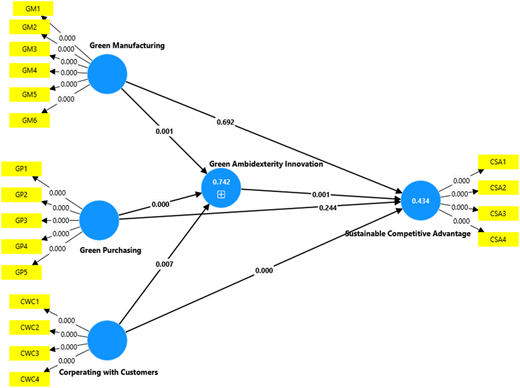
The results from Table 5 and Figure 2 show that there is a significant negative relationship between GM and GAI (beta = −0.114, p = 0.001). This counterintuitive finding implies that GM efforts in public healthcare institutions may constrain and not foster ambidextrous green innovation. Drawing on the logic of NRBV, GM in such contexts tends to be compliance driven and focused mainly on pollution prevention, waste reduction and enhanced energy efficiency to comply with regulations. While these initiatives lead to higher efficiency in the operations, they tend to focus on exploitative innovation rather than exploratory innovation.
In resource-constrained public hospitals, investments in cleaner production technologies might consume financial and managerial resources that might better be directed towards experimentation with radical green innovations. As a result, GM practices could inadvertently crowd out the exploratory innovation practices that are important for ambidexterity. This finding supports previous arguments on the potential for compliance-oriented environmental strategies to constrain strategic flexibility and innovation potential especially when organisations are not blessed with slack resources. Thus, without conscious investment in the exploratory green innovation, GM alone may fail to promote green ambidexterity.
Due to rigid production systems and high capital investment costs, many manufacturing firms struggle to adopt riskier green technologies (Belhadi et al., 2022). In GM, emissions standards may prioritise process optimisation over exploratory innovation. Green innovation thrives when firms integrate new technologies beyond regulatory requirements, according to Coelho et al. (2024). GP significantly affects GAI (β = 0.822, p = 0.000), stating that eco-friendly sourcing and circular economy principles boost innovation. Working with green suppliers exposes firms to new technologies and sustainable materials, encouraging exploitative and exploratory innovation, say Muhammad et al. (2024).
The non-significant impact of GP on SCA (β = −0.099, p = 0.244) indicates that innovation alone does not guarantee competitive advantage. This may be because green procurement strategies are costly and time-consuming. On the same note, the insignificance of the effects of GM and GP on SCA suggests that operational greening is not sufficient to ensure competitive advantage in the healthcare industry. Although green procurement is advantageous in promoting sustainable sourcing, it tends to raise costs and introduce uncertainties to the supply chain, thus limiting its immediate potential for competitive advantage. This supports the relevance of GAI as a dynamic capability that converts green practices into results that stakeholders appreciate, including cost reduction, leadership in innovation and better patient perceptions. Many sustainable sourcing firms face supply chain disruptions, higher procurement costs and resistance from traditional supply chain partners (Al-Awamleh et al., 2022). Thus, while GP builds innovation capacity, firms may need additional market positioning and consumer engagement strategies to leverage green procurement as a competitive advantage fully. Engaging customers in green initiatives is crucial, as CWC significantly affects GAI (β = 0.132, p = 0.007) and SCA (β = 0.536, p = 0.000), unlike GM and GP. Companies that involve customers in sustainability efforts are more likely to innovate and differentiate through green product co-design, feedback loops and sustainability awareness programs.
Firms benefit from internal and external stakeholder green efforts, as noted by Suanpong et al. (2025). Green products are in demand due to customers' eco-friendly purchasing and sustainable lifestyles, which encourage innovation and market acceptance. Companies using blockchain for supply chain transparency (Muhammad et al., 2024) gain a competitive edge by improving traceability and consumer trust. The positive correlation between GAI and SCA (β = 0.322, p = 0.001) indicates the importance of green innovation for long-term competitiveness. GM and GP alone do not directly affect SCA, proving that green supply chain practices do not necessarily boost competitiveness. Instead, firms must create market-relevant green innovations using these methods. Ahmad and Khokhar (2024) found that green innovation-capable companies adapt better to regulations and consumer preferences. Companies with biodegradable packaging, renewable energy or carbon-neutral supply chains comply with sustainability regulations and stand out from the crowd.
Not all GSCM practices confer a competitive advantage, this study finds. CWC significantly impacts SCA, but GM and GP do not, suggesting sustainability-driven differentiation requires more than operations. Green producers and buyers must consider consumer perceptions, brand positioning and regulatory incentives. Qualitative research suggests that firms that fail to communicate their sustainability efforts may struggle to gain market share. Poor marketing strategies prevent green logistics firms from maximising sustainability, according to Belhadi et al. (2022). Green supply chain investments are most effective when companies incorporate green branding, digital transparency and regulatory compliance into their competitive strategy.
Mediating role of green ambidexterity innovation
Table 6 shows that GAI mediates the relationship between GSCM and SCA. GM's negative impact on SCA via GAI (β = −0.037, p = 0.005) The mediation analysis shows that GAI is central to the translation of GSCM practices to SCA. The high indirect effects show that GSCM practices do not necessarily boost competitiveness unless they are channelled through ambidextrous green innovation. This finding adds credibility to the theoretical argument that environmental practices need to be strategically leveraged through innovation capabilities to create value that can be recognised by stakeholders.
Specifically, the negative indirect effect of GM through GAI suggests that efficiency-oriented environmental practices may cost competitiveness when they are not accompanied by exploratory green innovation. In contrast, the positive mediation effects observed in relation to GP and cooperation with customers suggest the importance of external knowledge sourcing and the involvement of stakeholders for the promotion of ambidextrous innovation. These results put GAI in the position of being the dynamic capability that defines the evolutionary journey from where green supply chain initiatives are operational routines and, while on the way, become the source of SCA. Resource efficiency and process improvements reduce costs but may not drive radical innovation for market differentiation, say Lu et al. (2024). Manufacturing firms prioritise compliance-driven optimisations over disruptive sustainability initiatives, resulting in incremental innovation. GM without exploratory green innovations may not boost competitiveness.
GP positively affects SCA via GAI (β = 0.265, p = 0.001), indicating a competitive advantage for firms with sustainable procurement and innovation strategies. According to Suanpong et al. (2025), eco-friendly sourcing and sustainable supplier partnerships increase cost efficiency and product differentiation. Suppliers who invest in renewable energy, biodegradable materials and closed-loop supply chains can provide firms with new green technologies, improving exploitative (efficiency-driven) and exploratory (radical) green innovation. Sustainability in procurement boosts innovation and long-term competitiveness as regulations tighten and green-conscious consumers rise (Gelmez et al., 2024).
CWC indirectly affects SCA through GAI (β = 0.043, p = 0.023), emphasising the significance of customer engagement in sustainability-driven innovation. The effect is smaller than GP's but still significant, supporting Muhammad et al.'s (2024) claim that customer collaboration drives market-driven green innovations. Co-creating green solutions, such as customised eco-friendly packaging, carbon footprint tracking and sustainable product co-design, helps companies meet consumer expectations and compete. Demand-driven sustainability, where companies incorporate consumer insights into green innovation strategies, advances innovation and market positioning. These findings show that GAI is crucial to turning green supply chain initiatives into SCA and that sustainability must be strategic and innovation-driven.
Implications for theory
The findings explain how GSCM, GAI and SCA interact in healthcare. The negative correlation between GM and GAI suggests that healthcare organisations focused on energy efficiency and waste reduction may prioritise cost-effective, incremental improvements over disruptive, innovative practices. Healthcare institutions must balance compliance-driven efficiency with radical green healthcare technology innovations. Healthcare facilities must adopt green technologies beyond regulatory compliance for sustainability. GP and GAI are strongly correlated, suggesting that sustainable healthcare procurement strategies, such as sourcing eco-friendly medical supplies and equipment, can spur exploitative and exploratory green innovations. The absence of GP's direct effect on SCA suggests that green healthcare procurement has benefits beyond cost savings and efficiency. Healthcare organisations need patient-centred innovations, green-practice marketing and regulatory alignment to sustain competitive advantage in green procurement. CWC, which involves patients and stakeholders in sustainability efforts, shows how healthcare organisations can differentiate themselves through patient education on sustainable practices and collaborative green initiatives.
Implications for practice
The results give a number of practical implications for healthcare managers and policymakers. First, hospital administrators should realise that investments in GM, including energy-efficient infrastructure and waste management systems, are necessary but not sufficient in order to achieve competitive advantage. To prevent innovation stagnation, these efforts should be accompanied by investments in exploration green technologies, for instance, renewable energy systems, digital health solutions and medical equipment that is environmentally sustainable. Second, GP strategies should be leveraged as innovation platforms and not cost-containment tools. Healthcare organisations should be developing strategic partnerships with environmentally responsible suppliers to co-develop sustainable medical products and packaging solutions. Such collaborations can improve exploitative and exploratory innovation and enable hospitals to differentiate their services whilst ensuring sustainability goals. Finally, there is the strong role played by cooperation with customers, which highlights the importance of patient and stakeholder engagement. Hospitals should be actively engaging with patients on sustainability initiatives through awareness programmes, open communication on green practices and co-creation of environmentally responsible care models. By co-aligning sustainability efforts with patient values and expectations, medical providers can support trust, boost reputation and gain SCA.
Conclusion
The study concluded that GM and purchasing practices promote innovation, but do not offer a SCA in healthcare. The findings show that GM prioritises incremental innovations over radical green innovations for long-term competitive differentiation. Green procurement practices boost innovation capacity but need market strategies and consumer engagement to be competitive. According to research, healthcare providers must go beyond operational efficiencies and incorporate market-driven, patient-focused green innovations to compete. The study emphasised customer collaboration in green innovation and competitive advantage. Patient and stakeholder participation in sustainability initiatives significantly impacts innovation efforts, suggesting that healthcare organisations can gain a competitive edge by involving patients in eco-friendly practices, such as sustainable care models and green treatment options. GAI turns green supply chain initiatives into a SCA, proving that healthcare providers who employ both exploitative and exploratory green innovations while actively engaging patients will succeed in an eco-conscious market.
Limitations and future directions
There are a number of limitations of this research. To start with, cross-sectional research design does not allow one to conclude about the causality among GSCM practises, GAI and SCA. The upcoming research should use generalisable designs to capture the dynamics of green capabilities and innovation over time. Second, the emphasis on respondents' healthcare sector does not allow generalisation of the findings to other sectors, for example the manufacturing, logistics or pharmaceutical sectors. Multi-industry comparative studies may provide deeper insights into the boundary conditions of the proposed model. Third, self-reported data may also result in perceptual bias, even though common method bias is addressed to the best of the researcher's ability. Future studies might combine objective environmental performance data or secondary data. Also, the contribution of digital technologies, including IoT, AI-powered supply chain analytics and blockchain, was not analysed and could play a significant mediating role in future studies.