


This research studies the behavior choice of key actors in the construction supply chain and constructs a model which includes the benefit function of the government, contractors and owners, aiming at improving the coverage of green buildings.
In this paper, tripartite dynamic game is studied and simulated based on duplicate dynamic equation. The tripartite game under government intervention is rarely considered, and government punishment measures are seldom introduced into the research.
According to the simulation results, the practical insights in line with the development of green supply chain are put forward. Rewards and punishments affect the development of the supply chain. New technologies and new materials accelerate the development of green supply chain and then improve the coverage of green buildings.
This paper constructs a dynamic model based on complete information rationality, which is difficult to realize in practice, for information is incomplete and human rationality is limited.
In fact, the government has not issued a punishment document to introduce a new variable adjustment model.
1. Introduction
The development of green buildings has received great attention by governments at all levels. On September 22, 2020, General Secretary Xi pointed out at the 75th United Nations General Assembly that China will decidedly increase its national contributions and adopt more forceful policies and measures to achieve carbon peaks by 2030 and carbon neutral by 2060. In recent years, the indicators of energy conservation and emission reduction have been improved and implemented strictly, and the green building industry has made significant progress. By the end of 2020, more than 200 million square meters of green buildings had been added. The proportion of urban new buildings to implement energy conservation mandatory standards has reached 100%. Even though the development of green buildings has entered a steady stage, the problem of the environmental pollution in construction industry should not be underestimated. The current situation of energy utilization and energy supply and reserve are becoming increasingly severe in China. The work of energy conservation and green building development still faces many difficulties and problems. The total scale of green buildings is small, the development is not coordinated, the project operation effect is poor and the market allocation of resources mechanism is not perfect. It is still arduous to achieve the goal of comprehensively building an ecological civilization proposed by the Party Central Committee. Building green supply chain management can save consumption and reduce pollution effectively. The implementation requires the participation of multiple parties from the government and related enterprises. At this stage, government policies and supervision are key to support and ensure the effective implementation of building the green supply chain. In order to reduce the energy consumption and carbon emission of the construction industry, expand the total scale of green buildings, organize the coordinated development of supply chain and improve the mechanism of market allocation of resources and other issues, the article introduces the analysis of key players in the development of green buildings.
It is crucial that the government cooperates and guides the relevant businesses in the construction supply chain to carry out green supply chain management. At present, researchers have made some achievements in the study of green building supply chain. The development and construction of a building is a long and complex process involving different stakeholders. There are some studies on the decision-making behavior of building stakeholders. For example, Du et al. (2020) took the government, contractors and the public as stakeholders to explore the influencing factors of waste management in building demolition and found the importance of public participation in waste management. By establishing an evolutionary game model between developers and consumers, Du et al. (2021) concluded that the probability of developers building low-carbon buildings is positively correlated with carbon tax. Policy research on green building promotion. Feng et al. (2020) suggested the government needs to take measures to stimulate demand for green buildings among home buyers. From the perspective of consumers, Luo et al. (2017) confirmed that green energy and price are the main factors influencing consumers’ choices. Some researchers focus on the relationship among different game subjects. He and Chen (2021) set up an evolutionary game model with developers and consumers as the main subject, analyzed the stability of the main players’ strategic choices and gave corresponding suggestions for different main players. Based on the characteristics of long construction period, Zhu et al. (2018) established a game model with the main contractor and subcontractor as the main subject and found that the main contractor decides the subsidy coefficient of the government and the owner. Vinodh et al. (2010) used fuzzy network analysis to determine the best supplier. After that, Shi et al. (2018) studied the cooperation choice direction of multiple suppliers and concluded that owner incentive mechanism directly affects the cooperation trend of suppliers. In addition, Feng et al. (2017) analyzed the coordination and cooperation between manufacturers. The government plays a key role in the development of green buildings. The government’s policy support is the main way to promote the development of green building market in China. The government can compensate the incremental cost of developers or consumers by policy incentives (Jia et al., 2019). However, there are limits to just rely on government incentive subsidies to promote the large-scale promotion of green building.
In recent years, the hot spot of low-carbon economy has been deepening. Energy conservation and environmental protection, resource recycling and waste recycling and other hot topics have also been concerned by relevant personnel. Thinking about the policy experience in enterprise carbon emission reduction and new energy vehicle promotion, the implementation of the government reward and punishment system has received immediate results. Green buildings can provide a comfortable indoor environment and reduce energy consumption and carbon emissions, while meeting people’s maximum living comfort (Franco et al., 2020). In summary, many results have been achieved in the research on the green supply chain of construction, but the following problems still exist: (1) Existing research considers government intervention, and there is less research on the trilateral interest game between the government, contractor and owner in the construction supply chain. (2) Existing research rarely introduces government punishment measures into the model. Therefore, the article intends to improve from the following aspects. (1) This article tries to establish a tripartite evolutionary game model based on the government, contractors and owners, discusses the stability, strategic choice and influence relationship of the three, and deeply studies the key factors affecting system stability. (2) Introduce government punishment measures into the model.
2. Model assumption and construction
2.1 Model assumption
The participants involved in the green building supply chain are complex. For the sake of analysis, assume that the whole chain consists of the government, the contractor and the owner. According to the characteristics of each subject, the following assumptions are made:
Following the assumption of “rational man” in the classical game model, the game parties make independent choices for the maximization of their interests and can make independent decisions.
The government participates, guides and formulates laws and regulations related to environmental protection from economic regulation, market supervision and social management services, which plays a regulatory role in the whole chain.
Contractors cover a wide range of contents and play a momentous role. It has a powerful influence on the procurement of construction materials and equipment, construction technology and recycling of construction waste.
The owner is at the end of the chain and is the end user of construction products. At the same time, the demand of owners for green buildings drives the management and operation of the green supply chain in the construction.
Table 1 shows relevant parameters and their descriptions in the game strategy model, and all parameter values are not less than 0.
Relevant parameters and instructions
| Parameter | Instructions |
|---|---|
| CG | Government supervision and publicity costs |
| SC | Subsidies from the government for the construction of green buildings by contractors |
| PC | Government punishment for contractors not building green buildings |
| SO | Owners receive government subsidies to buy green buildings |
| PO | Government punishment for owners do not accept purchasing green buildings |
| CC1 (UC1) | The contractor builds green building cost (income) |
| CC2 (UC2) | The contractor does not build green building cost (income) |
| CO1 (UO1) | Owners accept the cost (income) of purchasing green buildings |
| CO2 (UO2) | Owners do not accept the cost (income) of purchasing green buildings |
| U1 | Government revenues when government controls and contractors build green buildings |
| U2 | Government revenue when the government does not regulate and contractors build green buildings |
| U3 | The revenue that traditional architecture brings to the government |
At present, China is actively developing the green supply chain, but the relevant ideological propaganda and measures have not been implemented. It is necessary to improve the implementation and acceptance of green buildings by contractors and owners. In response to this phenomenon, the government, as a representative of environmental organization and environmental protection associations, should properly supervise the behavior of the objects in the green supply chain of construction. Regulatory publicity mainly includes financial subsidies and penalties for contractors and owners. Assuming that the probability of governments supervision is x , the proportion of non-regulation is 1−x, and the strategic space of the government is G (regulation, no regulation). Contractors have a choice between building and not building green buildings. Therefore, assuming that the probability of the contractor building a green building is y . On the contrary, the proportion of not making a green building is 1−y, and the contractor’s strategic space is C (to build, not to build). The choice of the owner is not controlled by the government and the contractor. The owner may or may not accept the purchase of green building. Similarly, assuming that the owner’s probability of receiving the purchase of green buildings is z , the proportion of the owner not receiving the purchase of green buildings is 1−z, and the strategic space of the owner is O (accept, do not accept). It can be concluded that there are eight kinds of game strategy choices among the supply chain game subjects.
2.2 Model construction
In the game combination strategy of the contractor and the owner, when the game behaviour choice is opposite, assuming that the total benefit obtained by the owner is 0, the contractor makes a choice in advance, and the input cost is regarded as the sunk cost. Combined with the assumptions and analysis of the above construction green supply chain, the evolutionary game income matrix between game subjects is established in Table 2.
The pay off matrix of tripartite evolutionary game
| Strategy combination | Owners accept | Owners do not accept | |
|---|---|---|---|
| Government regulation | Contractor construction | U1−SC−SO−CG | U1−SC−CG |
| UC1−CC1+SC | −CC1+SC | ||
| UO1−CO1+SO | 0 | ||
| Contractor does not build | U3+PC−CG | U3+PC + PO−CG | |
| −CC2−PC | UC2−CC2−PC | ||
| 0 | UO2−CO2−PO | ||
| Government does not supervise | Contractor construction | U2 | U2 |
| UC1−CC1 | −CC1 | ||
| UO1−CO1 | 0 | ||
| Contractor does not build | U3 | U3 | |
| −CC2 | UC2−CC2 | ||
| 0 | UO2−CO2 | ||
3. Game analysis
Based on Table 2, if the expected return under government regulation is EG1, then in the same way, the expected return without restriction is EG2, these returns can be calculated as follows:
According to Equations (1) and (2), the average expected return of the government is , which is calculated as follows:
If the expected income which contractors accept from building green buildings is EC1, and which contractors do not accept from building green buildings is EC2, then in the same way, these returns can be calculated as follows:
According to Equations (4) and (5), the average expected return of contractor is , which is calculated as follows:
If the owners accept the expected return of green building as EO1, an the expected return they do not accept from building green buildings as EO2, then in the same way, these returns can be calculated as follows:
According to Equations (7) and (8), the average expected return of owners is , which is calculated as follows:
3.1 Strategic stability analysis of government
According to Equations (1)–(3), the replication dynamic equation of government strategy choice is follows:
According to Equation (10), the first derivative of x:
Based on the theorem of the replication dynamic equation stability, it means that the government in a stable state must satisfy: . Let , then . Discussion on the equilibrium point of Equation (10):
If , solved . Under these conditions, the government takes any x value system to be stable.
If , solved . At the same time, x = 1 is the evolutionary stable point. That is, when the probability of contractors choosing to build green buildings is less than , and governments tend to choose regulatory strategy.
If , solved . At the same time, x = 0 is the evolutionary stable point. That is, when the probability of contractors choosing to build green buildings is more than , from the perspective of cost, the government chooses not to regulate publicity is an evolutionary equilibrium strategy.
3.2 Strategic stability analysis of contractor
Similarly, according to Equations (4)–(6), the dynamic replication equation of contractor strategy choice is as follows:
According to Equation (12), the first derivative of y is as follows:
Similarly, the probability of contractors in a stable state must satisfy: . Let , then . Discussion on the equilibrium point of Equation (12):
If , solved . Under these conditions, the government takes any y value system is stable.
If , solved . At the same time, y = 0 is the evolutionary stable point. That is, when the probability of the owner accepting the purchase of green buildings is less than , it is an evolutionary equilibrium strategy for the contractor not to build green buildings.
If , solved . At the same time, y = 1 is the evolutionary stable point. That is, when the probability of the owner accepting the purchase of green buildings is more than , from the perspective of demand, it is an evolutionary equilibrium strategy for contractors to choose to build green buildings.
3.3 Strategic stability analysis of owner
Similarly, according to Equations (7)–(9), the replication dynamic equation of owner strategy choice is as follows:
According to Equation (14), the first derivative of z is as follows:
Similarly, the probability of owners in a stable state must satisfy: . Let , then . Discussion on the equilibrium point of Equation (14):
If , solved . Under these conditions, the government takes any y value system is stable.
If , solved . At the same time, z = 0 is the evolutionary stable point. That is, when the probability of the contractor choosing to build green buildings is less than , from the perspective of price, the owner does not accept the purchase of green buildings as an evolutionary equilibrium strategy.
If , solved . At the same time, z = 1 is the evolutionary stable point. That is, when the probability of the contractor choosing to build green buildings is more than . It may be supplied in large quantities and sold at a relatively low price. Therefore, it is an evolutionary equilibrium strategy for owners to accept the purchase of green buildings.
3.4 Strategic stability analysis of tripartite evolutionary game
According to Friedman’s research, the equilibrium stability of the replication dynamic equation is obtained (Friedman, 1998). The Jacobian matrix of the tripartite evolutionary game is as follows:
Based on the conclusions of Ritzberger (1994) and Bomze (1992), when discussing the evolutionary stability strategy of the interaction of government regulators, general contractors and owners, only need to analyze the asymptotic stability of equilibrium points in Table 3.
Stability determination of equilibrium points
| Equilibrium | Eigenvalue | Stability |
|---|---|---|
| E1(1,1,1) | −(U1−U2−SC−SO−CG), −(UC1−CC1+CC2+SC + PC),−(UO1−CO1+SO) | Saddle point |
| E2(1,1,0) | −U1+U2+SC + CG, UC2−CC2−SC−PC + CC1, UO1−CO1+SO | Uncertain |
| E3(1,0,1) | CG−PC, UC1−CC1+CC2+SC + PC, UO2−CO2−PO | Uncertain |
| E4(0,0,1) | U1−U2−SC−SO−CG, −(UC1−CC1+CC2), −(UO1−CO1) | Saddle point |
| E5(0,0,0) | PC + PO−CG, −(UC2−CC2+CC1), −(UO2−CO2) | Saddle point |
| E6(0,1,0) | U1−U2−SC−CG, UC2−CC2+CC1, UO1−CO1 | Instability point |
| E7(0,0,1) | PC−CG, UC1−CC1+CC2, UO2−CO2 | Instability point |
| E8(1,0,0) | CG−PC−PO, −(UC2−CC2+CC1−SC−PC), −(UO2−CO2−PO) | Uncertain |
Based on the matrix properties, the eigenvalues of the Jacobian matrix E1=(1,1,1) are as follows: . According to Lyapunov’s first method, if this point is asymptotically stable, the eigenvalue of this point in the corresponding Jacobian matrix must be less than 0. As can be seen from Table 3, if point E1(1,1,1) is a stable point, the following conditions should be met simultaneously:
At this time, the government is more inclined to choose the regulatory strategy, the general contractor is more prone to build green buildings and the owner is more willing to accept the purchase of green buildings. In summary, besides being affected by their own strategic choices, each game subject will also be affected by other game subjects. Thus, if E1(1,1,1) reaches the final ideal stable point of the system, it mainly depends on the size of multiple parameter values such as government subsidies, penalties, income, contractor construction costs and sales prices.
4. Simulation analysis
In order to more clearly and intuitively show the influence of key factors on the evolution state and results of multi-party games and verify the effectiveness of evolutionary stability analysis, the following will further use MATLAB to simulate the evolution trajectory of each game. Under the condition of E1=(1,1,1) stability strategy, according to the dynamic replication equation and constraint conditions, combined with literature review and realistic situation (Liu et al., 2022), the following parameters are initially assigned: CG = 0.1, SC = 0.5, SO = 0.4, PC = 0.2, PO = 0, CC1 = 0.4, CC2 = 0.25, CO1 = 0.2, CO2 = 0.1, UC1 = 0.5, UC2 = 0.4, UO1 = 0.3, UO2 = 0.15, U1 = 1.6, U2 = 0.5 and U3 = 0.45. Figure 1 shows the initial results obtained. Based on the initial value, the effects of CG, SC, SO, PC, PO, CC1 on the process and outcomes of the evolutionary game are analyzed.
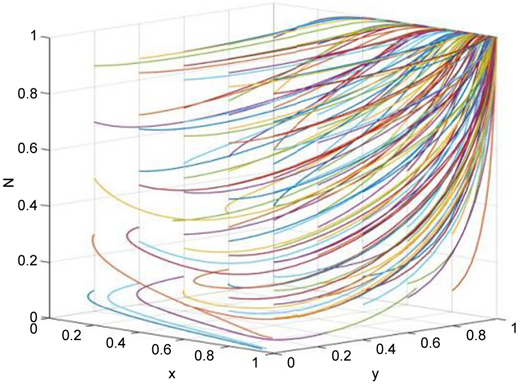
Figure 1 shows that in the initial state, the evolution stability point of the government, contractor and owner fluctuates from E4(0,1,1) to E1(1,1,1). That is, the government’s strategy changes from nonsupervision publicity to supervision publicity. In addition, even if the government's strategic choice is to supervise, some contractors and owners still tend to 0 in their strategic choices.
4.1 The effect of government subsidies for SC and SO on the evolution path
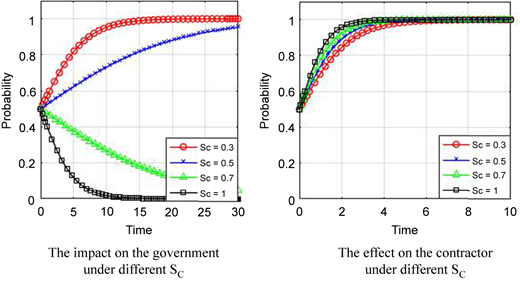
In order to strengthen the government’s policy support for green buildings, expand the scale of green buildings and speed up development, government subsidies for contractors and owners to participate in the green supply chain have to be increased. By the simulation results shown in Figure 2, government subsidy SC has a significant impact on the trend of the government’s stability strategy. The SC is within a specific range. In order to better enable contractors and owners to participate in the green supply chain, the government increases a particular cost when taking subsidy measures, which slows down the evolution speed of the government. As time changes, the final evolution state of the government tends to 1. But after paying a certain degree of subsidies, the government’s comprehensive income decreases. After that, the less the government is willing to spend on regulation and publicity, the less likely it is to do so. On the contrary, the contractor chooses to build green buildings, and the more subsidies the government gives the contractor to build green buildings, the more benefits the contractor will get, so the contractor's enthusiasm to build green buildings will be stronger. Finally, the contractor chooses to construct a green building. The strategic choices of the government, the general contractor, and the owner all evolve in the same direction, reaching the evolutionary ideal stability point E1(1,1,1). The selection strategy is government supervision, the general contractor builds green buildings and the owner accepts the purchase of green buildings.
According to Figure 3, the change of government subsidy SO has little effect on owners. With the increase of government subsidy SO, it has little influence on the tendency of owners to adopt the stable strategy. In general, contractors will transfer the incremental cost of building green buildings to owners, resulting in the price of green buildings being higher than that of traditional buildings. Government subsidy is not the main reason for the decision-making of owners. Therefore, policy subsidies have little impact on the choice of owners.
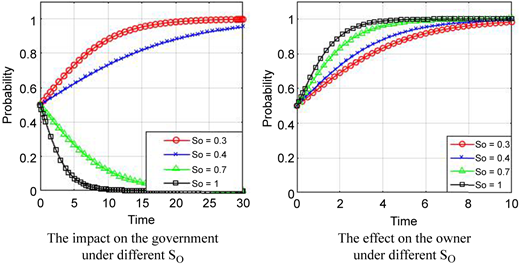
In order to build and improve the green supply chain of construction industry more effectively, make the SO value within a certain range, appropriately reduce the subsidy of the owner to accept the purchase of green buildings, stimulate the contractor and the owner to actively participate in the construction of the green building supply chain, and make the game of the three parties stable to maintain “supervision”, “build green buildings” and “accept purchases”. Therefore, when implementing the policy on green building, the government should consider the subsidies of contractors and owners to ensure the green development of the construction supply chain.
4.2 The impact of government punishment PC and PO on the evolution path
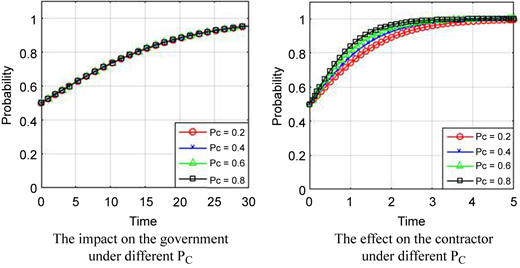
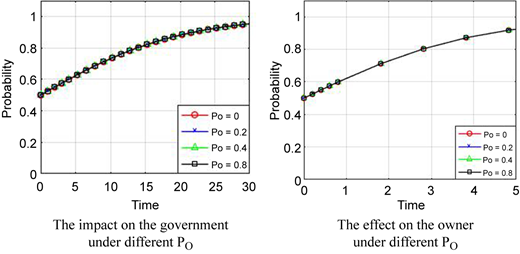
By the simulation results shown in Figures 4 and 5. With the increase of punishment values PC and PO, the trend of the government and the owners towards stability strategy does not change significantly. The contractor is greatly affected by the government’s punishment. When the government punishes the contractor for not building green buildings more severely, the contractor wants to obtain higher profits and their willingness to construct green buildings gradually increases, which is more conducive to develop green supply chain.
4.3 The impact of government regulation cost CG on evolution path
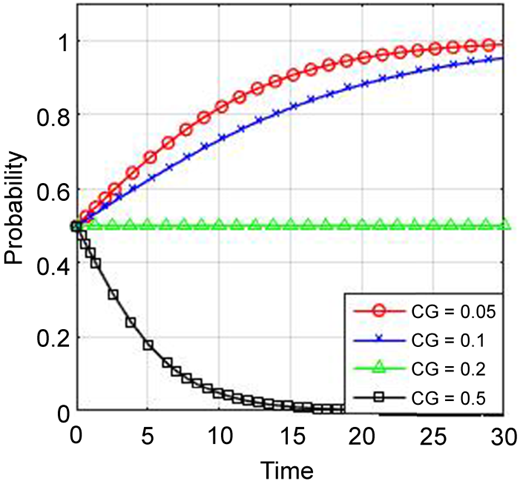
By the simulation results shown in Figure 6. Government strategy choice is influenced by regulatory cost CG. When contractors build green architectures and owners accept the purchase of green architectures, the government supervises and promotes the green supply chain of construction, expands the coverage area of the green supply chain concept of construction, strengthens and encourages local enterprises to implement the management of green supply chain and makes every effort to provide residents with high-quality buildings with harmonious coexistence between man and nature. When the government’s supervision cost CG < 3, with the decrease of CG, its evolution speed is accelerated. As time changes, the government’s final evolution state tends to 1, that is, the choice of supervision publicity. When the government’s supervision cost CG > 3, with the increase of CG and the change of time, the final evolution state of the government tends to 0, that is, without the supervision of publicity, the comprehensive benefits of economy, environment and society obtained by the government do not increase significantly so that the government chooses to appropriately reduce the regulatory cost and reduce the enthusiasm of green publicity.
4.4 The impact of green building construction cost CC1 on evolution path
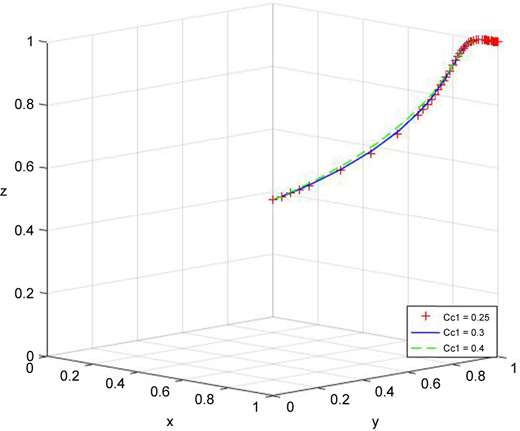
By the simulation results shown in Figure 7. In the process of evolution, the construction cost CC1 of green buildings is reduced from 25 to 23.5. With the decrease of CC1, the probability of contractors building green buildings increases, and the likelihood of owners accepting the purchase of green buildings increases. Finally, it reaches the ideal evolutionary stable point E1. Notably, the strategy is that the government chooses supervision, the general contractor builds green buildings and the owners accept the purchase of green buildings. When the government gives policy support, it will provide special financial support for new materials and technologies for green building, and corresponding costs will be paid. Therefore, the evolution speed of the government is accelerated. The government's financial support to contractors reduces the cost of building green buildings, which directly affects the strategic choice of contractors. Therefore, the evolution trend of contractors is 1. At the same time, increasing the supply of green buildings by contractors will also promote the choice of owners, and the owners will eventually converge to 1. In short, reducing the construction cost of green buildings affects the strategic choice of each game subject. The government evolves faster than the initial state. The contractors are significantly affected, and the convergence changes from 0 to 1. The owners also accelerate the convergence to 1.
Ideally, the government should strictly control and publicize the green supply chain of the construction industry to better ensure that contractors build green building products and the owners accept the purchase of green buildings to maximize social utility. Contractors actively build green buildings and follow the guidelines and policies issued by the state and government. The government has invested a lot of workforce, material and financial resources to support the construction of green supply chain, enhance and strengthen the core competitiveness of enterprises, and maximize the benefits of contractors. From the perspective of environmental protection and energy saving, owners are willing and able to buy green buildings. In order to support national policies, owners will also take the initiative to buy green buildings and integrate them into the green supply chain.
5. Conclusion
The behavioral decisions of the government, contractors and owners in the development of green buildings have an important impact on the development of the green building market. The multi-subject cooperative operation mechanism ensures the sustainable development of green buildings. This paper establishes a tripartite evolutionary game model for the government, green building contractors and owners. This article introduces government subsidies and punishment policies and analyzes the influence of various factors on the evolutionary path. Analysis shows that effective government intervention promotes the development of green supply chains. When government subsidies and penalties for contractors and owners are less than a certain value, increase subsidies and penalties for contractors and owners to accelerate the development of green buildings. To reduce the cost of government supervision, the government chooses a supervision strategy; reducing the construction cost of green buildings changes the choices of various entities. The government changes from no supervision to supervision, and the owners choose to accept the purchase of green buildings, which improves the possibility of contractors constructing green buildings.
In the process of green supply chain, government departments need to take the lead in providing guidance and support to ensure the effective realization of the green supply chain of construction, as far as possible to bring more economic benefits to participants in the green supply chain. From the current stage of development, the guidance and encouragement of governments at all levels are crucial to the orderly development of green buildings (Wang et al., 2020). The government should adopt diversified economic incentives for contractors. In addition to tax relief, financial subsidies and so on, it can also provide contractors with special grants, technical support and loan concessions so as to fully mobilize contractors’ enthusiasm for green buildings. At the same time, it is necessary to control the corresponding subsidies and penalties for contractors and owners. The government can also vigorously publicize green buildings through the media and the Internet to strengthen the public’s awareness of green buildings, thereby enhancing owners’ motivation to purchase green buildings, and finally forming an effective demand pull.
The contractor is the subject who pursues the maximization of economic benefits. Therefore, effectively reducing the construction cost of green buildings is an effective way to promote its development. To reduce construction costs, it is necessary to upgrade professional skills, introduce new materials, improve technical systems and build a whole industrial chain, such as the introduction of intelligence, informatization and digitization in the construction projects of green buildings. It is impossible to rely solely on the contractor itself, and the government’s participation must be used to optimize the allocation of resources. Among them, the government’s credit policy to support the contractor is construction, which is conducive to the efficient progress of the construction schedule. Government penalties for PC have a greater impact on contractors. By increasing government penalties, the contractor’s construction of green buildings can be accelerated. In addition, when constructing green buildings, contractors should focus on improving project quality, accelerating construction progress, and energy conservation and environmental protection. In addition, when constructing green buildings, contractors should focus on improving project quality, accelerating construction progress and energy conservation and environmental protection. It can also take advantage of the academic resources and technical advantages of universities and research institutions, which can not only reduce the construction cost of green buildings, but also reduce the additional cost and risk rate of core enterprises taking the lead in joining the green supply chain so as to improve the contractor’s income. The increase of contractor’s income also promotes the choice of building green buildings and expanding the scale of green buildings.
The owner is at the end of the construction supply chain. The industry mainly responds to the call of the country to change the consumption concept of choosing construction products and increase the willingness to buy green buildings. Among them, government subsidies for SO have a greater impact on owners. When the government chooses to monitor, it can speed up the owners’ acceptance of green building purchases by increasing government subsidies. At the same time, the government appropriately grants subsidies to owners who purchase green buildings, reduces loan interest rates and down payment ratios and takes practical actions to increase the sales of green buildings and promote the rapid development of the green building market.
The work of K. Lu is supported by Anhui philosophy and Social Sciences Planning Project (Grant No. ahsky2021d141).

