


Supply chain finance (SCF) is a cutting-edge method for optimizing financial flows in supply chains that has piqued the interest of both academics and businesses. This study examines the literature on the drivers of SCF, as well as the mediators, moderators and theories used in the SCF–performance link.
This research uses a systematic literature review technique to examine 175 articles using bibliometric analysis and subsequently 30 empirical studies for content analysis of SCF and performance literature that were found on Web of Science.
The study identified drivers of SCF and classified them into financial, managerial, supply chain and external drivers. Supply chain risk, green supply chain integration, supply and demand-oriented performance were the mediators in the SCF and performance relationship. The study further identifies gaps in the SCF–performance link.
The paper contributes to the body of knowledge by identifying and discussing previous studies on SCF and performance, presenting what is already known, identifying research gaps and offering five actionable options for further research.
1. Introduction
The evolving nature of supply chain operations has increased complexity in supply chain management (Min et al., 2019). Small- and medium-sized businesses (SMEs) seek diverse funding options to address credit issues and enhance financial performance (Cummings et al., 2020). Effective supply chain management underscores the importance of building enduring partnerships with collaborators (Saragih et al., 2020; Fei and Yi-na, 2006; Zaman et al., 2024). In challenging situations, businesses, particularly those with strong negotiation skills, are securing or providing financing through supply chain partners to tackle supply chain challenges (Garcia-Appendini and Montoriol-Garriga, 2013; Moretto and Caniato, 2021).
Supply chain finance (SCF) is increasingly favoured by SMEs as a viable financing option within supply chain networks (Lu et al., 2022; Wang et al., 2020). SCF enhances business performance by enabling extended payment terms and strengthening receivable facilities for suppliers (Wuttke et al., 2016). SMEs utilize SCF to bolster working capital, expanding payment terms and accessing additional credit (Tanrisever et al., 2015; Abbasi et al., 2018). SCF has transformed business practices by providing risk-free loans to ensure smooth supply chain operations (Ali et al., 2018; Basole and Bellamy, 2014). This approach has effectively bolstered financial stability due to its low capital requirements and risk-averse nature, hence, helps to build resilience and robustness (Muntaka et al., 2024).
Pfohl and Gomm (2009) define SCF as the process of optimizing financial interactions between companies and integrating financial activities with customers, suppliers and service providers to maximize overall value. Wuttke et al. (2013) characterize SCF as the convergence of financial institutions and fintech solutions that link cash flow to product and information flows throughout the supply chain, aiming to optimize cash flow from a supply chain perspective.
Interest in SCF research has surged over the past decade, with a growing number of scientific articles dedicated to the subject. This increased attention has helped clarify SCF’s identity and framework. However, despite its significance, certain areas of SCF research remain fragmented. While previous literature reviews, such as Gelsomino et al. (2016), have focused on conceptualizing SCF, and others have explored SCF outcomes and solutions, there is a lack of comprehensive reviews that examine SCF’s impact on performance. This study distinguishes itself by specifically focusing on the relationship between SCF and performance, while also exploring key variables such as antecedents, mediators, moderators and underlying theories. Unlike previous reviews, this paper offers a deeper investigation into how SCF influences performance outcomes. With growing interest from both academia and industry, this systematic review consolidates knowledge on the drivers and mechanisms behind SCF’s impact on performance, addressing a crucial gap in the literature for a more detailed and comprehensive understanding of this relationship.
To address these gaps, this study follows a systematic literature review (SLR) methodology, which incorporates both bibliometric analysis and content analysis. The bibliometric analysis helps map publication trends, key authors and influential journals, while the content analysis delves into empirical studies to extract insights on the antecedents, mediating and moderating variables of SCF’s impact on performance. This rigorous methodology ensures a comprehensive review of existing literature, facilitating a clear understanding of the state of SCF research and identifying areas for future exploration.
In that regard, the study addresses the research questions: What is the state of the art of SCF and performance research by focusing on publication and keyword trends, influential authors, prominent journals and countries. In addition to the state of the art, the study addresses four objectives: identify the antecedents of SCF, identify the theories used in SCF and performance literature, identify the moderating and mediating variables used in SCF and performance research, and identify knowledge gaps for future research.
The subsequent sections of the paper are organized as follows: Section 2 outlines the methodology, followed by section 3 which presents the findings. The paper is then summarized and concluded in section 4, encompassing discussions on potential avenues for future research and acknowledging the study’s limitations.
2. Materials and methods
In line with the research questions outlined earlier, this paper adopts a SLR approach that incorporates bibliometric and content analysis techniques. This methodology is chosen to facilitate a comprehensive and critical examination of the existing body of literature pertaining to the intersection of SCF and performance. The SLR methodology is a rigorous and replicable process designed to collect and assess all pertinent evidence necessary for addressing specific research inquiries within a defined subject area. It involves a meticulously planned and thorough exploration of the available literature, coupled with a discerning evaluation of studies that satisfy predetermined criteria. This approach ensures that the review process is comprehensive and methodical, enabling a robust analysis of the topic at hand (Briner and Denyer, 2012; Han et al., 2020; Ritterbusch and Teichmann, 2023).
The advancement of information technology makes it possible to do objective, scientific quantitative analysis of the articles. Many scholars use Vos Viewer and other programs to do bibliometric analyses, which has grown to be a crucial step in the process of conducting academic literature reviews. This study uses the bibliometric analysis method to analyse publication sources, citation analysis, etc. Content analysis is also done on empirical papers to answer objectives two, three and four.
2.1 Locating studies
Following the systematic methodology advocated by Denyer and Tranfield (2009), the second step in conducting a SLR involves the comprehensive search for pertinent research studies within the chosen subject area. The objective here is to systematically identify, select and evaluate a curated list of key papers that directly address the research questions at hand (Denyer and Tranfield, 2009). In the case of this study, the search for relevant articles pertaining to SCF and performance was carried out using the Web of Science database. The rationale behind selecting the Web of Science database lies in its extensive coverage, which allows for a thorough exploration of research articles even in more specialized and niche areas of study, as highlighted by Singh et al. (2020).
To locate studies within our focal areas and research questions, some keywords were set as the search criteria, following extant literature. The phrases used for the search were namely:
supply chain financ*AND performance OR resilience OR disruption orientation
These keywords were searched in the titles, abstracts and keywords of the papers. There was no restriction to the date of the papers. The search identified 204 papers (see Figure 1).
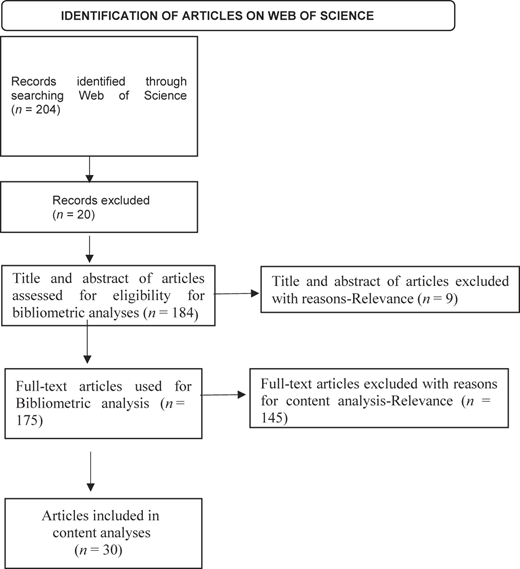
PRISMA framework of the article selection process. Source: Authors’ own creation
PRISMA framework of the article selection process. Source: Authors’ own creation
2.2 Study selection and evaluation
To ensure transparency and rigor in the study selection process, explicit criteria were applied, following the guidelines outlined by Han et al. (2020). These criteria, informed by the PRISMA framework (refer to Figure 1), guided the inclusion and exclusion of relevant studies in the review process. Inclusion criteria encompassed studies that met the following conditions: publication in international peer-reviewed journals, use of the English language, availability of authorship information (Conz and Magnani, 2020; Gallardo-Gallardo and Thunnissen, 2016) and access to full-text articles (Chakuu et al., 2019). Conversely, studies falling into categories such as conference papers, editorial notes, book chapters, reviews, brief communications, commentaries, symposia and presentation slides were excluded from consideration (Anlesinya et al., 2019; Jia et al., 2020). Notably, no time restrictions were imposed in this study to ensure the comprehensive coverage of all available literature on the subject (Xu et al., 2018). By applying the exclusion criteria mentioned above, 20 papers were excluded, and 184 papers remained; 9 were again excluded after a title and abstract assessment to ensure they were in line with the objectives of the study. Even though the search string included resilience and disruption orientation, an assessment of the title and abstract showed that articles on resilience and disruption orientation did not relate to SCF. The bibliometric analysis was therefore done on 175 remaining articles. Finally, to achieve objectives 2, 3 and 4, further exclusion criteria were undertaken to select only empirical papers, hence the full texts of the remaining articles were perused to select only empirical articles which were in line with the research questions. The main criteria used here was to exclude all articles that did not deal with only SCF such as articles that looked at drivers of blockchain adoption in SCF since it was not within the object of this study, modeling and simulation papers were also excluded. After this screening, 145 papers were removed and 30 papers were selected for the content analysis.
3. Results
3.1 State of the art of supply chain finance and performance literature
As part of the objectives of the study, we sought to examine the state of research in the SCF and performance nexus. Using HistCite and VOSviewer software, the study analysed the keyword and publication trends and also identified the influential authors, journals and countries in the SCF and performance literature.
3.1.1 Keyword trends
The study undertook an analysis of keywords and their trends. VOSviewer was used to analyse 55 keywords extracted from the 175 publications. Figure 2 depicts the co-occurrence network of keywords linked to SCF and performance. VOSViewer was used to find the words with the highest keyword occurrence. The pattern of these keywords indicates a shift in emphasis from SCF to blockchain, sustainability, firm performance and empirical analysis, as against earlier issues of reverse factoring, integration and innovation. This indicates the prevailing issues within the SCF and performance literature. Current studies within the subject matter consider issues of empirical analysis as against earlier papers, as suggested by (Gelsomino et al., 2016), empirical papers on SCF have generally been low, hence the possible feature of empirical analysis as a current keyword trend. Also, issues of sustainable financing have attracted the interest of SCF and performance scholars. Sustainability in general has been a global trending issue, hence the need to understand the role of sustainable financing within the supply chain ecosystem. Technology has highly been associated with supply chain financing. The issues of fintech continue to thrive (Ashta and Biot-Paquerot, 2018).
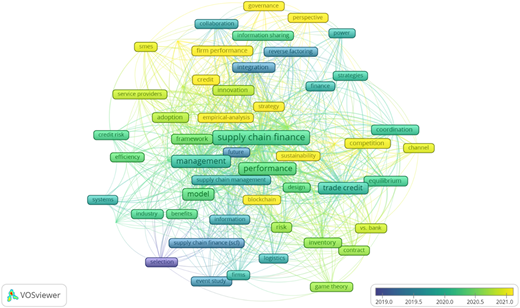
A challenge of SCF as with supply chains is trust (Fellenz et al., 2009), hence the possible reason blockchain is currently trending in SCF and performance literature. Blockchain takes care of the trust issues within supply chain activities and further ensures the smooth operation of supply chain activities including financing (Dutta et al., 2020). Finally, issues of supply chain governance also feature in the keyword trends. SCF is highly influenced by how the supply chain is governed. As posited by Natanelov et al. (2022), how a supply chain is governed plays a key role in the effectiveness of SCF.
3.1.2 Trends of publication
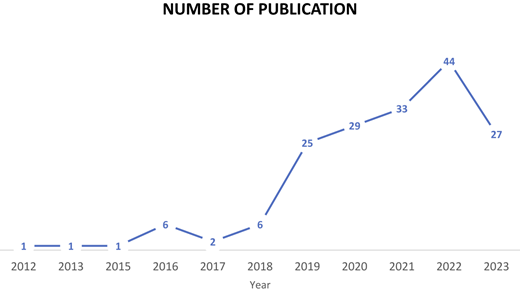
Figure 3 shows the trends of publication within the subject matter of SCF and performance. Even though the concept of SCF has existed for some time now, preceded by issues of trade credit, factoring and reverse factoring among others (Gelsomino et al., 2016). It is important to know that issues of how SCF, a broader term for financing the needs of the supply chain influence performance started in 2012 with only one article. Articles on SCF and performance saw a significant increase in 2019. The year 2022 saw the highest number of articles on the subject matter. The year 2023, even though very early, has already recorded 27 articles. The significant increase in the number of publications coincides with the outbreak of COVID-19 in China in the year 2019. COVID-19 came with a lot of distress among supply chains (Barman et al., 2021; Kumar et al., 2021; Sharma et al., 2021), hence the increase in the number of publications during this era.
3.1.3 Publication by authors
This section highlights notable contributors to SCF and performance. Influence is not solely determined by publication count, as Price (1965) observed that 75% of academics published just one article, while 10% authored half of all publications. Instead, influence is assessed using publication count, average global citation score and aggregate global citation score. As depicted in Table 1, among 487 authors of 175 documents, only 15% had multiple publications, with 27 authors exceeding two papers. Few of these ranked among the top 20 influential authors based on global citation scores. Blome C achieved the highest global and average citation scores despite having only three publications. In contrast, the most prolific author, Song H, contributed six publications, with a global citation score of 139 and an average of 29.13. Caniato F and Yu KK followed with five publications each, while Gelsomino LM and Hofman E had four each.
Influential authors
| S/N | Author | Number of papers | TGCS | TGCS/t |
|---|---|---|---|---|
| 1 | Blome C | 3 | 309 | 44.23 |
| 2 | Wuttke DA | 3 | 269 | 32.38 |
| 3 | Caniato F | 5 | 206 | 36.58 |
| 4 | Wang GJ | 3 | 190 | 33.28 |
| 5 | Xie C | 3 | 190 | 33.28 |
| 6 | Zhu Y | 3 | 190 | 33.28 |
| 7 | Ronchi S | 2 | 172 | 25.25 |
| 8 | Ahn SH | 1 | 164 | 13.67 |
| 9 | Cho DW | 1 | 164 | 13.67 |
| 10 | Hwang MK | 1 | 164 | 13.67 |
| 11 | Lee YH | 1 | 164 | 13.67 |
| 12 | Gelsomino LM | 4 | 161 | 25.58 |
| 13 | Heese HS | 2 | 151 | 21.65 |
| 14 | Hofmann E | 4 | 141 | 24.2 |
| 15 | Song H | 6 | 139 | 29.13 |
| 16 | Tseng ML | 2 | 139 | 24.87 |
| 17 | Wu KJ | 2 | 139 | 24.87 |
| 18 | Yu KK | 5 | 139 | 30.3 |
| 19 | Yang SA | 2 | 131 | 21.67 |
| 20 | Tang CS | 1 | 130 | 21.67 |
Source(s): Authors’ own creation
Interestingly, many top-ranked authors had only one publication, with the lowest global citation score among them being 130 and the lowest average citation score 13.67. This demonstrates that influence in the field is not proportional to publication volume, suggesting a need for analysis beyond publication counts. Co-authored papers were counted multiple times in this analysis.
3.1.4 Publication by journal
The study also delved into an analysis of publications based on journals. Table 2 presents the top 20 journals identified in the review. Notably, the International Journal of Production Economics emerged as the most prolific contributor, accounting for 23 articles, which represents 13.1% of the total publications considered in the review. Additionally, this journal boasted the highest total global citation score of 784 and an impressive average total global citation score of 162.5, making it the frontrunner in terms of citations among the articles under review. Following closely, the International Journal of Production Research made a substantial contribution with 8 articles, securing its position as the second most influential journal. Interestingly, despite its relatively modest contribution of five articles to the review, the International Journal of Physical Distribution and Logistics Management demonstrated remarkable performance, ranking second both in terms of total global citation score and average total global citation score. It’s worth noting that only approximately 10% of the journals made more than two contributions to the subject matter.
Publication by journal
| S/N | Journal | Recs | Percent | TGCS | TGCS/t |
|---|---|---|---|---|---|
| 1 | “International Journal of Production Economics” | 23 | 13.1 | 784 | 162.5 |
| 2 | “International Journal of Production Research” | 8 | 4.6 | 138 | 28.76 |
| 3 | “Industrial Management and Data Systems” | 7 | 4 | 53 | 12.8 |
| 4 | “International Journal of Operations and Production Management” | 6 | 3.4 | 25 | 8.5 |
| 5 | “Journal Of Purchasing and Supply Management” | 6 | 3.4 | 172 | 38 |
| 6 | “International Journal of Physical Distribution and Logistics Management” | 5 | 2.9 | 199 | 29.58 |
| 7 | “International Transactions in Operational Research” | 5 | 2.9 | 110 | 29.17 |
| 8 | “Journal Of Business and Industrial Marketing” | 5 | 2.9 | 10 | 5 |
| 9 | “Sustainability” | 5 | 2.9 | 63 | 10.78 |
| 10 | “Transportation Research Part E-Logistics and Transportation Review” | 5 | 2.9 | 45 | 15.58 |
| 11 | “Annals of Operations Research” | 4 | 2.3 | 19 | 0.01 |
| 12 | “Complexity” | 4 | 2.3 | 19 | 6.33 |
| 13 | “International Journal of Logistics-Research And Applications” | 4 | 2.3 | 107 | 20.05 |
| 14 | “Supply Chain Management-An International Journal” | 4 | 2.3 | 134 | 20.42 |
| 15 | “Computers and Industrial Engineering” | 3 | 1.7 | 196 | 20.82 |
| 16 | “MandSom-Manufacturing and Service Operations Management” | 3 | 1.7 | 131 | 21.67 |
| 17 | “Benchmarking-An International Journal” | 2 | 1.1 | 15 | 2.8 |
| 18 | “Business Process Management Journal” | 2 | 1.1 | 42 | 7.33 |
| 19 | “IEEE Access” | 2 | 1.1 | 6 | 1.5 |
| 20 | “IEEE Transactions on Engineering Management” | 2 | 1.1 | 15 | 0.01 |
Source(s): Authors’ own creation
3.1.5 Publication by country
The information on affiliated countries with the greatest total global citation scores was extracted using HistCite. Table 3 shows the top 20 countries with the highest total global citation scores from the publications under review. It can be observed that a high proportion of citations are generated from publications from the People’s Republic of China with a total global citation score of 1,567 followed by the United Kingdom and United States with total global citation scores of 709 and 607 respectively. A greater proportion was altogether generated by citations of publications from European and Asian countries with very few coming from a smaller number of African countries.
Publication by country
| S/N | Country | Recs | Percent | TGCS |
|---|---|---|---|---|
| 1 | Peoples R China | 116 | 66.3 | 1,567 |
| 2 | UK | 23 | 13.1 | 709 |
| 3 | USA | 22 | 12.6 | 607 |
| 4 | Germany | 3 | 1.7 | 269 |
| 5 | Italy | 10 | 5.7 | 248 |
| 6 | Switzerland | 5 | 2.9 | 233 |
| 7 | Spain | 3 | 1.7 | 218 |
| 8 | Belgium | 2 | 1.1 | 195 |
| 9 | Taiwan | 8 | 4.6 | 186 |
| 10 | South Korea | 3 | 1.7 | 171 |
| 11 | Australia | 11 | 6.3 | 105 |
| 12 | Iran | 7 | 4 | 71 |
| 13 | Egypt | 1 | 0.6 | 47 |
| 14 | India | 8 | 4.6 | 44 |
| 15 | Netherlands | 3 | 1.7 | 39 |
| 16 | Canada | 3 | 1.7 | 32 |
| 17 | Malawi | 1 | 0.6 | 27 |
| 18 | Singapore | 1 | 0.6 | 27 |
| 19 | France | 5 | 2.9 | 17 |
| 20 | Morocco | 2 | 1.1 | 16 |
Source(s): Authors’ own creation
3.2 Antecedents of supply chain finance
The study’s primary objective was to scrutinize the factors driving SCF. To accomplish this goal, a comprehensive content analysis of 33 empirical papers was conducted. Upon meticulous examination of these papers, the drivers of SCF were systematically categorized into four distinct groups: financial drivers, managerial drivers, supply chain drivers and external drivers as depicted in Table 4.
Drivers of supply chain finance
| Category | Drivers | Citation |
|---|---|---|
| Financial drivers | Capital pressure, Access to financing, Cost reduction | Wang et al. (2020), Wuttke et al. (2019) |
| Managerial drivers | Inventory turnover cycle, Self-efficacy, Attitude towards SCF, Bargaining power, Digitization, Negotiation, Big data analytic capabilities | Ali et al. (2019), Bi et al. (2022), Cho et al. (2019), Li et al. (2021), Wang et al. (2020), Yu et al. (2021) |
| Supply chain drivers | Legitimacy motives (mimetic, normative, and coercive), Ego network density; External collaboration, Network cohesion, Network Power, Order fulfilment cycle, Social influence, Relational governance, Contract governance, Customer concentration, Customer stability | Ali et al. (2019), Bi et al. (2022), Carnovale et al. (2019), Li et al. (2021), Liu et al. (2022), Lu et al. (2022), Wang et al. (2020), Wuttke et al. (2019) |
| External drivers | Financial institutions | Bi et al. (2022) |
Source(s): Authors’ own creation
Financial drivers encompass all factors related to an organization’s financial well-being and the imperative to enhance its financial performance. For instance, Wuttke et al. (2019) discovered that suppliers facing constraints in accessing financing are more inclined to adopt SCF. Moreover, suppliers tend to adopt SCF more swiftly when it leads to substantial reductions in their financing costs. Wang et al. (2020) also identified a positive correlation between capital pressure and the adoption of SCF. Firms experiencing significant capital pressure encounter heightened liquidity risk concerning their working capital, prompting them to bolster cash reserves and mitigate financial risks.
Moreover, managerial drivers encompass factors within the purview of management, including bargaining power, digitization initiatives, inventory turnover cycles and capabilities in big data analytics, among others. Cho et al. (2019) established a positive correlation between bargaining power and SCF adoption. Similarly, Bi et al. (2022) reported a positive relationship between digitization efforts and SCF adoption. This implies that firms actively pursuing digitization are more likely to embrace SCF compared to those without such initiatives. Firms with substantial bargaining power are poised to gain financially through superior negotiation positions with their supply chain partners (Cho et al., 2019). Additionally, the integration of SCF was found to be driven by big data analytics capabilities in a study conducted by Yu et al. (2021). Yu et al. (2021) emphasized that big data analytics capabilities play a crucial role as an information conduit, connecting data generated by these capabilities with clients and suppliers. This, in turn, facilitates the implementation of SCF instruments by enhancing information processing capabilities for internal SCF integration.
The third category of drivers is the supply chain drivers, which contain the highest number of driving factors of SCF. Factors within this category include external collaboration, network cohesion supply chain governance, among others. Carnovale et al. (2019) found network cohesion to have a shortening effect on the cash conversion cycle. Network cohesion is the connectedness and togetherness among actors within a network (Carnovale et al., 2019). This means that the level of cohesion within the supply network is a key driver of SCF. Further, a firm’s level of collaboration with other supply chain actors is an antecedent of SCF. External collaboration entails fostering cooperation, commitment and business effectiveness among supply chain partners, which leads to higher productivity in businesses due to established processes, competencies and procedures among chain partners through the utilization of the benefits that accrue in such relationships (Bi et al., 2022; Mishra et al., 2022). Lu et al. (2022) studied the role of supply chain governance in terms of relational and contractual governance influencing SCF availability. They found that contract governance played a greater role in SCF availability than relational governance even though they both have a positive influence on supply chain financing availability, contract governance reduces financing risk (Lu et al., 2022).
Financial institutions wield significant influence in the realm of SCF. This categorization falls under external drivers, which encompass factors beyond the control of the firm and its supply chain partners. Bi et al. (2022) found financial institutions to have a positive relationship with SCF adoption. Financial institutions are firms that give out funds or facilitate funds for supply chain activities.
3.3 Theories used in supply chain finance and performance studies
In line with the objectives of the study, we sought to find out the level of use of theories in the SCF and performance nexus. As shown in Table 5, out of 30 empirical papers, 23 papers applied theories in the papers representing 77% of the papers under review, on the other hand, 7 papers representing 23% of the papers did not apply any theory. The most dominant theories used as presented in Table 5 include agency theory, dynamic capability theory, resource dependency theory, transaction cost theory and resource-based view theory, each one appearing more than once in the papers under review. Each of the dominant theories is discussed below;
Theories used
| Articles | Use of theory | Theory used |
|---|---|---|
| Bi et al. (2022) | ✓ | “Dynamic Capability View” |
| Beka Be Nguema et al. (2022) | ✓ | “Dynamic Capability View” |
| Guo et al. (2022) | ✓ | “Social Exchange Theory” |
| Rajaguru et al. (2022) | ✓ | “Dynamic Capability Theory” |
| Liu et al. (2021a) | × | |
| Li et al. (2021) | ✓ | “Theory of Planned Behaviour” |
| Ali et al. (2020) | ✓ | “Agency Theory” |
| Wang et al. (2020) | × | |
| Ali et al. (2018) | ✓ | “Resource-Based View” |
| Cho et al. (2019) | ✓ | “Resource Dependency Theory” |
| Alora and Barua (2019) | ✓ | “Stakeholders’ Theory and Transaction Cost Economics” |
| Wuttke et al. (2019) | ✓ | “Institutional Theory” |
| Carnovale et al. (2019) | ✓ | “Resource Dependency Theory” |
| Lu et al. (2022) | ✓ | “Transaction Cost Theory” |
| Wuttke et al. (2013) | × | |
| Ali et al. (2021) | ✓ | “Contingency Theory” |
| Song et al. (2018) | × | |
| Lam et al. (2019) | × | |
| Lam and Zhan (2021) | ✓ | “Resource Dependence Theory” |
| Shou et al. (2021) | ✓ | “Resource-Based View” |
| de Goeij et al. (2021) | ✓ | “Transaction Cost Theory” |
| Wandfluh et al. (2016) | ✓ | “Agency Theory” |
| Ali et al. (2019) | ✓ | “Transaction Cost Theory” |
| Liu et al. (2021b) | × | |
| Yu et al. (2021) | ✓ | “Organizational Information Processing Theory” |
| Liu et al. (2022) | ✓ | “Resource Dependence Theory” |
| Chen et al. (2019) | ✓ | “Resource-Based View and Dynamic Capabilities Theory” |
| Xu et al. (2022) | ✓ | “Social Capital Theory” |
| Li and Chen (2019) | × | |
| Moretto and Caniato (2021) | ✓ | “Contingency Theory, Resource Orchestration Theory” |
Source(s): Authors’ own creation
3.3.1 Agency theory
A significant challenge in supply chain risk management is the limited availability of credit for firms. Consequently, firms resort to leveraging multiple credit sources, including SCF, to establish safeguards that provide access to risk-free credit. This strategic approach ultimately contributes to improved performance (Ali et al., 2020). Agency theory is applied to the relationship between firms and financiers. Financiers are seen as the principals while the firms are seen as the agent. The agency theory serves as a valuable framework for understanding SCF and its implications because it aims to create mutually beneficial outcomes for both the principal and the agent. In this context, both parties engage in negotiations to safeguard their respective interests. The principal, often a financier, seeks to maximize profits by offering financing solutions to the buyer (agent). Meanwhile, the buyer benefits from the credit provided, optimizing their working capital and ensuring efficient business operations. This win–-win dynamic in the agency–principal relationship is a central theme explored by researchers like Ali et al. (2020), Beka Be Nguema et al. (2021) and Juniati et al. (2019) who apply the agency theory to their studies.
3.3.2 Dynamic capability theory
Dynamic capability is a concept denoting an organization’s ability to adapt and reconfigure its internal and external resources in response to shifting environments (Khan et al., 2020). In light of its management processes and market positioning, a company needs to acquire and mobilize various resources and capabilities, including SCF, to align with changing circumstances (Teece and Pisano, 2003; Ambrosini and Bowman, 2009; Oliva et al., 2019). The capacity to devise strategies for unpredictable and evolving conditions is crucial for an organization. Therefore, SCF plays a vital role in ensuring a significant competitive advantage in dynamic environments, contributing to organizational renewal. SCF, considered a fundamental capability (Beka Be Nguema et al., 2021), can mitigate the risk of default, enhance working capital management and improve firm performance in rapidly changing business landscapes by enhancing an organization’s dynamic capabilities for sustained competitive advantage.
3.3.3 Resource dependency theory
Resources are vital for organizations to achieve their long-term strategic goals. Often, due to a scarcity of strategic resources within, firms must seek external resources. They do so by forming both formal and informal partnerships with other organizations, ensuring a stable financial foundation and access to necessary resources (Moretto and Caniato, 2021). Resource dependency theory views inter-organizational interactions as outcomes of reliance and constraints, positing that organizations depend on each other for essential resources (Drees and Heugens, 2013).
Uncertainties, such as the high cost of obtaining external resources, can impede a firm’s growth. Resource Dependency Theory suggests that firms seek to mitigate uncertainty by establishing relationships with external parties possessing crucial resources. This theoretical perspective views an organization’s network, including its supply chain, as a source of resources, including financial ones. Moretto and Caniato (2021) and Carnovale et al. (2019) have both employed this theory in their analyses of SCF and its implications.
3.3.4 Transaction cost theory
Transaction costs encompass all expenses associated with establishing, sustaining and concluding business associations (Carr and Pearson, 1999). This concept is commonly employed to describe how businesses interact with and oversee inter-organizational business connections. Transaction cost theory, on the other hand, focuses on determining the most efficient governance structure to minimize overall expenses, given specific external conditions pertaining to the transaction’s nature. SCF entails a transaction between buyers and financiers, underscoring the importance of optimizing governance to lower costs and enhance performance.
3.3.5 Resource-based view theory
The resource-based view theory suggests that firms possess a collection of resources, and optimizing the utilization of these resources can both facilitate and restrict business growth (Cho et al., 2019). Barney (1991) asserts that the resource-based view theory centres around two key elements: resource heterogeneity (the varied resources and capabilities a firm possesses) and resource immobility (the potential long-term differences among firms). Firms possess a range of resources, including SCF, which they leverage to potentially achieve superior performance. In SCF research, the resource-based view theory is applied by regarding SCF as a valuable resource capable of enhancing a firm’s capabilities and, ultimately, improving its overall performance.
3.4 Mediators and moderators of supply chain finance and performance
3.4.1 Mediators
As part of its objectives, the paper aimed to examine various variables that have been investigated as potential mediators in the relationship between SCF and performance. It is important to highlight that while several intervening variables were identified in the review, only three were found to directly mediate the relationship between SCF and performance. However, it’s worth noting that other intervening variables were identified, although they mediated certain antecedents or drivers of SCF, as well as the availability or adoption of SCF. The three mediators that were specifically identified are: supply chain risk, green supply chain integration and supply and demand-oriented performance.
3.4.1.1 Supply chain risk
SCF serves as a tool to mitigate risk within the supply chain. In the past, companies seeking liquidity and operational capital often operated independently from their trading partners when it came to financing their operations. They would secure working capital funding based on their own terms and financial needs, which sometimes led to conflicting goals between companies and their business partners. “Buyer firms’ typically aimed to increase their inventory and extend payment terms to maximize their revenue, while “supplier companies” preferred shorter collection periods (Dyckman, 2011). These conflicting objectives among supply chain partners heightened the overall supply chain risks, making the chain more vulnerable.
SCF, recognized as one of the risk mitigation strategies, effectively reduces supply chain risk, consequently improving overall performance (Ali et al., 2020; Beka Be Nguema et al., 2021; Bi et al., 2022). It’s important to note that, in this context, the study focuses on supply chain risk primarily from the perspective of operational risk. However, it’s worth mentioning that the broader supply chain risk literature generally identifies two dimensions of risk: operational and disruptive risk (Tang, 2006; Thun and Hoenig, 2011). Table 6 identifies the dimensions of supply chain risk studied.
Dimensions of supply chain risk studied
| Author | Title | Perspective |
|---|---|---|
| Bi et al. (2022) | “Does supply chain finance adoption improve organizational performance? A moderated and mediated model.” | Operational risk |
| Beka Be Nguema et al. (2021) | “The effects of supply chain finance on organizational performance: a moderated and mediated model.” | Operational risk |
| Ali et al. (2020) | “Predicting firm performance through supply chain finance: a moderated and mediated model link.” | Operational risk |
Source(s): Authors’ own creation
3.4.1.2 Green supply chain integration
Guo et al. (2022) studied sustainable SCF and its relationship with firm and environmental performance. When businesses provide favourable conditions to supply chain partners, the latter may expect a reciprocal benefit, especially when SCF adoption provides supply chain partners with preferential financial resources in exchange for their compliance in implementing green supply chain integration. Customers and suppliers, in turn, would go above and beyond to assist businesses in achieving long-term goals and increasing competitiveness. As a result, green supply chain integration has a mediating influence in attaining firm and environmental performance.
3.4.1.3 Supply and demand oriented performance
Rajaguru et al. (2022) in analysing the relationship between SCF and performance, studied the mediating role of supply and demand-oriented performance. SCF, they believe, is a lower-order capacity that aligns demand and supply across the supply chain, resulting in high-order supply and demand-oriented performance, which improves the organization’s performance.
3.4.1.4 Antecedent mediators
Lu et al. (2022) in studying supply chain governance in terms of contract and relational governance, analysed the role of opportunism in mediating the relationship between supplier buyer relationship and SCF availability. Using the transaction cost theory, they explain that transaction cost accrues from opportunism which is curtailed by the supplier–buyer relationship, be it by contract or relationship. Relationship governance enhances trust and social norms (Chen et al., 2021) whilst contract governance inhibits opportunism through terms and contracts (Wei et al., 2022). A supply chain ecosystem governed by either relation or contract or both reduces opportunism, which encourages supply chain financing availability, either from chain partners or financial service providers. Yu et al. (2021) also studied the role of internal SCF integration in mediating the relationship between big data analytics capability and SCF integration with suppliers and customers. Adoption intention was also studied as a mediator by Li et al. (2021) in the relationships between self-efficacy, attitude towards SCF, social influence and actual adoption of SCF.
3.4.2 Moderators
The study examines the conditions under which SCF impacts performance, focusing on various moderating factors that influence this relationship. As presented in Table 7, one significant factor is customer concentration, defined as the extent to which a supplier relies on a small number of customers. Liu et al. (2021a) found that higher customer concentration strengthens SCF’s positive impact on performance while also intensifying its ability to reduce risk, suggesting that SCF becomes particularly effective in high-concentration scenarios. Another critical factor is trade digitization, as explored by Ali et al. (2020). Their research highlights that digitization enhances operational efficiency and supply chain visibility, making SCF more impactful by improving access to supply chain orders and amplifying its benefits for performance.
Moderators
| Moderator | Source |
|---|---|
| Environmental dynamism | Bi et al. (2022), Beka Be Nguema et al. (2022) |
| Environmental leadership | Guo et al. (2022) |
| Perceived partner opportunism | Rajaguru et al. (2022) |
| Buyer-supplier relationship (customer concentration) | Liu et al. (2021a) |
| SC visibility | Ali et al. (2020) |
| Trade digitization | Ali et al. (2020) |
| Innovation intensity | Cho et al. (2019) |
| Sales growth | Cho et al. (2019) |
| Financing alignment | Lu et al. (2022) |
| Operational slack | Lam and Zhan (2021) |
| IT capability | Lam and Zhan (2021) |
| Political connection | Lam and Zhan (2021) |
| Firm capabilities (Production and Innovation) | Shou et al. (2021) |
| Customer financial constraints | Lu et al. (2022) |
| Data-driven culture | Yu et al. (2021) |
| Supplier market power | Liu et al. (2022) |
| SC concentration | Xu et al. (2022) |
Source(s): Authors’ own creation
Environmental conditions also play a crucial role in shaping SCF outcomes. Bi et al. (2022) and Beka Be Nguema et al. (2022) studied environmental dynamism, which refers to the constant and unpredictable changes in an organization’s external environment. They found that SCF helps firms maintain competitiveness in dynamic environments, emphasizing its importance in adapting to rapid changes and uncertainties. Similarly, environmental leadership, examined by Guo et al. (2022), reflects senior executives’ concerns about balancing economic growth and environmental conservation. While firms with strong environmental leadership are more likely to adopt innovative financial solutions, Pan et al. (2020) discovered that this leadership can diminish the benefits of sustainable SCF, requiring firms to strategically prioritize between SCF adoption and environmental initiatives.
Partner behaviours also moderate SCF’s effectiveness. Rajaguru et al. (2022) investigated perceived partner opportunism, which can emerge in dynamic supply and demand environments. Opportunistic behaviours, such as financial imbalances and information asymmetry, weaken the benefits of SCF by reducing its ability to enhance supply- and demand-oriented performance. This finding underscores the need for firms to manage partner behaviours effectively to maximize SCF’s impact. In addition, Ali et al. (2020) highlighted the importance of supply chain visibility, defined as the ability of participants to access supply chain orders. High visibility strengthens SCF’s risk mitigation capabilities by enabling better decision-making. In contrast, poor visibility can lead to mismanagement, reduced performance and disruptions, as noted by Moshood et al. (2021) and Kalaiarasan et al. (2022).
Firm capabilities further shape SCF outcomes. Shou et al. (2021) analysed the role of production and innovation capabilities in enhancing the relationship between reverse factoring and operational performance. Their findings revealed that these capabilities boost the profitability benefits of reverse factoring, though they have no significant effect on cost efficiency. This suggests that specific capabilities align better with particular SCF outcomes, particularly profitability. Additionally, customer stability and financial constraints influence the dynamics of SCF, as highlighted by Liu et al. (2022). Their research found that supplier market power mitigates the adverse effects of customer concentration while enhancing the benefits of customer stability. However, customer financial constraints exacerbate the risks associated with customer concentration and diminish the positive impacts of customer stability on SCF.
4. Future research direction, summary of findings, limitation and conclusion
4.1 Future research direction
Several gaps have been discovered as a result of the review, which will serve as the foundation for future research. First of all, it can be observed that generally, the number of empirical papers on the subject matter is very low. This study out of 175 articles only found empirical 30 articles for the content analysis which signifies the low number of empirical papers on the subject matter. It is therefore imperative that future studies expand empirical studies on the subject matter. Secondly, papers are skewed towards Asia, with no paper emanating from Africa. These contextual differences leave more to be desired. Future research should look at how the relationships exist within the African context since it may give more insights that may not have been seen in other contexts.
Third, supply chain risk has been studied as a mediator in the SCF and performance relationship. Tang (2006) posits two dimensions of supply chain risk, disruptive and operational risks. Supply chain risk within the context of this review has been studied from the perspective of operational risk. If these dimensions are studied in totality, will the occurrence of supply chain risk especially the disruptive dimension not become a barrier to the adoption of SCF? More importantly, in an industry that is more susceptible to disruptive risk such as the agricultural industry and in a context of a developing economy.
Fourth, several intervening variables have been studied in the SCF and performance literature, the review observes that some of the intervening variables focus on the antecedents of SCF (Li et al., 2021; Lu et al., 2022; Yu et al., 2021), while others focus on the outcome variables (Ali et al., 2021; Beka Be Nguema et al., 2022; Bi et al., 2022). There are a lot of intervening variables yet to be studied. For instance, SCF is postured as though it is only a risk-mitigating tool, hence authors such as Ali et al. (2021), Bi et al. (2022) and Beka Be Nguema et al. (2022) all studied supply chain risk as a mediator. There has been little emphasis on how SCF results in performance in the absence of risk. Future studies should therefore consider intervening variables such as operational capability, operational flexibility and product and process innovation among others. Fifth, big data analytics capabilities have been studied as an antecedent of SCF, but it is yet to be explored relative to its conditioning or intervening role in achieving performance through SCF, likewise other technology-related constructs such as blockchain and fintech.
Based on the above, the study makes the following research propositions;
What are the unique dynamics and relationships between SCF and performance within the African context, and how do they differ from findings in other regions?
How does the consideration of both operational and disruptive dimensions of supply chain risk impact the adoption and effectiveness of SCF, especially in industries prone to disruptive risks, such as agriculture in developing economies?
What other intervening variables beyond risk mitigation play a role in the relationship between SCF and performance? For instance, how do operational capability, flexibility, innovation and other factors contribute to performance enhancement through SCF?
How does the incorporation of technology-related constructs like big data analytics, blockchain and fintech influence the relationship between SCF and performance? What conditions or roles do these technological factors play in enhancing performance outcomes?
4.2 Summary of findings
The study analysed the relationship between SCF and performance by reviewing 175 articles, offering insights into keyword trends, publication patterns, influential contributors and key SCF drivers. Keyword analysis shows a shift from traditional SCF topics like reverse factoring to newer areas like blockchain, sustainability, firm performance and empirical analysis, reflecting the growing role of technology and sustainability in SCF.
Since 2019, SCF literature has grown significantly, particularly during the COVID-19 pandemic, with 2022 seeing the highest number of publications. Song H was the most prolific author, but Blome C had the highest citation impact. The International Journal of Production Economics led in both publication volume and citation scores. China contributed the most to SCF research, followed by the UK and USA, with minimal input from African countries.
The study identified four key drivers of SCF: financial, managerial, supply chain and external. Financial drivers include capital constraints and liquidity needs, while managerial drivers involve digitization and bargaining power. Collaboration and external factors, like the role of financial institutions, also play a key role in SCF adoption. Of the 30 empirical papers reviewed, 77% applied theories, with agency theory, dynamic capability theory and resource dependency theory being the most common. The study also highlighted three mediators—supply chain risk, green supply chain integration and supply and demand-oriented performance—and noted several moderators, such as customer concentration and trade digitization, which amplify SCF’s positive impact on performance.
4.3 Limitation of the study
Despite the insights this study provides, it has significant limitations. In the first place, the Web of Science database was utilized to assemble the literature and because the Web of Science database does not index or cover all articles, possible SCF and performance studies may have gone unnoticed, impacting the paper’s findings. Second, the study employed a combination of objective and subjective data collection methods, including keyword searches, screening and shortlisting. While the subjective approach of screening and shortlisting is advantageous, biases in article selection may exist. In addition, the keywords were picked based on the definition of SCF and performance as well as the literature on the subject. Despite our best efforts, the keywords utilized may not be complete; a different set of search terms might produce different results, leading to alternative assessments of the state of the subject. Future research could address these limitations by exploring additional databases, refining keyword strategies and employing more standardized selection methods to provide a more comprehensive understanding of the field.
4.4 Conclusion
This paper reviews 175 articles using the bibliometric analyses approach, 30 empirical papers are further used for the content analysis. The paper sets out to achieve four research objectives. It begins by analysing the state of art of the SCF and performance literature concerning the various journals that published these papers, the most cited papers of the affiliated countries. It further looks at the drivers of SCF, the mediators and moderators as well as the theories used in SCF and performance literature. The drivers identified were classified into financial, managerial, supply chain and external drivers. Supply chain risk, green supply chain integration and supply and demand-oriented performance were the mediators in the SCF and performance relationship. Managers can therefore enhance SCF benefits by leveraging mediators like risk management and green integration, amplifying impact through moderators like trade digitization and fostering trust and collaboration across the supply chain.
This study contributes to the literature in four folds, first, this is one of the first SLR papers that looks at SCF and performance, secondly, the paper reviews the literature on the mediators and moderators of the SCF and performance relationship, one of the few if not the only review to capture mediators and moderators of the relationship. Finally, the study proposes five future research directions and consequently four research propositions.
This study was funded by United States Agency for International Development, Grant/Award Number: 7200AA20CA00010.

