


The study aims to determine in a dual-channel low-carbon supply chain (DCSC with LC), when the adoption of Blockchain technology (BT) can maximize the profits of supply chain (SC) businesses?
To tackle the information opacity issue of low-carbon (LC) products in the dual-channel supply chain (DCSC), this paper constructs a Stackelberg model of different DCSCs with LC and explores the impact of BT on pricing decisions of DCSCs with LC.
The research finds: (1) Without BT, when the unit direct sales cost (UDC) is within a large threshold, the low-carbon products manufacturer’s (LCPM’s) profits under the distribution model are higher than those under the direct sales model. With BT, in both models, the profits of both LCPMs and retailers grow with the surge in the value coefficient of the shared information. (2) In the direct sales model, regardless of whether BT is adopted, the profits of LCPMs reduce with the increase in UDC; when the emission reduction cost coefficient (ECC) is within a large threshold, profits of traditional retailers (TRs) multiply with the UDC and vice versa; the profits of LCPMs after adopting BT are larger than that those without BT implementation. (3) In the distribution sales model, LCPMs and retailers that incorporate BT are more profitable than those that do not.
In the literature exploring the impact of information-sharing benefits resulting from BT on the pricing decisions of DCSCs with LC, numerous studies are conducted from the perspective that BT application can advance the consumption demand of consumers; however, only a few studies have been conducted from the perspective that the BT application can upgrade the efficiency of manufacturers and thus achieve additional information-sharing merits. Therefore, this paper investigates the pricing decisions of DCSC with LC based on BT, which further enriches the research in DCSC management.
1. Introduction
The National Bureau of Statistics reported that online retail sales reached 15.52 trillion yuan in 2024, a 0.8% increase compared to 2023. Within this figure, online retail sales of physical goods grew by 0.5%, amounting to 13.08 trillion yuan, which represents 26.8% of the overall retail sales of consumer goods. The above data reveal the increasing proportion of online consumers; however, physical stores remain dominant. In this context, manufacturers have created several marketing models that integrate online and offline dual-channel (DC) structures. For instance, online shopping platforms like Jingdong Mall and Suning Shopping have self-operated businesses that sell goods using a distribution sales model and have flagship stores opened through the consignment sales mode. However, Apple, Dell and other manufacturers adopt the online direct sales model. But in reality, the coexistence of multiple channels can result in significant channel conflicts. Therefore, how manufacturers can develop pricing strategy for DCSCs to maximize profits while effectively alleviating channel conflicts is a critical issue.
With the growth of the economy and the intensification of climate issues, the government has implemented various policies to address climate change. It has actively promoted the concept of environmental protection, which strengthens consumers’ environmental awareness. For example, Ray and Jewkes (2004) indicated increased environmental protection awareness among consumers, with eco-conscious consumers willing to spend more on low-carbon (LC) products. Furthermore, 70% of respondents from Europe expressed their readiness to incur higher costs for products that carry an environmental label [1]. Therefore, it is necessary to introduce low-carbon technology (LCT) into the SC to produce LC products. However, due to the information asymmetry of the SC, some merchants falsely advertise their LC properties to obtain more profits. For example, on February 26, 2025, consumers accused Apple of misleading marketing for three Apple Watch models that claimed to be “carbon neutral”, relying on carbon offset programs that did not achieve the promised emissions reductions [2]. Therefore, how to disclose accurate and complete low-carbon information of products to meet the consumer demand for green and LC products is also a critical issue to address at present.
BT, with its decentralized, transparent, immutable and traceable characteristics, could enable information sharing of the SC and address information asymmetry issue caused by the lack of transparency. Additionally, BT can track and record the carbon emissions of products and address the distrust of consumers for the green and LC products (Bai et al., 2021). For instance, Covalent, an American fashion brand, utilizes IBM’s BT, which helps consumers track the carbon footprint of fashion accessories to view the product’s environmental impact. Furthermore, the information sharing of BT can lower businesses costs and increase profits, improve the cooperation ability among businesses in the SC and the efficiency of their operations. Therefore, it is of great significance for us to investigate the pricing decisions of DCSCs with BT-based LC.
The introduction of BT into the DCSCs with LC profoundly affects businesses, but the adoption of blockchain brings high technical costs. However, it remains unclear whether LCPMs should introduce BT and what level of emission reduction investment could maximize businesses’ interests, alleviate the conflicts of DCs and disclose comprehensive LC information of products to meet consumer demand for green products. According to these phenomenon, this research seeks to explore the following issues: How do BT and LCT affect the pricing strategies of businesses in DCSCs with LC? It can be further divided into three specific questions:
In a DCSC with LC, determine when the adoption of BT can maximize the profits of SC businesses.
Based on the four DCSC with LC models, what boundary conditions must be considered for SC members while selecting the optimal sales model and making the best pricing decisions?
What is the influence of the UDC, the emission reduction cost coefficient (ECC) and the value coefficient of shared information on the pricing decisions of DCSC with LC businesses?
To overcome the above challenges, this paper first selects two common DCSC structures of direct and distribution sales to discuss the impacts of BT and LCT on the pricing decisions of DCSCs with LC. Four DCSCs with LC structures of direct and distribution sales, without and with BT, are constructed, respectively. Among them, BT can bring information-sharing benefits. Second, the optimal equilibrium solutions under the four models are obtained using Stackelberg’s backward induction. Finally, sensitivity and comparative analyses are used to determine the influence of BT and LCT on the pricing decisions of DCSCs with LC, and the effects of relevant parameters on the demand and profits of each channel are discussed.
The primary contributions of this study are detailed as follows: (1) In the context of information-sharing benefits arising from BT, this paper determines the effects of BT on pricing decisions of DCSCs with LC by comparing four DCSCs with LC models. It presents theoretical guidance for businesses and governments to make pricing decisions for DCSCs with LC within the context of BT. (2) In the literature exploring the impact of information-sharing benefits resulting from BT on the pricing decisions of DCSCs with LC, numerous studies are conducted from the perspective that BT application can advance the consumption demand of consumers; however, only a few studies have been conducted from the perspective that the BT application can upgrade the efficiency of manufacturers and thus achieve additional information-sharing merits. Therefore, this paper investigates the pricing decisions of DCSC with LC based on BT, which further enriches the research in DCSC management.
2. Literature review
This section examines the studies in three major areas: pricing decisions in SCs, LC investment strategies in SCs and the effects of BT on SC decisions.
2.1 Pricing decisions of SCs
For single-channel SCs, Zhang et al. (2023) constructed a SC composed of manufacturers, third-party logistics providers and retailers. The results show that the manufacturer-led Stackelberg game enables all members of the SC to achieve consistent profit maximization goals. Chang et al. (2023) studied the optimal combination of platform channel contracts and guaranteed financing strategies. The results show that regardless of who guarantees, platforms tend to offer reselling (marketplace) models when market demand risk is flat (high). For dual-channel SCs, numerous research have been conducted on the pricing and channel selection decision of SCs under a mixed structure of traditional and network channels. For example, Liu et al. (2020a, b) examined how varying levels of network acceptance of consumers affect the best pricing, demand and profit margins for differentiated products in single-channel and DCSC. Chen et al. (2017) investigated the decision issues related to pricing and quality in different SCs. The findings demonstrate that introducing new channels can generate higher SCs’ and their members’ profits while considering price and quality decisions. Li et al. (2022) delved into the pricing decision of electronic waste product recycling in DC reverse SC under the joint influence of recyclers’ loss aversion and consumers’ bargaining power. The results demonstrate that the competition in recycling channels can enhance the recycling price and profit of each member of the SC. Chen et al. (2017) and Li et al. (2022) stated that incorporating dual channels can increase the earnings of each member of the SC. In addition, the above literature primarily focuses on the competition within the channels, and there is little discussion on the influence of competition between different DCSCs on the pricing decision of SCs. Therefore, it is essential to examine pricing decisions and channel choice for different DCSCs. For example, Aslani and Heydari (2019) examined the product greenness, pricing and coordination of centralized and decentralized DCSCs under channel disruption. The findings highlighted that the trans-shipment contract proposed to coordinate the SC can ensure the profitability of members.
2.2 LC investment strategies for SCs
With the development of an LC economy, the SC’s LC investment strategy has gained significant attention in recent years. Wang and Zhang (2023) constructed two models: product subsidy and emission reduction subsidy. The results show that when the emission reduction efficiency is high, the effects of regulation and subsidy offset each other. When the efficiency is low, it is mutually reinforcing. Wang et al. (2022) constructed a two-period supply chain composed of manufacturers and retailers, and studied the impact of emissions trading on manufacturers’ investment in emission reduction. The results show that the level of emission reduction decreases with the increase of the permit price, and its uncertainty also decreases. Luo et al. (2016) discussed how cooperation and competition affect manufacturers’ pricing and emission reduction choices under the LC system. The findings prove that higher emission reduction efficiency will lead to higher profits. Dong et al. (2023) stated that supply chain members can use different combination financing methods to effectively resolve the problem of financing constraints. The research shows that under the partial financing model, consumers’ strong LC preference will increase the retail price level of LC products with low cost and low price sensitivity. Luo et al. (2016) and Dong et al. (2023) discovered that LC abatement efficiency and consumers’ LC preference affect the pricing decision of the SC, and emission reduction efficiency plays a positive role in promoting profits. He et al. (2024) examined the influence of government subsidy policies and information asymmetry on manufacturers’ abatement and retailers’ LC promotion in the LC SC. Their research showed that manufacturers do not lie about incentives under information asymmetry, but retailers do. The proposed screening model can be used to reduce the negative impact of information asymmetry on SC and improve its performance. Cheng et al. (2024) analyzed the optimal contract design in asymmetric information SC under the constraints of dual environmental responsibility. Research has demonstrated that producers often set lower wholesale prices for high-type retailers in an environment of asymmetric information. This strategy allows producers to achieve higher profits with lower carbon emissions while helping retailers gain additional information profits. He et al. (2024) and Cheng et al. (2024) revealed that BT applications can solve the problem of information asymmetry well by eliminating the negative impact of information asymmetry on the SC and improving its performance. Yang (2023) built a DCSC model including e-commerce companies and green product manufacturers. Their investigation showed that green investment by e-commerce companies is more beneficial to the overall SC profit and the environment. It boosts the manufacturer’s profits under the platform sales model but is not always advantageous to its profit under the self-operated sales model. Zhou and Ye (2018) examined joint abatement strategy and contract design in DCSC under the LC environment. Their findings showed that manufacturers’ profits and abatement efforts are higher, and retailers’ profits and advertising efforts are lower in DCSCs than in single-channel SCs. Under certain conditions, cooperative advertising and abatement cost-sharing contracts are more effective than cooperative advertising contracts. Yang (2023) and Zhou and Ye (2018) found that introducing LC technologies into the DCSCs is meaningful in examining pricing decisions in the manufacturer-led SC (Xu et al., 2018). Under cap-and-trade regulation, LC preference and channel substitution are considered, and two DCSC decision models comprising manufacturers and retailers are constructed. The research shows that consumers’ LC preference can strengthen SC profits. Xu et al. (2018) considered the influence of consumers’ LC preference on the optimal emission reduction investment strategy and profit of DCSC. It concluded that consumers’ LC preference is positively correlated with SC profits.
2.3 The influence of BT on SC decision
Among the relevant literature examining the effects of BT on SC decisions, Wu et al. (2023) built a green SC model involving cash-constrained manufacturers and retailers. They investigated the impact of the applications of BT on manufacturers’ financing strategies. The research proves that when the efficiency of BT investment is at a low level, the adoption of a no-financing strategy is considered to be the best choice. In contrast, in the case of high efficiency, the trade credit financing strategy is considered to be more advantageous. Choi (2019) examined the value of BT-enabled platforms in the diamond certification and verification process. The research shows that reducing the cost of accreditation positively impacts all participants in the luxury SC. Liu et al. (2020a, b) evaluated the SC of green agricultural products, including the manufacturer and the retailer. They analyzed changes in investment decisions before and after applying big data and blockchain-based information services (ISBD). The research demonstrates that when the total investment cost of manufacturers and retailers is in a certain range, ISBD can effectively increase the profits of SC enterprises. Jiang et al. (2024) constructed a DCSC composed of domestic e-commerce and manufacturers and overseas offline stores. The research demonstrates that the adoption of BT can maximize the profits of SC businesses. According to researches of Liu et al. (2020a, b) and Jiang et al. (2024), introducing BT into the SC will positively affect the profits of SC enterprises under specific conditions. While considering the LC preference and green trust of consumers, Xu et al. (2023) analyzed the model selection of online platform and the coordination of DCSC. Their paper demonstrated that the application of BT is conducive to reducing emissions for enterprises and bringing more profits to enterprises and platforms. Jiang and Liu (2022) considered the LC sensitivity of consumers and studied the collaborative strategies of SC enterprises in LC emission reduction and BT investment under multiple DC models. Their study stated that different DC models have certain BT investment thresholds, and raising the threshold can help achieve emission reduction targets. According to researches of Xu et al. (2023) and Jiang and Liu (2022), under specific conditions, incorporating BT into the SC benefits the emission reduction of SC enterprises. Liu et al. (2021) analyzed the influence of BT on the selection of sales mode in the DCSC of fresh food. The research demonstrates that the competition between online and offline channels drives up the price of fresh produce, prompting businesses to invest more in blockchain traceability goodwill. Zhu et al. (2023) scrutinized the influence of BT on the equilibrium strategy of a brand owner-dominated DCSC and the conditional thresholds that motivate brand owners to implement BT. Their investigation explained that BT adoption always benefits retailers but not always brand owners.
This paper examines two aspects of BT and SCs. First, it investigates the influence of BT on abatement and profits of SC enterprises by examining its influence on the equilibrium strategy of manufacturer-led DCSC with LC to determine the optimal pricing decision of SC. On the other hand, much of the above literature exploring the impact of information sharing benefits from BT on SC decision making focuses on consumer perspectives, where the application of BT can facilitate consumer demand. However, this study adds a new perspective of the LCPM where the application of blockchain can enhance the LCPM efficiency and thus gain additional information sharing benefits. While the above literature examines the impact of applying LCT and BT on SC decision making, this study examines the impact of applying both LCT and BT by LCPMs on pricing decisions in different DCSCs.
3. Problem description and model assumptions
3.1 Problem description
This study considers that the LCPM produces only one LC product and invests in LCT. In DCSCs, where the retailer follows the LCPM in making the decision, the DCSCs are classified into four distinct DC sales models according to the implementation of BT (Figure 1).
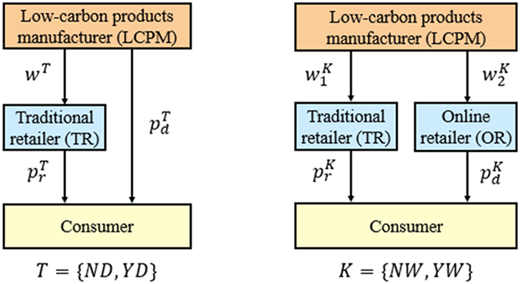
Figure 1: (1) Direct sales model without BT ( model): the LCPM maintains the traditional retail channel, selling products to traditional retailers (TRs) at wholesale prices . Next, TRs sell products to consumers at traditional retail prices . In contrast, the LCPM autonomously establishes an online direct sales channel, enabling the direct sale of products to consumers at self-determined online direct sales prices , which generate the unit direct sales cost (UDC) (Arya et al., 2007). (2) Distribution sales model without BT ( model): the LCPM maintains the traditional retail channel, selling products to TRs at wholesale prices . Next, TRs sell products to consumers at traditional retail prices . In contrast, the LCPM implements the online retail channel, selling their products to online retailers (ORs) at wholesale prices . Then, ORs sell products directly to consumers at self-determined online retail prices . (3) Direct sales model with BT ( model): the LCPM maintains the traditional retail channel, selling products to TRs at wholesale prices . Next, TRs sell products to consumers at traditional retail prices . In contrast, the LCPM autonomously sets up an online direct sales channel, enabling the direct sale of products to consumers at self-determined online direct sales prices , which generate the UDC c (Arya et al., 2007) (4) Distribution sales model with BT ( model): the LCPM maintains the traditional retail channel, selling products to TRs at wholesale prices . Next, TRs sell products to consumers at traditional retail prices . In contrast, the LCPM incorporates an online retail channel, selling its products to ORs at wholesale prices . Then, ORs sell products directly to consumers at self-determined online retail prices .
3.2 Model assumption
According to the LC investment cost proposed by Jiang and Liu (2022), this study assumes that the LC investment cost of the LCPM is , where is the EED and is the ECC.
Based on the demand functions proposed by Jiang et al. (2024), Liu et al. (2012) and Xia et al. (2018), it can be observed that the retail price, the direct sales price and the EED are all linearly related to the demand of conventional and online channels. On the one hand, these two kinds of demand are negatively correlated with the sales price in their own channel, and positively correlated with the sales price in the competing channel. For example, when the price of Apple’s official website and offline direct stores is reduced, consumers’ purchase demand in these channels increase, and when the price reduction of competitive channels such as third-party e-commerce platforms is significant consumers’ purchase demand for competitive channels increase [3]. On the other hand, the environmental sustainability of products drives demand, reflecting consumers’ willingness to pay more for more sustainable products. For example, a report showed over 75% of the respondents strongly approve of low-carbon and environmentally friendly consumption behavior, and more than 60% are willing to pay extra to reduce their carbon footprint [4]. When BT is not used, the sensitivity coefficient of the EED is , which is a proportional parameter. Therefore, when LCPM does not adopt BT, the demand functions for conventional and online channels are defined as follows:
where is the demand, is the basic potential market demand, is the retail price and is the cross-elastic price coefficient between the two channels.
When LCPM adopts BT, consumers can obtain comprehensive and accurate information on the reduction of carbon emissions associated with the production of LC products. This transparency solves the problem of green distrust and increases consumer sensitivity to EED. For example, Molian Technology cooperates with Wanxiang Blockchain and Microsoft Azure Sphere to realize the verifiability and traceability of green electricity data throughout its life cycle. Consumers can obtain data on these blockchains through specific ways to clearly understand the green power sources and low-carbon attributes of products, thereby increasing their sensitivity to low-carbon information [5]. Therefore, this study assumes that the sensitivity coefficient of the emissions reduction efforts degree is , and the functions of demand for conventional and online channels are defined as follows:
To streamline the analysis, this paper posits that both the LCPM’s production cost and the investment cost of BT are zero.
Information-sharing benefits. Hayrutdinov et al. (2020) indicated that BT could bring information-sharing benefits along with the information-sharing benefit function , which is based on the th-order Taylor formula (where , represents the value of information sharing, represents the level of ecological design effort, represents the value coefficient of information sharing, subscript represents the core businesses and non-core businesses respectively). On this basis, this study assumes that the information-sharing benefit is (where , represents the value of information sharing, represents the EED and represents the value coefficient of information sharing).
The parameters of the model discussed in this study and their economic implications are presented in Table 1.
Parameters notation and description
| Parameters notation | Description |
|---|---|
| Basic potential market demand | |
| Cross-elasticity price coefficient between dual channels | |
| Sensitivity coefficients of the emissions reduction efforts degree (a measure of the willingness of consumers to pay more for products that are more sustainable for the environment) | |
| Unit direct sales cost (UDC) in the online direct sales channel | |
| Emission reduction cost coefficient (ECC) | |
| Value coefficient of shared information | |
| In model , emission reduction efforts degree (EED) | |
| In model , online retail price (when indicates the online direct sales price) in the online retail channel | |
| In model , the traditional retail price in the traditional retail channel | |
| In the direct sales model , the wholesale price in the traditional retail channel | |
| In the distribution sales model , wholesale price in the traditional retail channel | |
| In the distribution sales model , wholesale price in the online retail channel | |
| In model , online channel demand | |
| In model , traditional channel demand | |
| In model , LCPM’s profit | |
| In model , TR’s profit | |
| In model , OR’s profit | |
Source(s): Table 1 created by authors
4. The DC sales model without BT
4.1 Direct sales model without BT ( model)
The retailer adheres to the LCPM in making the decision, and the LCPM invests in LCT. Model’s decision-making hierarchy: first, the LCPM establishes online direct sales price , the EED and wholesale price . Next, the TR establishes traditional retail price .
The functions of demand for conventional and online channels are defined as follows:
The function of the LCPM’s profit is expressed as follows:
The function of the TR’s profit is described as follows:
In the model, there are optimal wholesale price , optimal online direct sales price , optimal EED , optimal traditional retail price , optimal traditional channel demand and optimal online channel demand to maximize the earnings of the LCPM and the TR.
Proof: The equilibrium solutions see Appendix.
4.2 Distribution sales model without BT ( model)
The retailer follows the LCPM to make a decision, and the LCPM invests in LCT. Model’s decision-making hierarchy: first, the LCPM sets up the wholesale price , and the EED . Second, the TR establishes traditional retail price . Finally, the OR establishes online retail price .
The functions of demand for traditional and online channels are represented as follows:
The function of the LCMP’s profit is described as follows:
The function of the TR’s profit is mentioned as follows:
The function of the OR’s profit is detailed as follows:
In the model, there are optimal wholesale price , , optimal online retail sales price , optimal EED , optimal traditional retail price , optimal traditional channel demand and optimal online channel demand to boost the profits of the LCPM, the TR and the OR.
Proof: The equilibrium solutions are provided in Appendix.
ECC and UDC of the above two models meet: ; . A similar treatment was used by Chen et al. (2021).
Lemma 1 describes the validity of the above two models and shows that a low ECC and a high UDC are not feasible. ECC and UDC must be kept within a certain range to ensure the operation of the models. First, high ECC encourages manufacturers to increase investment in emission reduction technology innovation to reduce the cost. For example, Budweiser Sezin, through technological innovation, improves its carbon peak and carbon neutral management capacity, constantly reducing the factory consumption indicators. On the other hand, high UDC prompts manufacturer to reduce the investment in the direct sales channel to avoid the higher total investment costs. For example, due to the high input and low output of the direct sales channel, Jinxin Fund closed the online direct sales trading platform. This indicates that setting appropriate ECC and UDC is conducive to the development of LC supply chains.
4.3 Analysis of and models
4.3.1 Sensitivity analysis
This section primarily investigates the influence of the UDC , the ECC and the sensitivity coefficients of the EED on the equilibrium solutions. In particular the following are investigated: (1) the influence of on all equilibrium solutions; (2) the influence of on all equilibrium solutions; (3) The influence of on all equilibrium solutions, where .
The influence of on all equilibrium solutions
| Condition | |||||||||
|---|---|---|---|---|---|---|---|---|---|
| (1) | None | ||||||||
| (2) | |||||||||
Source(s): Table 2 created by authors
Proof: Appendix.
Proposition 1 examines the influence of the UDC on the wholesale price, the EED, the online and traditional channels demand, online direct sales price, traditional retail price, the TR’s profit and the LCPM’s profit under the model. The result (1) demonstrates that the wholesale price, the EED, the LCPM’s profit and the online channel demand will all reduce with the increase in . The reason is the increase in , indicating the surge in online direct sales costs. It could prompt the LCPM to have the motivation to set a lower wholesale price, and invest more in the traditional retail channel. On the other hand, an increase in could also lead to a boost in the total investment cost. Hence, the LCPM is incentivized to reduce the investment in LCT to maintain the balance of the total investment cost, thus reducing the EED. At this time, environmentally aware consumers hesitate to purchase products associated with significant carbon emissions, which decreases the demand for online channels (Ray and Jewkes, 2004). Reduced wholesale prices and the demand for online channels ultimately lead to lower profits for the LCPM. Results (2) demonstrate that when is large , online direct sales price, traditional retail price, traditional channel demand and TR’s profit will all rise with the rise of . When is small , with the rise of , all the above equilibrium solutions will reduce. The reason is that when is large, and continues to rise, it indicates that emission reduction costs are high and online direct sales costs rise. The LCPM has the motivation to raise the online direct sales price to maintain the profit level of this channel. This price increase shifts consumers to purchase products through the traditional channel, resulting in a decrease in the online channel demand. In contrast, consumers’ demand for the traditional channel could increase. The increase in the online direct sales price and the increase in the traditional channel demand encouraged the TR to raise the traditional retail price to obtain higher profits. The increase in the traditional retail price and the traditional channel demand has raised TR’s profits. When is small, and continues to rise, it indicates that the LCPM’s emission reduction costs are small and the EED decreases as increases. Therefore, environmentally conscious consumers are reluctant to purchase products with high carbon emissions, resulting in a decrease in the online channel demand. At this point, considering that the emission reduction cost is relatively small, the LCPM has the motivation to lower the online direct sales price to alleviate the decline in the online channel demand. The reduction in the online direct sales price could lead consumers to purchase products through the online channel, thereby reducing the traditional channel demand. These conclusions show that under the model, the LCPM’s profit gradually reduces with the increase in . When is large, the TR’s profit rises with the surge in . Otherwise, when is small, the TR’s profit reduces with the increase in . The government should encourage businesses to research and develop LCT to minimize the input of abatement costs and raise the earnings of SC businesses.
In the and models, with the rise of , the following is obtained , , , , , , , , , ,
Proof: Appendix.
Proposition 2 analyzes the effects of the ECC on the wholesale price, online direct sales price, online and traditional retail price, the EED, the traditional and online channels demand, the LCPM’s profit, the TR’s profit and the OR’s profit under and models. The outcomes reveal that the above equilibrium solutions all reduce with the rise of both models because of the increase in , indicating that the emission reduction cost increases and the LCPM is incentivized to decrease the input of emission reduction costs; hence, the EED decreases. Considering the reduction in emission reduction costs and the increasing environmental awareness of the consumer, the LCPM is likely to set a lower wholesale price and a decreased online direct sales price. In turn, the retailer will also decrease their retail prices in response to the reduced wholesale prices. While consumers may enjoy the advantages of reduced retail prices, those who prioritize environmental considerations may remain reluctant to acquire products associated with elevated carbon emissions, lowering demand (Ray and Jewkes, 2004). Lower wholesale prices, decreased retail prices and reduced demand have reduced profits for LCPMs, TRs and ORs. The above outcomes demonstrate that the higher the profit of SC businesses under the two models, the smaller it is. The government should encourage businesses to conduct in-depth research and development of LCT, further reducing . This reduction would lower the investment costs associated with emission reduction so that SC businesses can obtain greater profits.
In and models, with the rise of , the following is obtained , , , , , , , , , , .
Proof: Appendix.
Proposition 3 analyzes the effects of the sensitivity coefficients of the EDD on the wholesale price, online direct sales price, online and traditional retail price, the EED, the conventional and online channels demand and the profit of LCPMs, TRs and ORs under and models. The results demonstrate that the above equilibrium solutions increase with the boost in both models. The reason is that an increase in suggests that consumers are more responsive to the EED, and consumers have a stronger green awareness and are inclined to spend more for LC products (Ray and Jewkes, 2004), which encourages LCPMs to invest in more LCT and improves the EDD, thus leading to a rise in demand. The increase in LCPMs’ LCT investment costs leads to a boost in the total costs of investment; therefore, LCPMs have an incentive to raise wholesale and online direct prices to obtain higher profits. For retailers, with the increase in wholesale prices, retailers are likely to boost retail prices to boost profits. The rise in wholesale prices, retail prices and consumers’ demand leads to a surge in earnings of both LCPMs and retailers. These conclusions showed that the improvement in is conducive to increasing the profits of SC businesses. Therefore, the government should promote environmental protection concepts to enhance consumers’ understanding of environmental issues .
4.3.2 Comparative analysis
This section mainly investigates the size comparison of the equilibrium solutions between the and models.
Comparison of the size of equilibrium solutions between and models
| Condition | ||||
|---|---|---|---|---|
Source(s): Table 3 created by authors
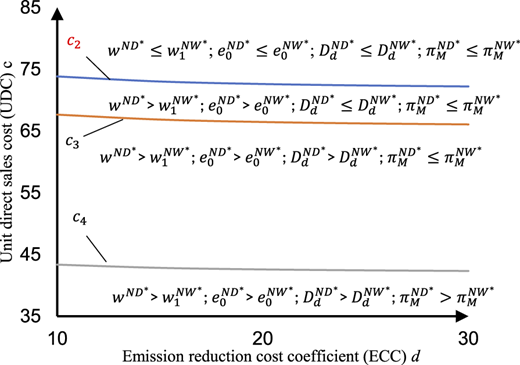
Proposition 4 compares the size of the wholesale price, the EED, the online channel demand and the LCPM’s profit between and models. The results show that without BT, when the UDC is large , the above equilibrium solutions are smaller in the model than those in the model. When is small , the above equilibrium solutions are significantly larger in the model compared with the model. The reason is that small suggests a reduction in the costs of online direct sales; therefore, the online direct sales price is also reduced, which increases the online channel demand. Considering the reduction of the expenses for online direct sales, the overall increase in consumer awareness regarding green, and the readiness of eco-conscious consumers to spend more on LC products (Ray and Jewkes, 2004), LCPMs are motivated to increase the investment in LCT, thus improving the EED. At this time, eco-conscious consumers are inclined to spend a premium on purchasing LC products; therefore, LCPMs raise wholesale prices to obtain higher profits. Increasing wholesale prices and online channel demand have boosted LCPM’s profits. These conclusions show that when LCPMs control within a small threshold, they can profit more by choosing the model. In contrast, when is controlled within a large threshold, more profits can be obtained by selecting the model. Figure 2 explores the impacts of different DCSC models without BT on optimal decisions.
5. The DC sales model with BT
5.1 Direct sales model with BT ( model)
The retailer follows the LCPM in making the decision, and the LCPM invests in LCT. Model’s decision-making hierarchy: first, the LCPM establishes online direct sales price , the EED and wholesale price . Next, the TR establishes traditional retail price :
The functions of demand for traditional and online channels are expressed as follows:
The function of the LCPM’s profit is represented as follows:
The function of the TR’s profit is described as follows:
In the model, there are optimal wholesale price , optimal online direct sales price , optimal EED , optimal traditional retail price , optimal traditional channel demand and optimal online channel demand to maximize the profits of the LCPM and the TR.
Proof: The equilibrium solutions see Appendix.
5.2 Distribution sales model with BT ( model)
The retailer follows the LCPM in making the decision, and the LCPM invests in LCT. Model’s decision-making hierarchy: first, the LCPM sets up the wholesale price , and the EED . Second, the TR establishes traditional retail price . Finally, the OR establishes online retail price .
The functions of demand for traditional and online channels are described as follows:
The function of the LCPM’s profit is defined as follows:
The function of the TR’s profit is detailed as follows:
The function of the OR’s profit is presented as follows:
In the model, there are optimal wholesale price , , optimal online retail sales price , optimal EED , optimal traditional retail price , optimal traditional channel demand and optimal online channel demand to maximize the profits of the LCPM, the TR and the OR.
Proof: The equilibrium solutions see Appendix.
The ECC of the above two models need to meet the condition in Lemma 1.
5.3 Analysis of and models
5.3.1 Sensitivity analysis
This section primarily evaluates the effects of the value coefficient of shared information, the UDC and the ECC on the wholesale price, online direct sales price, online and traditional retail price, the EED, the traditional and online channels demand, the LCPM’s profit, the TR’s profit and the OR’s profit. In particular, (1) The influence of on all the above equilibrium solutions; (2) The influence of on all the above equilibrium solutions; (3) The influence of on all the above equilibrium solutions, where .
The influence of on all equilibrium solutions
| Condition | |||||||||
|---|---|---|---|---|---|---|---|---|---|
| (1) | None | ||||||||
| (2) | |||||||||
Source(s): Table 4 created by authors
Proposition 5 analyzes the impacts of UDC on all equilibrium solutions under model. Results show that wholesale price, the EED, the LCPM’s profit and the online channel demand all reduce with the rise in . The increase in , indicates the surge in online direct sales costs. It certainly could prompt the LCPM to have the motivation to set a lower wholesale price, and invest more in the traditional retail channel. On the other hand, an increase in could also lead to a boost in the total investment cost. Hence, the LCPM is incentivized to reduce the investment in LCT to maintain the balance of the total investment cost, thus reducing the EED. At this time, environmentally aware consumers hesitate to purchase products associated with significant carbon emissions, which decreases the demand for online channels (Ray and Jewkes, 2004). Reduced wholesale prices and the demand for online channels ultimately lead to lower profits for the LCPM. Results (2) show that when is small , traditional retail price, the traditional channel demand, online direct sales price and the TR’s profit all reduce with the rise in . When is large , the above equilibrium solutions all increase with the rise in . When is small, and continues to rise, it indicates that the LCPM’s emission reduction costs are small and the EED decreases as increases. Therefore, environmentally conscious consumers are reluctant to purchase products with high carbon emissions, resulting in a decrease in the online channel demand. At this point, considering that the emission reduction cost is relatively small, the LCPM has the motivation to lower the online direct sales price to alleviate the decline in the online channel demand. The reduction in the online direct sales price will lead some consumers to purchase products through the online channel, thereby reducing the traditional channel demand. The TR has observed the reduction in the online direct sales price and the decrease in the traditional channel demand. As a result, the TR has the motivation to lower the traditional retail price to alleviate the decrease in the traditional channel demand. The reduction in the traditional retail price and the traditional channel demand has led to a decrease in the TR’s profits. When is large, and continues to rise, it indicates that emission reduction costs are high and online direct sales costs rise. The LCPM has the motivation to raise the online direct sales price to maintain the profit level of this channel. The increase in the online direct sales price will lead some consumers to purchase products through the traditional channel, resulting in a decrease in the online channel demand. In contrast, consumers’ demand for the traditional channel will increase. The TR have observed the increase in the online direct sales price and the increase in the traditional channel demand, which has encouraged the TR to raise the traditional retail price to obtain higher profits. The increase in the traditional retail price and the traditional channel demand has raised TR’s profits. These conclusions show that under the model, the LCPM’s profit gradually reduces with the increase in . When is large, the TR’s profit rises with the surge in . Otherwise, when is small, the TR’s profit reduces with the increase in . The government should encourage businesses to research and develop LCT to minimize the input of abatement costs and raise the earnings of SC businesses.
These results in proposition 5 are similar to those in model, indicating that in the direct sales models, the impacts of on all equilibrium solutions are independent of whether BT is adopted or not.
In and models, with the rise of k, the following is obtained , , , , , , , , , , .
Proposition 6 examines the impacts of the value coefficient of shared information on all equilibrium solutions under and models. The results demonstrated that all equilibrium solutions increase with the rise of in both models. The reason is that the surge in suggests that the greater the value of shared information brought by BT, the more benefits will be yielded by reducing costs through information sharing and collaborative cooperation (Liu et al., 2020a, b). Considering the reduction in investment costs, the overall increase in consumer awareness regarding green and the readiness of eco-conscious consumers to spend more on LC products (Ray and Jewkes, 2004), LCPMs are motivated to raise investment in LCT, thus improving the EED. At this time, eco-conscious consumers are inclined to spend a premium on purchasing LC products, increasing the demand and motivating LCPMs to set higher wholesale and online direct sales prices to boost profits. Retailers will correspondingly set higher retail prices when wholesale prices increase so that retailers can raise profits. The rise in demand and price increases the earnings of LPCMs, TRs and ORs. The above results show that when BT is adopted, the greater is, the greater the profit of SC businesses, whether in direct sales or distribution sales model. The government should guide businesses in conducting research and developing blockchain-related technologies, further enhancing the value of shared information and obtaining more benefits from information sharing.
5.3.2 Comparative analysis
This section primarily studies the comparison of equilibrium solutions sizes between the and models.
Comparison of the size of equilibrium solutions between and models
| Condition | ||
|---|---|---|
Source(s): Table 5 created by authors
Proof: Appendix.
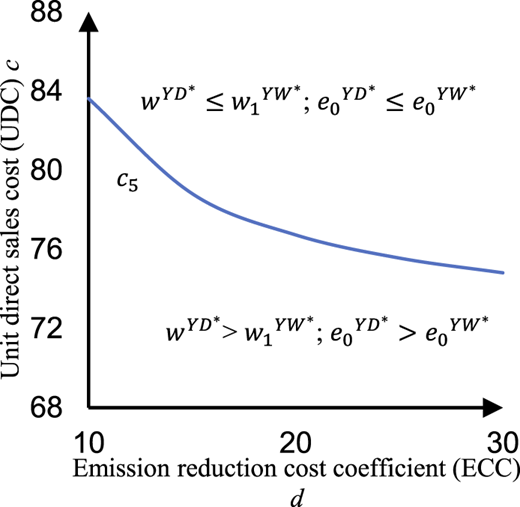
Proposition 7 compares the size of the wholesale price and the EED between and models. The findings demonstrate that when UDC is large , the wholesale price and the EED in the model are significantly smaller than those in the model. When is small , the above equilibrium solutions are significantly larger in the model compared with model. When c is small, it indicates a reduction in the online direct sales cost. Considering the reduced online direct sales costs and the general improvement of consumers’ environmental awareness, as well as their willingness to pay higher for LC products, LCPMs are motivated to increase their investment in LCT, thereby raising the EED. At this time, environmentally conscious consumers are willing to pay more to purchase LC products. Therefore, LCPMs have accordingly raised the wholesale prices to obtain higher profits.
These conclusions are similar to the findings of and models, indicating that when the LCPM controls within a certain threshold, whether the use of BT exerts little impact on the size relationship between the wholesale price and the EED under the direct sales and the distribution sales models. Figure 3 explores the effects of different DCSC models with BT on the wholesale price and the EED.
6. Results analysis
This section primarily examines how using BT affects pricing decisions and channel selection strategies for DCSCs with LC.
6.1 Comparative analysis of the model and the model
In models of direct sales, the following is obtained , , , , , , .
Proposition 8 compares the size of the wholesale price, the EED, the online channel demand, the LCPM’s profit, the traditional retail price, the online direct sales price and the traditional channel demand in and models. The above results show that in direct sales models, the above equilibrium solutions are larger after using BT than without BT. The reason is that the implementation of BT has resulted in information sharing among businesses in SCs, thus lowering businesses’ costs and increasing profits (Liu et al., 2020a, b). Considering the reduction in investment costs, the overall increase in consumer awareness regarding green and the readiness of eco-conscious consumers to spend more on LC products (Ray and Jewkes, 2004), LCPMs are motivated to raise investment in LCT, thus enhancing the EED. At this time, eco-conscious consumers are inclined to spend a premium on purchasing LC products, increasing the demand. Meanwhile, LCPMs will correspondingly set higher wholesale prices and online direct sales prices to obtain more profits. According to the rise in wholesale prices, TRs have correspondingly raised traditional retail prices to get higher profits. The increase in price and demand raises LCPMs’ profits. The above findings show that the introduction of BT in models of direct sales can improve LCPMs’ profits. The government should formulate corresponding BT subsidy policies to encourage businesses to actively adopt BT.
6.2 Comparative analysis of and models
In models of distribution sales, the following is obtained , , , , , , , , .
Proposition 9 compares the size of the wholesale price, the EED, the online channel demand, the LCPM’s profit, the traditional retail price, the online retail sales price, the traditional channel demand and the profit of TRs and ORs under and models. The results reveal that in distribution sales models, the above equilibrium solutions are larger with BT than without BT. The reason is that the introduction of BT has resulted in information sharing among businesses in SCs, thus reducing businesses’ costs and increasing profits (Liu et al., 2020a, b). Considering the reduction in investment costs, the overall increase in consumer awareness regarding green and the readiness of eco-conscious consumers to spend more on LC products (Ray and Jewkes, 2004), LCPMs are motivated to raise investment in LCT, thus improving the EED. At this time, eco-conscious consumers are inclined to spend a premium on purchasing LC products, increasing the demand. At the same time, LCPMs will correspondingly set higher wholesale prices to achieve more profits. Retailers raise prices in response to the rise in wholesale prices to gain higher profits. The increase in prices and demand raises the profits of both LCPMs and retailers. The above results show that introducing BT in distribution sales models can improve SC businesses’ profits. SC businesses should actively invest in BT research and development to raise BT’s scope of use and improve their earnings.
7. Algorithm analysis
Numerical analysis is adopted in this section to better demonstrate the effects of the UDC and the ECC on the pricing decisions of DCSC with LC businesses. There are: (1) The influence of ; (2) The influence of .
7.1 The impact of the UDC
This section explores in detail the effects of on all the optimal equilibrium solutions under two direct sales models. In the selection of parameter values, to ensure the existence and uniqueness of the optimal solutions without the loss of generality, referring to the assignment of parameters by Jiang and Liu (2022) and combining the conditions of Lemma 1, the parameters are: , , , , and take . (a)–(h) in Figure 4 are analyzed as follows:
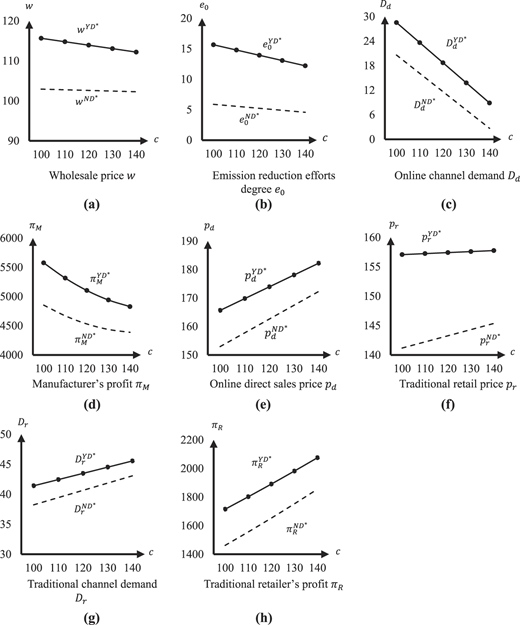
Figure 4 (a)–(d) show that in and models, as the increases, wholesale price, the EED, the LCPM’s profit and the online channel demand will reduce, and the above equilibrium solutions in the model are greater than those in the model. According to the parameter values in the figures (e)–(h), in model and model, when is within the large threshold , with the rise of , online direct sale price, traditional retail price, the traditional channel demand and the TR’s profit will all rise and the above equilibrium solutions in the model are all greater than those in the model. Therefore, the above numerical results verify the correctness of the conclusions of propositions 1, 5 and 8.
7.2 The influence of the ECC
This part analyzes in detail the influence of on all the optimal decisions under four direct sales and distribution sales models. In the selection of parameter values, to ensure the existence and uniqueness of the optimal solutions without loss of generality, referring to the assignment of parameters by Jiang and Liu (2022) and combining the conditions of Lemma 1, the parameters are: , , , , and take . (a)–(h) in Figure 5 are analyzed as follows:
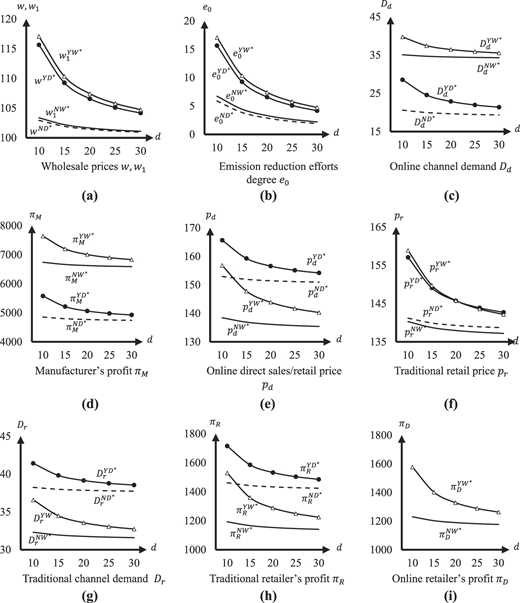
In Figure 5, according to the parameter values in Figure (a)–(d), regardless of whether BT is implemented when is within the large threshold , wholesale price, the LCPM’s profit, the EED and the online channel demand in the model of distribution sales are all greater than those in the model of direct sales, which verifies the correctness of propositions 4 and 7. Figures (a)–(i) show that regardless of whether BT is adopted, in models of direct sales and distribution sales, with the rise of , wholesale price, online direct sales price, online and traditional retail price, the EED, the traditional and online channels demand and the profits of LCPMs, TRs and ORs decrease, which verify the correctness of proposition 2. In addition, in models of direct and distribution sales, wholesale price, online direct sales price, online and traditional retail price, the EDD, the traditional and online channels demand and the profit of LCPMs, TRs and ORs in the two sales models with BT are all greater than those in the two sales models without BT. Therefore, the correctness of propositions 8 and 9 is verified.
8. Conclusions and management enlightenments
8.1 Conclusions
Under and models, wholesale price, online direct sales price, online and traditional retail price, the EED, the online and traditional channels demand and TR’s profits, LCPM’s profits and OR’ profits are all positively correlated with the sensitivity coefficient of the EED. All of them are negatively correlated with the ECC. When the UDC is within a certain large threshold, compared with the model, wholesale price, the EED, the online channel demand and the LCPM’s profit are all larger in the model. In contrast, the above equilibrium solutions in the model are greater than those in the model.
Under and models, the wholesale price, online direct sales price, online and traditional retail price, the EED, the online and traditional channels demand, the TR’s profit, the LCPM’s profit and the OR’s profit surge with the rise of the value coefficient of shared information. When the UDC is within a certain large threshold, compared with the model, the wholesale price and the EED are larger in the model. In contrast, the above equilibrium solutions in the model are greater than those in the model.
In distribution sales models, compared with the non-adoption of BT, the wholesale prices, the online and traditional retail prices, the EDD, the online and traditional channels demand, TR’s profits, LCPM’s profits and OR’s profits are all larger following the implementation of BT.
8.2 Management enlightenments
From the perspective of the LCPM, under and models, the LCPM’s profit rises with the increase in the sensitivity coefficients of the EED and reduces with the rise in ECC. When the UDC is within a certain large threshold, the LCPM chooses the model to gain more profit. In contrast, the model is selected to gain more profit. Under and models, the LCPM’s profit rises with the rise of the value coefficient of shared information. When the channel model is fixed, for example, in the models of direct sales, with or without BT, the LCPM’s profit reduces as the UDC rises. That means, LCPMs using BT can earn more profits than those without BT. In the distribution sales models, LCPMs with BT can make more profits than those without BT.
From the perspective of retailers, under and models, the TR’s profit and the OR’s profit rise with the rise of the sensitivity coefficients of the EED, and both reduce with the rise of the ECC. Under and models, the TR’s profit and the OR’s profit rise with the rise of the value coefficient of shared information. When the channel model is fixed, for example, in the models of direct sales, regardless of whether the BT is adopted when the ECC is within a certain large threshold, the TR’s profit rise with the rise of the UDC. Conversely, the TR’s profit reduce with the rise of the UDC. Considering distribution sales models, the profits of the TR and the OR, using BT, are larger than the profits of the TR and the OR without using BT.
From the perspective of cooperation between the government and businesses, the government should strengthen the publicity of green theoretical knowledge to raise consumers’ green awareness so as to improve the sensitivity coefficient of the EED and business profits. First, the government should guide businesses in carrying out research and development on LCT to reduce their investment costs in emission reduction. On the other hand, businesses should actively carry out research and development to reduce total investment costs and obtain more profits. The government should also encourage supply chain businesses to conduct research and development on BT to enhance the value coefficient of shared information further and improve the operation efficiency of businesses. Businesses should also actively conduct research and development of blockchain-related technologies to obtain more information-sharing benefits.
This work was supported by China Postdoctoral Science Foundation (2023M740532) and the Natural Science Foundation of Sichuan Province of China (2023NSFSC1025).
Notes
References
The supplementary material for this article can be found online.

