


This paper aims to discuss the potential for developing an educational campus in the metaverse, provides a demonstration of an immersive virtual learning environment, and presents a description of the interdisciplinary collaboration focused on incorporating immersive serious game development in online education.
The paper presents a description of a prototype immersive virtual reality environment that was created using Unity Game Engine (v.2022.3), with massive loop handling multiplayer functionality. Due to technical instability in the immersive platform, students in an online organizational behavior course did not ultimately participate in the immersive environment; instead, students were surveyed regarding their perceptions of engagement during synchronous online class sessions that incorporated interactive and simulation-based activities.
The prototype immersive virtual reality learning environment demonstrates the potential for immersive serious games within a Metaversity context. Survey results indicate that students perceive synchronous online sessions incorporating interactive and simulation-based activities as engaging and valuable, suggesting design implications for future immersive learning environments.
The small sample size and the unstable platform hosting the immersive environment limit the ability to draw generalizable conclusions. However, the prototype immersive environment does provide a demonstration of the potential of the metaverse for serious game education.
This paper further develops the literature of online learning and student engagement by illustrating the impacts of immersive virtual reality as an online learning tool. In addition, the interdisciplinary approach to developing the prototype environment expands, not only the application of technology, but also demonstrates the quality of serious game development for use in the metaverse that goes beyond standard off-the-shelf immersive environments for online educational purposes.
Introduction
Discussions over the future of higher education are occurring frequently in political arenas, media outlets and the halls of higher education. During the COVID-19 pandemic, the challenge of suddenly delivering education online became particularly intense. The delivery of higher education through online modalities was on the rise before the pandemic, but the viability, convenience and potential market for online education were accelerated. Nevertheless, concern remains despite decades of research showing no significant difference regarding the delivery of online education as equivalent to in-person delivery, especially in terms of the overall student experience. With business and the gaming industry embracing and implementing metaverse and immersive virtual reality technologies, the possibilities for using serious games for higher education gave rise to the idea of a “Metaversity” that can enhance the university student learning experience. Despite this potential, the progress in developing metaversities has been slow. This paper discusses the potential for developing an educational campus in the metaverse, provides a discussion of a prototype that demonstrates an immersive virtual learning environment, and presents outcomes of interdisciplinary collaboration focused on incorporating immersive serious game development in online education.
Background
Since the early days of the internet and immersive gaming, many educators have envisioned a future where students could enter virtual worlds to learn, work and socialize. A significant precursor to the metaverse concepts was Linden Lab’s Second Life, which allowed users to engage with virtual spaces in ways that were innovative for its time. Early immersive environments like Second Life showcased the potential for educational experiences in a virtual setting, offering interactive spaces that went beyond the static nature of Web 1.0. For example, the National Library of Medicine’s Tox Town project in 2008 used Second Life to deepen engagement in environmental health education, demonstrating immersive learning’s potential by allowing participants to interact with location-based content (Keselman, Arnott Smith, & Wilson et al., 2011). Though technologically limited by today’s standards, Second Life provided an engaging, location-based educational experience that integrated presence and richer interactions that set the stage for deeper engagement possibilities.
Popularized by Neil Stephenson’s (1992) book Snow Crash, the concept of the metaverse has since evolved as the third stage (or Web3) of Internet development. Like the Internet, the metaverse represents a single entity with myriad interconnected immersive experiences. It is defined as a network of virtual environments and avatars that provide constant, immersive interactions (Onggirawana, Khoa, Kartiwaa, Anderiesa, & Gunawan, 2023, p. 275). This concept of a metaverse for learning has a long legacy, evolving from early 3D Virtual Learning Environments (Burton & Martin, 2010) to IBM’s Watson commercials in 2016, and more recently, to the creation of Metaversity environments by Morehouse and other universities. Together, these advancements represent a persistent drive among researchers and educators to realize the potential of the metaverse in educational contexts, building on the pioneering vision of platforms like Second Life.
We examine two research questions in this paper:
Do students perceive a higher level of engagement when provided with an immersive learning environment?
What were the outcomes of a collaborative project between an online professor and technology students?
The metaverse and the metaversity
Derived from the broader notion of the Metaverse, the concept of the Metaversity has emerged as an evolution of online learning environments. While the metaverse generally refers to an interconnected network of immersive, persistent and shared virtual spaces, the metaversity specifies how these environments are purposefully adapted for higher education. The term itself, an amalgamation of “metaverse” and “university,” describes the intentional creation of academic institutions within extended reality platforms (Winer & Geri, 2024). Unlike traditional online learning systems such as learning management systems (LMSs) or videoconferencing platforms, which largely replicate classroom functions in two-dimensional interfaces, a metaversity emphasizes immersion, co-presence and embodied interaction.
In this way, the metaversity can be understood as a next step beyond existing models of distance and online education. Whereas MOOCs or virtual classrooms mediate learning through screens and text-based interaction, metaversities provide entire campus-like spaces where students and teachers experience a shared sense of presence. This distinction is crucial: metaversities are not simply digital repositories of content but immersive environments designed to foster authentic social interaction, identity expression through avatars, and experiential learning opportunities that more closely approximate the dynamics of an in-person institution. By using serious game and game-based learning techniques, these environments can embed educational content within interactive experiences that promote engagement, problem-solving and knowledge retention (Wouters, van Nimwegen, van Oostendorp, & van der Spek, 2013). As scholars of game-based learning note, such approaches hold promise for transforming online education by facilitating deeper, more participatory forms of learning (Deterding, Dixon, Khaled, & Nacke, 2011).
Game-based learning, a pedagogical approach that leverages the principles of game design and mechanics for educational purposes, aligns seamlessly with the immersive nature of Metaversity environments. Through interactive simulations, role-playing scenarios and collaborative challenges, students immerse themselves in dynamic learning experiences that transcend traditional instructional methods (Prensky, 2001). Moreover, game-based learning promotes intrinsic motivation and autonomy, empowering learners to explore complex concepts at their own pace while receiving immediate feedback (Dickey, 2005).
The immersive nature of metaverse environments allows for a more engaging and interactive learning experience. Immersive learning is a pedagogical approach that uses immersive technologies to engage learners in scenarios that mimic real-world conditions (Dede, 2009). This approach allows students to holistically learn by doing, exploring and experimenting in a safe and controlled environment. It also enables the development of critical thinking and problem-solving skills as they navigate through complex scenarios and challenges (Mikropoulos & Natsis, 2011).
Artificial intelligence (AI) plays an important role in enhancing the learning experience in a Metaversity. AI can be used to create personalized learning paths, provide real-time feedback, and even predict student performance based on their learning patterns (Baker & Siemens, 2014). Furthermore, AI can be used to create intelligent virtual tutors that can guide students through their learning journey, providing personalized instruction and support (Graesser, Wiemer-Hastings, Wiemer-Hastings, Harter, & Person, 2001).
Virtual reality (VR), mixed reality, (MR) and augmented reality (AR) technologies (collectively referred to as XR) are potential enablers of a Metaversity (Darby & Burton, 2023). While immersive environments do not require additional equipment, VR does allow students to immerse themselves fully in a virtual environment, while AR overlays digital information onto the physical world, and MR combines the physical and virtual environments. These technologies can be used to create simulations and virtual labs, allowing students to gain hands-on experience and skills (Merchant, Goetz, Cifuentes, Keeney-Kennicutt, & Davis, 2014; Anderson & Rainie, 2022). A common example is how medical students can practice surgical procedures in a virtual operating room, allowing them to perfect their technique and receive immediate feedback before ever performing the procedure on a real patient.
Game-based learning and serious games are integral to the development of an immersive learning environment. These approaches use game design principles and mechanics to create engaging and interactive learning experiences. Serious games are designed with a primary purpose other than entertainment, such as education or training (Michael & Chen, 2005). They can be used to teach a wide range of subjects, from science and math to history and language arts. Game-based learning, on the other hand, incorporates game elements into the learning process to motivate and engage learners (Prensky, 2001).
Just as sites such as Roblox, Core, Meta Horizons and Massive Loop, are the early stages of the Metaverse, we are beginning to see the first metaversity environments take shape. The integration of serious games and game-based learning holds the potential to revolutionize online education. By harnessing the immersive capabilities of extended reality technologies, educators can create rich, interactive learning experiences that transcend the limitations of traditional online courses. Through the gamification of education, Metaversity campuses become dynamic hubs of exploration, discovery, and innovation, where students actively engage with course content and collaborate with peers in virtual worlds.
Student engagement and the immersive metaversity environment
One challenge that faculty often face in online higher education is the need to connect with students in a substantive and engaging manner. The concept of student engagement in higher education has come to attract attention in the learning literature (Kahn, 2014; Krause & Coates, 2008; Bond & Bedenlier, 2019). Some of the literature suggests that the term “student engagement” is a proxy for student interest in learning (Axelson & Flick, 2010). Whether the concept of student engagement is a proxy for student learning or not, there nevertheless is a measure of student engagement through the National Survey of student Engagement (NSSE) (2021). In addition, The US Department of Education, through the negotiated rulemaking change process, clarified the expectations for “regular and substantive interaction” whether asynchronously or synchronously (US Department of Education, 2018). Banna, Lin, Stewart, & Fialkowski (2015, p. 249) found that students who attended monthly synchronous sessions valued their interactions with faculty and other students. However, some students were either unable to attend or chose not to, which limited the effectiveness of the synchronous sessions. Other researchers identify that faculty-student interactive communication is important to positive student engagement and satisfaction (Roque-Hernandez, Diaz-Roldan, Lopez-Mendoza, & Salazar-Hernandez, 2023).
The literature regarding online learning and student engagement is expansive and supportive of the idea that student engagement is important to learning, but few have examined the impacts of presence within immersive environments. We consider that student engagement in online courses through synchronous sessions is an important element for enhancing student learning. We designed the study to examine whether students would perceive higher levels of engagement when provided with an immersive learning environment incorporating serious game elements. The planned procedure involved a simulation delivered in one of three modalities: traditional synchronous video conferencing, desktop-based virtual environment access, and a fully immersive virtual reality environment using head-mounted displays. The potentially attractive nature of a metaversity campus lies in its ability to reach students in more engaging ways.
While the immersive virtual reality environment was successfully developed and tested internally, technical instability in the hosting platform prevented its deployment during live course sessions. As a result, students did not participate in the immersive metaverse environment itself, and no direct measures of immersive engagement were collected. Consequently, the findings related to RQ1 are limited to student perceptions of engagement during synchronous online sessions that incorporated interactive and simulation-based activities.
Metaversity and extended reality environments
The immersive environment provides students with the opportunity for an engaging and interactive exercise through a serious game. The purpose of the exercise is to demonstrate how a team of people with diverse experiences and knowledge can perform better on certain tasks than an individual working alone. The exercise is a well-known exercise entitled “Winter Survival.” It involves a scenario where a group of passengers has just survived without injury from a plane crash. They are in a winter environment where they are presented with 12 items that they are to rank according to the most important items for their survival. Students rank the items first individually and then they work as a team to determine the most important items. Once the teams complete their rankings they are provided with the rankings from a winter survival expert.
To address the research question regarding student perceptions of engagement, we received IRB approval and created a process for incorporating the “Winter Survival” exercise into one of the author’s online management courses. During the course, the students were notified that participating in the synchronous session was voluntary and that every student would receive full points whether they attended or not. The author/professor conducted the exercise during the synchronous session via Zoom with a control group while others who were willing to participate in the immersive environment joined synchronously on the immersive website with one of the students who worked on creating the immersive environment.
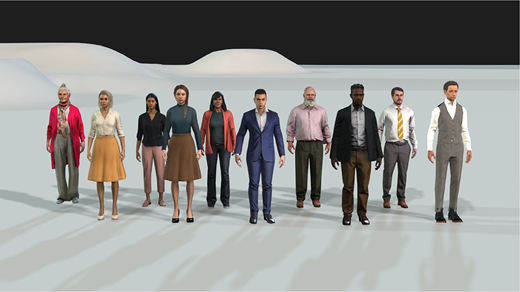
To examine the impacts of a Metaversity on students, the authors used a course in the Digital Entertainment Technologies (DET) program where the students were learning to create serious games, providing an excellent opportunity to use the knowledge they had gained. The students worked together to analyze the needs of the project, determined the look and feel of the environment, and created player avatars and three-dimensional (3D) models. The timeframe for the project was tight, lasting approximately 7 weeks from the start of the project to its completion. Massive Loop (Link to Massive Loop.Link to the cited article.) provided a virtual reality/multiplayer framework that used the Unity game engine, simplifying the project. Multiple avatars appropriate for the experience (Figure 1) were created using Reallusion Character Creator 4 (Link to Reallusion.Link to the cited article.) and had to be adjusted to meet the size limits of Massive Loop’s platform. The 3D models were all modeled and textured in Blender (Link to blender.Link to the cited article.).
The project included providing onboarding so that participants could navigate the environment with either a VR headset or a laptop (Figure 2).
 The left panel lists Massive Loop keyboard bindings. It includes sections for opening and closing the menu, using the mouse to navigate the user interface, movement using W A S D keys, interacting and clicking, jumping and climbing, crouching, sprinting, sneaking, moving arms, grabbing objects, resetting arms, resetting view, and secondary interaction. Individual keys such as escape, tab, Q, E, C, shift, control, X, and R are labelled with their functions. The right panel presents Massive Loop Oculus controller mapping. Two controller diagrams are provided for the dominant hand and the non-dominant hand. Labels indicate actions such as pushing to move, clicking to sprint, turning using the joystick, menu access, interaction, jumping and climbing, and grabbing objects. Each button and joystick is marked with a corresponding action.
Online student onboarding
The left panel lists Massive Loop keyboard bindings. It includes sections for opening and closing the menu, using the mouse to navigate the user interface, movement using W A S D keys, interacting and clicking, jumping and climbing, crouching, sprinting, sneaking, moving arms, grabbing objects, resetting arms, resetting view, and secondary interaction. Individual keys such as escape, tab, Q, E, C, shift, control, X, and R are labelled with their functions. The right panel presents Massive Loop Oculus controller mapping. Two controller diagrams are provided for the dominant hand and the non-dominant hand. Labels indicate actions such as pushing to move, clicking to sprint, turning using the joystick, menu access, interaction, jumping and climbing, and grabbing objects. Each button and joystick is marked with a corresponding action.Online student onboarding
After onboarding and an explanation of the exercise provided in writing with accompanying audio, participants were shown a short, animated film of a plane struggling in rough weather. The scene next showed the crash site (Figure 3).
 The virtual environment shows an outdoor setting with ground covered by snow and trees in the background. A body of water occupies the left area. An aircraft appears tilted above the water surface. On the snow, multiple cubic crates are arranged in a curved line. Several crates display numbers written as one, two, three, four, five, and six. Near the crates, a small upright object emits a vertical glow. To the right, flat rectangular panels lie on the ground beside stacked crates.
A rough landing
The virtual environment shows an outdoor setting with ground covered by snow and trees in the background. A body of water occupies the left area. An aircraft appears tilted above the water surface. On the snow, multiple cubic crates are arranged in a curved line. Several crates display numbers written as one, two, three, four, five, and six. Near the crates, a small upright object emits a vertical glow. To the right, flat rectangular panels lie on the ground beside stacked crates.A rough landing
The students were first able to select how they would prioritize the items, then work as a group to select the group priority of the survival items. Participants were able to communicate either by voice or a text chat system (Figure 4).
 The virtual outdoor environment shows snow-covered ground, trees, and steep rocky terrain in the background. Several cubic crates are placed across the foreground and mid-ground. Some crates display numbers written as one, two, three, and four. On the right, a large upright rectangular panel contains a vertical list numbered from one to twelve, with the word empty written next to each number. Near the centre, flat rectangular objects and small geometric items rest on the ground. Another tall rectangular panel stands behind these objects and contains dense lines of text that are not legible.
Winter survival environment – group priorities of survival equipment
The virtual outdoor environment shows snow-covered ground, trees, and steep rocky terrain in the background. Several cubic crates are placed across the foreground and mid-ground. Some crates display numbers written as one, two, three, and four. On the right, a large upright rectangular panel contains a vertical list numbered from one to twelve, with the word empty written next to each number. Near the centre, flat rectangular objects and small geometric items rest on the ground. Another tall rectangular panel stands behind these objects and contains dense lines of text that are not legible.Winter survival environment – group priorities of survival equipment
When the group was finished or time had expired, the final scene showed the group being rescued and revealed how a survival expert would rank the items (Figure 5).
 The indoor warehouse environment is given with a wide open floor and metal wall structures. An ambulance vehicle is parked near the centre, facing away. Wooden crates are stacked on shelves and on the floor. Several loose wheels and small cylindrical objects rest near the crates. Metal shelving lines the walls. On the right, a large upright panel displays the heading expert rankings. Next to it, a vertical list is numbered from one to twelve with item names written in text.
Rescue with results
The indoor warehouse environment is given with a wide open floor and metal wall structures. An ambulance vehicle is parked near the centre, facing away. Wooden crates are stacked on shelves and on the floor. Several loose wheels and small cylindrical objects rest near the crates. Metal shelving lines the walls. On the right, a large upright panel displays the heading expert rankings. Next to it, a vertical list is numbered from one to twelve with item names written in text.Rescue with results
Discussion of findings
Do students perceive a higher level of engagement when provided with an immersive learning environment?
RQ1 examines student perceptions of engagement during synchronous online learning sessions that incorporated interactive and simulation-based activities, as the immersive metaverse environment could not be deployed during live course sessions due to technical instability. The online management students enrolled in the courses that are included in this study were provided with synchronous sessions throughout the term. Of the two times the “Winter Survival” exercise has been run in these courses, the environment crashed either before students arrived in the environment or as they were entering as a team. So, unfortunately, we do not have data regarding student perceptions of engagement in an immersive learning environment. However, we do have indications that students do feel more engaged in synchronous sessions when the professor provides opportunities for engagement and interaction. Over three courses, the exercise was run during the synchronous session with the professor providing the exercise via Zoom. These students were surveyed about their perceptions of engagement in synchronous sessions. Synchronous session attendance is required for the online business programs at the study university. The students who participated were from management courses at both the undergraduate and graduate levels. The study groups came from one Module during the seven-week course with a total N of 18. While this is not enough to draw conclusions, there are indications that engagement and interactive synchronous sessions are important to online students. Sixty percent of the students indicated that they “completely agree” with the statement, “I feel engaged with the course when I attend synchronous sessions.” 33% of the students “agree” with the statement, and only one student selected the neutral level of agreement. Sixty-six percent of the students surveyed indicated complete agreement with the statement “Synchronous Sessions add value to the course,” with a mean score of 6.52 on a scale from 1 being “I do not agree at all” to 7 being “I completely agree.” When surveyed specifically about the “Winter Survival” exercise, students indicated that they did feel engaged in the “Winter Survival” synchronous session. All students selected either agree” or “completely agree” with the feeling of engagement during the “Winter Survival” exercise.
These findings indicate that students perceive the importance of synchronous sessions for their education. Students also perceive that the “Winter Survival” exercise provided them with an opportunity for engagement. Based on our research and experience designing and testing this first immersive reality educational environment, it is clear that such experiences hold promise for the future of education and warrant continued empirical examination as immersive platforms stabilize.
There are limitations regarding the conclusions we may draw from the collected data. In general, we are not able to fully understand the impact on student engagement through immersive virtual reality because of the unstable platform hosting the Winter Survival exercise. Similarly, the small sample size limits our ability to draw conclusions, but does give important provisional results. Based on the prototype immersive environment that has been created, future studies will migrate the environment to a new platform and continue to examine student perceptions of engagement. Additional sections across different courses will increase the generalizability of the findings in future research:
What were the outcomes of a collaborative project between an online professor and the technology students?
In addressing the second research question, we found significant potential in the collaborative approach to creating an immersive virtual reality environment. The DET professor led his students through the development of the project, and the management professor acted as the client. The DET professor guided students through a project management process and discovered that the program and students would benefit from more project management training in the degree. Students also learned about setting and meeting deadlines as the management professor visited their classroom to view and critique their progress throughout the last half of the 16-week semester. She provided insights and explanations regarding the anticipated learning outcomes for her management students and provided feedback to the students on the images and models created by the students. Some items needed to be less literal in ways that the management students might have to draw either upon their own experiences or the experiences of their diverse team members to understand how particular items might be or might not be important to survival in a winter environment.
For the DET students, the Winter Survival project was the first time many of the students were accountable to an “outside” client. Facing real-world challenges of learning to use an external platform that would be updated without notice with breaking changes, while creating assets that met the client’s expectations while meeting the platforms’ limitations. While the project worked in every beta test conducted internally and with the management professor, when the two classes of management students were scheduled to enter the Winter Survival environment, the sudden platform changes and updates caused the environment to crash.
From a DET student’s perspective, enhancing project management skills was identified as a critical need across the cohort. The structured client meetings conducted by the management professor emphasized the necessity of setting realistic timelines, meeting deadlines and delivering according to client expectations. For many students, this experience marked the first exposure to larger-scale project work with an interdisciplinary team, mimicking a real-world environment where they had to navigate varied roles and responsibilities. Through this process, students began to appreciate project management as a core competency crucial for professional success.
To support these project goals, students used tools such as Discord for communication outside of class, creating dedicated channels for different aspects of the project. This platform enabled consistent and informal communication, allowing students to exchange updates, coordinate meetings, and address any emerging issues in real-time. Discord facilitated an open line of communication among all team members, promoting a collaborative atmosphere where students could troubleshoot problems and provide feedback as they worked through complex project tasks.
The development team used Trello as the project management software to organize and streamline the project workflow. Students used Trello to set up timelines, establish deadlines and assign specific tasks to individuals, fostering accountability and transparency within the team. This hands-on experience with Trello taught students how to break down a large project into manageable segments and track progress across each task. By monitoring their assignments in a shared Trello board, students gained an understanding of dependencies between tasks, encouraging them to manage their time effectively and complete their responsibilities on schedule.
Moreover, asynchronous sessions during development and project testing, as well as the sessions done with the test group, encouraged higher levels of engagement, particularly among the more reserved students. These students often felt more comfortable contributing ideas and participating in discussions, demonstrating more active involvement than in traditional, in-person settings. Immersive learning environments like this appear to remove some of the social anxieties associated with face-to-face interaction, allowing students to focus solely on their work and collaborative tasks without the concern of peer judgment. This shift not only promotes inclusive participation but also reflects the dynamics of digital work environments, where asynchronous tools and project management platforms are essential for effective teamwork.
Overall, the experience taught students how to leverage digital tools to communicate, organize, and execute tasks efficiently, helping them develop the confidence and collaborative skills they will need in their post-graduation careers. By using platforms like Discord and Trello, students simulated the workflows they are likely to encounter professionally, preparing them to work seamlessly in team-based and remote settings.
Conclusion
A new frontier in higher education is just around the corner as new techniques for developing high-quality immersive virtual reality environments for students to engage with content, faculty and each other. This paper is intended to begin conversations among faculty who are interested in teaching in a Metaversity setting. Student engagement may be enhanced by participating in an immersive environment where students use serious games to learn interactive communication skills to enhance management, leadership, and team performance. This study provides an impetus for continuing the examination of the increasing student engagement and motivation to learn through immersion.
Our purpose in this project was to begin the process of scaffolding for our university and to begin the process of creating a Metaversity environment. While our initial foray into creating a Metaversity had a number of technical issues, a great deal of learning occurred and has created excitement to continue experimenting and creating immersive environments. Team members have already begun recreating the Winter Survival environment in a different game engine with plans for more serious games that take advantage of recent advances in artificial intelligence for greater immersive opportunities.
Finally, cross-disciplinary collaboration bridges the gap between online education pedagogy and emerging technologies while fostering creativity, innovation, and practical applications. More research needs to be conducted, but this paper provides important first steps in understanding the potential of serious game development, Metaversity, and online student engagement.

