Chronic kidney disease (CKD) is a worldwide public health problem which imposes a significant financial burden not only on patients but also on the healthcare systems, especially under the pressure of the rapid growth of the elderly population in China. The purpose of this paper is to examine the hospitalization costs of patients with CKD between two urban health insurance schemes and investigate the factors that were associated with their inpatient costs in Guangzhou, China.
This was a prevalence-based, observational study using data derived from two insurance claims databases during the period from January 2010 to December 2012 in the largest city, Guangzhou in Southern China. The authors identified 5,803 hospitalizations under two urban health insurance schemes. An extension of generalized linear model – the extended estimating equations approach – was performed to identify the main drivers of total inpatient costs.
Among 5,803 inpatients with CKD, the mean age was 60.6. The average length of stay (LOS) was 14.4 days. The average hospitalization costs per inpatient were CNY15,517.7. The mean inpatient costs for patients with Urban Employee-based Basic Medical Insurance (UEBMI) scheme (CNY15,582.0) were higher than those under Urban Resident-based Basic Medical Insurance (URBMI) scheme (CNY14,917.0). However, the percentage of out-of-pocket expenses for the UEBMI patients (19.8 percent) was only half of that for the URBMI patients (44.5 percent). Insurance type, age, comorbidities, dialysis therapies, severity of disease, LOS and hospital levels were significantly associated with hospitalization costs.
The costs of hospitalization for CKD were high and differed by types of insurance schemes. This was the first study to compare the differences in hospitalization costs of patients with CKD under two different urban insurance schemes in China. The findings of this study could provide economic evidence for understanding the burden of CKD and evaluating different treatment of CKD (dialysis therapy) in China. Such useful information could also be used by policy makers in health insurance program evaluation and health resources allocation.
Introduction
As a global public health problem, chronic kidney disease (CKD) was ranked among the top 25 leading cause of death globally (Lozano et al., 2012). In China, the overall prevalence of CKD was 10.8 percent, and it was estimated that 119.5m Chinese were patients with CKD (Zhang et al., 2012). A study from Southern China suggested that 12.1 percent adults 20 years or older had at least one indicator of kidney damage, indicating the presence of kidney damage with an awareness of only 9.6 percent (Chen et al., 2009). The high prevalence and low awareness of CKD suggested that critical information regarding CKD was needed for healthcare planning and financing, especially under the pressure of the rapid growth of the elderly population in China.
CKD imposed a heavy financial burden on the healthcare systems. In the USA, treatment of CKD was estimated at $48bn in 2015, consuming 6.7 percent of the total Medicare budget to care for less than 1 percent of the covered population (World Kidney Day, 2015). China’s economy was estimated to lose $558bn over the next decade due to morbidity and mortality attributable to heart disease and kidney disease (World Kidney Day, 2015).
Nowadays, China has expanded the coverage of social health insurance to all urban residents with two social health insurance schemes – the Urban Employee-based Basic Medical Insurance (UEBMI) and the Urban Resident-based Basic Medical Insurance (URBMI) (Meng et al., 2015). The UEBMI scheme for the urban employees and the URBMI scheme for the urban non-employed residents have different financing sources, and varied benefit levels and different financial protection (Meng et al., 2015). Furthermore, the Chinese Government enhanced insurance reimbursement for patients with major catastrophic diseases including CKD, in order to reduce the out-of-pocket (OOP) costs for these patients (Liu, 2013). Information on the hospitalization costs associated with CKD and the differences in costs between two health insurance schemes is needed for health insurance program evaluation and health policy in China.
Many countries have evaluated the economic burden and direct medical costs of CKD (Ahlawat et al., 2017; Eriksson et al., 2016; Kim et al., 2017; Ozieh et al., 2017; Roggeri et al., 2017). However, only one study examined the hospitalization costs of CKD in China (Liang et al., 2016). However, this study did not compare the differences in medical costs for CKD patients between the two urban health insurances in China. Furthermore, this study collected data from only one selected hospital with small sample sizes.
This study aimed to examine the hospitalization costs of patients with CKD between two urban health insurance schemes (UEBMI and URBMI) and investigated the factors that were associated with their inpatient costs using insurance claims data from Guangzhou.
Research methods
Data source
Guangzhou is the capital city of Guangdong Province, the largest and most developed city in Southern China. Data in this study were obtained from the UEBMI and URBMI hospitalization claims databases of Guangzhou for the years 2010–2012, including socio-demographic information, medical conditions, hospital information and hospitalization costs based on actual payments to providers. The detailed benefits and reimbursement policies of the UEBMI and URBMI schemes were shown in Table I. The dialysis therapies haemodialysis (HD) or peritoneal dialysis (PD) in the outpatient sector was matched using personal identifiers with a dialysis patient data set from the Outpatient Catastrophic Disease Program under these two insurance schemes. In addition, the most common comorbidities (hypertension, diabetes and coronary heart disease) was matched using personal identifiers with a chronic patient data set from the Outpatient Chronic Disease Program under these two insurance schemes. By 2012, 93.4 percent of the registered residents were enrolled in these two insurance programs in Guangzhou (Guangzhou Statistics Bureau, 2012). This study was approved by the Institutional Review Board of the School of Public Health, Sun Yat-sen University (Approval No. 2017012).
Patient selection
This was a retrospective, prevalence-based study designed to examine the hospitalization costs of patients with CKD. The authors obtained all the reimbursement claims submitted for inpatient care from January 2010 to December 2012 using the International Classification of Diseases tenth version (I12, N18, N19). Patients who were under 18 years old (n=25) were excluded. In total, 5,242 inpatients from the UEBMI scheme and 561 inpatients from the URBMI scheme were selected. The final sample size included 5,803 inpatients.
Theoretical framework
The Andersen’s behavioral model (Andersen, 1995) was adopted as the theoretical framework to identify the predictors of hospitalization costs for patients with CKD. Individual characteristics were chosen based on: predisposing factors – existing conditions with predispose individuals to use or not use services (age, gender); enabling factors – conditions that facilitate or impede the use of services (type of insurance); and need factors – conditions that healthcare providers recognize as requiring medical treatment (e.g. comorbidities, dialysis therapies, severity of disease, hospital levels and length of stay (LOS)) (Andersen, 1995).
The dependent variable in this study was total hospitalization costs per inpatient. The primary independent variable was type of health insurance and was dichotomized as UEBMI and URBMI. Additional confounders included in the model were: age, gender, comorbidities, dialysis therapies (HD, PD), severity of disease (kidney transplantation, intensive care unit (ICU) admission, readmission in 15 days or referral from other hospitals), hospital levels (primary, secondary and tertiary) and LOS.
Cost estimation
The claims databases contained information on the direct medical costs of inpatients with CKD from the payers’ perspective, including the total amount paid by the insurers and the patients. The total direct hospitalization costs were categorized as laboratory and diagnostic costs, non-medication treatment costs, medication costs, bed fees and the costs of other services, including special caring fees and air-conditioning, based on the classification of costs used in the health insurance claims database. Laboratory and diagnostic costs referred to the costs of physical examinations and biochemical tests. Medication costs were grouped into traditional Chinese medicine and western medicine costs. Non-medication treatment costs referred to the costs for any other treatments except for medication, which included blood transfusions, surgery fees, anesthesia charges and costs for medical consumables. Bed fees were the accommodation costs during hospitalization.
Costs were adjusted considering the urban residents consumer price index of 2012 in Guangzhou (Guangzhou Statistics Bureau, 2012) and were reported in CNY. The annual exchange rate between US dollar and CNY in 2012 was: $1.0=CNY6.3125.
Statistical analysis
Descriptive statistics (frequency, percentage, mean and standard deviation (SD)) were calculated for demographic information and costs. Since the medical costs data usually have a skewed distribution, a series of non-parametric tests, the Mann–Whitney test, the Kruskal–Wallis test and the Friedman’s two-way non-parametric analysis of variance (ANOVA) test, was used to investigate the differences in patient characteristics associated with inpatient costs by insurance types. To identify the predictors of total inpatient costs, the extension of generalized linear model – the extended estimating equations (EEE) approach (Basu and Rathouz, 2005) – was performed in this study. All statistical calculations were performed using Stata version 12.0 (Stata Corporation, College Station, TX, USA).
Results
Patient characteristics
A total of 5,803 inpatients were identified (Table II). More than half of the patients were male (55.1 percent). The average age was 60.6 years old (SD=17.2). Overall, 55.2 and 27.6 percent of the patients had hypertension and diabetes. Regarding dialysis therapies in the outpatient sector, more than half of the patients had haemodialysis (HD) only (58.3 percent), while 13.1 and 4.5 percent had PD only and both HD and PD, respectively. Most of the patients were under the UEBMI scheme (90.3 percent) and received medical treatment in tertiary hospitals (82.5 percent). The mean LOS was 14.4 days (SD=11.6). Only a small proportion underwent readmission in 15 days (2.0 percent), hospital referral (1.4 percent) and ICU admission (0.3 percent).
Hospitalization costs and cost composition by insurance types
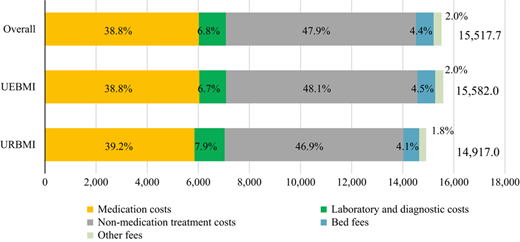
Overall, the mean direct medical costs per inpatient were CNY15,517.7 ($2,458.2) (see Table III). The OOP spending represented 22.1 percent of the total hospitalization costs. The mean total inpatient costs for CKD patients with the UEBMI scheme (CNY15,582.0=$2,468.4) were higher than those for patients with the URBMI scheme (CNY14,917.0=$2,363.1) (p<0.01). However, the percentage of OOP expenses out of the total costs for the UEBMI scheme patients (19.8 percent) was only half of that for the URBMI patients (44.5 percent).
Regarding cost composition, the non-medication treatment costs occupied the biggest proportion of total inpatient costs for both UEBMI (48.1 percent) and URBMI (46.9 percent) schemes (see Figure 1). The medication costs accounted for 38.8 and 39.2 percent for the UEBMI inpatients and URBMI inpatients, respectively. In addition, inpatient costs between the UEBMI subgroup and URBMI subgroup significantly differed according to age group, comorbidities, dialysis therapies in the outpatient sector, LOS and hospital levels (p<0.001) (see Table IV).
Predictors of total inpatient costs
Table V shows factors associated with total inpatient costs. Regarding the full sample, this study found that insurance type, age, comorbidities (diabetes), dialysis therapies, severity of disease (kidney transplantation, ICU admission, referral from other hospitals), LOS and hospital levels were significantly associated with inpatient costs of CKD. Compared with patients with the URBMI scheme, the inpatient costs of CKD were CNY1,004.4 lower for patients under the UEBMI scheme (p<0.01). Compared with the youngest age group (18⩽age<45), the hospitalization costs for older age groups of CKD patients aged 45–60, 60–75 and over 75 were CNY1,257.7, CNY1,569.4 and CNY2,494.2 higher, respectively, after controlling for other factors (p<0.01). Patients having diabetes had significantly higher hospitalization costs (p<0.01). With regard to kidney transplantation, CKD patients having transplant surgery incurred significantly CNY27,400.7 higher hospitalization costs (p<0.01). The ICU admission and hospital referral were significantly correlated with higher inpatient costs (p<0.01). Patients with longer LOS and higher hospital levels (e.g. secondary and tertiary level) had significantly higher hospitalization costs (p<0.01).
Regarding the insurance subgroups, age groups were significant only among the UEBMI subgroup, and the inpatient costs for patients aged over 75 were CNY2,546.3 higher than those aged 18–45 (p<0.01). With regard to dialysis therapies in the outpatient sector, the results were obviously different between the UEBMI and URBMI subgroups. Compared with those without any dialysis therapy in the outpatient sector, inpatient costs for CKD patients having HD only, both HD and PD, were CNY1,660.1 and CNY1,736.9 significantly higher among the UEBMI patients, while inpatient costs for CKD patients having PD only were CNY2,058.1 lower among the URBMI patients (p<0.01).
Discussion
In this observational study, the authors found that the average hospitalization costs of patients with CKD were CNY15,517.7 ($2,458.2). The mean total inpatient costs for CKD patients with UEBMI scheme (CNY15,582.0) were higher than those for patients with the URBMI scheme (CNY14,917.0). The type of insurance, age, comorbidities (diabetes), dialysis therapies, severity of disease (kidney transplantation, ICU admission, referral from other hospitals), LOS and hospital levels were significantly associated with hospitalization costs of CKD. This was the first study to compare the differences in hospitalization costs of patients with CKD between two different urban insurance schemes in China.
Costs comparison with previous studies in other countries
After comparing our costs with the results in other countries, a large variation in costs was observed. The average hospitalization cost (CNY15,517.7=$2,458.2) in this study was much lower than that was found in the USA ($39,873, 2014 price) (Ozieh et al., 2017) and European countries, €4,300 (2009 price) in Sweden (Eriksson et al., 2016), €3,912.8 (2011 price) in Italy (Roggeri et al., 2017), but much higher than that in other Asia countries, such as $386 in India (Ahlawat et al., 2017). The international comparison of medical costs for CKD patients was limited by different data sources (survey data or claims data) and different health services (outpatient or inpatient care), but the variation in costs was mainly attributable to the varied healthcare systems across different countries.
Costs comparison with previous studies in China
The authors also compared the average hospitalization costs of CKD reported in this study with the previous China-based study. Liang et al. (2016) reported that the mean inpatient cost per capita was CNY21,760.0, which was higher than the finding of this study (CNY15,517.7). The study covered 108 samples from only one hospital in Taiyuan, and the hospitalization expenses of their patients included HD spending. But in Guangzhou, dialysis (HD and PD) expenditures of patients under the two urban health insurance schemes were often reimbursed in the outpatient sector, which could induce lower hospitalization costs in our study. Furthermore, the previous China-based study did not compare the differences in medical costs of CKD patients between the two urban health insurance schemes in China.
Differences in costs between two insurance schemes
This study investigated the differences in hospitalization costs for CKD patients between two health insurance schemes for the first time. The UEBMI enrolees with CKD had higher average inpatient costs than the URBMI enrolees but had a lower percentage of OOP spending. The regression analysis also showed that the type of health insurance schemes was a significant predictor of inpatient costs for CKD. There are some reasons for this finding. First, since the UEBMI and URBMI schemes covered different population with different funding sources and reimbursement policies (as shown in Table I), the disparities in health expenditures might exist among CKD patients under different types of insurance schemes (Wang et al., 2018). As a result, CKD patients enrolled in the UEBMI scheme, who have a higher benefit level with higher reimbursement rates and higher reimbursement ceiling (Meng et al., 2015), might be more likely to incur higher hospitalization costs. Second, the URBMI scheme did not have adequate financial protection and service coverage for its enrolees, which could discourage the enrolled patients from spending more on healthcare (Pan et al., 2016). Thus, the URBMI patients who have lower ability to pay and limited healthcare access might have lower inpatient costs. As suggested in our finding, CKD patients enrolled in the URBMI scheme had a higher proportion of OOP spending than those UEBMI enrolees. Therefore, the insurance policy in China needs to focus on reducing the gap in reimbursement rates among these two health insurance schemes. In order to narrow the disparities between these two different insurance schemes in financing and benefit packages, it is suggested that the UEBMI and URBMI schemes should be further consolidated to be an integrated health insurance program in China.
Influential factors of hospitalization costs
The following section will discuss the four influential factors of hospitalization costs.
Age
In the regression results, this study found that after controlling for other confounding factors, patients with CKD in the older age groups had higher hospitalization costs for the overall sample, which was consistent with previous studies (Su et al., 2010; Wyld et al., 2015). However, when it comes to different insurance scheme subgroups, the authors found that age was a significant impact factor only within the UEBMI subgroup. This suggested that the costs management for CKD patients may be implemented differently across different insurance schemes.
Comorbidities and severity of disease
Comorbidities (diabetes) in CKD patients were also found to have higher hospitalization costs in our study. Nowadays, China and other countries face the similar CKD risk factor, diabetes. It was reported that diabetes remained the most important cause for CKD patients (Kirkman, 2014; Zuo and Wang, 2010). In addition, CKD patients having kidney transplantation surgery during hospitalization incurred significantly higher medical costs, which was consistent with previous studies(Erek et al., 2004; Kim et al., 2017). The severity of disease was positively correlated with the inpatient costs, with the help of proxies (ICU admission and referral from other hospitals) used in this study to capture the patients’ state of CKD. This result was in line with previous findings in China and other countries (Liang et al., 2016; Ramachandran and Jha, 2013).
Dialysis therapies
Compared with those without any dialysis therapy in the outpatient sector, inpatient costs for CKD patients having HD only, both HD and PD, were significantly higher for all sample and the UEBMI patients, but CKD patients having PD only had significantly lower hospitalization costs for the URBMI patients. Previous studies have reported that the direct medical costs of HD patients were higher than PD patients (Kim et al., 2017; Sun et al., 2016; United States Renal Data System, 2016), thus it seems reasonable to have higher inpatient costs for those CKD patients having HD in the outpatient sector. Normally, patients undergone PD are younger (Eriksson et al., 2016; Horl et al., 1999) and have better physical conditions and fewer complications, thus they would incur less inpatient costs. Some studies reported that PD patients were more likely to suffer from peritonitis (Chaudhary, 2011; Mehrotra et al., 2016), which might lead to higher hospitalization rates and higher inpatient costs. But in our study, there was no evidence suggesting that PD patients would incur higher hospitalization costs, and the authors also found that PD patients had significantly lower hospitalization costs within the URBMI subgroup. Previous study has suggested that PD was a more cost-effective therapy than HD where the benefits were driven by cost savings of PD over HD (Rosner, 2013). The high prevalence of CKD coupled with limited health resources highlights the need for strategies to maximize the use of PD in China (Yu and Yang, 2015). Therefore, the Chinese Government might consider increasing PD penetration rates and reducing hospitalization costs, in order to reduce the economics burden of CKD patients and the financial burden of health insurance funds in China (Yu and Yang, 2015).
Hospital level and LOS
In this study, CKD patients in tertiary and secondary hospitals had significantly higher inpatient costs than those incurred in primary hospitals. Tertiary hospitals in China were often better equipped. They provided more precise diagnosis and better medical services but also charged more than secondary or primary hospitals due to advanced diagnostic and surgical medical facilities (Li and Ji, 2018). Consistent with the findings in previous studies (Liang et al., 2016), LOS was a driver of hospitalization costs, with longer LOS considerably increased the hospitalization costs of CKD patients. It suggested that reducing LOS might be an effective method to contain the inpatient costs of CKD patients. This study found that the average LOS of CKD patients was 14.4 days, which was longer than that in the USA (10.3 days) (Blanchette et al., 2015), in Sweden (6.2 days) (Eriksson et al., 2016) and in Taiwan (8 days) (Yu et al., 2014). But the mean LOS of this study was similar as that in another China-based study (14.6 days) (Liang et al., 2016). The lengthy LOS in China might be due to that most CKD patients tend to stay in hospitals. Meanwhile, China has a limited number of community-based care centers or day care institutions available, which can hardly meet the increasing demand for those healthcare services among the aging population. The findings of this study suggested that strategies to reduce LOS such as building more community-based care facilities, day care centers and promoting home-based care might be effective methods to contain the hospitalization costs of CKD.
Conclusion
The costs of hospitalization for CKD were high and differed by types of insurance in China. The findings of this study could provide economic evidence for understanding the burden of CKD and evaluating different treatment of CKD (dialysis therapy) in China. Such useful information could also be used by policy makers in health insurance program evaluation and health resources allocation.
The findings of this study have important policy implications for reducing the costs of hospitalization for CKD patients and improving the health insurance system in China. First, given the differences in reimbursement rates and benefit packages between the UEBMI and URBMI schemes, the authors suggest that these two urban health insurance schemes should eventually be consolidated to be an integrated insurance program in China. Second, since the high prevalence of CKD coupled with limited economic resources, the Chinese Government can consider increasing PD penetration rates, which may reduce the hospitalization costs of CKD and the financial burden of China’s health insurance funds. Third, in order to contain the inpatient costs of CKD and reduce the overuse of medical resources in the hospitals, establishing more community-based care facilities, day care centers and promoting home-based care might be feasible methods to reduce the lengthy hospital LOS in China.
Limitations
There were some limitations in this study. First, this study only examined the hospitalization costs. The costs of outpatient services and indirect costs were not analyzed. Thus, the authors likely underestimated the total medical costs of CKD in China. Second, clinical severity factors such as glomerular filtration rate, an important predictor of costs, were omitted from the analysis due to data unavailability. But the authors employed three severity proxies to measure the CKD severity in this study. Third, the study population was limited to urban enrolees under two insurance schemes in one city of China, which cannot represent the whole Chinese population. Further studies considering the whole Chinese population, outpatient expenditures and indirect costs are necessary to have a more comprehensive evaluation of CKD costs in China.
With the support of National Natural Science Foundation of China (71704194) and the Natural Science Foundation of Guangdong Province (2016A030313204), the study of this paper has been approved by the Institutional Review Board of the School of Public Health, Sun Yat-sen University (Approval No. 2017012).