This paper aims to explore the impacts and challenges of the Southern African Development Community’s industrialization agenda on the industrialization of two Sub-Saharan African states, Botswana and Tanzania.
The study adopts the documentary research method by carefully analyzing relevant policy documents, conference papers, reports, and journals.
While there is an impact on policy provisions targeted towards industrialization, there are challenges such as poor policy implementation that, if not addressed, could dampen efforts by policymakers in achieving the goal of industrializing the countries.
Governments should ensure equal synergy relations amongst institutions tasked with implementation. Increase investment in research and development (R&D) and human capital as drivers of innovation are needed for industrialization.
This paper adds to the discourse on industrialization. It also highlights challenges faced by countries whose policies have had minimal impact on industrialization.
Introduction
Industrialization in Southern African Development Community (SADC) has been slow, particularly in the manufacturing sector, which has shown a decline in contribution of 10.6 percent to Gross Domestic Product (GDP) in 2015 compared to 14.1 percent in 2005 (SADC, 2020). The SADC framework hinges upon regional commitment, creation and intensification of individual country policies. The SADC region needs to increase the manufacturing sector share of GDP to above 25 percent to significantly transform the economic and social status of its citizens (Southern African Research and Documentation Centre, 2015). While there are concerted efforts towards regional industrialization in SADC, it is still a very individual experience. Member states will take different paths to achieve this goal. Thus, the aim of this paper is to explore the impacts and challenges of SADC’s Industrialization Agenda (SADC-IA) on the industrialization of Botswana and Tanzania guided by the integration theory.
This paper formulates three research questions: (1) Has policy alignment with SADC-IA contributed to overall performance of the manufacturing sector in Botswana and Tanzania?; (2) Has SADC integration impacted the manufacturing sector and therefore, strengthened industrial competitiveness of selected sub-sectors of both countries?; and (3) What could be the institutional learning in both countries for others to avoid or to emulate?
Theoretical framework
In integration theory, the functional approach is characterized by awareness of integration processes, benefits obtained through integration, and meticulous developments of alternative strategies and instruments for integration (Bolanos, 2016). This paper applied a functional approach in integration theory based on its characteristics being awareness, benefits, and alternative strategies of integration processes in exploring the impacts and challenges of SADC-IA on Botswana and Tanzania’s industrialization.
Research methodology
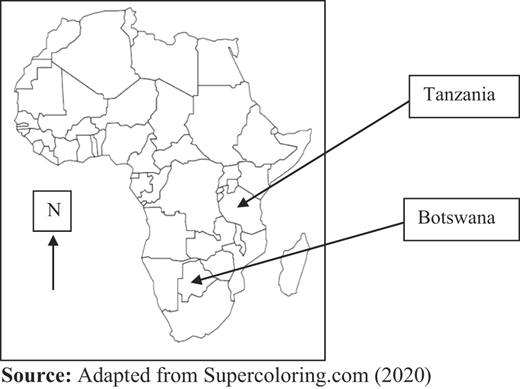
The documentary research methodology was adopted and involved literature review analysis of relevant policy documents, conference papers, reports and journals on industrialization policies. Figure 1 shows the location of Botswana and Tanzania in Africa as the study area. Table 1 presents their country profiles. The selection of these two countries is based on their commonality of serving as headquarters of regional blocs. Botswana is the headquarters of SADC while Tanzania is the headquarters of the East African Community (EAC) (SADC, 2020; EAC, 2020). Both countries have membership in SADC but also serve other integration blocs, namely, Botswana as a member of South African Customs Union (SACU, 2020) while Tanzania a EAC member (EAC, 2020). The scope of this paper is within SADC and not other integrations or declarations like Lima Declaration. The related domestic policies to SADC-IA for the case study of these two countries cover the period from 1984 to 2020 as shown in Table 2.
Findings
Awareness of integration processes
Policy alignment with SADC-IA in contributing to the manufacturing sector’s overall performance in Botswana and Tanzania is summarized in Table 2. The industrial decline led to the approval of a framework for SADC industrialization strategy and roadmap from 2015 to 2063 to boost industries’ productive capacity, develop infrastructure, and promote technological advancement (SADC, 2015). Funding was a challenge, and this was expected to be achieved through Public-Private Partnerships (PPPs) (SADC, 2015). On a broader policy context, SADC engages the Africa Union (AU) and international organizations. Examples of international organizations are the United Nations (UN) proclamations of the Africa Industrialization Day in 1989, the 1991-2000 and 2016 Industrial Development Decade for Africa, United Nations Industrial Development Organization (UNIDO), and action plan for the Accelerated Industrial Development of Africa (AIDA) (UN, 2020). Despite SADC’s international engagements, the manufacturing sector contribution to GDP has not exceeded 14.1 percent since 2005. Hence forcing AU to embark on Africa Continental Free Trade Area (AfCFTA) established in 2018 (AU, 2020). In 2019, UN proclaimed the UN Theme: Positioning African Industry to Supply the AfCFTA Market (UN, 2020). In the awareness of integration process, Botswana and Tanzania have formulated domestic industrial policies to address industrialization.
Botswana's first Industrial Development Policy (IDP I) was developed in 1984-1998 to promote economic diversification, employment creation and private sector development through import substitution of locally produced goods. IDP II of 1998-2012 emphasized export-led growth with a desire for long term economic development like strengthening industrial aligned skills, while IDP III of 2014-2028 focuses on export-led growth through strategic use of already established resources (Botswana Government, 2014). IDP III targets other potential sectors to drive industrial growth while maintaining manufacturing as the core sector to support the transition from a factor-driven economy to an efficiency-driven economy. Botswana initiated institutions to support the expected local manufactured outputs such as the Citizen Entrepreneurial Development Agency (CEDA) (Botswana Government, 2014).
Tanzania’s government formed the Sustainable Industrial Development Policy (SIDP) from 1996 to 2020 to enhance sustainable development of the industrial sector, employment creation, economic transformation, and equitable development (Ministry of Finance and Planning [MFP], 2016). The SIDP aims to strike a balance between import substitution and export orientation while recognizing the private sector as the primary vehicle for direct investments in the sector (MFP, 2016). Other initiatives include Vision 2025 which emphasizes on making Tanzania a semi-industrialized nation by 2025 (Policy Forum, 2018). In 2011, SIDP was reformulated to Integrated Industrial Development Strategy (IIDS) 2025 to match vision 2025 (MFP, 2016). The IIDS ensures that the manufacturing sector contributes to 23 percent of GDP with growth rate at 15 percent by 2025, while the Five Year Development Plan (FYDP) II 2016/17-2020/21 is to foster economic and industrialization development (MFP, 2016).
Benefits of integration process
The SADC integration has impacted the manufacturing sector and strengthened the industrial competitiveness of selected sub-sectors of Botswana and Tanzania. In Table 3, Botswana ranked 101/189 in Human Development Index (HDI) which indicated a high level of overall human development (HDI, 2017). Botswana also had a relatively high ranking in overall governance and prosperity index of 5/54 and 76/167 respectively (Ibrahim Index of African Governance [IIAG], 2018; LPI, 2019). The Corruption Perception Index (CPI) for Botswana is 34/180 meaning there is certain corruption (CPI, 2019).
Tanzania ranked 14/ 54 and + 1.3 which is a positive sign for overall governance and thus considered as bright green flag 2008-2017 with trends categorized as “Increasing Improvement” (IIAG, 2018). Tanzania is also ranked 96/180 in CPI which means that there is certain corruption (CPI, 2019). Tanzania scored 154/189 which indicated a low level of overall human development (HDI, 2017) whilst the prosperity index as per LPI (2019) was 120/167 (Table 3).
The success of competitiveness alignment with SADC-IA for Botswana from the perspective of benefits of integration process is aligned better with SADC-IA thematic policies of “politics and governance”, and “social and human development policy” while for Tanzania it is aligned with the “industrial development policies”.
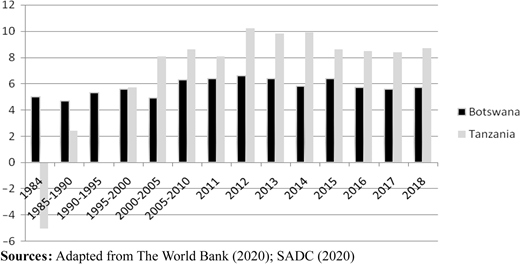
Regarding Botswana’s manufacturing sector contribution to GDP, Figure 2 showed a decline in the share of Manufacturing Value Added (MVA) to total GDP from 6.4 percent in 2015 to 5.7 percent in 2018; a downward trend since the integration of the SADC-IA. Tanzania’s MVA to total GDP increased from 8.6 percent in 2015 to 8.7 percent in 2018. Therefore, it shows an upward trend since the integration of the SADC-IA. Tanzania’s manufacturing sector growth is attributed to subsectors’ competitiveness, such as food processing, textiles and basic metals (Page, 2016).
Figure 2 showed a spike of 10.2 percent of MVA to total GDP in 2012 for Tanzania. This spike coincides with the policy reform in 2011 whereby SIDP was reformulated to IIDS 2025 to match vision 2025 and acquire productive facilities by the private sector (Ministry of Industry and Trade of United Republic of Tanzania [MIT] and UNIDO, 2012). Although studies in Tanzania have shaped research in industrialization (Mkwizu et al., 2019), more literature are needed about challenges in industrialization.
Although there are benefits for each country towards industrialization due to SADC-IA with highlighted impact on the manufacturing sector, there are challenges summarized in Table 4 and related SADC-IA thematic policy areas. These challenges include implementation of policies, governance, energy supply, innovation, informal sector, and skilled labor gap.
Implementation of policies
Implementation of Botswana policies is hindered by duplicated efforts, competing objectives and policy formulation leading to disjointed manner of implementation (Sekwati, 2010; Botlhale, 2017). Other challenges for poor implementation of policies include the lack of commitment to government agencies’ policy choices, declining levels of public accountability, reluctance to reform, and supply driven policy implementation without adequate assessment of the necessity of the projects (Kaboyakgosi and Marata, 2013).
Kweka (2018) revealed that Tanzania’s industrialization process and implementation of policy initiatives is hindered by limited finance, unfavourable regulatory environment, and weak coordination across ministries, departments and agencies.
Governance
Botswana’s public sector dominates the marketplace while the private sector remains weak (Sheriff and Muffatto, 2015). There is an unsuccessful promotion of linkages between private companies and local producers by institutions, but also PPPs in Botswana are not yet significant (Mbayi, 2011; African Development Bank, 2018).
In Tanzania there are five major challenges in governance which are: corruption, weak accountability, quality of public services, weak public systems, and sub-optimal public finance management system (MFP, 2016). The conducive trade rules and facilitation policy initiatives are faced with business environment obstacles like access to finance (Kweka, 2018; Kweka, 2019). Other governance challenges in implementing policies for industrialization in Tanzania are sustaining investor confidence, the inclusion of local content, and the role of State-Owned Enterprises (SOEs) in the industrialization process due to SOEs that were seen as barriers to growth (Kweka, 2018; Kweka, 2019).
Energy supply
Botswana experiences load shedding due to power shortages being a common regional problem. Evidence of this is a 29 percent access to the grid electricity of Sub-Saharan Africa compared to 60 percent of South Asia (Motsholapheko et al., 2018). As a factor that supports industrialization, the inadequate power supply inhibits its progress (Sekantsi and Timuno, 2017).
In Tanzania, Julius Nyerere hydro-electric power project is expected to add 2.1 GW of power (Aly et al., 2019). Mdee et al. (2018) noted that Tanzania’s small, mini and large hydropower resources are identified to reach 5.3 GW for electricity generation. However, there are barriers to hydropower development in Tanzania and this includes sediment in hydropower reservoirs and policy.
Innovation
Botswana’s Research and Development (R&D) expenditure was 0.54 percent of GDP in 2013, and the Global Innovation Index (GII) ranked 93/129 countries, whereas Tanzania’s R&D expenditure recorded 0.51 percent of GDP in 2013 and scored 97/129 countries for GII (The World Bank, 2019; GII, 2019). Moalosi et al. (2016) found that Botswana’s design-driven innovation is hindered by the weak link between creative industries and R&D institutions. Similarly, Tanzania has challenges in synergies between industrial and innovation policy frameworks to leverage growth and transformation in the industrial sector (United Nations Conference on Trade and Development [UNCTAD], 2015). For instance, in Tanzania, the industrial development strategies aim for overall economic targets, while innovation policies focus on institutional infrastructure (UNCTAD, 2015).
Informal sector
The informal sector in Africa accounts for about 42 percent of the gross national income (African Development Bank, 2017). Tanzania’s informal sector had an average of 52.20 percent of GDP between 1991 and 2015, respectively, while Botswana’s informal sector has had an average of 30.30 percent of GDP between 1991 and 2015 (Medina and Schneider, 2018).
Labor market skills gap
Botswana has challenges in the supply and demand of skilled labor force due to failure in producing flexible and transferable skills that are practical and thus creating a labor market skills gap (Boikhutso and Molosiwa, 2017). Therefore, Botswana needs to match the skills of the labor force to diversify the economy. For Tanzania, Kweka (2018) noted that there are obstacles like the availability of skills in the business environment. MIT and UNIDO (2012) cited that in Tanzania, there is skills misallocation emanating from higher-skilled labor which is not often required for jobs in the manufacturing industry. Hence Tanzania needs to ensure there is proper allocation of higher-skilled labor for economic upgrading and industrialization.
Alternative strategies of integration process
The institutional learning in both countries for other member states to avoid is the weaknesses of policy implementation related to inadequate monitoring and evaluation, and low investment in R&D. On the other hand, the institutional learning for other member states to emulate is the increase in the manufacturing sector performance of Tanzania through its various subsectors. On industrialization for African Vs Asian economies, Mkwizu and Ngaruko (2019) advocated that Africa’s trajectory for industrialization lies on technological spill-over to sustain the manufacturing sector.
Discussion
The findings of the literature review revealed that there is awareness of integration process with industrial policies for Botswana and Tanzania which suggests that existing domestic policies are aligned with SADC-IA thematic policy areas. It also indicated that the overall performance of the manufacturing sector is both positive and negative. Positive performance is evident in the share of MVA growth for Tanzania, while Botswana had negative performance indicating a declining share of MVA. Despite the policy efforts of SADC-IA with international partners like UNIDO, the manufacturing sector growth declined while the target is above 25 percent for the SADC region. This motivated AU to initiate AfCFTA to improve trade for African nations including SADC member states.
The findings further suggest that in view of the benefits of SADC integration through SADC-IA, the success of SADC-IA for Tanzania aligns with “industrial development policies” and thus strengthens its industrial competitiveness of selected sub-sectors like food processing, which is in line with Page (2016). Additional findings imply that the benefits of integration for Botswana are in competitiveness of high ranking in human development plus prosperity index which align better with SADC-IA thematic policies of “politics and governance”, and “social and human development policy” and thus lead to GDP growth on manufacturing sector. On the other hand, SADC-IA has had no discernible effect on MVA share to GDP. Hence, Tanzania’s manufacturing sector performs better than Botswana.
This paper indicates challenges in crucial areas, namely implementing policies, governance, energy supply, innovation, informal sector and labor market skills gap. Implementation of policies is difficult for both countries due to policy duplication, and a lack of regular monitoring and evaluation. Despite favorable governance records, Botswana’s PPPs are weak as noted by African Development Bank (2018) and Tanzania faces challenges on accountability and quality of public services as noted by Kweka (2018; 2019). Transparency can minimize corruption. Increasing innovation through skills development and investment in R&D is vital for the industrialization of both countries. Similarly, the informal sector’s exclusion may be a huge hindrance since the informal sector represents a significant portion of GDP. Hence, these challenges suggest weaknesses in the implementation of the SADC-IA policy areas namely “politics and governance”, “social and human development policy”, “infrastructure and services”, “technology and innovation policies” and “labor market policies”.
Alternative strategies for institutional learning for Botswana and Tanzania are avoidance of weaknesses in implementing policies and low investment in R&D. The trajectory for industrialization should be based on technological spill-over. Therefore, in examining the impacts and challenges of SADC-IA on Botswana and Tanzania using integration theory, there is awareness of SADC-IA and domestic policies, benefits of policies accompanied with challenges, and the alternative strategies of integration process which are mentioned as investment in R&D and implementation of policies.
Conclusion
This paper concludes that both countries’ policies are aligned with the Southern African Development Community’s Industrialization Agenda (SADC-IA). Botswana and Tanzania contributed to the manufacturing sector’s overall performance whereby in 2020 Botswana received Botswana pula 1494.90 million, and Tanzania earned Tanzanian shillings 2,888,507 million. There is a negative impact of SADC-IA on the manufacturing value added of manufacturing sectors contribution to the total gross domestic product of Botswana, whereas a positive impact on manufacturing value added of the manufacturing sector for Tanzania, thus strengthening Tanzania’s industrial competitiveness of sub-sectors. This paper highlighted the benefits and challenges in industrialization in both countries; and further elucidated that the institutional learning for others to avoid is policy implementation with no regular monitoring and evaluation as well as low investment in research and development.
Implications and recommendations
Other SADC member states may use the identified challenges to improve national policies and evaluate industrialization processes regularly. For policy alignment with SADC-IA to contribute to the overall performance of the manufacturing sector in both countries, Botswana and Tanzania should regularly review domestic policies to sustain industrial development in conformity with SADC-IA broader policy context of engagement with AU, particularly the Africa Continental Free Trade Area (AfCFTA) and Agenda 2030. SADC-IA supports the alignment of domestic policies by strengthening thematic policy areas that impact the manufacturing sector and elevate each country’s income status.
For SADC integration to impact the manufacturing sector and strengthen the industrial competitiveness of selected sub-sectors based on identified challenges, the following are suggested:
Implementation of policies: SADC should review weak thematic policy areas namely “politics and governance”, “social and human development policy”, “infrastructure and services”, “technology and innovation policies” and “labor market policies”. Botswana should avoid policy duplication by adopting a resource-based approach to industrialization and avoid the famed middle-income trap. Tanzania can strengthen evaluation and monitoring processes using systematic evaluation and monitoring. Remedy measures should be implemented immediately once errors are noted.
Governance: Both countries should aim for transparency.
Energy supply: Botswana’s government can harness sun rays as solar energy to minimize power shortages. Tanzania should ensure investments such as Julius Nyerere hydropower plant are completed on time to facilitate sufficient energy supply for industrialization growth. Tanzania’s internal funding/finance for projects should be sustained to reduce dependency on foreign donors and, thus strengthening its middle-income country status granted on 1 July 2020 ahead of its projection target by 2025.
Innovation: Botswana should include indigenous knowledge systems with scientific knowledge to improve the production of public knowledge, engagement with science by locals, and foster innovation by encouraging creativity from an already familiar knowledge base. Tanzania to ensure that innovation policies tackle issues like human capital advancement. Both countries can increase investment in research and development to assist the manufacturing sector growth in relation to modernization.
Informal sector: Both countries should provide conducive environment for the informal sector and their business growth. For example, viewpoints on their business challenges should be evaluated regularly to ensure inclusiveness towards industrialization.
Labor market skills gap: Investment in education, training, flexible and transferable skills are crucial in the labour market for both countries.
Both countries should review policies regularly and address shortfalls in implementing policies. They should emphasize improvements in monitoring and evaluation activities, increase investment in R&D and human capital. Alternative strategies based on institutional learning in both countries and for other nations to avoid are the weaknesses in policy implementation and low investment in R&D.